Showing posts with label Christopher Lee. Show all posts

Wednesday, December 19, 2012

The Hobbit: An Unexpected Journey

Getting to Be a Hobbit With Me
or
There and Back Again...and Again...And A-GAIN.

Peter Jackson returns to Tolkien's Middle-Earth, the scene of his greatest triumphs as a film-maker.  And it hasn't been easy for him.  "The Lord of the Rings" trilogy took the film industry by storm, changing all sorts of accepted things, like "sittable" film length, production timetables (filming three films simultaneously), elaboration of production design, and whether a "fantasy" film can ever be taken seriously by the Oscar Academy for anything other than technical awards.  In fact, when The Lord of the Rings: The Return of the King won Best Picture a few years back, more than one gossip-monger (or as they're known, "industry press") suggested it was for the entire series of films, rather than for the merits of the final one.  I believe that.  So, pressure immediately started to bring Tolkien's "The Hobbit" to the screen in as much the same way as possible, with Jackson producing and Guillermo del Toro directing, a good choice, actually (and the film benefits from his bizarre creature designs).  

But, "The Hobbit"'s past caught up with it, and the several (animated) versions of it came into play over who owned the film rights, and so The Hobbit: An Unexpected Journey has a complicated production titles sequence with Warner Brothers the (North American) distributor and New Line Cinema and M-G-M as the production facilities.  M-G-M's financial troubles (now long forgotten in the wake of Skyfall's nearly billion dollar take) caused del Toro to drop out, leaving Jackson and his orc-army of New Zealanders to once again handle the short-duties for the assembled hobbitage.


And how is it?  Much as you'd expect.  It's as if they'd never stopped production on the first series, and so sure of the continuity are they, that the moments immediately preceding the start of The Fellowship of the Ring are presented, as if it was the easiest thing in the world to do.  The film's been getting lukewarm reviews, and I can't can't quite fathom why. Nothing's really different.  The supporting cast is uniformly the same (there's no Viggo, but Frodo is briefly there, and Martin Freeman takes over the role of the younger Bilbo Baggins in a way that seems to suggest a more spry Ian Holm with much faster and more comedic reaction-sense), but the main criticism seems to be a more leisurely pace.  This, I don't mind.  Jackson has always regretted not showing more of Hobbiton, which might have given "The Lord of the Rings" more of a sense of "home," and as something worth fighting for—a theme played in spades in TH:AUJ.*

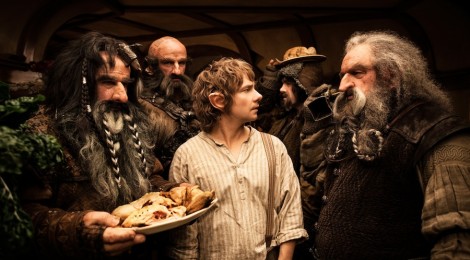
Seeing as so much of it is set in the Hobbit's land, and that the cast is dominated by a baker's dozen of knock-about dwarves (see below for a guide) that have a propensity for one-liners and malapropisms, the tone is considerably lighter and larkier (and dare I say "precious") than the Doom-laden "Rings" trilogy, and it is only once the band of adventurers get going that things change to the previous series' denatured color schemes, brooding skies, ugly thuggery and general bad-assery ensues.**  The pace may be slower, but the film is considerably richer for all of that, and with so many characters in this arc, it's rather a luxury to get to know them before they are threatened in all sorts of ghastly ways.

The other issue with this Tolkien adaptation is technological.  Films, since the frame-rate has been standardized, have traditionally been projected at twenty four frames per second, the estimated time that an image is retained by the eye.  Now that film is mostly passé, the video standard is 30 frames per second, but it's largely an arbitrary rate to match the traditional film experience.  During the late 70's, special effects wizard Douglas Trumbull offered up something he called "Showscan" which was 70mm film projected at 60 frames per second, which produced a larger, sharper image with less "streaking" of movement, due to the higher frame rate.  I saw one of these "Showscans" at the Vancouver World's Fair and the effect was like watching a richer, more beautiful version of videotape.  It was still film, with its photo-chemical reaction to light, but far more relatable to a "life-image" than film.

TH:AUJ is photographed digitally, but at a frame rate of 48 frames per second (what is being called HFR, or "Higher Frame Rate"), twice that of standard film, and in 3-D (to make what Jackson calls a more "immersive" film experience).  The effect, once one has adjusted to it, is quite magical.  Jackson doesn't try to do the 3-D tricks that Ang Lee does in Life of Pi, but the faster frame rate does improve the effect of things moving close by in 3-D; there is no longer the "stutter" effect, if something is moving by in the "near-field" at any rate of speed, which is something of a relief.  And given that Jackson employs even more helicopter shots over New Zealand terrain here than in the "Rings" trilogy (as well as parallel swooping "crane" shots during the many sequences underground), that's a big help.  Where it has its drawbacks are in some scenes that make the CGI characters look like toys figures, some of the impressive building constructs look like play-sets, and a slight mismatch of CGI (particularly during flying scenes) melded with terrain.

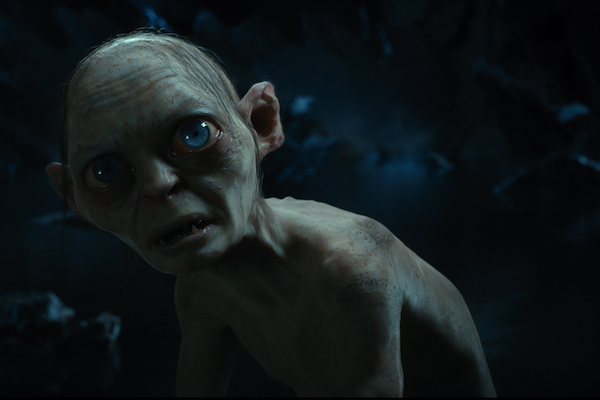
Still, it is hard to quibble when the image is so sharp, Jackson's color sense is eye-popping, and he still manages to keep a shimmering image through murky 3-D glasses.  It doesn't look like videotape (as so many reviewers seem to think), as the lighting is more graded and subtle, but the movement recalls a better videotape image, and even something moving fast still has a better chance of being registered by the naked, or glasses-hampered, eye.  It also allows the telling detail in even the CGI-est of images, like the moistness in Gollum's eyes, or the deep crags under Gandalf's.  It is oddly transporting, and given the care that everyone has put into it, it's a very rewarding experience.


The Hobbit: An Unexpected Journey is a Full-Price Ticket (worth it in 3-D and HFR).


Wilhelm Scream Alert: at 02:05 and 02:35


Ya can't tell a dwarf from a halfling without a program.


* Thauj...sounds like a character name.

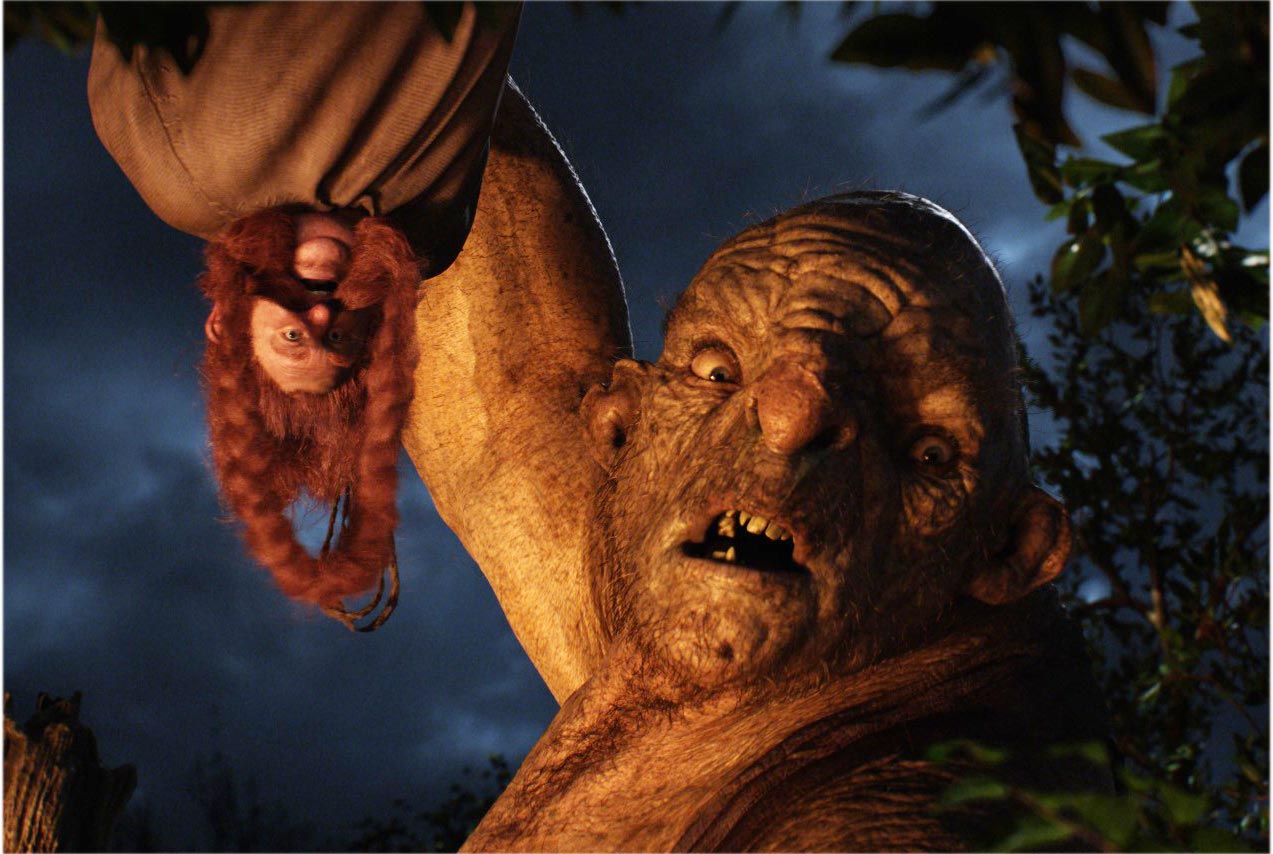
** Speaking of which, things have now approached and gone past the "Indiana Jones" threshold for physical believability here.  There's one particularly Rube Goldbergian sequence fighting trolls in an underground mine that strains credulity—but then, we're talking about a movie with dwarves, trolls, elves, ancient wizards, fire-breathing dragons, giant spiders, animated cliff-sides, and orcs riding big dogs.  That's enough to throw any griping fan-boys off their dyspepsia.  "Dude, this movie troll-kinged the bridge..."

Wednesday, May 16, 2012

Dark Shadows (2012)

Camping Vamps and Risible Damp
or
"What Strange Terrain is This?"

"Dark Shadows" has been a cult favorite for Baby-Boomers for 40 years (ouch!), long before it was fashionable to have vampires as fodder for young adults.  The ABC soap opera ran for several seasons of afternoons replacing the standard plot-lines of cheating spouses and long-lost family secrets with long-buried family relatives and a full range of gothic ghoulery that plundered every horror story in the crypt-library, including vampires, werewolves, Frankenstein-ish monsters, time-travel, parallel dimensions and ghost stories.

It was a TV habit of mine when I was a kid, timed perfectly to be the after-school tonic for a parochial school education, an occult chaser for the catechism, all those crucifixes I was surrounded by during the day being used for other purposes.  It was also a fixation for Tim Burton and Johnny Depp, Burton digging the horror genre and Depp grooving on the character of Barnabas Collins (played by the late—or is he?—Jonathan Frid, who puts in a very brief cameo here along with a couple of other cast-mates), the reluctant vampire who pursued hearts, rather than the blood that pumped through them.  The result of their dual obsessions is this version of Dark Shadows, produced by Depp, directed by Burton.

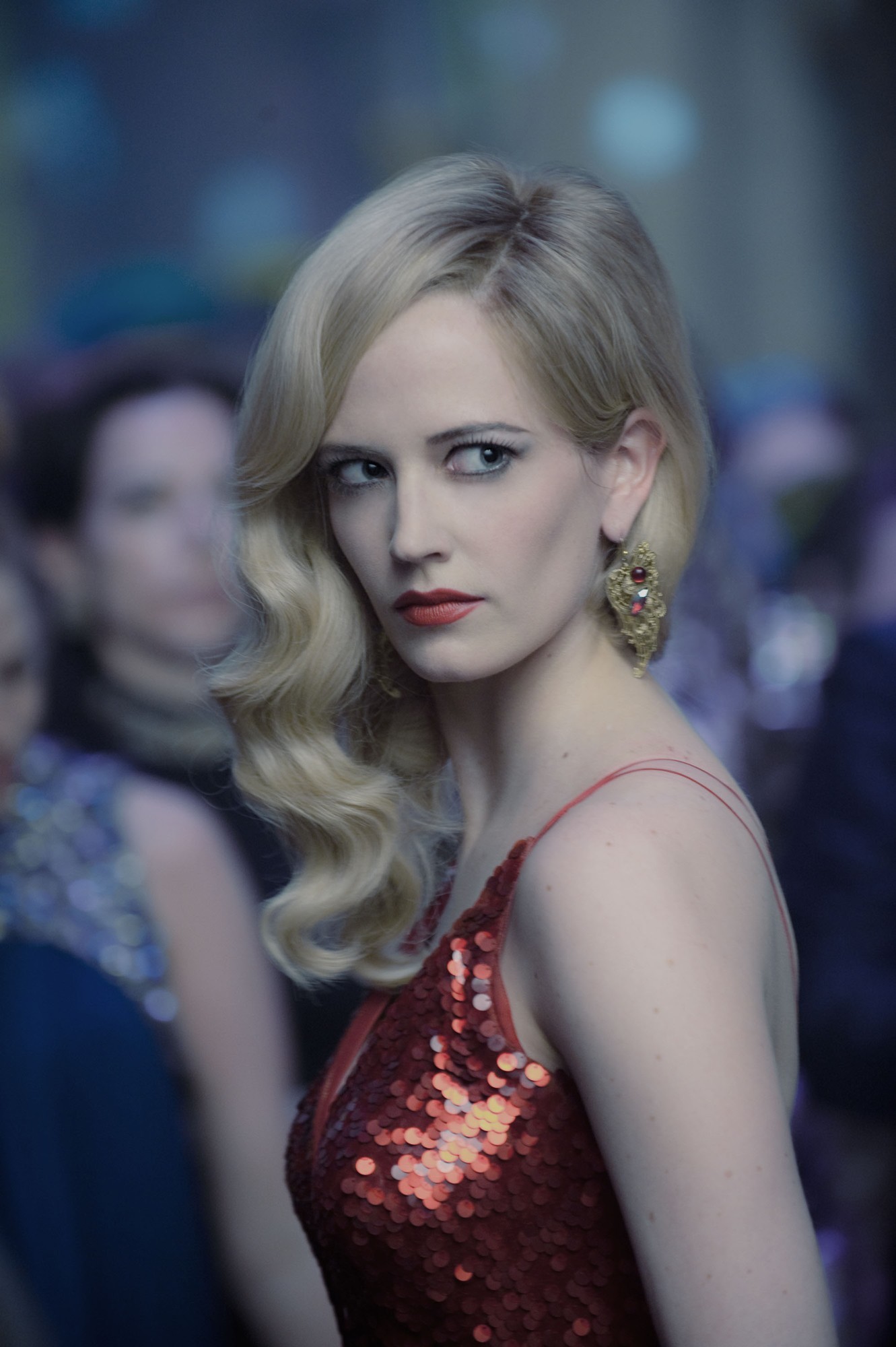
"It is said that blood is thicker than water," narrates Barnabas Collins (Depp), over the strains of Robert Colbert's alto flute-through-echoplex composition "The Secret Room" from the original series.  "It binds us, confines us, curses us."  For a moment, things are fairly serious as the 18th century story of young Collins scion Barnabas is unearthed, with his spurning of the witch Angelique Bouchard (Eva Green) and her subsequent dark revenge, killing the Collins elders, forcing the suicide of Barnabas' love Josette and turning him into an eternally cursed vampire.  She subsequently sets the townsfolk on the monster who chain him into a coffin and bury him for all eternity.

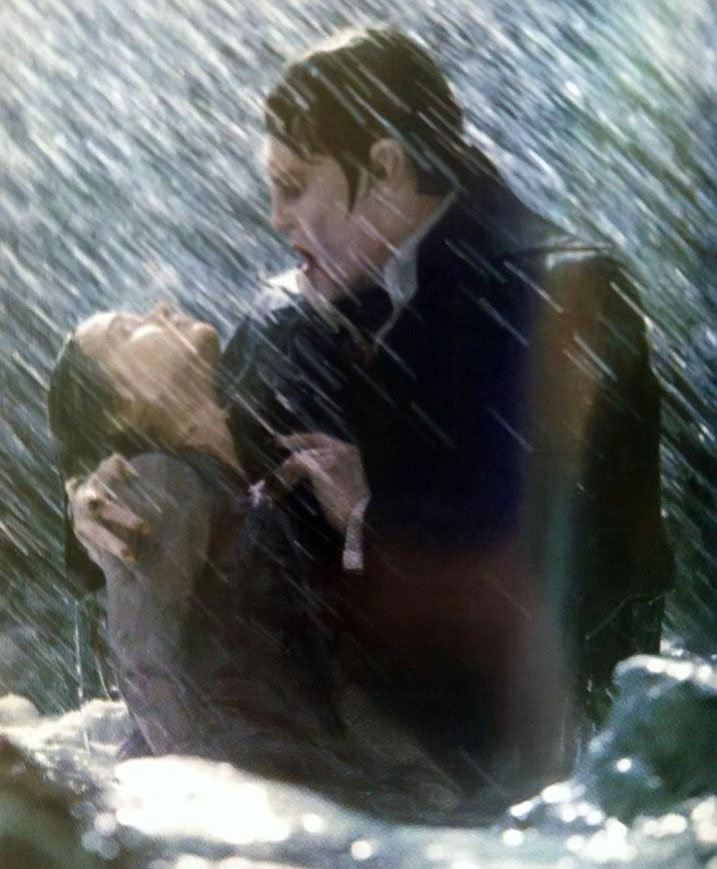
Depp and Burton get it right at the beginning: Barnabas learns his fate.
The worst-laid plans of mages and men...Eternity is cut short around 1972 as the construction of a new McDonald's in Collinswood unearths Barnabas and he lays waste to a construction crew (who must have been getting overtime working at night!) with an explanatory "You have no idea how thirsty I am!" 

On a parallel course, Maggie Evans (Bella Heathcote, the latest in a long line of Burton ingenues with thin necks topped by big heads with huge eyes and "big" hair) is on a train to Collinswood where she has applied for a job as a governess to young David Collins (Gulliver McGrath), who is having psychological issues from the disappearance of his mother at sea.  Abruptly, she decides to change her name to Victoria Winters, indicating a past she wants to run away from, as The Moody Blues tune "Knights in White Satin" burbles over the soundtrack.  Hey, Burton may be onto something here.  The combining of '70's kitsch and some of its more mordant songs with the gothic mood of "Dark Shadows" works well, setting the tone of the series and the morbid fascination my generation had with it.  Can "Don't Fear the Reaper" be far behind?

Then, things get a little weird.  She's picked up by a VW van of hippies, and there's some stoned comedy about how they're so wasted, and Vicky is cool, man, and it's easy laughs and you wish it was more clever.  It becomes apparent quickly that Burton will be playing this for laughs, which is fine (he always does to a certain extent), but the original material is already so melodramatic and over-the-top that the humor undercuts the effectiveness of what drama there is that ekes through the dramatic stares and the vamping poses.  "Dark Shadows" was always "camp" entertainment in the broad sense, but to broaden it even further nullifies whatever chills and thrills can be drained from it.  This is why Frid's performance on the show was such an anchor for it—he played it absolutely straight, and in fact, ramrod-stiff; you didn't make fun of Barnabas for fear of his wrath—or his breaking down in tears.

Depp's Barnabas is tortured, of course, but risibly so (in a performance that's a combination of Frid's formality, some Max Schreck thrown in, and a bit of Ed Wood cast-mate Martin Landau's incarnation of Bela Lugosi).  And there's the "otherness" factor that Depp brings to so many of his roles, as if he's in a different movie from everybody else—he walks through it, and everybody reacts, usually comedically and derisively.  In part, that's the point: it ties in with Burton's feelings growing up as being an outsider-geek, looking on at the rest of the world that he found strange, while it found him odd (and there's a mirroring through-line of humor throughout the film of Barnabas, out of his time, observing to some horror the eccentricities of 1970's life, that reflects it).*

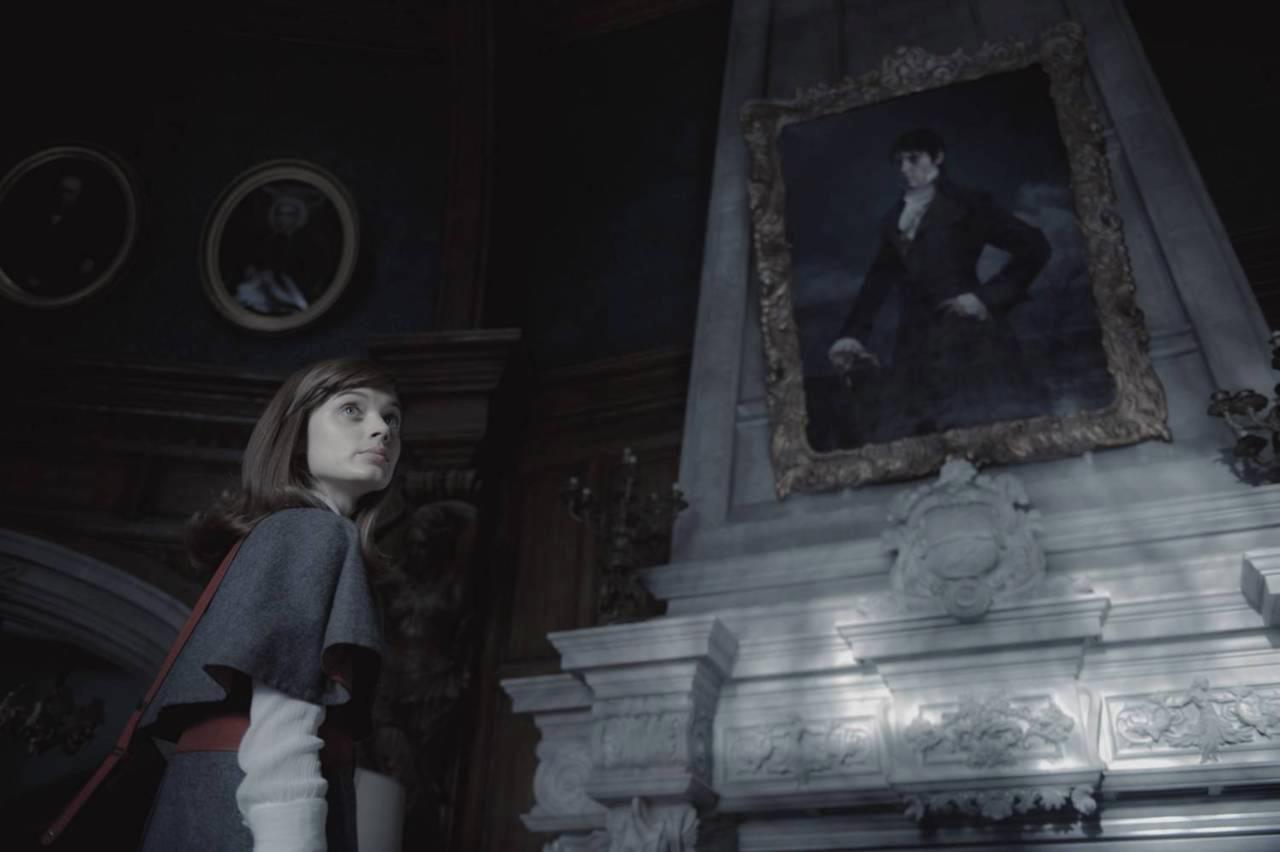
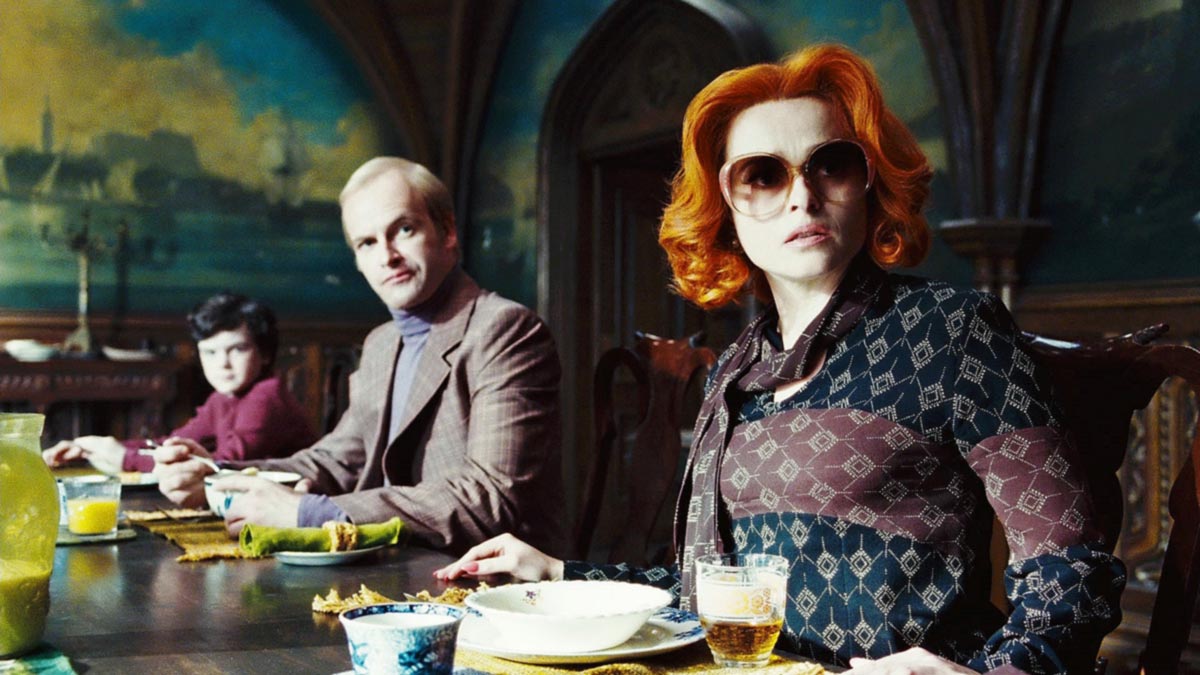
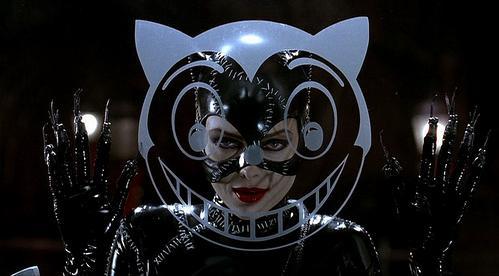
But Collinwood's odd family doesn't bat an eye when Victoria shows up and doesn't react to the disrepair of the gothic Collinwood mansion or to David's assertion that he speaks to his dead mother, and she follows quite readily when the ghost of Josette appears floating down the hallways, whispering "He's coming..."  Barnabas' arrival, in Victorian array and the palest of skin, and the oddest of manners only brings up temporary suspicions, but the matriarch of the house (Michelle Pfeiffer, who played Burton's Catwoman) readily accepts him as family, even after revealing his vampirism.  The cast is uniformly fine, gamely being archly camp throughout, but the one performer who's best at it is Green, who clearly relishes the villainess role and has fun with it, taking it in some very odd, even poignant places.

It looks great.  Burton's films always do, with a superb design sense and his knack for picking terrific, seemingly impossible angles to shoot from.  But, like a lot of Burton films, it tends to fall apart in story, snatching hasty explanations and deus ex machina to get out of trouble, or to provide the director with a bizarre concept that may seem right in retrospective sub-context, but that comes out of nowhere, randomly and jarringly.  One has to stop, back-track, only to realize that, no, this has never been mentioned before, and why now?

One suspects it's a whim, a passing "wouldn't-it-be-crazy-if" thought passed between Depp and Burton as they geek out, rocking in their corners, internal logic no longer mattering as much as a superficial entertaining notion.  As such, Dark Shadows accomplished their goals.  Yeah, it's entertaining, but highly insubstantial, a mere spirit of a movie.

Dark Shadows is a Rental.


The first Dark Shadows movie (left) and the original Barnabas Collins, Jonathan Frid


* This also sets up a series of sight-gags that are somewhat clever, as Barnabas never seems to be able to find appropriate sleeping arrangements at Collinwood.

Thursday, December 1, 2011

Hugo

"One for the Kid"
or
"The Secret in the Clockworks"

Okay, okay.  Let me get this straight...a Martin Scorsese "Kid's Picture?"  In 3-D?

Honestly, I laughed when I saw the preview.  What could be more incongruous than the director of Mean Streets, Taxi Driver, Raging Bull, and Goodfellas making a film for the kiddies.*  I mean, face it, if Scorsese made a baseball film half the players would be killed by line drives. What's next? Spielberg making a snuff film? Kevin Smith making a good one?

Well, will wonders never cease?

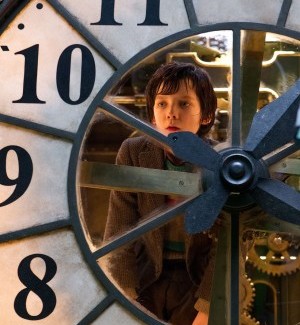
Hugo, the film that Scorsese made for the youngsters runs about 2 hours 8 minutes but feels longer, probably because it has so much on its plate.  A period piece—set post-WWI—about a young orphan, Hugo Cabret (Asa Butterfield, possessing the most angelic urchin face since Elijah Wood) who caretakes the extended clockworks inside Paris' Montparnasse station, it also contains a brief history of the birth of the film era, an extended history of the career of French film pioneer Georges Méliès (Ben Kingsley) as well as being a feature-length advocacy piece for one of Scorsese's pet projects, film restoration.  But, lest one imagine a long lecture on the subject, it is so imbedded in the film's story as to seem nearly invisible—a message hidden in a film of glass-sugar, so as to make the medicine go down.

Hugo ekes out a mouse-like existence, away from the orphanges, maintaining, unseen, the intricate, but elaborate clockworks that the trains run and the people depend on.  From the crystal clock-faces he can see life passing by and through, the scraps of left-over food that can provide a meal, and across the way the toy-maker's shop (with the very cranky proprietor) from whom he steals the tools and odd-parts to try and repair the last link to his late father (Jude Law, briefly), an amateur watch-maker, who took it upon himself to repair a mechanical automaton, discovered at the museum where he worked—the mechanical man's purpose no one knows.  From his vantage-point, Hugo is at the hub of the station's bustling activity and many side-stories, but when the need or the hunger arises, he'll make time to enter that world through any number of vents, passageways and access-doors, usually one step ahead of the persistent Station Inspector, who is trying to maintain his own kind of order in the depot.

It may be a PG rated kids movie, but it is still Scorsese, so there are dark elements running all the way through, like Dickens. And Scorsese is never one for a light touch, no matter what the rating is or to whom the demographic is targeted. Still, it is Scorsese's breeziest project in years, recalling the set-bound, intricate work he did on New York, New York all those years ago. But, with the tools of CGI, the scope is huge and the director swoops and swings through corridors and tunnels and crawlspaces with a verve he's never displayed before. It's Scorsese unleashed, not unlike the doberman pinscher partner of the station garde (Sacha Baron Cohen, who displays a fine depth for physical comedy, as well as a Sellers-like ability to plumb perverseness from the lightest subjects), who scampers like a hell-hound through the station's ornately vast spaces (the most elaborate set-piece is a nearly wordless pre-title sequence that is its own CGI 3-D hurdle-fest, that is also a tribute to the silent film era.** 

Yeah, it's a kid movie, but it's also a relentless love letter to cinema, with craning shots the old masters would have busted Union rules for, emulations of the arty interpretive shots from the silent era—things the neo-realist Scorsese has never attempted before—while at the same time taking a toymaker/magician/film-makers' fascination with capturing what James Stewart (in an interview with Peter Bogdanovich) called "little pieces of time."  It is all a bit of magic, a bit of technology, a bit of art, presented with a stylists' eye for the dramatic.  And Scorsese, with an army of the best at their cinematic craft—Robert Richardson, Thelma Schoonmaker, Dante Ferretti, Sandy Powell and Howard Shore (Shore's score is wonderfully soaring and French-laced)—including such fine actors as Kingsley, Law, Richard Griffiths, Emily Mortimer, Ray Winstone, Christopher Lee, Kick-Ass' "Hit-Girl" Chloë Grace Moretz and A Serious Man's Michael Stuhlbarg, have taken John Logan's intricately geared script-work and constructed a well-oiled entertainment machine taking today's technology to recreate an ephemeral past.

Wonders will never cease. Not with directors like Scorsese. Thank God!

Hugo is a Full-Price Ticket (and I can't wait to see it in 3-D!)


Méliès accompanying himself on banjo in one of his films.


* This brings up one of those stories—the ones you repeat over and over again at Family Gatherings—of my Mother's side of the family, when she and her fellow Bannick sisters went to see Scorsese's Casino...because they thought it might be a musical? (!!!!) Casino. The one that begins with De Niro being blown up in a car, and later, a man's head in put in a vise until his eyes pop out, and Joe Pesci is bludgeoned to a pulpy death with a baseball bat—this, after an even more grisly scene where he has sex with Sharon Stone?

I've often wondered at what point in the film did they figure out there wouldn't be any dancing?

** It reminded me of the kids toy-box of Paris opening of Moulin Rouge!, Baz Luhrmann's zest-fest mash-up of period piece and slash and dash modern culture.

Friday, August 8, 2008

The Three Musketeers/The Four Musketeers

"The Three Musketeers: The Queen's Diamonds"/
"The Four Musketeers: Milady's Revenge"(Richard Lester, 1974/1975)
These rollicking films, originally planned as a two and a half hour epic (no matter what the Producers say!) may just be one of the best adventure films (and adaptations of a classic) ever filmed, balancing the demands of the story, the tenor of the times in which it was made and the idiosyncrasies of its director.

When approached, Lester (who hadn't made a film since "
The Bed Sitting Room" in 1969) wasn't enthused. Then he read the story, and did some research...and heartily agreed. One can see why. For "The Three Musketeers," as Lester and his screen-writer George MacDonald Fraser envisioned it is a story of intrigue in high places carried out by the lackeys and foot-soldiers who live to serve. Forget that the palace-dwellers are either snakes or dullards--they provide an opportunity for income and adventure--two qualities lacking amongst the citizens of France and England, who, at the time are at war. The opportunities for thrills, humor and pointed satire are rich and mined well by the film-makers.


Lester's direction is masterful--simple set-ups and multiple cameras used during the swash-buckling to make sure there's a glimpse of every buckled swash. And those scenes are choreographed as a group participation so that every Musketeer has "business." Lester also worked to makes sure that the fights were inelegant affairs--not balletic, but more like street-fights, with few rules and the use of landscape and surroundings as equal strategies to the sword technique (and every part of the sword is used, as opponents are sometimes conked with ornate handles).

Lester surrounds the royalty with games and idle amusements that have a slight tint of mindless cruelty to them, and that extends to the villains, whose machinations involving the Royals are merely extensions of those games, with regime-toppling consequences.

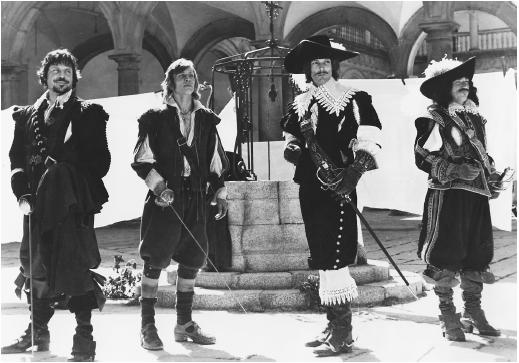
And the cast! As the musketeers, Oliver Reed as the surly Athos, Richard Chamberlain as the effete Aramis, Frank Finlay as the clownish Porthos, and Michael York as the young and naive D'Artagnan. As the Royals, Jean-Pierre Cassel as the foppish King Louis XIII, Geraldine Chaplin as the frail Queen Anna of Austria, and Simon Ward as the rakish Duke of Buckingham. As the villains, Faye Dunaway as Lady De Winter, Christopher Lee as the villainous Rochefort, and Charlton Heston in one of his best performances as the Machiavellian Cardinal Richelieu. Rounding out the cast are Raquel Welch as the Queen's seamstress, the accident-prone Constance de Bonacieux,* Spike Milligan as her randy husband, and Lester regular, the great Roy Kinnear as D'Artagnan's man-servant, Planchet. A superb cast, rarely equalled.

It's long been contended that the film was supposed to be one movie, but that the Salkind's split it into two to maximize profits. That's the rumor--there is a natural split of the film at the half-way point that feature almost all the actors for a sort-of bow, but it could have been used for an intermission. Certainly, there is less movie in "The Four Musketeers," it being padded with an "up-to-that-point" narrated prologue.

But there are two distinct stories of different tones, the first being the intrigue-filled, but relatively light-hearted "The Queen's Diamonds" story (in which Athos, Aramis and Porthos are wounded, but not killed), and the darker "Milady's Revenge" with its beheadings, extended back-story and several prominent deaths. Where Part 1 is rollicking fun with minimal consequences, the stakes in Part 2 are very high, passions flare, and the sword-play becomes deadly. The humor is darker than the first, too. Despite the same cast and crew,** the two are very different in tone.

Taken together, they have a moralist's sensibility of the costs of frivolity and duplicity; adventure can be fun, but in a poisonous political atmosphere, one adventure's at one's own risk. You can have a good time watching "The Three Musketeers," but the story is incomplete without the paid dues in "The Four Musketeers." Together, they make one of the finest adaptations of a classic novel ever put to film.

* Welch, not the most versatile of actresses, won the Golden Globe for her hilarious performance in "The Three Musketeers" and tearfully told the crowd "I've been waiting for this since "One Million Years B.C.!"

** except for the score composers--Michel Legrand for "The Three Musketeers" and Lalo Schifrin for "The Four Musketeers."

Sunday, February 3, 2008

The Hound of the Baskervilles (1958)

"The Hound of the Baskervilles" (Terence Fisher, 1958) I'll go see any Sherlock Holmes story (as long as it's not a spoof), not so much because the story's are compelling--they're fascinating for the glimpse of salaciousness in Victorian England, but the story-template is rarely altered--but because the portrayal of Holmes is an actor's showcase. Holmes by Doyle is something of a blank slate, so an actor can infuse him with whatever qualities they choose to emphasize: Basil Rathbone, the heroic; Jeremy Brett, the neurotic; and on down the line to the worst--Stewart Granger who was content to make Holmes merely British (we won't get into Hugh Laurie as "House"). So, it's interesting to see the Hammer Studios' "take" on Holmes. Hammer was the British equivalent of Roger Corman's AIP, but with a distinct advantage. They also purloined classics in the public domain, but they had Terence Fisher, with his flawless eye of direction (and cleavage) and a repertory cast that included Peter Cushing and Christopher Lee. Here Cushing plays Holmes and he's obviously devoured the Doyle stories for Holmes quirks, stabbing documents into his mantelshelf and writing notes on his cuffs. His Holmes is energetic and flinty, bordering on rude with a relish of the melodramatic. His skull-like face even recalls Sidney Paget's original drawings. Until Brett came along, Cushing, to this Baker Street Irregular, was the best of the Holmes portrayals. Christopher Lee plays the put-upon Henry Baskerville, and as the actor is quick to point out in a "Special Features" interview, it's one of a handful of romantic leads that he's played in his long, long career. What makes this "Baskervilles" different from the countless others? Holmes is absent for less time, a lurid flash-back acquaints us with the origins of the Baskerville curse, there is a romance (of sorts) and the death by quicksand is given to someone entirely different. It is, though, faithful in spirit, if not in detail.