Showing posts with label Michael York. Show all posts

Saturday, November 26, 2011

The Mill and the Cross

"Every Picture Tells a Story, Don't It?
or
"Framing the Argument"

Anyone who tries to do something new in films should be applauded, no doubt about it.  But one should not come away from the experience calling to mind other films and experiences—then you merely get the sound of one hand clapping.  Or the white-noise bustle of a disinterestedly browsing museum-crowd (with which the film begins and ends).

Not that film-maker Lech Majewski didn't try something new.  His new film The Mill and the Cross takes as its subject matter Flemish painter Peter Brueghel's painting "The Way to Calvary," and constructs the scenario inside the painting, with the artist (played by Rutger Hauer) and his patron (Michael York) walking through the painting as the artist sketches, puts it all together in his mind and takes it to completion.

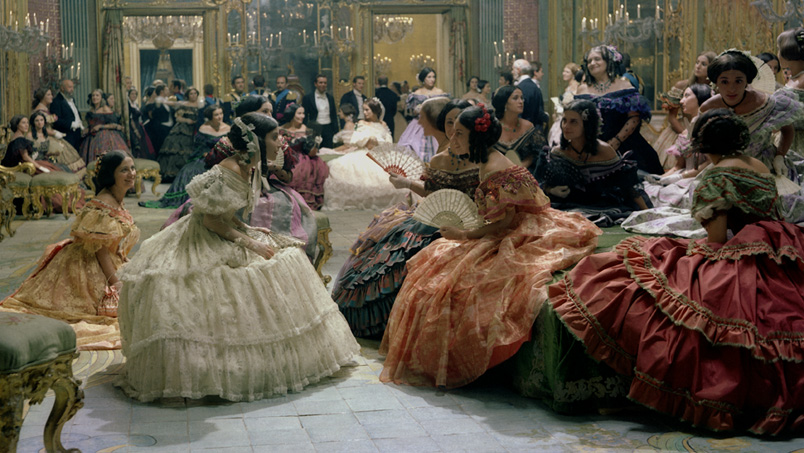
Films are, themselves, like paintings, if you can go with the analogy—both are contained in frames and there is the implied understanding that those frames are the limitations of our vision, that maybe without the frame they might go on to dimensions of breadth or depth and that what we see is the scope of the artists' vision, directing us to what is important, the focal point of the subject matter.  Some of the most gorgeous films I've seen, like Barry Lyndon or The Leopard, inspire a wish to merely hang images from them on my wall. 

No such thoughts crept to mind during The Mill and the Cross, as ingeniously as Majewski endeavored to bring the many facets of "The Way to Calvary" to life.  Rather than having any "life" to it, it feels like a passionless exercise, the characters impenetrable cyphers, meandering around trying to "inspire" the moment of the painting (which holds far more activity than the film seems to want to evoke).  All those new ideas are solely in the design and conceptual stage and not in the actual realization of the film.  Pretty much limited to sets and blue screen, there is a flatness of tone that sometimes occurs when actors are restricted to surroundings that are uninspiring.  And even with the technical wizardry required to pull it off, there is a tendency for the actors to appear visually separated from their backgrounds (as if the lighting were off) in the same way that the blue-screened citizens of Tokyo seemed like they were never in danger of being trampled by Godzilla.

But, it's not only technically that the movie falls...as flat as a canvas.  There's a paucity of dialogue for any of the characters, so that their motivations and actions are completely unclear.  Things happen, people are tortured, bread is baked, Christ is crucified—then what that's over, everybody gets up and dances away like the fools at the end of The Seventh Seal, but without Death leading the way.  It is, after all, only a painting (no one was killed in the making of this picture, all the subjects got up and went home).

Besides The Seventh Seal, The Mill and the Cross also reminded me of a graphic novel that I've long admired, Neil Gaiman's "Signal to Noise,"* in which a dying film-maker decides to make his one last epic, a project that he knows will never be put to celluloid.  And so, because it remains in script-form, it will be as close to his original vision without the compromises of budget or time...or collaboration.  It is as pure as it can be, only susceptible to the impressions it forms in the reader's mind.  In a sense, all the barriers—technical, budgetary and time—that must be overcome from written word to image on film or video are opportunities for compromise that can erode that concept from its inception as inspiration to its final presentation.  In attempting to get below the paint of "The Way to Calvary," Majewski, rather than explaining, expanding, and presenting the process of the artist and the "life" of the art only gets further afield of the source in an intellectually safe, shallow interpretation.  We get the surface and never the depth of the characters that he presents, and so, The Mill and the Cross is an exercise of adaptation—just as a film-maker adapts the written word (a novel, say, and part of Majewski's source for the film is Michael Francis Gibson's analysis of the painting)—that fails.  The only thing unique and laudatory about it is that it attempts to "realize" another medium.  But the result—technically savvy but paper-thin—makes it a kindred spirit with so many of the current CGI blockbusters—an art-house version of a "Transformers" movie.

The Mill and the Cross is a Rental (but, frankly, I'd rather go back to Vienna to the Kunsthistorisches Museum and see the original—with my own eyes).


"The Way to Calvary"—far more interesting than the movie


* In pre-digital audio terms, "signal to noise" is the ratio of pure program sound to static or interference inherent in the analog medium on which it is imprinted.  It is a measure of signal quality, a meter (if you will) for perfection, which Gaiman then ascribed to purity of vision).

Friday, August 8, 2008

The Three Musketeers/The Four Musketeers

"The Three Musketeers: The Queen's Diamonds"/
"The Four Musketeers: Milady's Revenge"(Richard Lester, 1974/1975)
These rollicking films, originally planned as a two and a half hour epic (no matter what the Producers say!) may just be one of the best adventure films (and adaptations of a classic) ever filmed, balancing the demands of the story, the tenor of the times in which it was made and the idiosyncrasies of its director.

When approached, Lester (who hadn't made a film since "
The Bed Sitting Room" in 1969) wasn't enthused. Then he read the story, and did some research...and heartily agreed. One can see why. For "The Three Musketeers," as Lester and his screen-writer George MacDonald Fraser envisioned it is a story of intrigue in high places carried out by the lackeys and foot-soldiers who live to serve. Forget that the palace-dwellers are either snakes or dullards--they provide an opportunity for income and adventure--two qualities lacking amongst the citizens of France and England, who, at the time are at war. The opportunities for thrills, humor and pointed satire are rich and mined well by the film-makers.


Lester's direction is masterful--simple set-ups and multiple cameras used during the swash-buckling to make sure there's a glimpse of every buckled swash. And those scenes are choreographed as a group participation so that every Musketeer has "business." Lester also worked to makes sure that the fights were inelegant affairs--not balletic, but more like street-fights, with few rules and the use of landscape and surroundings as equal strategies to the sword technique (and every part of the sword is used, as opponents are sometimes conked with ornate handles).

Lester surrounds the royalty with games and idle amusements that have a slight tint of mindless cruelty to them, and that extends to the villains, whose machinations involving the Royals are merely extensions of those games, with regime-toppling consequences.

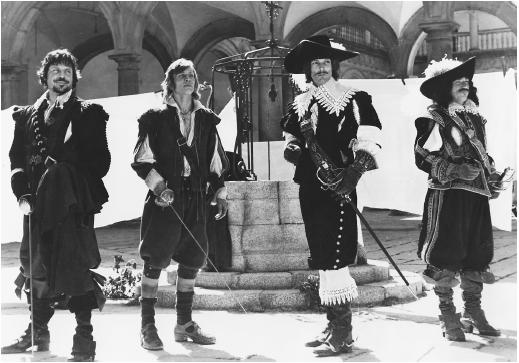
And the cast! As the musketeers, Oliver Reed as the surly Athos, Richard Chamberlain as the effete Aramis, Frank Finlay as the clownish Porthos, and Michael York as the young and naive D'Artagnan. As the Royals, Jean-Pierre Cassel as the foppish King Louis XIII, Geraldine Chaplin as the frail Queen Anna of Austria, and Simon Ward as the rakish Duke of Buckingham. As the villains, Faye Dunaway as Lady De Winter, Christopher Lee as the villainous Rochefort, and Charlton Heston in one of his best performances as the Machiavellian Cardinal Richelieu. Rounding out the cast are Raquel Welch as the Queen's seamstress, the accident-prone Constance de Bonacieux,* Spike Milligan as her randy husband, and Lester regular, the great Roy Kinnear as D'Artagnan's man-servant, Planchet. A superb cast, rarely equalled.

It's long been contended that the film was supposed to be one movie, but that the Salkind's split it into two to maximize profits. That's the rumor--there is a natural split of the film at the half-way point that feature almost all the actors for a sort-of bow, but it could have been used for an intermission. Certainly, there is less movie in "The Four Musketeers," it being padded with an "up-to-that-point" narrated prologue.

But there are two distinct stories of different tones, the first being the intrigue-filled, but relatively light-hearted "The Queen's Diamonds" story (in which Athos, Aramis and Porthos are wounded, but not killed), and the darker "Milady's Revenge" with its beheadings, extended back-story and several prominent deaths. Where Part 1 is rollicking fun with minimal consequences, the stakes in Part 2 are very high, passions flare, and the sword-play becomes deadly. The humor is darker than the first, too. Despite the same cast and crew,** the two are very different in tone.

Taken together, they have a moralist's sensibility of the costs of frivolity and duplicity; adventure can be fun, but in a poisonous political atmosphere, one adventure's at one's own risk. You can have a good time watching "The Three Musketeers," but the story is incomplete without the paid dues in "The Four Musketeers." Together, they make one of the finest adaptations of a classic novel ever put to film.

* Welch, not the most versatile of actresses, won the Golden Globe for her hilarious performance in "The Three Musketeers" and tearfully told the crowd "I've been waiting for this since "One Million Years B.C.!"

** except for the score composers--Michel Legrand for "The Three Musketeers" and Lalo Schifrin for "The Four Musketeers."

Saturday, June 21, 2008

Olde Review: Logan's Run

written September 5, 1976

"Logan's Run" (Michael Anderson, 1976) "Logan" is a movie I'd like to have been a part of. There are so many steps where someone should have taken Saul David, Michael Anderson, or David Zelag Goodman by the hand with a warm glass of milk and a cookie and explain to them that what they wanted to do wouldn't work, and that the slip-shod way they were planning to realize it wasn't going to help it, either.

Mind you, there are some things I like. The
Jerry Goldsmith score (what, I'm going to desert Goldsmith now? Herrmann's dead and Barry's comatose!)* Jenny Agutter is in it, and provides some moments of acting that actually seem natural in this spectacle of the unnatural (unnatural matte shots, etc.) (Why, in God's name has it taken Jenny Agutter five years since her last movie to appear in another one? The insight and wisdom displayed in her performances in "The Railway Children," and in Roeg's "Walkabout" should have made her much more in demand, since she is undoubtedly the best young actress since Pamela Franklin--and have you seen what's she's been in lately?)** Peter Ustinov comes in and says his lines like he just thought them up, and makes Michael York et al. look like The Reader's Theater.

The film brightens up a bit once
York and Agutter reach outside, not only because we, the audience, are on familiar ground, but also because we're out of those God-awful sets.

A friend of mine who's read the book says that book and movie have only the title in common. It's too bad that this should be such a turkey. I remember
Bruce Dern's plaintive cry in "Silent Running"--"What happened to the flowers?" Walking out (of "Logan's Run"), echoed in my mind "What happened to the $8 million?" Sleazy matte shots. Cruddy model shots. And from the company that put "2001" together.*** It has been said that we are about to be engulfed by a resurgence of sci-fi movies, their popularity expanding in the fifties, and then dwindling out to be revived when someone came out with a new special effect technique. Now, unfortunately, it looks like "Logan" predicts a resurgence of '50's technique. What happened to Magicam that was supposed to be so revolutionary? Is everything being used on the "Star Trek" film?****

But, lest it be mistaken that I am concerned only with special effects, let me say that "Special effects are worthless unless the ideas presented are special, as well!"***** Or else we get things like "
Space: 1999" which looks gorgeous, but its scripts have the consistency (and intelligence) of tapioca pudding.****** (I'm writing this in a camper-pickup truck bouncing over Wyoming's dirt roads). We must have intelligent writing! (and I'm not helping!)


Ah, youth. Pretty bad and squirrely writing here, even for the back of a pick-up truck, but my sentiments about "Logan's Run" haven't changed a jot. The sets are cheesey (although setting the city in a mall was a particularly good idea--we'll probably all live in hermetically-sealed malls in the future), the effects are bad--the city-scape miniatures wouldn't pass Gerry Anderson muster--and the story is fairly trashed.

However, the stupidest decision by the producers to make the central theme of the book-- the lottery for "renewal" (that is, not killing everyone who turns 30--it's 21 in the book)--
a spectator sport. You'd think that after weekly events that destroy every participant that one of these young people would come to the conclusion that NOBODY ever got renewed. I don't care how self-absorbed or de-sensitized or drugged-out they are, someone would notice.

They're working on a remake now, which is perfect for a youth-dominated market of kids barely out of their teens, while, in the meantime, the film had an unofficial distillation of themes in
Michael Bay's "The Island."

* I've written about Goldsmith here. Bernard Herrmann had recently died (his last released score--for DePalma's "Obsession" would be released a scant two weeks away. John Barry was not comatose--I was being facetious--but he had relaxed his style to a slow dirge pace orchestrated for a massive number of strings.

**I wrote this when I was 21. All I can say in my defense is I had the "hots" for Jenny Agutter, so I was partial. I think it was because she didn't mind doing nude scenes. There wasn't five years between movies--I just hadn't seen them--and she continues to act occassionally--she played the mother in a remake of "The Railway Children," and had a role in the excellent "Mi-5" series (aka "Spooks"). Pamela Franklin had just appeared in "The Legend of Hell House."

*** The distributor has nothing to do with it, kid. It's the producer and the director and the design team.

**** The plight of the science-fiction film would be resolved (or made worse, depending on your view) the next year with the release of "Star Wars" and "Close Encounters of the Third Kind." The success of these films kick-started the on-again/off-again "Star Trek" film and its reultant film series. It is now being re-vamped, with a new cast, and a new version of "Logan's Run" is being prepped.

***** This was bolded in big block letters. The sentiment is still good (if obvious anywhere except Hollywood), but, really, there's no need to shout!

******What's wrong with tapioca pudding?!