Showing posts with label The Three Musketeers. Show all posts

Sunday, August 11, 2013

Don't Make a Scene: The Three Musketeers (The Queen's Diamonds)

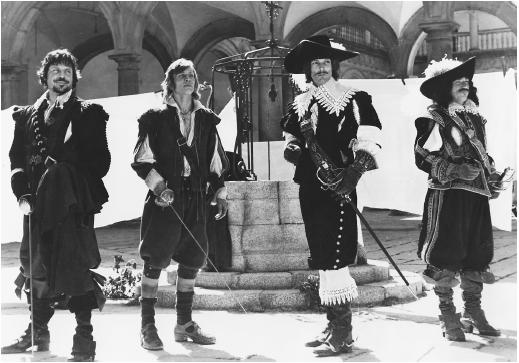
The Story:  Richard Lester's version of The Three Musketeers is my favorite of the many, many adaptations of Alexander Dumas' first volume of the adventure novels.  It's rollicking in every nuance of that term—fast-paced, in execution (frequently the first takes were printed and used, all the better to show mistakes, fumbles and freshness),ingenious, and (thanks to a script by "Flashman" novelist George McDonald Fraser) and witty, taking advantage of the strengths of a variety of styles of acting from Michael York, Oliver Reed, Christopher Lee, Faye Dunaway and Raquel Welch through to comedians like Spike Milligan (of "The Goons")* and frequent Lester collaborator Roy Kinnear.

Then, there's Charlton Heston, at the time of filming, still one of Hollywood's leading men, and who assumed that he'd be playing one of the Musketeers. After all, he was still a top draw at the box office, having essayed his way through the at-the-time in-fashion disaster movie cycle, and he was trained in his time as a swordsman for his various roles. 

But, Lester had other ideas.

"Chuck, take a look at Richelieu," Lester offered.  "Do a little reading about him." Heston did, and came away determined to take the role, even suggesting some of Richelieu's quotations to Lester (One that made it in was Richelieu's "I have no enemies.  There are only enemies of France.").  In a lifetime of wonderful roles, and holding up the slimmest of movies on his broad shoulders (Planet of the Apes, anyone?), The Three Musketeers was a juicy role that Heston played subtley, slyly, and to the hilt.  With all those stars, doing excellent work, Heston seems to stand apart...and above...them all.  

The Set-Up: There is intrigue in the high court of France. The Duke of Buckingham is rumored to be consorting with King Louis' wife, the Queen of France.  To get to the truth, Cardinal Richelieu (Charlton Heston) has dispensed one of his guards, the Comte de Rochefort (Christopher Lee) to bring in the husband (Spike Milligan) of the Queen's confidante, Constance Bonancieux (Raquel Welch), who has been rousted from his bed and brought before the diabolical Cardinal. 

En Guard!


GUARD: In you go...in!
MNSR. BONANCIEUX: Why won't you tell me? 


MNSR. BONANCIEUX: I did nothing at all!  I was lying in my bed! I was alone in my bed, when these enormous men broke into my room!


MNSR. BONANCIEUX: I swear I've done nothing!  Nothing!  What will they do to me?


GUARD: Everything!  You're in the Bastille, you must have done something.
MNSR. BONANCIEUX: but, but, wha...


CARDINAL RICHELIEU: What you have done is high treason!


MNSR. BONANCIEUX: Oh!  oh.


CARDINAL RICHELIEU: You are accused of conspiring with your wife and with the Duke of Buckingham.


MNSR. BONANCIEUX: No, no, no...


CARDINAL RICHELIEU: You know your accuser. Who brought you here?


MNSR. BONANCIEUX: That! 


MNSR. BONANCIEUX: That is the man!
CARDINAL RICHELIEU: Take him away!


MNSR. BONANCIEUX: That is NOT the man!


MNSR. BONANCIEUX: It's another man altogether.  This is a thoroughly honorable gentleman! I tell you he's an honest man, I tell you...


MNSR. BONANCIEUX: (he's beautiful, and generous and...)


ROCHEFORT: They have met, the Queen and Buckingham...
CARDINAL RICHELIEU: Where?


ROCHEFORT: At the palace.  I learned of this when it was too late.
CARDINAL RICHELIEU: You mean he slipped through your fingers?
ROCHEFORT: He slipped through your Eminence's fingers, 


ROCHEFORT: ...I had no orders.
CARDINAL RICHELIEU: What happened?
ROCHEFORT: The woman Bonancieux took Buckingham to the palace.


CARDINAL RICHELIEU: A woman Bonancieux?! I thought I told you to arrest her and to hold her.


ROCHEFORT: I failed.  One does, occasionally.


CARDINAL RICHELIEU: If I blundered as you do, my head would fall.


ROCHEFORT: I would say from a greater height than mine, Eminence.


CARDINAL RICHELIEU: You would.


ROCHEFORT: The height of vaulting ambition.
CARDINAL RICHELIEU: You have none?
ROCHEFORT: No.


CARDINAL RICHELIEU: You fear me, Rochefort?


ROCHEFORT: (pause) Yes...I...fear you, Eminence.


Richelieu nods.

Richelieu begins to walk away.


ROCHEFORT: I also hate you.


CARDINAL RICHELIEU: I love you, my son.  


CARDINAL RICHELIEU: Even when you fail.


The Three Musketeers: The Queen's Diamonds 

Words by George MacDonald Fraser (after Alexandre Dumas)

Pictures by David Watkin and Richard Lester

The Three Musketeers is available on DVD from Lionsgate Entertainment


* Milligan is an inspired choice and makes the best, dramatically and comedically of lines like  "I wish not to be sent to the Bastille!  Because it's got very deep dungeons, and terrible instruments of torture operated by very unsympathetic men and they snip very important parts off people!"

Friday, August 8, 2008

The Three Musketeers/The Four Musketeers

"The Three Musketeers: The Queen's Diamonds"/
"The Four Musketeers: Milady's Revenge"(Richard Lester, 1974/1975)
These rollicking films, originally planned as a two and a half hour epic (no matter what the Producers say!) may just be one of the best adventure films (and adaptations of a classic) ever filmed, balancing the demands of the story, the tenor of the times in which it was made and the idiosyncrasies of its director.

When approached, Lester (who hadn't made a film since "
The Bed Sitting Room" in 1969) wasn't enthused. Then he read the story, and did some research...and heartily agreed. One can see why. For "The Three Musketeers," as Lester and his screen-writer George MacDonald Fraser envisioned it is a story of intrigue in high places carried out by the lackeys and foot-soldiers who live to serve. Forget that the palace-dwellers are either snakes or dullards--they provide an opportunity for income and adventure--two qualities lacking amongst the citizens of France and England, who, at the time are at war. The opportunities for thrills, humor and pointed satire are rich and mined well by the film-makers.


Lester's direction is masterful--simple set-ups and multiple cameras used during the swash-buckling to make sure there's a glimpse of every buckled swash. And those scenes are choreographed as a group participation so that every Musketeer has "business." Lester also worked to makes sure that the fights were inelegant affairs--not balletic, but more like street-fights, with few rules and the use of landscape and surroundings as equal strategies to the sword technique (and every part of the sword is used, as opponents are sometimes conked with ornate handles).

Lester surrounds the royalty with games and idle amusements that have a slight tint of mindless cruelty to them, and that extends to the villains, whose machinations involving the Royals are merely extensions of those games, with regime-toppling consequences.

And the cast! As the musketeers, Oliver Reed as the surly Athos, Richard Chamberlain as the effete Aramis, Frank Finlay as the clownish Porthos, and Michael York as the young and naive D'Artagnan. As the Royals, Jean-Pierre Cassel as the foppish King Louis XIII, Geraldine Chaplin as the frail Queen Anna of Austria, and Simon Ward as the rakish Duke of Buckingham. As the villains, Faye Dunaway as Lady De Winter, Christopher Lee as the villainous Rochefort, and Charlton Heston in one of his best performances as the Machiavellian Cardinal Richelieu. Rounding out the cast are Raquel Welch as the Queen's seamstress, the accident-prone Constance de Bonacieux,* Spike Milligan as her randy husband, and Lester regular, the great Roy Kinnear as D'Artagnan's man-servant, Planchet. A superb cast, rarely equalled.

It's long been contended that the film was supposed to be one movie, but that the Salkind's split it into two to maximize profits. That's the rumor--there is a natural split of the film at the half-way point that feature almost all the actors for a sort-of bow, but it could have been used for an intermission. Certainly, there is less movie in "The Four Musketeers," it being padded with an "up-to-that-point" narrated prologue.

But there are two distinct stories of different tones, the first being the intrigue-filled, but relatively light-hearted "The Queen's Diamonds" story (in which Athos, Aramis and Porthos are wounded, but not killed), and the darker "Milady's Revenge" with its beheadings, extended back-story and several prominent deaths. Where Part 1 is rollicking fun with minimal consequences, the stakes in Part 2 are very high, passions flare, and the sword-play becomes deadly. The humor is darker than the first, too. Despite the same cast and crew,** the two are very different in tone.

Taken together, they have a moralist's sensibility of the costs of frivolity and duplicity; adventure can be fun, but in a poisonous political atmosphere, one adventure's at one's own risk. You can have a good time watching "The Three Musketeers," but the story is incomplete without the paid dues in "The Four Musketeers." Together, they make one of the finest adaptations of a classic novel ever put to film.

* Welch, not the most versatile of actresses, won the Golden Globe for her hilarious performance in "The Three Musketeers" and tearfully told the crowd "I've been waiting for this since "One Million Years B.C.!"

** except for the score composers--Michel Legrand for "The Three Musketeers" and Lalo Schifrin for "The Four Musketeers."