Showing posts with label Oliver Reed. Show all posts

Saturday, May 1, 2010

Tommy

"Tommy" (Ken Russell, 1975) There have been bad rock and roll movies—really bad ones. But the genre seemed to hit its peak during the glitzy, gay disco-days of the 1970's. "The kids"—and Robert Stigwood—were making hits (and lots of money) from movies like "Saturday Night Fever" and "Grease." But even more, the companies putting out the soundtracks filled with movie-hits were making a wind-fall. There was a subsequent crush of rock-movies with double-album soundtracks hitting theaters and stores and amidst that groundswell were such gems as the Barbra Streisand "A Star is Born," "Can't Stop the Music," "Sgt. Pepper's Lonely Hearts Club Band"—starring The Bee Gees and Peter Frampton—but ahead of the pack was this bloated and excessive refutation of all things revolutionary in rock n' roll—"Tommy."

Pete Townsend and The Who's "rock-opera" (though it doesn't follow strict form requirements) barely held together as an album, but it was a fine conceit. And where there's conceit, there is Hollywood.

An excessive film,
during an excessive time in Hollywood. This scattered and episodic movie actually has more in common with the episodic "Broadway Melody" revue films of the 30's and 40's—guest-stars are trotted out (Eric Clapton, Elton John, Tina Turner, Jack Nicholson) for one song, then they are shipped off, never to be seen again.

I don't remember much of "
Tommy" except the excesses (purging does that), but I do remember the frequent use by director Russell of the distorted close-up, how the songs didn't flow into each other but kinda...stopped.

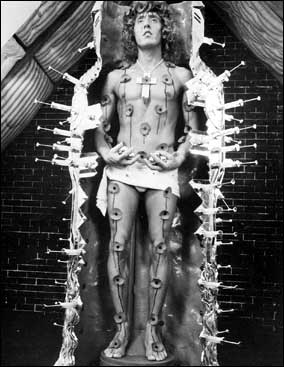
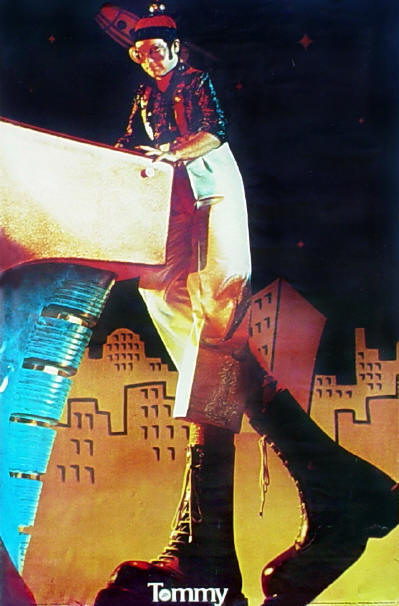
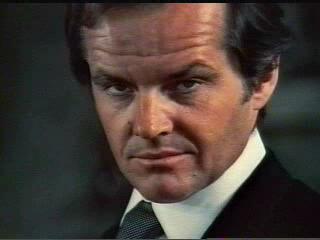
Then started again. Flow was something missing from "Tommy," and replaced by excess. Elton John was the biggest thing in music at the time, but he's just a blip in the film, perched atop stilt-like Doc Martens. Jack Nicholson (substituting for a probably-more-appropriate Christopher Lee) is in B-movie auto-pilot and CANNOT sing. Ann-Margret was inconceivably nominated for an Oscar for her performance in the filmprobably for bravery, Tina Turner was deliriously ferocious (and fidgety) as "The Acid Queen," and the heretical "Eyesight for the Blind" sequence that took place in The Church of Marilyn Monroe. Tasteless, crass, and jaw-droppingly audacious, it is also a very neat commentary on the idolatry of celebrity—a far better one than the movie itself...or Townsend's original...was trying to be. Except for that sequence, the film is a waste of time. An extremely commercial indictment of things commercial.

I suppose it could be due a re-make.

Let's forget it (Better, still).


The "Eyesight for the Blind" sequence (the song by "Sonny Boy Williamson II", performed by The Who, Eric Clapton—quite stoned—and Arthur Brown). Like the movie, it is padded to just go on soooo long and director Ken Russell (and editor Stuart Baird) do what they can to keep things semi-lively. Best thing about the movie.

Saturday, January 10, 2009

Olde Review: The Devils

This was part of a series of reviews of the ASUW Film series back in the '70's. Except for some punctuation, I haven't changed anything from the way it was presented, giving the snarky, clueless kid I was back in the '70's a break. Any stray thoughts and updates I've included with the inevitable asterisked post-scripts.

"The Devils" (Ken Russell, 1971) Ken's Russell's film of "The Devils" is what it is called. The quarter's only a week old and already in a Psychology class I have been told that the difference between an artist and a madman is that the artist can sift the good ideas from the bad.

So this leads me to believe that Ken Russell is a total madman. I don't like his films...at all. Some can accuse Russell of outlandishness beyong taste—but I think it can safely be said that Russell conducts outlandishness beyond sense. Even when he is at his most self-controlled, as "
The Boy Friend " and "Tommy," we are presented such things as a harkening back to the mindless musical days of Busby Berkley in the former, and a chutch that worships the effigy of Marilyn Monroe and a hypodermic filled sarcophagus in the latter. Well, those films were rated "G" and "PG," respectively, and "The Devils" was rated "X." "Presented" becomes "assaulted."

I'm not going to list the excesses out of context, but it involves lecherous priests, mad nuns, and you can take it from there...if you can take it. And as far as I care you can take it and do anything you want with it.

I do have to say, however, that the stars of the thing,
Vanessa Redgrave and Oliver Reed give fascinating performances—I wish they were in another movie— and there is an alright trial scene, but that's it for me to recommend, folks! But you can do a lot of jerky people do during a Ken Russell movie, keep repeating over and over "Ken Russell is a genius—Ken Russell is a genius" You may begin to believe it, and while you're concentrating on saying this, you may be fortunate enough to miss the movie. I didn't.

This was broadcast on KCMU-FM on January 8, 1976

Reading this throws me into all kinds of murky thinking. If you've read my reviews of, say, "Deliver Us from Evil," and "Doubt," you know my issues with the Catholic Church. I am, as I like to say, a recovering Catholic. My final break with "The Papists" came with the scandal of priests molesting kids in their charge and the hierarchy then sweeping the charges under the rug, ignoring the pain of the victims and sending the vioating priests to other parishes..to do exactly the same thing somewhere else. Given that scenario, Aldous Huxley's "The Devils" merely sounds like a party. "Lecherous priests and mad nuns" sounds a bit like this season's "Doubt." We know longer burn people at the stake for witchcraft, but an Alaskan evangelist did pray to keep Gov. Sarah Palin from the sins of witchcraft.

We've come a long way.

So, has the film. So controversial, so over-the-top, "The Devils" had to have several cuts just to get an "X" rating at the time of its release! A restored version was shown at festivals in 2004, and Warners announced a DVD release for 2009, but plans for that have apparently been shelved. I would like to think that my hostility towards the film was based purely on my latent Catholicism, but I doubt it. I've never been a fan of Russell's, whose aim has seemed to be not so much creating art as causing as big a stink as possible. He's taken a lot of peculiar material, and pitched them as fever-dreams rather than straight-ahead narrative, and he's been quite guilty of burying his points in pretension and obfuscation. And Russell's film of "The Devils" freely adapted from the Huxley novel is heavy on that and high-pitched histrionics.

That's probably what I wanted to say in this review, where I criticized with only faint damnation. The most interesting part of the whole thing is the quote at the beginning, of the difference between a madman and an artist. Really? So Ed Wood, David Lynch, Michael Bay, Tom Cruise...are all mad? The difference between a madman and an artist boils down to "Good Taste?" I think I believe that less now than I did back then. Ed Wood had a lot of problems, to be sure, but I'm not sure he was crazy. Deluded, yes, and we celebrate that blinkerdly delusion. But it was useful as an entree to Ken Russell. I did end up liking his film of "Altered States ," though.

Friday, August 8, 2008

The Three Musketeers/The Four Musketeers

"The Three Musketeers: The Queen's Diamonds"/
"The Four Musketeers: Milady's Revenge"(Richard Lester, 1974/1975)
These rollicking films, originally planned as a two and a half hour epic (no matter what the Producers say!) may just be one of the best adventure films (and adaptations of a classic) ever filmed, balancing the demands of the story, the tenor of the times in which it was made and the idiosyncrasies of its director.

When approached, Lester (who hadn't made a film since "
The Bed Sitting Room" in 1969) wasn't enthused. Then he read the story, and did some research...and heartily agreed. One can see why. For "The Three Musketeers," as Lester and his screen-writer George MacDonald Fraser envisioned it is a story of intrigue in high places carried out by the lackeys and foot-soldiers who live to serve. Forget that the palace-dwellers are either snakes or dullards--they provide an opportunity for income and adventure--two qualities lacking amongst the citizens of France and England, who, at the time are at war. The opportunities for thrills, humor and pointed satire are rich and mined well by the film-makers.


Lester's direction is masterful--simple set-ups and multiple cameras used during the swash-buckling to make sure there's a glimpse of every buckled swash. And those scenes are choreographed as a group participation so that every Musketeer has "business." Lester also worked to makes sure that the fights were inelegant affairs--not balletic, but more like street-fights, with few rules and the use of landscape and surroundings as equal strategies to the sword technique (and every part of the sword is used, as opponents are sometimes conked with ornate handles).

Lester surrounds the royalty with games and idle amusements that have a slight tint of mindless cruelty to them, and that extends to the villains, whose machinations involving the Royals are merely extensions of those games, with regime-toppling consequences.

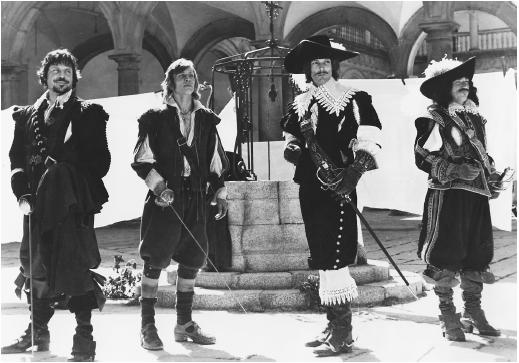
And the cast! As the musketeers, Oliver Reed as the surly Athos, Richard Chamberlain as the effete Aramis, Frank Finlay as the clownish Porthos, and Michael York as the young and naive D'Artagnan. As the Royals, Jean-Pierre Cassel as the foppish King Louis XIII, Geraldine Chaplin as the frail Queen Anna of Austria, and Simon Ward as the rakish Duke of Buckingham. As the villains, Faye Dunaway as Lady De Winter, Christopher Lee as the villainous Rochefort, and Charlton Heston in one of his best performances as the Machiavellian Cardinal Richelieu. Rounding out the cast are Raquel Welch as the Queen's seamstress, the accident-prone Constance de Bonacieux,* Spike Milligan as her randy husband, and Lester regular, the great Roy Kinnear as D'Artagnan's man-servant, Planchet. A superb cast, rarely equalled.

It's long been contended that the film was supposed to be one movie, but that the Salkind's split it into two to maximize profits. That's the rumor--there is a natural split of the film at the half-way point that feature almost all the actors for a sort-of bow, but it could have been used for an intermission. Certainly, there is less movie in "The Four Musketeers," it being padded with an "up-to-that-point" narrated prologue.

But there are two distinct stories of different tones, the first being the intrigue-filled, but relatively light-hearted "The Queen's Diamonds" story (in which Athos, Aramis and Porthos are wounded, but not killed), and the darker "Milady's Revenge" with its beheadings, extended back-story and several prominent deaths. Where Part 1 is rollicking fun with minimal consequences, the stakes in Part 2 are very high, passions flare, and the sword-play becomes deadly. The humor is darker than the first, too. Despite the same cast and crew,** the two are very different in tone.

Taken together, they have a moralist's sensibility of the costs of frivolity and duplicity; adventure can be fun, but in a poisonous political atmosphere, one adventure's at one's own risk. You can have a good time watching "The Three Musketeers," but the story is incomplete without the paid dues in "The Four Musketeers." Together, they make one of the finest adaptations of a classic novel ever put to film.

* Welch, not the most versatile of actresses, won the Golden Globe for her hilarious performance in "The Three Musketeers" and tearfully told the crowd "I've been waiting for this since "One Million Years B.C.!"

** except for the score composers--Michel Legrand for "The Three Musketeers" and Lalo Schifrin for "The Four Musketeers."