Showing posts with label Vanessa Redgrave. Show all posts

Thursday, November 14, 2013

The Sea Gull (1968)

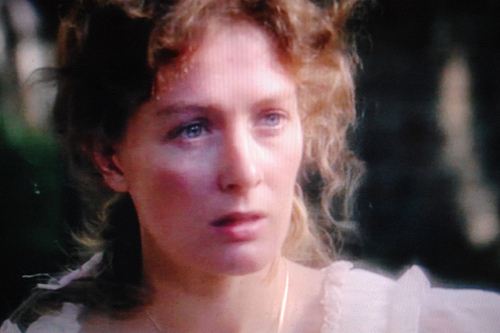
The Sea Gull (Sidney Lumet, 1968) Reading Sidney Lumet's book "Making Movies" he mentions that he got the idea to make this film of Anton Chekhov's play when working with James Mason, Simone Signoret, Harry Andrews and David Warner on The Deadly Affair in 1966.  Lynn Redgrave, sister of Vanessa, also worked on The Deadly Affair. By the time the financing was arranged and filming was set for Sweden, Lumet pretty much had his dream cast. Also, a couple times in the book. he announces "the theme" of The Sea Gull: "Everybody loves the wrong person."

No kidding...


He could also talk about the various strata of life stages and work-worth going on, of folks who are successful, or post-success, or craving success in their lives and how their attractions are reflected not only in their choices of who to imprint on (and they are choices), but also in how they regard other folks inside their strata and more importantly outside of it (Oh, this is getting complicated...and we haven't even gotten to the irony of success and getting to do what you want having nothing to do with happiness or self-worth, but, man, I keep digressing further and further here...).


The point is "everybody loves the wrong person" is such an obvious and simplistic break-down of The Sea Gull that you want to shake Lumet and say "anything else?"  Oh, it's there, and the actors are superb in playing it, but Lumet, as a director, imposes his technology on it in a ham-fisted way, choice of angles, edits, he's still directing for television and for a "rube" audience that might not get it if he doesn't beat you over the head with it, and as it's a character piece, any decision that the director chooses to show his hand (and the material's) just gets in the way of the communication between actors and audience.  We'll get to that in a second.


It's a less than idyllic retreat at the lake side getaway of Sorin (Andrews), who's in failing health.  His sister Irina (Signoret) has brought her lover, the successful writer Trigorin (Mason) with her to visit her son Konstantin (Warner), an aspiring playwright whose ambition for the stay is to stage an esoteric play about the death of the Earth with his love Nina (Redgrave, Vanessa), an aspiring actress, who lives on the neighboring estate. Sorin's place is being maintained by an out-of-work civil servant (Ronald Radd) and his wife (Eileen Herlie) and their daughter Masha (Kathleen Widdoes), who is pursued by Medvedenko (Alfred Lynch), despite that she is in love with Konstantin.   Konstantin is in love with Nina, though Nina is enamored of Trigorin.  The bailiff's wife is in love with Dr. Dorn (Denholm Elliott), whose affections are suspect. 

Things begin to get complicated when Konstantin stages his play within the play, an avant-garde work of the future Earth describing its decay at the hands of its now extinct population of human beings, a role played by Nina. Irina scoffs at the play, Trigorin dismisses it by his lack of of commenting on it, and Konstantin storms off, humiliated, while Nina, despite the group's apathy, is entranced with her time on stage.  It sets in motion the group's interactions as Konstantin, coveting Trigorin's success while critical of his work, and jealous of the writer's relationship with his Mother, increases his anti-social behavior, which further drives a wedge between him and Nina, who is drawn to Trigorin.

It's Lumet's presentation of the Konstantin's play here that frustrates and, frankly, its effect that keeps me from fulling embracing Lumet as a master film-maker.  How he presents the play is to keep the stage (and Redgrave performing her scene) out of focus, and keeping the far field across from a lake IN focus.  Dramatically and intellectually, one might defend it—the play within a play has Nature "speaking" and so maybe it makes some sort of sense to have the scenery in focus instead of the foreground action, or it's out of focus to reinforce that it is a "bad" play.  However, those contrarily focally challenged shots are intercut with the reaction of the people watching it and they are very much in focus, which creates this bizarre unease to the watcher of the film.  Is this a mistake?  Is there a "point" being made?  If so, why ruin it by interrupting it with sharply photographed reactions that call attention to the falsity of the effect?  And if it is to show that it's a "bad" play, isn't that communicated by the reaction shots?

It is this "going for a temporary effect," even on an intellectual level, at the expense of the experience of everyone in the scene as a whole, and the film's naturalism in toto.  Film is an illusion already, there's no point in calling attention to the fact, unless you want to just explode the whole intention of presenting a moment in time truthfully to the best of your craft.  And Lumet, especially, in his earlier films, has a tendency to just grand-stand at the risk of the film entire.

Still, it's a brilliant cast—Mason is a marvel here, and one should be grateful that we get a chance to see Redgrave's Nina (even if she might be a bit old for the part).  One cannot fault the amazing performances, even if the frame, pacing, cutting scheme might show them at a disadvantage.


Thursday, January 13, 2011

Julia


Julia (Fred Zinnemann, 1977) Alvin Sargent's literate, excellent screenplay begins with the aged Lillian Hellman sitting in a boat at twilight, fishing, while over the soundtrack the voice of Jane Fonda  (playing Hellman) talks of the phenomenon of some paintings that reveal earlier paintings below the surface pigments—"pentimento," because the canvas "remembers."

The story that makes the spine of this film is much in dispute.  Hellman swears it occurred exactly as she wrote about it, but that the woman, Julia (Vanessa Redgrave), seems to have disappeared without a trace of documentation that she ever existed, makes one suspect.  Hellman was a writer, above all—a dramatist.  She would not be the first to sacrifice the truth for a better story. It may be a case of a story shining through the layers of artistry, like pentimento.

In the film, Hellman recounts her girl-school friendship with the free-spirited Julia, and how they parted: Julia to study in Vienna, Lily to study in the States and pursue both a writing career and a long affair with writer Dashiell Hammett (Jason Robards).  The two keep in touch, but the free-spirited Julia becomes involved in anti-fascist groups, making her a target for assault.  Hellman uses a world-tour after her Broadway successes to sidetrack to Austria to try to find her friend, who is hiding from the authorities, who, if they catch her, will most assuredly kill her.

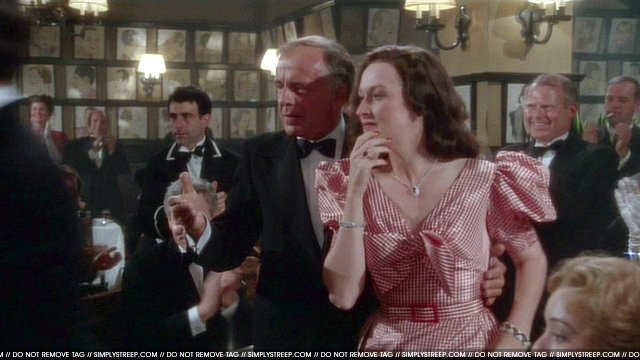
It boasts a great cast (both Robards and Redgrave deservedly won Supporting Oscars), with Maximilian Schell, Hal Holbrook, and, in her film debut, a young brunette actress named Meryl Streep.*  Zinnemann's direction is unfussy skipping back in memory, and recounting the desperate times.  The film was edited by Walter Murch, one of his first editing jobs that did not entail working for school-chums like Francis Coppola and George Lucas

This was the favorite film of the girl I was dating in college; we must have seen it five times or so, images, situations and lines of dialogue all burned into my memory, like etchings on a canvas.


* Her blonde hair was dyed for the part.  And she was great, right from the start.  I still remember, burned into my mind, how Streep turned a parting compliment into a dismissal: "You look very slim, Lillian..."

Saturday, January 10, 2009

Olde Review: The Devils

This was part of a series of reviews of the ASUW Film series back in the '70's. Except for some punctuation, I haven't changed anything from the way it was presented, giving the snarky, clueless kid I was back in the '70's a break. Any stray thoughts and updates I've included with the inevitable asterisked post-scripts.

"The Devils" (Ken Russell, 1971) Ken's Russell's film of "The Devils" is what it is called. The quarter's only a week old and already in a Psychology class I have been told that the difference between an artist and a madman is that the artist can sift the good ideas from the bad.

So this leads me to believe that Ken Russell is a total madman. I don't like his films...at all. Some can accuse Russell of outlandishness beyong taste—but I think it can safely be said that Russell conducts outlandishness beyond sense. Even when he is at his most self-controlled, as "
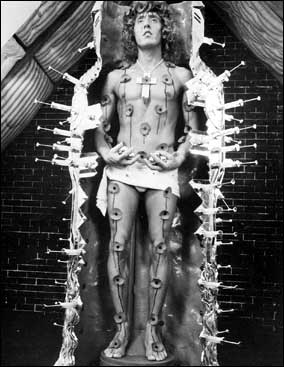
The Boy Friend " and "Tommy," we are presented such things as a harkening back to the mindless musical days of Busby Berkley in the former, and a chutch that worships the effigy of Marilyn Monroe and a hypodermic filled sarcophagus in the latter. Well, those films were rated "G" and "PG," respectively, and "The Devils" was rated "X." "Presented" becomes "assaulted."

I'm not going to list the excesses out of context, but it involves lecherous priests, mad nuns, and you can take it from there...if you can take it. And as far as I care you can take it and do anything you want with it.

I do have to say, however, that the stars of the thing,
Vanessa Redgrave and Oliver Reed give fascinating performances—I wish they were in another movie— and there is an alright trial scene, but that's it for me to recommend, folks! But you can do a lot of jerky people do during a Ken Russell movie, keep repeating over and over "Ken Russell is a genius—Ken Russell is a genius" You may begin to believe it, and while you're concentrating on saying this, you may be fortunate enough to miss the movie. I didn't.

This was broadcast on KCMU-FM on January 8, 1976

Reading this throws me into all kinds of murky thinking. If you've read my reviews of, say, "Deliver Us from Evil," and "Doubt," you know my issues with the Catholic Church. I am, as I like to say, a recovering Catholic. My final break with "The Papists" came with the scandal of priests molesting kids in their charge and the hierarchy then sweeping the charges under the rug, ignoring the pain of the victims and sending the vioating priests to other parishes..to do exactly the same thing somewhere else. Given that scenario, Aldous Huxley's "The Devils" merely sounds like a party. "Lecherous priests and mad nuns" sounds a bit like this season's "Doubt." We know longer burn people at the stake for witchcraft, but an Alaskan evangelist did pray to keep Gov. Sarah Palin from the sins of witchcraft.

We've come a long way.

So, has the film. So controversial, so over-the-top, "The Devils" had to have several cuts just to get an "X" rating at the time of its release! A restored version was shown at festivals in 2004, and Warners announced a DVD release for 2009, but plans for that have apparently been shelved. I would like to think that my hostility towards the film was based purely on my latent Catholicism, but I doubt it. I've never been a fan of Russell's, whose aim has seemed to be not so much creating art as causing as big a stink as possible. He's taken a lot of peculiar material, and pitched them as fever-dreams rather than straight-ahead narrative, and he's been quite guilty of burying his points in pretension and obfuscation. And Russell's film of "The Devils" freely adapted from the Huxley novel is heavy on that and high-pitched histrionics.

That's probably what I wanted to say in this review, where I criticized with only faint damnation. The most interesting part of the whole thing is the quote at the beginning, of the difference between a madman and an artist. Really? So Ed Wood, David Lynch, Michael Bay, Tom Cruise...are all mad? The difference between a madman and an artist boils down to "Good Taste?" I think I believe that less now than I did back then. Ed Wood had a lot of problems, to be sure, but I'm not sure he was crazy. Deluded, yes, and we celebrate that blinkerdly delusion. But it was useful as an entree to Ken Russell. I did end up liking his film of "Altered States ," though.

Monday, May 26, 2008

Evening

"Evening" (Lajos Koltai, 2007) Okay, before we say anything about this movie, look at the cast--that'd be the reason people would be drawn to this movie: Vanessa Redgrave, Meryl Streep, Glenn Close, Eileen Atkins, Claire Danes, Natasha Richardson, Toni Collete. That is some heavy-duty fire-power and far eclipses the male contingent of Patrick Wilson, Hugh Dancy and Barry Bostwick.

Add in the stunt-casting: Natasha Richardson plays the daughter of Vanessa Redgrave's character, which should be easy to do as she's Vanessa Redgrave's daughter. Then there's Mamie Gummer, whose character's wedding is the centerpiece of the flash-backs for this film, and who is played in the present-day by Gummer's real-life mother, Meryl Streep.* All nice for a little conversation-starter at the coffee-klatsch.

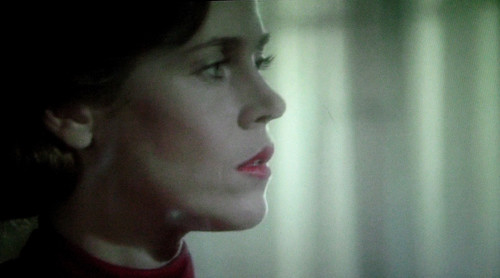
But the reason to see this film is late in the proceedings: it's a scene between the two old friends played by Streep and Redgrave, both very old, and the latter, dying. And it's amazing. Redgrave is always good--surprising in how she can breathe life into any kind of scene. To see Streep and her play off of each other, is one of those rare moments of seeing two great actors at the top of their game combining their talents, even if the movie is no great shakes.** Upon finding out who her visitor is, Redgrave's arms fly out, reaching for her, a girlish gasp in delight escaping from this bed-ridden woman of no strength, but for that moment, she's young again, in memory and reality. And the two become gossipy friends again, though Streep's character is held in check somewhat by reality, and Redgrave's has no time for holding back. Great actresses. Great scene.

But the rest of the film is lacking. Whenever the film is off of Redgrave (her nurse is played by Eileen Atkins, who is Streep's counterpart in England), the film lags. Claire Danes plays the younger version in the flashbacks for the better part of the film, and though Danes can make her character dither at the drop of an impulse, that part feels soapy and over-written, and not as felt. And the present-day conflicts of the Redgrave character's children seem far less interesting than the flights of fancy of their dying mother, who flickers in and out of fantasy and reality. In the end, her obsessions are passed off as not amounting to much, though they're important to her, and the lesson of the film--there are no mistakes--comes off as hopelessly banal as saying "It is what it is."

Still, it's an impressive cast, but it's a mired chick-flick, that tested the patience of some chicks I know.

*"Nepotism," I hear you cry. And it is. Funny thing is, Gummer was cast first, and then and only then was Streep, who'd been in screenplay-writer Cunningham's "The Hours," approached to play the olde part. On the DVD, Gummer cracks: "Nice to be able to find my Mom a job!"

**I'm thinking here of DeNiro and Brando in "The Score," or Brando and George C. Scott in "The Formula," or Hepburn and Wayne in "Rooster Cogburn" or Hepburn and Fonda in "On Golden Pond." These are events couched in humble films of limited means, and it's just fun to watch legends work together, even if you have to suffer through the rest of the movie to do it.

Monday, March 17, 2008

Venus

"Venus" (Roger Michell, 2006) Peter O'Toole, in an interview in the special features section of the "Venus" DVD sums it up as a story between "a dirty old man and a slutty young woman." Exactly, and if it had been sold like that it would have made much more money at the box-office. As it is, the film has to stand on its own merits, which are considerable. Hanif Kureishi's script is literate but low-down, full of humanity in all its frailties, both young and old, well-played by a stellar cast. And that's where the elements of specialness occur:

1) O'Toole--he plays an elderly thespian who, these days, "specializies in corpses," who has lived an impulsive romantic life, and in the winter of his discontent, still does. O'Toole makes the most of the words, but, more than any other actor, knows what to do between the lines. O'Toole is frail, but not THIS frail, and his tremulousness is a stunning act of craft over pride. He's not alone.


2) Playing the ex-wife he abandoned with three kids ("under six," she reminds him) is Vanessa Redgrave, the greatest actress extant, who does the part sans make-up, unglamourously and brilliantly. To see O'Toole and Redgrave play a scene together for the first time is a great event, and should be required viewing for all aspiring actors. These two actors, once coltish and prancing, now old and playing broken down is heart-breaking, but exciting (I'm starting to sound like bloody James Lipton!)


3) Jamie Alexander, in a seemingly artless way, matches them. That is not an insignificant thing. Picked, no doubt, because she resembles the young Vanessa Redgrave, one waits for the scene where the two meet. the viewer is not disappointed.

4) A scene where O'Toole, humiliated, goes for a walk and finds himself at a small, humble proscenium--the benches covered and strewn with leaves and garbage, as the soundtrack becomes awash with O'Toole's voice from past performances of different eras and different fidelities that's as fine as any piece of film I've ever seen

5) A waitess at the old actor's favorite eating hole sees a picture of the young actor in the paper. "Gawd, he was GO-geous, wasn't he?" Someone should make another starrer for O'Toole and call it "Give The Man The Friggin' Oscar He So Richly Deserves, Already" and be done with it.

Monday, February 4, 2008

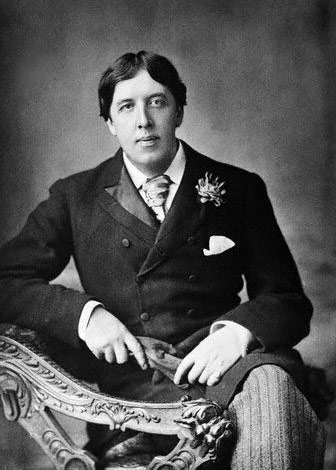
Wilde

"Wilde" (Brian Gilbert, 1997) A nearly definitive biographical film of the scholar and playwight whose career was destroyed and life shortened by the spiteful trial and imprisonment for "indecent acts" directly relating to his gay trysts. Stephen Fry plays Wilde, and he's a bit too old for the part but the resemblance is there, and his bulk and refinement put you in the sphere of what it must be like to be a bull in a china shop. Vanessa Redgrave (wonderful, as always) plays Mother Wilde, Jennifer Ehle as his wife Constance, and as the earnest young men in Wilde's affections, a virtual parade of young British heart-throbs--Orlando Bloom (for 3 s., tops), Ioan Gruffud, Michael Sheen, and as Wilde's obsession Lord Alfred "Bosie" Douglas, Jude Law in full schizophrenic movie mode. One becomes aware all too quickly that Wilde's problems stem from a bad match and his tragedy is that he could never stop going back no matter the cost to him or those around him. Frye communicates the "struck dumb" quality that must have evoked, which for a man of Wilde's intellect and eloquence must have been over-powering. Tom Wilkinson is hissingly malevolent as "Bosie's" father, The Marquess of Queensbury, the acknowledged "rule setter" for the subtle art of bashing someone's brain in. Here he forgets his own rule about hitting below the belt. The film is a cautionary tale of how reaching the heights of fame guarantee the hardest of falls, and how hubris has a remarkable way of proving to be one's undoing.