Showing posts with label 1977. Show all posts

Saturday, May 25, 2013

Star Wars and Me

36 years ago tomorrow. Star Wars premiered and changed the space-time continuum of movies forever, for good or ill. ** Here's a look back.  Tomorrow, a scene.


For some reason, the nation has latched onto May 4th as "Star Wars Day," the forced, lispy association between "May the Force..." and "May Fourth" being the main stretch. Not buying it, not for a "parsec."* "Star Wars Day" is May 26th—the day it opened in 1977, with little fanfare and low expectations, at a handful of theaters (many of them forced to show it) across the country.

I remember it clearly. I was a junior in college, and at the time I was doing reviews for the college radio station, KCMU, on the weekly student union film series and broadcast on a whopping 10 watts of power. My first glimpse of
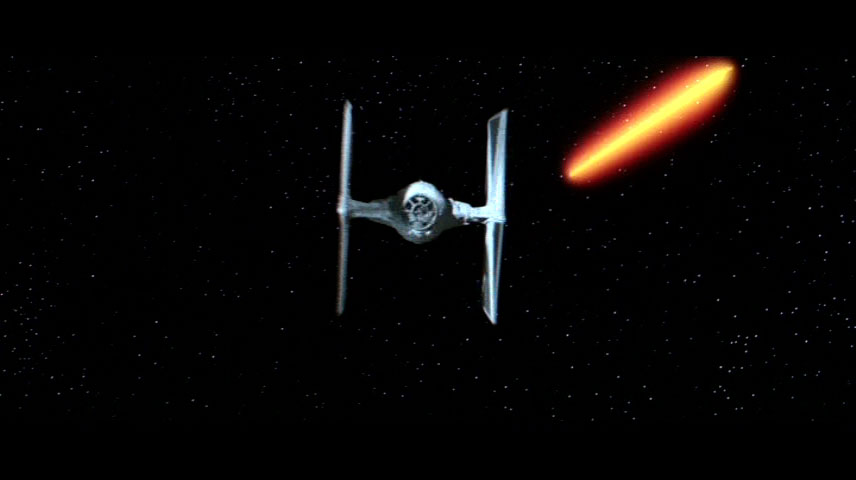
Star Wars was a preview attached to The Rocky Horror Picture Show, the copy of which was suffering from having the sound swapped out on two of the reels. That preview had no music by John Williams playing underneath it, but a non-descript tension piece. It had few FX scenes, but scenes of the robots, Darth Vader, some Tatooine shots, and the rope-swing across the Death Star chasm.


I was intrigued by it, but I'd been following the career of George Lucas with high expectations since seeing his first film, THX-1138, in the theater (it was the bottom-half of a double-bill with the lackluster Soylent Green). It's odd sociological look at a neutered futuristic society, told in an immersing, non-linear manner, intrigued me. This was intelligent science-fiction on a shoe-string budget where the special effects were ideas rather than matte paintings and super-imposed shots. It's ingenious use of sound inspired me to enter the field of audio post-production which would dominate my life for the next 20 years. Lucas' subsequent film, American Graffiti, also told a story of heroic empowerment seeking a better way of life, but in the milieu of a low-budget high-school film, about a last Summer night where the majority of teens cruised an endless loop of city-streets, symbolizing their own townie instincts—endlessly circling the same comfortable known patterns of their lives. Only one character realizes that to advance, he must escape and leave his past behind.

So, as I say, I was looking forward to it, however odd-looking and "
Wizard of Oz-ish" it looked in the previews.

I wish I could communicate to younger readers what a world before Star Wars was like and how the movie was a game-changer. In one film, Lucas opened up the commercial potential of a space fantasy, while at the same time narrowing the expectations for a film devoting itself to speculative fiction. The ideas took a back-seat to the visual aspects of the story, and subsequent films carried a similar tall-tale aspect that harkened back to the past, rather than imagining the future. Star Wars made more films in the genre viable in the marketplace, and science-fiction less cultish, while also limiting the template. The genre tilted to space-gun swashbucklers that straddled both past and future.

But, there had been nothing with such a flair for the beaten down-exotic: no robots with chemical formula names, the determined combination of fairy tale and sci-fi, wizards of arcane powers, the polyglot of exotic alien life-forms not limited to bi-peds, or the editorial (the way the Death-Star hatches zoomed open and shut) and sonic flourishes (a main character who only communicated through electronic chirps). Oh, one or two of these things might have showed up in a past movie, but Star Wars did something odd every few seconds, and paced it like a long compilation of a D-movie serial. That ingenuity is missing from most modern sci-fi films, where the FX dazzle the eye while the mind goes blank.

But, I put it on my "to-do" list and let a few folks know of my interest and shared what little knowledge I had of it, gleaned from some non-specific articles in "Starlog" magazine. One of my fellow disc-jockeys went to an opening day matinee and came back gob-smacked. He returned to the radio station and babbled at whoever would listen about the creatures, the ships, the fire-fights, the crazy "to-infinity-and-beyond" prologue scroll. It was all "too much information." I got on the phone and called my clutch of high-school buddies. "I'm going to see Star Wars tomorrow at noon. I'm going to be there to stand in line at 10 am and hold places. If you want to see it, find me in line, but I don't think you want to miss this."

The next day, waiting-book in hand, I was among a nerdly few who stood in line at that hour, and, one by one, my friends showed up, and the line grew geometrically as the time to open the theater doors approached until it stretched around the block, and, incredibly, started to form a line for the
next showing. The obsession had already begun, spurred by glowing reviews in the newspaper and a lengthy article in Time Magazine. And the audience I attended it with loved it—the film had an extended run for more than a year.


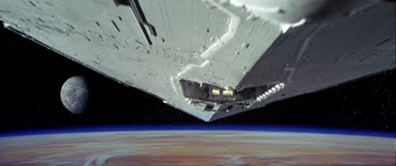
I knew the thing was going to be a ride with its first bravura shot—one of the ballsiest to announce just what its intentions were: panning down from the disappearing chapter head, its fanfarish opening fading to a discrete twinkling as we contemplate the stars, the view descends and narrows its scope while expanding its horizons—taking in a floating moon and then settling on a frame-defining planet's edge. Then a sleek ship zooms over our heads into view with tracing laser blasts flashing from it and towards it, causing flashes of damage. Then, the pursuing ship defines the top of the frame—first a wedge of a bristling ship that expands and expands and expands, with ever-more complex details including a large empty bay. It grows to impossible proportions until finally the vast nozzles of its engines blue-glow into frame, accompanied by the sound of crackling plasma-sounds that pierce the thudding hunter's drums of John Williams' martial music with a romantic's flourish. The intention is to dazzle, and to change our perspective of what is possible in this techno-fairy tale, filled to bursting with arcana, culled from the rich history of cinema and make-believe.

It flew by, with dozens of fun little touches: the blue specters of holograms (merely realized by filming
Carrie Fisher's lines from a variety of angles on low-res video screens—she can still remember that speech), the bones of a dinosaurish creature on the crest of a Tatooine dune while Williams' score recalls Stravinsky's "Rite of Spring," which served as the backdrop for the dinosaur segment of Disney's Fantasia, the hob-goblin Jawas-used "droid" salesmen of the desert, the varieties of robots and aliens, the casual conversations of the stormtroopers, one denizen of Mos Eisley space-port ("You will never find a more wretched hive of scum and villainy") represented by stork-legs that brush by the camera (you never see the whole creature, just a suggestion of it), Alec Guinness' inscrutable wizard, Han firing first and proving his worth by diving out of the Sun like a WWI Ace, the nothing-made-of-it reaction shots between the scruffy Chewbacca and Princess Leia, the dangerous sparking sizzle of whooping light-sabers, the nerve-wracking go-for-broke flights through the trenches of the Death Star, the initial dives into those trenches done with a Wellesian slight of hand, transitioning from long model-shot to three-dimensional close-up by a cut disguised as a blast of laser-fire.

It was stunning. I exited the theater with a stupid kid's smile on my face, the main thought in my head being just wanting to get back in line to see it again...right now. The huge line of people, though, was daunting. An impatient yuppie who'd been in line since I'd entered the theater had to ask me: "How was it? Is it any good?"

I babbled: "Wow...I just...it's absolutely...amazing...it's...it's...it's"

He looked at me piteously. "Are you high?" the guy asked.

Truth is, I was. As high as any really good, ingenious film can make me (and still can).

I dragged friends, family, girlfriends to see it just to see what their reactions would be—I wanted to see their sense of wonder, if there was any. But I also wanted to see it again and again to see if I'd missed anything (telling answer—Nope, only its flaws). And the memory of that Summer day lingers on, like a particularly joyful memory, a force that informed my life.

May the Force (or Something Like it) Be with You. Always.

(And I still have that poster that's perching up there at the top of this article).


* One of my favorite stories about "Star Wars" involves Carl Sagan going on "The Tonight Show" with Johnny Carson and railing about the inaccuracies of "Star Wars." It was the usual stuff—no sound or turning ship flight-paths in space, distance between systems, yadda yadda yoda. But one thing really irked Sagan: "they've got one guy who said he made a trip in parsecs—a parsec isn't a measure of time, it's distance!" This, in turn, really irked Lucas. He knew that. The line was there to show that Solo's not too good with technical details and a bit of a blow-hard—hence Obi-Wan Kenobi's pitying reaction to him saying it. In space, no one can hear you grind your teeth in frustration.

** Subsequently, I participated in a blog meme of "What Movie Do I Wish Was Never Made" and I chose Star Wars for the effect it had on the movie industry to this day.  That article is here.

Friday, February 18, 2011

The American Friend

The American Friend (Wim Wenders, 1977) of all the "Talented Mr. Ripley's" that emerged from the poison-pen of Patricia Highsmith, there was never one so unusual as this adaptation.  Wim Wenders had been looking for a Highsmith property to adapt, and came up trumps—all the writings of the author of "Strangers on a Train" had been secured for adaptation.  And when the elderly Highsmith met with Wenders, she was suitably impressed to present him with a prize she'd been saving, the galley of the unpublished "Ripley's Game," her third novel in the exploits of Tom Ripley, American A-type (amoral, asexual) sociopath, who's managed through murder, masquerade and machiavellian tactics to make himself a very rich, cultured man in the selling of forged paintings.

There've been many Ripleys: you could say that Robert Walker's Bruno Antony in Hitchcock's adaptation of Strangers... was a good blueprint, but then Alain Delon had played the character in René Clément's Purple Noon, Barry Pepper in Ripley Underground, the almost-respectable adaptation of the first book starred Matt Damon, and John Malkovich portrayed him in the remake of Ripley's Game.  She initially didn't like Dennis Hopper's portrayal of "a cowboy in Hamburg," but she came around.


This was Hopper's first movie after the strung-out (in all meanings of the term) work he'd done as the fried photojournalist in Apocalypse Now, and the contrast couldn't be more striking.  Hopper's Ripley is quiet, almost shy, highly observational—check out the once over he gives Bruno Ganz in the gallery—and highly self-reflexive.


His Ripley seems to believe that a movie is being made about him, and he's constantly recording himself, and taking self-polaroids.  But, in action, his Ripley is fast, savage, uncompromising, and truly scary.


He's matched, step by clumsy step, by Bruno Ganz as the hapless picture framer, Jonathan Zimmermann, who becomes entangled in Ripley's scheme to provide for his family as he's dying. 


Wenders has fun with the film, casting many directors in prominent roles, most notable to American audiences, two experts of the crime film, Nicholas Ray (he portrays Ripley's one-eyed genius of a forger) and Sam Fuller, who plays the snakish gangster at the center of the plot. 


Also of note is the incredible work of director of photography Robby Müller, who manages to make every location suffuse with an unnatural glow of evil.


Ultimately, though, it is a love story.  Whatever Ripley's motivations, his squiring of Zimmermann through a series of plots, murders and misadventures, secures the man a fortunate death.  In the Malkovich Ripley's Game, the character celebrates his accomplishments by luxuriating in a sumptuous concert performance, but The American Friend is much more heart-breaking.  Ripley observes the final act of Zimmermann on a beach, embracing a pier support, a sad, satisfied smile on his face, alone with his triumph.  Simple, poignant, and a glimpse into a monster's heart, it is the one I prefer.


Thursday, January 13, 2011

Julia


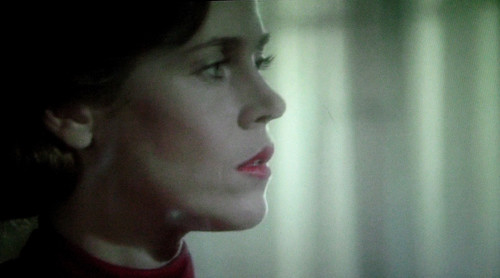
Julia (Fred Zinnemann, 1977) Alvin Sargent's literate, excellent screenplay begins with the aged Lillian Hellman sitting in a boat at twilight, fishing, while over the soundtrack the voice of Jane Fonda  (playing Hellman) talks of the phenomenon of some paintings that reveal earlier paintings below the surface pigments—"pentimento," because the canvas "remembers."

The story that makes the spine of this film is much in dispute.  Hellman swears it occurred exactly as she wrote about it, but that the woman, Julia (Vanessa Redgrave), seems to have disappeared without a trace of documentation that she ever existed, makes one suspect.  Hellman was a writer, above all—a dramatist.  She would not be the first to sacrifice the truth for a better story. It may be a case of a story shining through the layers of artistry, like pentimento.

In the film, Hellman recounts her girl-school friendship with the free-spirited Julia, and how they parted: Julia to study in Vienna, Lily to study in the States and pursue both a writing career and a long affair with writer Dashiell Hammett (Jason Robards).  The two keep in touch, but the free-spirited Julia becomes involved in anti-fascist groups, making her a target for assault.  Hellman uses a world-tour after her Broadway successes to sidetrack to Austria to try to find her friend, who is hiding from the authorities, who, if they catch her, will most assuredly kill her.

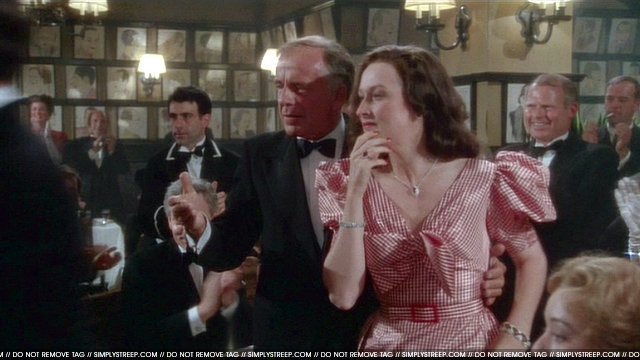
It boasts a great cast (both Robards and Redgrave deservedly won Supporting Oscars), with Maximilian Schell, Hal Holbrook, and, in her film debut, a young brunette actress named Meryl Streep.*  Zinnemann's direction is unfussy skipping back in memory, and recounting the desperate times.  The film was edited by Walter Murch, one of his first editing jobs that did not entail working for school-chums like Francis Coppola and George Lucas. 

This was the favorite film of the girl I was dating in college; we must have seen it five times or so, images, situations and lines of dialogue all burned into my memory, like etchings on a canvas.


* Her blonde hair was dyed for the part.  And she was great, right from the start.  I still remember, burned into my mind, how Streep turned a parting compliment into a dismissal: "You look very slim, Lillian..."

Tuesday, May 25, 2010

'Star Wars' and Me

For some reason, the nation has latched onto May 4th as "Star Wars Day," the forced, lispy association between "May the Force..." and "May Fourth" being the main stretch. Not buying it, not for a "parsec."* "Star Wars Day" is May 26th—the day it opened in 1977, with little fanfare and low expectations, at a handful of theaters (many of them forced to show it) across the country.

I remember it clearly. I was a junior in college, and at the time I was doing reviews for the college radio station, KCMU, on the weekly student union film series and broadcast on a whopping 10 watts of power. My first glimpse of
Star Wars was a preview attached to The Rocky Horror Picture Show, the copy of which was suffering from having the sound swapped out on two of the reels. That preview had no music by John Williams playing underneath it, but a non-descript tension piece. It had few FX scenes, but scenes of the robots, Darth Vader, some Tatooine shots, and the rope-swing across the Death Star chasm.


I was intrigued by it, but I'd been following the career of George Lucas with high expectations since seeing his first film, THX-1138, in the theater (it was the bottom-half of a double-bill with the lackluster Soylent Green). It's odd sociological look at a neutered futuristic society, told in an immersing, non-linear manner, intrigued me. This was intelligent science-fiction on a shoe-string budget where the special effects were ideas rather than matte paintings and super-imposed shots. It's ingenious use of sound inspired me to enter the field of audio post-production which would dominate my life for the next 20 years. Lucas' subsequent film, American Graffiti, also told a story of heroic empowerment seeking a better way of life, but in the milieu of a low-budget high-school film, about a last Summer night where the majority of teens cruised an endless loop of city-streets, symbolizing their own townie instincts—endlessly circling the same comfortable known patterns of their lives. Only one character realizes that to advance, he must escape and leave his past behind.

So, as I say, I was looking forward to it, however odd-looking and "
Wizard of Oz-ish" it looked in the previews.

I wish I could communicate to younger readers what a world before Star Wars was like and how the movie was a game-changer. In one film, Lucas opened up the commercial potential of a space fantasy, while at the same time narrowing the expectations for a film devoting itself to speculative fiction. The ideas took a back-seat to the visual aspects of the story, and subsequent films carried a similar tall-tale aspect that harkened back to the past, rather than imagining the future. Star Wars made more films in the genre viable in the marketplace, and science-fiction less cultish, while also limiting the template. The genre tilted to space-gun swashbucklers that straddled both past and future.
But, there had been nothing with such a flair for the beaten down-exotic: no robots with chemical formula names, the determined combination of fairy tale and sci-fi, wizards of arcane powers, the polyglot of exotic alien life-forms not limited to bi-peds, or the editorial (the way the Death-Star hatches zoomed open and shut) and sonic flourishes (a main character who only communicated through electronic chirps). Oh, one or two of these things might have showed up in a past movie, but Star Wars did something odd every few seconds, and paced it like a long compilation of a D-movie serial. That ingenuity is missing from most modern sci-fi films, where the FX dazzle the eye while the mind goes blank.

But, I put it on my "to-do" list and let a few folks know of my interest and shared what little knowledge I had of it, gleaned from some non-specific articles in "Starlog" magazine. One of my fellow disc-jockeys went to an opening day matinee and came back gob-smacked. He returned to the radio station and babbled at whoever would listen about the creatures, the ships, the fire-fights, the crazy "to-infinity-and-beyond" prologue scroll. It was all "too much information." I got on the phone and called my clutch of high-school buddies. "I'm going to see Star Wars tomorrow at noon. I'm going to be there to stand in line at 10 am and hold places. If you want to see it, find me in line, but I don't think you want to miss this."

The next day, waiting-book in hand, I was among a nerdly few who stood in line at that hour, and, one by one, my friends showed up, and the line grew geometrically as the time to open the theater doors approached until it stretched around the block, and, incredibly, started to form a line for the
next showing. The obsession had already begun, spurred by glowing reviews in the newspaper and a lengthy article in Time Magazine. And the audience I attended it with loved it—the film had an extended run for more than a year.


I knew the thing was going to be a ride with its first bravura shot—one of the ballsiest to announce just what its intentions were: panning down from the disappearing chapter head, its fanfarish opening fading to a discrete twinkling as we contemplate the stars, the view descends and narrows its scope while expanding its horizons—taking in a floating moon and then settling on a frame-defining planet's edge. Then a sleek ship zooms over our heads into view with tracing laser blasts flashing from it and towards it, causing flashes of damage. Then, the pursuing ship defines the top of the frame—first a wedge of a bristling ship that expands and expands and expands, with ever-more complex details including a large empty bay. It grows to impossible proportions until finally the vast nozzles of its engines blue-glow into frame, accompanied by the sound of crackling plasma-sounds that pierce the thudding hunter's drums of John Williams' martial music with a romantic's flourish. The intention is to dazzle, and to change our perspective of what is possible in this techno-fairy tale, filled to bursting with arcana, culled from the rich history of cinema and make-believe.

It flew by, with dozens of fun little touches: the blue specters of holograms (merely realized by filming
Carrie Fisher's lines from a variety of angles on low-res video screens—she can still remember that speech), the bones of a dinosaurish creature on the crest of a Tatooine dune while Williams' score recalls Stravinsky's "Rite of Spring," which served as the backdrop for the dinosaur segment of Disney's Fantasia, the hob-goblin Jawas-used "droid" salesmen of the desert, the varieties of robots and aliens, the casual conversations of the stormtroopers, one denizen of Mos Eisley space-port ("You will never find a more wretched hive of scum and villainy") represented by stork-legs that brush by the camera (you never see the whole creature, just a suggestion of it), Alec Guinness' inscrutable wizard, Han firing first and proving his worth by diving out of the Sun like a WWI Ace, the nothing-made-of-it reaction shots between the scruffy Chewbacca and Princess Leia, the dangerous sparking sizzle of whooping light-sabers, the nerve-wracking go-for-broke flights through the trenches of the Death Star, the initial dives into those trenches done with a Wellesian slight of hand, transitioning from long model-shot to three-dimensional close-up by a cut disguised as a blast of laser-fire.

It was stunning. I exited the theater with a stupid kid's smile on my face, the main thought in my head being just wanting to get back in line to see it again...right now. The huge line of people, though, was daunting. An impatient yuppie who'd been in line since I'd entered the theater had to ask me: "How was it? Is it any good?"

I babbled: "Wow...I just...it's absolutely...amazing...it's...it's...it's"

He looked at me piteously. "Are you high?" the guy asked.

Truth is, I was. As high as any really good, ingenious film can make me (and still can).

I dragged friends, family, girlfriends to see it just to see what their reactions would be—I wanted to see their sense of wonder, if there was any. But I also wanted to see it again and again to see if I'd missed anything (telling answer—Nope, only its flaws). And the memory of that Summer day lingers on, like a particularly joyful memory, a force that informed my life.

May the Force (or Something Like it) Be with You. Always.

(And I still have that poster that's perching up there at the top of this article).


* One of my favorite stories about "Star Wars" involves Carl Sagan going on "The Tonight Show" with Johnny Carson and railing about the inaccuracies of "Star Wars." It was the usual stuff—no sound or turning ship flight-paths in space, distance between systems, yadda yadda yoda. But one thing really irked Sagan: "they've got one guy who said he made a trip in parsecs—a parsec isn't a measure of time, it's distance!" This, in turn, really irked Lucas. He knew that. The line was there to show that Solo's not too good with technical details and a bit of a blow-hard—hence Obi-Wan Kenobi's pitying reaction to him saying it. In space, no one can hear you grind your teeth in frustration.

Monday, August 4, 2008

Night Moves

"Night Moves" (Arthur Penn, 1977) Harry Moseby (Gene Hackman) is your classic detective as tarnished knight. A lone-wolf ex-jock who plays the cards he's dealt and holds them close to the vest. Nobody gets in, not his wife, not his clients, not even his acquaintances. To accentuate the point, Director Arthur Penn surrounds Harry with glass and view-screens. He's a detective--a peeper--and he's always peering through thosee wind-shields, portals, and glass-bottomed boats at the world, though a little filtered, a little distorted. They are part of his job, but as they also provide him a view, they are also a hinderance...and a refuge. He can look through these transparent barriers, but he can't touch. And no one can get through to him. Frequently--so frequently you can't miss their use--the windows have one of those distorting fish-eye aplliques that bend and distort the world in a round, limited circle--a fish-bowl--appropriate for someone so myopic as Harry.

Harry's a loner, so much so that he won't take a job at an information mill because it's "not for him." And he's got a big mouth but just enough suppression instinct that the one it hurts the most is him, and a snide sense of humor that rubs the wrong way. He's so set in his ways that this old dog that won't learn new tricks has begun to chase his own tail. He's investigating himself, or rather, his wife, who's been stepping out on him. When he exposes the affair, everybody involved throws Harry's history back at him, something he avoids at all costs. He's more comfortable analyzing other people's problems to look at his own.

The screenplay is by
Alan Sharp, and Harry is another solitary guy on a "last run," at a cross-roads that he'll turn after he's done one more job. He'll quit while he's ahead. But his timing is a bit off. The movie starts just as this one case begins: a dirt-job for an aging starlet whose slut of a daughter (Melanie Griffith) has run off to the step-father. It's a family in the Chandler-mystery mode, good money can't hide bad blood-lines. Mom wants her back, but not out of some familial bond. She just wants the child-support. So, Moseby takes a long trip to Florida to try and convince the kid to do something neither of them thinks is a good idea: Go back. And, as in Chandler, that case is just the tip of a dangerous ice-berg, one that improves Harry's vision, but only with 20/20 hind-sight.

When I first saw "Night Moves"--back when it played theaters, I was unimpressed. Now, seeing it at an older age, it looks like a masterpiece, the understated classic that some have said it was. The movie hasn't changed...but I have, and I appreciate the issues in it, and see it with a much better clarity than when I was younger. Getting old does that. I'm just lucky enough to be getting
old.