Showing posts with label Maximillan Schell. Show all posts

Thursday, January 13, 2011

Julia


Julia (Fred Zinnemann, 1977) Alvin Sargent's literate, excellent screenplay begins with the aged Lillian Hellman sitting in a boat at twilight, fishing, while over the soundtrack the voice of Jane Fonda  (playing Hellman) talks of the phenomenon of some paintings that reveal earlier paintings below the surface pigments—"pentimento," because the canvas "remembers."

The story that makes the spine of this film is much in dispute.  Hellman swears it occurred exactly as she wrote about it, but that the woman, Julia (Vanessa Redgrave), seems to have disappeared without a trace of documentation that she ever existed, makes one suspect.  Hellman was a writer, above all—a dramatist.  She would not be the first to sacrifice the truth for a better story. It may be a case of a story shining through the layers of artistry, like pentimento.

In the film, Hellman recounts her girl-school friendship with the free-spirited Julia, and how they parted: Julia to study in Vienna, Lily to study in the States and pursue both a writing career and a long affair with writer Dashiell Hammett (Jason Robards).  The two keep in touch, but the free-spirited Julia becomes involved in anti-fascist groups, making her a target for assault.  Hellman uses a world-tour after her Broadway successes to sidetrack to Austria to try to find her friend, who is hiding from the authorities, who, if they catch her, will most assuredly kill her.

It boasts a great cast (both Robards and Redgrave deservedly won Supporting Oscars), with Maximilian Schell, Hal Holbrook, and, in her film debut, a young brunette actress named Meryl Streep.*  Zinnemann's direction is unfussy skipping back in memory, and recounting the desperate times.  The film was edited by Walter Murch, one of his first editing jobs that did not entail working for school-chums like Francis Coppola and George Lucas. 

This was the favorite film of the girl I was dating in college; we must have seen it five times or so, images, situations and lines of dialogue all burned into my memory, like etchings on a canvas.


* Her blonde hair was dyed for the part.  And she was great, right from the start.  I still remember, burned into my mind, how Streep turned a parting compliment into a dismissal: "You look very slim, Lillian..."

Friday, May 8, 2009

Judgment at Nuremberg

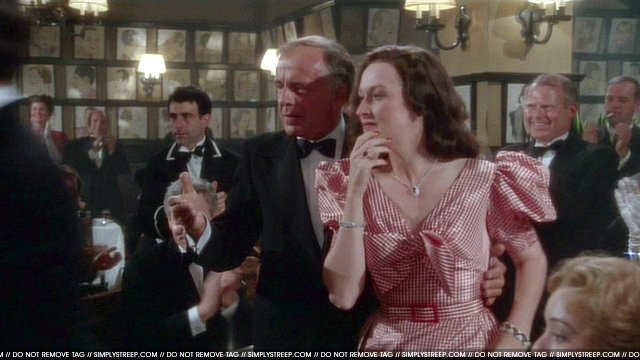
"Judgment at Nuremberg" (Stanley Kramer, 1961) It was Katharine Hepburn who shepherded this film from its origins as an episode of "Playhouse 90" to this version as a three hour epic.* The movie is padded with shots of Spencer Tracy touring the city (still in rubble in 1960, twelve years after the judges trials at Nuremberg**), and background of the characters, including a chaste meeting of minds with a Nazi widow (Marlene Dietrich, still oozing mystery at the age of 60). Screenwriter Abby Mann makes the citizenry complicit in his expanded screenplay, despite their protestations of ignorance. And the military at the time of the trial was in the middle of the Berlin Airlift, their attention now turned to "the Bolsheviks" and cozying up to Germany for strategic advantage, casting the worth and even the result of the trial in question for political expediency. The movie is allowed much more cynicism than the Playhouse 90 broadcast, where the words "gas chambers" were subject to censorship by sponsor The American Gas Association.

The movie threatens to swamp itself with star-power but leavened it by Tracy disappearing into his role.
Maximilian Schell repeats his television performance (winning an Oscar in the process, as did Mann for his adaptation). Of the newcomers, the best performances are Montgomery Clift in face and body language denoting a characters damaged by the brutality of the Nazi regime. And Judy Garland, who'd always seemed like a raw nerve in her films, acts merely from the neck up—and that's all that's required. Not as controlled are Richard Widmark, whose prosecutor is a bit too demonstrative in private for a courtroom strategist, and Burt Lancaster, given a great speech but, a weakness of the actor, aware of it. Laurence Olivier was intended to play German Ernst Janning, but dropped out. I'm not sure that would have been an improvement, but it would have been interesting.

Kramer struggles with the material; he would later become an expert on courtroom directing. But here, he's more intent on making the drama look interesting with camera moves by circling witnesses and, most egregiously, using a fast zoom to zero in on a dramatic moment. It's used sparingly, but even that's too much for the material. He would learn to trust his actors and inherent drama of the scene to carry it.

But, "
Judgement at Nuremberg" manages to be something that eludes most Kramer films—it's a bit more timeless, especially in regards to the short-sightedness of chipping away at bedrock principles for today's political viability and the future's further erosion. One could be speaking of water boarding as torture in Abby Mann's summation speech.

Read it. Read the whole thing. But linger on the words after the picture below.


Judge Haywood: The trial conducted before this Tribunal began over eight months ago. The record of evidence is more than ten thousand pages long, and final arguments of counsel have been concluded.

Simple murders and atrocities do not constitute the gravamen of the charges in this indictment. Rather, the charge is that of conscious participation in a nationwide, government organized system of cruelty and injustice in violation of every moral and legal principle known to all civilized nations. The Tribunal has carefully studied the record and found therein abundant evidence to support beyond a reasonable doubt the charges against these defendants.

Herr Rolfe, in his very skillful defense, has asserted that there are others who must share the ultimate responsibility for what happened here in Germany. There is truth in this. The real complaining party at the bar in this courtroom is civilization. But the Tribunal does say that the men in the dock are responsible for their actions, men who sat in black robes in judgment on other men, men who took part in the enactment of laws and decrees, the purpose of which was the extermination of humans beings, men who in executive positions actively participated in the enforcement of these laws -- illegal even under German law. The principle of criminal law in every civilized society has this in common: Any person who sways another to commit murder, any person who furnishes the lethal weapon for the purpose of the crime, any person who is an accessory to the crime -- is guilty.

Herr Rolfe further asserts that the defendant, Janning, was an extraordinary jurist and acted in what he thought was the best interest of this country. There is truth in this also. Janning, to be sure, is a tragic figure. We believe he loathed the evil he did. But compassion for the present torture of his soul must not beget forgetfulness of the torture and the death of millions by the Government of which he was a part. Janning's record and his fate illuminate the most shattering truth that has emerged from this trial: If he and all of the other defendants had been degraded perverts, if all of the leaders of the Third Reich had been sadistic monsters and maniacs, then these events would have no more moral significance than an earthquake, or any other natural catastrophe. But this trial has shown that under a national crisis, ordinary -- even able and extraordinary -- men can delude themselves into the commission of crimes so vast and heinous that they beggar the imagination. No one who has sat at through trial can ever forget them: men sterilized because of political belief; a mockery made of friendship and faith; the murder of children. How easily it can happen.


There are those in our own country too who today speak of the "protection of country" -- of "survival." A decision must be made in the life of every nation at the very moment when the grasp of the enemy is at its throat. Then, it seems that the only way to survive is to use the means of the enemy, to rest survival upon what is expedient -- to look the other way.

Well, the answer to that is "survival as what?" A country isn't a rock. It's not an extension of one's self. It's what it stands for. It's what it stands for when standing for something is the most difficult!

Before the people of the world, let it now be noted that here, in our decision, this is what we stand for: justice, truth, and the value of a single human being.


* Probably to give her love and paramour Spencer Tracy another plumb acting role. His health (owing to his tendency to drink to excess) was always improved when he was working.

** Although shots of Richard Widmark driving through the city are obvious process shots.

Friday, December 19, 2008

Topkapi

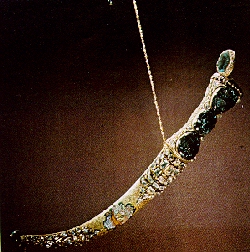
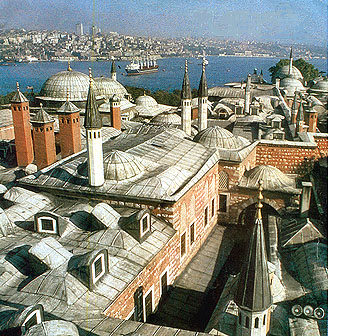
"Topkapi" (Jules Dassin, 1964) Dassin spoofs his earlier crime dramas with this comedy-caper (based on an Eric Ambler novel) set in Istanbul. There an odd assortment of crooks (Melina Mercouri, Maximillian Schell, Robert Morley) recruit an English prat (Peter Ustinov) to take the fall for an elaborate heist—the stealing of a priceless ornamental dagger from the well-alarmed Topkapi museum. Shot in rapturous color—with an opening sequence that seems a precursor to psychedelic films—Dassin uses the local color to spice up the activities of the wily criminals and their elaborate scheme, which involves clambering over the pointed roof-tops, impeding the progress of a beam from a nearby lighthouse, suspending an aerialist over the display, while also precisely elevating its heavy glass case. It's one of those "Mission: Impossble" capers, where what could go wrong, probably will. The escapade is fraught with perils of all sorts, not the least of which is getting caught.

It's a jolly good time, and Dassin has as much fun seriously pulling off the robbery as he does spoofing the characters.

Plans are afoot for a remake under the direction of Paul Verhoeven, with Pierce Brosnan repeating his debonair thief role from "The Thomas Crown Affair." It's to be called "The Topkapi Affair." We shall see.