Showing posts with label Peter Ustinov. Show all posts

Saturday, July 9, 2011

Lola Montès

Lola Montès (Max Ophüls, 1955) "The things we do to women"—one of the mantras of fictional President Jed Bartlett in "The West Wing," said several times over the course of the series in the presence of a male audience (but never as much as "What's next?"). 

The last film of master craftsman Max Ophüls (two years before his death) is a reverie, a cautionary tale of the course of the life of dancer/courtesan Lola Montez, who climbed socially through the world of prominent men until a dalliance with the King of Bavaria (who appointed her The Countess of Landsfeld) created such an uproar, it caused a revolution in 1848.  The real Lola lived quite well, though doing it so fast ultimately cost her.  She died from pnuemonia after suffering a stroke at age 40 in the United States.


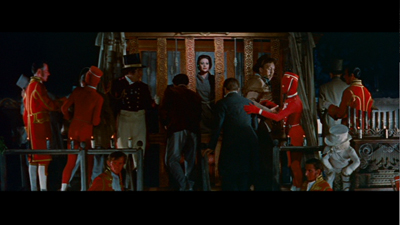
Ophüls' "reel" Lola (played by Martine Carol) lives out her foreshadowed final days as a featured performer of a circus (ring-led by Peter Ustinov), a public spectacle where she is forced to re-live and metaphorically re-enact her scandalous rise and precipitous fall before an audience of French rubes, who, like the rabble they are, shout questions from the dark (and Ustinov's Circus Master smarmily answers, egging them on). 


She is the star performer, but trappedby the schedule, by the spotlight, and finally caged, as a seemingly endless line of paying customers queue up to kiss her hand, paying homage and risking little.  She is a prisoner of her fame, her reputation and her life, that once represented a kind of freedom, where she felt she could challenge the limitations of polite society.


For Lola, it must seem a little like Hell, and for director Ophüls, it might have, too.  A long, complicated shoot, his first in color and wide-screen (at the producers' insistence), with a star he didn't want (at the producers' insistence), his film's complicated flashback structure, shifting back and forth from the circus' smarmy presentation of incidents to Lola's memories of the events—was re-edited into an uneasy chronological order to get to "the good parts" faster (at...well, you already know), after its premiere.  And that version of Lola—with one or two bits of lost footage tacked on over the years—was what the world knew of Ophüls' last film...until 2008.  Restored to the structure Ophüls intended, the film wheels between Lola's life in charge and manipulating events, to her being manipulated reliving the events, like a sideshow attraction.  And the presentation has an accusatory, sensationalist tone—a show-trial, literally.


It's a cunning look at fame (or infamy), of how one's actions can be sold as just about anything (the director's son in a supplemental interview says "Lola Montès is anti-advertising.")—and ironically the producers took the deception one step further, missing, or ignoring, or even sabotaging, the point.


Meanwhile, Ophüls managed to make the most of his star's lack of range, making her a stoic throughout the self-abasement.  Politically, it's an odd film: ostensibly, a "Comeuppance" film where an upstart (in this case, Lola) gets her "just desserts" (if one is thinking uncharitably), suffering humiliation and entrapment at the hands of men—once powerful and influential, she's now powerless.  But, that's a simplistic, even a foolish, reading.  Lola still holds fascination, draws a crowd, and those lines of men at the end are paying money to kiss her hand and pay their respects.  Even the Circus Master betrays his personal devotion to her.  Caged she may be, but she's still "got" it.

And Ophüls might have just told the flashback story, but the tragic scenes at the circus provoke empathy for Lola, reliving her lost past, generating understanding, or as Ophüls' son says, "in a spirit of penitence and mortification, benevolence." An audience might not be so sympathetic if Lola wenched her way around the world. getting her way and getting away with it, but the circus summaries exploit and promote her past victories, while placing her in marked contrast with her accomplishments. Like the circumstances of Barry Lyndon (Ophüls was a huge influence on Kubrick), the comedown goes a long way to evoking sympathy for the unfortunate forever caught in the frame.


Critic Andrew Sarris once called Lola Montès "the greatest film ever made."  One can see why.


Saturday, May 15, 2010

Missed It By That Much: Quo Vadis

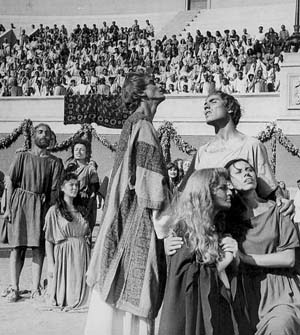
"Quo Vadis" (Mervyn LeRoy, 1950) This is M-G-M's first big biblical epic in the post-World War II environment, the one that spawned a genre that prospered in theaters for the next twenty years...and that has been revived for these times—you can't have enough bread and circuses for a recessed populace. The studio re-built the war-torn studios of Cinecittà, which would be home to Roman epics for the next two decades. The expansive sets would increasingly overtake the films created, until the out-sized production of "Cleopatra" nearly bankrupted 20th Century Fox.

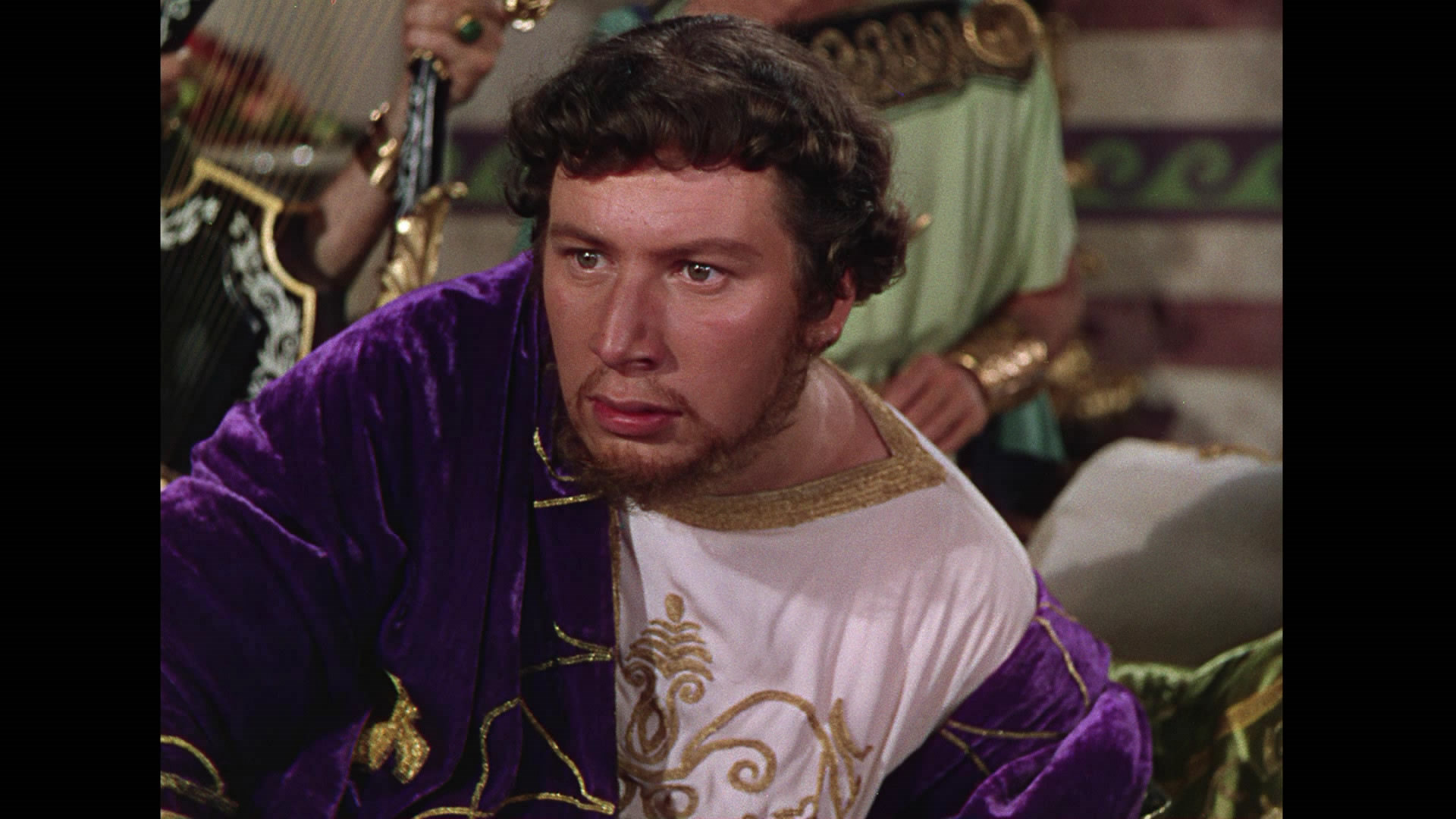
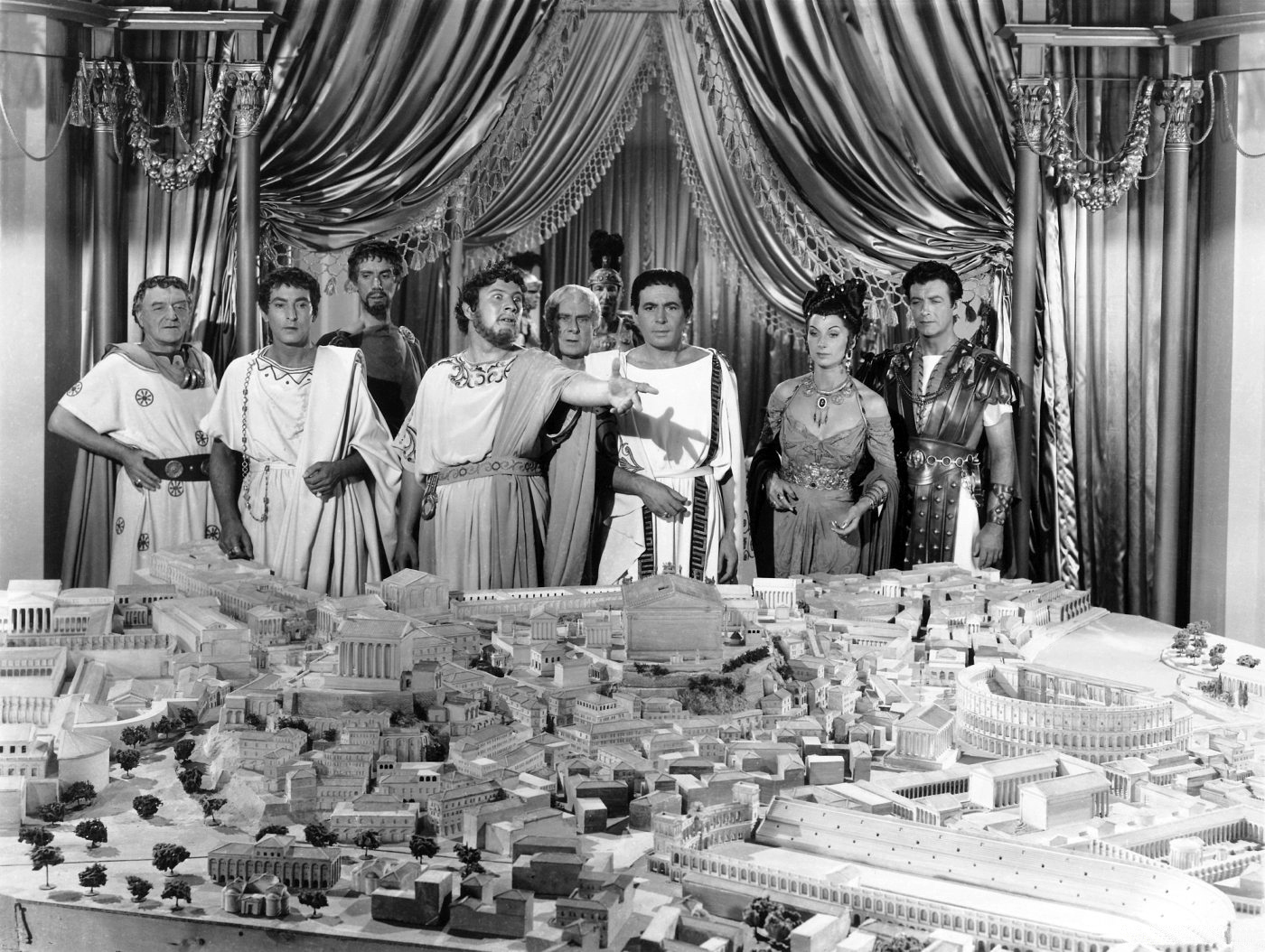
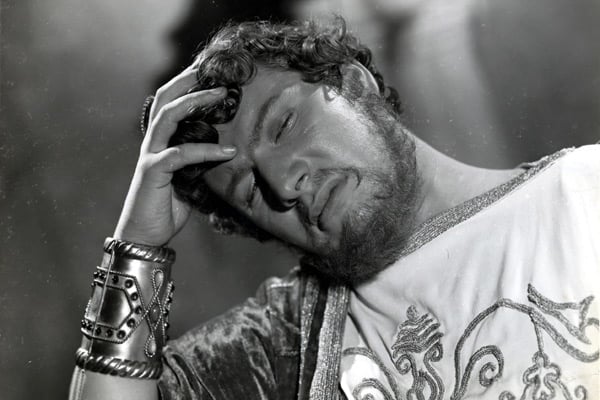
"Quo Vadis" tells two stories—of the Fall of Rome and the Rise of Christianity. Marcus Vinicus (Robert Taylor) returns from the wars to a very different Rome than the one he left; The Emperor Nero (Peter Ustinov) has declared himself a god, and the city is divided by his heinous act of murdering his wife and mother in order to marry the courtesan Poppaea (Patricia Laffan). Now, convinced of his own infallibility, the Emperor indulges his every whim and artistic pretension. That he's not very good at anything does not occur to him; anything a god can do must be significant.

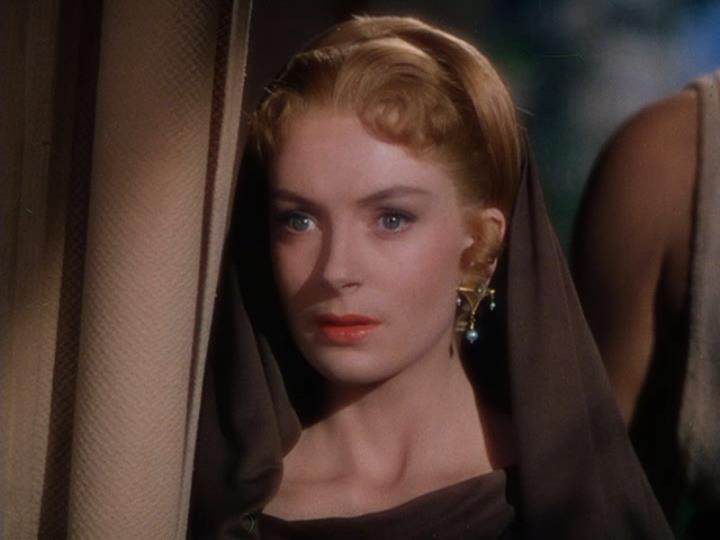
Vinicus, like the rest of Rome, indulges the Emperor—as long as what he does doesn't touch their lives, he can do anything he wants. For the returned tribune, what he wants is wine and wenching; Nero's wife is eyeing his lasciviously, but Vinicus sets his sights on the ward of the Senate, the captured princess of a Roman campaign, Lygia (Deborah Kerr). She is made a gift to him for his duty for Rome, but she initially spurns his advances. She's a follower of the teachings of the martyr Christ, as taught by his followers Paul (Abraham Sofaer) and Peter (Finlay Currie). This merely amuses Vinicus. But, when the Mad Nero decides he's going to design a new Rome in his own honor, and torches the old (without any evacuation plans), Vinicus sacrifices all to save Lygia.

It takes a lot of screen-time to get to that point in the story, and the film still has to have the persecution and throwing of Christians to the lions at Nero's behest, not to mention resolve all the story-tangles. So, the Christianity theme of "Quo Vadis" is given short shrift, despite the fact that the story hinges on it. As it ultimately leads to the establishment of The Church on the very spot where some of the events occurred, it undermines the religious under-pinning of the story.

The acting is a bit arch, as well. Leo Genn does a good turn as one of Nero's sycophants, but Kerr and Taylor are stuck in theatrical star mode, Taylor seems a bit out of place as a Roman Tribune, and doth protest too much when playing the Roman egotist. Peter Ustinov's Oscar-nominated turn as Nero is over-the-top and slobbering, a rare instance when the actor isn't doing precisely the right thing, even though the performance is an amusing one. All these elements lend a falseness to a story that has major significance to history and religion (however apocryphal it may be)

The Latin words "Quo Vadis?" translates to "whither thou goest?" or "where are you going?" It is what Simon Peter, fleeing Rome and its persecution of Christians, asks the passing vision of Jesus he encounters on the road. "Quo Vadis, Domine?" And the reply is "Eo Romam iterum crucifigi" (I am going to Rome to be crucified again), prompting Peter to return and sacrifice himself for his church. It's not a part of the "recognized" "approved" Bible—it is a section of the Apocrypha. And it is dramatised in the film with Christ speaking through the voice of a child. Peter goes back, and when confronted by his tormentors says "To die as Our Lord did is more than I deserve," to which the Roman guard replies in the tough-guy-henchman mode of the movie era, "We can change that." Another example of how this first modern Epic owes as much to LeRoy's gangster pictures as it does to the source material.*

It's always terrible to play the "what if?" game—the movie on the screen is the movie that was made. But in its early stages, it was being developed, and would have been directed, by...John Huston. Huston's historical films are always interesting for their attention to detail, and one ponders what he would have done with ancient Rome with a sad interest. His ironical eye would have been interesting, as well, when it came to Church matters. At that stage, before Huston's run-in's with Louis B. Mayer soured the deal (as reported in Lillian Ross's "Picture"), Marcus Vinicus was to be played by Gregory Peck and Lygia by Elizabeth Taylor, all of 19 years old. Now, Peck was not the most versatile of actors, but he could be counted on to deliver a prideful manliness with some depth, the kind that Taylor musters up as an oafish braggadocio. Taylor manages to pull off the scenes of Vinicus in distress, but Peck would have provided a younger, more believable protagonist. Elizabeth Taylor would have been able to pull off the vulnerability that Kerr has difficulty providing, while also giving Lygia the same spine of steel as Kerr's. What might have been... One looks at this "Quo Vadis" and wishes things could have been different.

"Whither thou goest?" At this point in the history of the Catholic Church—at this cross-roads it has reached—where it is caught in a choice between Unquestioned Authority and the culpability of its representatives, that question has never been more pertinent.

Quo Vadis? Indeed.


* Nero's last words in the film are the same as Johnny Rico's at the end of LeRoy's "Little
Caesar:" Is this the end of (me)?"

Friday, December 19, 2008

Topkapi

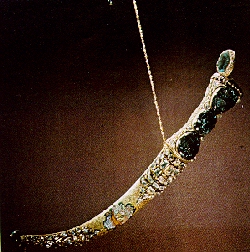
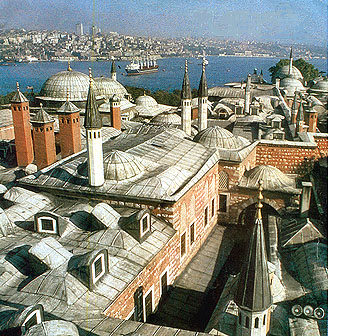
"Topkapi" (Jules Dassin, 1964) Dassin spoofs his earlier crime dramas with this comedy-caper (based on an Eric Ambler novel) set in Istanbul. There an odd assortment of crooks (Melina Mercouri, Maximillian Schell, Robert Morley) recruit an English prat (Peter Ustinov) to take the fall for an elaborate heist—the stealing of a priceless ornamental dagger from the well-alarmed Topkapi museum. Shot in rapturous color—with an opening sequence that seems a precursor to psychedelic films—Dassin uses the local color to spice up the activities of the wily criminals and their elaborate scheme, which involves clambering over the pointed roof-tops, impeding the progress of a beam from a nearby lighthouse, suspending an aerialist over the display, while also precisely elevating its heavy glass case. It's one of those "Mission: Impossble" capers, where what could go wrong, probably will. The escapade is fraught with perils of all sorts, not the least of which is getting caught.

It's a jolly good time, and Dassin has as much fun seriously pulling off the robbery as he does spoofing the characters.

Plans are afoot for a remake under the direction of Paul Verhoeven, with Pierce Brosnan repeating his debonair thief role from "The Thomas Crown Affair." It's to be called "The Topkapi Affair." We shall see.