Showing posts with label Oskar Werner. Show all posts

Wednesday, August 24, 2011

The Spy Who Came In From the Cold

The Spy Who Came In From the Cold (Martin Ritt, 1965) With the antcipation of the Christmas release of a film version of Tinker Tailor Soldier Spy, it would do well to revisit the world of George Smiley, "Control," and the duplicity of John le Carré's "kitchen-sink" version of spies.  They're background characters in The Spy..., the focus being operative Alec Leamas (Richard Burton) former head of the West Berlin branch of "The Circus," who must go behind enemy lines—one of the toughest of them, the Berlin Wall—as a potential "mole"* to ferret out who might be a double agent for the Soviets, responsible for the death of one of Leamas' agents.

His identity is kept the same—The Circus wants Leamas and his background history out in the open—but he is demoted in rank and stature, and, depressed and drinking heavily, he becomes bait for Soviet recruitment to betray information.  That's the mission, become a decoy on the "inside," another "double" feeding the Soviets false information, while trying to find out if there's a player on the other side in The Circus feeding information to the Russians.** 

Oh, what a tangled web the Cold War weaves.

Taken to East Berlin, Leamas is interrogated by a suspicious Russian administrator named Fiedler (
Oskar Werner) who (rightly) suspects Leamas of being a "plant."  Fiedler suspects a British "mole" already underground in the Soviet service and so sweats Leamas for any information to discover who that might be.  Ultimately, Leamas is undone by what so many of LeCarre's heroes or anti-heroes are susceptible to, the warmth of human contact—a failing that trips up a lot of the author's protagonists.  Leamas "comes out of the cold," the world of spies, and his friends, relations or lovers—the thread of decency and honesty they provide—are used against him.

For the fact of the matter is the Spymasters of "The Circus" are cold-hearted bastards ("without sympathy" as "Control," played by
Cyril Cusack, ponders)—they have to be to combat their enemies—and they're just as capable of betraying their own as those they fight. 

Case in point: George Smiley (played here by
Rupert Davies).  He would become le Carré's most celebrated character, but here he's a bit of a functionary, and he's just as cold-hearted as the rest.  In the "Tinker, Tailor..." timeline, "Control" was long since dead, having been driven out by "the new broom" from his station, which had left him suspicious and paranoid (ultimately with good reason) with Smiley his only trusted colleague.  When the BBC made a television mini-series of the book, Smiley was famously played by Sir Alec Guinness and (as le Carré amusingly notes in his new forward to "Tinker, Tailor...," because of that he "lost control" of the character.  But Smiley (however sympathetically Guinness played him) is also a "cold-hearted bastard"—if he wasn't, he wouldn't have lost the vital clue that was exploited by his enemies.  He gives as bad as he gets, and, even at his most triumphant, takes little joy in what he does.

In such a world, Ritt's direction is entirely appropriate—low-key, almost documentary in feel on the streets of London—in drab black-and-white, not the high-contrast color of other spy films of the era.  There is nothing glamorous about it, and plays out slowly and subtley—in fact, after a de-briefing by his boss, the shift in tone is so dreary one suspects one is watching a different film.  It is part and parcel of the subterfuge—it works on us as it does for Leamas' Sov' recruiters (most prominently
Michael Hordern).

And the script, now there's an interesting tale.  A beginning draft was written by Hollywood veteran
Guy Trosper, who died subsequently.  Taking over was poet-playwright Paul DehnDehn had written the final polish on the James Bond spy film Goldfinger (amusingly, as the two film could not be more polar opposite), and was the mainstay-writer for the "Planet of the Apes" sequels.  But, Dehn knew the world of spies well—during the second World War, Major Paul Dehn was the "Political Warfare" officer at the BSC training headquarters "Camp X" (where among the trainees were Roald Dahl and Bond creator Ian Fleming).***  Dehn was well-versed in spycraft, deceit, and keeping secrets and his distillation of le Carré's novel brings the moral duplicity to the fore, while keeping the audience guessing on whose side is whom.

If the film has one flaw, it is the casting of Burton as Leamas.  Burton was too good, too charismatic an actor/star to play a functionary like Leamas (it's about the same as "buying"
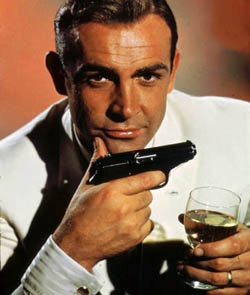
Sean Connery as a spy (which was part of the joke of the Bond series)—he's someone you'd notice walking into a room, and thus, hardly spy material.  But, Burton's presence, no doubt, got the film made, so the point is a bit moot.  Still, if its ideas and mysteries of the State and the heart you want more than action and fireballs (shall we say if you want to be "stirred and not shaken?"), The Spy Who Came in From the Cold is a fine, bracing tonic.


Davies as George Smiley in The Spy...


...and Guinness in the BBC-TV Tinker, Tailor...


Gary Oldman: "this year's" Smiley


* The term "mole" is a le Carré invention—his spy-circles code-name for a double agent hiding in plain sight within one of the other spy agencies, Soviet or british, and relaying information to "the other side."

** There has been a rich history of double agents throughout the annals of spydom, the most significant of which were "The Cambridge Five"—Kim Philby, Donald Duart Maclean, Guy Burgess, Anthony Blunt, and a fifth (and possibly more)—who'd been recruited during their college years, passed information to the Russians during WWII, and subsequently during the post-War years through the early 1950's.  "Tinker, Tailor, Soldier, Spy" (and the other two of the le Carré "Karla" novels) and le Carré's subsequent "A Perfect Spy" are inspired by "The Five" and their Russian puppet-master.

*** And, interestingly, one of the people who asked, and was briefly considered, to run Camp X...was Kim Philby!


Saturday, July 9, 2011

Lola Montès

Lola Montès (Max Ophüls, 1955) "The things we do to women"—one of the mantras of fictional President Jed Bartlett in "The West Wing," said several times over the course of the series in the presence of a male audience (but never as much as "What's next?"). 

The last film of master craftsman Max Ophüls (two years before his death) is a reverie, a cautionary tale of the course of the life of dancer/courtesan Lola Montez, who climbed socially through the world of prominent men until a dalliance with the King of Bavaria (who appointed her The Countess of Landsfeld) created such an uproar, it caused a revolution in 1848.  The real Lola lived quite well, though doing it so fast ultimately cost her.  She died from pnuemonia after suffering a stroke at age 40 in the United States.


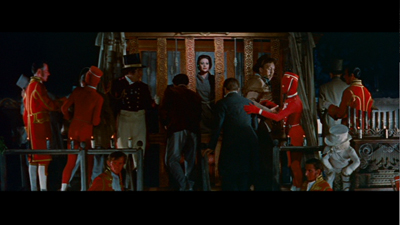
Ophüls' "reel" Lola (played by Martine Carol) lives out her foreshadowed final days as a featured performer of a circus (ring-led by Peter Ustinov), a public spectacle where she is forced to re-live and metaphorically re-enact her scandalous rise and precipitous fall before an audience of French rubes, who, like the rabble they are, shout questions from the dark (and Ustinov's Circus Master smarmily answers, egging them on). 


She is the star performer, but trappedby the schedule, by the spotlight, and finally caged, as a seemingly endless line of paying customers queue up to kiss her hand, paying homage and risking little.  She is a prisoner of her fame, her reputation and her life, that once represented a kind of freedom, where she felt she could challenge the limitations of polite society.


For Lola, it must seem a little like Hell, and for director Ophüls, it might have, too.  A long, complicated shoot, his first in color and wide-screen (at the producers' insistence), with a star he didn't want (at the producers' insistence), his film's complicated flashback structure, shifting back and forth from the circus' smarmy presentation of incidents to Lola's memories of the events—was re-edited into an uneasy chronological order to get to "the good parts" faster (at...well, you already know), after its premiere.  And that version of Lola—with one or two bits of lost footage tacked on over the years—was what the world knew of Ophüls' last film...until 2008.  Restored to the structure Ophüls intended, the film wheels between Lola's life in charge and manipulating events, to her being manipulated reliving the events, like a sideshow attraction.  And the presentation has an accusatory, sensationalist tone—a show-trial, literally.


It's a cunning look at fame (or infamy), of how one's actions can be sold as just about anything (the director's son in a supplemental interview says "Lola Montès is anti-advertising.")—and ironically the producers took the deception one step further, missing, or ignoring, or even sabotaging, the point.


Meanwhile, Ophüls managed to make the most of his star's lack of range, making her a stoic throughout the self-abasement.  Politically, it's an odd film: ostensibly, a "Comeuppance" film where an upstart (in this case, Lola) gets her "just desserts" (if one is thinking uncharitably), suffering humiliation and entrapment at the hands of men—once powerful and influential, she's now powerless.  But, that's a simplistic, even a foolish, reading.  Lola still holds fascination, draws a crowd, and those lines of men at the end are paying money to kiss her hand and pay their respects.  Even the Circus Master betrays his personal devotion to her.  Caged she may be, but she's still "got" it.

And Ophüls might have just told the flashback story, but the tragic scenes at the circus provoke empathy for Lola, reliving her lost past, generating understanding, or as Ophüls' son says, "in a spirit of penitence and mortification, benevolence." An audience might not be so sympathetic if Lola wenched her way around the world. getting her way and getting away with it, but the circus summaries exploit and promote her past victories, while placing her in marked contrast with her accomplishments. Like the circumstances of Barry Lyndon (Ophüls was a huge influence on Kubrick), the comedown goes a long way to evoking sympathy for the unfortunate forever caught in the frame.


Critic Andrew Sarris once called Lola Montès "the greatest film ever made."  One can see why.


Thursday, December 3, 2009

Jules et Jim

"Jules et Jim" aka "Jules and Jim" (François Truffaut, 1962) If only the folkies who saw "Jules and Jim" in 1962 had read it correctly, maybe the free-love era might not have overcompensated with drugs and disco in the '70's.

But, I'm getting ahead of myself.

Truffaut's third film is a sprawling time-spanner
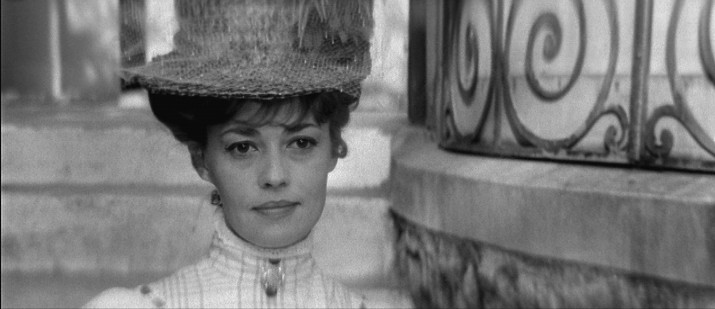
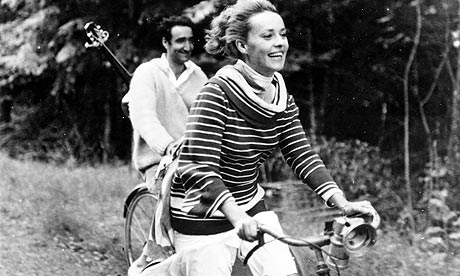
that starts in 1916 and falls just short of World War II and tells the story of a menage a trois that can't be managed by the partcipants. Jules and Jim (Oskar Werner, Henri Serre) are two life-long friends, whose friednship is complicated by war and the woman, Catherine (Jeanne Moreau) who comes between them. Their bohemian life-style flaunts society's more's, but living without rules means walking an imaginary line while drunk—even if you knew where you were going, you're unsure of how to get there.

The two boy-men (one French, one Austrian, which makes things difficult during the First World War) live an apparently work-free life pursuing art, until they encounter a Greek statue with a magnetic smile—on a whim they seek it out—
only to see it appear in the flesh on Catherine. Both men are drawn to her, but Jules—the one unlucky in love—wins her, while the non-committal Jim hangs back and observes and, as always, bides his time.

He observes, but he doesn't see.
Catherine is fascinating, but there's a shadow to that smile. She lives in the moment, and her mood can swing with the wind. She carries vitriol (sulfuric acid) for "lying eyes." And it's too soon in the relationship for him to make anything of the fact that she catches her dress on fire while burning love letters. Jim snuffs it out before there can be a complete "Bonfire of the Vanities."

On one of their excursions, Catherine dresses in men's clothing and
draws on a moustache. On this particular outing, she will be a man, living a man's life. But she's already doing it, making her rules, living by them and chucking them when they restrict her, the men following her because they can't keep up with her instincts. It will intensify when she marries Jules after the war, becoming the dominant one in the marriage, Jules almost slavishly putting up with her infidelities, brought on by the yoke of motherhood. For all the perfect happiness they seek outside of conformity, they end up perfectly miserable, and when Jim and Catherine begin an affair, something psychic snaps.

For being a part of the French "New Wave," it is very much a cautionary tale (taken from the novel by
Henri-Pierre Roché), old-fashioned in its insights warning of the dangers of an unconventional life-style.* Made on a limited budget, but with a large scope, Truffaut makes use of news-reels and other period chronicles (and movie-tropes like irises and wipes) to create a multi-media presentation of the period, and Truffaut starts his movie hyper-kinetically to show the puppyishness of youth, then gradually tapers the speed off to show the arc of a love affair and a life.

That arc has only one way to go, and it leaves all three adrift: Jim, his choices taken away from him, Catherine, her freedom from her, and Jules loses the captains of his fate.

Un sourire peut enchanter mais également séduire. Prenez l'attention.

* And, "of course," the woman is "the problem," but she is also the driving force—the vitality—that informs the lives of two rootless and feckless men.