Showing posts with label 1966. Show all posts

Tuesday, October 29, 2013

Incubus (1966)

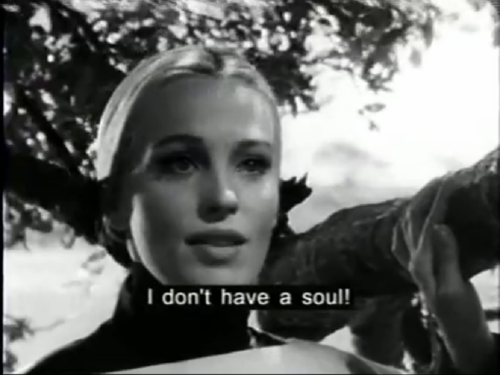
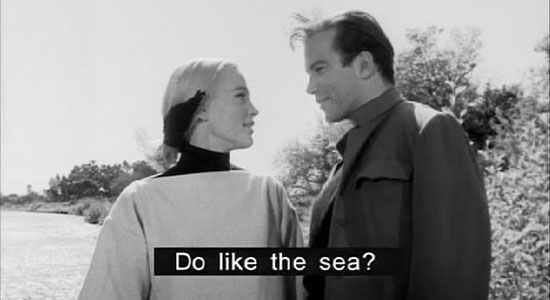
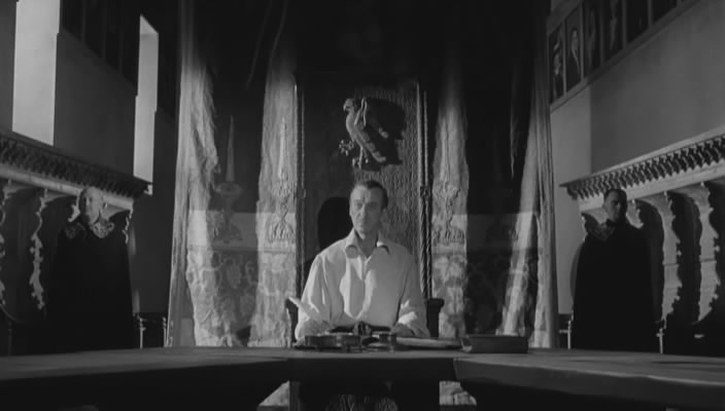
Incubus (Leslie Stevens, 1966) A quick view of Incubus brings up two oddities: 1) it's famously filmed in Esperanto (to give it a more cultured air—it was filmed near Big Sur in California—and it also obfuscated any questions about the script when getting permission to film at a local mission, as nobody could read it; and 2) it looks like it's an episode of "The Outer Limits," albeit with satanic leanings and some implied sexuality about it.  Facts are, it is very much in the "Limits" area, directed by the show's creator Stevens, and employing cinematographer Conrad Hall and composer Dominick Frontiere from the series.  

It also follows a typical "Limits" template, with a voice-over telling us we're in the village of Nomen Tuum (where the mayor is "Lorem Ipsum," I think) where, legend has it, there's a well that's a fountain of youth, curing all ills, and restoring beauty.  The rich and vain are attracted to Nomen Tuum to "test the waters," as it were, and thus are easy prey for a coven of satanic succubi who do that voodoo they do nearby.  The movie demonstrates with a drunken victim, lured by one of its members, Kia* (the alluring Allyson Ames, who was to become the third Mrs. Stevens) to the ocean, where she drowns him and is quite proud of it.  She tells the coven's leader Amael (Eloise Hardt) that just dragging lustful men to their deaths isn't very challenging so her next target must be a man of faith and strong will.  
Incubus came out the same year as Bergman's Persona.
I'd say "great directors think alike," but...
They choose war veteran Marc (William Shatner), who lives with his sister, Armdis (Ann Atmar), who lives down the road apiece on a farm that doesn't appear to grow anything, but where there's plenty of wood to chop. Kia wanders by, saying she's lost and Marc, nice guy that he is, offers to take her back, but not before the three discuss the fact that there's going to be an eclipse ...why, in mere moments!  Despite being warned by Marc that you could burn your eyes by looking directly at one, sister Arndis does it anyway just as Marc and Kia go wandering back to wherever Kia thinks she came from. This affords some shots of Arndis flailing around the farm, calling for Marc, while Kia attempts to seduce him and drag him down to the ocean.  Marc is all too willing to be seduced, but insists that they be married in the eyes of God before any further hanky-panky occurs ("hanky-panky" doesn't translate well in esperanto).

A visit to the nearby mission doesn't go so well, as Kia panics seeing crucifixes, religious statues, pews, and holy water, leaving Marc to wonder if she might be Unitarian, or something.  Then Arndis stumbles in, saying the darkened church makes her eyes feel better, and that sub-plot goes away.


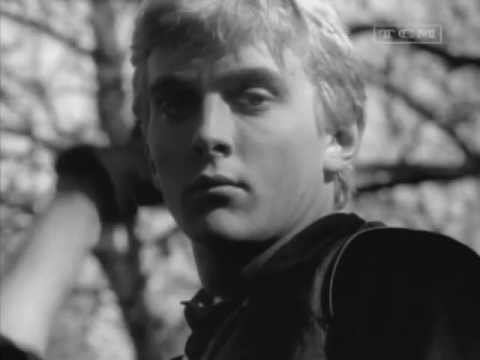
But Kia decides that she wants revenge on Marc and so she and Amael call up an incubus (Milos Milos), who arrives writhing and muddy from out of the ground, and then things just go horribly, horribly wrong, both for Marc, Armdis and for the movie: Marc gets attacked, their farm is burned down, Armdis gets incubussed, and the movie gets padded with people roving around in the dark from the house to the mission to wherever the succubi go beddie-bye.  Stevens could make the slimmest of ideas stretch for 50 minutes on television, but here, there's a bit of padding that has more to do with atmospherics than it does with showing off the locations.  Done at a minimal budget, with just enough artiness to sell to Europe, and just enough suggested sex and horror to try and sell to the drive-in crowd seeing the horror films of Corman and Hammer, Incubus never lived up to its creators' expectations, receiving next to no exposure in the States, and was considered lost until a sub-titled copy was found in Paris—it's why the subtitles are burned in with a black background, obscuring the picture, but also the French sub-titles.   The film's at its best when "suggesting" (in the first half) and at its worst having to pay off the conceits (in the second half).  


And it's always fun to watch Shatner, here mere weeks before starting work on the original "Star Trek" television series.  One moment that makes me laugh is his speaking esperanto (which he does competently—Shatner is Shatner in any language) and feeling the need to gesture like an Italian.  It has its moments, though: flashes where you see something and then hit the remote to see if that was what you thought it was—for moments both perverse and absurd.


"Could we put a key-light right across the eyes?  Ya know, make it more dramatic?"


* pronounced Kye'-a, not Kee'-a (like the car).

Saturday, October 26, 2013

Eye of the Devil

Eye of the Devil (aka 13, J. Lee Thompson et al., 1966)
Going in cold to Eye of the Devil—its end-credits say that "13" is presented by M-G-M and that was the name of it when released in Europe—you wonder what were the filmmakers trying to achieve.  A great cast, with a middling occult story (although the dialogue is a bit "highfalutin'"), a rather amazing location in the Chateau de Hautefort, undercut by direction that one can only describe as "odd" and off-kilter, and editing that follows a particular beat for no apparent reason, then when it comes to shock moments, cuts away just too soon, so that one can't register what they're seeing.  Eye of the Devil is frustrating on very many levels

But probably more for the producer.  More on that later.  First, the film.


You start off watching the film by asking the question "why does Deborah Kerr have two children under the age of six?"  It was physically possible, of course (she was 45 at the time of filming), it's just that...well, in movie terms* it doesn't quite skew.  Then, the editing has an odd rhythm, allowing you to hear all the words people are saying, of course, but the natural beats are slightly "off." The camera glides along, cat-like, and BOOM there's an edit that feels uncomfortable or unnecessary given what's transpiring on-screen.


Things unravel as the mysteries deepen and people start to do "movie-logic" things.  For example, David Niven's marquis Phillipe de Montfaucon is called away at a dinner party; it seems the vineyards at his estate are dying and he must make one of his infrequent trips to the old stomping grounds of Bellenac. He explicitly tells his wife Catherine (Kerr) to keep the home fires burning while he goes to tend to things. Trusting him implicitly, she bundles up the kids and drives all the way out there, where she is greeted with all the welcome you'd give to a burning bag of poop at the front door.

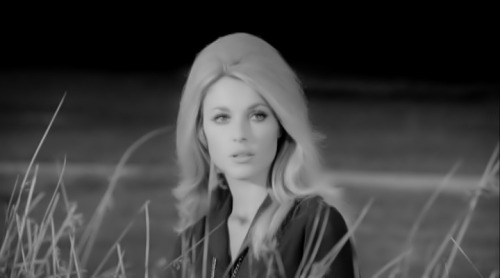
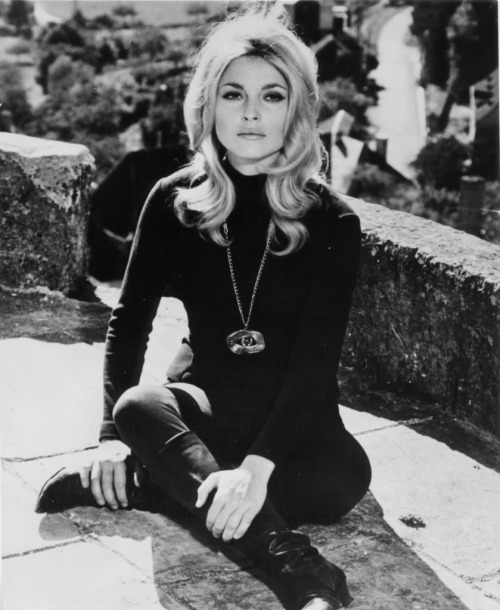
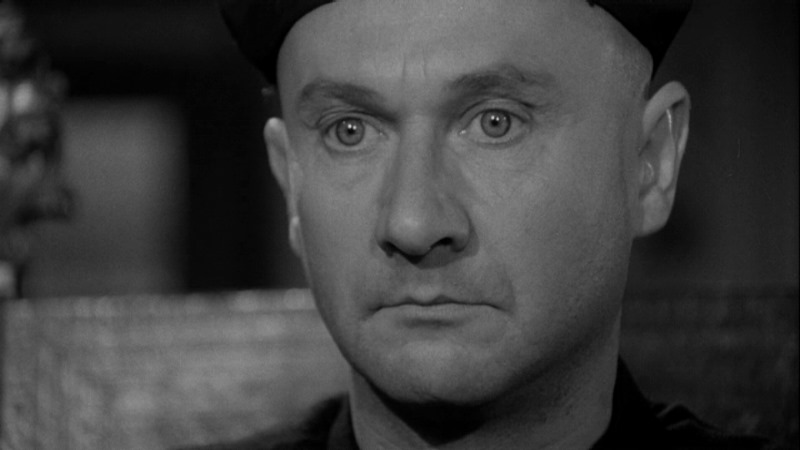
Phillipe's Aunt Estell (the wonderful Flora Robson) is outward-smiles, but suggests that things are fine (dear), why don't you go home?  Then, there are the strange kids hanging around, Christian and Odille de Caray (David Hemmings and "introducing" Sharon Tate, dubbed).  Christian thinks nothing of bow-skewing a dove in front of the wife and kids and Odile is all heavily-made-up blond-thing-in-a-black-catsuit (Were they able to watch "The Avengers" in Bellenac?).  Then, there's the unwelcome presence of Father Dominic (Donald Pleasence, whose name rhymes with "unwelcome presence," especially in the 1960's), who has the gaze of a psycho and looks like if he ran out of wine, he'd skip a step in the Mass and just serve blood to the parishioners, instead.  Plus, Mrs. de Montfaucon has creeping "Rebecca" disease, where the uneasy mistress of the house can't stop poking around all the dark corners and shuttered rooms of the castle.  One night, she finds a conclave of robed visitors surrounding her husband in a circle, and frightened, she runs into a mysterious man who tells her to go far, far from here.


Does she?  Nope.  Not even when the kids are encouraged to play near the edge of the castle's high parapets by Odile, not when she is nearly sent over the edge herself, and not when she decides to take an impromptu trip to the family mausoleum and finds herself surrounded by those 12 hooded...who-evers.  She doesn't get a clue when she finds the word "DEMON" chiseled into the mausoleum's wall.


It's a mess of a film, trying to emulate the Hammer style of occultish films—long entrance to the story, heavy atmospherics, and heaving starlets—and it probably would have been this messy even with the original players.  The first director attached was Michael Anderson, then Sidney J. Furie (probably where a lot of the confusion came in, even though it worked well with The Ipcress File), then, briefly Arthur Hiller, then J. Lee Thompson came in to pick up the pieces.  When filming started, the cast was in place, but Kim Novak was playing the role of Niven's suspicious wife, and left the production weeks into filming.**  Kerr was quickly hired and any frame involving Novak had to be re-shot.  There's only so much work-around you can do, and that's why Eye of the Devil looks so odd in presentation.  It's a patch-work affair with a good cast and good intentions, but a Frankenstein monster of a script and a completion cut. 

Maybe it belongs in the "Horror" category, after all.


No, really, honey, what was your first clue?


* And when I say "movie terms" I mean the ageist and sexist tropes that go along with film entertainment (and not just Hollywood, folks)—that an older woman can't have younger children, or that older men can't have wives that are older than, say, 20.  Or that older film stars can have mothers who are two years older (or younger) than they are

** "Creative differences."  Let's call it that.  It was explained away as a back injury from a horse riding scene (Novak is an excellent equestrian and lives with her vet-husband on a horse ranch these days) for insurance purposes.  These things are always "he said/she said." Kim Novak is an extremely talented actor, who manages to make the most of material, good, bad and indifferent.  She was particular in how she wanted to come across on-camera for the character and that could rankle the front office.  But, it is also tough to negotiate the "boy's club" of the picture making industry, and if you want to take control at all, you're considered "difficult."  I'm sure that leaving the production was a difficult decision.  I found this interesting web-site that tells the changing story.  

Wednesday, August 24, 2011

The Spy Who Came In From the Cold

The Spy Who Came In From the Cold (Martin Ritt, 1965) With the antcipation of the Christmas release of a film version of Tinker Tailor Soldier Spy, it would do well to revisit the world of George Smiley, "Control," and the duplicity of John le Carré's "kitchen-sink" version of spies.  They're background characters in The Spy..., the focus being operative Alec Leamas (Richard Burton) former head of the West Berlin branch of "The Circus," who must go behind enemy lines—one of the toughest of them, the Berlin Wall—as a potential "mole"* to ferret out who might be a double agent for the Soviets, responsible for the death of one of Leamas' agents.

His identity is kept the same—The Circus wants Leamas and his background history out in the open—but he is demoted in rank and stature, and, depressed and drinking heavily, he becomes bait for Soviet recruitment to betray information.  That's the mission, become a decoy on the "inside," another "double" feeding the Soviets false information, while trying to find out if there's a player on the other side in The Circus feeding information to the Russians.** 

Oh, what a tangled web the Cold War weaves.

Taken to East Berlin, Leamas is interrogated by a suspicious Russian administrator named Fiedler (
Oskar Werner) who (rightly) suspects Leamas of being a "plant."  Fiedler suspects a British "mole" already underground in the Soviet service and so sweats Leamas for any information to discover who that might be.  Ultimately, Leamas is undone by what so many of LeCarre's heroes or anti-heroes are susceptible to, the warmth of human contact—a failing that trips up a lot of the author's protagonists.  Leamas "comes out of the cold," the world of spies, and his friends, relations or lovers—the thread of decency and honesty they provide—are used against him.

For the fact of the matter is the Spymasters of "The Circus" are cold-hearted bastards ("without sympathy" as "Control," played by
Cyril Cusack, ponders)—they have to be to combat their enemies—and they're just as capable of betraying their own as those they fight. 

Case in point: George Smiley (played here by
Rupert Davies).  He would become le Carré's most celebrated character, but here he's a bit of a functionary, and he's just as cold-hearted as the rest.  In the "Tinker, Tailor..." timeline, "Control" was long since dead, having been driven out by "the new broom" from his station, which had left him suspicious and paranoid (ultimately with good reason) with Smiley his only trusted colleague.  When the BBC made a television mini-series of the book, Smiley was famously played by Sir Alec Guinness and (as le Carré amusingly notes in his new forward to "Tinker, Tailor...," because of that he "lost control" of the character.  But Smiley (however sympathetically Guinness played him) is also a "cold-hearted bastard"—if he wasn't, he wouldn't have lost the vital clue that was exploited by his enemies.  He gives as bad as he gets, and, even at his most triumphant, takes little joy in what he does.

In such a world, Ritt's direction is entirely appropriate—low-key, almost documentary in feel on the streets of London—in drab black-and-white, not the high-contrast color of other spy films of the era.  There is nothing glamorous about it, and plays out slowly and subtley—in fact, after a de-briefing by his boss, the shift in tone is so dreary one suspects one is watching a different film.  It is part and parcel of the subterfuge—it works on us as it does for Leamas' Sov' recruiters (most prominently
Michael Hordern).

And the script, now there's an interesting tale.  A beginning draft was written by Hollywood veteran
Guy Trosper, who died subsequently.  Taking over was poet-playwright Paul Dehn.  Dehn had written the final polish on the James Bond spy film Goldfinger (amusingly, as the two film could not be more polar opposite), and was the mainstay-writer for the "Planet of the Apes" sequels.  But, Dehn knew the world of spies well—during the second World War, Major Paul Dehn was the "Political Warfare" officer at the BSC training headquarters "Camp X" (where among the trainees were Roald Dahl and Bond creator Ian Fleming).***  Dehn was well-versed in spycraft, deceit, and keeping secrets and his distillation of le Carré's novel brings the moral duplicity to the fore, while keeping the audience guessing on whose side is whom.

If the film has one flaw, it is the casting of Burton as Leamas.  Burton was too good, too charismatic an actor/star to play a functionary like Leamas (it's about the same as "buying"
Sean Connery as a spy (which was part of the joke of the Bond series)—he's someone you'd notice walking into a room, and thus, hardly spy material.  But, Burton's presence, no doubt, got the film made, so the point is a bit moot.  Still, if its ideas and mysteries of the State and the heart you want more than action and fireballs (shall we say if you want to be "stirred and not shaken?"), The Spy Who Came in From the Cold is a fine, bracing tonic.


Davies as George Smiley in The Spy...


...and Guinness in the BBC-TV Tinker, Tailor...


Gary Oldman: "this year's" Smiley


* The term "mole" is a le Carré invention—his spy-circles code-name for a double agent hiding in plain sight within one of the other spy agencies, Soviet or british, and relaying information to "the other side."

** There has been a rich history of double agents throughout the annals of spydom, the most significant of which were "The Cambridge Five"—Kim Philby, Donald Duart Maclean, Guy Burgess, Anthony Blunt, and a fifth (and possibly more)—who'd been recruited during their college years, passed information to the Russians during WWII, and subsequently during the post-War years through the early 1950's.  "Tinker, Tailor, Soldier, Spy" (and the other two of the le Carré "Karla" novels) and le Carré's subsequent "A Perfect Spy" are inspired by "The Five" and their Russian puppet-master.

*** And, interestingly, one of the people who asked, and was briefly considered, to run Camp X...was Kim Philby!


Wednesday, April 14, 2010

Seconds

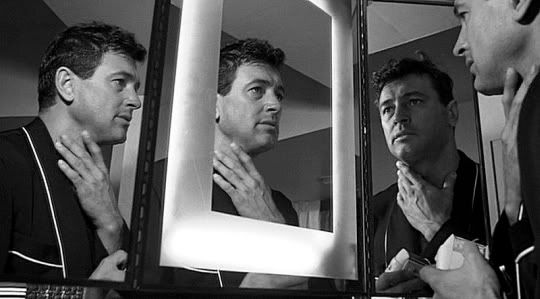
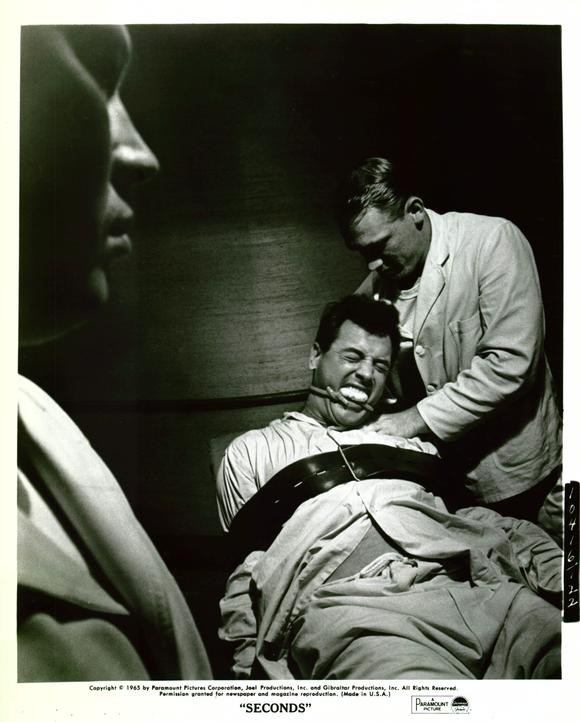
"Seconds" (John Frankenheimer, 1966) Post "Star Wars," science fiction films have been pretty cookie-cutter—fleet-ships, a Hero with a Thousand Names, odd plasticized bi-ped creatures in supporting roles. Science Fiction used to be about concepts, and technology was just an aspect of futurism. That's why to see "Seconds" is still a thrilling experience, as it calls to mind a feature-length, subtler "Twilight Zone" episode,* that takes an idea and turns it around in its hand, exploring the angles...and the consequences.

Bank executive Arthur Hamilton (
John Randolph) is receiving mysterious phone-calls from someone who claims to be an old friend but doesn't sound like him. A note is slipped into his hand as he enters the subway, and upon further exploration (and prompting) learns that he is being offered a second chance in life. The anonymous corporation will transform him with plastic surgery (even replacing his finger-prints) and an exercise regimen, while setting up a planned "accident" with an unrecognizable "similar body-type" to explain his absence. To the world, he will die, but he'll be resurrected as a new man, with a new life, in a new community—everything re-arranged neatly and clinically.

From the ashes of Arthur Hamilton will emerge Antiochus Wilson (Rock Hudson), bohemian painter. "Wilson" makes a go of his second chance, but he's still the man he used to be inside, and he struggles internally with his new choices...and the ones he left behind. Changing his mind becomes the greatest challenge.

Filmed in black and white—
this film would have been over-powering and kinda ugly in color—by the master cinematographer James Wong Howe (with assistance by John A. Alonzo), "Seconds" is filmed in disorienting tight close-ups, and with unnerving wide-angle lenses that contort, bend and mold the right-angles of life into constricting prisons. The helter-skelter editing of David Newhouse and Ferris Webster keeps the viewer from becoming complacent, and Jerry Goldsmith's bizarre discomiting score only adds to the unease.

This is Hudson's best role—if you're like me and aren't into rom-com's—and his best movie. But it's contradictorily a one-sided performance—there's not an awful lot of joy (I think that may be the point), and he's unsure, disoriented or drunk throughout most of it. And, as Frankenheimer says in his commentary, he really worked hard in this role...especially towards the end.

One should also be aware that in one scene in the corporation's stark "briefing room," the cast is comprised of
Randolph, Will Geer (he's especially creepy in this role, while being his most benevolent) and Jeff Corey—all "brethren" in the secret society of blacklisted actors.

This version of "
Seconds" is not the one released in the States in 1966. A disorienting wine-making festival sequence with pre-hippie free-thinkers orgiastically stomping grapes in the buff was deemed too risque for its release (and Hudson wasn't comfortable with the sequence, as is evident in his performance), but it has been restored for the DVD release.

It's still an affecting film, even now, over 40 years later, a cautionary time-capsule of that era when the concerns of the speculative writer was society and not space-ships. Somtimes, fantasies have a nasty habit of becoming nightmares.


* Director Frankenheimer worked in the Golden Age of Live Television and worked with Rod Serling, pre-TZ, and post-TZ—Serling wrote the script for Frankenheimer's "Seven Days in May."

Wednesday, September 30, 2009

Olde Review: Closely Watched Trains

This was part of a series of reviews of the ASUW Film series back in the '70's. Except for some punctuation, I haven't changed anything from the way it was presented, giving the snarky, clueless kid I was back in the '70's a break. Any stray thoughts and updates I've included with the inevitable asterisked post-scripts.

This Friday's films in 130 Kane Hall at 7:30pm are "Closely Watched Trains" and "Lacombe, Lucien."

"Closely Watched Trains" aka "Ostre sledované vlaky" (Jirí Menzel, 1966) "Closely Watched Trains" is a wry, sometimes hysterical Czech film by Jiri Menzel, a person you've probably never heard of and have already forgotten.* It tells the story of Miloš Hrma, an insignificant young man in the scope of WWII, whose father was retired at 48 and now spends his day lying around and keeping track of the comings and goings of the train. Another relative was a hypnotist and a couple years back, he tried his skills on an advancing Nazi tanke-gruppe and was promptly crushed to a pulp (I am telling you this because there is no way in Hell that you'll be able to read the sub-titles in the opening minutes).** These are only two examples of Menzel's comedy-of-errors style of telling his story.

Menzel takes little incidents of the story of MiloÅ¡'s work-a-day situation standing at the train platform—a job he wanted "just so he could strut on the platform." And his stories are sometimes hilariously satirical (for an example, there is an hysterical look at a town Nazi explaining the war situation and in a blase manner explaining that withdrawals from the American forces are such wonderful tactical maneuvers). Sometimes (most of the time), the stories are very ribald; one of the sub-plots is MiloÅ¡'s constant failure with women, which, in context with the habits of a fellow platform-strutter, makes him turn to a suicide attempt in a dilapidated hotel. The hotel is being worked over by a fellow with a pile-driver. In this scene what is going to happen—how the two will intersect—is very apparent, but the sequence's effect is that it displaces the humor of the situation (which passed with the audience's first realization of what, inevitably, will happen) with suspense. Will it happen before MiloÅ¡ is dead? It's an effective sequence because it anticipates viewer reaction and changes it to the further effect of the film.

In the last half-hour, Miloš is used like a pawn in a chess game in an attempt to head off a Nazi munitions train. It's outcome is consistent with the rest of the film, but there is no sense of real tragedy at the end, more an explosion of fulfillment. You may find "
Closely Watched Trains" a very entertaining film.

Just a reminder (he said, slapping his forehead with his palm) I wrote this back in February 1977, and, although sorely tempted, I didn't change anything besides punctuation (and had to get fairly creative with that!). "Closely Watched Trains" won the Oscar for Best Foreign Film in 1968, and is one of three films I remember most fondly from the Winter ASUW series—the other two being "Hari-Kiri" and "Il Posto"—"Trains" probably because it's crack comic timing reminded me of my beloved Warner Brothers cartoons, with a dash (a mad dash!) of Buster Keaton thrown in for good measure. And the comedy came from character, not from out of the blue.

This review is more than thirty years old, but it's heartening—in fact, a bit miraculous—that Jiri Menzel is still making movies, his last being "
I Served the King of England," which was also about young professionals learning their craft to uproarious results.


* This was near the end of the series and I was getting a bit punchy by this time, but that's no excuse for insulting the audience that one is trying to "encourage" to go see a film.

** As I recall they were "white-on-white" and virtually indecipherable. Criterion has put out the DVD of "Closely Watched Trains" and they're more scrupulous in their translations and making sure that they're legible. Criterion is a great DVD publisher.

Saturday, September 20, 2008

Batman (1966)

"Batman" (Leslie H. Martinson, 1966) The success of the "Batman" TV-show spurred 20th Century Fox (still reeling from project cost-overruns) to create a full-length motion picture teaming Batman (Adam West) and Robin (Burt Ward) against a phalanx of dastardly desperadoes--the Joker (Ceasar Romero), Catwoman Lee Merriwether, subbing for the absent Julie Newmar), The Penguin (Burgess Meredith), and The Riddler (Frank Gorshin). The plot is some nonsense about de-hydrating U.N. officials down to dust and holding them for ransom. Ambassador-jerking-plot aside, there are three new Bat-vehicles (the -Copter, -Boat and -Cycle) to gawk at, there is just enough wit in the script so you know that no one's taking this too seriously, if at all. And if things aren't as tight or as pointedly comic-satiric as they were on the show's first season, well, whatever. It's still colorful, West still treads that dangerous razor's edge of serious/camp ("Some days, you just can't get rid of a bomb!") without going too far over the top.*

The villains basically play their roles at top-volume without much range (although
Burgess Meredith's FDR/Popeye blend for The Penguin is a stitch *Waugh!*), with the exception of the truly bi-polar performance of Frank Gorshin as the Riddler, practically quivering with psychosis.

One has to acknowledge that if this version of Batman and his villains hadn't been so iconic, film-makers wouldn't have needed to brainstorm so long and hard to come up with a Bat-antidote for the movie versions.

* It's still amazing to see West fill this role with mock-humor. Can you imagine how stuck-in-first this show would be if second-choice Lyle Waggoner had won the role?


Holy Love-Boat, Batman! Everybody's "D-List!"
The percursors to Danny DeVito, Jim Carrey, Michelle Pfeiffer and Jack Nicholson/Heath Ledger


Tuesday, April 8, 2008

How to Steal a Million

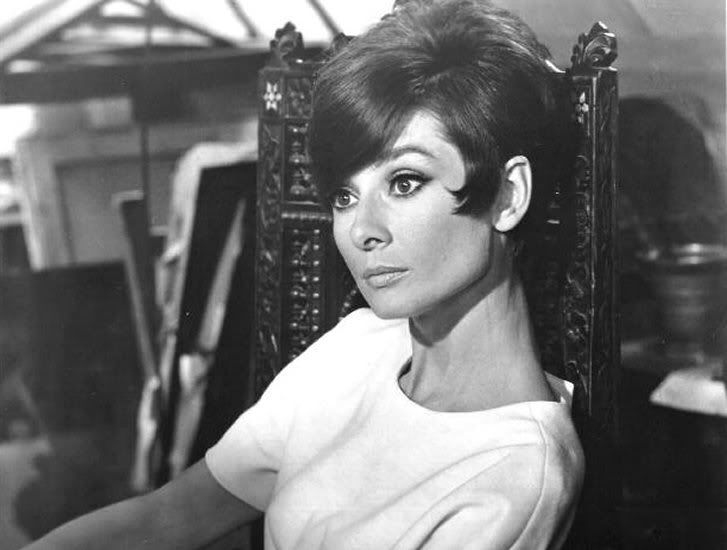
"How to Steal a Million" (William Wyler, 1966) Audrey Hepburn, all Givenchy'd up and no place to go, with her "Roman Holiday" director, William Wyler. Now the locale is Paris--the exteriors, at least--and the slim plot revolves around Hepburn securing the services of an art thief (Peter O'Toole--committed, but aloof) to break into a National Gallery to nab a statue (created by her forger-father) before the insurance company can examine it and expose it as a fraud. It takes about an hour of cute dialogue, spry encounters, several costume changes and an incident of "meet-cute" before we get there. The rest of the movie documents the long, drawn-out robbery which relies on false alarms--and we see all of them. There is magnetism involved, but not among the principal actors--Hepburn pirouettes in her own spotlight, and O'Toole observes, amused. Wyler, on the other hand, is content to make sure we see how expansive the sets are, like he was still filming "Ben-Hur." Those sets, however, never seem more than nattily-dressed cavernous soundstages (his next film would be the equally leaden "Funny Girl"). It's a trifle, with all the consistency of just-applied meringue, and with as much confectioner's sugar.