Showing posts with label John Frankenheimer. Show all posts

Wednesday, April 14, 2010

Seconds

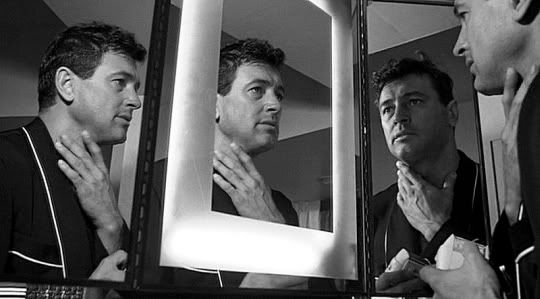
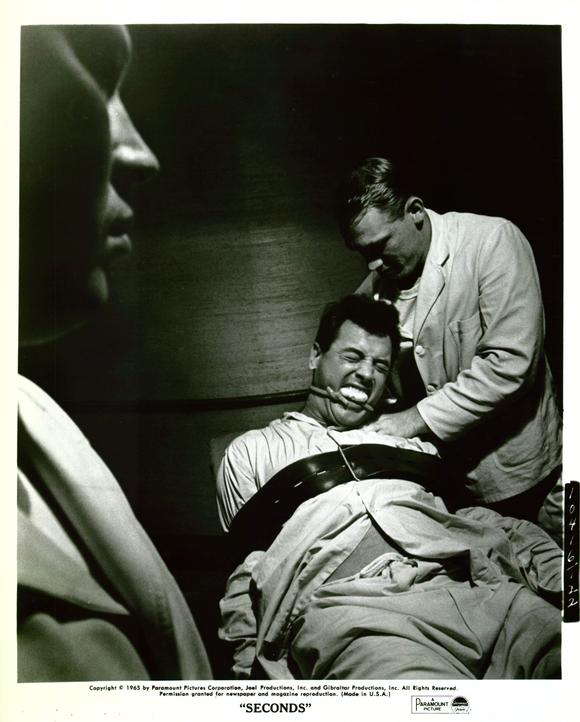
"Seconds" (John Frankenheimer, 1966) Post "Star Wars," science fiction films have been pretty cookie-cutter—fleet-ships, a Hero with a Thousand Names, odd plasticized bi-ped creatures in supporting roles. Science Fiction used to be about concepts, and technology was just an aspect of futurism. That's why to see "Seconds" is still a thrilling experience, as it calls to mind a feature-length, subtler "Twilight Zone" episode,* that takes an idea and turns it around in its hand, exploring the angles...and the consequences.

Bank executive Arthur Hamilton (
John Randolph) is receiving mysterious phone-calls from someone who claims to be an old friend but doesn't sound like him. A note is slipped into his hand as he enters the subway, and upon further exploration (and prompting) learns that he is being offered a second chance in life. The anonymous corporation will transform him with plastic surgery (even replacing his finger-prints) and an exercise regimen, while setting up a planned "accident" with an unrecognizable "similar body-type" to explain his absence. To the world, he will die, but he'll be resurrected as a new man, with a new life, in a new community—everything re-arranged neatly and clinically.

From the ashes of Arthur Hamilton will emerge Antiochus Wilson (Rock Hudson), bohemian painter. "Wilson" makes a go of his second chance, but he's still the man he used to be inside, and he struggles internally with his new choices...and the ones he left behind. Changing his mind becomes the greatest challenge.

Filmed in black and white—
this film would have been over-powering and kinda ugly in color—by the master cinematographer James Wong Howe (with assistance by John A. Alonzo), "Seconds" is filmed in disorienting tight close-ups, and with unnerving wide-angle lenses that contort, bend and mold the right-angles of life into constricting prisons. The helter-skelter editing of David Newhouse and Ferris Webster keeps the viewer from becoming complacent, and Jerry Goldsmith's bizarre discomiting score only adds to the unease.

This is Hudson's best role—if you're like me and aren't into rom-com's—and his best movie. But it's contradictorily a one-sided performance—there's not an awful lot of joy (I think that may be the point), and he's unsure, disoriented or drunk throughout most of it. And, as Frankenheimer says in his commentary, he really worked hard in this role...especially towards the end.

One should also be aware that in one scene in the corporation's stark "briefing room," the cast is comprised of
Randolph, Will Geer (he's especially creepy in this role, while being his most benevolent) and Jeff Corey—all "brethren" in the secret society of blacklisted actors.

This version of "
Seconds" is not the one released in the States in 1966. A disorienting wine-making festival sequence with pre-hippie free-thinkers orgiastically stomping grapes in the buff was deemed too risque for its release (and Hudson wasn't comfortable with the sequence, as is evident in his performance), but it has been restored for the DVD release.

It's still an affecting film, even now, over 40 years later, a cautionary time-capsule of that era when the concerns of the speculative writer was society and not space-ships. Somtimes, fantasies have a nasty habit of becoming nightmares.


* Director Frankenheimer worked in the Golden Age of Live Television and worked with Rod Serling, pre-TZ, and post-TZ—Serling wrote the script for Frankenheimer's "Seven Days in May."

Friday, May 30, 2008

Olde Review: French Connection II

This was written November 5, 1975

"French Connection II" (John Frankenheimer, 1975) Fortunately, Friedkin's original "The French Connection" was on television last week, so that I was able to refresh my memory somewhat, as to what was there. As FCII is a sequel, it begs to be compared with its parent film. There isn't much difference alphabetically between Friedkin and Frankenheimer, but they are night and day on the screen. Friedkin in FCI punched the viewer with his action and cutting and forced people to crawl over the backs of their chairs because of it. Frankenheimer ain't no slouch, either, as one can see by his sequence on the Marseilles docks (I wasn't on the edge of my seat, but I was flinching a lot), or "Popeye" Doyle's (Gene Hackman) final chase down of "Frog One" Alain Charnier (Fernando Rey).

But Frankenheimer has a different emphasis in his film. Friedkin's characters are one-dimensional. Even the most fleshed-out character, Doyle, is reduced to quirks: his fetish for boots, his gun holster on his ankle, his "Didja ever pick your feet in Poughkeepsie?" line of questioning. Not so with Frankenheimer. He doesn't dwell on these (why should he, they've been done?), but fleshes them out. "Popeye," a stranger in a strange land, is reduced to having a drink with the only person who weill, the bartender. A sympathy develops for him that was never attained in TFC (just as their was a twinge of disappointment when TFC's famous car-chase ended, so I felt a twinge, again, when Hackman's "cold turkey" scene with Bernard Fresson, where a pitiful "Popeye" talks about his Catholic upbringing and sports--just one of those moments that are instanatly identifiable as "great.") Friedkin's people were there to be "blown away," an excuse for instant action, but Frankenheimer in most cases drags out the killing, allowing the viewer to get to know who's who before they're gone-gone.

Even the subject matter of the films reflect their directors. "The French Connection" was a pursuit film. We knew that "Frog One" was dealing in heroin, but heroin was an abstract term--it was bought and sold like candy--and Charnier could be afforded a little grudging admiration for his plot. Not so with Frankenheimer. In "French Connection II" heroin is no longer just a word. It's effects, its evil, is clearly displayed on the screen in vivid detail. Frankenheimer is a "feeling" director. Even Cathleen Nesbitt's "little old lady" is given sympathy by showing her a sweet, frail little thing, abansoned by her family, and then showing her gnarled hands, decimated arms and thieving habits.

Friedkin was action, with little heroics that weren't bordering on the obsessed. In FCII, even though battling for his life "Popeye" Doyle still has the time to try to save Barthelemy from drowning after being konked by a timber. When actions are obsessive and excessive (as in "Popeye" burning down the Hotel Del C______., as was his elevated train chase). Frankenheimer has the mind to show it as such by using a device common to Houston and Altman--by enveloping his subject in flame. The images that stick in my mind from this film are the ones that evoked a feeling in me from Frankenheimer's "feeling" direction--the ones already mentioned, Barthelemy's look of concern outside a locked door for that irritatinf foreigner jabbering inside the cell as he goes through withdrawal, the agnoy of stiffened limbs that is tangible to the viewer as "Popeye" tries to chin up, push-up, sit-up or jog. Oh, it is to be admired and appreciated.

Thursday, April 10, 2008

Ronin

"Ronin" (John Frankenheimer, 1998) John Frankenheimer's long directorial career started out with him as a young television "turk," who wasn't afraid to be controversial or veer into the surreal. Early works like "The Manchurian Candidate" (the earlier, better one), "Seven Days in May" and "Seconds" (Rock Hudson's finest hour) showed a film-maker not afraid to tackle political and social issues in an entertaining, often satirical way. He'd veer off into odd territory like "Grand Prix," and "The Gypsy Moths," where the indifferent material would win out over his film-making expertise. The films would be a technical marvel, but descend into soap-opera when not behind the wheel, or falling through space. On ocassion, he'd even hit the skids ("Prophecy," "The Extraordinary Seaman," "99 and 44/100% Dead"). But then, there are his thrillers, like "Black Sunday," and even "French Connection II" (which had Gene Hackman's "Popeye" Doyle in France to track "Frog One") that in their final acts are primers on how to stage chases and action finale's--bare-boned, fast-paced and visceral. "Ronin" was like an entire final act--lean and mean, with no fancy motivations and cryptic dialogue. Even the point is obscure--it is never established what is in that suitcase that everybody wants, nor does it matter. They just want it, and are willing to plot, and double-cross and double-deal to get it. The characterizations are on the thin side--people just have their jobs to do, and their marks and targets to hit. And the cast is superb. Robert DeNiro, Jean Reno, Sean Bean, Natascha McElhone (where's she been?), Stellan Skarsgard, Michael Lonsdale, and Jonathan Pryce, all doing professional, unsentimental work. The set-pieces are amazing, especially a car chase through the Paris tunnels. But just as much care goes into the staging of the planing. If anybody wants to see how the "Mission:Impossible" franchise should be done, this movie is the model.