Ice Station Zebra(John Sturges, 1968) The movie that was (supposedly) Howard Hughes' favorite movie—one that he would watch obsessively. One can only wonder why. It is not exactly inspired, entertainment, though competently directed by John Sturges. It was also one of the last of the prestigious "roadshow" presentations , shot in "Super-Panavison-70" and featuring "Overture" music and an Intermission at the theater. But, beyond that, the film may be one of the dullest thrillers ever filmed. ISZ has the same stolid air of other adaptations of Alistair MacLean adventure yarns (The Guns of Navarone, Where Eagles Dare). It's just not as adventurous, and the locations—studio-created—are claustrophobic and closed-in, as opposed to having any dramatic vistas or intriguing locales of other MacLean stories. Here, it's meeting rooms, a submarine and a burned out polar station on a floating ice flow. People don't get out much, and the whole film feels close and boxed-in (quite a trick in "Super-Panavision-70). Oh, there are intrigues—it wouldn't be a MacLean story if there wasn't one or two double-crosses thrown in—but they're fairly typical. The sub' has to have a debilitating leak, and as befitting a Cold War drama (the coldest!), there are dueling loyalties and the to-be-expected double-agent (but who?). It never rises above the slightly edgy to the exciting and is mostly cliché-ridden, especially when it comes to the "whodunnit" aspects. Fairly good cast with not much to do except glower at each other, and top-liner Rock Hudson isn't at his best at that, and is ham-strung by the script (by MacLean, Douglas Hayes—he wrote Kitten with a Whip, after all—Harry Julian Fink, and W.R. Burnett, no slouches, any of them) from doing anything interesting, like humor. Patrick McGoohan has one interesting scene where he loses it, but mostly he's clipped and acerbic in hyper-Danger-Man mode. Jim Brown matches him frown for frown—twin performances by actors playing characters hating each other, and Ernest Borgnine does a Russian accent. A lot of testosterone, mostly going to waste, in material which is stretched to the breaking point. Supposedly there's going to be a remake, so there's a lot of room for improvement.
Patrick McGoohan recreates my expression watching this movie
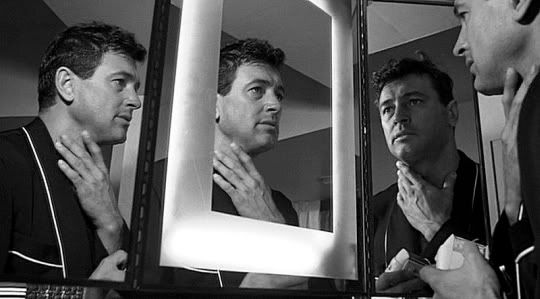
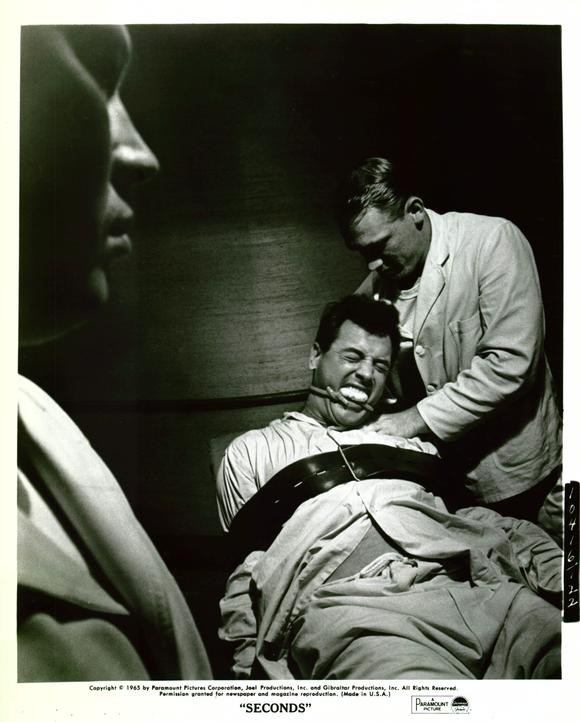
"Seconds"(John Frankenheimer, 1966) Post "Star Wars," science fiction films have been pretty cookie-cutter—fleet-ships, a Hero with a Thousand Names, odd plasticized bi-ped creatures in supporting roles. Science Fiction used to be about concepts, and technology was just an aspect of futurism. That's why to see "Seconds" is still a thrilling experience, as it calls to mind a feature-length, subtler "Twilight Zone" episode,* that takes an idea and turns it around in its hand, exploring the angles...and the consequences.
Bank executive Arthur Hamilton (John Randolph) is receiving mysterious phone-calls from someone who claims to be an old friend but doesn't sound like him. A note is slipped into his hand as he enters the subway, and upon further exploration (and prompting) learns that he is being offered a second chance in life. The anonymous corporation will transform him with plastic surgery (even replacing his finger-prints) and an exercise regimen, while setting up a planned "accident" with an unrecognizable "similar body-type" to explain his absence. To the world, he will die, but he'll be resurrected as a new man, with a new life, in a new community—everything re-arranged neatly and clinically.
This is Hudson's best role—if you're like me and aren't into rom-com's—and his best movie. But it's contradictorily a one-sided performance—there's not an awful lot of joy (I think that may be the point), and he's unsure, disoriented or drunk throughout most of it. And, as Frankenheimer says in his commentary, he really worked hard in this role...especially towards the end.
This version of "Seconds" is not the one released in the States in 1966. A disorienting wine-making festival sequence with pre-hippie free-thinkers orgiastically stomping grapes in the buff was deemed too risque for its release (and Hudson wasn't comfortable with the sequence, as is evident in his performance), but it has been restored for the DVD release.
It's still an affecting film, even now, over 40 years later, a cautionary time-capsule of that era when the concerns of the speculative writer was society and not space-ships. Somtimes, fantasies have a nasty habit of becoming nightmares.
* Director Frankenheimer worked in the Golden Age of Live Television and worked with Rod Serling, pre-TZ, and post-TZ—Serling wrote the script for Frankenheimer's "Seven Days in May."
"Written On the Wind"(Douglas Sirk, 1956) Consummate trash is still something to be celebrated, and "Written on the Wind" is consummate trash; so soap-opera it squeaks, it has pretensions towards Tennessee Williams but with dialogue straight out of Indiana Jones, and sophisticated airs that smell a little fetid, like last night's twelve course meal left in the sink.
But it's directed like a dream (with the occasional diversion into night-sweats) by Douglas Sirk, who may be the most manipulative film director since Hitchcock, steering an audience's sight-lines like a Dutch master, by means both sly and obvious.
There's been a bit of a kerfluffle on the cin-terwebs recently over Sirk's worth as a director. Well, it's one thing to design the sets and wardrobe and choose the colors and decor, but it's quite another to orchestrate all those things and design a course through it to make an image that complements, makes explicit or counters the words on the script-page (that, at the time Sirk was working, had to be approved by a censor, mind you). Call it "Dancing through the Hays Code" and Sirk's direction cuts quite a path of stylish elegance while presenting the mire of the "comfortably well-off." It's a bit like trying to keep your dignity running through a cow-field.
The story is about the Hadley family, thick—almost gooey—with the oil business, and something of a gusher when it comes to spilling their muck in all directions, soiling those in their vicinity. Take Mitch Wayne (Rock Hudson), son of a farmer who worked the Hadley property and school-chum to the Hadley scum of a scion, Kyle (Robert Stack), an intense guy who always comes on a little strong to the ladies. Mitch, on the other hand, is hard-working, poor, and a perfect gentleman. Even when Kyle sweeps Lucy, the girl Mitch has his eye on (Lauren Bacall), off her feet and out of Mitch's grasp with a dazzling display of Hadley life-style. Simple enough. Then toss in Kyle's sister Marylee (as in "...we roll along")(Dorothy Malone*), who's been in love with Mitch since they were kids, and things get real complicated. In fact, they get as wild as the wind, which blows and batters the Hadley Estate in a show of Nature's distaste—a protest as violent as Akira Kurosawa's dust-devils.
Not too worry, though. Sirk is the tour guide through this E-ticket sexual Disneyland. Enjoy the ride (and keep your hands in the vehicle at all times).
Let's start off with something safe. Women's heads as a proscenium arch—their curiosity points us to and frames the principals.
Sirk used a moving camera sparingly and with a great deal of control. He let you see what he wanted you to see when he wanted you to see it. In this set-up, the eye would wander to what's around the corner (the garish red on the wall attracts your eye)—patience, Sirk will take you there in a minute. In the meantime, there is a large mirror, incongruously in front of the check-in desk, that allows you to see the characters coming out of an elevator before they approach the lady at check-in. Your eyes move to that. Sirk likes to make entrances interesting by having them reflected in mirrors.
After a bar fight that leaves Kyle defeated and humiliated, everybody's showing him the door without saying anything, the beaded curtain forming a light-weight barrier. When he violently goes through it, the body of Dorothy Malone's character Marylee will follow the sway of the beads before she turns and follows her brother.
Where do your eyes go? The camera has followed Bacall and Hudson into the bar, where they stop, looking for Stack. If their body positions didn't point you in the right direction, Sirk has put Stack between the two brightest things in the room—the white-shirted bartenders.
Lucy and Mitch bring the drunken Kyle home to recover—that's Mitch climbing the stairs in the background, Kyle's the limp sack over his shoulder—while a mortified Lucy explains to father Jasper...well, *sigh* it's probably a story's he's heard before.
And if you think the director's taking this florid stuff too seriously, brothers and sisters, you aren't looking close enough. Get out your de-coder rings. There'll be a quiz.
Doesn't get more obvious than this...you couldn't show sex on the screen in the 50's (without pan-aways to roaring fires and crashing ocean waves)—but you can show this and it isn't any surprise when Marylee is revealed to be having an affair with the pump-jockey (who for a perverse bit of trivia is played by Grant Williams, "The Incredible Shrinking Man").
This is an insert shot. It was deliberate and could have been edited out without hurting anything, and yet it remains. It occurs when Lucy tours the hotel suite Kyle Hadley has arranged for her and opens a drawer...of clutch-purses. How many purses have been snapped in anger (and in men's faces) over the cinematic war between men and women during the Hays Code? Lots, because purses with those snapping openings were a metaphor for a woman's genitalia. And when a woman got mad at a man--SNAP!--she would loudly shut the purse...thereby showing her disdain for the man by metaphorically denying him sex (Things were that complicated in the Hays Code days). Lucy should have inferred how much Kyle played around by this little collection and ran like hell. *
Kyle Hadley starts this conversation on the right side of the frame in front of the bed, then as he becomes more ardent, the bed is uncovered. And oh, by the way, rival-for-Lucy's-affections Mitch is seen in the mirror between them, but because he's on a different plane from Lucy and Kyle, he could be on another planet. So, although he comes between them, he's little (diminutive, in fact) threat. There's a lot of triangulation in this family.
Some friend. Now here's Kyle's sister Marylee (Dorothy Malone) a hyperbolic hyphenate of dipso- and nympho-manias.* She's been in love with Mitch since they were kids, and despises her brother with a passion that practically pops the buttons off her blouse. Sirk makes sure we see her pouring the booze in the Cinemascope frame. Or she's so drunk, she has to hold it that close to avoid spillage.
Marylee in her well-ordered, yet cluttered room. The room is orderly, tidy—everything in its place, including her intended in a thick, wrought-iron frame—with the occasional wild errant splash of color...that being red—including her phone. Looking at this angle from above, the angles of things would look crazy and at odd angles--they're directing your attention to her, but she's small and trapped by her surroundings. Of course she is. Her room is a reflection of her own roiling mind, shadowed and complicated and morbid like a funeral hall.
Speaking of reflections, Sirk does a lot with this shot. Marylee plunks herself down, inserting herself into Lucy's mirror (she likes the attention), and adjusts her hair as Lucy brushes. Marylee thinks they're just alike, with their attachments to Mitch and Kyle linking them...but she's alone, posing in that mirror. She is the storm to Lauren Bacall's calm, seemingly incapable of remaining still, where Bacall is all stillness. They're counter-points, not reflections.
Dysfunctional family portrait. Father Jasper Hadley (Robert Keith), old and frail and ineffectual, has put all his strength into his oil business—check out his portrait—and his kids have run out of control (Their mother's dead—they probably ate her after they were born, like the spiders they are).
Your turn! Now what (oh, what) could Sirk be saying with this shot?
Nothing. I just like this shot. Thanks for playing. Exits by the mirror on the wall. Mind the gap.
* Malone won an Oscar for her role. It's easy to see why—she put a lot of work and jitter-bugging energy into this performance (see the video). Even at 24 frames per second it's hard to keep up with her. Both Malone and Bacall had worked with Bogart in "The Big Sleep" (Bogart, by the way, hated this movie and told Bacall she should stay clear of this sort of material).
** If you think my theories are a bit far-fetched, I can only remind you of the story of the woman who went to a psychiatrist who gave her a rorshach test. "Now, what does this remind you of?" he asks her, and she says, "That's a vagina." "How about this one?" "That's two people making love." "Interesting, what do you see in this picture?" "That's another picture of making love." "And what's this one?" "Well, that's a penis." "Well, it's obvious," says the shrink. "You're obsessed with sex." "I am!" says the woman. "You're the one with the dirty pictures!"
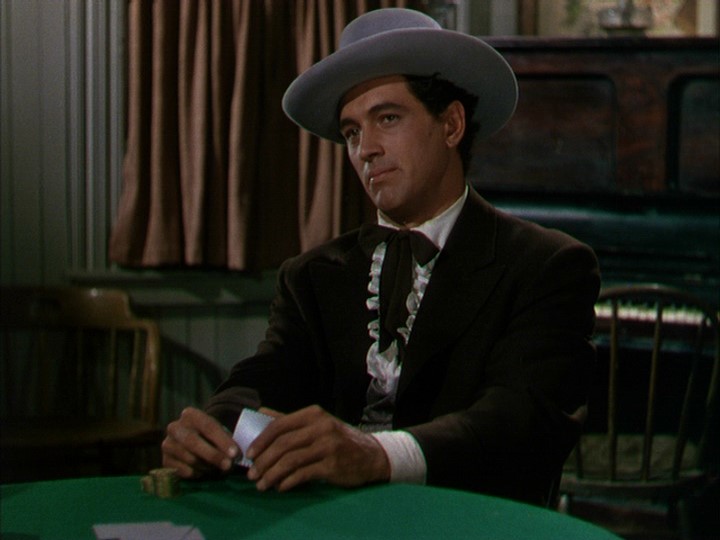
"Bend of the River"(Anthony Mann, 1952) "Any man can make a mistake" Take Glyn McLintock (James Stewart). He's scouting a trail for a wagon-train of farmers, led by Jeremy Baile (Jay C. Flippen) in the Northwest territories when he comes across an impromptu necktie-party and Emerson Cole (Arthur Kennedy) is the guest of dishonor. Maybe it's his sense of honor. Maybe it's the itch he feels in his neck. But he rescues Cole and finds that they're two peas in a morally questionable pod: both men have reputations loud enough to follow them through the virginal Oregon territory. They think the same, completing each other's sentences, they fight the same, pulling each other's fat out of the fire many a time—the two of 'em together is deadly. Put 'em at odds—over a girl or a deal—and the results could be equally deadly if the modicum of good shared between the two didn't delay the inevitable.
They're both likable bad men, looking for a good future away from civilization. It just depends how close their pasts follow them. Baile has his own ideas on the subject: "A man like that don't change." McLintock hopes he's wrong, but just in case, he's going to keep that kerchief around his neck tied tight. Daughters Laurie (Julie Adams) and Marjie (Lori Nelson) think that the right woman can change a man. Gambler Trey Wilson (Rock Hudson, very good in an early role) who's "fast on the draw, but soft" and "not the marrying kind," thinks that's long odds. But the time will come when the two men so evenly matched are going to have to choose sides. And when they do...
You see a lot of Howard Hawks' "Red River" in "Bend of the River." That's because they share the same script and story-writer, Borden Chase. A lot of incidents and lines of dialogue reflect each other. Hawks joked his way out of "Red River's" volatile climax, but there's no chance of that here, even though both movies do share a heroine who gets hit, literally, with an arrow when they meet the man they're going to fall in love with. And where John Wayne found underplaying the line "One day you'll look back and I'll be there" most effective, James Stewart seethes it through his teeth. The Mann-Stewart Westerns had complicated psychologies with Stewart exploring his dark side in each of them (although not so much in their other collaborations in the '50's, "The Glenn Miller Story" and "Strategic Air Command"). "Bend of the River" is one of the best of them, with a vengeful Stewart picking off his enemies one by one, without a mind to the morality of an ambush.*
It is that razor's edge of sanity and judgement that makes "Bend of the River" interesting. At any time, one can imagine Stewart losing the veneer of good-guy and killing in hot blood or cold. It is that sense of real danger that Mann and Chase and Stewart bring to the conflict of being in a tight spot with no way out that makes "Bend of the River" one of the better Westerns ever made, and one that feels timeless in a genre considered past its time.
There's something you don't see every day: A cold-blooded Jimmy Stewart
* Oh, now here's a scary thought—the movie could play as a Westernized "Rambo"


 Sirk used a moving camera sparingly and with a great deal of control. He let you see what he wanted you to see when he wanted you to see it. In this set-up, the eye would wander to what's around the corner (the garish red on the wall attracts your eye)—patience, Sirk will take you there in a minute. In the meantime, there is a large mirror, incongruously in front of the check-in desk, that allows you to see the characters coming out of an elevator before they approach the lady at check-in. Your eyes move to that. Sirk likes to make entrances interesting by having them reflected in mirrors.
 After a bar fight that leaves Kyle defeated and humiliated, everybody's showing him the door without saying anything, the beaded curtain forming a light-weight barrier. When he violently goes through it, the body of Dorothy Malone's character Marylee will follow the sway of the beads before she turns and follows her brother.
 Where do your eyes go? The camera has followed Bacall and Hudson into the bar, where they stop, looking for Stack. If their body positions didn't point you in the right direction, Sirk has put Stack between the two brightest things in the room—the white-shirted bartenders.
 Lucy and Mitch bring the drunken Kyle home to recover—that's Mitch climbing the stairs in the background, Kyle's the limp sack over his shoulder—while a mortified Lucy explains to father Jasper...well, *sigh* it's probably a story's he's heard before.
 And if you think the director's taking this florid stuff too seriously, brothers and sisters, you aren't looking close enough. Get out your de-coder rings. There'll be a quiz.
 Doesn't get more obvious than this...you couldn't show sex on the screen in the 50's (without pan-aways to roaring fires and crashing ocean waves)—but you can show this and it isn't any surprise when Marylee is revealed to be having an affair with the pump-jockey (who for a perverse bit of trivia is played by
 This is an insert shot. It was deliberate and could have been edited out without hurting anything, and yet it remains. It occurs when Lucy tours the hotel suite Kyle Hadley has arranged for her and opens a drawer...of clutch-purses. How many purses have been snapped in anger (and in men's faces) over the cinematic war between men and women during the Hays Code? Lots, because purses with those snapping openings were a metaphor for a woman's genitalia. And when a woman got mad at a man--SNAP!--she would loudly shut the purse...thereby showing her disdain for the man by metaphorically denying him sex (Things were that complicated in the Hays Code days). Lucy should have inferred how much Kyle played around by this little collection and ran like hell.
 Kyle Hadley starts this conversation on the right side of the frame in front of the bed, then as he becomes more ardent, the bed is uncovered. And oh, by the way, rival-for-Lucy's-affections Mitch is seen in the mirror between them, but because he's on a different plane from Lucy and Kyle, he could be on another planet. So, although he comes between them, he's little (diminutive, in fact) threat. There's a lot of triangulation in this family.
 Some friend. Now here's Kyle's sister Marylee (
 Marylee in her well-ordered, yet cluttered room. The room is orderly, tidy—everything in its place, including her intended in a thick, wrought-iron frame—with the occasional wild errant splash of color...that being red—including her phone. Looking at this angle from above, the angles of things would look crazy and at odd angles--they're directing your attention to her, but she's small and trapped by her surroundings. Of course she is. Her room is a reflection of her own roiling mind, shadowed and complicated and morbid like a funeral hall.
 Speaking of reflections, Sirk does a lot with this shot. Marylee plunks herself down, inserting herself into Lucy's mirror (she likes the attention), and adjusts her hair as Lucy brushes. Marylee thinks they're just alike, with their attachments to Mitch and Kyle linking them...but she's alone, posing in that mirror. She is the storm to Lauren Bacall's calm, seemingly incapable of remaining still, where Bacall is all stillness. They're counter-points, not reflections.
 Dysfunctional family portrait.
 Your turn! Now what (oh, what) could Sirk be saying with this shot?
 Nothing. I just like this shot. Thanks for playing. Exits by the mirror on the wall. Mind the gap.