Showing posts with label Adventure. Show all posts

Saturday, August 31, 2013

Ice Station Zebra

Ice Station Zebra (John Sturges, 1968) The movie that was (supposedly) Howard Hughes' favorite movie—one that he would watch obsessively.

One can only wonder why.  It is not exactly inspired, entertainment, though competently directed by John Sturges.  It was also one of the last of the prestigious "roadshow" presentations , shot in "Super-Panavison-70" and featuring "Overture" music and an Intermission at the theater.  But, beyond that, the film may be one of the dullest thrillers ever filmed. 


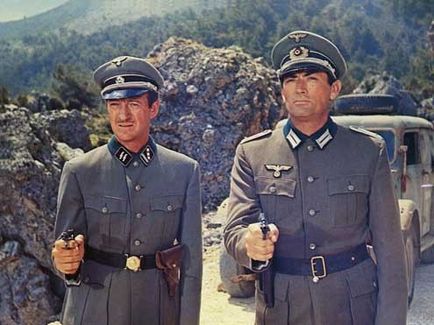
ISZ has the same stolid air of other adaptations of Alistair MacLean adventure yarns (The Guns of Navarone, Where Eagles Dare).  It's just not as adventurous, and the locations—studio-created—are claustrophobic and closed-in, as opposed to having any dramatic vistas or intriguing locales of other MacLean stories.  Here, it's meeting rooms, a submarine and a burned out polar station on a floating ice flow.  People don't get out much, and the whole film feels close and boxed-in (quite a trick in "Super-Panavision-70). Oh, there are intrigues—it wouldn't be a MacLean story if there wasn't one or two double-crosses thrown in—but they're fairly typical.  The sub' has to have a debilitating leak, and as befitting a Cold War drama (the coldest!), there are dueling loyalties and the to-be-expected double-agent (but who?).  It never rises above the slightly edgy to the exciting and is mostly cliché-ridden, especially when it comes to the "whodunnit" aspects.


Fairly good cast with not much to do except glower at each other, and top-liner Rock Hudson isn't at his best at that, and is ham-strung by the script (by MacLean, Douglas Hayes—he wrote Kitten with a Whip, after all—Harry Julian Fink, and W.R. Burnett, no slouches, any of them) from doing anything interesting, like humor.  Patrick McGoohan has one interesting scene where he loses it, but mostly he's clipped and acerbic in hyper-Danger-Man mode.  Jim Brown matches him frown for frown—twin performances by actors playing characters hating each other, and Ernest Borgnine does a Russian accent.  A lot of testosterone, mostly going to waste, in material which is stretched to the breaking point.

Supposedly there's going to be a remake, so there's a lot of room for improvement. 


Patrick McGoohan recreates my expression watching this movie


Thursday, September 6, 2012

Mogambo (1953)

Mogambo  (John Ford, 1953) It's good to be The King.  When you're Clark Gable, King of Hollywood, you can forgive a lot of shortcomings on the acting front.  Mogambo, situated in Africa, and for a large part photographed there, makes Gable the King of the Jungle and no less predatory than some of the denizens.  If the film has a shortcoming, and it has a few, it's that it depends so much on Gable's charisma to carry what is essentially an under-written "man's man" of a role—one who will take a woman in his arms and plant one with a mere change in the barometer, his, hers or Nature's.  Gable's Vic Marswell is so fragile in his moods, he's practically bi-polar, swinging from cranky to rapacious to "I don't care," running hot and cold and more than a little unreadable either way.  And for the women in the film, Eloise "Honey Bear" Kelly (a plucky Ava Gardner), a recklessly adventurous widow, and Lina Nordley (Grace Kelly, still in her neurotic, fragile period), wife of Marswell's current client, it creates a weird triangle that I.Sosceles himself couldn't figure out.  Maybe it's the heat of Africa, or maybe it's the wild life of the wildlife, but both of these women, with lots going for them, still neurotically slam themselves like meteors into Winslow's orbit.  And while the heat and flash are nice, things burn out mighty quick.  And the only explanation is "it's Gable," in a writer's shorthand that defies logic, common sense, or understandable motivation (other than box-office).  It's just assumed that any woman's going to throw themselves at the King, no matter how much of a tiger trap he might be.

That shaky "given" aside, it's a nice adventure entertainment, directed by John Ford with a painterly eye trained on a new canvas.  The Technicolor cinematography—by Freddie Young and Robert Surtees—is absolutely gorgeous, whether in the blinding sunlight of a native village, or the shadowy slats of a "civilized" encampment.  Ford is a long way from the locations he favored in his Westerns, but adjusts, employing his fascination with native culture in the same diversions of including the faces of the tribes, distinguishing them from each other and, in a single set up, putting the flavor of the place on obvious display.  He's truly recharged and energized by Africa, his camera roaming all over, finding the picturesque and telling details.*

And it's interesting to note (to me, anyway) that Ford is essentially making a Howard Hawks movie:  a group of professionals and semi-professionals trying to eke out a living (and a kind of focused community) despite their differences.  Hawks and Ford would knowingly tip their hats to each other in their projects—if it didn't interfere with their own process—and there are a lot of the Hawks hallmarks here—the group sing-along, the loaning and sharing of a cigarette as relationship sub-text, the strong females (one of whom is "just one of the boys"), and the alpha male who has a code, few words, and manages to mangle them around the opposite sex.**

Even if the emotions run a little too high and there's way too much drama to get any real work done, there's a lot in Mogambo to like, that is pleasing to the eye.  The story's not much, but it sure is interesting to see how Ford tells it.

  
Gardner and Kelly-revealed in their environments


* One of my favorite shots is a simple one of Gable and company walking the high grass on a trapping trip, shot at ground level, looking up through the wisps at the party.  How much less interesting would that shot have been from any other angle?  How much less would it have said about the conditions there, while making the most of the surroundings?  Ah, I'm probably getting all "academic" here.  Ford probably shot it that way to avoid seeing a garbage heap in the distance.  

** Hawks made his own version of the "African trapper" story—Hatari—ten years later with John Wayne (although internet sources say Gable was to co-star "but who believes the Internet?") with a more cohesive group (the kids have the relationship problems, not the leader) turning the story into a metaphor for a filmmaking crew).  The differences are night and day—in style and atmosphere—despite the similarities in subject matter.  In Hawks, the relationships are background, while the job is scenter-stage.  In Ford, it's the other way around.  They'd make an interesting double-bill.

Thursday, June 7, 2012

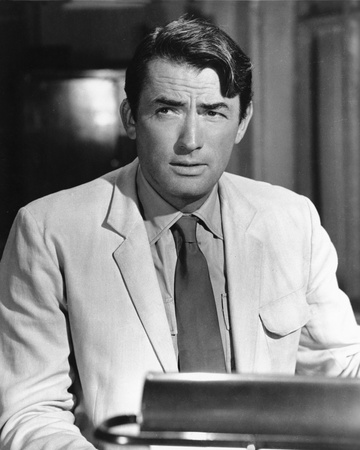
The Guns of Navarone

The Guns of Navarone (J. Lee Thompson, 1961) Maybe I should do a new LNTAM series—"The Ones That Got Away."  Somehow I managed to miss this one, an essential "action" film that "everybody" saw when it first came out, AND during umpteen playings on television. Not me.  I managed to sit down and watch it straight through only recently.  I do remember it from one particular Dick Van Dyke Show episode (Season 5, Episode 139-"You're Under Arrest") where Dick and Laura had a fight and Dick stomped out and went to a drive-in and fell asleep in the car and no one believed him because the movie playing was The Guns of Navarone. "YOU SLEPT THROUGH THE GUNS OF NAVARONE??!!" 

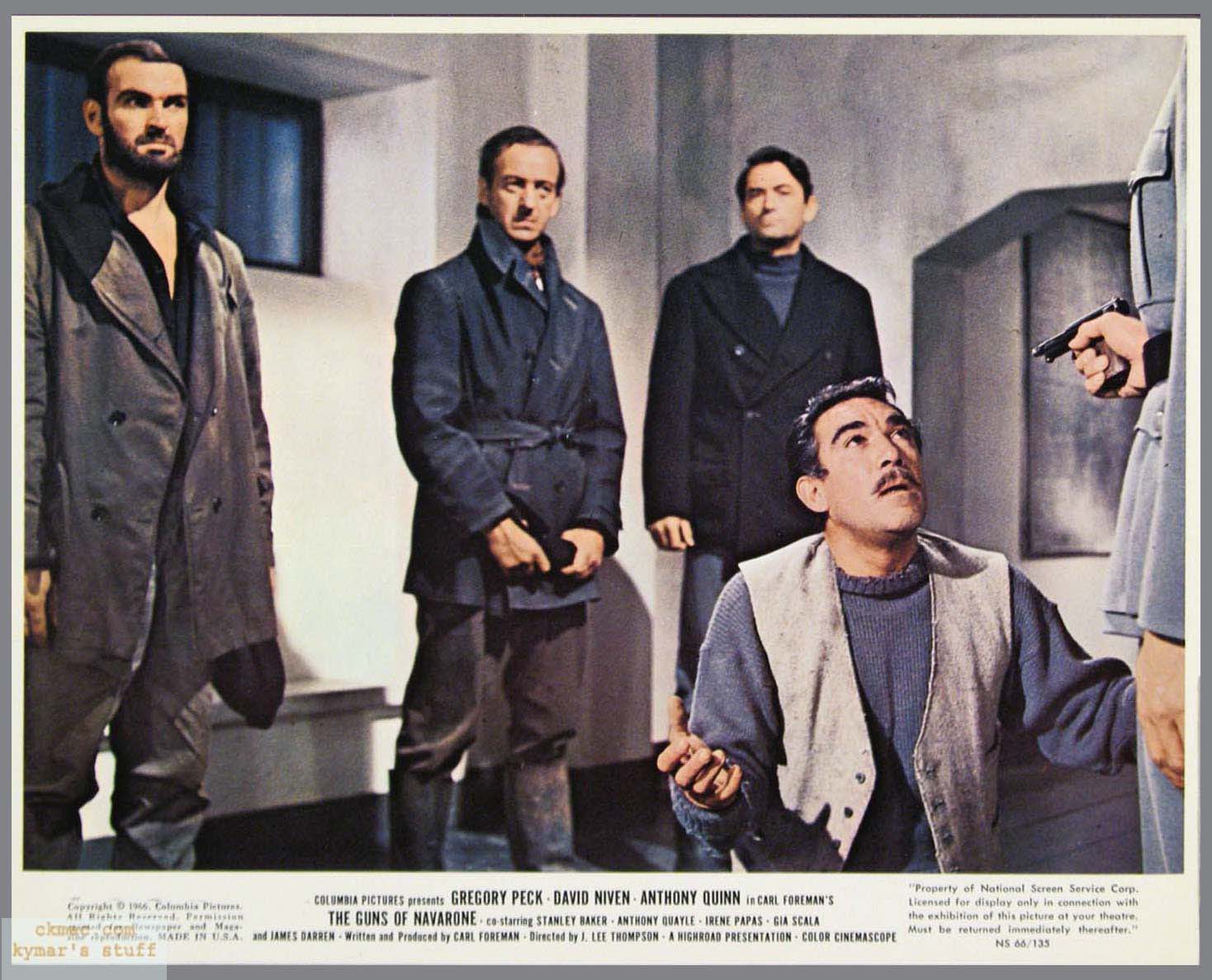
"With so many geniuses," says Team Captain Keith Mallory (Gregory Peck), "how can we fail?"

Ask a silly question...get a two and a half hour answer.  Particularly when the answer involves material supplied by Alistair McLean, from whose books nothing ever goes as planned and improvisation, no matter how well provisioned for, rules the day.

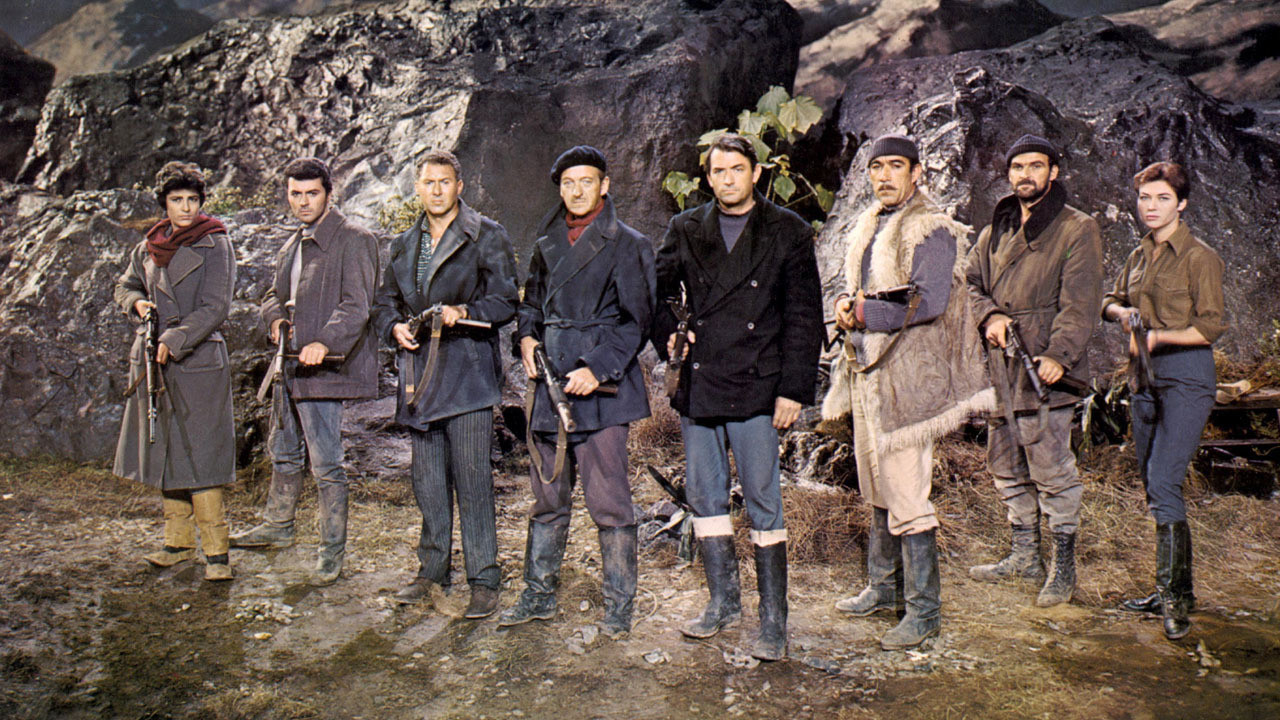
There are these cannons, see?*  They're caved into vertical cliff faces that have been daunting to regular forces.**  So, a team of specialists, cut-throats, and patriots form a surly group of cynics to make land-fall—extraordinarily uneasily—go up-country and meet up with resistance forces infiltrating a hummocky terrain populated by locals (who seem to be having a wedding every hour of the day) and an endless supply of Nazis, who seem to fall like ten-pins.

There's always a weak link in these groups.  In this case, it's Major Roy "Lucky" Franklin (Anthony Quayle), who has brittle bones and seems to have the ability to attract shrapnel.  The initial cliff-assault proves to be his undoing, although the rest of the team manage to make the climb without falling into the rear-projection.  And while not quite The Dirty Dozen, conflicts pop up pretty quickly—Corporal Miller (David Niven) is the griper, constantly needling Mallory and protective of Franklin.  Mallory has issues with Col. Andrea Stavros (Anthony Quinn) who holds a grudge for what happened to his family previously in the war.  Then there's Brown (Stanley Baker), "the Butcher of Barcelona," who seems to be having trouble negotiating wish-bones and his own conscience.***

Director J. Lee Thompson (a good yeoman-like director, who only gets "arty" on inanimate objects) keeps things moving fast and the frame centered—despite being a "widescreen" Cinemascope roadshow—managing to make everything capable of fitting into a square TV-frame.

The hero of the story, though, is Carl Foreman, black-listed writer-producer, who migrated to Europe to make films.  Despite the gung-heavery on display, his script still squeezes in enough anti-war sentiment and issues of conscience without slowing down the action any, even impressing crusty old John Wayne, one of the anti-communists who pressured him to leave the States.  His "Guns" fits into the same cynical fox-hole as the earlier Awards magnet The Bridge on the River Kwai, which he had once worked on. 

Curiously, even though I missed the original, I still managed to see its sequel Force 10 from Navarone (which recycled quite a lot of the first film's climax) a couple of times.  That one came out a full 16 years after the first, just in time to catch such up-and-coming stars as Harrison Ford, Barbara Bach and Richard Kiel, and replacing Peck and Niven with Robert Shaw and Edward Fox, two (count 'em, two) British actors who seemed to fit the characters a little bit better.  


* Them bloody "Navaronian" guns


*** Peck had an amusing homo-erotic spin on the story:  "David Niven really loves Anthony Quayle and Gregory Peck loves Anthony Quinn. Tony Quayle breaks a leg and is sent off to hospital. Tony Quinn falls in love with Irene Papas, and Niven and Peck catch each other on the rebound and live happily ever after." 


Tuesday, May 18, 2010

Robin Hood (2010)

"Rise...and Rise Again...and Again...and Again"

Every fifteen years or so, there must be a big budget remake of the "Robin Hood" legend—that's a bit less than the turnaround cycle for The Compleate Works of Jane Austen. The last time the fletches flew on the big screen there were two competing Hoods—the flashy Kevin Reynolds/Kevin Costner version and one starring Patrick Bergin. Before them was "Robin and Marian," various series, and "The Adventures of Robin Hood," the Warner Bros. classic with Errol Flynn, which was itself a remake of silent versions. Then, there have been satiric vignettes in "Shrek" and "Time Bandits,"* Mel Brooks has done a movie ("Men in Tights") AND a series ("When Things Were Rotten")—Mel loves his Public Domain. Disney has touched on it a couple times as well, including an animated funny animals version.

The character and his ancillary co-stars have a long oral tradition with many variations of "The Hode," so it's natural that someone drums him up for another "Have at ye" every few years, each reflecting the times in which they were made. Robin has been yeoman and nobleman, Crusader and thief, trickster and military man, young and old. Although we've been down this well-trod pathe in the glenne before, it was interesting to think about what the "
Gladiator" team of Ridley Scott and Russell Crowe could do with the story, and how they would approach it.

And the answer is: with a little bit of everything.
Scott with the help of scenarist Brian Helgeland** has a Robin Hood, an orphan Saxon Crusading with Richard the Lionheart (Danny Huston-he's great in this), who's an expert bowman and strategist by day, and a grifter by night. At the end of the Crusades, he is given a task, the complications of which lead him to Nottingham and the masquerade of being Robert Loxley, slain son of Sir Walter Loxley (Max von Sydow) and spouse of Lady Marian Loxley (Cate Blanchett)—this Robin is both commoner and gentry. The Sheriff of Nottingham (Matthew McFadyen) is not given much to do this time 'round, instead the intrigues are by Sir Godfrey (Mark Strong) and King Phillip of France, who plot to undermine the already shaky reign of the new King John (
Oscar Isaac), the last son of King Henry and Eleanor of Aquitaine (Eileen Atkins), and invade England.

The general structure of "Robin Hood" is superficially similar to “Gladiator” with big battles at both ends, and Scott uses the same stutter-shutter technique to give some verve to the action scenes. But there it ends. Crowe is considerably lighter as Robin Hood, though he does summon up genuine moments of drama. Performances are fine all around withCate Blanchett and William Hurt being stand-outs. But the best performance is by Max von Sydow as the elderly Sir Walter. Blind, but nobody’s fool, Sir Walter takes the news of his son’s death with grim determination and courtesy for its messenger, and comes up with the Robin-as-Loxley ruse to protect Marion from having their land confiscated should he die. Von Sydow has been ill-used of late, playing teutonic villains of similar coldness, but this role shows him at full thespian power, and it would be robbery if he was not nominated for an Oscar for this performance.

The film boasts good values all around, with Scott’s keen eye for cinematography and detail, the writing is clever and often ingenious (I think the fact that it's
another Robin Hood movie sours a lot of people's expectations). The film never drags and offers considerable entertainment value. Only at the end does it falter, with a beach battle that seems overly-stretched in terms of production value and credibility. Either there was not enough planning or extras, but it looks to be constructed to not show something as opposed to creating an epic battle. Too much is made of the presence of landing craft as obstacles, and of one particular participant in the clamor, which seems to be done for scoring political points rather than good story-telling.

But that is twenty minutes out of 140. For the most part, this new “
Robin Hood” hits its mark. Yes, it might be superfluous (we can say this—with a straight face—with so many sequels headed our way?), but what's there on the screen is an interesting "take" on the legend that has lasted so long.

"Robin Hood" is a Matinee.

* John Cleese's immaculate nobleman with a "Bonny Prince Charlie" manner is one of my favorites.

** The original script, by the team of Ethan Rieff and Cyrus Voris, called "Nottingham," was more radical, but interesting in a concept-twist kind of way, but once Ridley Scott came on board, the concept changed.


Wednesday, January 20, 2010

Captain Horatio Hornblower (R.N.)

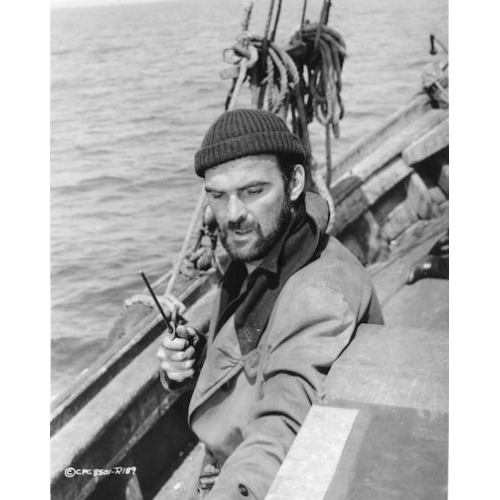
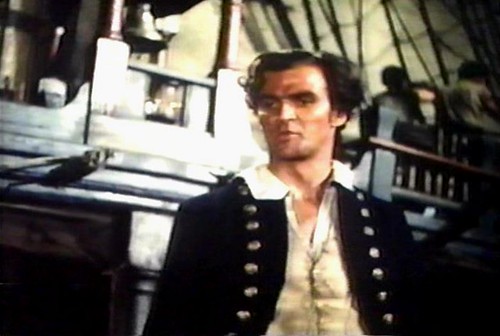
"Captain Horatio Hornblower (R.N.)"* (Raoul Walsh, 1951) Supposedly C.S. Forester himself adapted his first three Hornblower novels to make the screen-story for this swashbuckling distillation of the Royal Navy's fictional hero. It is 1805, and his majesty has sent the HMS Lydia on a secret mission. England is at war with Spain and France, and Hornblower must enlist the aid of a mad South American dictator in the war efforts a world away. But, upon arriving, Hornblower's distaste for the assignment and the "El Supremo" (Alec Mango) has him violating the Admiralty's standard orders, and when he captures the massive El Natividad (commanded by a very young Christopher Lee), he is forced to turn over the ship to the mad-man. Heading for home, he finds out that Spain is now England's ally (oops!) and he must re-take the massive ship on open seas, risking his crew and an unwanted passenger, Her Ladyship Barbara Wellesley (Virginia Mayo), sister to tthe Duke of Wellington and betrothed to Admiral Leighton (Denis O'Dea).

The crew is very British (
including a young Stanley Baker), but its Captain is played by the very American Gregory Peck,** ramrod-stiff and stoic, so even though the accent is wrong, the attitude is just so—Forrester's Hornblower is a stoic, constantly questioning himself and his failings, reflected in his constant lecturing and drilling of his crew. And Raoul Walsh is the perfect man to direct, as the action director has a keen eye toward the psychological and characters with complicated motivations. Peck has the attitude, but is a bit uneasy when called upon to display the comical aspects of the still-upper-lip Hornblower—his uneasy "harumphs" are constantly dubbed in to make more of them than Peck could convey on-set. But for the brooding and irritation (and the authoritarian air), Peck is fine.

The battles are well-choreographed for the times—one can practically see the wires yanking pieces of ship-railing past the players—and sometimes the falling masts and ropes get a little out of control, but the model-work and staging are excitingly done. A fine way to spend a rainy afternoon.


* The added "R.N." because the British version of the title included them, the American did not. As with the recent "Master and Commander," nothing is made of Hornblower maybe having to fight the American Navy, as he might have seven years in the future.

** The screen-rights were acquired for a vehicle for Errol Flynn, but after Flynn's previous movies had poor ticket sales (and the actor was proving difficult to manage), other actors (including Burt Lancaster) were considered. Peck got the part. Lancaster would star in "The Crimson Pirate" the next year.

Tuesday, January 13, 2009

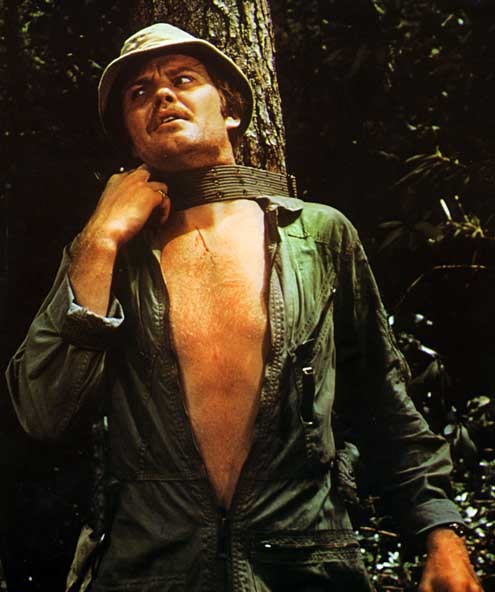
Deliverance

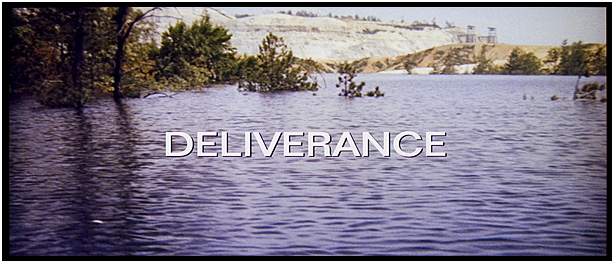
"Deliverance" (John Boorman, 1972) Let me start with an anecdote. I have a dog who's feisty as all get-out. There's not too much he's afraid of, other than missing a meal, and he can be quite aggressive in protecting his perceived territory. My wife and I took him camping, which he enjoyed immensely. That is, until it came time to sleep in the tent. At that point, the dog was quite agitated, especially because he could see through the mesh to the outside world. He kept looking at us as if we were insane: "Sleep? Out here? There's nothing but some fabric to protect us! Are you crazy?" He didn't sleep all night, dutifully looking around to make sure everything was safe, especially his idiot-masters who thought a tent in the wilderness was the same as a house.

I tell that story only because the dog realized something only a non-biped would realize--Nature is cruel. Cruel in tooth and claw, as they say. But "human" nature's got it beat ten ways from Sunday.

And so "
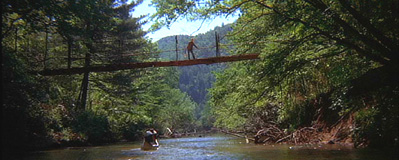
Deliverance," from the novel by poet James Dickey that I was quite fond of back in the day. At the time it appeared in theaters I was worried about its adaptation because the simple story, of four city-boys who take on the adventure of canoeing a river about to be dammed out of existence, could have been a crude film. But, instead, under the austere direction of John Boorman, it's themes of ecology and fool-hardiness, vain-gloriousness and finding strength where none was expected are enhanced and made into an almost mystical experience by the film-maker.

Boorman accentuates the danger of the surroundings by avoiding clearings and staging so many scenes in the middle of forests,
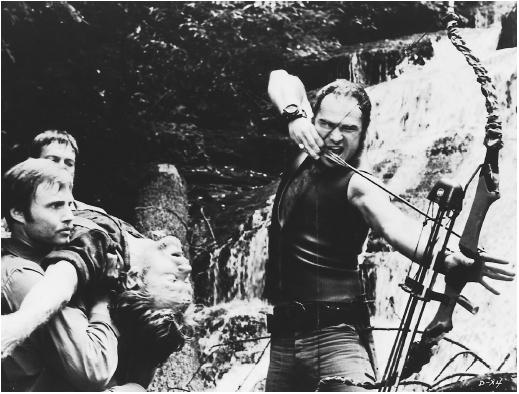
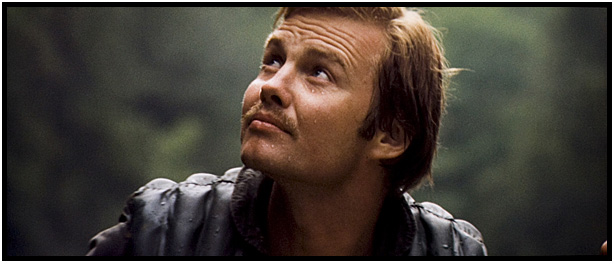
with a restless camera that shifts perspective around trees, moving the formations of them around, to the point where you think you can see things in the patterns of the woods. And he presents tangible, visceral horrors not present in the book-- a mountain man newly killed falling forward into the crotch of a small tree and remaining upright; macho Lewis Medlock (Burt Reynolds) pulling an arrow out of the breast-bone of a backwoods attacker ("Where'd the fletches go..." I thought when the act was done); the exaggerated horror of the men's injuries--the broken thigh-bone that pierces Lewis' leg (Reynolds does an incredible job undercutting his character's uber-stage-manliness with some of the most blood-curdling whimpering I've ever heard), the dislocated shoulder of Drew Ballinger (Ronny Cox) that has the man cradling his own head, sitting, weirdly on a rock out-crop, and Ed Gentry (Jon Voight) cutting an arrow out of his side to prepare for a final show-down below a sky that simmers in a yellow exposure-pushed sky. We won't even talk about Ned Beatty.

If there is a weak performance in the film it's author Dickey as the seething Sheriff who's just a little too-unsubtle in his suggestions. Voight, Beatty (his first film) and Cox do great work, and forgoing insurance, did their own rafting stunts. But Reynolds is terrific in his role, totally dominating the first half of the film, and, though out of action for the rest of the movie, still makes an impression. Hollywood may have a problem with him (doesn't take them...or himself...too seriously, perhaps?) but it would be nice to acknowledge that he can give gifted performances when gifted with good scripts.


In the latest pick, The Library of Congress chose "Deliverance" as one of the significant films to be added to the Film Registry.

Friday, November 28, 2008

The Man Who Would Be King

"The Man Who Would Be King" (John Huston, 1975) The obsessive quest. The lust for riches and the good life it will bring. The realization that the journey may be more important than the rewards. Laughter.

Two ne'er-do-wells cross into unknown territory for riches and are undone by their own greed and discord.

John Huston made this story before--a couple times, in fact. The closest might be "The Treasure of the Sierra Madre," which "The Man Who Would Be King" resembles. But it could also be "The Maltese Falcon," from the villains' perspective. Both films deal with wealth evading their questers' grasp, and both end with some laughter.* In "The Man Who Would Be King," that laughter comes earlier, and provides the miracle that leads the adventurers to achieving their hearts' desires. And gaining wisdom.

Although in each film someone always has to take "the fall."

The story is by
Rudyard Kipling, and story-teller Huston provides the conceit that might have led to the writing of
the tale, as Kipling is featured prominently in the film, portrayed with genial bonhomie and a writer's intrigued fascination at the train-wreck-sure-to-happen by Christopher Plummer. The story, of two confidence men/ex-British militiamen--Daniel Dravot (Sean Connery) and P.T. "Peachey" Carnahan (Michael Caine)--who brave the impossible journey through the Himalayas to find the fabled city of Kafiristan to set themselves up as "kings" held echoes of themes featured prominently throughout the work of John Huston. When he realized his dream of making this film, he was nearly 70 and suffering from emphysema, but the travel and the foreign locations did not dim his enthusiasm at such an age. He said it was one of his favorite shoots in his long-storied career. And one of the easiest.

And it was all due to the casting.

Huston had wanted to make the film in the 50's with
Clark Gable as Danny and Humphrey Bogart as Peachey then later with Burt Lancaster and Kirk Douglas, then Paul Newman and Robert Redford.

It was
Newman who suggested Connery and Caine. The two old friends had never worked together before and seized on the opportunity. Evenings during filming the two would go over the next day's scenes and work out little bits of well-coordinated business that would indicate the relationship between the two con-men, like old vaudevillians who had shared many a stage...and those routines would delight the wolfish Huston when presented with the ideas the next morning.

One wonders what Huston would have made of the film earlier in his career with those teams of actors. Lighter, perhaps. More comedy. Maybe not so hard on the message of the exploitation of conquered nations. But, with Connery and Caine there is a maturity as these two "
soldiers for fortune" go about their business robbing the various "-istan's" "three ways from Sunday."

Would it have ended as it does now, with the grisly but apt ending, and the story-teller becoming so engaged in the telling of the tale, that he is no longer a part of it? Would it have resonated so?

In the end, the point is so moot as to be laughable in itself. "The Man Who Would Be King" is a classic motion picture of any era--a dream project from a master director who had thirty years to perfect it, many chances to get it right, and, unlike his protagonists, the grace and wisdom to appreciate the luck he'd been given and let it live on its own when it was in his grasp.

Not even emphysema could have stopped his laughter at that.

* "The Asphalt Jungle" also has a similar ending...but its low-level crooks do not possess the self-knowledge--or the grace--to laugh at the Cosmic Joke played at their expense.

Thursday, August 7, 2008

Olde Review: The Wind and the Lion

Written November 7th, 1975

"The Wind and the Lion" (John Milius, 1975) I avoid seeing films twice unless I really, really love the flm (due to a lack of funds).* When I saw "The Wind and the Lion" the first time, it was as if I was seeing two movies at time. The dialog was really wretched ("Mulai--that's a nice name"), but at the same time the photography, direction and editing were all fabulous. It was a film that had "sweep" (I assume that when a film has "sweep," the camera tends to move along a field, up a wall, through a street, "sweep" through the visual plane of the camera. Oh, but does this movie do that!) "The Wind and the Lion" just swells with movement of all kinds--inside the frame and the frame outside itself.

John Milius is a director I don't tend to think much of. I wasn't too fond of his "Dillinger" film, some good things, but not wholly satisfying. But his direction in 'Wind & Lion" is just marvelous. Some of the shots combined with Jerry Goldsmith's score** are just chillingly beautiful: The trucking shot along a line of berbers silhouetted against a sunset;

A diagonally rising crane-shot that drifts over a dune as an entire army of berbers move down a road while a dark, cloudy sky presses down on the whole scene;

After the Raisuli (Sean Connery) has killed off the final horseman at the leper colony (that was the impression I got anyway) Milius cuts to a stunning shot of Eden Pedecaris (Candice Bergen) watching behind a net in the right foreground, while against a low sun on the ocean-tide, the Raisuli slows his horse and the now-riderless horse of his opponent still charges across the screen;

Theodore Roosevelt (Brian Keith) and "his" bear towering over him, as he reads the "Wind and the Lion" letter.


The second time around, my appreciation of the Milius direction grew. It was what I concentrated on throughout and because of it, the dialog that I was uneasy about went down easer and (My God!) some of that dialog was downright poetic. Roosevelt's speech about the bear as the U.S, symbol, his getting on his desk and growling at the camera for the Smithsonian--things that made me squirm in my seat before--I enjoyed this time around.

This movie is flawed to be sure. Some of the writing is still bad. There are inaccuracies in technique and in history. *** The fellow I went to see it with thought there were too many "riding-in-the desert" shots for his taste, but not for mine. And I heartily enjoyed myself and the film.


I still enjoy it (now that I own it) and all qualms that I had about it are gone, and a lot of the things that I found a bit over-dramatic are things that I now dearly love about it. I neglected to mention the huge contribution that cinematographer Billy Williams brings to this movie, as he carried out some of the beautifully outlandish shots Milius came up with. I wish he was allowed to make more films (he's certainly been allowed to doctor scripts most of his career, and Turner gives him a mini-series or TV movie to do once in awhile). His is a singular voice in Hollywood, and he's smart with what he does on film. Who knows, maybe they'll let him re-boot the new "Ahnold-less" Conan film series, as he did the first one. One would wish.

* This was 1975. It would be another five years before the video-tape boom that allowed folks to watch films in their own home, and even own media of that film. Seems like such a long time ago. Now, if one likes a film, one can buy it, and watch it as many times as they want. That's a great convenience--but it tends to make people cluster to stuff they like, rather than explore and take a chance on a new film.

** An aside from this review here: "Goldsmith just happens to be one of my favorite film scorers. I snap up one of his albums as soon as it appears in the racks, and seldom am I ever disappointed with what I hear. However, one of Goldsmith's pieces doesn't seem to mesh correctly with the visuals--the Raisuli's initial ride on a horse gone hay-wire." Um--that was the point, I think.

*** For instance, an incident like this DID take place during the Roosevelt administration. Ion Pedecaris WAS kidnapped by the Raisuli, in 1904. Ion was male. I'm sure it matters to history buffs, but changing Pedecaris to a woman raises the stakes of the story, and provides a whiff of romance and exoticism. Without "The Wind and The Lion" that incident would have been lost in the sands of time.