Showing posts with label 1961. Show all posts

Thursday, June 7, 2012

The Guns of Navarone

The Guns of Navarone (J. Lee Thompson, 1961) Maybe I should do a new LNTAM series—"The Ones That Got Away."  Somehow I managed to miss this one, an essential "action" film that "everybody" saw when it first came out, AND during umpteen playings on television. Not me.  I managed to sit down and watch it straight through only recently.  I do remember it from one particular Dick Van Dyke Show episode (Season 5, Episode 139-"You're Under Arrest") where Dick and Laura had a fight and Dick stomped out and went to a drive-in and fell asleep in the car and no one believed him because the movie playing was The Guns of Navarone. "YOU SLEPT THROUGH THE GUNS OF NAVARONE??!!" 

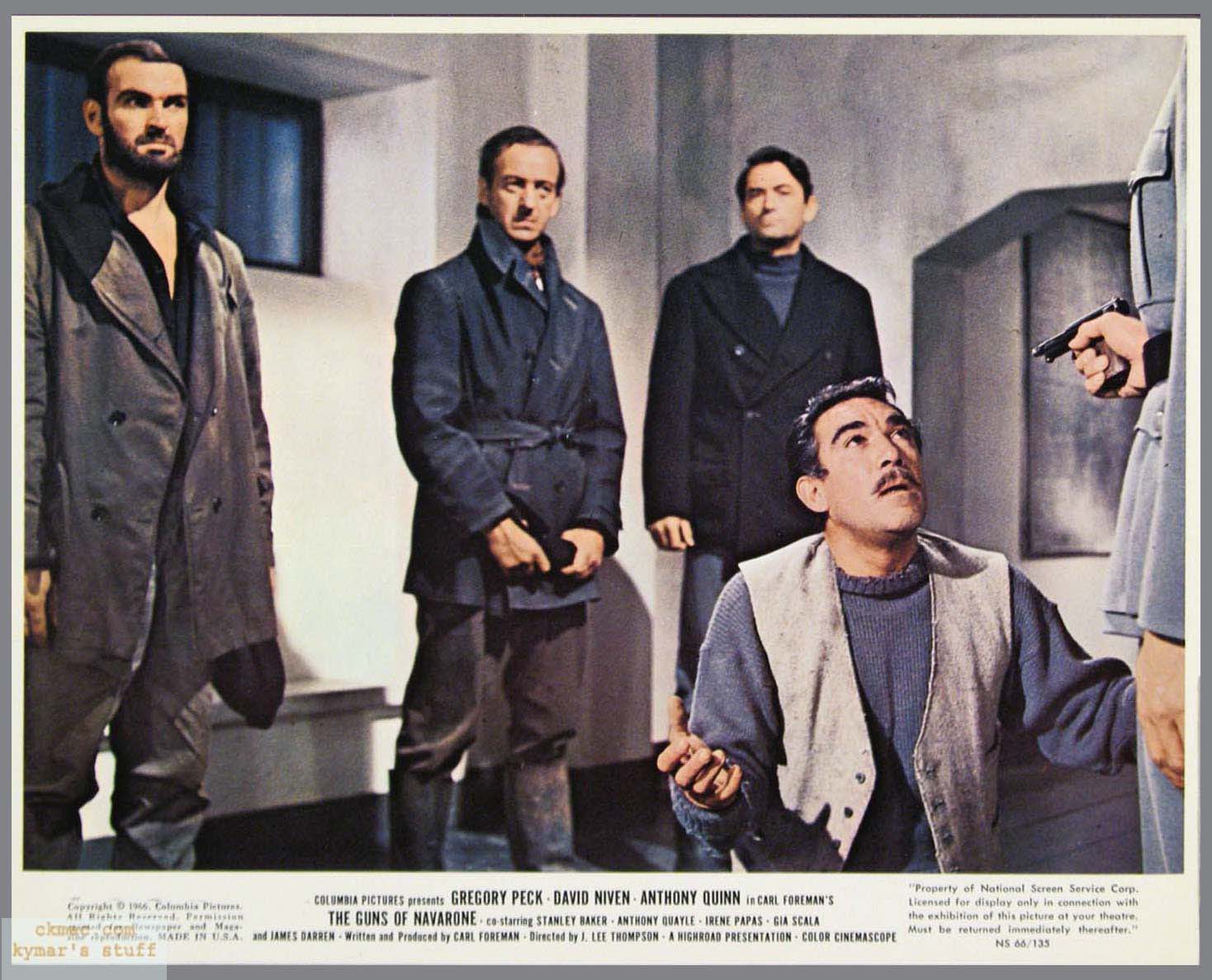
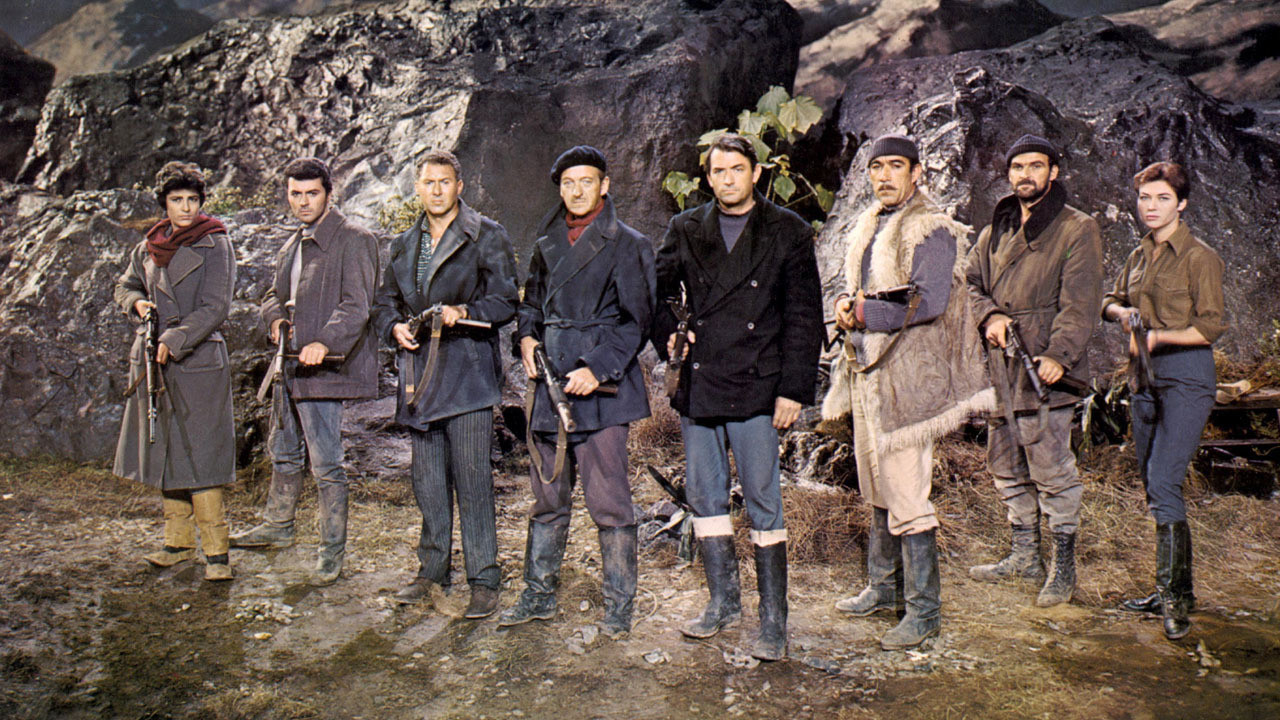
"With so many geniuses," says Team Captain Keith Mallory (Gregory Peck), "how can we fail?"

Ask a silly question...get a two and a half hour answer.  Particularly when the answer involves material supplied by Alistair McLean, from whose books nothing ever goes as planned and improvisation, no matter how well provisioned for, rules the day.

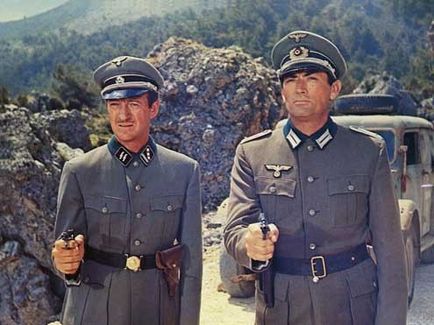
There are these cannons, see?*  They're caved into vertical cliff faces that have been daunting to regular forces.**  So, a team of specialists, cut-throats, and patriots form a surly group of cynics to make land-fall—extraordinarily uneasily—go up-country and meet up with resistance forces infiltrating a hummocky terrain populated by locals (who seem to be having a wedding every hour of the day) and an endless supply of Nazis, who seem to fall like ten-pins.

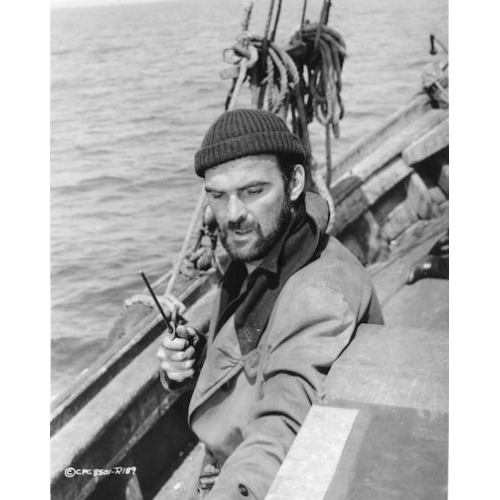
There's always a weak link in these groups.  In this case, it's Major Roy "Lucky" Franklin (Anthony Quayle), who has brittle bones and seems to have the ability to attract shrapnel.  The initial cliff-assault proves to be his undoing, although the rest of the team manage to make the climb without falling into the rear-projection.  And while not quite The Dirty Dozen, conflicts pop up pretty quickly—Corporal Miller (David Niven) is the griper, constantly needling Mallory and protective of Franklin.  Mallory has issues with Col. Andrea Stavros (Anthony Quinn) who holds a grudge for what happened to his family previously in the war.  Then there's Brown (Stanley Baker), "the Butcher of Barcelona," who seems to be having trouble negotiating wish-bones and his own conscience.***

Director J. Lee Thompson (a good yeoman-like director, who only gets "arty" on inanimate objects) keeps things moving fast and the frame centered—despite being a "widescreen" Cinemascope roadshow—managing to make everything capable of fitting into a square TV-frame.

The hero of the story, though, is Carl Foreman, black-listed writer-producer, who migrated to Europe to make films.  Despite the gung-heavery on display, his script still squeezes in enough anti-war sentiment and issues of conscience without slowing down the action any, even impressing crusty old John Wayne, one of the anti-communists who pressured him to leave the States.  His "Guns" fits into the same cynical fox-hole as the earlier Awards magnet The Bridge on the River Kwai, which he had once worked on. 

Curiously, even though I missed the original, I still managed to see its sequel Force 10 from Navarone (which recycled quite a lot of the first film's climax) a couple of times.  That one came out a full 16 years after the first, just in time to catch such up-and-coming stars as Harrison Ford, Barbara Bach and Richard Kiel, and replacing Peck and Niven with Robert Shaw and Edward Fox, two (count 'em, two) British actors who seemed to fit the characters a little bit better.  


* Them bloody "Navaronian" guns


*** Peck had an amusing homo-erotic spin on the story:  "David Niven really loves Anthony Quayle and Gregory Peck loves Anthony Quinn. Tony Quayle breaks a leg and is sent off to hospital. Tony Quinn falls in love with Irene Papas, and Niven and Peck catch each other on the rebound and live happily ever after." 


Saturday, August 22, 2009

Olde Review: Purple Noon

This was part of a series of reviews of the ASUW Film series back in the '70's. Except for some punctuation, I haven't changed anything from the way it was presented, giving the snarky, clueless kid I was back then a break. Any stray thoughts and updates I've included with the inevitable asterisked post-scripts.

This Saturday's films in 130 Kane at 7:30 pm are thrillers: one sophisticated; the other unsophisticated, but God, it's neat, and they are Rene Clément's "Purple Noon" and Brian DePalma's "Sisters"

"Purple Noon" or "Plein Soleil" (René Clément, 1960)Clément's "Purple Noon" was shown on TV Thursday night under a different title—"Lust for Evil"—and in a dubbed English version. Even if you saw it on Channel 9,* you should go see it Saturday night because, let's face it, movies always lose something on the television screen,** especially if they're dubbed in a sort of ill-fitting English as the televised version was.

"Purple Noon" is the story of two somewhat irresponsible young men. They tour the streets at night looking for trouble, rousting whoever they can. And in the course of the plot, one of them is murdered by the other. But how can
Alain Delon, who plays the murderer, get away with it? Well, it happened out at sea, they were alone on the victim's boat (the victim's fiancé in a fit of pique had gone ashore), there were no witnesses.

But won't people, especially those close to the victim notice his disappearance?
Delon has a plan for that: he is an excellent forger, he has the victim's belongings, his passport, and he can imitate his voice. And the fascination in this story is in the second portion. Will Delon be detected by those who knew the victim—especially the fiancé? Will he get out of all the close calls? How will he avoid it? It's a run through a maze and it culminates without a nice surprise ending.

And Clément's direction can sometimes come up with pleasant little touches that leave the viewer just a little bit amazed, as in the murder on the boat (that is over so quickly) only to be replaced by the problem of getting rid of the body, a task that is made more difficult by a sudden storm at sea that seems to rise up in moral vindictiveness over Delon's act. It's a nice touch, and "Purple Noon" is a nice, somewhat sedate little thriller.

Broadcast February 12, 1977

I didn't know from Patricia Highsmith in college. I discovered her quite later. Her delightfully dark amoral little tales filled a musty little hole in my heart for years. I did not know Highsmith when I saw "Purple Noon" in college, nor could I know that what I was seeing was the original, slimmed down and altogether superior French version of "The Talented Mr. Ripley."

It's bad form to speak ill of the dead (although Ripley would do it with his usual lack of conscience), but
Anthony Minghella's 1999 version of the tale starring Matt Damon, Jude Law and Gwyneth Paltrow was too puffed up and proud of itself to make an effective thriller. It felt staged and lethargic (and that is the last thing a Ripley movie should be), whereas Clément is a witty, nimble director who will never let any cruel irony go unexploited.

Highsmith wrote five "Ripley's"—called "
The Ripliad," only three of them have been made into films, two of them twice—and five men have played Ripley, besides Delon. Dennis Hopper played him in Wim Wenders' "The American Friend" (adapted from "Ripley's Game"), Matt Damon in the Minghella film, John Malkovich in the second "Ripley's Game" adaptation, and Barry Pepper in "Ripley Under Ground." Highsmith died in 1995 of leukemia (not foul play).


* Channel 9 was, and is, Seattle's main PBS affiliate—public television—and at the time of writing plays movies on Friday nights. The fare is some package of American movies that might have fallen off the populist radar—for every "Lone Star" there's a "Fiddler on the Roof"—that are old enough that they're not on standard rotation on the so-called "movie channels." I suspect they wouldn't be caught dead playing a foreign film—unless it involved cooking.

** Bear in mind this was the 70's—pre-HD, pre-plasma-screens, pre-home theater—when the ol' cathode-ray tubes didn't do justice to the pan-and-scanned images that were culled from the wide-screen prints—which was because they were 36" in diagonal.

Thursday, May 14, 2009

Anytime Movies Reloaded: To Kill a Mockingbird

It's Spring-Break for me. Times are busy. The Summer Movie Season is already begun (and I'll be writing about the new ones) and the Film Festivals are grinding away like creaky mills separating wheat from chaff. It's as good a time as any to re-boot a feature I started years ago, when it was suggested I do a "Top Ten" List.

I don't like those: they're rather arbitrary; they pit films against each other, and there's always one or two that should be on the list that aren't because something better shoved it down the trash-bin.

So, I came up with this: "Anytime" Movies.

Anytime Movies are the movies I can watch anytime, anywhere. If I see a second of it, I can identify it. If it shows up on television, my attention is focused on it until the conclusion. Sometimes it’s the direction, sometimes it’s the writing, sometimes it’s the acting, sometimes it’s just the idea behind it, but these are the movies I can watch again and again (and again!) and never tire of them. There are ten (kinda). They're not in any particular order, but the #1 movie IS the #1 movie.

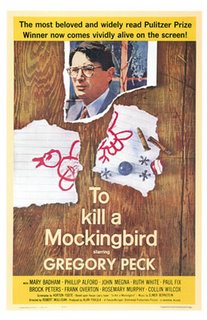
What is it about this film that puts it on so many favorites lists. Horton Foote’s masterful telescoping of Harper Lee’s frail, powerful novel? The fact that, as movie adaptations go, this is certainly one of the best? That it has an impeccably picked cast, directed to feel absolutely real, including three of the best child-performances in all of movies, by one of the best directors of actors, Robert Mulligan? The beautiful, fragile score by Elmer Bernstein, certainly contributes.

I remember seeing “
To Kill A Mockingbird” when I was seven years old, and not “getting it” much. I remember being annoyed with my Mom for trying to cover my eyes during the “scary” parts—although Robert Duvall as “Boo” Radley did genuinely creep me out back then (in fact, he still does, a bit). I didn’t “get” the dog-shooting (“He won’t kill a mockingbird, but he’ll sure-as-shootin' kill a dog!”) But I remember that it was a scary movie for a kid. In the film, the night was so dark, and any light cast spooky elongated shadows and trees moved and leaves rustled. The World seemed restless and alive when it should have been still and asleep. It was a world that, under the pretense of peace and calm, seethed with menace and dread just under the surface.

And that’s the key, I think. There seemed to be, in the movie, at least, a sense that the tremulous world was lurching and struggling to change—that the very earth was metamorphosing and demanding it, while the people entwined in that world, moved along, oblivious to the change, holding onto a complacent life that would inevitably end. At the same time, “Mockingbird” has the feel of nostalgia—the palpable sense that life flows through our fingers like sand, and that we’re always in danger of losing that life we hold precious.

But you don’t think of these things when you’re a child. Summers are endless. Life is eternal. If born into a nurturing, protecting household (and that is key) there is the illusion that the world is benign and all things are possible…under heaven.

Heaven is a concept easily grasped by a child. If you’ve been “good” in your life, as a reward after death, you go to a “good” place to spend Eternity. In the years of growth, a child struggles to understand its world and to assert itself in an environment it has no control over. In a world too complex to understand, the concept of Heaven is a comfort to a child. It’s simple. It’s uncomplicated. It’s black and white. Like Good and Bad.

Like integrity.


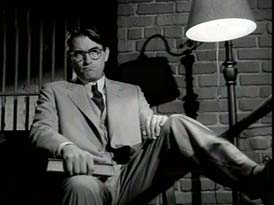
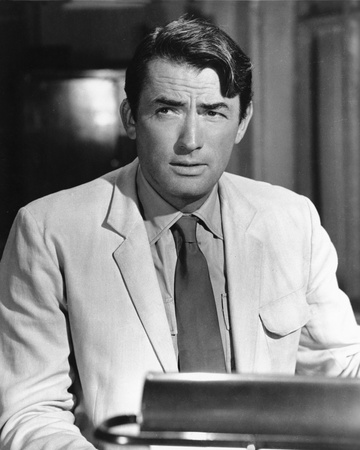
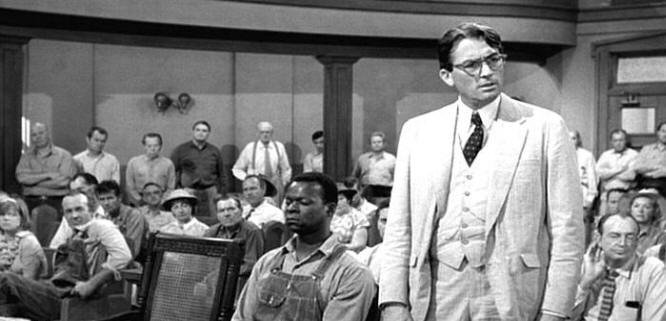
Atticus Finch (Gregory Peck) awaits a lynch-mob, that first to his initial dismay and then wonder is shamed and turned away by his own children. He shouldn't have wondered.

The children in “To Kill a Mockingbird” learn the world isn’t nearly as simple as they thought. That the Radley “kid” may not be the evil thing they whisper about in the dark before they go to sleep. That other peoples’ lives may not resemble their own. That their father is many things—but he is also fallible. Jem breaks down when Tom Robinson is convicted of raping a white woman, but I would doubt that he’s crying for Robinson. He’s crying for his father’s failure—a disappointment as palpable as his father being not willing to play football for the Methodists. Jem and Scout are too young to understand the idea of integrity. No, that's not quite accurate. They’re too young to understand the pressures of a world where integrity might be compromised. And they’re too young to understand that their father’s belief in right and good could actually cause them harm. But it is that integrity that makes their father dependable, despite the tragedies of the summer. It is that integrity in a fragile, changing world that will sustain and endure and remain a constant as sure as the north star in the void. And that echoes long in our minds at the end of the film with its last line of narration: “He would be in Jem’s room all night. An he would be there when Jem waked up in the morning.”

When the
American Film Institute held a vote for the cinema’s best hero, the honor did not go to the Sergent Yorks or the Skywalkers or the Bonds or any of the roles played by Eastwood, Willis or Schwarzenegger. It went to a character of gentle heroics who in the course of the movie only fires one shot, who does not raise a hand in anger, and with jaw set and quiet voice does what he knows to be right. It was a shock that Atticus Finch would be voted the greatest movie hero, but it was the best choice possible, and legitimized the idea of holding such a silly poll in the first place.


Stephen Frankfurt's evocative title sequence.
Music by Elmer Bernstein


Horton Foote died March 4th of this year. Robert Mulligan died right before Christmas last year. Brock Peters died in 2005. Peck, in 2003. My favorite actor in this and many things, Frank Overton, died in 1967. Survivors are William Windom (Prosecutor Gilmer), Robert Duvall (Arthur "Boo" Radley), Rosemary Murphy ("Miss" Maudie Atkinson), and the Finch kids.

And Harper.

Except for her one gentle novel that stood like a golden spike in the Civil Rights Era, Nelle Harper Lee has published no other novels, only a scattering of essays. Not a recluse, she merely avoids the public spotlight. She, in her shy ways, does no public speaking. She has said what she is going to say. And that should be enough.

Harper endures.

To Kill a Mockingbird
Goldfinger
Bonus: The Edge of Darkness

Tomorrow: Where were you?

Friday, May 8, 2009

Judgment at Nuremberg

"Judgment at Nuremberg" (Stanley Kramer, 1961) It was Katharine Hepburn who shepherded this film from its origins as an episode of "Playhouse 90" to this version as a three hour epic.* The movie is padded with shots of Spencer Tracy touring the city (still in rubble in 1960, twelve years after the judges trials at Nuremberg**), and background of the characters, including a chaste meeting of minds with a Nazi widow (Marlene Dietrich, still oozing mystery at the age of 60). Screenwriter Abby Mann makes the citizenry complicit in his expanded screenplay, despite their protestations of ignorance. And the military at the time of the trial was in the middle of the Berlin Airlift, their attention now turned to "the Bolsheviks" and cozying up to Germany for strategic advantage, casting the worth and even the result of the trial in question for political expediency. The movie is allowed much more cynicism than the Playhouse 90 broadcast, where the words "gas chambers" were subject to censorship by sponsor The American Gas Association.

The movie threatens to swamp itself with star-power but leavened it by Tracy disappearing into his role.
Maximilian Schell repeats his television performance (winning an Oscar in the process, as did Mann for his adaptation). Of the newcomers, the best performances are Montgomery Clift in face and body language denoting a characters damaged by the brutality of the Nazi regime. And Judy Garland, who'd always seemed like a raw nerve in her films, acts merely from the neck up—and that's all that's required. Not as controlled are Richard Widmark, whose prosecutor is a bit too demonstrative in private for a courtroom strategist, and Burt Lancaster, given a great speech but, a weakness of the actor, aware of it. Laurence Olivier was intended to play German Ernst Janning, but dropped out. I'm not sure that would have been an improvement, but it would have been interesting.

Kramer struggles with the material; he would later become an expert on courtroom directing. But here, he's more intent on making the drama look interesting with camera moves by circling witnesses and, most egregiously, using a fast zoom to zero in on a dramatic moment. It's used sparingly, but even that's too much for the material. He would learn to trust his actors and inherent drama of the scene to carry it.

But, "
Judgement at Nuremberg" manages to be something that eludes most Kramer films—it's a bit more timeless, especially in regards to the short-sightedness of chipping away at bedrock principles for today's political viability and the future's further erosion. One could be speaking of water boarding as torture in Abby Mann's summation speech.

Read it. Read the whole thing. But linger on the words after the picture below.


Judge Haywood: The trial conducted before this Tribunal began over eight months ago. The record of evidence is more than ten thousand pages long, and final arguments of counsel have been concluded.

Simple murders and atrocities do not constitute the gravamen of the charges in this indictment. Rather, the charge is that of conscious participation in a nationwide, government organized system of cruelty and injustice in violation of every moral and legal principle known to all civilized nations. The Tribunal has carefully studied the record and found therein abundant evidence to support beyond a reasonable doubt the charges against these defendants.

Herr Rolfe, in his very skillful defense, has asserted that there are others who must share the ultimate responsibility for what happened here in Germany. There is truth in this. The real complaining party at the bar in this courtroom is civilization. But the Tribunal does say that the men in the dock are responsible for their actions, men who sat in black robes in judgment on other men, men who took part in the enactment of laws and decrees, the purpose of which was the extermination of humans beings, men who in executive positions actively participated in the enforcement of these laws -- illegal even under German law. The principle of criminal law in every civilized society has this in common: Any person who sways another to commit murder, any person who furnishes the lethal weapon for the purpose of the crime, any person who is an accessory to the crime -- is guilty.

Herr Rolfe further asserts that the defendant, Janning, was an extraordinary jurist and acted in what he thought was the best interest of this country. There is truth in this also. Janning, to be sure, is a tragic figure. We believe he loathed the evil he did. But compassion for the present torture of his soul must not beget forgetfulness of the torture and the death of millions by the Government of which he was a part. Janning's record and his fate illuminate the most shattering truth that has emerged from this trial: If he and all of the other defendants had been degraded perverts, if all of the leaders of the Third Reich had been sadistic monsters and maniacs, then these events would have no more moral significance than an earthquake, or any other natural catastrophe. But this trial has shown that under a national crisis, ordinary -- even able and extraordinary -- men can delude themselves into the commission of crimes so vast and heinous that they beggar the imagination. No one who has sat at through trial can ever forget them: men sterilized because of political belief; a mockery made of friendship and faith; the murder of children. How easily it can happen.


There are those in our own country too who today speak of the "protection of country" -- of "survival." A decision must be made in the life of every nation at the very moment when the grasp of the enemy is at its throat. Then, it seems that the only way to survive is to use the means of the enemy, to rest survival upon what is expedient -- to look the other way.

Well, the answer to that is "survival as what?" A country isn't a rock. It's not an extension of one's self. It's what it stands for. It's what it stands for when standing for something is the most difficult!

Before the people of the world, let it now be noted that here, in our decision, this is what we stand for: justice, truth, and the value of a single human being.


* Probably to give her love and paramour Spencer Tracy another plumb acting role. His health (owing to his tendency to drink to excess) was always improved when he was working.

** Although shots of Richard Widmark driving through the city are obvious process shots.

Friday, November 21, 2008

Olde Review: The Sound of Trumpets

This Friday's ASUW films in 130 Kane at 7:30 pm are Ermanno Olmi's "The Sound of Trumpets" and John Schlesinger's "Midnight Cowboy." In a broad sense, both films deal with the death of one's dreams. But the approaches of the films and film-makers to that theme are very different, and so, too, are my reactions to them.

"The Sound of Trumpets" aka "Il Posto" (Ermanno Olmi, 1961) After a rather depressing day, I was in no mood to see a movie called "The Sound of Trumpets"—sounded like another war film to me.

But it is not a war movie: it's original title was "The Job," which wouldn't have been too thrilling a prospect, either. "The Sound of Trumpets" is a modest little Italian movie about a naive and old-fashioned young man names Domenico, who is gently shoved by his family into looking for a "life-long" job with an important firm.
And this film should be a nostalgic jog for anyone who has ever taken a test, gone job-hunting, had a crush, had a family, worked in an office, or gone to an office New Year's party. In other words, everyone should recognize and enjoy this film.

For me, it was like looking into a mirror, one that looks both inside and outside.
For we not only see Domenico's reactions to, say, a test he's taking, but also what he sees—the same things we look at, basically—the ceiling, the other test-takers, the lousy crud who finishes first, anything but the test. And it's all done with wit, subtlety, compassion and economy; at one point during the film a thoroughly irrelevant look at the lives of the other clerks whose jobs Domenico covets, is included for the bloody hell of it. But the segments do so much in so little time that one is thankful that its included, even if you are a trifle anxious to continue with the main story. I think you will be. I think you'll care about the people in this film because the director so obviously did. And a lot of important things are said in this film—about competition, about dreams, about wasted potentials, and about the "security" of a life-long job. I know this is a film you've never heard of, but it's definitely one you should see, because, folks...it's us.

Broadcast on KCMU-FM December 3rd and 4th, 1976

Or not. That's a little presumptuous to say.

I remember "Il Posto" being one of the best films I saw in that quarter, and I need to see it again for many reasons. The most important one is how it has held up over time. But the second most important is how it holds up compared to the mockumentary approach to similar situations, ala "The Office." My memory of "Il Posto" is of it being absurdly dry for a deliberate comedic effect, and far more formal than the hand-held "busy-ness" of any of the "Office" incarnations (it's gone international, if you hadn't heard). And with far more warmth and humanity than seen displayed in the American or British versions. Plus,
Olmi's vision places an emphasis on architecture and its relation to the figures in each landscape. I still recommend this movie, even if its less known than Olmi's most popular film 1978's "The Tree of the Wooden Clogs."

And it just goes to show what joys you can experience in the cinema, if you just give a film with a lackluster title a chance, depressing day or no.

Tuesday, September 2, 2008

Olde Review: One-Eyed Jacks

This was part of a series of reviews of the ASUW Film series back in the '70's. Except for some punctuation, I haven't changed anything from the way it was presented, giving the kid I was back in the '70's a bit of a break. Any stray thoughts and updates I've included with the inevitable asterisked post-scripts.

This Saturday's films in 130 Kane Are Marlon Brando's "One-Eyed Jacks" and Robert Altman's "McCabe and Mrs. Miller."

"One-Eyed Jacks" (Marlon Brando, 1961) This one's something of an oddity--it's the only film directed by the greatest "method" actor, Marlon Brando. But what you will see on the screen is really not the film that Brando made. You see, it's one of those stories where nothing really works right. Brando and a number of script-writers worked onthe screenplay for a couple of years. Stanley Kubrick was signed to direct and pulled out.* Then, Brando decided to direct it himself and shot a quarter of a million feet of film over a six month period at a cost of five million dollars. Supposedly, there was about 35 hours of film to edit down to a watchable size. Brando's cut was five hours long, but with some noticeable studio shooting, plot summaries were accomplished and got it down to its current two hours and twenty minutes. So it isn't totally Brando's concept.

What is there in those two hours and twenty minutes? A superbly acted film, based on a script that at times is intriguing and at times is dull cliche. It's a very wierd movie. It's wierd, but it does show that Brando certainly had an artistic eye for shots, camera angles, sequences that sometimes take the breath away. You'll also see excellent performances from a cast of Brando,
Karl Malden (before TV neutered him),** Katy Jurado, Slim Pickens, Pina Pellicer, Elisha Cook, and Ben Johnson..especially Ben Johnson.

Johnson first worked for
John Ford in his westerns and evolved into more than a great actor, but one of those genuine screen presences working in film today. When Johnson and another screen presence, Brando, play off each other in a scene, sparks fly across the screen. Those sparks were expected to fly between Brando and Jack Nicholson in "The Missouri Breaks," and never appeared. To see these two greats square off is one of the joys I had watching this film, and also, this film contains my favorite epitheit in all of cinema....

"Get up, you scum-suckin' pig!"

They just don't write 'em like they used to.

Broadcast on KCMU-FM on November 19th and 20th, 1975

Or over-write them. The parts that you can glean from the current cut of "One Eyed Jacks" (and no one is rushing to restore the full length version, certainly not Paramount Studios) suggest an idiosyncratic western with a gritty, grimy feel, which would have made it unique in the western-glut that was happening across theater and televison screens across America. Brando's fights were inelegant, and people looked like they got hurt. But the film is a cliche about Authority Figures and Oedipal Conflicts--Karl Malden plays a once-friend-turned-lawman named..."Dad." At one point, Brando's character is whipped in the street before a crowd of on-lookers, and if that doesn't convince you he's a Christ-figure, his tied outstretched arms just might.

Ulp! It starts to get so thick with things like that, you need hip-waders out in that desert.

* Kubrick says he quit because Brando was wasting a lot of time, and really wanted to direct it himself, so he moved on to a more worthwhile project.

** Malden was appearing in an American cop series called "The Streets of San Francisco," with a young actor of good parentage named Michael Douglas.


"Get up, you scum-sucking pig!" occurs at 3:55 in this video

Thursday, June 5, 2008

Olde Review: The Innocents

This was part of a series of reviews of the ASUW Film series back in the '70's. Except for some punctuation, I haven't changed anything from the way it was presented, giving the kid I was back in the '70's a break. Any stray thoughts and updates I've included with the inevitable asterisked post-scripts.

"The Innocents" (Jack Clayton, 1961) is based on Henry James' classic story "The Turn of the Screw" co-scripted for the screen by none other than Truman Capote. Both deal with the attempts of a nanny to break her two young charges of the psession imposed on them by their former nanny and the old gardener---both of whom died under mysterious circumstances. The beauty of the story is that it is never stated outright--the posession may just be a figmentof the nanny's sexually repressed imagination. And Deborah Kerr's sometimes feverish performance adds support to this argument. Add to the other side of the argument the eerily mature peformances by Martin Stephens and Pamela Franklin as the children. Ms. Franklin grew up to give equally mature and accomplished roles later in her career--her performance in "The Prime of Miss Jean Brodie" rivalled the Oscar-winning one by Maggie Smith.

A great deal of the credit of "The Innocents" goes to director
Jack Clayton who creates such a bloody eerie mood, in much the same way as Robert Wise did in "The Haunting." Clayton also, I think, has a bird fetish. We were treated to a lot of cruddy birds in Clayton's over-produced, over-publicized, under-acted version of "The Great Gatsby." But he does something neat here, there appear to birds all over the place--during the day, (and) at night, even.But you don't see them too often. They are merely a presence, like the two aberrations of the household. The horror is done so well, so subtley in "The Innocents," as opposed to the atrociousness of "The Exorcist." Who would have thought that the sight of a woman dressed in black, sitting among the reeds in the distant haze could throw such cold at your back and make the roots of your hair tingle? That's the beauty of "The Innocents," it does so much with so little, but when it pulls the stops out, the effect is damn near devastating.

Broadcast on KCMU-FM on January 21, 1977

Nothing to add, really. I wrote another review of "The Innocents" recently and it's remarkably the same.

Tomorrow (668-Neighbor of "The Beast"): "The Exorcist," in all its atrociousness.