Showing posts with label William Shatner. Show all posts

Tuesday, October 29, 2013

Incubus (1966)

Incubus (Leslie Stevens, 1966) A quick view of Incubus brings up two oddities: 1) it's famously filmed in Esperanto (to give it a more cultured air—it was filmed near Big Sur in California—and it also obfuscated any questions about the script when getting permission to film at a local mission, as nobody could read it; and 2) it looks like it's an episode of "The Outer Limits," albeit with satanic leanings and some implied sexuality about it.  Facts are, it is very much in the "Limits" area, directed by the show's creator Stevens, and employing cinematographer Conrad Hall and composer Dominick Frontiere from the series.  

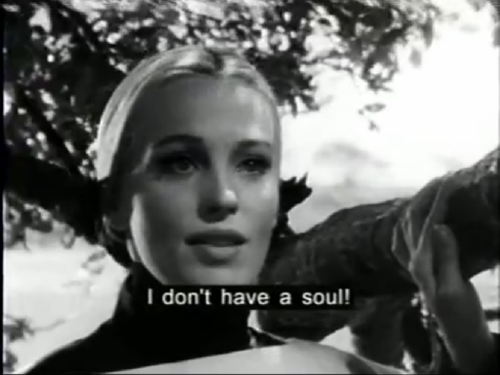
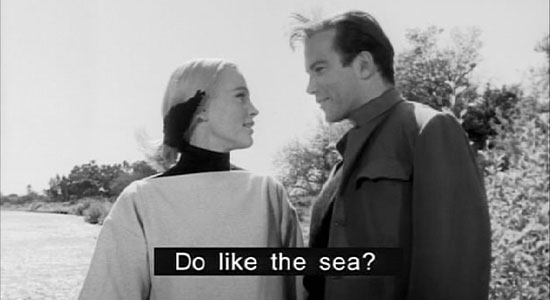
It also follows a typical "Limits" template, with a voice-over telling us we're in the village of Nomen Tuum (where the mayor is "Lorem Ipsum," I think) where, legend has it, there's a well that's a fountain of youth, curing all ills, and restoring beauty.  The rich and vain are attracted to Nomen Tuum to "test the waters," as it were, and thus are easy prey for a coven of satanic succubi who do that voodoo they do nearby.  The movie demonstrates with a drunken victim, lured by one of its members, Kia* (the alluring Allyson Ames, who was to become the third Mrs. Stevens) to the ocean, where she drowns him and is quite proud of it.  She tells the coven's leader Amael (Eloise Hardt) that just dragging lustful men to their deaths isn't very challenging so her next target must be a man of faith and strong will.  
Incubus came out the same year as Bergman's Persona.
I'd say "great directors think alike," but...
They choose war veteran Marc (William Shatner), who lives with his sister, Armdis (Ann Atmar), who lives down the road apiece on a farm that doesn't appear to grow anything, but where there's plenty of wood to chop. Kia wanders by, saying she's lost and Marc, nice guy that he is, offers to take her back, but not before the three discuss the fact that there's going to be an eclipse ...why, in mere moments!  Despite being warned by Marc that you could burn your eyes by looking directly at one, sister Arndis does it anyway just as Marc and Kia go wandering back to wherever Kia thinks she came from. This affords some shots of Arndis flailing around the farm, calling for Marc, while Kia attempts to seduce him and drag him down to the ocean.  Marc is all too willing to be seduced, but insists that they be married in the eyes of God before any further hanky-panky occurs ("hanky-panky" doesn't translate well in esperanto).

A visit to the nearby mission doesn't go so well, as Kia panics seeing crucifixes, religious statues, pews, and holy water, leaving Marc to wonder if she might be Unitarian, or something.  Then Arndis stumbles in, saying the darkened church makes her eyes feel better, and that sub-plot goes away.


But Kia decides that she wants revenge on Marc and so she and Amael call up an incubus (Milos Milos), who arrives writhing and muddy from out of the ground, and then things just go horribly, horribly wrong, both for Marc, Armdis and for the movie: Marc gets attacked, their farm is burned down, Armdis gets incubussed, and the movie gets padded with people roving around in the dark from the house to the mission to wherever the succubi go beddie-bye.  Stevens could make the slimmest of ideas stretch for 50 minutes on television, but here, there's a bit of padding that has more to do with atmospherics than it does with showing off the locations.  Done at a minimal budget, with just enough artiness to sell to Europe, and just enough suggested sex and horror to try and sell to the drive-in crowd seeing the horror films of Corman and Hammer, Incubus never lived up to its creators' expectations, receiving next to no exposure in the States, and was considered lost until a sub-titled copy was found in Paris—it's why the subtitles are burned in with a black background, obscuring the picture, but also the French sub-titles.   The film's at its best when "suggesting" (in the first half) and at its worst having to pay off the conceits (in the second half).  


And it's always fun to watch Shatner, here mere weeks before starting work on the original "Star Trek" television series.  One moment that makes me laugh is his speaking esperanto (which he does competently—Shatner is Shatner in any language) and feeling the need to gesture like an Italian.  It has its moments, though: flashes where you see something and then hit the remote to see if that was what you thought it was—for moments both perverse and absurd.


"Could we put a key-light right across the eyes?  Ya know, make it more dramatic?"


* pronounced Kye'-a, not Kee'-a (like the car).

Friday, May 8, 2009

Judgment at Nuremberg

"Judgment at Nuremberg" (Stanley Kramer, 1961) It was Katharine Hepburn who shepherded this film from its origins as an episode of "Playhouse 90" to this version as a three hour epic.* The movie is padded with shots of Spencer Tracy touring the city (still in rubble in 1960, twelve years after the judges trials at Nuremberg**), and background of the characters, including a chaste meeting of minds with a Nazi widow (Marlene Dietrich, still oozing mystery at the age of 60). Screenwriter Abby Mann makes the citizenry complicit in his expanded screenplay, despite their protestations of ignorance. And the military at the time of the trial was in the middle of the Berlin Airlift, their attention now turned to "the Bolsheviks" and cozying up to Germany for strategic advantage, casting the worth and even the result of the trial in question for political expediency. The movie is allowed much more cynicism than the Playhouse 90 broadcast, where the words "gas chambers" were subject to censorship by sponsor The American Gas Association.

The movie threatens to swamp itself with star-power but leavened it by Tracy disappearing into his role.
Maximilian Schell repeats his television performance (winning an Oscar in the process, as did Mann for his adaptation). Of the newcomers, the best performances are Montgomery Clift in face and body language denoting a characters damaged by the brutality of the Nazi regime. And Judy Garland, who'd always seemed like a raw nerve in her films, acts merely from the neck up—and that's all that's required. Not as controlled are Richard Widmark, whose prosecutor is a bit too demonstrative in private for a courtroom strategist, and Burt Lancaster, given a great speech but, a weakness of the actor, aware of it. Laurence Olivier was intended to play German Ernst Janning, but dropped out. I'm not sure that would have been an improvement, but it would have been interesting.

Kramer struggles with the material; he would later become an expert on courtroom directing. But here, he's more intent on making the drama look interesting with camera moves by circling witnesses and, most egregiously, using a fast zoom to zero in on a dramatic moment. It's used sparingly, but even that's too much for the material. He would learn to trust his actors and inherent drama of the scene to carry it.

But, "
Judgement at Nuremberg" manages to be something that eludes most Kramer films—it's a bit more timeless, especially in regards to the short-sightedness of chipping away at bedrock principles for today's political viability and the future's further erosion. One could be speaking of water boarding as torture in Abby Mann's summation speech.

Read it. Read the whole thing. But linger on the words after the picture below.


Judge Haywood: The trial conducted before this Tribunal began over eight months ago. The record of evidence is more than ten thousand pages long, and final arguments of counsel have been concluded.

Simple murders and atrocities do not constitute the gravamen of the charges in this indictment. Rather, the charge is that of conscious participation in a nationwide, government organized system of cruelty and injustice in violation of every moral and legal principle known to all civilized nations. The Tribunal has carefully studied the record and found therein abundant evidence to support beyond a reasonable doubt the charges against these defendants.

Herr Rolfe, in his very skillful defense, has asserted that there are others who must share the ultimate responsibility for what happened here in Germany. There is truth in this. The real complaining party at the bar in this courtroom is civilization. But the Tribunal does say that the men in the dock are responsible for their actions, men who sat in black robes in judgment on other men, men who took part in the enactment of laws and decrees, the purpose of which was the extermination of humans beings, men who in executive positions actively participated in the enforcement of these laws -- illegal even under German law. The principle of criminal law in every civilized society has this in common: Any person who sways another to commit murder, any person who furnishes the lethal weapon for the purpose of the crime, any person who is an accessory to the crime -- is guilty.

Herr Rolfe further asserts that the defendant, Janning, was an extraordinary jurist and acted in what he thought was the best interest of this country. There is truth in this also. Janning, to be sure, is a tragic figure. We believe he loathed the evil he did. But compassion for the present torture of his soul must not beget forgetfulness of the torture and the death of millions by the Government of which he was a part. Janning's record and his fate illuminate the most shattering truth that has emerged from this trial: If he and all of the other defendants had been degraded perverts, if all of the leaders of the Third Reich had been sadistic monsters and maniacs, then these events would have no more moral significance than an earthquake, or any other natural catastrophe. But this trial has shown that under a national crisis, ordinary -- even able and extraordinary -- men can delude themselves into the commission of crimes so vast and heinous that they beggar the imagination. No one who has sat at through trial can ever forget them: men sterilized because of political belief; a mockery made of friendship and faith; the murder of children. How easily it can happen.


There are those in our own country too who today speak of the "protection of country" -- of "survival." A decision must be made in the life of every nation at the very moment when the grasp of the enemy is at its throat. Then, it seems that the only way to survive is to use the means of the enemy, to rest survival upon what is expedient -- to look the other way.

Well, the answer to that is "survival as what?" A country isn't a rock. It's not an extension of one's self. It's what it stands for. It's what it stands for when standing for something is the most difficult!

Before the people of the world, let it now be noted that here, in our decision, this is what we stand for: justice, truth, and the value of a single human being.


* Probably to give her love and paramour Spencer Tracy another plumb acting role. His health (owing to his tendency to drink to excess) was always improved when he was working.

** Although shots of Richard Widmark driving through the city are obvious process shots.

Friday, April 17, 2009

Now I've Seen Everything: Star Trek

In which the author, having seen everything that needs to be on the subject, draws some conclusions about the series, or director.

Lord knows how many times I've seen each episode of The Original Series, but I believe it approaches the Sagan-ian concept of "billyuns and billyuns." But, I'll state this up-front: "Star Trek, the Movie Series" is only somewhat similar to "Star Trek, the Television Series." Whereas TOS was the crew dealing with a space phenomenon or political crisis, The Movie Series was an extended soap opera that just happened to coincide with space phenomena, usually man-made or man-manipulative. If the infinity of Space is not enough for screen-writers, then what's a Heaven for?

Sulu, prepare for time-slingshot.

"I: The Motion Picture" (Robert Wise, 1979) The success of "Star Wars" in 1977 scuttled a second "Star Trek" series (without Spock and possibly with Kirk) that Paramount was hoping to release as a syndicated show (that experiment held off until "ST:TNG"), and putting it on the front-burner as a Major Motion Picture. Fans were ecstatic, but the show was in trouble. First writer-director Philip Kaufman jettisoned an escape pod working with creator Gene Roddenberry who had Executive Producer rights over the show. Then, Roddenberry worked on a script—one to have been used as the "STII" pilot. It was a last minute decision,* plus they needed a director--all this with a drop-dead delivery date that was already established and would not move. The chronometers were still running.

Veteran director
Robert Wise, not unfamiliar with big movies and sci-fi, stepped in and started wrestling the bag of Rigelian cats: getting reluctant "Spock" Leonard Nimoy to commit to it, and whatever Nimoy got, Shatner had to have, too. Neither of them liked the script, which Roddenberry kept changing to no one's satisfaction. Writer Harold Livingston was hired to make changes, which Roddenberry would re-write, which Livingston would re-re-write. Pretty soon, the writers were not talking to each other and actively working against each other. Petulance on and off-screen was the order of the day, but Wise managed to get the filming done, only to find that the sfx group hired to do the extravagant effects was still in R&D mode. They were "jettisoned", and Paramount reached very deep into their pockets to secure the two most prominent effects men working at the time: John Dykstra (who'd supervised "Star Wars") and Douglas Trumbull (who'd done the same for "Close Encounters of the Third Kind"). The two whizzes took half a film apiece and began the tedious work of doing all the effects, while composer Jerry Goldsmith began composing an epic score for scenes he couldn't see.

They made it. But barely. Audiences watching "
Star Trek: The Motion Picture" opening weekend probably didn't realize when they saw a splice in the first reel that it had only been made, physically into each reel, that week, and "shipped wet" as they say. There were no screenings of "Star Trek: The Motion Picture" before its debut. Indeed, very few people had seen it at all.

What they would have found was
a strangely starchy movie that displayed dazzling effects (that went on for a bit too long), a bloodless screenplay, one of William Shatner's most self-centered performances (and that's saying something), and an odd off-kilter rhythm that had no momentum...and felt like nobody had watched it all the way through.

Because no one had. Wise would barely mention the film later in his career, revisiting it only to tighten, and
switch-out new digital effects for what didn't work the first time around. There was some improvement, but not much. Although "Star Trek: The Motion Picture" is closer to its roots than the other films in the series, it's dramatically inert, with long sections of "space-sightseer" scenes gazing at ships and phenomenon. Jerry Goldsmith's music does what it can to goose up the energy (and does—it became synonymous with "Star Trek"), but TMP is bloodless, as drained of color and imagination as the gray jump-suits the crew was shoe-horned into.


"II: The Wrath of Khan" (
Nicholas Meyer, 1982) The first "Star Trek" movie did fine at the box-office, but was deemed a disaster by the Paramount brass, expecting revenues along the lines of "Star Wars." Roddenberry was demoted to "Consultant" status, plans for a follow-up (there were no plans for a continuing series) green-lit only on the condition that it could be done cheaply and with a tighter reign over the entire Enterprise. The solution was a television exec Harve Bennett, who slashed budgets, prepped a television crew to film and scoured the Original series for some kind of story. He found it in the Eugenics War episode, "Space Seed," guest starring Ricardo Montalban as rebel leader Khan Noonien Singh, who led a devastating Civil War on Earth and was exiled with his remaining followers to space in suspended animation.
Montalban was enthusiastic, but worried he might play it too much like his then-current television role of Mr. Roarke on "Fantasy Island." The cast was brought back, even Nimoy—with the enticement of having a great death scene, the leak of which created a howl of protests among "Trekkies."

To direct,
Bennett
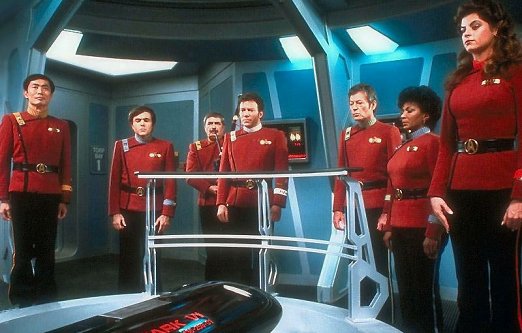
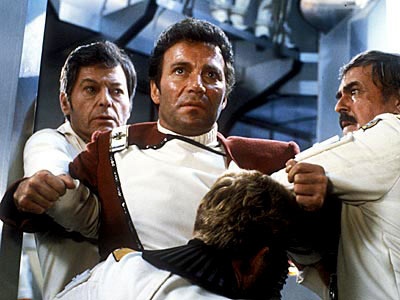
acquired a writer-in-need-of-a-director's-gig, and Nicholas Meyer, best-selling author of "The Seven Percent Solution" and writer-director of the H.G. Wells-Meets-Jack the Ripper yarn "Time After Time," filled the bill admirably, even heroically, despite the fact that, like Bennett, he'd never watched an episode in his life. Meyer refined a script from a handful of screenplays "with some good ideas," to breathe more life into the characters and make the story personal. The result was a coming-of-age movie of sorts for Captain Kirk (William Shatner), as he suffers through a less-than-celebratory birthday and must confront a series of past regrets.
But
the blood-and-thunder comes from the Clash of Ego's between Khan and Kirk, both driven by revenge and hatred. The two actors have rarely been better: Montalban, quietly disturbing and hissing like a snake, and Shatner, blustery and over-the-top, but able to milk scenes less-checked actors might let slip by. The rivalry is palpable, despite the fact that the two actors never appear on the same stage, or act against each other—a technical challenge that nobody seems to notice, given the impressive results on the screen.

"The Wrath of Khan" (retitled from "
The Vengeance of Khan" as a courtesy to George Lucas who was shooting "The Revenge of the Jedi" (sic) at the time) became a huge hit with Trekkies and general audiences and plans were immediately put in place to create a follow-up.


"
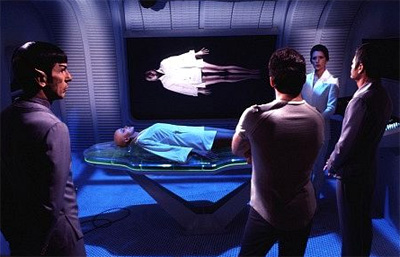
III: The Search for Spock" (Leonard Nimoy, 1984) The problem was...Spock was dead at the end of STII. And it was a really good death scene—audiences responded to it. But, seeing the success the movie had with preview audiences, Bennett (over Meyer's objections) constructed a coda that held out hope that Spock might still be alive in the photon-sarcophagus lying on the Genesis planet. And as bait to the recalcitrant Nimoy, Bennett held out the chance to direct the third "Star Trek" film. Nimoy heartily agreed, the novice director having two advantages—he knew "Star Trek" and he wouldn't have to appear until the end of the film.
The results were a bit stodgy, but Nimoy proved to have a good pointed ear for dialog, and was generous in spreading the story around through the acting company—everybody got a good "bit" in the film, which was more of a re-visitation of the "Wrath of Khan" and dismantling the story infra-structure that it built. By the end of III, things were a lot simpler in the "Star Trek" universe, though not necessarily for the better. III was a bit of a re-hash, continuing the soap story-line from II, and not invoking the sense of wonder and exploration that was the hallmark of the series. "Star Trek" took a small step down on this one. But it would leap forward warp-speed.
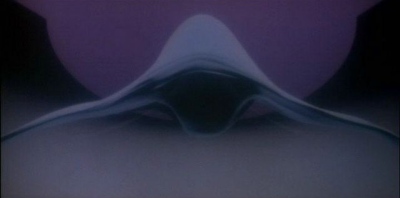
"IV: The Voyage Home" (Leonard Nimoy, 1986) Okay, Spock's alive, the stolen Enterprise destroyed and the mutinous crew under Admiral Kirk is being hunted by Starfleet. What to do? Turn themselves in. But when they get back to Earth, the planet is under attack by....a big black tube. The crew puzzles out that the thing is looking for whales, long ago extinct, and so to save the Earth, the Enterprise goes back in time to bring back humpback whales and assuage the...tube.

Sounds dumb.
But it works like gang-busters. The script—a collaboration between Bennett and Nicholas Meyer (Meyer did the funny time-travel section) has a grand time making the Enterprise crew fish out of water in the backwards 1980's, satirizing current society, and letting the actors make the most of the comedy. Nimoy's directing is clean and stays out of the way. And he keeps the movie fun and gee-whiz all the way through. Audiences responded with enthusiasm, making "The Voyage Home" the most profitable of the "Star Trek" movies. Paramount had their franchise, and was beginning production of a follow-up series with Roddenberry for syndication. What could go wrong?


"V: The Final Frontier" (William Shatner, 1989) It seemed only natural that if Nimoy was given a chance to direct a "Star Trek" movie, that Shatner be given the opportunity as well. Quid pro quo. Which is Andorian for "Let's turn the asylum over to the craziest inmate!"

The script tries for the breeziness of IV
and comes away seeming juvenile in tone, and as the actors were at this point in their 50's, it seemed sadly giddy and embarrassing. The other actors are given demeaning jokes to pull off—navigators Sulu and Chekhov get lost in the woods, and Engineer Scott knocks himself out walking into a support beam. Shatner's recently demoted Captain Kirk has no such problems, but has such brio that he debates "God;" "Why would 'God' need a star-ship?" Why, indeed? Everything about this exercise is sub-par—the script, the performers, the sets, the un-special effects. This one entry nearly scuttled the franchise (producer Bennett, given a cameo in this film, was petitioning jettisoning the old crew and starting afresh with a "Starfleet Academy" idea—hold that thought), so Paramount went to a fall-back position.


"
VI: The Undiscovered Country" (Nicholas Meyer,
1991) The studio asked Nimoy to spear-head one last "Trek"—Nimoy had parlayed his "Trek" success with two movies, "Three Men and a Baby" and "The Good Mother," one a huge success, the other a controversial downer (probably unfairly--I haven't seen it). Nimoy was savvy enough—and humble enough—to tread the rocky shoals of warp-speed ego's and planet-sized demands of the franchise, and bring back Nicholas Meyer to helm it. "Why Would God Want a Starship?" was the crux of V. "Only Nixon Could Go to China" was the basis of VI: where Captain Kirk is the one man in the Universe to broker a peace between a suspicious Federation of Planets and the traditional heavies, the Klingons.
Meyer's smartest move was to separate Kirk (the attention-needy Shatner) and Dr. McCoy (the late DeForest Kelley) from the rest of the cast so that everyone is given moments to shine—even Sulu (George Takei) is given his own command. Plus, the movie series gets its strongest guest star in Christopher Plummer, delightedly chewing the futuristic scenery. ILM is back to bring the FX back to top-shelf. And some minor screen-time is given to Kirk and Spock musing about their own usefulness. In fact, Paramount had already developed plans to ditch this crew and begin producing films featuring the very popular "Next Generation" cast.

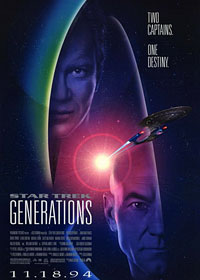
"VII: Generations"
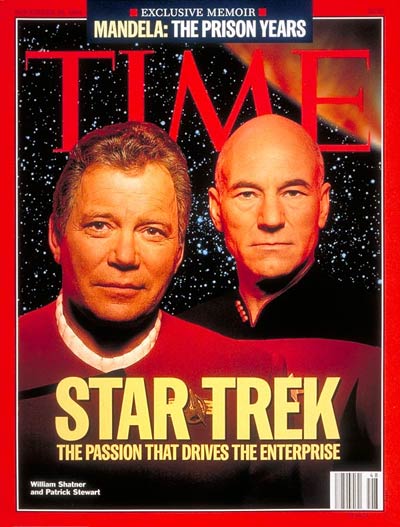
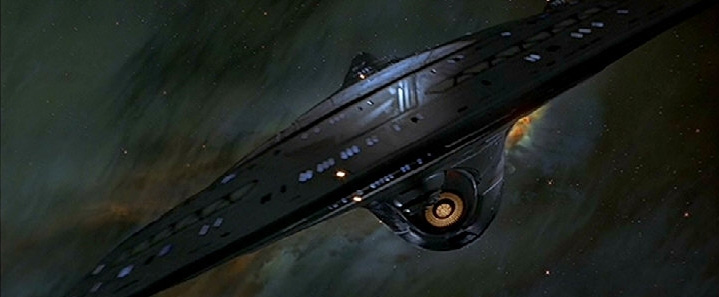
(David Carson, 1994) A clean slate, sort of. Producer Harve Bennett was gone. TNG producer Rick Berman was "in." Nimoy and Meyer moved on. But on the heels of the production of the "Next Generation" series finale, came the first "Next Generation" movie.** And it is a classy affair (Time Magazine put it on their cover!). Cameos by Scotty (the late James Doohan)and Chekhov (Walter Koenig) to start things off, to accompany a prologue of Captain Kirk (William Shatner) as reluctant witness to the launch of the Enterprise-B. This introduces a cosmic thread/Nexus that destroys things but grants the destroyed their heart's desire....

Eh? Say that again...slowly.

Dr. Soren (
Malcolm McDowell...really good at playing pathetically manic, or is that maniacally pathetic?) is a scientist teaming with ex-pat Klingons to capture the Nexus and make it his own private Valhalla, no matter how many civilizations are wiped out in the space-time (as if anything could stop it!)

The Enterprise-D, helmed by
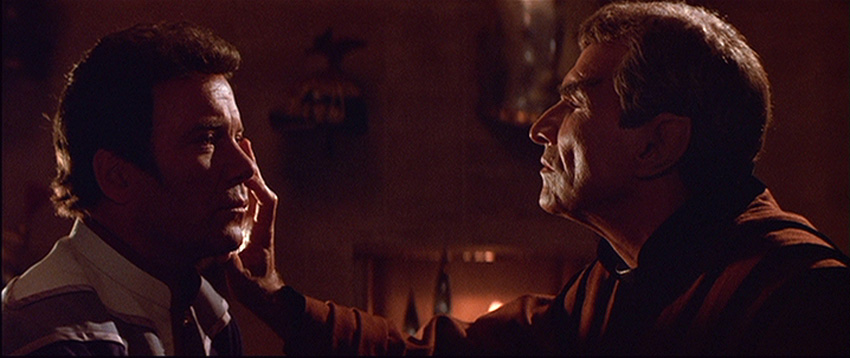
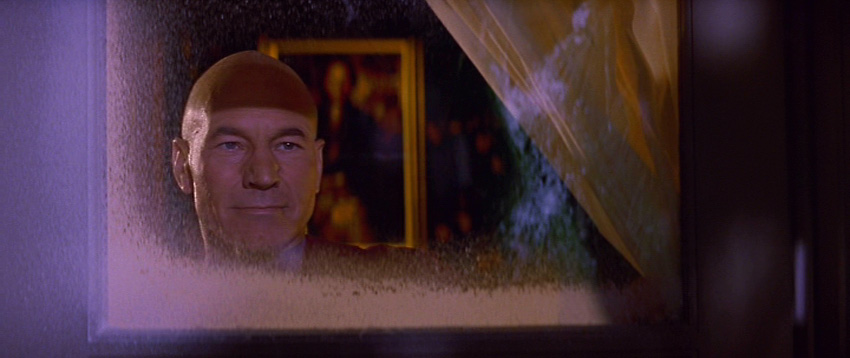
Captain Jean-Luc Picard (the cerebral, invaluable Patrick Stewart) must out-wit Soren, but Picard is caught in the Nexus (and before you can say "Didn't I see this in the original series episode "This Side of Paradise?" and we must all live in our own private Purgatories) and whisked off to his heart's desire, which would appear to be a stable family life with a perpetual Dickensian Christmas. He's shaken out of it by handy crewman-living-outside-the-plot-device Guinan (Whoopi Goldberg) to take things back to reality, back in time, and stop Soren. Fortunately, Captain Kirk's fantasy is right next door (it involves a rustic farm, horses, and chopping pre-scored wood-blocks) and the two Captains team up against the Bad Doctor.

Shatner gets his dream come true—Kirk dies, is resurrected and dies heroically on-camera in the same movie (Stick it, Nimoy!)—
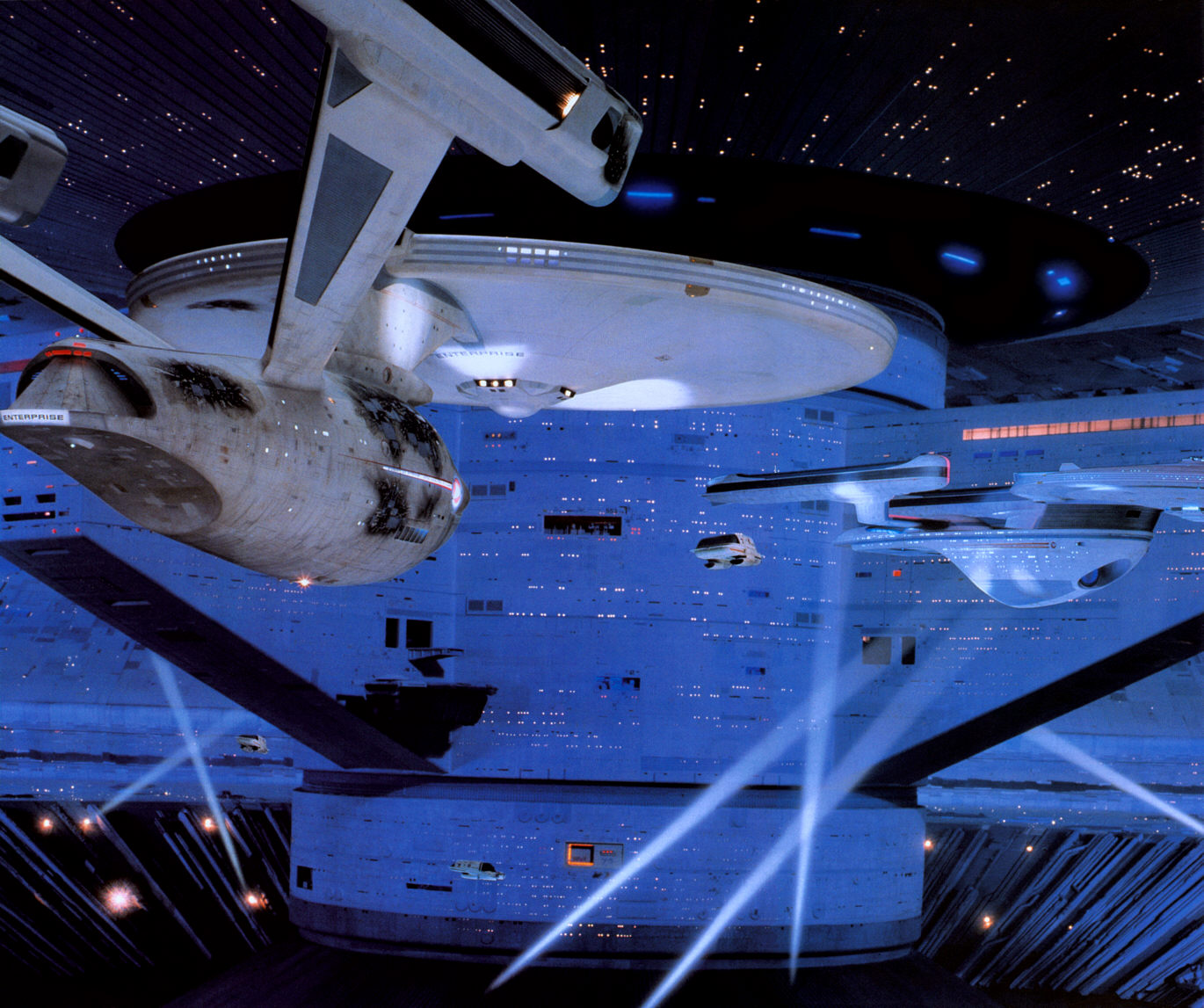
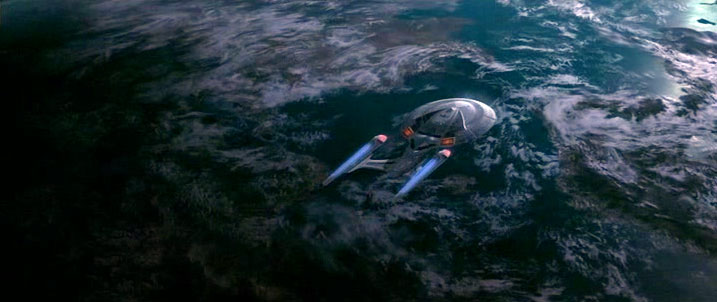
the Enterprise gets destroyed (great sequence of the saucer section crash-landing on a planet). "Generations" points out the flaws in trying to shoe-horn "The Next Generation" crew into the "Star Trek" movie format: just as the Original Series was about ideas and Cosmic Concepts and the movies about Relationships and Action, "The Next Generation" cerebralness doesn't translate well when dumbed down to action set-pieces. The TNG actors were better at knitting their brows than duking it out. Plus, the actors were all pretty mature when the movies started, so having them run around dodging phaser blasts seems lame. Still, "Generations" seemed to break the curse of the even-numbered "Trek's" being good, and the odd ones being bad—as over-simplified as that summary is.


"VIII: First Contact" (Jonathan Frakes, 1996) The first totally "Next Generation" movie is still an exercise in nostalgia. The villains (and by this time, the movies are supposed to have moustache-twirling villains) are the Borg—a neat little concept from the TNG series, an assimilating marauder-race, part human part machine, interdependent on a hive-mind. Except the writers, Ronald D. Moore and Brannon Braga, take it a bit too literally, giving the Borg a "Queen" (which nullifies part of the Borg "specialness" and gives them an instant weakness). The just-commissioned Enterprise-E must go back in time (again?!) to stop the Borg from undoing the key Earth event that established the United Federation of PlanetsZephram Cochrane's first test-flight of the the Phoenix using warp-technology, which, in turn led to the first contact Earth had with an alien species. And just as Nimoy got his chance to direct, The next generation's second-in-command, Jonathan Frakes, who'd directed some of the more intricate TNG episodes, directed "First Contact" with a fine balance between drama, horror and comedy. "First Contact" would prove to be the best of the "Next Generation" films, filling in a lot of "Trek" back-story, while having fun de-bunking myths, while giving the entire cast something to do and finding room to guest-star James Cromwell, Alfre Woodard and Alice Krige (and two quick cameo's from cast-members of the "Trek" series "Voyager"). Ambitious in scope and epic in execution, "First Contact" would prove to be a tough act to follow.

"IX: Insurrection"(Jonathan Frakes, 1998) More in line with traditional "Next Generation" storylines, "Insurrection" feels like a bit of a re-tread. The story concerns a "Fountain of Youth" planet that one of those slimey Federation diplomats (Anthony Zerbe) is trying to requisition in trade negotiations with a youth-obsessed bad guy (F. Murray Abraham). It's up to Picard and co. to help the planet's citizens and go against Starfleet's imperialist wishes. Frakes again directs and he's just as assured, but the script (by TNG stalwart Michael Piller) is sub-par and ends with another Picard-dukes-it-out sequence, which is never a good idea. Plus, it's not a good idea to have a "Fountain of Youth" planet when the crew is noticeably agingincluding unageable android Data (Brent Spiner). A weak entry, it was chalked up to the "odd/even" phenomena and plans were made for another movie.


"X: Nemesis" (
Stuart Baird, 2002) John Logan, Academy award winning writer of "Gladiator" *** wrote the script for "Nemesis" (with a lot of input from Brent Spiner), which has the crew fighting renegade Romulans (which have suddenly grown a parallel race of bat-like humanoids personified by the impressive Ron Perlman) led by the supposed clone of Captain Picard himself (Tom Hardy). Why this should matter is never made clear, but motivation and character are all a bit murky in this installment which doesn't seem to gell at all. Picard's actions at the end are inexplicable and Data sacrifices himself for the good of the ship. Everyone mourns. So sad....

But...he's an android. He's a robot. It seems a bit silly, like feeling bad for your beloved Chrysler when you have to tow it to the junkyard.
Besides, Spiner hedged his bets with a spare-parts version which has conveniently been provided.
It seems very much like a transitional "Trek" story—Riker and Troy (Marina Sirtis) are married and he gets his own command. Wedding bells are breaking up that old crew of mine. But some sequences feel cheap and unplanned and director Stuart Baird (who is a hell of a good editor) is a bit out of his depth tying it all together. Box office results for this one were far below expectations, and the voyages stopped at X. Inspiration seemed to have dried up, given a universe of possibilities. Paramount, having trouble maintaining anything franchiseably dependable, desperately needed something to cold-start the warp engines.

Whither "Star Trek?" Well, Harve Bennett long ago had the idea of firing all the actors and re-starting the franchise from scratch at Starfleet Academy. With the deaths of DeForest Kelly, James Doohan and Majel Barrett, it seemed the time was right to re-boot the franchise ala "Batman" and James Bond, with fresh blood. Time will tell, as "Star Trek" goes back in time once again...this time, to save itself.


XI: Star Trek (JJ Abrams, 2009) Will it revive one of Paramount's major tent-pole series (and does Paramount, given the way it keeps dropping the dilithium crystal-ball, deserve that?) God, make it so.


* Harlan Ellison on Tom Snyder's "Tomorrow" Show told a great anecdote about he and Roddenberry going up to Studio head Michael Eisner, who was rejecting story ideas about time-travel, Adam and Eve, dinosaurs ("It's gotta be bigger!" he'd always say). Ellison went into a spiel about a story where The Enterprise finds God. No--really finds God. Eisner paused. "Not big enough."
** Indeed, "Generations" began filming the week after the series wrapped, with only a week-end break.
*** Which, if I remember Ridley Scott and Russell Crowe correctly, went into production without a complete script!