Showing posts with label Richard Widmark. Show all posts

Wednesday, May 29, 2013

Kiss of Death (1947)

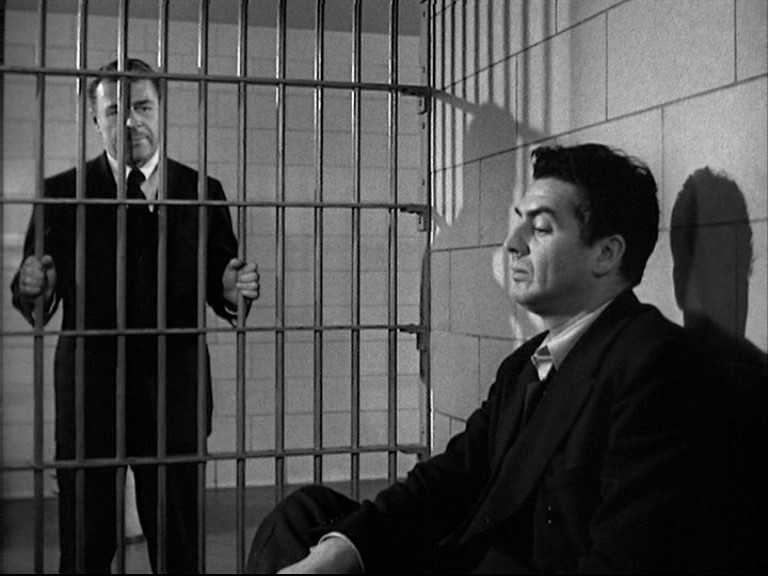
Kiss of Death (Henry Hathaway, 1947) Another of Henry Hathaway's neo-realist film noir's that aped the post-war Italian film penchant for shooting dark themes in real locations without glamour and emphasizing the grit.  This one, about the rise and fall and rise of heist-criminal Nick Bianco (Victor Mature), starts out in the sky-scrapers, jail-houses, and police offices that reverberate with the realistic sound that you can't acquire in a sound-baffled soundstage, but once the mayhem starts, the film scurries back to the safety of studio sets.  It's rough in the mean streets of noir.  Safer to make your own.

Bianco is an ex-con who can't find a job, and with a wife and two kids to support, he decides to make his own work—robbing a jewelry business in downtown Manhattan.  The job goes South and he ends up on the street with a police bullet in his leg and a stretch awaiting him at the gray-bar hotel.  He's offered a chance by assistant D.A. Louis D'Angelo (Brian Donlevy) to supply evidence on his cronies, but Bianco sticks to the criminal code—he won't squeal, sing, or rat, even when D'Angelo offers him an early parole so he can see his kids.  But Bianco won't bend.  His family is being "taken care of" by his sheister of a lawyer (Taylor Holmes), who visits him in prison to keep tabs on Bianco's loyalty.

But, in prison, Bianco gets wind that things aren't going so well.  And a visit to the prison library newspaper galleys tells him his wife has committed suicide, his kids are now orphans, and his silence has bought him nothing.

Hathaway's direction is no-nonsense throughout, but stylistic, anyway, and the scenes in the initial robbery, in the D.A.'s office and the lock-up have a drab, utilitarian look to them—the robbery has a nice touch in it, as the crooks' target is on the 44th floor of a Manhattan skyscraper, and the post stick-up elevator ride (with plenty of stops) provides a particularly teasing kind of tension.  Mature is fine, Donlevy's abilities aren't taken advantage of, and there are bit parts by Karl Malden and one of my character actors, the short-lived Millard Mitchell (who played Gene Kelly's producer buddy in Singin' in the Rain).

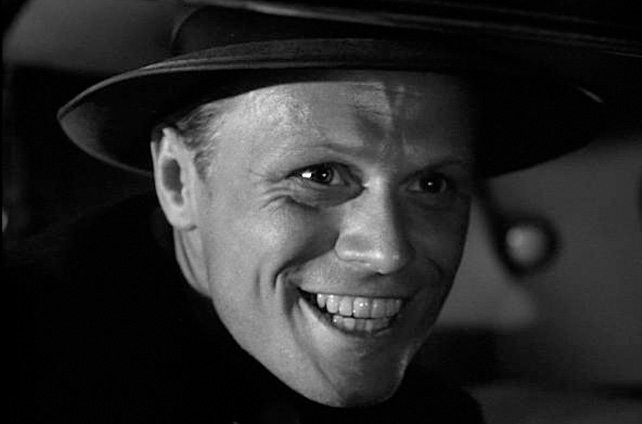
But Kiss of Death is also the feature debut of Richard Widmark, who plays the cheap gangster killer Tommy Udo.  You don't see him kill too many people, but one of them is indelible in its cruelty and vicious enthusiasm.  Widmark's performance is amazing, looking like a wire-thin Dan Duryea, with Cagney's ability to hold the eye in every scene he's in.  His dialogue isn't the greatest (even though the script is by Ben Hecht and Charles Lederer) and limited, and repeated over and over, but Widmark punctuates it with a goonish laugh that implies a sarcastic inner amusement that he knows he's stringing you along.  Hathaway, knowing what he was getting from the young actor, pulled out all the stops for his performance.  There's one scene where someone's waiting for udo, who's holding court in a curtained-off restaurant back-room.  Hathaway holds on the curtain, elongating the wait, then cuts to a close shot of the part in the curtains, where all you can see is the glint in Udo's eye before he gets up and makes his way to the camera,  It's an amazing shot and one that shows the director's confidence in his young actor's ability to hold an audience's attention, even when he isn't actually seen.


It's curtains for Widmark's Tommy Udo


Tuesday, August 14, 2012

The Bedford Incident

The Bedford Incident (James B. Harris, 1965) A veritable Bartlett's fills my head after seeing The Bedford Incident.  For instance, the astronaut's description of his job as "98% tedium punctuated by moments of sheer terror," and Elwood P. Dowd's "You can be 'oh-so-smart' or 'oh-so-pleasant'—I recommend "pleasant."  Then, because the story is basically, "Moby Dick in The Cold War," there are all sorts of Melville quotes...and one bad joke: "Cook 'em, Dan-O."

It's that last one that sticks, though.  The Bedford Incident is, basically, a terrible, terrible joke with a possible several mega-tonnage punchline.  And director James B. Harris, who before making this film was Stanley Kubrick's film-making partner, can't have missed the thought as his ex was making an out-and-out comedy of errors out of the nuclear arms race.  

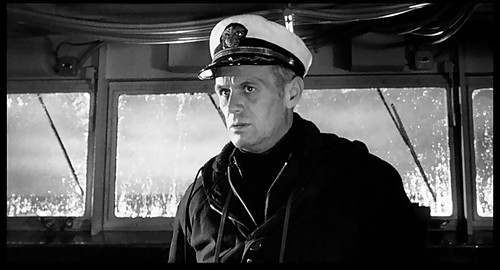
But where that one took to the air, The Bedford Incident plays out at sea in a cat-and-mouse game between a Soviet nuclear sub and a naval destroyer.  In command is Captain Eric Finlander (Richard Widmark, steely with just a touch of baleful twitchiness that goes full-on berzerkoid in an interview), a determined commander who takes enormous pride in the proficiency of his crew, and in the hunt and pursuit of his targets.  As an advisor is a former Nazi U-boat commander Wolfgang Shrepke (Eric Portman), who was responsible for the most tonnage (ours) sunk during the second World War.    Also on board is reporter Ben Munceford (Sidney Poitier), who serves as an exposition conduit and Royal Pain In The Ass.  Among the crew are Martin Balsam as the ship's new doc, James MacArthur as a too-eager ensign, Wally Cox as the sonar bat, and if you're watching early and quickly, there's a young Donald Sutherland as a garbage analyst—garbage being clues to conditions on the enemy boat, and age-analysis gives tracking position and history.

It shows how extreme the measures are on the Bedford, how detail oriented, how precise, how strategic and how puckered the thought processes go into keeping an eye on the enemy.  And once found, Finlander will pursue chasing Soviet subs out of territorial waters, even forcing them to stay underwater until they're desperate for air, provoking confrontation.  When your Nazi adviser tells you he's scared of your methods, it means you might be going so overboard as to pro-actively lower the life-rafts.

If you're immersed at all in pop-culture, you can see elements of Bedford in such disparate strategy plays as "Star Trek" and The Hunt for Red October.  And such gamesmanship is all well and good in limited skirmishes.  But, when the arsenal is nuclear?  Do you really want a cigarette in a room full of gasoline?  

No, and that the game is played despite the mega-stakes makes the movie and its characters seem not just petty, but a little dim for all the talk of brilliance.  The point of hubris is well taken, but the point was better made as an out-and-out black comedy about short-term, selfish interests in the face of global catastrophe.

Friday, May 8, 2009

Judgment at Nuremberg

"Judgment at Nuremberg" (Stanley Kramer, 1961) It was Katharine Hepburn who shepherded this film from its origins as an episode of "Playhouse 90" to this version as a three hour epic.* The movie is padded with shots of Spencer Tracy touring the city (still in rubble in 1960, twelve years after the judges trials at Nuremberg**), and background of the characters, including a chaste meeting of minds with a Nazi widow (Marlene Dietrich, still oozing mystery at the age of 60). Screenwriter Abby Mann makes the citizenry complicit in his expanded screenplay, despite their protestations of ignorance. And the military at the time of the trial was in the middle of the Berlin Airlift, their attention now turned to "the Bolsheviks" and cozying up to Germany for strategic advantage, casting the worth and even the result of the trial in question for political expediency. The movie is allowed much more cynicism than the Playhouse 90 broadcast, where the words "gas chambers" were subject to censorship by sponsor The American Gas Association.

The movie threatens to swamp itself with star-power but leavened it by Tracy disappearing into his role.
Maximilian Schell repeats his television performance (winning an Oscar in the process, as did Mann for his adaptation). Of the newcomers, the best performances are Montgomery Clift in face and body language denoting a characters damaged by the brutality of the Nazi regime. And Judy Garland, who'd always seemed like a raw nerve in her films, acts merely from the neck up—and that's all that's required. Not as controlled are Richard Widmark, whose prosecutor is a bit too demonstrative in private for a courtroom strategist, and Burt Lancaster, given a great speech but, a weakness of the actor, aware of it. Laurence Olivier was intended to play German Ernst Janning, but dropped out. I'm not sure that would have been an improvement, but it would have been interesting.

Kramer struggles with the material; he would later become an expert on courtroom directing. But here, he's more intent on making the drama look interesting with camera moves by circling witnesses and, most egregiously, using a fast zoom to zero in on a dramatic moment. It's used sparingly, but even that's too much for the material. He would learn to trust his actors and inherent drama of the scene to carry it.

But, "
Judgement at Nuremberg" manages to be something that eludes most Kramer films—it's a bit more timeless, especially in regards to the short-sightedness of chipping away at bedrock principles for today's political viability and the future's further erosion. One could be speaking of water boarding as torture in Abby Mann's summation speech.

Read it. Read the whole thing. But linger on the words after the picture below.


Judge Haywood: The trial conducted before this Tribunal began over eight months ago. The record of evidence is more than ten thousand pages long, and final arguments of counsel have been concluded.

Simple murders and atrocities do not constitute the gravamen of the charges in this indictment. Rather, the charge is that of conscious participation in a nationwide, government organized system of cruelty and injustice in violation of every moral and legal principle known to all civilized nations. The Tribunal has carefully studied the record and found therein abundant evidence to support beyond a reasonable doubt the charges against these defendants.

Herr Rolfe, in his very skillful defense, has asserted that there are others who must share the ultimate responsibility for what happened here in Germany. There is truth in this. The real complaining party at the bar in this courtroom is civilization. But the Tribunal does say that the men in the dock are responsible for their actions, men who sat in black robes in judgment on other men, men who took part in the enactment of laws and decrees, the purpose of which was the extermination of humans beings, men who in executive positions actively participated in the enforcement of these laws -- illegal even under German law. The principle of criminal law in every civilized society has this in common: Any person who sways another to commit murder, any person who furnishes the lethal weapon for the purpose of the crime, any person who is an accessory to the crime -- is guilty.

Herr Rolfe further asserts that the defendant, Janning, was an extraordinary jurist and acted in what he thought was the best interest of this country. There is truth in this also. Janning, to be sure, is a tragic figure. We believe he loathed the evil he did. But compassion for the present torture of his soul must not beget forgetfulness of the torture and the death of millions by the Government of which he was a part. Janning's record and his fate illuminate the most shattering truth that has emerged from this trial: If he and all of the other defendants had been degraded perverts, if all of the leaders of the Third Reich had been sadistic monsters and maniacs, then these events would have no more moral significance than an earthquake, or any other natural catastrophe. But this trial has shown that under a national crisis, ordinary -- even able and extraordinary -- men can delude themselves into the commission of crimes so vast and heinous that they beggar the imagination. No one who has sat at through trial can ever forget them: men sterilized because of political belief; a mockery made of friendship and faith; the murder of children. How easily it can happen.


There are those in our own country too who today speak of the "protection of country" -- of "survival." A decision must be made in the life of every nation at the very moment when the grasp of the enemy is at its throat. Then, it seems that the only way to survive is to use the means of the enemy, to rest survival upon what is expedient -- to look the other way.

Well, the answer to that is "survival as what?" A country isn't a rock. It's not an extension of one's self. It's what it stands for. It's what it stands for when standing for something is the most difficult!

Before the people of the world, let it now be noted that here, in our decision, this is what we stand for: justice, truth, and the value of a single human being.


* Probably to give her love and paramour Spencer Tracy another plumb acting role. His health (owing to his tendency to drink to excess) was always improved when he was working.

** Although shots of Richard Widmark driving through the city are obvious process shots.

Friday, June 20, 2008

Night and the City

"Night and the City" (Jules Dassin, 1950) Frenetic film noir directed by Jules Dassin two steps ahead of the HUAC that was trying to get him to name names. Dassin fled to London under the auspices of Darryl F. Zanuck to direct this turgid Film-Noir-in-London about a Charlie Hustle tout, Harry Fabian (Richard Widmark), exploiting people's passions trying to make a big score any way he can, this time through wrestling tournaments, encroaching on the turf of Kristo (Herbert Lom), who'll do anything to stop him. eEverything that is, except cross his father, who just happens to be Fabian's new business partner.

The first time we see Fabian, he's running. He spends a lot of time running in the film, trying to out-pace his creditors, or the next guy who wants to kill him, or dashing after The Next Big Thing, but the line between him running to something or from is a bit blurred now. And there's not much difference between the patter he spins his long-suffering girlfriend (
Gene Tierney, whose small role belies her second billing placement) or any of the marks he's trying to hustle. Fabian's sincerity is veneer-thick, just enough to make you think he's on somebody's side besides his own. When he stands helplessly on the sidelines while his meal-ticket fights for his life (a brutal sequence amazingly staged by Dassin and the two wrestlers involved), you get the sense that he's distraught because his future could go up in smoke.

The thing is, Fabian's a rat in a trap, which is visually communicated by
Dassin's many shots of him stuck in place, or running the maze-like side-streets and ruins of London, as well as the cages that substitute for offices in the sleazy back-world the denizens inhabit. Despite the squalor, the film is beautiful to look at, with Dassin and his cinematographer Mutz Greenbaum bending the shadows into Gothic patterns that rival those of "Citizen Kane."


"
Night and the City" is a fascinating film, with an animated (perhaps too animated) Widmark performance-probably to make his character a bit more sympathetic; the British actors have their emotions checked in reserve and come off best, while Tierney's performance is all Fox-ingenue. And the desperate, frentic sense feels like it was made by a man on the run. Dassin stayed in Europe, continuing his career, which hit an international career-peak with "Never On Sunday" in 1960. He died March 31st this year in his adopted home of Greece.

"Night and the City" was remade in 1992, starring Robert DeNiro and Jessica Lange. It was not improved on.

Saturday, May 31, 2008

The Street With No Name

"The Street with No Name" (William Keighley, 1948) Another of the odd docu-dramas with the real ambiences, but not better actors that 20th Century Fox made in the 40's with the FBI's full co-operation. Lloyd Nolan again plays FBI inspector George Briggs (although he's been promoted since being an agent in 1945's "The House on 92nd Street") who hires a new recruit to infiltrate a mob racket run by Alec Stiles (the late Richard Widmark, a year after tearing up the screen in "Kiss of Death"). Mark Stevens plays the mole, while a young John McIntire (wait a minute, he looks old in this one, too!) is his chief contact. The gang is high on fashion, but low on smarts with the exception of Stiles, who's big on by-the-book schemes, secret rooms in warehouses and likes to whine about his gang, his moll, and probably the government, too, if he actually paid taxes. The movie builds to a violent climax with anybody-who's-anybody in the cast all in the same place dodging bullets and daggers and hiding in all the spacious blackness that director Keighley and cinematographer Joe MacDonald (he shot "My Darling Clementine," "Call Northside 777," and "Pickup on South Street") can offer. It's a minor noir, curious only for Widmark's early work and the spare elements of the truthiness at FBI Headquarters, which are less on display than "The House on 92nd Street." This would be the last film of its type to come along until James Stewart starred in "The FBI Story" in 1959, and, of course the TV series "The F.B.I." starring Efrem Zimbalist, Jnr.

Wednesday, April 2, 2008

Pickup on South Street

"Pickup on South Street" (Samuel Fuller, 1953) By the time Samuel Fuller wrote and directed "Pickup on South Street" for Darryl F. Zanuck* in 1953, he'd already had three tough careers, as an infantryman in WWII, as a street-wise journalist for a New York daily (he was the New York Evening Graphic's crime reporter at the tender age of 17!) and a pulp-fiction novelist and ghost-writer. Fuller knew the seamy side of life, knew how to portray it suggestively to avoid the censors but punch it up to make sure audiences picked up on it. Fuller's movies had a crusty vitality that few directors have successfully emulated (though many have tried). That sort of lesson you learn on the street, not in the video store.

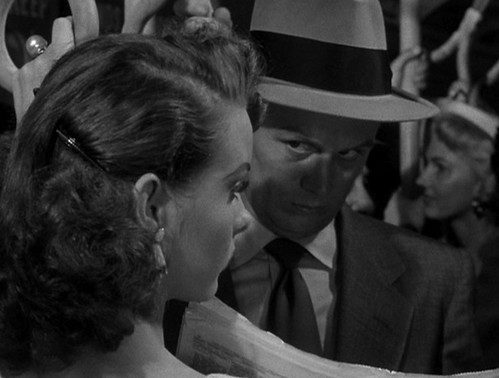
"Pickup on South Street" has amazing sequences, starting with the opening gambit: a couple of fed's are tailing a call-girl, Candy (the soon-to-be-Mrs. Howard Hughes, Jean Peters), whose found some temporary legitimacy as a courier for her ex-boyfriend, Joey (Richard Kiley), when who should sidle up to her but professional pick-pocket Skip McCoy (Richard Widmark). He gets in close, uses a newspaper as a blind, then deftly violates her purse (no, there is no ambiguity here--Fuller edits it like it's a sexual act, cutting from the purse to a flushed-looking Candy). He intercepts something he doesn't expect--micro-film with industrial secrets. Soon he's being hounded in his squalid little bait-shack domicile by the cops, the fed's, the moll he buzzed, and the communist cell that Joey's really working for. What's a dipper to do? The patter is wise and rapid, the love scenes smoldering and intimate, and the fight scenes look like they hurt! A lot!** (There's a particularly nasty one with Peters and Kiley in which the camera hurriedly rushes back out of the way of the hurling bodies--the best thing about the fights is they look spontaneous and unchoreographed, and quite thuggish) It's hard to believe that Zanuck would approve this film, but he liked his B-roster rough and down in the dirt, and Fuller wouldn't have it any other way. However, just because these folks are all grifters, the cops are nasty creeps, they're all Good Americans, as opposed to the well-tailored, polite communists, and that's Fuller's punch-line to the whole magilla. You can practically hear his wheezing cackle.

* Fuller liked to tell the story of why, after making succesful B-movies he decided to sign a contract with Fox and Zanuck over the other studios. He asked the other studio-heads what they did with the profits from their movies. All gave advice on tax shelters. Zanuck was the only one who said, "We make better movies."


** The fight scenes kept the film from receiving a pass from the Production Code, and had to be filmed a few times before the film could be accepted for exhibition. As it is, Peters goes slamming face-first into a book-case, and Widmark socks Kiley over a subway turnstile, and drags him by his ankles down some stairs, his jaw hitting every step along the way.


------------------------------------------------------------------------


Richard Widmark died last week at the age of 93, just when we were getting to know him through a series of naturalistic performances in tough-minded noirs and detective films.


He burst on to the movie scene playing the giggling sociopathic thug Tommy Udo in Henry Hathaway's "Kiss of Death," famous for the scene where Udo kicks a woman in a wheelchair down a flight of stairs--it's Noir 101. It makes all the highlight reels. And for that, they nominated him for an Academy Award.


But Widmark had a real versatility, playing both heroes and villains and the various shades of gray. He could be counted on to be believeable in any extreme. And he could play your average "Joe"--but better. He was dependable, even as a gangster. And you never thought of his heroes as naive. Widmark conveyed intelligence in all his roles, whatever their moral stripe.


My favorite scene of his is an odd one: a long sustained rambling conversation in a held two-shot with James Stewart on a river bank in the John Ford "Two Rode Together." The two actors are just basically trying to convey the information and Ford probably told them to "make it interesting" (and if they didn't Ford would hector them for the rest of the day), and the two, Stewart and Widmark, are just jawing, improvising as they go, but it never feels like actors showing off--it's two veterans being people through force of personality, and long after the movie has faded from memory that little conversation--was it five minutes long?--remains with its prevarications, its annoyed pauses, and its subtle hilarity. I've seen DeNiro and Hoffman improvising. It's not nearly as much fun.


There are two more Widmark's on the docket waiting to be sprung on these pages, one directed by Jules Dassin, who also recently passed. He became for me, just before his death, one of the most interesting things to see in a movie, and when it's all rushing at you 24 frames a second, that's saying quite a bit. When someone dies just as you begin to really appreciate them, the loss is just a bit more palpable.

Monday, March 3, 2008

Panic in the Streets (1950)

"Panic in the Streets" (Elia Kazan, 1950) Kazan's gritty "N'Orleans noir" with pneumonic plague substituting for the rot in men's souls. Richard Widmark steps away from playing giggling gangsters to take on a too-earnest-by-half Naval doctor who is alerted to a murder victim's communicable disease and must find the killers and anyone they've come in contact with before the people of New Orleans start falling in the streets. He's given grudging help by the police commisioner (Paul Douglas, great in a non-comedic role), but it's the targets of the man-hunt that are the real interest. One of the perpetrators is played by Zero Mostel, looking a hundred pounds lighter but with the same crazy comb-over and the quicksilver reactions that threaten to spill into comedy. As his boss Blackie is one Walter Jack Palance--yup, him, in one of his first movies--very young, very tall and with a face of so many concave facets that Kazan's naturalistic lighting schemes pay off in wierdly evocative ways. There's an extended chase through a coffee warehouse where the stunts, some of them a bit risky, are performed by Palance...and Mostel! Seeing the slightly svelter Zero leap from a ceiling transom to a stack of coffee bags is pretty scary to consider. Filmed on location with a lot of "real" folks playing "real folks" (and a lot of them are really good!), this kinetic movie keeps wanting to drop into hysteria at any moment--a Kazan trademark--but, that lends credence to the whole impending disaster.