Showing posts with label Gene Tierney. Show all posts

Wednesday, January 23, 2013

The Shanghai Gesture

The Shanghai Gesture (Josef von Sternberg, 1941) So, what would happen if a film-stylist like Josef von Sternberg had directed a programmer like Casablanca? It would be a lot like The Shanghai Gesture (made a year before Ilsa walked into Rick's), with a disparate group of diaspora all gathered around a central community house—but, instead of Rick's Cafe Americain, it's Mother Gin-Sling's Casino, a casino of ill-repute that the Shanghai city-fathers (all white, all Brits) frequent with abandon, even while they're plotting to get rid of it ("I am shocked, SHOCKED that gambling is going on in this establishment!") The script is by von Sternberg, Gerza Herczeg, and Howard Hawks' scripter Jules Furthman, with emphasis on the smart-aleck remark, witty patter and easy irony.  The script is smart, the acting mannered (but in the von Sternberg manner of haughtiness and exaggeration for effect), and everything else from costuming, set design, and photographic style is elaborate.

Boris Leven's design for Mother Gin-Sling's Casino resembles a multi-level Pit of Hell
The men are von Sternberg's collection of stiffs, drones, and leering rakes (heck, von Sternberg turned Gary Cooper into one of the latter in Sahara). Walter Huston plays the stiff, a reforming developer who runs afoul of Mother Gin-Sling, while the latter is in the form of Victor Mature's "Dr. Omar," a Muslim "doctor of nothing," except one assumes, for a memorized expertise on "The Rubaiyat of Omar Khayyam."


The women are von Sternberg's complicated, well-lit archetypes, more devils than angels, the way he used Marlene Dietrich.  They had to do a lot of cleaning up of the original play by John Colton, resulting in a "coded" film that "suggested" what was really going on.*  The original location was a house of ill repute—a brothel (hinted at by the caged women ringing the casino's playing area, which, as designed by Boris Leven, looks like the Pit of Hell), the floosie (Phyllis Brooks) that Omar picks up in the street is a hooker, not a "dance-hall girl, in the play "Mother Gin-Sling" is named Mother Goddam, and the addiction the young thrill-seeker Gene Tierney plays isn't gambling (as in the film), but drugs, as suggested by her name "Poppy."  So, yes, a lot of self-censorshp, but sophisticated audiences could see through the veiled references to see what the issues were.


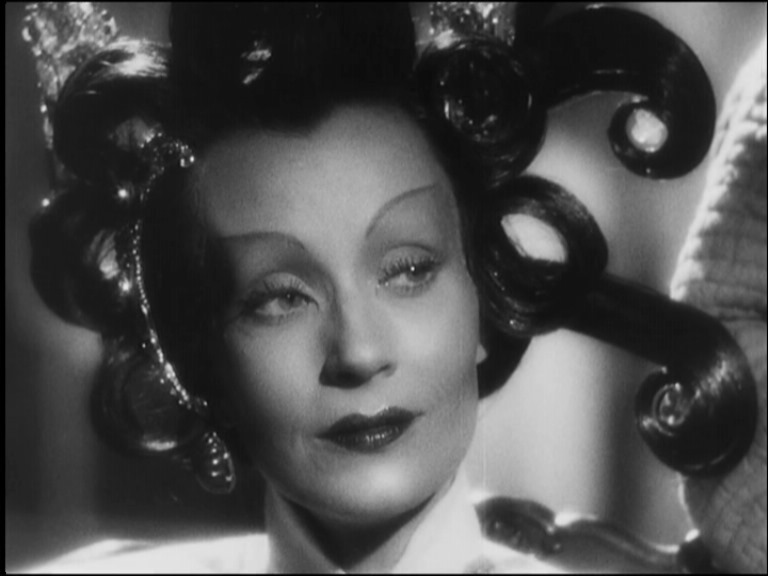
Von Sternberg was a stylist with an emphasis on glamor photography—his work with Dietrich is some of the most scrupulously accomplished shadow work in movies—and his capturing of Ona Munson, Brooks, and especially Tierney is a tightly controlled use of light to emphasize the contours of the face.  Munson's wild hair-styles suggest nothing so much as a medusa, and Tierney, once she slides down the slippery slope of..."too much gambling" begins, in her body language, is all broken doll, a marionette with some strings broken (something foreshadowed by von Sternberg early on)

Both Curtiz and von Sternberg had penchants for filling up the screen-frame, but Curtiz kept things naturalistic, with his performers squarely rooted in specific places.  Von Sternberg's close-ups are frequently floating heads, backed by a light pattern that has nothing to do with their surroundings.

But, that's where comparisons end: The Shanghai Gesture is a bizarre bazaar of weirdness, a combination of kitsch and creepiness, a glamorized descent into degradation and venality (beautifully shot, though!), with possibly the worst example of mother-love demonstrated on screen.  It is the dark side of entertainment, gussied up with glamor to make the proceedings seem tolerable, something that could be said for all of the work of von Sternberg, master of both light and darkness.


The Shanghai Gesture is also unique for giving a credit to the extras.


 * Furthman was great at that: in The Big Sleep he and Hawks suggested nymphomania by having the character suck her thumb.

Wednesday, August 31, 2011

The Razor's Edge (1946)

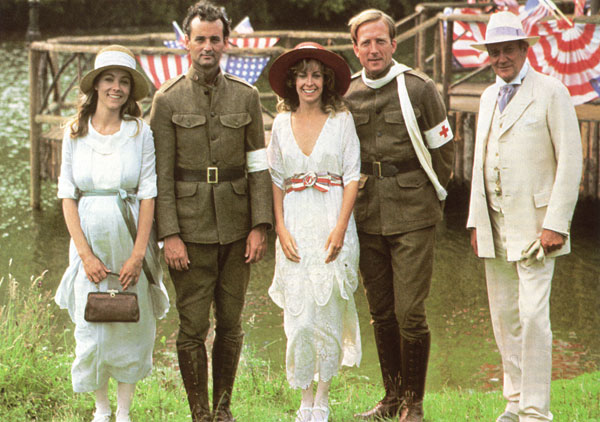
The Razor's Edge (Edmund Goulding, 1946) "The Razor's Edge" is a favorite book of mine, one I was inspired to read after a disappointing film adaptation, starring Bill Murray, who stood out from an otherwise respectful version like a howling sore thumb.  But, it had been filmed before, in 1946, under the tutelage of producer Darryl F. Zanuck and directed by Edmund Goulding, only two years after the novel's first publication.

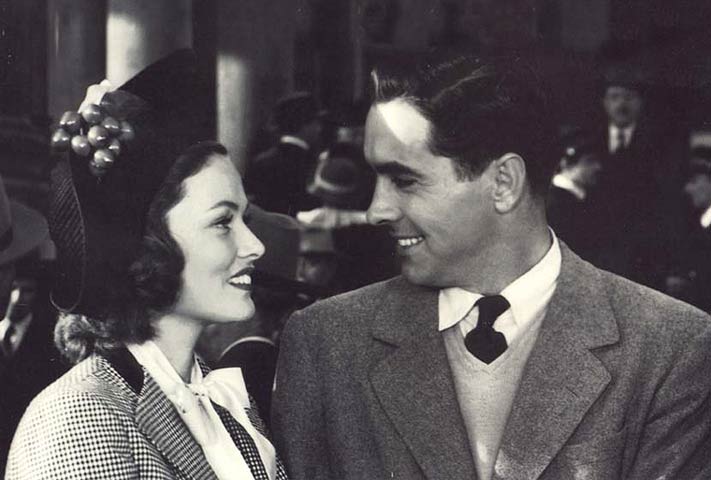
W. Somerset Maugham's book documents (in absentia) the travels of Larry Darrell (played in 1946 by Tyrone Power), who returns from pilot duties during World War I,* deeply affected by the death and devastation he's seen, and takes a period of time to "find himself"—a lot of time.  This seems odd to his high society friends, especially the family of his fiancee, Isabel (Gene Tierney), who can't seem to understand why Larry won't settle down, put his nose to the grindstone and make sure that she gets to live in the manner she's accustomed to.  Larry travels to Paris, ostensibly under the supervision of Isabel's prissy Uncle Elliott (Clifton Webb) (who does NOT approve), but Larry would rather live the life of a bohemian, working menial jobs.  After a year's separation, Isabel comes to visit and is appalled by Larry's simple living conditions.  She breaks off the engagement after taking one last attempt to seduce Larry back to her way of thinking, then returns to Chicago, where she marries Larry's millionaire friend.

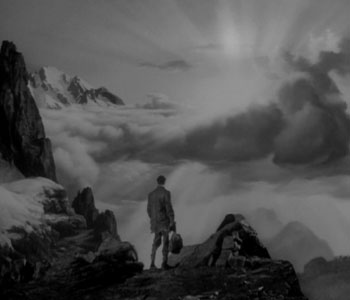
Larry continues his life in Paris, still searching for answers.  Eventually, he makes a pilgrimage to India,** where, after studying and living a monk's existence in the Himalayas, he achieves a measure of happiness, finds his answers and returns to Paris to find that Isabel and her husband have lost everything in the 1929 crash, and are now living off her Uncle's charity.  His old friends have all suffered various tragedies and are at a loss how to cope...and Isabel still loves him, complicating everyone's lives.

The Goulding version hews fairly close to the book, smoothing the rough edges that might have ruffled the feathers of the Hays Office, and implying what could not be said in Maugham's book—Uncle Elliott's gay, Isabel is a too-willing adulteress, and their mutual friend Sophie (Anne Baxter), who suffers her own tragedies, has turned to drink and prostitution.  Larry would seem to be the answer to everyone's problems, but he knows that the problem lies in living in a material world and the cheapening of human life to get ahead.  And the 1946 version also includes one character that the '84 version excluded—the author (played by Herbert Marshall).  Maugham wrote "The Razor's Edge" as a roman a clef, an observance as he made his way between world wars through society as a successful author, settling in Paris and the Riviera.  The post-war version relies a bit too heavily on him, while the John Byrum version with Murray manages to make due without.  The author becomes a sounding board in the book and first film, revealing characters' innermost thoughts—a little too forthcoming, actually (one should never get too cozy with an author)—and revealing a little too much about what they're feeling.

Power is a good Larry, but not a great one (whereas Bill Murray could have been great, if his propensity for ad-libbing goofily hadn't gotten the better of him).  It's a little too hard to distinguish just what about him changes from "troubled" to "enlightened," other than a little too much intensity in the eyes.  Not the greatest of emoters, his war-weary Larry seems merely peeved and a shade brittle, but his post-pilgrimage Larry seems not so enlightened as slightly moony when reflective and somewhat superior and self-satisfied when things go his way.  Gene Tierney's Isabel seems far more shallow than the actress is capable of and when she turns vindictive, its done with a raising of the eyebrows and a haughty air—it's more a pose than a performance (as opposed to Catherine Hicks who wasn't afraid to make Isabel conspiratorial.  Clifton Webb has as much fun with Templeton as Denholm Elliott did (a role John Gielgud coveted), and Anne Baxter has some very good moments as Sophie, although her theatricality gets the better of her in the more demonstrative scenes (it did win her an Oscar, though), but she doesn't hold a candle to Theresa Russell's "fragility with a spine" Sophie.

One comes away with no definitive screen-version of "The Razor's Edge:" you'd like to take the supporting cast of the 80's version, find a new Larry and keep the later's travel footage as a replacement for the pristine (and wholly set-bound) ashram from the '46 version (were they trying to evoke Shangri-La from Lost Horizon?  Why does it look like a Hollywood hotel lobby designed by Frank Lloyd Wright?).  The dissatisfaction is high with both, with flaws impossible to overlook, but there is a great movie in there somewhere, and each film supplies some answers to what that might be like. 

The pilgrimage continues. 


* In the Murray version, he was an ambulance driver.


** In the the latter version, he goes to Tibet.


Friday, June 20, 2008

Night and the City

"Night and the City" (Jules Dassin, 1950) Frenetic film noir directed by Jules Dassin two steps ahead of the HUAC that was trying to get him to name names. Dassin fled to London under the auspices of Darryl F. Zanuck to direct this turgid Film-Noir-in-London about a Charlie Hustle tout, Harry Fabian (Richard Widmark), exploiting people's passions trying to make a big score any way he can, this time through wrestling tournaments, encroaching on the turf of Kristo (Herbert Lom), who'll do anything to stop him. eEverything that is, except cross his father, who just happens to be Fabian's new business partner.

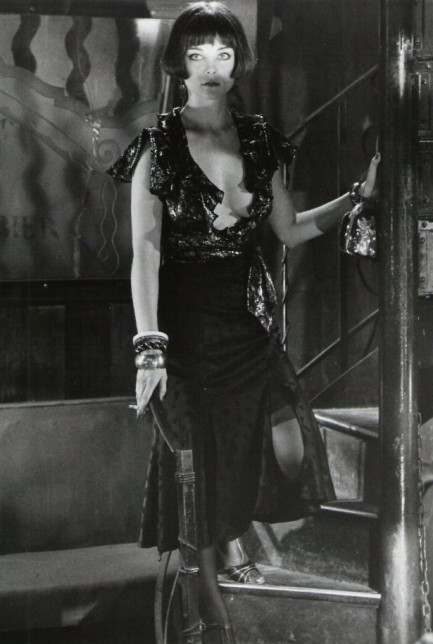
The first time we see Fabian, he's running. He spends a lot of time running in the film, trying to out-pace his creditors, or the next guy who wants to kill him, or dashing after The Next Big Thing, but the line between him running to something or from is a bit blurred now. And there's not much difference between the patter he spins his long-suffering girlfriend (
Gene Tierney, whose small role belies her second billing placement) or any of the marks he's trying to hustle. Fabian's sincerity is veneer-thick, just enough to make you think he's on somebody's side besides his own. When he stands helplessly on the sidelines while his meal-ticket fights for his life (a brutal sequence amazingly staged by Dassin and the two wrestlers involved), you get the sense that he's distraught because his future could go up in smoke.

The thing is, Fabian's a rat in a trap, which is visually communicated by
Dassin's many shots of him stuck in place, or running the maze-like side-streets and ruins of London, as well as the cages that substitute for offices in the sleazy back-world the denizens inhabit. Despite the squalor, the film is beautiful to look at, with Dassin and his cinematographer Mutz Greenbaum bending the shadows into Gothic patterns that rival those of "Citizen Kane."


"
Night and the City" is a fascinating film, with an animated (perhaps too animated) Widmark performance-probably to make his character a bit more sympathetic; the British actors have their emotions checked in reserve and come off best, while Tierney's performance is all Fox-ingenue. And the desperate, frentic sense feels like it was made by a man on the run. Dassin stayed in Europe, continuing his career, which hit an international career-peak with "Never On Sunday" in 1960. He died March 31st this year in his adopted home of Greece.

"Night and the City" was remade in 1992, starring Robert DeNiro and Jessica Lange. It was not improved on.