Showing posts with label 1946. Show all posts

Wednesday, August 31, 2011

The Razor's Edge (1946)

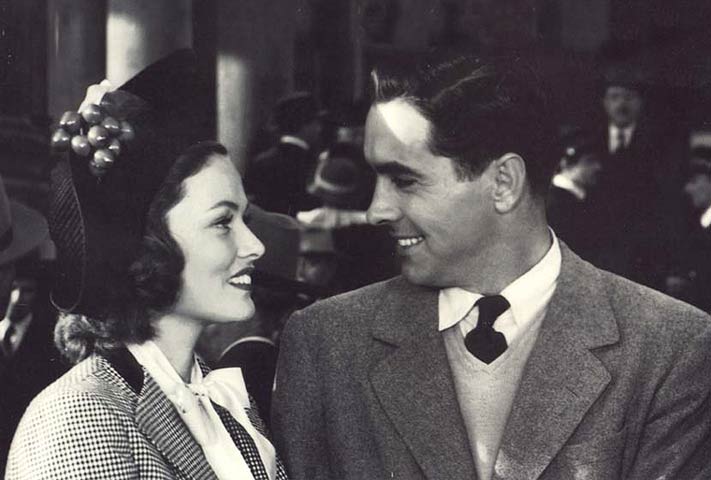
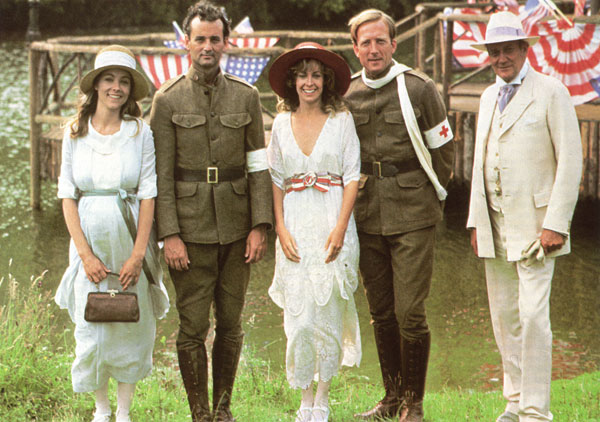
The Razor's Edge (Edmund Goulding, 1946) "The Razor's Edge" is a favorite book of mine, one I was inspired to read after a disappointing film adaptation, starring Bill Murray, who stood out from an otherwise respectful version like a howling sore thumb.  But, it had been filmed before, in 1946, under the tutelage of producer Darryl F. Zanuck and directed by Edmund Goulding, only two years after the novel's first publication.

W. Somerset Maugham's book documents (in absentia) the travels of Larry Darrell (played in 1946 by Tyrone Power), who returns from pilot duties during World War I,* deeply affected by the death and devastation he's seen, and takes a period of time to "find himself"—a lot of time.  This seems odd to his high society friends, especially the family of his fiancee, Isabel (Gene Tierney), who can't seem to understand why Larry won't settle down, put his nose to the grindstone and make sure that she gets to live in the manner she's accustomed to.  Larry travels to Paris, ostensibly under the supervision of Isabel's prissy Uncle Elliott (Clifton Webb) (who does NOT approve), but Larry would rather live the life of a bohemian, working menial jobs.  After a year's separation, Isabel comes to visit and is appalled by Larry's simple living conditions.  She breaks off the engagement after taking one last attempt to seduce Larry back to her way of thinking, then returns to Chicago, where she marries Larry's millionaire friend.

Larry continues his life in Paris, still searching for answers.  Eventually, he makes a pilgrimage to India,** where, after studying and living a monk's existence in the Himalayas, he achieves a measure of happiness, finds his answers and returns to Paris to find that Isabel and her husband have lost everything in the 1929 crash, and are now living off her Uncle's charity.  His old friends have all suffered various tragedies and are at a loss how to cope...and Isabel still loves him, complicating everyone's lives.

The Goulding version hews fairly close to the book, smoothing the rough edges that might have ruffled the feathers of the Hays Office, and implying what could not be said in Maugham's book—Uncle Elliott's gay, Isabel is a too-willing adulteress, and their mutual friend Sophie (Anne Baxter), who suffers her own tragedies, has turned to drink and prostitutionLarry would seem to be the answer to everyone's problems, but he knows that the problem lies in living in a material world and the cheapening of human life to get ahead.  And the 1946 version also includes one character that the '84 version excluded—the author (played by Herbert Marshall).  Maugham wrote "The Razor's Edge" as a roman a clef, an observance as he made his way between world wars through society as a successful author, settling in Paris and the Riviera.  The post-war version relies a bit too heavily on him, while the John Byrum version with Murray manages to make due without.  The author becomes a sounding board in the book and first film, revealing characters' innermost thoughts—a little too forthcoming, actually (one should never get too cozy with an author)—and revealing a little too much about what they're feeling.

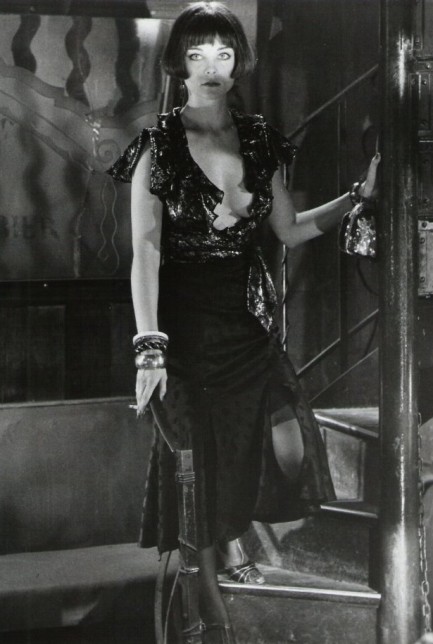
Power is a good Larry, but not a great one (whereas Bill Murray could have been great, if his propensity for ad-libbing goofily hadn't gotten the better of him).  It's a little too hard to distinguish just what about him changes from "troubled" to "enlightened," other than a little too much intensity in the eyes.  Not the greatest of emoters, his war-weary Larry seems merely peeved and a shade brittle, but his post-pilgrimage Larry seems not so enlightened as slightly moony when reflective and somewhat superior and self-satisfied when things go his way.  Gene Tierney's Isabel seems far more shallow than the actress is capable of and when she turns vindictive, its done with a raising of the eyebrows and a haughty air—it's more a pose than a performance (as opposed to Catherine Hicks who wasn't afraid to make Isabel conspiratorial.  Clifton Webb has as much fun with Templeton as Denholm Elliott did (a role John Gielgud coveted), and Anne Baxter has some very good moments as Sophie, although her theatricality gets the better of her in the more demonstrative scenes (it did win her an Oscar, though), but she doesn't hold a candle to Theresa Russell's "fragility with a spine" Sophie.

One comes away with no definitive screen-version of "The Razor's Edge:" you'd like to take the supporting cast of the 80's version, find a new Larry and keep the later's travel footage as a replacement for the pristine (and wholly set-bound) ashram from the '46 version (were they trying to evoke Shangri-La from Lost Horizon?  Why does it look like a Hollywood hotel lobby designed by Frank Lloyd Wright?).  The dissatisfaction is high with both, with flaws impossible to overlook, but there is a great movie in there somewhere, and each film supplies some answers to what that might be like. 

The pilgrimage continues. 


* In the Murray version, he was an ambulance driver.


** In the the latter version, he goes to Tibet.


Wednesday, September 15, 2010

A Matter of Life and Death


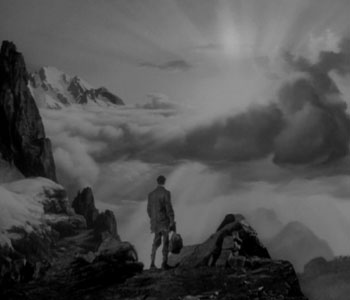
"A Matter of Life and Death" (aka "Stairway to Heaven") (The Archers, 1946) A cryptic reference to "The Archers" (and their ability to seamlessly combine reality and fantasy) crept into my review of "Scott Pilgrim vs. The World," and necessitated the completion of a couple reviews I've had in draft stage the last few months, waiting for the creative spark that would ignite them into a full-blown post.


"A Matter of Life and Death," coming as it did with the stench of the Second World War still enveloping the planet, is a meditation on, and an impassioned plea for, the value of a single human life at a time when the world had seen so much slaughter.  Like it's American counterpart, Frank Capra's "It's a Wonderful Life," both films begin in the Heavens for a brief prelude contemplating cosmic predetermination.  One man is literally, and spiritually, put to trial for his life, on Earth (as it is in Heaven) when he doesn't die in circumstances that should have killed him.  The story proper begins with the protagonist's life in the air.  A lone RAF pilot, poet Peter Carter (David Niven) is the last man crouching on a doomed bomber hurtling to destruction.  The rest of the crew has bailed out, and Carter, without a parachute, has determined to go down with the plane, hoping to bail out at the last second to avoid death. 


He spends his last fleeting moments in tenuous radio communication with June (Kim Hunter), an American radio operator, who listens, horrified, as Carter banters through his stiff upper lip, and a  parallel falling occurs, as the two are linked in life, death and love for those precious few minutes.  Nothing can come of it, of course.  He's a dead man, for sure.


So, the two are both shocked (though delighted) that Carter survives the fall and is washed up on the beach.  It's some sort of miracle.


"Every time the factory whistle blows, an angel gets it's wings..."

Heavens Above...

The Earth Below

Actually, no.  It is more of a clerical error, as the being-counters in Heaven (we presume, and it's never stated outright) await Carter's arrival with the rest of his crew (none of them made it).  A representative (Marius Goring) is dispatched from Powell and Pressburger's amusing depiction of Kingdom Come (as a sort of empyrean General Motors, an Industrial Age Promised Land), to send Carter packing for Paradise...except...he doesn't want to go.  And won't, unless, he's forced to.  Of course, that he's seeing time-stopping visions of Heavenly Hosts indicates "chronic adhesive arachnoiditis" suffered from an earlier brain injury, and a battle for Carter's life is fought on two fronts, both dependent on the work of one man: Doctor Frank Reeves (Roger Livesey), who diagnoses the ailment and, before he can perform surgery, is killed, where he can conveniently argue Carter's case for life in a celestial court-room—the highest court of all.


The Highest Court of All


Carter's out-of-body experience on the operating table—a comic highlight

But, it is more than that—it always is with the films of Powell and Pressburger.  At the end of the European War, there was bitterness on both sides of "the pond:" Americans were grieving their losses and blaming England for "having to be bailed out;" Britons were bitter of the first American Invasion of the war—their own country, and of the havoc "the Yanks" caused creating their launch-point.*  The Case for Peter Carter becomes, in a deeper and richer sense, a debate centering on "Whither England," and whether the "special arrangement" between The Kingdom and The Colonies should be continued, unquestioned.  This odd and whimsical fantasy** becomes a propaganda piece for the very existence of Britain itself, God (or Whoever) Save the King.


The production values are top-notch and imaginative, including an ecumenical escalator that bridges the two worlds...and two photographic processes.  Reversing "The Wizard of Oz" schema, it is the worlds under the rainbow that glow with rich eye-dazzling Technicolor, while "the next world" is shown in black and pearly-white. 


And you thought "Led Zeppelin" made it up...

  It is rich in humor, rich in thought, and it stands right behind "Get Carter"(...?) in polls of the greatest British-made film.  This is one of those films you should see before you die...if only so you can get directions. And to make the journey until then...that much more enjoyable and precious.


* A fine film, too often overlooked, about this war on the home-front is John Schlesinger's unusually restrained (for him) "Yanks."

** This is one of those films that modern critics would sniff "is inconsistent in tone."  Hey, life is inconsistent, pal!

Tuesday, July 7, 2009

The Stranger

"The Stranger" (Orson Welles, 1946) Fairly conventional film from Orson Welles, which means it's a surrealist experiment in style for everyone else. Welles did this one under a time-constraint (which might be why the thing looks lush and complicated at the beginning and a might skimpy towards the end). It's Welles' least favorite of his films and the only film he directed that turned a profit at the time of its release.

Here, Welles is having fun with the idea of a Nazi war criminal hiding in plain sight in a small American college town. He's become a professor—college prof's being allowed certain eccentricities, like a secret allegiance to Der Fuehrer
—and he has wooed and become engaged to a Supreme Court Justice's daughter (Loretta Young with her "deer-in-the-headlights" look). But for Nazi's it's safety in numbers, usually in concentric patterns. So when another war criminal is allowed to escape as bait by a War Crimes Commission, he heads straight for Harper, Connecticutt, picturesque in Fall, and his superior, Franz Kindler (Welles), hiding as Professor Charles Rankin, hoping to start a Fourth Reich. As the professor is a clock-hobbyist, Kindler's precise deceptions begin to ungear. His current project, the old school clock tower with its carouseling angels and demons in pursuit high above the town is his refuge.

He should be keeping his eyes on the ground and the dogged—one might say pugged—pursuit by War Crimes investigator Wilson (Edward G. Robinson, whose good "badness" is used to great effect). Welles and his screenwriters (with an assist by John Huston) have a lot of fun with the global affairs effecting a small town and its eccentric collection of rubes, who prove to be inconveniently adept at things: the busy-body checkers hustler has a good memory and the town gossips are good sources of information, especially when they're in the dark about what secrets they have. Pretty soon, suspicion is sewn and in a small town, word gets around.

Welles manages to make a propaganda film, a detective story, a woman-in-jeopardy tale, with elements of comedy, AND show concentration camp footage all in one storyline (filmed in 1946!), couched in a popular entertainment (for George Schaefer who brought Welles to Hollywood) and knock it out before heading to Rio De Janeiro to film "The Lady from Shanghai."

It's lower-tier pulp Welles, which still puts it far above Hollywood's average.


Shadows of "The Stranger"
Loretta Young's shadow of a doubt about her new husband (Welles) who's just come home.

"Use Gym Equipment at Your Own Risk" says a sign.
Edward G. Robinson is about to get clocked with a ring.

An informant is faceless and anonymous.

A Nazi criminal is on the run, and gets his picture taken for a fake passport.

Welles' shadows turn that same Nazi...into Adolph Hitler?

But don't take my word for it! As "The Stranger" is in the Public Domain,
you can watch it or download it here
.

Friday, January 16, 2009

The Life and Death of Colonel Blimp

"The Life and Death of Colonel Blimp" (The Archers, 1946) Controversial film for the majority of its life, although looking at it now, one wonders what all the fuss was about.

"Colonel Blimp" was a political cartoon created by cartoonist David Low as a blow against pomposity and complacency, but writer/director team of Michael Powell and Emeric Pressburger ("The Archers") took the name and reputation and turned it into another animal altogether—an epic about manners, regimentation and the Rules of Engagement, both intimate and grandiose.

After serving in the
Boer War, Clive Wynne-Candy (the criminally forgotten Roger Livesey) is embroiled in a sword-duel with a German officer, Theodor Kretschmar-Schuldorff (Anton Walbrook), which results in both men being wounded and a substantial recovery time in the same hospital. The two become friends, and while friendships may last, alliances do not, especially in the European history of the 20th Century. Times change, the borders of countries shift like Teutonic plates, but loyalties...what happens to them? It may seem an odd thing to focus on to American audiences (as we've always fought "dirty" in our wars, bending the rules of warfare to our advantage), but the British throughout that century struggled to maintain a decorum to war, which, if it were not so ingrained, must seem like a flight of fancy.*

"The criminally-forgotten Roger Livesey"

Flights of Fancy are what Powell and Pressburger do best. And despite mis-understanding by, primarily, Churchill (who must have thought it was about him), the film has been unfairly maligned, and expectations for it blown out of proportion. Satirical it is. But also a melancholy treatise on long life and outliving one's epoch. One walks in expecting brash and finds it sad and sweet. And cleverly inventive, in technique and story-line. Deborah Kerr (in a daunting screen debut) plays three women in Candy's life: the woman he gave away to a friend, the woman he married, and his driver during WWII—the arc of a love in three acts for women who resemble each other, if only in the mind of one man.

If nothing else, "The Life and Death of Colonel Blimp" is amazing in its look--a Technicolor confection that pops off the screen, a mark of "The Archers."


*However...given the film begins with The Boer War, one can't help but use the word "decorum" a bit sarcastically given the British use of "scorched Earth" policies and concentration camps during that conflict.