Showing posts with label Orson Welles. Show all posts

Wednesday, October 30, 2013

The War of the Worlds Through the Years

Seventy five years ago tonight (at 8 pm EST, in fact), Orson Welles chose to do a radio broadcast just for Hallowe'en—a radio adaptation of H.G. Well's novel of "The War of the Worlds" on his "Mercury Theater On the Air" broadcast on the CBS radio network. 
  
Welles' show was not that popular, and so a lot of people didn't hear the introduction of the piece stating clearly that it "presenting 'The War of the Worlds' by H.G. Wells"; most of those listening to the radio at that time of the evening were listening to the more popular "The Chase and Sanborn Hour", which featured ventriloquist Edgar Bergen and his dummy Charlie McCarthy (yes, a show with a ventriloquist was very popular on radio).  But, twelve minutes into the comedy show, there was a song interlude, and people did then what they do now—they surfed the dial, looking for something better until the segment was over and they could turn back.

And what they found was this:


At about twelve minutes in, the broadcast was just getting interesting: a faux dance music program was being presented and interrupted by "news bulletins" reporting that plumes of incandescent gas had been seen leaving the planet Mars and headed for Earth. A "return to scheduled programming."  Then another interruption saying that meteorites have landed near Grover's Mill, New Jersey (as opposed to Woking, Surrey in Wells' novel) and Princeton expert Professor Richard Pearson (Welles) is brought in to speculate that there is no life on Mars.  The next segment is a "live report" from Grover's Mill where "reporter Carl Phillips" (played by Frank Readick, who had "prepped" for this segment by listening to reporting of the explosion of The Hindenburg) reports on the opening of the cylindrical meteorites, the appearance of tentacled creatures wielding a death beam that incinerates the crowd...

And then...silence.

The original script (by the ubiquitous Howard Koch) was deemed to dull by Welles, and a new draft was created, inspired by an Archibald MacLeish radio-play "Air Raid" (in which Welles had appeared).  The idea was not to dramatize events as in the novel, but to use the medium of radio to provide the context and the drama of how such an invasion might play out under the circumstances and over the air-waves.  More than the audio of a staged play (as most of these things were), it was very much of its source—a radio-play, by, of, and about the experience of getting the news live over this new medium, unfiltered and immediately...without a chance for resolution. 

"Panic" may be too strong a word for the result, and the newspapers played it up to discredit the reliance of radio for news,* but there were many, many, many people who heard the simulated news-casts and, now used to recent advances that allowed "news flashes" interrupting programming, and at a time when Germany was making moves on Austria and Czechoslovakia, took them for the real thing.  A cursory search on the dial would have told them that the only network broadcasting the events at Grover's Mill was CBS, but the events were so compelling that not many switched away.  Some merely left their radios in their panic to avoid "the coming invasion." It wasn't until the 43 minute mark in the broadcast (which ran no commercials as it was not sponsored) that the network broke in to remind listeners that they were, in reality, listening to a radio-play.  This was necessitated as the CBS switchboard in New York was flooded with calls to the point of incapacitation. 

For Welles, three things happened: he became a nationwide celebrity, "The Mercury Theater On the Air" got a sponsor and became "The Campbell Soup Hour", and Welles was lured to Hollywood by RKO Studios, where they hoped he might make a film of "The War of the Worlds," to cash in on the notoriety. He had other plans.  

A film of "The War of the Worlds" would have to wait.


••••••••••••••••••••••••••••••••••••••••••••••••••••••••••••••••••••••

The War of the Worlds (Byron Haskin, 1953) Twenty five years after Welles' broadcast, George Pal made a Technicolor movie out of Wells' novel.  Like the radio broadcast, it updated the story for the times.  The time is the present and the phenomenon is world-wide while the film concentrates on cylinders landing in Linda Rosa, California, outside of Los Angeles.  By chance, Dr. Clayton Forrester (Gene Barry), a scientist involved with America's development of the atomic bomb happens to be fishing nearby when the nearest craft zooms overhead.  Investigating, he finds a crowd of people, including Linda Rosa residents Silvia van Buren (Ann Robinson) and pastor Matthew Collins (Lewis Martin), her uncle.  The glowing craft is giving off radioactivity and so three locals elect to stand guard until the thing cools down enough to be investigated, and Forrester elects to wait until morning in town.  

Before he can return the meteorite opens up and a snake-like periscope rises from the crash.  As the three men approach, the scope emits a shrieking heat-ray that atomizes them on the spot, and knocks out power to the town, alerting Forrester that something's happened and he finds out that Earth is under attack from Martian war-machines, shaped like flying manta-rays.**


** Although not a tripod as in the novel, the Martian attack-ships start off
elevating on three beams of energy that then disappear
(no doubt owing to the cost of animating)

 
The 1953 movie is interesting for its inclusion of nuclear power and weaponry into the mix—eight years after Hiroshima and amid other films that, at the time, used atomic energy to produce horrors in Nature.  Religion is given far more importance in the 1953 movie than the novel (where Wells dismisses it entirely), although it proves ineffective in the short term, but is given the credit for the long-term outcome.  Forrester stands in for Wells' unnamed narrator, separated from his fellow survivors and struggling to evade the war machines to get back to his wife—in the movie's instance, its the newly reunited Ms. van Buren, Forrester's former student.  

Pal's version became a classic, one of the few science fiction films that the Hollywood establishment took notice of besides its receipts (in no small part due to Cecil B. DeMille's championing of it), winning a de facto Oscar for its spectacular effects combining wire-and-model work and animation (the machines were so popular they were re-used in Pal and Haskin's Robinson Crusoe on Mars).  It is still well-regarded as a superior sci-fi adventure film. The Wells estate was so enthusiastic with the result that they gave Pal the pick of any of Wells' stories to make a film of.  His choice was "The Time Machine," which was released in 1960.


War of the Worlds (Steven Spielberg, 2005) Fifty two years after George Pal's film and sixty seven years after Welles' broadcast, Spielberg completed his unofficial trilogy of Earth invasion films (after Close Encounters of the Third Kind and E.T. the Extra-terrestrial) with his own version of the Wells story, again, updated for the times, and without the article "the" in the title.  The invasion is, once again, world-wide, although attention is centered on the east coast of the United States.

This "War" was made within the memory of the 9/11 attacks, as Spielberg staging large infrastructure-dusting battles that tip over intersections and vaporize human beings (leaving their clothes to float empty to the ground).  The attackers are not named as "Martians" but acknowledged as "other-worldly" with a suspiciously complicated origin—evidently, they've been long buried in the Earth, only needing the transmission of a spirit via lightning storm that simultaneously energizes the war-machines and knocks out the surrounding power grid.  These machine are more the design of Wells original intent—ungainly tripods that still manage to do sizable damage with its heat-rays, black smoke, and red vegetation that carpets the area in a means of terra-forming (all from Wells' source). 


Although it may seem like a "typical" Spielberg project, it is an odd blend of Wells' and Spielberg's sensibilities, and in fact, anti-Spielberg sensibilities. Wells story was about his narrator trying to get back to his wife amidst the chaos of the war.  Spielberg has the same story-line, but his protagonist is another Spielberg "common man" (or as common as Tom Cruise will allow himself to be), who must rise to the occasion—in this case Cruise's Ray Ferrier is a dead-beat, uninvolved dad who must get his kids back to his estranged wife, amidst all the chaos.  Given that CE3K and ET were films by a less mature Spielberg that broke families apart, offering a glimpse of the heavens, this time, Spielberg's protagonist is doing everything he can (as in Wells' novel) to re-unite his family.  Spielberg had grown up by the time these aliens visited Earth.  And yet, for all his heroics, the film has more in keeping with the ending of John Ford's The Searchers, as Ferrier is left standing in the street of his in-laws' brownstone (and they're played, naturally, by Gene Barry and Ann Robinson from the '53 version), satisfied enough that he has brought them together, but acknowledging that he is still an outsider without regard for acceptance as reward.  He's done what he should have been doing all along.  And mature enough now to not expect anything from it.

It's one of my favorite Spielberg endings.


* The Slate article preceding this asterisk debunks the myth by citing lack of evidence—not the most reliable indicator—but what's strange is that when stations repeat the stunt (as reported on Radiolab's episode about the broadcast), the results tend to skew the same way.  There are always going to be a few that will panic, and with mob-mentality as an accelerant, things can get out of hand...even for Martians to handle.

Friday, June 11, 2010

War of the Welles'

I'm working on reviews for films from the sublime to the ridiculous, so hope you don't mind if we schedule a "video-day" with one of my favorite directors, Orson Welles.

Welles was something of a renaissance man, and the way he raised money for his films was to act in other people's movies, do commercials, appear on TV shows, tour his magic act, or put on a show. Here's one of his fund-raising efforts, the short program "Orson Welles' Sketchbook" which aired on the BBC from May to July of 1955. At that time, Welles was working on "Confidential Report" (aka "Mr. Arkadin"), and he would create another series for "The Beeb" "Around the World with Orson Welles."

Here, Welles talks about "The Night That Panicked America"—the Hallowe'en broadcast of the Mercury Theater's adaptation of H.G. Wells' "The War of the Worlds," that, for its first portion, seems to be live coverage of an actual Martian invasion. Welles, was an extremely creative man, so you can count on him being creative with the story. But, it's an interesting story, writ large in the Welles manner, and has a punch-line that circles back to Welles, cagily inflating himself in an extremely self-deprecating manner.

The "posh" accent he affected, I'm sure, was for the benefit of the British audience. Always acting, was Orson.


Friday, May 14, 2010

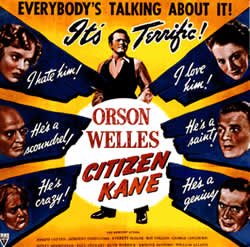
Best Posts: Anytime Movies: Citizen Kane

It's Spring-Break for me. Times are busy. The Summer Movie Season is already begun (and I'll be writing about the new ones) and the Film Festivals are grinding away like creaky mills separating wheat from chaff. It's as good a time as any to re-boot a feature I started years ago, when it was suggested I do a "Top Ten" List.

I don't like those: they're rather arbitrary; they pit films against each other, and there's always one or two that should be on the list that aren't because something better shoved it down the trash-bin.

So, I came up with this: "Anytime" Movies.

Anytime Movies are the movies I can watch anytime, anywhere. If I see a second of it, I can identify it. If it shows up on television, my attention is focused on it until the conclusion. Sometimes it’s the direction, sometimes it’s the writing, sometimes it’s the acting, sometimes it’s just the idea behind it, but these are the movies I can watch again and again (and again!) and never tire of them. There are ten (kinda). They're not in any particular order, but the #1 movie IS the #1 movie. Here is #2.

So obvious a choice.

Yet Citizen Kane (or RKO 281) has been fielding off re-appraisals and critical backlash since the day of its premiere. Is it really "the greatest American film ever made?"

Yes.

So far….

Part of the argument against it is that it can’t be since it was the product of a 26 year old who had never made a film before. But
Orson Welles was a 26 year old who grew up pampered and precocious—who read Shakespeare at an age when other kids are reading Seuss. As a teen he made his way in the world by his brio and his considerable talents and his nerve to try just about anything. He was an artistic sociopath who staged alternative Shakespeare productions and avant-garde radio plays for years before be given, as Kane puts it, the candy store”—a carte blanche contract with a film studio to make any film of his choice, any way he wanted with final cut and a stipulation that said no one could alter it in any way in perpetuity (This is the reason why Turner Broadcasting in its rush to colorize movies could never put so much as a pink pixel to “Citizen Kane.” Some contract!). With it, he gathered his seasoned Mercury Theater actors (some of whom would go onto major Hollywood careers), one of the most innovative and painterly cinematographers, Gregg Toland, young, daring editor Robert Wise, the arrogant and brilliant composer Bernard Herrmann, and the amazing technical crew at RKO who produced such amazing feats as “King Kong” and the Astaire-Rogers musicals and turned them loose on Herman Mankiewicz’s long-in-the-planning screenplay that he believed could never be produced.

Out of all that talent at the top of its game, Welles produced the best American movie ever made, and as a reward he was never allowed that freedom again. Ever.

No good movie goes unpunished.

His next film, “
The Magnificent Ambersons” was a more mature and accomplished–looking film, but RKO chopped it up. re-shot the ending into a certain incomprehensibility and threw it on the bottom of a cheesey double bill. Welles’ Falstaff movie “The Chimes at Midnight” was the project closest to his heart, and might be better if not for the logistical and technical hurdles Welles had to jump in order to make it.

But “Kane” is the grail—the stuff of legend, and has been looked on ever since with avarice by
would-be auteurs with more guts than talent, and therein lies the danger. That reputation could make "Kane" as cold and lifeless as one of the statues in Xanadu’s basement. It’s actually more like one of Susan Alexander Kane’s puzzles—intricate and maybe unsolvable without a lot of effort. There’s one shot where Welles shows his hand. It occurs after Susan has left him, accompanied by the screeching cockatiel superimposed on the screen (“I wanted to wake the audience up at that point,” Welles joked. Really, Orson? Right Linkthere?) and right after he trashes her room—destroying the acquisitions of her life—and Kane picks up the snow-globe that will fall from his hand at his death. “Rosebud,” he murmurs (both times) and then walks as in a daze out of her room, into the hall, and past the servants. He then crosses through a mirrored hallway that reflects an endless line of Kanes that recede and disappear. After Kane (and his many reflections) has passed, the camera then pushes into the mirror and out of the reverie of the butler (“Sentimental fella, aren’t you?” “Mmm. Yes and no.”)


That shot is the exit from the worlds of memory through which we have seen many reflections of Kane—the house of mirrors that makes up the bulk of “Citizen Kane,” the movie. It is also our last image of Kane, himself, in the film. He’s talked about through to the end, of course, but that splintered mirror-shot is our final impression of him (Kane—and Welles—are not even seen in the End Credits review of actors). At that point it becomes clear (as crystal) that the entire film is like that hall of mirrors that reflected back the aspects of Kane important to each narrator—a process that began with the newsreel that quickly jumped through the highlights of Kane’s life as a public figure and set up the film’s surface mystery—what is the meaning of Kane’s last word (and so serves as a stand-in for “who was Kane, really?”).

In the course of the various reflections there are all sorts of legerdemain—little tricks and in-jokes—that Welles, who was an amateur magician, clearly loved pulling off even if an audience didn’t immediately “get” them. One of my favorites is the craning shot through the model of the “El Rancho” nightclub where Susan Alexander performs and drinks herself into a stupor every night. The night of Thompson’s first visit it’s storming outside and flashes of lightning hide the camera’s passage through the roof sign and through the glass transom into the nightclub inside. When, half the movie later, we again travel through that transom it’s broken—presumably by our first trip through it. In the film’s original framing (unfortunately not in the DVD presentation) there is the slightest nudge of the camera to the right in the rather severe shot of Mrs. Kane signing little Charles away to the banker, and we see, just on the edge of the frame, that significant snow-globe that keeps popping up in dramatic moments. In the newsreel there is a shot of a newspaper of the entire Kane family. Later in the film, we actually see that shot being taken. Another is the way Kane’s hectoring “Sing-Siiiiing!” to “Boss” Jim Gettys is cut off by a shutting door, but continues by a braying car-horn out on the street. These are little filigrees to the grand architecture of lighting, framing and editing tricks that Welles and his crew pull off.*

But that central question “who was Kane?” is purposely never answered, not by a word, not by an object, and not by a person. In the end, the film says that it can’t solve the problem, that it can only present it, and leave us with the acknowledgement of its complexity.

So what are we left with as the remnants of Kane and his life fly up from the furnace of Xanadu? An answer to the mystery of "Rosebud," but not an answer to the man. For Kane was many things, but as Kane himself passed judgment on himself, he was never great. Given gifts that many of us will never ever have, he ultimately squandered them. Insular, wasteful, in his house of mirrors, he is left alone to contemplate himself.

We all have our gifts. What do we do with them? “Citizen Kane” is like that glass globe that we can peer inside and see the illusion of life…and consider our own lives. And in the end we are left with its final image to contemplate, and one may consider that Kane was a master illusionist himself, pretending greatness where there was none, and utilizing the very same tools used by those other illusionists—magicians and very young film directors--to create those illusions.

Those tools being smoke…and mirrors.


* Orson Welles is unique in the group of directors of movies that I’ve seen in that every time I exit from a new film of his, I come out looking at the world with new eyes…or with a new perception of the old world--one that seems filled with possibilities.


Citizen Kane
Once Upon a Time in the West
-Only Angels Have Wings
The Searchers
Mr. Smith Goes to Washington
Chinatown
American Graffiti
To Kill a Mockingbird
Goldfinger
Bonus: Edge of Darkness


Tuesday, January 5, 2010

Me and Orson Welles

"Waiting for Orson"

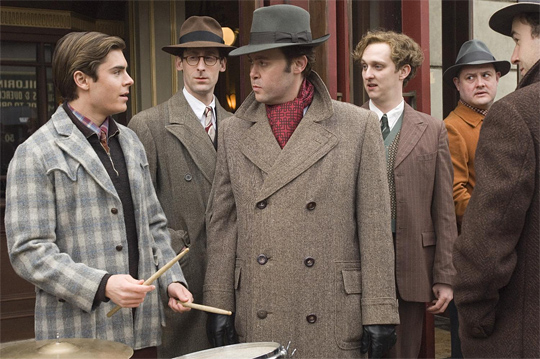
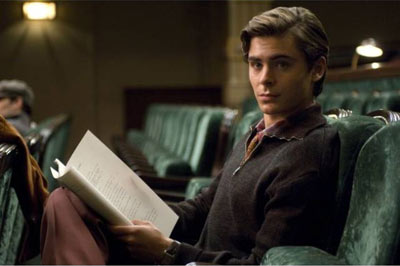
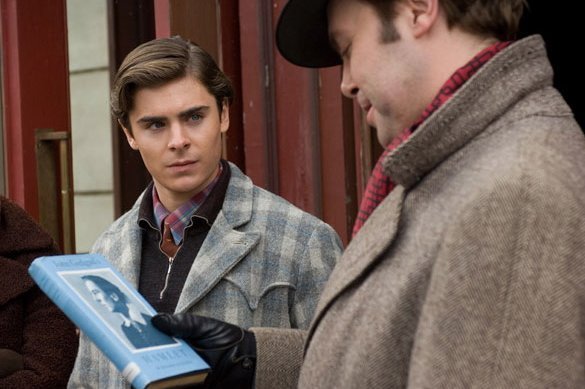
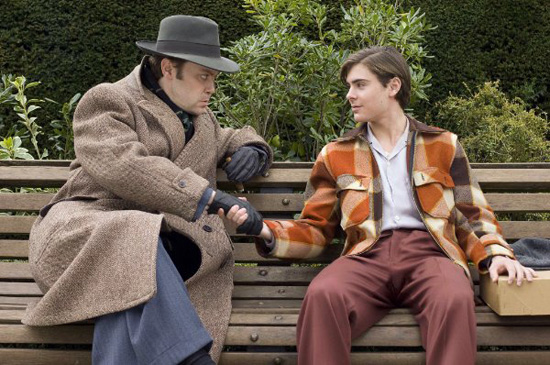
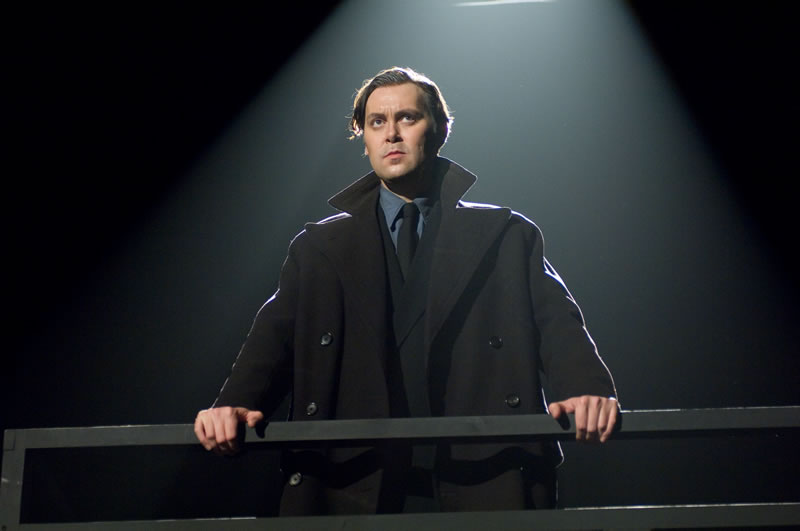
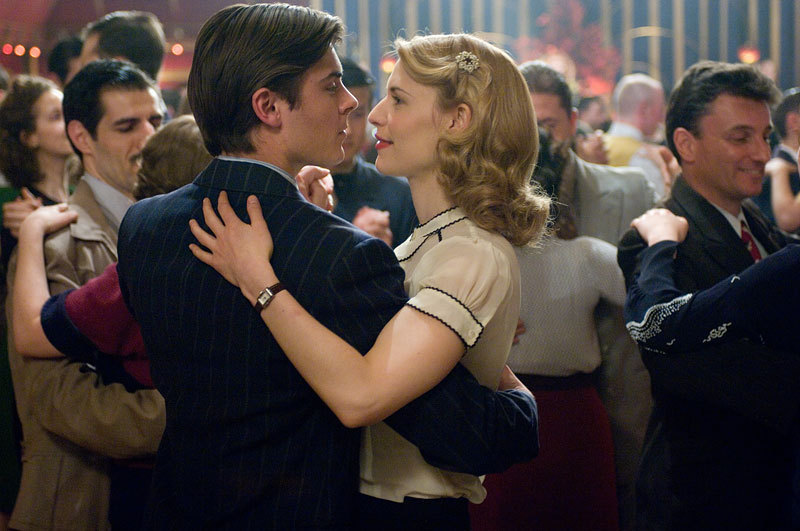
Young Richard Samuels (Zac Efron) is 17, "almost an actor," which puts him just a few hefty years (and worlds) behind the 22 year old Orson Welles (Christian McKay), who has established (by a shoestring) his Mercury Theater in New York, where he is in rehearsals for his modern-dress version of "Julius Caesar"—that is when he is not being whisked from studio to studio by ambulance to perform in various network radio shows, carrying on affairs with ballet dancers, associates, and "just met" women behind the aching back of his pregnant wife.*

Young Samuels manages to vocally pad his resume a bit and kibitzes with some of the players, just enough that
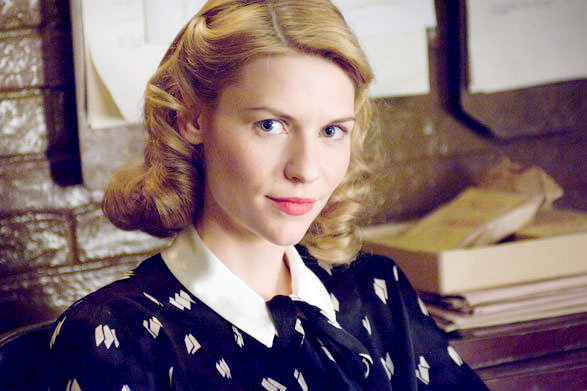
when Welles himself shows up to see the lighting of the big neon sign outside of "his" theater, he sees another bright, shiny object, and as he's about to fire a troublesome actor and "junior" can play the ukulele, Welles hires him on the spot...so he can fire the other kid. "He had a personality problem with Orson," says the Mercury's girl Friday Sonja Jones (Claire Danes). "Meaning he had a personality."

And that just wouldn't do.
It's all about Orson, even when it isn't.

There's not that much difference between on-stage and off-stage because the star of it all is Orson Welles, manufacturing drama where there is none, generating excitement even needlessly, and making sure that the limelight is on him. He is the hero of it all and the villain with the best lines. He desires to be, as Alice Roosevelt said of her president-father, "the bride at every wedding and the corpse at every funeral." Life isn't enough, and art has to be stretched to accommodate him.

So do budgets. This fascist recreation of "Julius Caesar" is "modern dress" because there is no money for costumes, but nobody has to know that, it looks like a comment is being made and art is reflecting life au courant. Just like doing a "Voodoo" Macbeth means his all African-American cast is that much cheaper. It looks like a statement, but its merely the ones with a bottom line.


But it's a fine recreation, and if you're not interested in the details, it still makes a compelling story of getting what you need, whether you want it or not. For those who do know the history, it's particularly fun to see
Big Names tossed off: there's Joe (James Tupper), and Lloyd (Leo Bill) and Coulouris (Ben Chaplin) and Jack (Eddie Marsan).** McKay only slightly resembles Welles, and his voice is a timbre higher, but his phrasing, his articulation are spot-on....if the mannerisms seem to be those of the Welles that is familiar on-screen.

And if Zac Efron isn't entirely up to the task of playing his part, that's okay. His role is "Candide," trying to run with thoroughbreds, while he's still admiring the track, crushed with more experienced hoof-tracks. And Efron has just enough skill to do nothing when playing a kid who "doesn't know what he doesn't know." It's a boy's version of "The Devil Wears Prada," but it's also "The Stunt Man," where illusion is all and practiced and can dazzle the rubes. "J.H. (John Houseman) says everything about theater is bull-shit." says Sonja (which she explains is spelled with a "j" but pronounced with a "y"). But the trick is getting the bull-shit to flow in one direction and that's towards the audience, so they can't see the gears in the background, and the compromises, and the cat-fights and ego-clashes and the spit flying in the klieg-lights. It's new and they've never seen it before, and like the magician he was, Welles was good at deflection while making you never want to blink.

And director
Linklater ("Dazed and Confused,""A Scanner Darkly") suddenly seems to understand that. Where before he was content to trace his way through movies, now he's using it as a weapon to win over the audience rather than merely please himself. The big joke at the beginning of the film is a seemingly endless number of production companies that "present" "Me and Orson Welles." Hell, the Isle of Man Film Commission is a producer and so is the special effects company that maintains the period illusions (they had me at the "Re-Elect Laguardia" bumper-sticker on the phone-booth), for like Welles, Linklater is trying to make his movie any way he can, and in one telling shot in the latter part of the movie, he shows how deep he knows his themes. He starts with a close-up of an orchestra singer, and she's nothing to look at. But as the camera moves back, back, back in the hall, soon all you hear is her voice and the spangling of her dress and at some point, it doesn't matter where—she's the most beautiful girl in the world and she can make you fall in love. It's a simple camera move, just a way-stop to what is important in the scene, but it speaks volumes about illusion and The Moment.

It's this trickery and the fascination with the curtain that distinguishes this little recreation of
Welles' prestidigitation from Tim Robbins' hyper-serious (and more than a little dull) "Cradle Will Rock." At times, it seems like Robbins was making a judgmental spoof rather than telling the story, which in its own way revelled in the incalculable effect of stirring theater.

And Linklater has a keen grasp of what makes Welles tick (not in his words, because "the official" Welles confounds biographers by telling different stories of his past), but by his actions. Welles had a fascination with the ephemeral, of the moment that could disappear in a flash and make you wonder if it was ever really there to begin with. Not wanting to be tied down, or set things in stone, he was finally confounded—not in the confused sense, but the frustrated sense—
with film and its opening dates and burned-in images and permanent records. Change it, compress it, speed it up, keep everybody on their toes—they might see something up there—that was the Welles credo. Keep it fresh, or, at least play it fresh. Everything is fleeting, nothing is permanent, so you better move fast and enjoy it, or move past and forget it. "Ripeness is all." In that way, "Me and Orson Welles" is in the same radar zone with "Up in the Air."

At a time when
James Cameron is recycling his old stuff as futuristic, and trumpeting it as revolutionary at the top of his ego, the most amazing thing in this movie season is how two boy-filmmakers, Guy Ritchie and Richard Linklater, grew up to make stellar, fun and deep entertainments out of the past. Like Quentin Tarantino, these film-makers always gave off an air of being too hip for the screening room, but like Tarantino's "Inglorious Basterds," "Sherlock Holmes" and "Me and Orson Welles" are smart, tough entertainments that may only appeal to the loges, but the fact that, given the materials, these directors can rise so magnificently to the occasion is the most eye-opening of movie-going experiences.

For awhile now, I've been peppered with little alerts about this movie on Welles-groups on the Internet and taking them with a grain of salt. There've been other movies about those wild early years, even a couple of TV-movies about "
The Night That Panicked America," and "RKO 281" (about the making of "Citizen Kane") and they've been tepid exercises that oftentimes embellished the facts. But, I think Welles would have enjoyed this one, and even roared with laughter a couple of times. But he would have had one problem with it.

That billing
.

"Me and Orson Welles" is a Full-Price Ticket. See it before it goes away.

72 Years difference: the NYT Hirschfeld cartoon for "Julius Caesar"

The 2009 cartoon of "Me and Orson Welles" in The New Yorker.


* The story is fiction based on fact: Author Robert Kaplow saw a photograph of the "Julius Caesar" production of Welles with a young man playing a lute, and decided to write a story about that young man. Except for the fact that his story is fictional, the rest if fairly accurate. Odd. Usually goes the other way.

** That would be Joseph Cotton, Norman Lloyd (who, like Cotton, worked with Hitchcock-becoming Hitchcock's Supervising Producer on "Alfred Hitchcock Presents" and starring as Dr. Auschlander on "St. Elsewhere," George Coulouris (who had a long, storied career on stage and in Hollywood), and John Houseman, who produced for many years and then, late in life, became a character actor, first in "Seven Days in May," then became ubiquitous, first winning a Best Supporting Actor Award for his Professor Kingsfield in "The Paper Chase." He EARNED it).

Friday, October 16, 2009

Personal Heroes: This is Orson Welles

"I discovered at the age of six that everything was a phony, worked with mirrors. Since then, I've always wanted to be a magician."

I had a lot to say about Orson Welles. I wrote a long dissertation about genius and discipline. About magic and illusion. But a lot of what I had to say was said in “Anytime Movies Reloaded: Citizen Kane”—I just said it differently.

Suffice it to say that, for me, every new Welles film opened up the world to a new, more wondrous interpretation. I would, literally, walk out of a new (to me) Welles film with "new" eyes. But…there are damned few Welles films. We will never see his unexpurgated version of “
The Magnificent Ambersons.” Nor his modern dress version of “Don Quixote."* Nor his suspense film "The Deep" (taken from the same source novel as Philip Noyce’sDead Calm”) which starred Laurence Harvey, Jeanne Moreau and Welles). There are tantalizing glimpses of his London documentary in the DVD of “F for Fake.” Then there’s the film he was working on when he died “The Other Side of the Wind”—Peter Bogdanovich is trying to get it finished for cable. But it won’t be the same. Every so often, bits and pieces of these projects appear to tantalize and disappoint. I guess the way I feel about Welles is like the diner who is promised a sumptuous meal but gets a maddeningly small portion.—there’s never enough. It’s frustrating.

Like this story.

I was going on vacation once when I was working at
KIRO radio, and it was a much-needed vacation. A couple of days before it would begin one of the sales-sharks approached me. “Are you really going on vacation?” she asked. “What!” I said, suspecting a trap. “Are you going somewhere?” “Why do you ask?” “Well, I was wondering...if you wanted to record Orson Welles…” I would! Would I! Apparently, Welles was booked to appear with the Seattle Symphony to read
Ogden Nash’s “Carnival of the Animals” to the specific Saint-Saëns piece. He was going to phone in a promotional commercial, and I’d have the chance to record him. Well, being that I idolized Welles, it didn’t matter if he was in the studio or I was recording him down the phone-line…it was Orson Welles! And, as a bonus, they’d give me a ticket to the concert. Yes!! Any nebulous plans I had for traveling someplace to relax went away—I was going to have a chance to record….Orson Welles! I made sure that I would be home all day and available at a moment’s notice to head down to the studio when the call came in that he was ready.

"The enemy of art is the absence of limitations."

That call came on Tuesday. Great! I’d get to record Orson (I was calling him “Orson”) AND have the bulk of my vacation. I went down to Broadcast House and met the Symphony folks there—extraordinarily nice people who I subsequently had a long relationship doing ads promoting the Symphony (through them, I got some free passes to performances like the one where I saw the perfect version of the “New World Symphony” my favorite piece of “classical” music. Welles was supposed to call at a designated time, and I showed up early—so excited was I to record my hero.

We had a speaker-phone arrangement in the studio, so there was no way to record the conversation when it was off. The way it’d work was we’d set up the call, put Orson on the speaker-phone and through that, then and only then, record him. Remember that. It’ll be important later.

The appointed time came and Orson hadn’t called. We checked with the switchboard and no, if Orson Welles had called, they’d know it—plus, he had the direct line to the studio. But he hadn’t called. An hour and a half later, the symphony rep called the number she had** and talked to someone at his house who said that Orson was “out” and he was supposed to be back two hours ago, and no, she didn’t know when he’d be back.

Okay, it wasn’t going to happen that day. We’d regroup, set up another time and get it done then. The Symphony ad wasn’t supposed to start airing until that Saturday, so we had time.

"The director is simply the audience. So the terrible burden of the director is to take the place of that yawning vacuum, to be the audience and to select from what happens during the day which movement shall be a disaster and which a gala night. His job is to preside over accidents."

Well, let me telescope this story and just say that we had a scheduled time almost every day that week, and I trudged down to the studio to record each time, and, each time, the same scenario played out, including the phone call to Orson’s house and the excuses—and the apologies. Still, I thought it was worth it if I could get him on tape and the Symphony folks, though wearying of it all, still were enthusiastic about the prospect.

As was I.

Friday was our “make or break” day. We had to record something—anything--to air over the weekend to promote the concert. All the usual suspects joined in the studio for the appointed time. True to form, the time passed with no phone call. He was supposed to call us. We’d been assured he’d be home. Nothing was going to interfere. An hour went by, a phone call was made, and we were assured he’d be home by 3pm. Okay, we said, we’ll call him at 3.

By this time, I was skeptical, so I started writing an alternative in case we couldn’t record Orson. I dashed it off and it was approved by the Symphony crew on the spot. 3pm rolled around. We all looked at each other—give him ten minutes, then call. As I remember, nobody spoke. We just sort of watched the clock.
3:05
. This was going to be our last shot at recording Orson. 3:06. I checked the equipment to make sure everything was working, because after all, (3:07), it’d be really embarrassing to finally get him after al this time, and then (3:08) have something fall apart on us. Everything was fine. Tape was ready to roll. 3:09. We called. The Symphony rep dialed Orson’s number and we waited. She and I exchanged glances every time the phone buzzed down the line. I couldn’t hear anything, and I wouldn’t until the speaker-phone was engaged.

Then her eyes widened. A huge smile spread across her face. “Mr. Welles…” she started. But that’s all she said. The smile disappeared and turned into an expression of shock. I couldn’t hear any of it, but she blinked a couple of times and made the impression she was going to start to speak, but she never got the chance. After about 30 seconds, her mouth closed, never managing to say another word.

“What happened?”

“He yelled at me!”

“Wha…?!”

“He said to stop calling and bothering him”

“But…was it really him?”

“He called me a pest!”

“Yeah, that was Orson, all right,” I said. That was a particularly memorable word he used in the out-takes from a commercial session that had been floating around studios around the country (and which you can hear below).


Damn! Orson in a tirade and because of that damned speaker-phone, I didn’t get to hear it, let alone record it.

Well, I set about to get my alternative recorded, and the symphony folks went back to headquarters to lick their wounds and wait for my phone-call to play the advertisement down the line.

Ultimately, I was told that Orson stewed about the “pests” and in the evening, figured out that it wasn’t a French interviewer who had been hounding him, but it was actually the Symphony, and he called and profusely apologized—it was a huge misunderstanding, please forgive him.

Yeah, yeah. But it was too late to record the commercial. I made the best I could of a nice weekend to try to turn it into a vacation, and returned to work Monday morning, having learned a lesson to never do anything like that again. At least, there was still the concert to look forward to.

A little while later. A phone call. “Orson’s not coming!” “Oh? What’s the matter?” “Doctor’s orders. He’s too ill to travel. We have to go with a substitute.” That would turn out to be Seattle actor John Gilbert, who did a superb job (if feeling somewhat out of his depth standing in for Orson Welles). And the program was great—witty and energetic and expertly played. A wonderful show.

But it wasn’t Orson Welles. But then again, it was all too much like Orson Welles. The potential for great things. The magic. And the frustration when things fall short. The disappontment. The lost chances. That is also Orson Welles. So much was out of his control. But quite a bit of it was.
***

"I think I made essentially a mistake in staying in movies, because I--but it's a mistake I can't regret, because it's like saying ''I shouldn't have stayed married to that woman, but I did because I love her.'' I would have been more successful if I'd left movies immediately, stayed in the theater, gone into politics, written, anything. I have--I have wasted the greater part of my life looking for money and trying to get along, trying to make my work from this terribly expensive paint-box, which is a movie. And I've spent too much energy on things that have nothing to do with making a movie. It's about two percent moviemaking and ninety-eight percent hustling. It's no way to spend a life."

ORSON WELLES: [1982]


Orson Welles is a poet
through his violence
and through his grace.
Never does he tumble
from the tightrope
on which he crosses cities
and their dramas.


He is a poet too in the
Loyal friendship he bears
our dreams and our struggles.

��

Others will know better than I
how to praise his work


I content myself with sending him
my fraternal greeting.

��

His handshake is as firm as he is
and I think of it each time my work
obliges me to leap over an obstacle.


Jean Cocteau

"If you want a happy ending, that depends, of course, on where you stop your story."

Orson Welles....here, at his best.


"The movie director must always remain a slightly ambiguous figure, after all, because so much of what he signs his name to came from elsewhere, so many of his best things are merely accidents over which he presides. Or the good fortune he recieves. Or the grace."
"This is Orson Welles" p. 259 Orson Welles and Peter Bogdanovich; ©1998 Da Capo Press

Wellesnet - an Orson Welles blog
Orson Welles at IMDB
Orson Welles at Wikipedia
The Estate of Orson Welles - a tribute site
Orson Welles: a Man and his Genius - another tribute site
An interesting article about Welles
An article on "The War of the Worlds" broadcast
A rather definitive site on "The Mercury Theater"
Welles FBI Files
The infamous Orson Welles "outtakes"

* Well, we get to see some of it: a segment of Welles' "Don Quichotte" (backed by a bizarre version of The Doors' "The End") but you can see where Welles was going with taking the Don's visions into the modern era. This is a haunting piece of film, soundtrack or no.

** I made a note of the number and wrote it down into my phone-ledger. I found that ledger the other day, and inside it was Orson Welles' home phone number.

*** Post-script: Reading this, you'd think I had the opinion that Orson Welles was a failure. Far from it. If anything, Welles can only be said to have not lived up to his potential, which seemed limitless. He could make amazing films and images out of limited resources and binding constraints—an escape-artist film-maker. As it stands, he is merely more human, more approachable. For all his foibles and falterings, his accomplishments, as they stand (and we are privy to so few of them!), are (to be annoyingly alliterative) formidable. We should all aspire to be such "failures."


Tuesday, July 7, 2009

The Stranger

"The Stranger" (Orson Welles, 1946) Fairly conventional film from Orson Welles, which means it's a surrealist experiment in style for everyone else. Welles did this one under a time-constraint (which might be why the thing looks lush and complicated at the beginning and a might skimpy towards the end). It's Welles' least favorite of his films and the only film he directed that turned a profit at the time of its release.

Here, Welles is having fun with the idea of a Nazi war criminal hiding in plain sight in a small American college town. He's become a professor—college prof's being allowed certain eccentricities, like a secret allegiance to Der Fuehrer
—and he has wooed and become engaged to a Supreme Court Justice's daughter (Loretta Young with her "deer-in-the-headlights" look). But for Nazi's it's safety in numbers, usually in concentric patterns. So when another war criminal is allowed to escape as bait by a War Crimes Commission, he heads straight for Harper, Connecticutt, picturesque in Fall, and his superior, Franz Kindler (Welles), hiding as Professor Charles Rankin, hoping to start a Fourth Reich. As the professor is a clock-hobbyist, Kindler's precise deceptions begin to ungear. His current project, the old school clock tower with its carouseling angels and demons in pursuit high above the town is his refuge.

He should be keeping his eyes on the ground and the dogged—one might say pugged—pursuit by War Crimes investigator Wilson (Edward G. Robinson, whose good "badness" is used to great effect). Welles and his screenwriters (with an assist by John Huston) have a lot of fun with the global affairs effecting a small town and its eccentric collection of rubes, who prove to be inconveniently adept at things: the busy-body checkers hustler has a good memory and the town gossips are good sources of information, especially when they're in the dark about what secrets they have. Pretty soon, suspicion is sewn and in a small town, word gets around.

Welles manages to make a propaganda film, a detective story, a woman-in-jeopardy tale, with elements of comedy, AND show concentration camp footage all in one storyline (filmed in 1946!), couched in a popular entertainment (for George Schaefer who brought Welles to Hollywood) and knock it out before heading to Rio De Janeiro to film "The Lady from Shanghai."

It's lower-tier pulp Welles, which still puts it far above Hollywood's average.


Shadows of "The Stranger"
Loretta Young's shadow of a doubt about her new husband (Welles) who's just come home.

"Use Gym Equipment at Your Own Risk" says a sign.
Edward G. Robinson is about to get clocked with a ring.

An informant is faceless and anonymous.

A Nazi criminal is on the run, and gets his picture taken for a fake passport.

Welles' shadows turn that same Nazi...into Adolph Hitler?

But don't take my word for it! As "The Stranger" is in the Public Domain,
you can watch it or download it here
.

Tuesday, May 26, 2009

Anytime Movies Reloaded: Citizen Kane

It's Spring-Break for me. Times are busy. The Summer Movie Season is already begun (and I'll be writing about the new ones) and the Film Festivals are grinding away like creaky mills separating wheat from chaff. It's as good a time as any to re-boot a feature I started years ago, when it was suggested I do a "Top Ten" List.

I don't like those: they're rather arbitrary; they pit films against each other, and there's always one or two that should be on the list that aren't because something better shoved it down the trash-bin.

So, I came up with this: "Anytime" Movies.

Anytime Movies are the movies I can watch anytime, anywhere. If I see a second of it, I can identify it. If it shows up on television, my attention is focused on it until the conclusion. Sometimes it’s the direction, sometimes it’s the writing, sometimes it’s the acting, sometimes it’s just the idea behind it, but these are the movies I can watch again and again (and again!) and never tire of them. There are ten (kinda). They're not in any particular order, but the #1 movie IS the #1 movie.

So obvious a choice.

Yet Citizen Kane (or RKO 281) has been fielding off re-appraisals and critical backlash since the day of its premiere. Is it really "the greatest American film ever made?"

Yes.

So far….

Part of the argument against it is that it can’t be since it was the product of a 26 year old who had never made a film before. But
Orson Welles was a 26 year old who grew up pampered and precocious—who read Shakespeare at an age when other kids are reading Seuss. As a teen he made his way in the world by his brio and his considerable talents and his nerve to try just about anything. He was an artistic sociopath who staged alternative Shakespeare productions and avant-garde radio plays for years before be given, as Kane puts it, the candy store”—a carte blanche contract with a film studio to make any film of his choice, any way he wanted with final cut and a stipulation that said no one could alter it in any way in perpetuity (This is the reason why Turner Broadcasting in its rush to colorize movies could never put so much as a pink pixel to “Citizen Kane.” Some contract!). With it, he gathered his seasoned Mercury Theater actors (some of whom would go onto major Hollywood careers), one of the most innovative and painterly cinematographers, Gregg Toland, young, daring editor Robert Wise, the arrogant and brilliant composer Bernard Herrmann, and the amazing technical crew at RKO who produced such amazing feats as “King Kong” and the Astaire-Rogers musicals and turned them loose on Herman Mankiewicz’s long-in-the-planning screenplay that he believed could never be produced.

Out of all that talent at the top of its game, Welles produced the best American movie ever made, and as a reward he was never allowed that freedom again. Ever.

No good movie goes unpunished.

His next film, “
The Magnificent Ambersons” was a more mature and accomplished–looking film, but RKO chopped it up. re-shot the ending into a certain incomprehensibility and threw it on the bottom of a cheesey double bill. Welles’ Falstaff movie “The Chimes at Midnight” was the project closest to his heart, and might be better if not for the logistical and technical hurdles Welles had to jump in order to make it.

But “Kane” is the grail—the stuff of legend, and has been looked on ever since with avarice by would-be auteurs with more guts than talent, and therein lies the danger. That reputation could make "Kane" as cold and lifeless as one of the statues in Xanadu’s basement. It’s actually more like one of Susan Alexander Kane’s puzzles—intricate and maybe unsolvable without a lot of effort. There’s one shot where Welles shows his hand. It occurs after Susan has left him, accompanied by the screeching cockatiel superimposed on the screen (“I wanted to wake the audience up at that point,” Welles joked. Really, Orson? Right Linkthere?) and right after he trashes her room—destroying the acquisitions of her life—and Kane picks up the snow-globe that will fall from his hand at his death. “Rosebud,” he murmurs (both times) and then walks as in a daze out of her room, into the hall, and past the servants. He then crosses through a mirrored hallway that reflects an endless line of Kanes that recede and disappear. After Kane (and his many reflections) has passed, the camera then pushes into the mirror and out of the reverie of the butler (“Sentimental fella, aren’t you?” “Mmm. Yes and no.”)


That shot is the exit from the worlds of memory through which we have seen many reflections of Kane—the house of mirrors that makes up the bulk of “Citizen Kane,” the movie. It is also our last image of Kane, himself, in the film. He’s talked about through to the end, of course, but that splintered mirror-shot is our final impression of him (Kane—and Welles—are not even seen in the End Credits review of actors). At that point it becomes clear (as crystal) that the entire film is like that hall of mirrors that reflected back the aspects of Kane important to each narrator—a process that began with the newsreel that quickly jumped through the highlights of Kane’s life as a public figure and set up the film’s surface mystery—what is the meaning of Kane’s last word (and so serves as a stand-in for “who was Kane, really?”).

In the course of the various reflections there are all sorts of legerdemain—little tricks and in-jokes—that Welles, who was an amateur magician, clearly loved pulling off even if an audience didn’t immediately “get” them. One of my favorites is the craning shot through the model of the “El Rancho” nightclub where Susan Alexander performs and drinks herself into a stupor every night. The night of Thompson’s first visit it’s storming outside and flashes of lightning hide the camera’s passage through the roof sign and through the glass transom into the nightclub inside. When, half the movie later, we again travel through that transom it’s broken—presumably by our first trip through it. In the film’s original framing (unfortunately not in the DVD presentation) there is the slightest nudge of the camera to the right in the rather severe shot of Mrs. Kane signing little Charles away to the banker, and we see, just on the edge of the frame, that significant snow-globe that keeps popping up in dramatic moments. In the newsreel there is a shot of a newspaper of the entire Kane family. Later in the film, we actually see that shot being taken. Another is the way Kane’s hectoring “Sing-Siiiiing!” to “Boss” Jim Gettys is cut off by a shutting door, but continues by a braying car-horn out on the street. These are little filigrees to the grand architecture of lighting, framing and editing tricks that Welles and his crew pull off.*

But that central question “who was Kane?” is purposely never answered, not by a word, not by an object, and not by a person. In the end, the film says that it can’t solve the problem, that it can only present it, and leave us with the acknowledgement of its complexity.

So what are we left with as the remnants of Kane and his life fly up from the furnace of Xanadu? An answer to the mystery of "Rosebud," but not an answer to the man. For Kane was many things, but as Kane himself passed judgment on himself, he was never great. Given gifts that many of us will never ever have, he ultimately squandered them. Insular, wasteful, in his house of mirrors, he is left alone to contemplate himself.

We all have our gifts. What do we do with them? “Citizen Kane” is like that glass globe that we can peer inside and see the illusion of life…and consider our own lives. And in the end we are left with its final image to contemplate, and one may consider that Kane was a master illusionist himself, pretending greatness where there was none, and utilizing the very same tools used by those other illusionists—magicians and very young film directors--to create those illusions.

Those tools being smoke…and mirrors.


* Orson Welles is unique in the group of directors of movies that I’ve seen in that every time I exit from a new film of his, I come out looking at the world with new eyes…or with a new perception of the old world--one that seems filled with possibilities.


Citizen Kane
Once Upon a Time in the West
-Only Angels Have Wings
The Searchers
Mr. Smith Goes to Washington
Chinatown
American Graffiti
To Kill a Mockingbird
Goldfinger
Bonus: Edge of Darkness