Showing posts with label George Pal. Show all posts

Wednesday, October 30, 2013

The War of the Worlds Through the Years

Seventy five years ago tonight (at 8 pm EST, in fact), Orson Welles chose to do a radio broadcast just for Hallowe'en—a radio adaptation of H.G. Well's novel of "The War of the Worlds" on his "Mercury Theater On the Air" broadcast on the CBS radio network. 
  
Welles' show was not that popular, and so a lot of people didn't hear the introduction of the piece stating clearly that it "presenting 'The War of the Worlds' by H.G. Wells"; most of those listening to the radio at that time of the evening were listening to the more popular "The Chase and Sanborn Hour", which featured ventriloquist Edgar Bergen and his dummy Charlie McCarthy (yes, a show with a ventriloquist was very popular on radio).  But, twelve minutes into the comedy show, there was a song interlude, and people did then what they do now—they surfed the dial, looking for something better until the segment was over and they could turn back.

And what they found was this:


At about twelve minutes in, the broadcast was just getting interesting: a faux dance music program was being presented and interrupted by "news bulletins" reporting that plumes of incandescent gas had been seen leaving the planet Mars and headed for Earth. A "return to scheduled programming."  Then another interruption saying that meteorites have landed near Grover's Mill, New Jersey (as opposed to Woking, Surrey in Wells' novel) and Princeton expert Professor Richard Pearson (Welles) is brought in to speculate that there is no life on Mars.  The next segment is a "live report" from Grover's Mill where "reporter Carl Phillips" (played by Frank Readick, who had "prepped" for this segment by listening to reporting of the explosion of The Hindenburg) reports on the opening of the cylindrical meteorites, the appearance of tentacled creatures wielding a death beam that incinerates the crowd...

And then...silence.

The original script (by the ubiquitous Howard Koch) was deemed to dull by Welles, and a new draft was created, inspired by an Archibald MacLeish radio-play "Air Raid" (in which Welles had appeared).  The idea was not to dramatize events as in the novel, but to use the medium of radio to provide the context and the drama of how such an invasion might play out under the circumstances and over the air-waves.  More than the audio of a staged play (as most of these things were), it was very much of its source—a radio-play, by, of, and about the experience of getting the news live over this new medium, unfiltered and immediately...without a chance for resolution. 

"Panic" may be too strong a word for the result, and the newspapers played it up to discredit the reliance of radio for news,* but there were many, many, many people who heard the simulated news-casts and, now used to recent advances that allowed "news flashes" interrupting programming, and at a time when Germany was making moves on Austria and Czechoslovakia, took them for the real thing.  A cursory search on the dial would have told them that the only network broadcasting the events at Grover's Mill was CBS, but the events were so compelling that not many switched away.  Some merely left their radios in their panic to avoid "the coming invasion." It wasn't until the 43 minute mark in the broadcast (which ran no commercials as it was not sponsored) that the network broke in to remind listeners that they were, in reality, listening to a radio-play.  This was necessitated as the CBS switchboard in New York was flooded with calls to the point of incapacitation. 

For Welles, three things happened: he became a nationwide celebrity, "The Mercury Theater On the Air" got a sponsor and became "The Campbell Soup Hour", and Welles was lured to Hollywood by RKO Studios, where they hoped he might make a film of "The War of the Worlds," to cash in on the notoriety. He had other plans.  

A film of "The War of the Worlds" would have to wait.


••••••••••••••••••••••••••••••••••••••••••••••••••••••••••••••••••••••

The War of the Worlds (Byron Haskin, 1953) Twenty five years after Welles' broadcast, George Pal made a Technicolor movie out of Wells' novel.  Like the radio broadcast, it updated the story for the times.  The time is the present and the phenomenon is world-wide while the film concentrates on cylinders landing in Linda Rosa, California, outside of Los Angeles.  By chance, Dr. Clayton Forrester (Gene Barry), a scientist involved with America's development of the atomic bomb happens to be fishing nearby when the nearest craft zooms overhead.  Investigating, he finds a crowd of people, including Linda Rosa residents Silvia van Buren (Ann Robinson) and pastor Matthew Collins (Lewis Martin), her uncle.  The glowing craft is giving off radioactivity and so three locals elect to stand guard until the thing cools down enough to be investigated, and Forrester elects to wait until morning in town.  

Before he can return the meteorite opens up and a snake-like periscope rises from the crash.  As the three men approach, the scope emits a shrieking heat-ray that atomizes them on the spot, and knocks out power to the town, alerting Forrester that something's happened and he finds out that Earth is under attack from Martian war-machines, shaped like flying manta-rays.**


** Although not a tripod as in the novel, the Martian attack-ships start off
elevating on three beams of energy that then disappear
(no doubt owing to the cost of animating)

 
The 1953 movie is interesting for its inclusion of nuclear power and weaponry into the mix—eight years after Hiroshima and amid other films that, at the time, used atomic energy to produce horrors in Nature.  Religion is given far more importance in the 1953 movie than the novel (where Wells dismisses it entirely), although it proves ineffective in the short term, but is given the credit for the long-term outcome.  Forrester stands in for Wells' unnamed narrator, separated from his fellow survivors and struggling to evade the war machines to get back to his wife—in the movie's instance, its the newly reunited Ms. van Buren, Forrester's former student.  

Pal's version became a classic, one of the few science fiction films that the Hollywood establishment took notice of besides its receipts (in no small part due to Cecil B. DeMille's championing of it), winning a de facto Oscar for its spectacular effects combining wire-and-model work and animation (the machines were so popular they were re-used in Pal and Haskin's Robinson Crusoe on Mars).  It is still well-regarded as a superior sci-fi adventure film. The Wells estate was so enthusiastic with the result that they gave Pal the pick of any of Wells' stories to make a film of.  His choice was "The Time Machine," which was released in 1960.


War of the Worlds (Steven Spielberg, 2005) Fifty two years after George Pal's film and sixty seven years after Welles' broadcast, Spielberg completed his unofficial trilogy of Earth invasion films (after Close Encounters of the Third Kind and E.T. the Extra-terrestrial) with his own version of the Wells story, again, updated for the times, and without the article "the" in the title.  The invasion is, once again, world-wide, although attention is centered on the east coast of the United States.

This "War" was made within the memory of the 9/11 attacks, as Spielberg staging large infrastructure-dusting battles that tip over intersections and vaporize human beings (leaving their clothes to float empty to the ground).  The attackers are not named as "Martians" but acknowledged as "other-worldly" with a suspiciously complicated origin—evidently, they've been long buried in the Earth, only needing the transmission of a spirit via lightning storm that simultaneously energizes the war-machines and knocks out the surrounding power grid.  These machine are more the design of Wells original intent—ungainly tripods that still manage to do sizable damage with its heat-rays, black smoke, and red vegetation that carpets the area in a means of terra-forming (all from Wells' source). 


Although it may seem like a "typical" Spielberg project, it is an odd blend of Wells' and Spielberg's sensibilities, and in fact, anti-Spielberg sensibilities. Wells story was about his narrator trying to get back to his wife amidst the chaos of the war.  Spielberg has the same story-line, but his protagonist is another Spielberg "common man" (or as common as Tom Cruise will allow himself to be), who must rise to the occasion—in this case Cruise's Ray Ferrier is a dead-beat, uninvolved dad who must get his kids back to his estranged wife, amidst all the chaos.  Given that CE3K and ET were films by a less mature Spielberg that broke families apart, offering a glimpse of the heavens, this time, Spielberg's protagonist is doing everything he can (as in Wells' novel) to re-unite his family.  Spielberg had grown up by the time these aliens visited Earth.  And yet, for all his heroics, the film has more in keeping with the ending of John Ford's The Searchers, as Ferrier is left standing in the street of his in-laws' brownstone (and they're played, naturally, by Gene Barry and Ann Robinson from the '53 version), satisfied enough that he has brought them together, but acknowledging that he is still an outsider without regard for acceptance as reward.  He's done what he should have been doing all along.  And mature enough now to not expect anything from it.

It's one of my favorite Spielberg endings.


* The Slate article preceding this asterisk debunks the myth by citing lack of evidence—not the most reliable indicator—but what's strange is that when stations repeat the stunt (as reported on Radiolab's episode about the broadcast), the results tend to skew the same way.  There are always going to be a few that will panic, and with mob-mentality as an accelerant, things can get out of hand...even for Martians to handle.

Thursday, May 23, 2013

The Power

The Power (Byron Haskin, 1968) A sci-fi "who-thunk-it" by the producing-directing team of George Pal and Byron Haskin, whose work included the 1953 War of the Worlds, When Worlds Collide, and Robinson Crusoe on Mars.  The subjects of the Pal-Haskin team were usually puerile, with sophisticated special effects that dazzled the child in anyone, no matter their age.  The Power, however, is light on special effects, and the sub-text is less extra-terrestrial than sensorial.

A team of scientists (George Hamilton, Suzanne Pleshette, Richard Carlson, Earl Holliman, Nehemiah Persoff, and Arthur O'Connell) are working on a top-secret project testing astronaut endurance.  They are visited one day by their government liaison Arthur Norlund (Michael Rennie) who is skeptical of the worth of the whole project, other than the ideas of the team crack-pot, anthropologist Henry Hallson (O'Connell) who is convinced by his survey studies that one of the subjects has paranormal abilities.  His outbursts embarrass the entire board, especially Dr. Tanner (Hamilton) who tries to beat down the doctor's ideas at every opportunity.  However, a simple test proves that one of the scientific team has extraordinary mental powers.


Before you can say "Agatha Christie's 'Ten Little Indians'" the scientists start being knocked off in strange ways that only we, the audience, are privy to.  First Dr. Hallson is found dead, centrifugally squished in a centrifuge run amok.  Then Dr. Tanner is fired from the project, accused of never having attended college, and faking his way into his position.  He teams up with fellow researcher (and main squeeze) Marge Lansing (Pleshette) to try and track down who the murderer could be.  In the meantime, more of the research team end up incapacitated, and it becomes readily apparent to Tanner and Lansing that they're going to end up on a slab unless they can find the killer.  But who is it?


The movie is quite clever in how it clicks along, even if the love story feels a bit tepid, and Haskin's stage sense is always assured at making the strange either commonplace or particularly fascinating.*  For instance, the scientists work in a facility where their offices are separated by glass, so everybody can keep tabs on everybody else, making hiding the killer a difficult project.  Once Tanner is fired, however, the confining space is taken out of the equation, and the individual attempts at messing with people's minds are given free reign and can come out of anywhere...and nowhere at the same time.


As far as the acting is concerned, it's a bit cheesy, with O'Connell over-emoting until you wonder about his credentials, and Hamilton smolders throughout, as if told he'd be the leading man, but not told how.   He's at his best convincing us that the illusions he sees are real, and the horror/confusion that he feels play across his face.  That's when he truly bonds with his audience, and is the filmmakers' best asset in making the movie come across.


  * Haskin had worked with Disney live action films, and did the more superior episodes of the original version of "The Outer Limits" as well as the first pilot for a little series called "Star Trek."


Monday, February 4, 2008

The 7 Faces of Dr. Lao

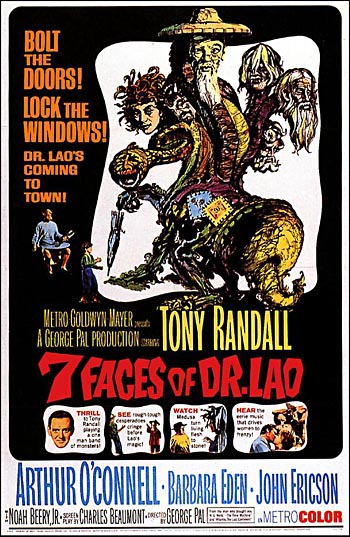
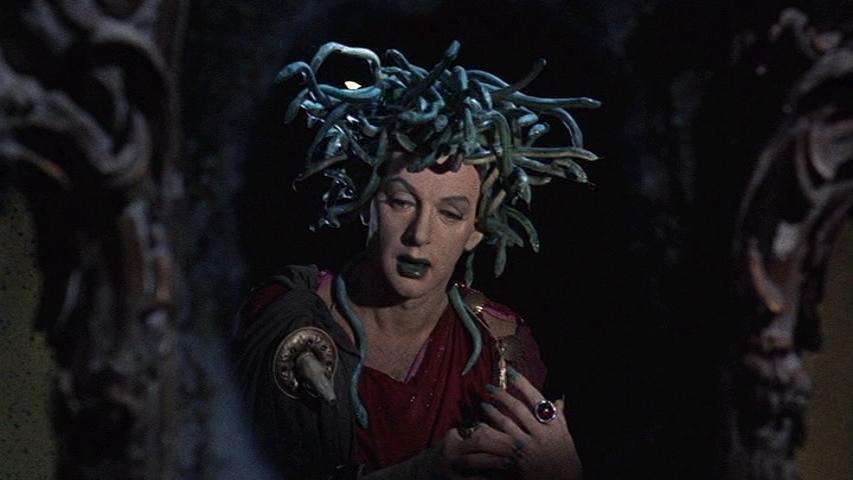
"The 7 Faces of Dr. Lao" (George Pal, 1964) One of those movies I wanted to see as a kid, but never got the chance. An ersatz Western directed by film-fantasist George Pal ("The War of the Worlds," "The Time Machine") with a screenplay by the mordantly sunny Charles Beaumont, responsible for many of the best mind-twisting "Twilight Zone" episodes. Dr. Lao is the "Mysterious Stranger" who comes into the troubled town of Abalone with a circus that exposes truth, shines a light on hypocrisy, and turns lives around. One might be a bit off-put by Lao's initial pigeon-English, but it's as epehemeral as everything else about Dr. Lao, for he's not any nationality ("He looks like a 'Jap' to me" "Naw, he's more Chinese" "How d'you know that?" "'Cause I'm not stupid!"), sticks to no dialect or any sex, for that matter--if he's made of matter, at all! One should be more concerned with the idea that a "Good Man" will unstarch the collar of the Local School-Marm, except that this transformation (by the Circus' "Pan") leaving Barbara Eden sweating and panting is bravurely provocative for a G-rated kid's film. That's something Disney wouldn't try! Everything turns nicely-nicely at the end, but there is trauma along the way to balance it. Tony Randall plays Lao beneath all sorts of William Tuttle (another "TZ" alum) make-up that doesn't hamper the elasticity of his performance, and as a kind of bow/acknowledgement he appears in the circus audience gravely shaking his head.


But back to Beaumont. Check out this thesis speech delivered in low reverent tones by Randall:


"The whole world is a circus, if you know how to look at it. The way the sun
goes down when you're tired, and comes up when you want to be on the move.
That's real magic. The way a leaf grows. The song of the birds. The way the
desert looks at night with the Moon embracing it. Oh, my boy. That's circus
enough for anyone. Every time you watch a rainbow and feel wonder in your heart.
Every time you pick up a handful of dust, and see not the dust, but a mystery--a
marvel, there in your hand. Every time you stop and think "I'm alive, and being
alive is fantastic!" Every time such a thing happens, you're a part of the
Circus of Dr. Lao."


That is heavy stuff, delivered in an intoxicating rhythm and smoothness of tone--it's joy mounting as the commonness of the examples increases, getting down to the dirt. That's a great speech. And as Beaumont could be dark in tone, his words could excite and throw apart any veil of despair. But even if that speech gets a little heavy, Beaumont has the cure. "I don't understand," the child answers. Lao grabs the top of his head and leaps over it. "Neither do I!" he exults, and begins a high-kicking dance. Life is too wonderful to spend your time saying how wonderful it is. Use it. Dance!