Showing posts with label 1938. Show all posts

Wednesday, October 30, 2013

The War of the Worlds Through the Years

Seventy five years ago tonight (at 8 pm EST, in fact), Orson Welles chose to do a radio broadcast just for Hallowe'en—a radio adaptation of H.G. Well's novel of "The War of the Worlds" on his "Mercury Theater On the Air" broadcast on the CBS radio network. 
  
Welles' show was not that popular, and so a lot of people didn't hear the introduction of the piece stating clearly that it "presenting 'The War of the Worlds' by H.G. Wells"; most of those listening to the radio at that time of the evening were listening to the more popular "The Chase and Sanborn Hour", which featured ventriloquist Edgar Bergen and his dummy Charlie McCarthy (yes, a show with a ventriloquist was very popular on radio).  But, twelve minutes into the comedy show, there was a song interlude, and people did then what they do now—they surfed the dial, looking for something better until the segment was over and they could turn back.

And what they found was this:


At about twelve minutes in, the broadcast was just getting interesting: a faux dance music program was being presented and interrupted by "news bulletins" reporting that plumes of incandescent gas had been seen leaving the planet Mars and headed for Earth. A "return to scheduled programming."  Then another interruption saying that meteorites have landed near Grover's Mill, New Jersey (as opposed to Woking, Surrey in Wells' novel) and Princeton expert Professor Richard Pearson (Welles) is brought in to speculate that there is no life on Mars.  The next segment is a "live report" from Grover's Mill where "reporter Carl Phillips" (played by Frank Readick, who had "prepped" for this segment by listening to reporting of the explosion of The Hindenburg) reports on the opening of the cylindrical meteorites, the appearance of tentacled creatures wielding a death beam that incinerates the crowd...

And then...silence.

The original script (by the ubiquitous Howard Koch) was deemed to dull by Welles, and a new draft was created, inspired by an Archibald MacLeish radio-play "Air Raid" (in which Welles had appeared).  The idea was not to dramatize events as in the novel, but to use the medium of radio to provide the context and the drama of how such an invasion might play out under the circumstances and over the air-waves.  More than the audio of a staged play (as most of these things were), it was very much of its source—a radio-play, by, of, and about the experience of getting the news live over this new medium, unfiltered and immediately...without a chance for resolution. 

"Panic" may be too strong a word for the result, and the newspapers played it up to discredit the reliance of radio for news,* but there were many, many, many people who heard the simulated news-casts and, now used to recent advances that allowed "news flashes" interrupting programming, and at a time when Germany was making moves on Austria and Czechoslovakia, took them for the real thing.  A cursory search on the dial would have told them that the only network broadcasting the events at Grover's Mill was CBS, but the events were so compelling that not many switched away.  Some merely left their radios in their panic to avoid "the coming invasion." It wasn't until the 43 minute mark in the broadcast (which ran no commercials as it was not sponsored) that the network broke in to remind listeners that they were, in reality, listening to a radio-play.  This was necessitated as the CBS switchboard in New York was flooded with calls to the point of incapacitation. 

For Welles, three things happened: he became a nationwide celebrity, "The Mercury Theater On the Air" got a sponsor and became "The Campbell Soup Hour", and Welles was lured to Hollywood by RKO Studios, where they hoped he might make a film of "The War of the Worlds," to cash in on the notoriety. He had other plans.  

A film of "The War of the Worlds" would have to wait.


••••••••••••••••••••••••••••••••••••••••••••••••••••••••••••••••••••••

The War of the Worlds (Byron Haskin, 1953) Twenty five years after Welles' broadcast, George Pal made a Technicolor movie out of Wells' novel.  Like the radio broadcast, it updated the story for the times.  The time is the present and the phenomenon is world-wide while the film concentrates on cylinders landing in Linda Rosa, California, outside of Los Angeles.  By chance, Dr. Clayton Forrester (Gene Barry), a scientist involved with America's development of the atomic bomb happens to be fishing nearby when the nearest craft zooms overhead.  Investigating, he finds a crowd of people, including Linda Rosa residents Silvia van Buren (Ann Robinson) and pastor Matthew Collins (Lewis Martin), her uncle.  The glowing craft is giving off radioactivity and so three locals elect to stand guard until the thing cools down enough to be investigated, and Forrester elects to wait until morning in town.  

Before he can return the meteorite opens up and a snake-like periscope rises from the crash.  As the three men approach, the scope emits a shrieking heat-ray that atomizes them on the spot, and knocks out power to the town, alerting Forrester that something's happened and he finds out that Earth is under attack from Martian war-machines, shaped like flying manta-rays.**


** Although not a tripod as in the novel, the Martian attack-ships start off
elevating on three beams of energy that then disappear
(no doubt owing to the cost of animating)

 
The 1953 movie is interesting for its inclusion of nuclear power and weaponry into the mix—eight years after Hiroshima and amid other films that, at the time, used atomic energy to produce horrors in Nature.  Religion is given far more importance in the 1953 movie than the novel (where Wells dismisses it entirely), although it proves ineffective in the short term, but is given the credit for the long-term outcome.  Forrester stands in for Wells' unnamed narrator, separated from his fellow survivors and struggling to evade the war machines to get back to his wife—in the movie's instance, its the newly reunited Ms. van Buren, Forrester's former student.  

Pal's version became a classic, one of the few science fiction films that the Hollywood establishment took notice of besides its receipts (in no small part due to Cecil B. DeMille's championing of it), winning a de facto Oscar for its spectacular effects combining wire-and-model work and animation (the machines were so popular they were re-used in Pal and Haskin's Robinson Crusoe on Mars).  It is still well-regarded as a superior sci-fi adventure film. The Wells estate was so enthusiastic with the result that they gave Pal the pick of any of Wells' stories to make a film of.  His choice was "The Time Machine," which was released in 1960.


War of the Worlds (Steven Spielberg, 2005) Fifty two years after George Pal's film and sixty seven years after Welles' broadcast, Spielberg completed his unofficial trilogy of Earth invasion films (after Close Encounters of the Third Kind and E.T. the Extra-terrestrial) with his own version of the Wells story, again, updated for the times, and without the article "the" in the title.  The invasion is, once again, world-wide, although attention is centered on the east coast of the United States.

This "War" was made within the memory of the 9/11 attacks, as Spielberg staging large infrastructure-dusting battles that tip over intersections and vaporize human beings (leaving their clothes to float empty to the ground).  The attackers are not named as "Martians" but acknowledged as "other-worldly" with a suspiciously complicated origin—evidently, they've been long buried in the Earth, only needing the transmission of a spirit via lightning storm that simultaneously energizes the war-machines and knocks out the surrounding power grid.  These machine are more the design of Wells original intent—ungainly tripods that still manage to do sizable damage with its heat-rays, black smoke, and red vegetation that carpets the area in a means of terra-forming (all from Wells' source). 


Although it may seem like a "typical" Spielberg project, it is an odd blend of Wells' and Spielberg's sensibilities, and in fact, anti-Spielberg sensibilities. Wells story was about his narrator trying to get back to his wife amidst the chaos of the war.  Spielberg has the same story-line, but his protagonist is another Spielberg "common man" (or as common as Tom Cruise will allow himself to be), who must rise to the occasion—in this case Cruise's Ray Ferrier is a dead-beat, uninvolved dad who must get his kids back to his estranged wife, amidst all the chaos.  Given that CE3K and ET were films by a less mature Spielberg that broke families apart, offering a glimpse of the heavens, this time, Spielberg's protagonist is doing everything he can (as in Wells' novel) to re-unite his family.  Spielberg had grown up by the time these aliens visited Earth.  And yet, for all his heroics, the film has more in keeping with the ending of John Ford's The Searchers, as Ferrier is left standing in the street of his in-laws' brownstone (and they're played, naturally, by Gene Barry and Ann Robinson from the '53 version), satisfied enough that he has brought them together, but acknowledging that he is still an outsider without regard for acceptance as reward.  He's done what he should have been doing all along.  And mature enough now to not expect anything from it.

It's one of my favorite Spielberg endings.


* The Slate article preceding this asterisk debunks the myth by citing lack of evidence—not the most reliable indicator—but what's strange is that when stations repeat the stunt (as reported on Radiolab's episode about the broadcast), the results tend to skew the same way.  There are always going to be a few that will panic, and with mob-mentality as an accelerant, things can get out of hand...even for Martians to handle.

Wednesday, July 18, 2012

The Dawn Patrol (1938)

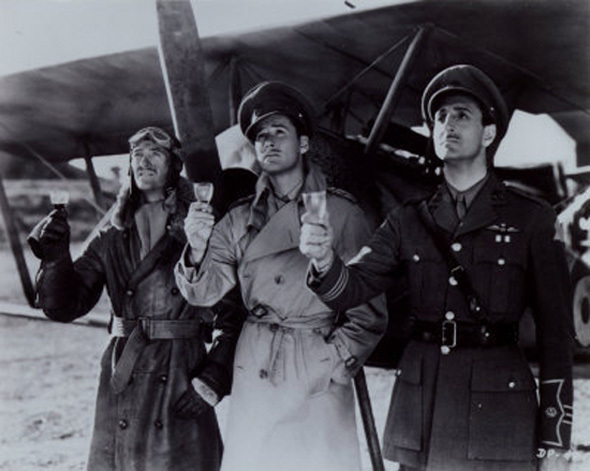
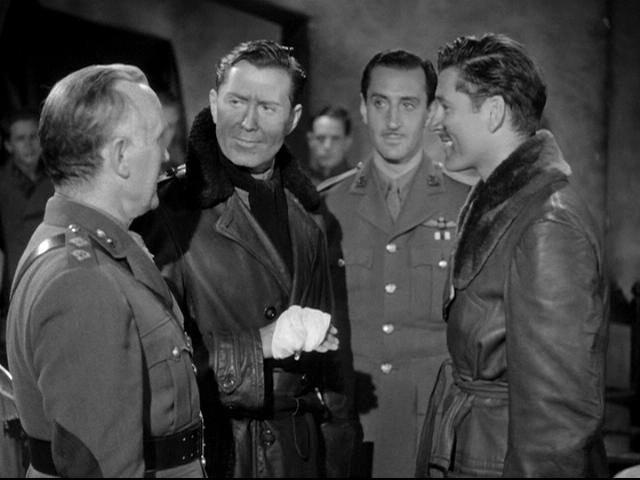
The Dawn Patrol (Edmund Goulding, 1938) Eight years after the silent Howard Hawks hit starring Richard Barthelmess and Douglas Fairbanks, Jr., the same studio released this remake, taking advantage of sound technology to enhance the story, not only in the roar of engines in combat (they even used the same planes from the Hawks version), but also the fellowship of song (a Hawks staple, by the way--I'm very curious to see how the first film got away without it, with no music and no use of the emblematic "Hurrah for the Next Man Who Dies.") This time, it's Errol Flynn as the pilot with the longest shelf-life, reporting to superior Basil Rathbone (who sits and waits, listening for the sound of each plane returning) aided and abetted by Donald Crisp, who does the paper-work, writing the letters home to bereaved families.

Headquarters is a slap-dash dormitory/strategy room with a 24 hour bar (tendered by Barry Fitzgerald)/rumpus room, done in late German atrophy and a blackboard containing the names of the squadron on duty and the chalk-dust that is left of the honored dead.  It's a rotating complement of young men dealing with the pressure cooker (with heavy seasoning) of combat and the existentialism of transitory bonhomie. Very quickly, rookies become veterans and the dreams of youth evaporate in the shots of whiskey and the oil grime that cakes their faces after every sortee.

They're all brothers in the air, dueling and jousting in the machines they pilot, and when they fall, there's enough honor to salute the plummeting.  These pilots are so joined that when a captured German pilot is brought to the barracks, he's welcomed to the party, even though he's just shot down one of their comrades (David Niven) and if someone holds a grudge, well, that's just bad manners, what?

A little odd for a war film,* but an example of Hawksian work ethics—do your job, be a professional, even in war-time.  It's just a grudge-match between nations, anyway, and once everyone's on equal footing—in this case, terra firma—you don't hold a grudge against professionals.  One has to prove oneself worthy, of course, but the general rule is to keep the war in the skies, keep your chin up and your upper lip stiff.

It's not a Hawks film, understand, just an interpretation of Hawks material.    And Edmund Goulding is quite adept at making the material soar, both in the skies and on the ground.  It's a British cast, so the bantering is quite formal with well-defined rules of engagement.  Goulding doesn't match Hawks' trademark at-the-shoulders camera compositions, choosing, instead, a more versatile shooting scheme, which are, at times, artful.  But, it is one odd war movie, removed from the geopolitics, insular and private.  You get the impression that these guys might be doing this, anyway, if it wasn't for the damned turnaround.  But, it is remarkably free of jingoism, glorification and other self-serving sentiments.  War is a hell of job, even in the first light of mourning.


* Odd, yes, but not without precedent, especially given the odd episode of the Christmas truce during WWI (a variation of which Steven Spielberg used for an episode in his War Horse film).  And, in these economic times, there are parallels: I have friends who work in a call center, who oft-times don't see the escorting off the premises of co-workers, while the "new recruits" keep revolving into the ranks to replace them.  I've suggested more than once the idea of a tontine for the "last man standing" from the many cliques that form in such situations.

Monday, February 4, 2008

The Lady Vanishes (1938)

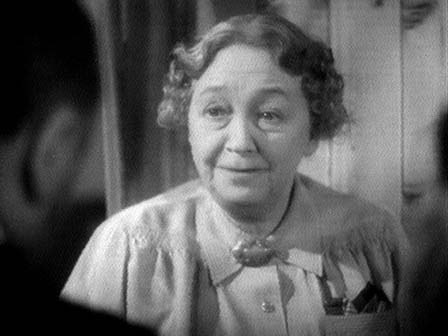
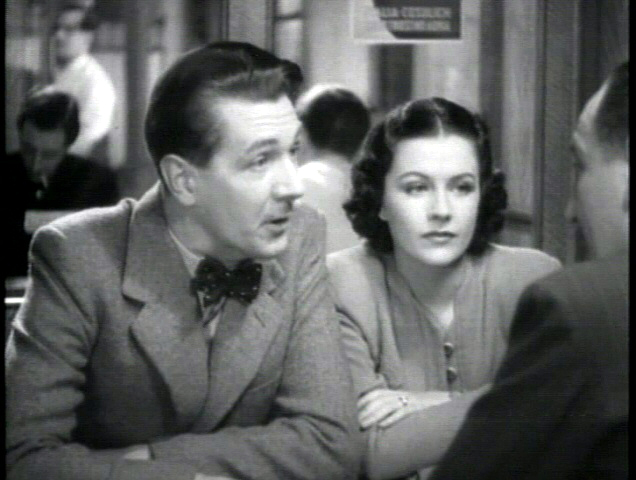
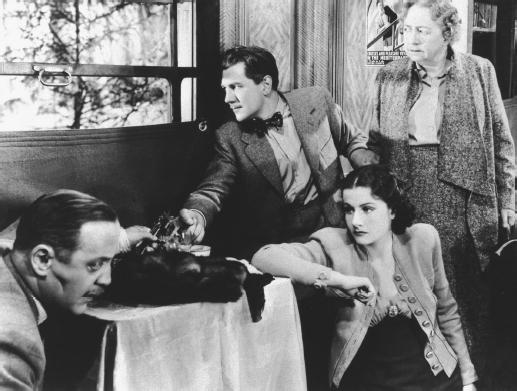
"The Lady Vanishes" (Alfred Hitchcock, 1938) Poor Iris Matilda Henderson has "been everyhwere and done everything," and is on her way to marry what her travelling companions call a "blue-blooded check-chaser" when she gets beaned by a suspiciously-unanchored flower box. She is helped onto her departing train and administered to by the elderly Miss Froy, a vacationing governess in love with the music of the Alps. Waking up from a recuperative nap, Iris discovers the woman missing, and what's worse, no one on the train claims to have seen her. Is everyone on the train lying, or has Iris just imagined the whole thing? The only ally she can find is the eccentric and rather obnoxious musicologist (Michael Redgrave, father of Lyn and Vanessa, and grandfather of Joely Richardson), whose racket has kept her awake nights at their lodgings. But now he comes to her aid ("My father taught me to never desert a lady in trouble. In fact I think that's why he married my mother!") to determine just what's been lost--the old lady or Iris' mind. Redgrave supposedly didn't get on with Hitchcock, and didn't have much respect for movie-acting, either--until another cast member saw him on-stage and wondered why he was so brilliant on the boards and so lackluster on-screen. For his part, Hitchcock took the material and accentuated the comedy and sexual situations, giving each of the train participants their own contrary behavior. It proved to be one of the most beloved of Hitchcock's British films, and legitimately can stand up to any of "The Master of Suspense's" later classics.

Monday, January 14, 2008

- Only Angels Have Wings

While in college, I worked as a movie projectionist, and had an opportunity to show many great films for the various film courses being taught. But one film left a distinct impression—over the course of five days I had to show it eight times. I got to know it pretty well. Its name is “-Only Angels Have Wings” and it was directed by one of the great director-producers, Howard Hawks.

Hawks directed all types of movies, many of them classics of their genre: westerns (
Rio Bravo, Red River); mystery/noir (The Big Sleep); adventure (To Have and Have Not, Hatari!) and comedy (Bringing Up Baby, His Girl Friday). He even produced one of the first truly classic science fiction films (The Thing! [From Another World]), and an iconic musical (Gentlemen Prefer Blondes). Despite the genre, and despite the decade in which it was produced each film is unmistakably a Hawks film – a group of men (and women, but usually men) of diverse talents must come together to achieve a singular goal, be it to drive a huge herd of cattle to Missouri, or contain the alien threat, or capture a live rhinoceros, or get the bad guy to the Marshall (alive if possible) or ferry the refugees to safety, or find the dinosaur clavicle, or land a millionaire.

Conflict is achieved by introducing a newcomer to the mix who doesn’t understand the synergy of the group and who must learn “the code” to belong, and to keep the group in cohesion. And so much the better if they do it without talking about it much.

That’s the Hawks formula, and he was able to create enough variations in the design that his films all seem different, even though they’re always telling the same basic story—a story that’s a metaphor for movie-making.*

“Hello, professional”


Why “-Only Angels Have Wings” out of all those classics? It’s the ultimate Hawks movie. Watch any of those others and you’ll hear similar lines and see similar situations, but in “Angels,” everything is distilled to the basic essence of the tale to become the best Hemingway story Hemingway never wrote. Distilled? The majority of the film takes place in one set! For this band of professionals, the goal is to fly the mail from the port city of Barancca through a narrow passage in the Andes utilizing one of a number of prop aircraft in need of repair. All the men realize they’re merely links in a chain getting the mail…or a doctor…or a shipment of nitro-glycerin…to its destination with the threat of death flying right alongside. So hazardous is the job for these civilian-pilots that their base is a revolving door for the new blood who have to prove themselves. It’s "The Right Stuff” twenty years before Tom Wolfe popularized the phrase.

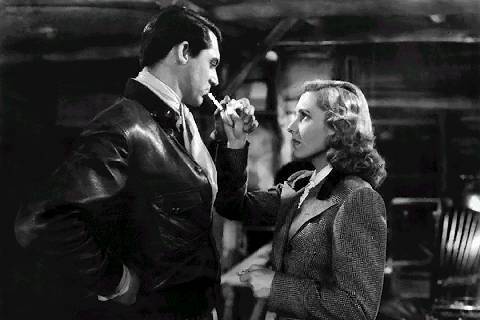
And it’s prime Hawks. For instance, watch the cigarettes. In a Hawks film, they’re visual short-hand for relationships—who’s in need, who can provide, who’s giving, who’s dependable. More than any other Hawks film, except perhaps “Rio Bravo,” the flame that’s there when you need it is a gambit that crams twice the information into the film, and reveals more about the characters than their deliberately circumspect dialog—what
Frank Capra called Hawks’ “three-corner dialog”—was allowed. To come right out and say things point-blank, well, not only would it be corny and unbelieveable…it just wasn’t done.

Hawks also liked to use music to convey mood. But it usually isn’t a Hollywood background score but indigenous music—in this case, the bar band at Dutchy’s bar/mercantile and air terminal (this is a couple of years before “
Casablanca”). They set the mood, provide a little extra entertainment value, some local color for a set-bound movie and when the time is right and there’s a meeting of minds it’s reflected in a musical number in which everyone
participates. Again, no one has to come out and say ”We’re all thinking the same way.” They’re all singing the same song, so it’s understood.

"Boy, things happen fast around here, don't they?"


There’s also the unspoken ethos of the professional—you do your job to the best of your ability and you don’t talk about it. You don’t brag. You don’t cut corners and you don’t dwell on it. You do your job, you move on. You do your job right and people will notice. Do your job wrong and everyone suffers. In this way the group can depend on each other while staying out of their debt. In this movie-atmosphere, bit-players are allowed to shine. Yeah, the movie revolves around Cary Grant (the only role where he’s more stoic than he is here would be playing the icy spy Devlin in Hitchcock’s “Notorious”) and the delightful Jean Arthur--she could turn on a dime from tragedy to comedy and not miss a step, but even the lowliest of character-actors get great moments of screen-time. Also of note are a very young Rita Hayworth at the start of her career and Richard Barthlemess—a former silent screen star who didn’t make the transition to “talkies.” He plays a pilot who must prove himself to the others and that he can “cut” it in their world. Art imitates life.

And then there’s
Thomas Mitchell, who might well be the greatest character actor to never achieve name-above-the-title status. A veteran of many a Frank Capra comedy—and whose most prominent role would be as Scarlett O’Hara’s father in “Gone with the Wind”—here he plays a character with the title “The Kid,” even though he’s the oldest of the pilots. So much of the movie centers on him that his one character fulfills every plot device except love interest, although with Hawks one could never be too sure of that, either. **

Ultimately it’s Mitchell’s Kid who provides the means for Grant’s character to express his feelings, which, typically, he does without really having to, and in a way that makes it obvious to everybody involved. And as if anybody missed the point how dependent everyone is on each other, most of the pilots wind up injured, “winged” so that by the end of the movie, two pilots have to perform the job of one to fly each mail-run. Perhaps the better title may have been “-Only Angels Have Two Wings.”

It’s all done so economically, so breezily and with so little in the way of “action” that one may get through the entire movie before realizing that mostly everybody just talked…without really coming out and saying what they mean. Everything is shot at eye-level. There’s nothing fancy in the camera-work. The story is the King, and everyone is working towards making it work…like professionals.


*Hawks was well-known for taking different stories and turning them into the Hawks formula, sometimes rewiting the entire film on a day to day basis to get there. The most extreme example of this is “El Dorado,” which after ten minutes of one story suddenly veers into becoming a remake of the earlier Hawks-Wayne western “Rio Bravo.” When Hawks called John Wayne to ask if he’d star in yet another western, “Rio Lobo,” Wayne knew exactly what he was getting into. “Do I get to play the drunk this time?” he drawled.

** Someday, someone far more intelligent than I is going to go through the Hawks filmography with an eye towards sexual politics—whether it’s the leering banter between
Montgomery Clift and John Ireland in “Red River,” or Cray Grant in drag in “Bringing Up Baby” (“I went GAY all of a sudden!!”) and “I Was a Male War Bride,” or some of the more bizarre stagings of musical numbers in “Gentlemen Prefer Blondes.” And then there’s the long line of husky-voiced women in his movies who are one of “the boys,” from Rosalind Russell to Lauren Bacall all the way up to future Paramount Studios exec. Sherry Lansing. For all the macho posturing exhibited in his movies, there are hints that Hawks never completely “bought” into it and is enjoying winking at it. He may well be second only to James Whale in sneaking so much gay subtext into his movies.


Cary Grant needs a match. Jean Arthur carries a torch.


Anytime Movies are movies I can watch anytime, anywhere. If I see a second of it, I can identify it. If it shows up on television, my attention is focused on it until the conclusion. Sometimes it’s the direction, sometimes it’s the writing, sometimes it’s the acting, sometimes it’s just the idea behind it, but these are the movies I can watch again and again and never tire of them. There are ten. This is Number 4.


IV: -Only Angels Have Wings


V: The Searchers


X: Goldfinger