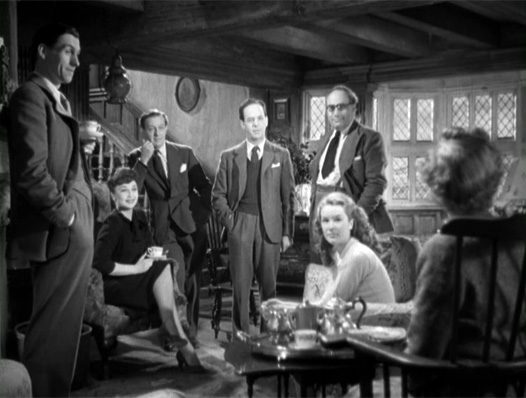
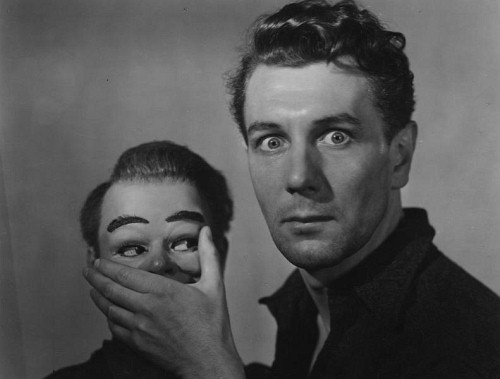
Dead of Night (Alberto Cavalcanti, Basil Dearden, Charles Crichton, Robert Hamer, 1945) British omnibus film from Ealing Studios where four stories of the bizarre are buttressed by a framing device of an architect (Mervyn Jones) invited to a country house that evokes an inescapable sense of déjà vu. At the house is a collection of strangers with odd stories: a race car driver who barely survives a crash and during a recovery has a strange dream involving a beckoning hearse and driver who says "just room for inside, sir"—a dream that has fateful repercussions later on; a girl (Sally Ann Howes) who recounts a strange encounter at a Christmas party; a woman who buys her fiancé an antiquated mirror with a mind—and a room—of its own; a whimsical tale of of two obsessed golf duffers (Basil Radford and Naunton Wayne) who wager for the affections of a woman over a match; and the last, featuring a ventriloquist (a bravura performance by Michael Redgrave) whose dummy wants to change the act's billing.
Anyone familiar with "The Twilight Zone" will have their own distinct sense of déjà vu watching Dead of Night—the race-driving story is remarkably similar to a Bennet Cerf story that was adapted by Serling as "Twenty Two;" the Christmas story echoes others; the ventriloquist story has been dummied about several times and not just on TZ. The stories have their own specific atmospheres that cling to their stories like shrouds, and Ealing proudly displays the collection of sets and artistry that made it one of the preeminent studios in Great Britain.
The stories are all decidedly set-bound with some quick outdoor scenes—it was wartime when the film was made and although the tone is fairly nightmarish (pluckily nightmarish), escapism from the rubble and the war news was the intent, and maybe a little tonic from "boogey-man-isms" by having a psychiatrist (Viennese, of course, played by Frederick Valk) popping the bubble of the story-tellers by trying to clinically explain things away. It provides a fine counter-balance (and a bit of straight-faced comic relief) to the tales of the supernatural, with their underpinnings of hysteria and mental imbalance. Fun, unsettling and meticulously done.
The Wreck of the Mary Deare (Michael Anderson, 1959) It was intended to be an MGM production for Alfred Hitchcock—he'd liked the best-seller and he'd wanted to work with Gary Cooper since Foreign Correspondent in 1940—but screenwriter Ernest Lehman found it pretty dull with an extended, dry courtroom scene at the end, and Hitchcock decided to "come up with something else"—which turned out to be North By Northwest.
We are all the better for it.
As it is, The Wreck of the Mary Deare is an odd picture with a great mysterious opening and a dry-as-dust finale, try as scripter Eric Ambler and director Anderson might to make a suitable action closer to it. In turbulent seas in the English Channel, a tug, captained by John Sands (Charlton Heston), finds a ghost-freighter marooned and adrift, nearly colliding and destroying his ship. Pulling alongside, Sands grabs a dangling line and laboriously clambers onto the ship. The rusting hulk, the Mary Deare, is without power, a large gash in its side that is slowly flooding the engine room, with no sign of life on-board...at least initially.
One man has remained—First Officer Gerald Patch (Cooper), a merchant marine eking out an existence on the ship, recently abandoned, and desperately trying to scuttle it before it sinks. With the reluctant help of Sands, Patch gets the boiler-room going, the ship under power, and the Captain-by-default's mission accomplished.
All of which is great stuff—the conflicts, the questionable sanity of Patch, Sands' greediness in wanting to claim the salvage on the ship—which would have made a great film if it ended there. Unfortunately, that's only thirty minutes of it. It would have been a great short subject, though, but the movie trundles along over the investigation and trial over who owns the boat and the conflicting testimonies between Patch and the eventually-found crew (ring-leadered by Richard Harris, who can't seem to eke out an interesting performance out of the material, try as he might). Both Cooper and Heston are good, in what seems to be dueling portrayals of earnestness. But, ultimately, the secrets that Patch is keeping just aren't very interesting, and although some attempt is made to salvage it at the end, the movie is, like its namesake, something of a drifting hulk.
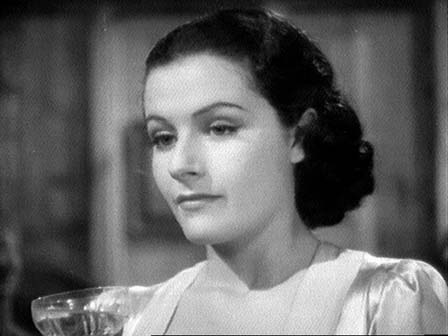
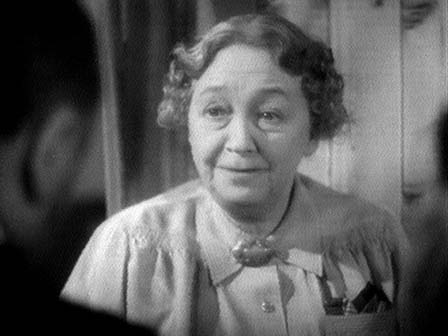
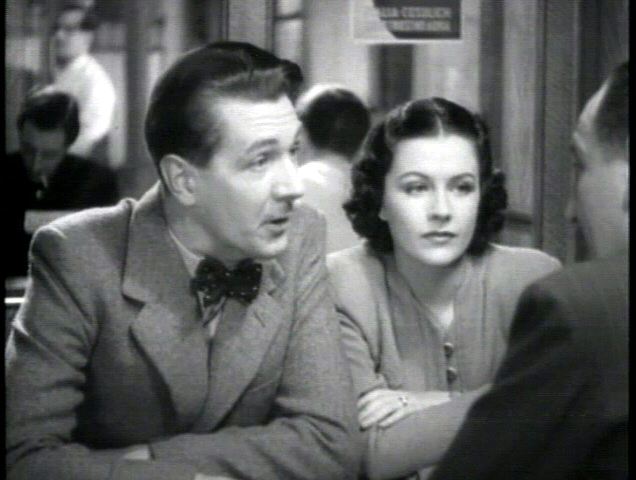
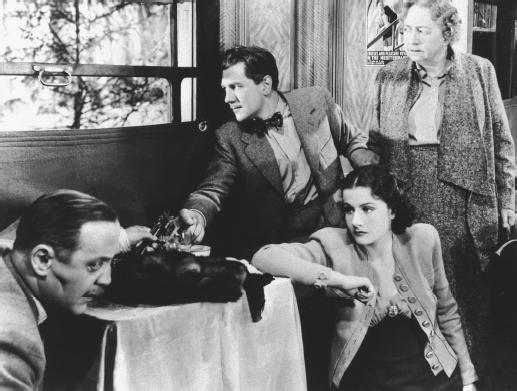
"The Lady Vanishes" (Alfred Hitchcock, 1938) Poor Iris Matilda Henderson has "been everyhwere and done everything," and is on her way to marry what her travelling companions call a "blue-blooded check-chaser" when she gets beaned by a suspiciously-unanchored flower box. She is helped onto her departing train and administered to by the elderly Miss Froy, a vacationing governess in love with the music of the Alps. Waking up from a recuperative nap, Iris discovers the woman missing, and what's worse, no one on the train claims to have seen her. Is everyone on the train lying, or has Iris just imagined the whole thing? The only ally she can find is the eccentric and rather obnoxious musicologist (Michael Redgrave, father of Lyn and Vanessa, and grandfather of Joely Richardson), whose racket has kept her awake nights at their lodgings. But now he comes to her aid ("My father taught me to never desert a lady in trouble. In fact I think that's why he married my mother!") to determine just what's been lost--the old lady or Iris' mind. Redgrave supposedly didn't get on with Hitchcock, and didn't have much respect for movie-acting, either--until another cast member saw him on-stage and wondered why he was so brilliant on the boards and so lackluster on-screen. For his part, Hitchcock took the material and accentuated the comedy and sexual situations, giving each of the train participants their own contrary behavior. It proved to be one of the most beloved of Hitchcock's British films, and legitimately can stand up to any of "The Master of Suspense's" later classics.





_01.jpg)