Showing posts with label Charlton Heston. Show all posts

Saturday, October 13, 2012

The Wreck of the Mary Deare

The Wreck of the Mary Deare (Michael Anderson, 1959) It was intended to be an MGM production for Alfred Hitchcock—he'd liked the best-seller and he'd wanted to work with Gary Cooper since Foreign Correspondent in 1940—but screenwriter Ernest Lehman found it pretty dull  with an extended, dry courtroom scene at the end, and Hitchcock decided to "come up with something else"—which turned out to be North By Northwest.

We are all the better for it. 


As it is, The Wreck of the Mary Deare is an odd picture with a great mysterious opening and a dry-as-dust finale, try as scripter Eric Ambler and director Anderson might to make a suitable action closer to it.  In turbulent seas in the English Channel, a tug, captained by John Sands (Charlton Heston), finds a ghost-freighter marooned and adrift, nearly colliding  and destroying his ship.  Pulling alongside, Sands grabs a dangling line and laboriously clambers onto the ship.  The rusting hulk, the Mary Deare, is without power, a large gash in its side that is slowly flooding the engine room, with no sign of life on-board...at least initially.


One man has remained—First Officer Gerald Patch (Cooper), a merchant marine eking out an existence on the ship, recently abandoned, and desperately trying to scuttle it before it sinks.  With the reluctant help of Sands, Patch gets the boiler-room going, the ship under power, and the Captain-by-default's mission accomplished.

All of which is great stuff—the conflicts, the questionable sanity of Patch, Sands' greediness in wanting to claim the salvage on the ship—which would have made a great film if it ended there.  Unfortunately, that's only thirty minutes of it.  It would have been a great short subject, though, but the movie trundles along over the investigation and trial over who owns the boat and the conflicting testimonies between Patch and the eventually-found crew (ring-leadered by Richard Harris, who can't seem to eke out an interesting performance out of the material, try as he might).  Both Cooper and Heston are good, in what seems to be dueling portrayals of earnestness.  But, ultimately, the secrets that Patch is keeping just aren't very interesting, and although some attempt is made to salvage it at the end, the movie is, like its namesake, something of a drifting hulk. 

Tuesday, June 16, 2009

Major Dundee

"Major Dundee" (Sam Peckinpah, 1965) Semi-restored version of "Major Dundee" that's a bit closer to the idea Sam Peckinpah had in mind when producer Jerry Bresler took the film over, edited it with a meat cleaver and threw on a wildly inappropriate score (a ranch massacre with bodies littering the desert and the main house on fire until it collapses is set to a bouncy Mitch Miller tune?* Say, what? Peckinpah has been accused of bad taste in his movies, but he'd never have pulled something as agregious as that!).

Peckinpah's first big-budget movie has a great story. A hard-nosed Union Major, Amos Dundee (Charlton Heston)** side-tracks a bit from the Civil War to capture or kill the marauding Apache chief who torched that outpost. To do so, he must cross the border to Mexico in a mission that doesn't officially exist. His requisitioned army of nobodies employs cut-throats and horse-thiefs, Confederate Rebels and Buffalo Soldiers. No one asks: Can't we all get along? It's just assumed that they can't, but a sense of order and hierarchy is maintained within the groups, while the groups test and prod each other en route.

The cast includes Richard Harris as leader of the Confederates (who has a past with Dundee), a small band made up of Peckinpah irreg'lars Ben Johnson, Warren Oates, L.Q. Jones and John Davis Chandler. Brock Peters is in charge of the Buffalo Soldiers. Slim Pickens and Dub Taylor are two of the criminals, R.G. Armstrong as a vengeful preacher and in Dundee's command are Michael Anderson Jr. (who narrates), Mario Adorf, Jim Hutton (whose character arc is almost as interesting as Harris' character's) and crusty scout James Coburn.

That's a great cast. And the film is full of detail (you want to see it on a big screen). There are some extraordinary screen-caps from the film below that show Peckinpah's innate ability to fuse landscape and character, not unlike John Ford, whom Peckinpah seems to emulate while presenting either a celebrational rabble or a ceremonial piety but infused with a more cynical rough-hewn presentation. I don't think John Ford would have had a soldier swatting flies away from a war wound, but I could be wrong.

Heston is a bit of an odd man out in the film, his acting rhythms are slower than Peckinpah is able to deal with in his cutting style (in fact, there's a couple places where Peckinpah cuts in the middle of Heston's reaction shots just to speed the man up a bit) and the clashes show. In an interview, R.G. Armstrong calls Heston "a poser," (which is certainly true, but also calls him "the nicest guy in Hollywood"—Heston gave up his salary to keep an embattled Peckinpah as director***), but Heston loosens up quite a bit in this film than he had in any previous one, setting a tone for his subsequent work as less heroic, more recognizably human presences.

But the movie falls apart somewhat, when the troop liberates a starving town from the French; everyone looks impoverished (even the dogs outside town are skin and bones), the exception being the widow Santiago (Senta Berger)**** whose nursing duties among the starving citizens hasn't reduced the glow in her cheeks or made her any less voluptuous. Her presence and the subsequent romance with Dundee just doesn't sit well with the grit of the rest of the movie, and so Peckinpah wounds Dundee and sets him on a rehabilitating toot that manages to negate a lot of the nobleness of the character, and undermines a couple other parts as well.

Production began before a suitable third act was constructed, and Peckinpah was convinced that once filming had begun, the script would be hammered out. But production delays and disputes between the director, the studio and the producer ate up a lot of that valuable work-time. And Peckinpah began to drink, most days towards the end, showing up drunk on the set.

Still,
up until the romance, it's a gritty, atypical Western story with integrity and a nice mature brusque edge to it. Studio interference would hamper this film and dog Peckinpah for the rest of his career.


Figures in a landscape:A broken arch does not connect (and thus dooms any romance)
between Major Dundee and Teresa Santiago (Senta Berger)

Peckinpah gives shape to Richard Harris' Captain Tyreen caught between
his sense of honor and loyalty to the Confederacy.

The remains of Dundee's command escape the French across the Rio Grande.
A shot with such depth it approaches 3-D.


* The opening credits run over the shot of the house burning, and the structure collapses when the director's credit comes up. Peckinpah liked to do things like that.

** To give you a flavor of the writing by Peckinpah and Harry Julian Fink (Dirty Harry), Dundee is characterized as a "$70 red-wool, pure-quill military genius or the biggest damn fool in Northern Mexico."

*** When asked by a reporter if that would set a precedent among Hollywood actors, Heston said, "It's not even going to set a precedent with ME!" A great line.

**** Peckinpah was dissatisfied with the romance storyline imposed on the script but not the actress: Senta Berger would work with Peckinpah again (and James Coburn) in the director's fine Nazi war film "Cross of Iron."

Saturday, March 28, 2009

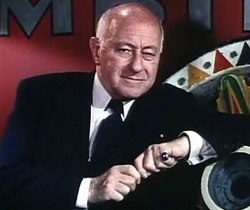
The Greatest Show On Earth

"The Greatest Show On Earth" (Cecil B. DeMille, 1952)

Insufferable.

In every way, insufferable.

Let's leave out winning the 1952 Best Picture Oscar (over "
High Noon" and "The Quiet Man"*), as obvious Hollywood Industry pandering during the McCarthy Era anti-communist witch-hunt to the Grand Wizard of that cause, Cecil B. DeMille.

Let's just take that out of the equation and take the film for what it is.

"
The Greatest Show On Earth" is an extended commercial/documentary/drama for The Ringling Brothers and Barnum and Bailey Circus. Filmed in eye-popping Technicolor (which is where the film, showing off the bright colors in many hues, truly is spectacular), that begins with the Director sepulchrally narrating a series of work-a-day location footage of the circus being prepped for its yearly run. The pompous tone that he sets is akin to a war film, the army metaphors stacked up thick and deep like a chain of marching elephants, with all the accompanying lack of grace and subtlety. Leave it to DeMille to take the fun out of a circus and turn it into something resembling boot-camp.

We transition (roughly, as DeMille's favorite transition is a quick right to left scene wipe, making it all seem like a moving slide-show) to the stars of the film acting roles that the folks who are told to stay out of their way actually do.
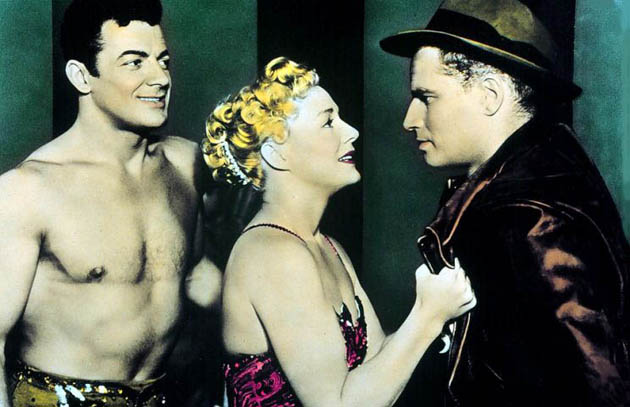
Charlton Heston is the circus "boss"--the show-runner, if you will--who, in order to guarantee a "full season" (the complete city tour) has brought a marquee name, "The Great Sebastian" (Cornel Wilde, cheerily smarmy) to take the center ring, displacing his aerialist sweetie, the plucky but vain Holly, played by Betty Hutton.

This top-billed character is particularly annoying. Hutton could play dumb well (with a vocal range from A to A-), but here's she's a schizo in need of a pair of padded tongs and a generator, with a change of motivation and character for every change of scene. Buffed up to do her own trapeze stunts (smattering of applause for that), her character is so insecure that she's a harpie spinning like a
Tasmanian Devil: "I HATE the Great Sebastian!" "I'm JEALOUS of the Great Sebastian!" "I LOVE the Great Sebastian," "No, now I HATE the Great Sebastian!" "I LOVE you, Sebastian!" "I feel GUILTY about Sebastian" "I'm going to forsake my Ca-REER for Sebastian!")

I pity Sebastian, myself. As well as Heston,
the guy you see rubbing his neck from whip-lash. See, she's in love with his character, although she's annoyed with the fact that he spends all his time trying to keep the Circus going, thus letting her keep the only job she's capable of, besides waving on floats. Hutton's Holly not only wears her heart on her sleeve, but also her ankle, around her pretty little neck as a broach, as a hat, anything but a symbol of commitment. She accuses Heston's Brad Braden** of having "sawdust in his veins"--at least he's got something in his. I wanted her capped in the head with her own trapeze twenty minutes in. Probably sawdust in that, too.

No such luck. Before one can turn their attention to what Holly would look like in the tiger-cage and quicker than one can shout "Sebastian! No! Don't do it without the net!!,"
tragedy does befall the circus leading to broken bones and souls, angst and recrimination and another case of Holly-pong in desperate need of a net...held by men in white coats.

The movie sets up a dull pattern: stentorian documentary section narrated by DeMille on "Circus as War Machine"/slide wipe to melodrama/slide-wipe to an extended sequence of abbreviated cir-cussedness that manages to make you feel slighted while still feeling interminable each time. Along the way, much of the subjects' opportunities are squandered, if not down-right sabotaged. For a scene of DeMille's heavies planning badness, DeMille stages the two Runyon-esque hoods*** (without the quaint patois) in front of a process shot simulating the outdoors. Halfway, DeMille cuts to a tighter shot of the two, but behind them the projection-screen image doesn't move, making it look like they've quantum-jumped closer to the camera. It's an amateurish give-away of a process shot.

And there's a cynical, rather crude attitude towards the circus audience—pandering to the audience while bashing them at the same time by endlessly showing giddy parents consuming ice-cream cones while their bored children look like they to want to erp up their cotton candy. But as the originator of this particular circus so famously said: "There's a sucker born every minute!" DeMille knew that lesson well.

Another lesson is the one of justice, where kindly Dr. Buttons (James Stewart in perpetual clown make-up...Richard Kimble never used that trick!), a surgeon on the lam for murder, unselfishly sacrifices himself by helping injured people on a train-wreck, exposing his true identity and is rewarded by getting cuffed and hauled off to the iron bar hotel. It was the '50's, after all—he could have been lynched. That would have to wait for prison, I guess. Thanks, doc! Take him away, boys.

Another little game of the movie is a sporadic "Spot the Stars." There's Hopalong Cassidy ! There's...somebody? Is that dewey debutante Jeanne Crain or a DeMille "ingenue?" And Bob Hope and Bing Crosby show up during Dorothy Lamour's number because its a Cyclical Universe on the Paramount Lot, with very tight gravitational rules; you could almost make a case for Creationism.

At some point during this megalith, you begin to realize with butt-numbing certainty, that if DeMille had cut out any of his "
Circuses aren't some pink clown-show, they're American Hard Work" lectures, or maybe cut a "Tribute" sequence or parade or two, or one of the forgettable songs (or allowed Holly one less seizure) that the movie wouldn't have had to clock in at 2 1/2 hours in length.

2 1/2 hours is a longish book, with...ya know...subtlties, not a circus movie. But DeMille must have seemed unable to strip whole sequences, however redundant, away. Like
Spielberg wanting to over-stuff "1941"**** with beloved-by-none-but him-gut-and-budget-busting sequences, DeMille super-saturates the screen until the Technicolor fairly bleeds. And he couldn't bear, or didn't know enough, to cut any of it.

The only thing never mentioned in the many of DeMille's "Bozo Marches On!" narrations, is the requisite shovelling of the tons of manure. Why bother? The evidence is all there on the screen.

* ...and the not-even-nominated "Singin' in the Rain."

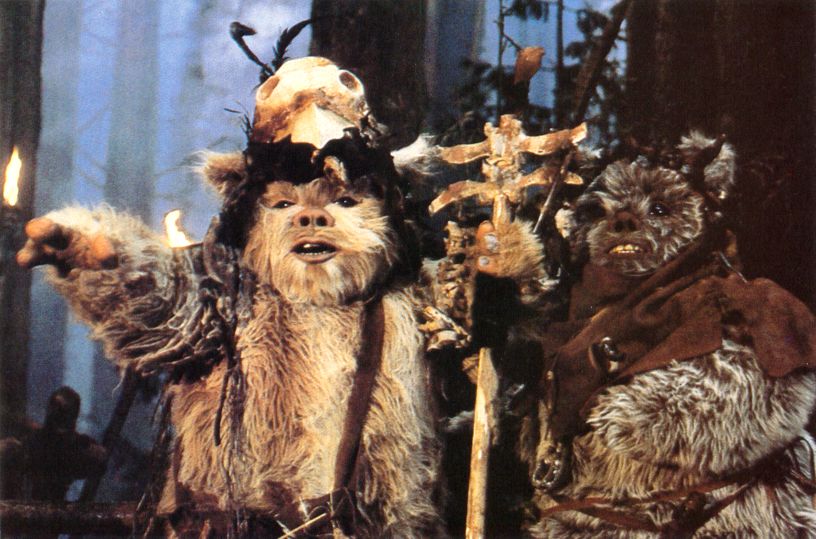
** ?...Brad Braden...of the "we-couldn't-come-up-with-a-better-last-name" Bradens? I think he became an "Ewok" trainer in later life.

*** One of them being Hollywood bad boy/guy Lawrence Tierney. He and Heston have a seething scene of clashing testosterone blasts.

**** It was this very movie that inspired the Spiel-boy-g to pursue a career directing films. Spielberg learned his lessons concerning movie elephantiasis in his 20's. DeMille was in his 60's.


Friday, August 8, 2008

The Three Musketeers/The Four Musketeers

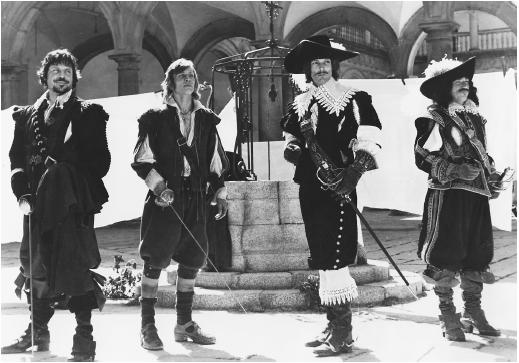
"The Three Musketeers: The Queen's Diamonds"/
"The Four Musketeers: Milady's Revenge"(Richard Lester, 1974/1975)
These rollicking films, originally planned as a two and a half hour epic (no matter what the Producers say!) may just be one of the best adventure films (and adaptations of a classic) ever filmed, balancing the demands of the story, the tenor of the times in which it was made and the idiosyncrasies of its director.

When approached, Lester (who hadn't made a film since "
The Bed Sitting Room" in 1969) wasn't enthused. Then he read the story, and did some research...and heartily agreed. One can see why. For "The Three Musketeers," as Lester and his screen-writer George MacDonald Fraser envisioned it is a story of intrigue in high places carried out by the lackeys and foot-soldiers who live to serve. Forget that the palace-dwellers are either snakes or dullards--they provide an opportunity for income and adventure--two qualities lacking amongst the citizens of France and England, who, at the time are at war. The opportunities for thrills, humor and pointed satire are rich and mined well by the film-makers.


Lester's direction is masterful--simple set-ups and multiple cameras used during the swash-buckling to make sure there's a glimpse of every buckled swash. And those scenes are choreographed as a group participation so that every Musketeer has "business." Lester also worked to makes sure that the fights were inelegant affairs--not balletic, but more like street-fights, with few rules and the use of landscape and surroundings as equal strategies to the sword technique (and every part of the sword is used, as opponents are sometimes conked with ornate handles).

Lester surrounds the royalty with games and idle amusements that have a slight tint of mindless cruelty to them, and that extends to the villains, whose machinations involving the Royals are merely extensions of those games, with regime-toppling consequences.

And the cast! As the musketeers, Oliver Reed as the surly Athos, Richard Chamberlain as the effete Aramis, Frank Finlay as the clownish Porthos, and Michael York as the young and naive D'Artagnan. As the Royals, Jean-Pierre Cassel as the foppish King Louis XIII, Geraldine Chaplin as the frail Queen Anna of Austria, and Simon Ward as the rakish Duke of Buckingham. As the villains, Faye Dunaway as Lady De Winter, Christopher Lee as the villainous Rochefort, and Charlton Heston in one of his best performances as the Machiavellian Cardinal Richelieu. Rounding out the cast are Raquel Welch as the Queen's seamstress, the accident-prone Constance de Bonacieux,* Spike Milligan as her randy husband, and Lester regular, the great Roy Kinnear as D'Artagnan's man-servant, Planchet. A superb cast, rarely equalled.

It's long been contended that the film was supposed to be one movie, but that the Salkind's split it into two to maximize profits. That's the rumor--there is a natural split of the film at the half-way point that feature almost all the actors for a sort-of bow, but it could have been used for an intermission. Certainly, there is less movie in "The Four Musketeers," it being padded with an "up-to-that-point" narrated prologue.

But there are two distinct stories of different tones, the first being the intrigue-filled, but relatively light-hearted "The Queen's Diamonds" story (in which Athos, Aramis and Porthos are wounded, but not killed), and the darker "Milady's Revenge" with its beheadings, extended back-story and several prominent deaths. Where Part 1 is rollicking fun with minimal consequences, the stakes in Part 2 are very high, passions flare, and the sword-play becomes deadly. The humor is darker than the first, too. Despite the same cast and crew,** the two are very different in tone.

Taken together, they have a moralist's sensibility of the costs of frivolity and duplicity; adventure can be fun, but in a poisonous political atmosphere, one adventure's at one's own risk. You can have a good time watching "The Three Musketeers," but the story is incomplete without the paid dues in "The Four Musketeers." Together, they make one of the finest adaptations of a classic novel ever put to film.

* Welch, not the most versatile of actresses, won the Golden Globe for her hilarious performance in "The Three Musketeers" and tearfully told the crowd "I've been waiting for this since "One Million Years B.C.!"

** except for the score composers--Michel Legrand for "The Three Musketeers" and Lalo Schifrin for "The Four Musketeers."

Monday, April 7, 2008

Away From Her

"Away From Her" (Sarah Polley, 2007) Julie Christie did her homework when it came to portraying early-stage Alzheimer's--the intense concentration, and the thousand yard stare, the polite smile to the intimate stranger. And the film does a remarkable job of putting the viewer into the "Alice-in-Wonderland" world of the Alzheimer's care-giver who must endure the pain of dealing with losing the relationship while still having to deal with the patient. The commitment is still there, even though the disease has severed the knowledge of it from patient to care-giver. Sacrifice without reward--makes you realize what being a nurse is like.*

And there's an aspect to Alzheimer's care-giving that's a bit like a lab experiment. Divorced from the ties that the disease has unpinned, one can observe the effect it has on the human being, given the prior knowledge of the sufferer. You can check off what goes, see the timeline disappear, the brain functions narrow and fluctuate, enjoy the false encouragement of "good days." For the Alzheimer's patient, it's a slow-motion float to death--at some stage they're not even aware of their condition. For the caregiver, it's a bit like watching a frog (a very dear frog) sitting in slowly heating water--you can only wait helplessly and steel yourself for the inevitable, as memory, identity, and life slips away. It's a slow death and a long good-bye.

So, in that way, "Away from her" is a good primer for the best-case Alzheimer's scenario. Christie's character, Fiona Anderson, is aware of the onset, and in an act of unselfishness, rather than go into denial and paranoia makes the decision to place herself in an assisted living facility, voluntarily giving up the freedom that so many patients cling to, kicking and screaming.

Her husband of 40 years, Grant (Gordon Pinsett, he's wonderful, too) sees the relationship go away in an accelerated fashion when the facility insists on isolating the patient from family members for a required thirty days (I've never heard of such a rule, but then it takes place in Canada)

By the time of Grant's first visit--one he highly anticipates--Fiona has already separated from their relationship, and he struggles mightily to regain it, a combination of wanting to halt the progress of the disease and his own selfishness.

Where that yin and yang pulls him forms the crux of the story, and in my household it led to some pointed discussion about responsibility and relationships, but one must also look at the brutal reality of the disease and the unique way that it eviscerates normalcy.

As I've said "Away From Her" paints a best-case scenario that is still far from rosy, but as a toe-dip into the issues surrounding dementia and Alzheimer's, it's a pretty effective film, and actor/director/savant Sarah Polley has found a fascinating way of deriving a positive and interestingly nuanced life-lesson out of the experience. Like Orson Welles with "Citizen Kane," she was all of 25 when making it.


--------------------------------------------------------------------------
Over the weekend, one of the most iconic stars of the silver screen left the stage. Charlton Heston died at the age of 84 from undisclosed circumstances, but as he announced in 2002 he had symptoms associated with Alzheimer's it's easy enough to put two and two together without the benefit of a Hollywood Press Release.

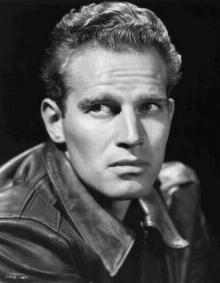
Born October 4, 1923, Charles Carter, who would take his step-father's name, Heston, and his mother's middle name, Charlton, for his stage name, was one of those actors whose careers straddled the old Hollywood and the "New" New York Stage, so he could be counted on to play larger-than-life characters, but with a humanity that made them relatable. He seemed less capable of playing modern-dress individuals than he was at playing stoic figures from another age, bringing them down to Earth or puffing them up to figures of Myth. One can't imagine too many actors playing Cecil B. DeMille's Moses and parting the Red Sea as Heston did when he bellowed "Behold, His Mighty Hand!" One got the impression Heston was doing it, all by himself.

Because he had that "stagey" air to him lines of Shakespeare keep floating up when considering Heston, so it may be a surprise to think of the guy from "The Omega Man" and "Soylent Green" as being so closely associated with the Bard, but he started out playing Shakespeare, and, indeed, in one of his last screen appearances, Kenneth Branagh chose Heston for The Player King in his full-length "Hamlet," and, of course, Heston played it like he owned the stage, his chiseled chin held high in imperiousness. He played Moses and John the Baptist. Michelangelo and Major Dundee and "El Cid" and Cardinal Richelieu and Sherlock Holmes (Jeremy Brett was his Watson onstage!) and Andrew Jackson. And he played Judah Ben-Hur.

Charlton Heston doing his own driving (and wondering when CGI will come along)

For that he won an Oscar, one of the 11 that elephantine production copped. But Heston had enough personal magnetism his character never got swamped in the chariots and the robes and the hokum. And he worked with Cecil B. DeMille, William Wyler, Orson Welles, Sam Peckinpah, Tim Burton and Jim Cameron--now there's a bumptious Guild meeting. He played both sides of the Darwinian divide in "Planet of the Apes" movies (His stipulation about going along with the sequel, the aptly-named "Beneath the Planet of the Apes" was that he got to blow the planet up at the end. He got his wish, but you couldn't keep those "damn, dirty apes" down!) That's another thing--only an actor of Heston's weight could keep the silliness of "Planet of the Apes" from spinning off its axis.
"The evil that men do lives after them, the good is oft-interred with their bones."

It's a sad thing, but Heston's political activity in his last few years may eclipse his life's body of esteemable work. Heston started out a very liberal activist, his being one of the few white faces in Dr. King's marches, and his work for charitable causes won him a Jean Hersholt Award. But, as the years progressed he became more and more curmudgeonly, He famously wrote a letter castigating NBC for the tone of "Saturday Night Live," then agreed to host it. Twice. He killed. As far as his politics, one can imagine in the competitive acting business Heston looking at Ronald Reagan's path to the White House and, with hubris and envy, wanting that part. And as the strain of conservatism grows rather virulently on "The Left Coast," he threw himself into increasingly conservative causes (What he didn't consider was that Reagan was a mediocre actor who needed a gig, whereas Heston's success never really waned).

One of his last appearances was in Michael Moore's "Bowling for Columbine" where Moore took him to task on-camera for his post-massacre activities as NRA president. Moore was typically bombastic and combative, and Heston, flummoxed and saying stupid inaccuracies--and realizing he was not doing well, just got up and left, trying to salvage some dignity. Neither man looked good in it (though it's amazing that Moore could go up to the intercom on Heston's gate, have Heston answer it, and later have him agree to meet with him--even Moore was taken aback).

Almost immediately after the film's release, Heston announced, as Reagan had before him, that he had symptoms of Alzheimer's. How long he'd had it, and how it'd affected his behavior and attitudes, no one can say. But anyone who's witnessed the Long Goodbye of Alzheimer's wouldn't be surprised at the change. One must blame the disease, not the afflicted. Lest any liberal be too self-satisfied at Heston's fate, "go and paint an inch thick, to this end you may come." Smirk at that.

Heston wrote four very good books: "The Actor's Life: Journals-1956-1976," "Beijing Diary," "In the Arena: An Autobiography," and "Charlton Heston's Hollywood: 50 years of American Film-making." He was married to the same woman for 64 years, his fellow actor Lydia Clarke. My thoughts are with her today.

I never met or worked with the man, but I have friends who did, and even when the job was merely as a favor, he would quickly drop any irritation he might have with doing it, and would lose himself in the work...and those voice-tracks were always...impressive. Another story a friend of mine tells is when setting a microphone up for a Heston voice-over, the actor made sure to shake his hand, and ask his name. "I'm Randy," said my friend. Heston grinned that wolfish, scary smile and said, "Me, too." It doesn't matter what team you play on, that's a little creepy.

My favorite Heston moment is a minuscule but fairly recent one in Richard Lester's "The Four Musketeers." Lester's "Musketeers" films are full of joys (such as Heston playing a scene with Spike Milligan!), but there is one scene towards the end, where Heston's power and ability to underplay is on display. His Cardinal Richelieu (a part Heston didn't want, but when Lester suggested it, Heston researched and snatched the part up to his everlasting joy), undone in his own machinations ("One must be careful what one writes"), sits back in his chair, an arm flung over the back to dismiss young D'Artagnan, which he does with a slight flip of the wrist. It's a concession of defeat to a lesser, and not another word is wasted on him. It's just one of his scenes I enjoy watching. Even at his most belligerently gun-toting, Heston's performances always evoked smiles...and admiration.


Oh, one last thing. You can take his guns now.


* The author lost his Mother to Alzheimer's in 2001, if one is so churlish to look for authority. The movie has received a lot of criticism from care-givers who think the movie soft-pedals the disease, and although it does present a best-case scenario and never goes further (actually) than early-stage Alzheimer's it does show, in a perfunctory way, the severing of emotional ties and history a patient can experience and the effect it can have on the care-giver.

Wednesday, January 9, 2008

I Am Legend


"Come Out, Ne-ville! Coooome Ouuuut!"

I have been in love with Richard Matheson's novel "I Am Legend" since I first read it in high school. A horror- sci-fi story, it tells of a world-wide plague that turns the world into either corpses or vampires, except for the one man who carries the immunity who spends his days hunting, and his nights being hunted.


It's been filmed three times, each version having its strengths and weaknesses, but none of the them really coming to the heart (er, so to speak) of the story.


"The Last Man on Earth" (Ubaldo Ragona/Sidney Salkow, 1964) Vincent Price stars as Dr. Robert Morgan, the last survivor of a plague that has turned the majority of the Earth's population into vampires. By day, he lathes a number of wooden stakes and hunts down the creatures, driving the stakes into their hearts to kill them. The closest the movies have come to Matheson's original concept, although the ending is changed, making Morgan an ersatz Christ-figure*, impaled by a spear in a church, his arms flung wide in a crucifixion pose. Made in Italy on the cheap, "The Last Man on Earth" is still a satisfying film merely for the strength of the ideas, the dusky black and white cinematography and Price's excellent performance. But don't take my word for it--you can download it or stream it here. It's been in the Public Domain for years (although MGM has come out with a nicely re-mastered version on DVD)


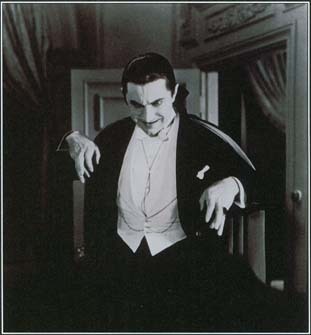
"The Omega Man" (Boris Sagal, 1971) Army Colonel Dr. Robert Neville (Charlton Heston) survives a world-wide plague as a result of a biological war between the Chinese and Soviets. Holed up in a bunkered, apartment in Los Angeles he leads a solitary life--by day blasting the mutated victims with his high-powered, high-intensity-beamed assault rifle. By night listening to their taunts, armored against their organized attacks. The mutants are light-sensitive albino's, banded together as a sort of political/sociological cult ("The Family"), led by a zealot named Matthias (Anthony Zerbe), who see Neville as a threat to their way of life, and well, yeah, that's a pretty effective rifle he hauls around. Using his own blood's immunity, he's trying to bring back the pigment-challenged. One of Heston's interesting forays into sociological sci-fi in the 70's, "The Omega Man" lays it on a little thick and heavy with the race-relations metaphor, but the cast is uniformly excellent especially Heston and Rosalind Cash. Again with the Christ-allegory as Neville is impaled in a fountain, arms floating out in a crucifixion pose while giving his life-saving blood to the rag-tag band trying to carry on his work. Though not strictly Matheson, it does reflect the times in which it was made.


"I Am Legend" (Francis Lawrence, 2007) Lieutenant Colonel Dr. Robert Neville (Will Smith)and his German Shepherd, Sam, are the last surviving unaffected Manhattan residents of a plague brought on by a mutating vaccine. All the bridges have been destroyed in an attempt to halt the disease which has become airborne. Neville is unaffected. Animals, only by contact. And the two cruise the car-jammed streets looking for food, and trying to make their way through the entire DVD inventory at the local video store. At noon, he and Sam go to the South Street Seaport, waiting for someone--anyone to respond to his broadcast plea.

"My name is Robert Neville. I am a survivor living in New
York City. I am broadcasting this message on all AM frequencies. I will be
at the South Street Seaport everyday, at midday, when the sun is highest in the
sky. I can provide food. I can provide security. I can provide
shelter. If there is anyone out there. Anybody. Please. ** You are not alone."
He has been waiting in his private hell for three years.

The effects work of a deserted Manhattan is nothing short of astonishing and several shots of Neville tracking deer in his Mustang GT500 are played out to please any action aficionado. Kudos to director Lawrence (who managed to salvage a good movie out of "Constantine" against all odds). Smith is amazing throughout this movie. He's the only game in town, literally, and he is extraordinarily frugal in what he displays throughout the first two-thirds of this movie. His rituals, his by-play with Sam, his clinging to normalcy, and his studied work ethic never give a hint that he's cracking up. Flashbacks in moments of unconsciousness are the only indication of his loss and his desperate feelings of responsibility. At some point, something's got to snap.

When they do, they take the movie with it. Oh, things are intriguing for a good long time after that, and appear that everything's fine--it's a bit like the plague really. But at some point, it becomes a confused muddle, story-wise and philosophy-wise, and that I place squarely at the hands of script-"doctor" Akiva Goldsman.***

Warning! Quarantine Zone!
Stand by for a retinal scan and display your ticket stub! This quadrant infected with Viral Spoilers! If you have not seen the movie, proceed no further!! I repeat, proceed no further!!!

First, let's back-track to the novel. In Matheson's original story, Neville discovers that not all the contaminated inhabitants have been turned vampiric. Some have been merely rendered sensitive to light, and during his daytime raids, Neville has killed a bunch of them. A representative from this group infiltrates his stronghold, and fills him in, telling him that he is now considered on the same scale as the the vampires of legend, coming to their houses in their sleep and killing them. Neville is eventually captured and sentenced to die for his crimes, as he ponders his fate that, now, he is the legend of death, not the ones he was hunting down.
Pretty dang bleak. But a fascinating concept, and a mind-bender of a story-turn. But nobody's done it like that. In the films Neville dies, but always as the sacrificing Christ-figure, who can one day restore the Human Race. Not the book. In the book, the Human Race is dead. Changed forever. No going back. And the last man of earth, the ancient old-guard, is the new source of horror. But the movies won't go that far--there's always got to be a glimmer of hope that the blood of the Savior can save Humanity.

Now, back to this movie. Things go swimmingly the first two-thirds of it, but things begin to snap after Neville rather ingeniously captures a female mutant to test his vaccine on (GA Series 319, compound 6, trivia-buffs). He makes a report that the mutants**** (standing in for Matheson's vampires) have stopped showing any sign of human behavior. Then he's immediately proven wrong in the most elaborate way possible--they emulate his own Rube Goldberg trap. Nothing is made of Neville's obvious miscalculation. By this time, his grief is too great and he's not thinking. And the movie is going someplace else and not using The Scientific Method doing it.

He is rescued at a very opportune time by two other survivors, who have heard his radio message and take him back to his apartment. All well and good. Something has to give in the scenario or there's no forward momentum. The woman tells him that God directed her to him to take him to a Survivor Stronghold in Vermont, to which Neville (no doubt because he's a scientist) gives her the statistics of the disease (90% dead, a few percent mutant, who eat the immune-which when you think about it, might cure them, but no such luck) telling her that with such an effective kill-rate that there can't be a God, and that we did it to ourselves, thank you very much.***** She then replies that its easier to hear God when it's so much quieter (sounds like Goldsman with the happy-meal schizophrenia, again).

So, what happens? The mutants storm Neville's strong-hold for the Third Act Attack--a staple of any action movie, and our plucky survivors head for the fairly impregnable lab, where it becomes quite apparent that Mutant #1 is going to break through the glass to get to his souless-mate. Neville grabs his vaccine, gives it to the other survivors and tells them if they find the Survivor Stronghold to give 'em that blood sample--that un-refrigerated, bound-to-go-bad blood sample--to further his work, sticks 'em in a secret hidey-culvert and tells them to leave when it's light. Then he blows himself up with a grenade and takes the mutants with him, because, as we all know from watching the news, suicide-bombing is the very epitome of heroism these days.

Fade to Black. Our two survivors end up at the fortess-walls of the colony. What will they find when they get there? More mutants? A blasted Statue of Liberty in the sand? Harrison Ford and Sean Young in that other ill-considered feel-good ending to a sci-fi movie? No, the door opens on an idyllic little town with a Main Street, and in the background a white church-steeple with a bonging bell. They've come just in time for services, it appears. And hopefully the guards with the machine guns won't force them to attend.

What we have here is one step beyond using Neville as a Christ-allegory. It's a pro-religion/anti-science zombie movie. If the Vatican was "consoled" by "The Golden Compass's" soft opening last weekend, they must be positively spilling wine on their cassocks celebrating over this one!

As good as it starts out, this one takes "I Am Legend" so much farther afield from its source material than the others, that I can't be happy about it. Smith is great. The abandoned Manhattan scenes are amazing. But...

The script obliterates a great book for another hokey feel-good ending. After all, isn't that how you're supposed to feel after a devastating plague with a 90% kill-ratio? The film ends with a Bob Marley tune (kudos to that, but Marley is used for another confused metaphor that in the context of the film is just stupid). Maybe they should've ended with a rousing up-beat group-sing of "Tomorrow" from "Annie."

Gloriosky in the highest.

"I Am Legend" is a very, very cheap matinee, but only because you'll want to see the effects scenes in theaters.

* I could do a few dozen pages on "Christ-allegories-in-the-movies," but let's just point out a few of them: E.T., the Extra-terrestrial, Cool Hand Luke, The Star Wars films, Braveheart, Narnia (of course), Blade Runner, The Superman films (especially.."Returns"), The Matrix, and ad infinitum spiritu.

** In just one of the beautiful touches in his performance, Smith's voice cracks on that one word only.

*** The name "Akiva Goldsman" on a writing or producing credit is enough to spoil any movie-going experience for me, although I have always given the benefit of the doubt--but than as I'm sure Goldsman would tell me, repeating any behavior expecting an outcome that never occurs is a sign of insanity. It was Goldsman who destroyed the first "Batman" movie franchise with his cartoonish, pun-heavy scripts. He "cracked" the script for "A Beautiful Mind" by reassuring movie-goers that schizophrenia was nothing more than delusions of grandeur with visions of Ed Harris and Paul Bethany included--forget any unpleasantness. His by-the-numbers adaptation of "The DaVinci Code" made it boring for anyone who read the book, and breezily incomprehensible for anyone who didn't. His scripts for "Practical Magic" and "Lost in Space" are incomprehensible humorless muddles. And "I, Robot" had one good, recycled and paranoid idea in its empty little head and chucked the great ones of Isaac Asimov. I'm not sure "whose windows he's washing" to be so successful with so much hack-work in his resume, but the man is the 21st Century Joe Eszterhas.

**** I've been calling them Danny Boyle "Red Bull" zombies, as they have the same out-sized aggressive energy as Boyle's "28 Days Later" zombies, but with a case of the energy drink in them. They are pigment-less, hairless albino's who start to burn at the first touch of sun, and during the day they apparently huddle in dark spaces and huff and puff spasmodically. And they screech a lot, with distended CGI-enhanced faces. So, they're basically vampires, but zombies have a higher "Q" rating, so they're called zombies.

***** I will say, however, that how the mutating disease comes to be is not only a plausible scenario, but wickedly likely.