This week, we're re-publishing some reviews of the films from the post 9-11 environment.
 The Quagmire at Home
This is Paul Haggis' first directorial effort since Crash. In the meantime he wrote three films for Clint Eastwood, The Last Kiss and Casino Royale. He wrote this one for Eastwood, too, but to star in, not direct, which Clintus declined, saying that he's retired from acting. Too bad. This one might have gotten him that Best Actor Oscar. As it is, Tommy Lee Jones has the role, probably does a better job of it, and is certainly deserving of an Oscar. His Hank Deerfield, ex-Army investigator, is a portrait of a guy so meticulous, so disciplined that you wait for him to crack the whole film. It's one of the joys of the film, along with another of Charlize Theron's fine "de-glammed" performances, and Susan Sarandon bringing maximum effort to a small but vital role, all doing great work in a film that tries to be too many things, though it does succeed in many of them.
Part mystery, part war-story, part psychological drama, "Elah," punctuates its story with fragments of media recovered from a cell-phone that, like "Blow-Up" and "The Conversation," give tantalizingly legible glimpses into Deerfield's son's tour in Iraq, and frustratingly opaque clues into his post-Iraq behavior. He's gone AWOL, and Dad Deerfield goes to New Mexico to get to the bottom of it, because that's what he does. Once there, he and a detective try to piece together the evidence, and fight the bureaucratic red tape that hinders their work. Just as Crash owes so much to La Ronde," Elah calls to mind Courage Under Fire, about the death of a Persian Gulf War veteran, where conflicting stories and the subject of post-traumatic stress disorder are dealt with tangentially. Here, it's more overt, but there is an underlying message of the power of doing nothing, or of passing the buck, even ignoring the buck, taking the easy way out, or as the phrase went in Chinatown, the futility of good intentions, when not backed with action. The characters of In the Valley of Elah do "as little as possible" until provoked, challenged and threatened, and its reach is all-pervasive. In the end there is no one perpetrator, but a constant thread of sins of omission, and therein lies the tragedy.
As he did so much in Crash, Haggis telegraphs too many things, with some pretty obvious set-ups that are none too subtle.** The man just doesn't believe in red herrings, and everything gets used. Maybe that's his buttoned-up-in-25-minutes television writing showing. He's become better at cloaking some, though, hiding them in plain sight until they're trotted out for weighty significance. Some will see his final statement as un-American (which they're looking for, I expect), but a careful reading of what's gone before* reveals exactly what he's saying, and its entirely appropriate and, frankly, completely non-controversial. But Haggis seems to invite mis-interpretation. It's what makes him interesting. On top of that, you'll never see better work out of Tommy Lee Jones and Susan Sarandon and their scenes together have a lived-in familiarity and friction that speaks volumes of history and experience. There's some awfully good work in this.
In the Valley of Elah is a solid Matinee.
* Easy for me to say, I take notes!
** According to the Addictionary, this is called "five-shadowing"
Friday, September 16, 2011
In the Valley of Elah

Thursday, September 15, 2011
Lions for Lambs
 "Never engage the enemy for too long, or he will adapt to your tactics"
 There are three arenas in play, and as the film begins the protagonists are checking their ledgers and statistics: Lt. Col. Falco (Peter Berg) is checking his strategy briefings; Senator Jasper Irving (Tom Cruise) is looking at dropping poll numbers; Professor Steven Malley (Robert Redford) is checking the quarter's attendance; Reporter Janine Roth (Meryl Streep) is looking at her unopened note-book--an empty slate. Thus begins Lions for Lambs* a polemic about the current Middle-East War, the entities that package and sell it, and the public that may not like it, but won't do anything to oppose it. All the stories intersect a bit and the movie takes place over a few hours. The script is by Matthew Michael Carnehan, who also wrote The Kingdom Its director, Peter Berg, who plays Falco here, said that film was "98% Action, 2% Message." Here, that ratio is reversed, and, man, is it tedious.
First off, there is a heavy veneer of liberal self-satisfaction (though not as much as when conservatives put the hammer down). The senator is a Republican tyro, trying to bolster his party's (and his) poll numbers by setting up a new front in Afghanistan (Senator's can do that? I mean besides Charlie Wilson?) He's given Roth a solid hour (this is supposedly a big deal) to argue his case that this attack (no, really, this one!) will win the war in Afghanistan, the war on terror, the hearts and minds of Afghans (he really says this) and presumably bring the troops back home for Christmas (he doesn't say this, but he might as well have). Cruise was bio-engineered for this role (and you just know this is the part Redford would have taken during his career in the cynical 1960's), an opportunistic-photo-op-ready politico, with flags on the desk, pants-press in the office, and flashing Chiclets in his mouth, while Meryl Streep is all shambling messiness, trying to counter the arguments (is that her job?) that Cruise spins on the head of a pin. Their section is the sort of "greased-pig" argument and obfuscation bull-session that keeps me from watching the "pundit" shows--nothing's less fun or informative than watching two used-policy salesmen, hectoring each other trying to get their feet stuck in the open door of your mind. Finally it gets down to my favorite argument when rats-on-their-hind-legs are cornered--The Multiple Choice Bottom-Liner: "Do you want to win the War on Terror: Yes or No?". ("Well, I don't know, Senator, when did you stop beating your wife?") At one point Streep asks, "When does the new offensive start?" Cruise looks at his (supposed) Rolex. "Ten minutes ago." So much for pre-selling.
And in that ten minutes, the mission is already SNAFU'd, when two grunts are bounced out of a helicopter taking heavy fire, turning the offensive thrust into a rescue mission. Not a good start to winning those hearts and minds.
And by a curious coincidence--or a heavy-handed ploy by the screenwriter--those very two soldiers were both students in Professor Malley's political science class, who, in a school project capped their volunteerism argument by enlisting. Now, Malley uses them to guilt a slacker-student who can't be bothered coming to class because he's "busy with stuff," into considering a more activist stance before the bigger challenges of jobs, mortgages, ball-games, and watching "American Idol" zombies away any chance of him doing any critical thinking for the rest of his life. That's a valid argument to make, whichever side of the aisle you take bribes on. But instead of making the arguments, Malley turns them into three-corner shots that kind of dance around the problem, rather than saying something, oh, like "I would suggest you start coming to class or I will flunk your lazy frat-ass: your call."
The trouble here is that the issues are so immediate that the arguments the film is making were too late four years ago. So, it's a bit like soft-ball preaching to the choir. The arguments are sound, but they have very little relevance to extricating us from the tar-pit of this conflict, and, yes, people are getting chewed up by it, but that's the business of war, and why you try to avoid it, rather than rush in like a damned fool. It's great to be able to say all this with 20-20 hind-smugness, but it's essentially useless. Now tell us something we don't know, and how we can avoid it the next time. "Is he failing you?" a fellow frat asks the student about his meeting. The movie certainly is.
"Lions for Lambs" is a cable-flick.
* The title derives from a phrase from World War I, but, the exact nature of the quote is subject to debate, and its history, like the film, is a bit muddled.
Wednesday, September 14, 2011
The Kingdom
This week, we're re-publishing some reviews of the films from the post 9-11 environment.
 Cries and Whispers
On the American military compound in Rhiyadh, two terrorists command a security vehicle and open up machine gun fire on a family softball game leaving carnage before they are killed. But like the WTC attacks, it's a two-pronged assault, the first wave of terror providing the means for a devastating explosion during the rescue efforts. For four FBI investigators it becomes a personal duty to investigate the scene and find out what happened and who was responsible. They only have five days. They're under constant surveillance by the local police. Their movements are restricted, their presence resented and the attack zone compromised in the clean-up efforts. The only thing they do have is an Exit Strategy, which has been formulated before their arrival, and things have a way of changing. But it's personal, and they have to find a way, doing an impossible task, in an unfamiliar and hostile area, without leaving a trace because it's not exactly sanctioned by the U.S. government. Yeah, good luck with that.
The Kingdom is directed by Peter Berg, whose previous film was Friday Night Lights, a film I greatly admire. Berg shepherded that film over to a fascinating series on NBC, and unlike his previous series "Wonderland," has made it all the way to a second season. He started out as an actor-- was the slightly lump-headed first seduction of Linda Fiorentino in The Last Seduction, and he starred for several seasons on "Chicago Hope," where he first started directing. Berg is a genuine find--an intelligent director who communicates everything-- gives you all you need to know, keeps things logistically decipherable, and lenses with an oblique eye that takes everything in but doesn't beat you over the head with it. An action-director who gives his audience credit for intelligence and propels the film along, trusting that the audience will keep up.
Berg has a flashy cast for "CSI: Rhiyadh" (scripter Matthew Carnehan describes it as "Imagine a murder investigation on Mars") in Jamie Foxx, Chris Cooper, Jennifer Garner and Jason Bateman (as well as Danny Huston, Frances Fisher, and Jeremy Piven--who basically plays his "Entourage" character working for the State department). Everyone's performance is tamped down, but the fact is they're all stars--well, Bateman is there for comedy relief--and unlike the cast of "Friday Night Lights," they stand out like sore thumbs, which actually serves the film well. But the stand-out performance is by Ashraf Barhom, whose Col. Faris Al Ghazi takes his job of providing protection for the team so seriously that he hampers their efforts at every turn. And given that his job is to stand in for the entire Arab world (almost every other local is a bit of a cypher), he carries off the role with a subtlety that doesn't betray the heavy lifting.
Berg has stated that he didn't want to make a "message" film, saying that the ratio for a film to make a point and make an audience is "98% action, and 2% message." That may be overstating the case, as there's a lot more message in the film hidden between the frames. But...though the film does put a face to the Arab world, though it does reflect the heavy-handed presence of America there, though it may bring into sharp focus the folly of having a formalized military presence in a guerilla situation and the dangers that that presence can provide in escalating the conflict--though it may say all these things that point to the folly of invading Iraq, that 98% action still has the effect of having the audience jingo-cheer on the Americans (even with Arab back-up) in a fire-fight in a hotel building. You have to have your message and the action that belies it. That's troubling. But while one contemplates that, the film moves on and delivers a spoken coda that says that, really, we're all not so different after all.
Boo-yah.
"The Kingdom" is a cheap Matinee
Tuesday, September 13, 2011
No End in Sight
This week, we're re-publishing some reviews of the films from the post 9-11 environment.
 "There are 500 ways of doing it wrong, and only 2 or 3 ways of doing it right. Little did we know we'd have to go through all 500 ways."
Charles Ferguson's comprehensive dissection of the Iraq War is as clinical as an autopsy--and just as much fun. It's the only movie in memory that has the bodyguards and security force listed in both the front and end credits. Using news footage from a variety of sources and interviews with a comprehensive number of people who had boots in the sand (but only one of the decision makers whohad their heads there), Ferguson precisely points to the errors made by the bureaucrats in the Bush administration, who made up their minds before they had the facts, and then cherry-picked the ones (however few) that skewed with their assumptions. It's a pattern that has represented this administration from...well, probably from its inception. Rather than look at the facts and draw conclusions (what's called the "scientific" method), these officials use an Academic approach, the lawyer's approach, the PR approach, and sift the facts that much their presumptions. Then to sell it, they spin it with homilies from the glib ("stuff happens!") to the ignorant ("there is no insurgency in Iraq, but there is a high degree of domestic violence") when the results are not what they expected. And the people in charge of carrying out these pipe-dreams are the bureaucrats and neophytes who are owed a favor, and under-perform in times of crisis.
And when they resign under a cloud, they get a medal.
One gets more than a sense of blundering from No End in Sight, one gets a sense of the arrogance in the face of incompetence, and lays blame on four individuals, Bush, Cheney, Rumsfeld and Rice, with able assistance from Paul Wolfowitz, none of whom served in the military, but asked that military to do the impossible while tying their hands.
The interviews are culled from both the U.S. and Iraq, reporters, military, active and retired, grunts and advisors, the haunted looks on their faces and the barely-contained disgust in their tones speak volumes of how success was constantly foiled by the decisions of the Bush administration and its cronies who seemed determined to follow the least effective, most destructive, most expensive path, leaving Iraq with sporadic electricity, water every other day, cities in ruin and a populace half of which is unemployed due to American actions, and the other half subject to violence and the constant threat of kidnapping and desperate to find a solution--any solution. In this chaos, with a voild in leadership, the desire for a strong leader is seen in the fundamentalist clergy, who seem destined to be the next elected leaders and the enemies of the U.S.
"I don't "do" quagmires," says Rumsfeld (twice) in the film. Wrong again. He does them exceedingly well.
No End in Sight> is a must-see, because it goes beneath the headlines that have hardly explained the war to the American public. And it goes a long way in explaining how corruption of the political system can lead to high levels of incompetence, as has been seen with both Iraq and New Orleans. And it does so without any snarky sarcasm, or cheap shots (at least none that aren't provided by the Administration's own words and actions). But there's no audience for the information. In the huge auditorium where I saw the film, there were only two people: me, and another guy.
No End in Sight is a full-price ticket.
Saturday, April 3, 2010
The Bucket List
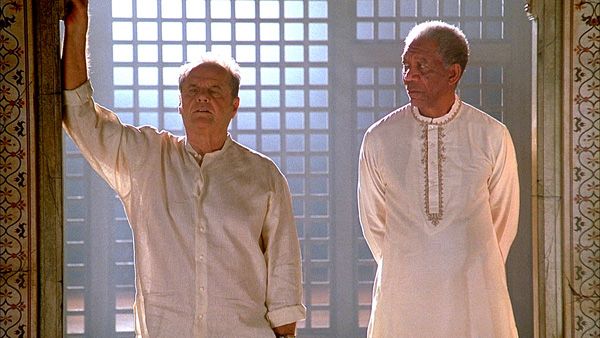
 "The Bucket List" (Rob Reiner, 2007) Movies about cancer patients don't do well at the box-office, by and large, but this one seemed to linger in theaters for quite a while. The reason could be the chemistry of the two stars, Nicholson and Freeman, who wanted to work together, and, here, fit as a team like comedy and tragedy. Nicholson lays it on a little thick to compensate for the considerable Freeman gravitas, but in moments of quiet they're evenly matched.
This one was savaged by the critics for its kumbaya—live-'til-ya-die saccharine quality, but armed with that fore-knowledge leavens the sugar-shock. Two cancer patients—one, ironically, the head of the no-frills hospital system he's being treated at—pull each other through their treatments and surgeries, with definite expiration dates and decide to fulfill a hastily cobbled together "bucket list" of things to do before they die. It includes the "Grumpy Old Men" comedy fodder of sky-diving and race-car driving, but also it doesn't shirk from the ravages of cancer treatment or the mood-swings accompanying the Kubler-Ross stages of death. And it's tough on the effects of a family when the figurehead, dying of cancer, decides he needs some quality time to eat, drink, be merry and see a handful of the seven wonders in a selfish act of squeezing as much experience into an ever-shrinking amount of time.
If there is anything that holds the movie back (besides its commitment to be a feel-good movie) it is Rob Reiner's direction, which never rises above the perfunctory. It's something that's plagued all his films, but is most noticeable when he tries to do something bigger than a two-hander romantic comedy—it's why his "The Princess Bride" never quite rises in presentation to meet its ingenious material. Reiner perpetually films like he was aiming for television movies (but even now, TV directors are getting better at using wide screen compositions for HD). True, he had to worry about his actors looking convincing over stock footage (predominately used during the travel sequences), but there must have been a way to do it with more panache and sense of style. "No frills" makes for a dispriting experience...in hospitals and movies.



Tuesday, February 9, 2010
Young @ Heart (Take Two)
 "Young @ Heart" (Stephen Walker and Sally George, 2007) Good movies need good casts and "Young at Heart," the documentary about seniors singing rock songs has one of the best casts in movies in many years. The motley gang of oldsters, struggling mightily with the rhythms and lingo of late model rock n' roll, charm and beguile. The characters and cranks, alike, are so fragile you worry for them and mourn briefly at the news of a death in the family, one of those proud voices stilled.
Conceived and led by Bob Cilman—one gets the idea that he more than lives the impresario role—the choir-leader picks the songs, teaches, cajoles, cheer-leads and nannies the old folks who are nothing but game...even at the risk of their health...to get out there and put on a show.
Quite the show it is. The film chronicles the ramp-up and try-outs of new material for an upcoming performance from the first halting attempts (they do "Yes, we Can-Can," something I'd be hard-pressed to get right!) to the suspense-filled stage appearance—will they pull it off?—before a sold out crowd of towns-people and family-members of fallen comrades. Interspersed are ingenious music videos that are clever and funny and are something of a tonic throughout the movie.
Because hovering over the film is the specter of mortality. The singers are frail, in failing health, their eyesight failing, their voices quavering, suffering from diabetes and heart flutters. But combined with the angst and nihilism of rock songs, the result is poignant, even defiant. To see Fred Knittle (who passed in January 2009), morbidly obese, on oxygen, going through Coldplay's "Fix You" is a revelation, not only due to the performer, but for the effect he has on the material—the song is transformed to a world-weary hymn. The Bee Gee's "Staying Alive," that vampire of the disco days is dug up and becomes a cheekily triumphant "up you" to death.
And in one of the most poignant moments, Bob Dylan's "Forever Young," sung to a group of hardened inmates, growing misty with it, becomes a benediction from one group of survivors to aspirants, only hoping to. The post-concert interaction between them brings tears to the eyes.
"By the end of the filming, I felt like I had 25 new grand-parents," says Walker in his voice-over.
Exactly well put. 25 new grandparents, their lives preserved for all time on film, in a special moment in time.


.jpg)
The poster for the concert. Joe Benoit, in front, died before the concert.
Saturday, January 30, 2010
Battle in Seattle
 "Battle in Seattle" (Stuart Townsend, 2007) I admit I have a bit of a chip on my shoulder regarding this movie. Written and directed by actor Stuart Townsend, the film was yet another Seattle movie that was photographed, for the most part, in Canada, specifically "Seattle" North, Vancouver British Columbia. It was post-produced in Montreal, Canada, and for authenticity, they cast a few American actors, shot a day or two in Seattle (actually!) and spent the rest of the time writing and shooting around the story. Give it credit, there is a lot of Seattle in it, but mostly from the archive footage of many news sources and folks present on the scene. In Townsend's version, Seattle looks a lot more "Caucasian" than it is, and feels entirely phony. But then, this isn't even trying to be a true telling of events, other than its advocacy. It's a disaster movie, with all the tarted up (they use that phrase in Vancouver) melodrama of an Irwin Allen picture. There's even that standard of the D-movie: "Pregnant Woman in Peril," played by the director's squeeze, Charlize Theron.
In his commentary, Townsend acknowledges he didn't know much about what went down in 1999 at the Seattle-housed WTO conference, but, like everyone else, he was grabbed by the headlines and that phrase "Battle in Seattle." Research into the WTO and the complications from its basic philosophy of "you can't have a war with someone you're economically tied with (but you can sure as hell exploit them)" led to him finding a reason to make the movie in the second place. But, ultimately, although the message is there in the graphics-laden sections, the story still boils down to police versus demonstrators and bricks versus windows. The message, like with the riots, can't be seen for all the tear-gas.
And Townsend tries to represent all sides—the demonstrators', the delegates', the mayor's, the governor's, the reporters', the merchants,' as well as that of the police—to the point where the only folks to blame are those darned anarchists (much like the surface spin of the event) for not towing the line of having an orderly demonstration, albeit one with as many different agendas as there were countries in attendance. Lip-service is given to the fact that things didn't get dicey until Madeleine Albright called to gripe to her boss, President Clinton, that she couldn't get out of her hotel room, thus throwing the fellow local Democratic administrations to get their own brown-shirts in a twist and over-react.
Townsend even shoots himself in the foot by showing delegates of the WTO with legitimate concerns having them over-shadowed and ignored by...those darned uppity protesters. By showing all sides, ultimately Townsend doesn't take sides and the movie becomes merely about the relationships of the demonstrators and the hurdles the National Guard presence threw up for all concerned. A political riot should be about more than delaying True Love, which, according to "Battle in Seattle," it does, until the movie ends in an extended group-hug.
A making-of documentary has a clutch of representatives from a few of the protest groups pay lip-service to the film, and they're all cheery about it, despite the fact that everybody got their own black eyes from the occurrence. But, then, if you want to get your message out there, there isn't such a thing as "bad" publicity; it's what happens when idealists become egotists and politics becomes show business (or is it the other way around?).
The performances are fine, although Ray Liotta is far too young to be playing someone elected mayor of Seattle—and the guy they've got playing Gary Locke sounds like the first one they found from Central Casting who fit the description "Chinese." Among the protesters, Jennifer Carpenter is merely okay as a lawyer representative for the protesters—she rocks on "Dexter"—there is a token African-American (André Benjamin from Outkast), a token Latina (Michelle Rodriguez), and a token New Zealander (Martin Henderson) and that's about it. Attempts at cast diversity is merely skin-deep. Although two of the delegates are played by Rade Serbedzija and Isaach De Bankolé, their roles are small and, like Woody Harrelson, they spend most of their time looking frustrated.
If so, I'm walking in solidarity, brothers.









Thursday, September 10, 2009
Elizabeth: The Golden Age, Take Two
 "Elizabeth: The Golden Age" (Shekhar Kapur, 2007) Like its 1998 predecessor, "The Golden Age" is sumptuously produced, ornate in both costuming and production design, but also in filming and conceptual work. It is one of the most beautiful films I've seen in a longish time—excepting the sequences of torture and carnage—but the material feels a bit shallow (if not altogether juggled, shuffled and finagled*), like one of those bio-pic's that attempt to tell a tumultuous life in 90 minutes; no one likes to have their life, especially a Queenly one, summed up in Cliffs Notes.
"When last we left" Elizabeth I, she had ascended the throne, unmarried and without heir, but unbowed as "The Virgin Queen." Catholics to the right of her, Mary, Queen of Scots (Samantha Morton) to the left of her, and a seemingly endless line of suitors brought before her. No one has her back except her adviser Francis Walsingham (Geoffrey Rush returning to the role) and lady in waiting Bess Throckmorton (Abbie Cornish).
But there's one angle overlooked, although director Kapur has it covered with a dizzying number of overhead shots. Since the issue in "The Golden Age" boils down to whose side is God on—between the Protestant England and the Catholic Spain—a lot of time is spent from His point of view.**


Kapur, who started his career in Bollywood, uses color more imaginatively than most current directors (rather than embracing the current trend of leeching the color from films, he adheres to using it as another communicative tool). At the end of "Elizabeth" the audience was confronted with Elizabeth "the Virgin Queen" symbolized in all her alabaster glory. We see that same white Queen often in "The Golden Age" but are also confronted with different aspects of Elizabeth. Here, with the issue of finding a proper husband and the potential of an heir, she is frequently seen behind closed doors in far rosier tones than the alabaster appearance—"the divine here on Earth," in the words of Walsingham—that she uses for regal functions. She tells the Archduke Charles, a negligible suitor: "I have a secret, my dear. I pretend there's a pane of glass between me and them. They can see me, but they cannot touch me."
In times of regal impartiality, that "pane of glass" informs itself as the color blue in Kapur's direction. It sets Elizabeth apart and keeps her coolly disengaged and formal, as in the scene below, her she visits her former suitor, Sir Walter Raleigh (Clive Owen), and wife, her former lady-in-waiting to bestow her blessing on their first-born. The rest of the room, in slightly gloomy but warm colors, are off-set by her glowing in a frosty light.
And here, leaving the death-bed of a trusted advisor, she shows no emotion as Queen, allowing the man to know that he can die in peace, his work preserving her Monarchy—and her—is done.
The shot is also centered and composed like a Baroque painting, with many tableau layered in three-dimensions within it, each with their own lighting scheme. Kapur and his production designers fill the movie with such images (when the camera isn't flitting from one side of the room to the other), especially in the climactic sea-battle where some of the battle sequences look like they could have been copied from the cover of a Patrick O'Brian novel.


 Ultimately, the cold blues and alabasters give way to "the golden age," and Elizabeth is bathed in a warm glowing sunlight, holding the child of Raleigh and Bess—her position of Queen finally legitimized in reality and defended in battle—and the child that might have been hers, a subject—part of her charge, with no man her master and all of England under her protection.
* The Wikipedia entry on "Elizabeth: The Golden Age" has a nice run-down of the shuffling of events in the Queen's reign. One wonders if they'll be more accurate in the inevitable sequel—after all, we haven't seen Essex yet.
** Before I get e-mails from the indignant, we'll use the paternalistic designation...because the participants of the film did.
Thursday, September 3, 2009
Hairspray (2007)
 "Hairspray" (Adam Shankman, 2007) I'm not big on musicals. Rarely are they better than their source material and the songs, more often than not, are filler with "Moon/June" lyrics that fail to impress. My idea of clever musicals are "Guys and Dolls" and "The Music Man" that carry their music fantasies with a little bit of arrogant panache, daring you to not take it as seriously as regular dialog. My expectations of musicals are pretty low (which is good, I think, as it gves them more of a chance), and my expectations of "Hairspray"—despite rave reviews of the stage version that debuted *huzzah* in Seattle—were quite low. You just knew that a musical of "Hairspray" wouldn't be as edgy as the John Waters original. It was going to have to be neutered to be made "safe."
Plus, it has John Travolta in it. I can't remember a John Travolta* movie where I was impressed with him. I was probably going in with the wrong attitude.
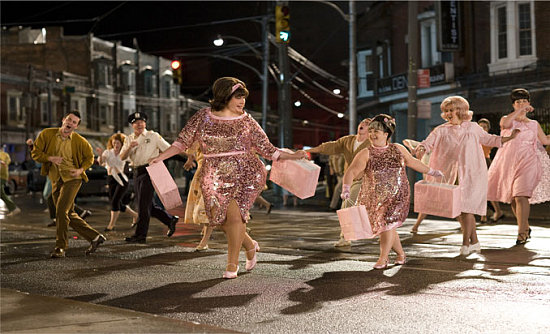
Because I enjoyed the Hell out of it. Word is that the movie version is a bit more stream-lined and a lot less camp than its stage-version. That may have helped, because "Hairspray" (the musical; the movie) is joyously anarchic, popping baloons gleefully as it goes—maybe laying it on a bit thick, as it goes—but as an expression of the freeing power of rock n' roll, few movies can top it. Especially the serious ones.
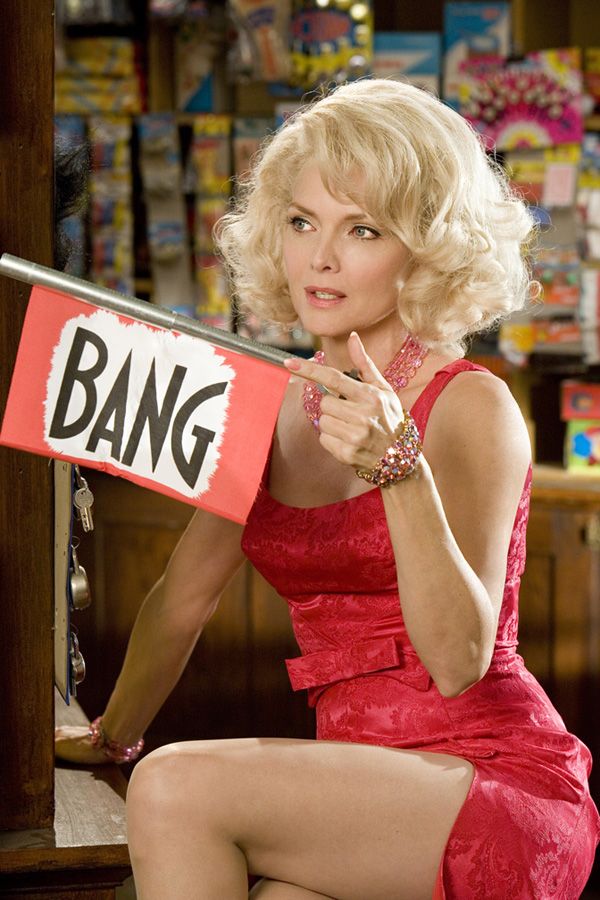
The year: 1962, pre-Kennedy assassination (it would have to be) in segregated Baltimore. For Tracy Turnblad (Nikki Blonsky—this girl needs to work more), life is surviving school in time to get home to watch "The Corny Collins Show" (with James Marsden, going full-wattage cheese), a dance party television show, featuring her dancing dreamboat Link Larkin (Zac Efron, not quite legitimizing the hysteria over him). Her dreams come true when one of the teen-dancers takes a leave of absence ("Nine months," she doesn't need to explain) giving Tracy and her blond twig girlfriend Penny Pingleton (Amanda Bynes) a chance to audition. She has many obstacles: station owner Velma von Tussle (Michelle Pfeiffer, whom my wife described as "voluptuously hideous"—yes, indeed**), and her parents, Wilbur and Edna Turnblad (Christopher Walken and John Travolta).
Now, here I must stop. Christopher Walken rarely fails to please, but it's a too-rare treat to see him sing-and-dance, which he obviously loves. And Travolta, in drag and dressed in a fat suit with a raspy ovah-the-"twop" Maryland accent?
He's great. Except for his accent slipping during the songs, he's damned near pitch-perfect, doing dance moves weighed down in prosthetics (and in high-heels no less), and providing a sympathetic life-force to the proceedings. Everybody's terrific in it, including old guys Paul Dooley and Jerry Stiller (who played Tracy's dad in Waters' original). Then there's Queen Latifah, who plays the "fill-in" host on Corny Collins' once-a-month "Negro Day"—the black dancers cordoned off from the white dancers by a rope partition—proving once again she is the Rock n' Roll Renaissance woman, who can rise above bad material, and soars with the good.
But it'd all be naught if not for the songs (well-staged with choreography-friendly directing by Shankman that recalls past movie musicals) by Scott Wittman and Marc Shaiman. Shaiman's ear for 60's rock styles is flawless and the words by Wittman and Shaiman are clever and sassy and occasionally downright rude.
Original "Hairspray" auteur John Waters even shows up (in an early cameo as a flasher). Word is that he's working on a screenplay for a sequel. If the product is half as fun as this singing step-child of his work, it will be a must-see.






* Since writing this, I remember I thought he did an extraordinary job of carrying Nicolas Cage's tic's in "Face/Off."
** Pfeiffer has a torchy song—"Miss Baltimore Crabs"—that she vamps though in such high-style that it catches one off-guard...until one remembers "Oh yeah...Susie Diamond."
Friday, August 14, 2009
Becoming Jane
 "Becoming Jane" (Julian Jarrold, 2007) Jane Austen is a double-edged sword for Hollywood, a god-send and a nightmare. Her stories make great movies that make quite a bit of coin and their period settings and costuming guarantee that they will receive at least technical Oscar nominations. The only problem is Jane died at the age of 41, having written only six complete novels, those being (say along with me now) "Emma," "Sense and Sensibility," "Pride and Prejudice," "Mansfield Park," "Northanger Abbey," and "Persuasion." They have become their own English cottage industry in the last 20 years or so, and there have been numerous films and BBC series of each of them. I would dare say that Keira Knightley has a shot at appearing in all of them, and if not her, Kate Winslet. Emma Thompson could retire making adaptations of Austen films, so successful was her adaptation of "Sense and Sensibility." But, it's counter-productive to keep making the same six movies over and over (although God knows they've tried*) There have been modern-dress adaptations of them, like "Clueless," and "Bridget Jones's Diary," and "The Jane Austen Book Club."** An obvious solution would be to broaden one's literary horizons and go back to the Brontë sisters (although they're a bit gloomy and have also been well-represented in media).
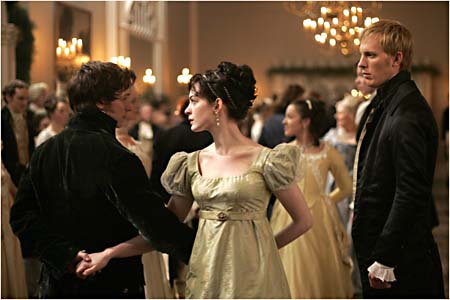
But instead they've concocted a sort of "Jane Austen Begins" origin story which plays fast and loose with the facts in order to make her life play like a Jane Austen novel (but without the "incandescent marriage" or happy ending). It's a great cast with Anne Hathaway as the spunky young Jane, James McAvoy as her would-be love Tom Lefroy, Julie Walters and James Cromwell as Jane's fretting parents, and Maggie Smith and Ian Richardson as the stodgy bumps in the road of romance that are an intrinsic part of any Jane Austen story.
Was there a romance? Well, Jane did write about Lefroy to her sister Cassandra:


"I am almost afraid to tell you how my Irish friend and I behaved. Imagine to yourself everything most profligate and shocking in the way of dancing and sitting down together."
And Lefroy supposedly confessed in his dotage to having "a boyish love" for her. Probably a lot of sighing went on. But "Becoming Jane" blows it up to be the Great Love of her life, the inspiration for her writing, becoming a wish-fulfillment of what could have been. Maybe. But maybe, as it is inconveniently often is, the truth is a bit more complicated than that. "Becoming Jane" would have you believe that she was a great literary success—when the truth is that she was published anonymously as "By a Lady." She enjoyed good sales of her book (two of which were published posthumously), but few knew her identity while she was alive. That flies in the face of what the movie manufactures for a "happy ending."
Still, the filmmakers get to cherry-pick the Austen canon for their story, and carefully insert the few known biographical bits—Wikipedia has this fine quote by a biographer saying that details of her life are "famously scarce." But, they know she ended up writing those novels, so once they know the end-point the authors can start constructing the path of the creature of "Becoming Jane." Whether that portrait is becoming, doing justice to the author, is open to debate. There's a term that serves as an ad hominem defense for writers making it up in the absence of facts—"writing to silence," in other words, there's no one alive to protest the accuracy. The assumption for the people who wrote "Becoming Jane" is that she wrote what she knew, and that her novels were somewhat autobiographical, negating that most essential of writerly gifts—imagination. If that's not an injustice to any writer, I don't know what is.
* One of my favorite titles for a movie in the last 15 years was the gangster spoof, originally called "Jane Austen's 'Mafia!'" as a knock on how many adaptations of Austen there had been, but the producers chickened out and took her name off before it opened.
** And just as this was to be published, I became acquainted (via PBS) of the British mini-series "Lost in Austen," in which a modern day Austen fan exchanges positions with Elizabeth Bennett of "Pride and Prejudice" (via time portal, and one would assume a fiction/non-fiction bridge) and tries to keep the storyline in place—much like an Austen heroine—while trying to put herself and Elizabeth back in their proper places. Naturally, a movie adaptation is being planned with an executive producer being Sam Mendes...who is the husband of Kate Winslet.
Naturally.


Wednesday, August 5, 2009
Great World of Sound
 "Great World of Sound" (Craig Zobel, 2007) Wonder why there are so many contestants for these broadcast "Talent" shows? Surprised that the open auditions inevitably pull lines of people that extend for blocks? Because the world is full of deluded people with such a lack of perspective, or a reality-crushing ego that they think they can become a star if someone would just notice them. And there are enough people in the world who just need to be told that they're good. At something. At anything.
And you can make a lot of money from these people, as "American Idol" and the various "Fill in the Blank's Got Talent" programs have proved again and again. Give people a little gold dust and they go ga-ga—they stop thinking and want more of that gold dust. You can do it big time, as in "American Idol."
Or you can do it as portrayed in "Great World of Sound"—with a "vanity press" of sorts for bands and singers.
"Great World of Sound" is all about advertising. Martin (Pat Healy) answers an ad for a "record producer" position with the "Great World of Sound" company. But the position is really a con-job masquerading as a sales job. G-W-O-S puts out advertisements for the aspiring singer to respond to, and it's the job of Martin and his co-hort Clarence (Kene Holliday) to land them for the whole package: for a fee, they will record said singer at a "professional" recording studio, press the CD's and present the singer with a professionally average-looking product and a valueless gold-plated record for them to hang up...in their den, presumably, if they still have a house after the process.
It's a great idea for a movie and the technique Zobel used to get auditions—by actually auditioning people who answered the very real advertisement they put up in the towns they were filming in—blurs the lines between reality and fiction. The auditioners inter-acted with the actors playing the parts and the process seems uncomfortably real.
Because it is.
But it boils down to a pyramid scheme. These producers are merely salesmen, gathering money for the folks running the company. But these producers are in on and victim to the same con. They never know if the next person coming in will have real talent and genuine ability...and if they find them? Well, there's that gold-dust again.
A great idea for a movie. But one that doesn't really come across successfully. There is that frisson of reality invading cinema, but it's what is done with it that makes a great film. And "Great World of Sound" has nowhere to go, but to where most pyramid schemes go when the well runs dry. In this case. the well is the ingenuity of the film-makers and ultimately the film just ends with a double-edged sense of "What Might Have Been," both for the world inside the film and the film itself.
I saw this movie before the "Susan Boyle" story broke. But, being a former recording engineer and having recorded scores of "demo's" in my life, I know the odds of finding genuine talent are long.
But they're not impossible. And "Great World of Sound" churned up a bunch of old memories of the process. In my world, I couldn't tell a person with no talent they were doing "great." I'd shut down the session and give them advice. Come back, sure. But do this, first. Practice this, first.
I once did an audition for a game-producer for a promotional piece. They needed a young "game-player," and I spent a fruitless afternoon trying to coax that from a series of auditioners. Then, a guy came in, said he just graduated from an arts program and his agent sent him out to try his luck. Not expecting much, I was amazed to find that not only could the guy read, he could act and provide a depth to the material no one had reached. He provided sub-text. He wasn't just reading words. He was playing a part. "You have got to use this guy," I told the producer.
They did.
But the game-producer thought he sounded too old and so they re-cast with another actor, and the client and the producer were satisfied with the finished product. That's the bottom-line.
And the actor who was so good, and was rejected? Don't feel too sorry for him.
It was Brendan Fraser.
True story.


