Showing posts with label Rob Reiner. Show all posts

Wednesday, August 1, 2012

Misery

Misery (Rob Reiner, 1990) A return to Stephen King territory for Reiner after adapting King's novella "The Body" into Stand By Me.  That one was an unexpected hit for Reiner, who'd only achieved a certain cult following with This is Spinal Tap and The Sure Thing.  Stand By Me changed all that, and Reiner had his pick of projects. 

The story is every creator's worst nightmare: meeting critics and fans.  As adapted by William Goldman, Writer Paul Sheldon (James Caan) goes to his mountain writing-retreat to put the finishing touches on his latest novel—a departure from the successful historical potboilers he has been churning out.  Trouble starts when a traffic accident leaves him injured and in the care of nurse Annie Wilkes (Kathy Bates, who won a Best Actress Oscar for this), who declares herself his "number one fan."  The care she gives him is fine—of course, he's helpless, bed-ridden, incapacitated with two broken legs, and there is the usual paranoia that comes from being in the care of a stranger.  But his condition goes from "stable" to "critical" when Annie reads his manuscript, and doesn't like it as it's not the same thing he's been writing.  But, he's down-graded from "critical" when she gets ahold of his latest "Misery" book and discovers her favorite character is killed in it.  At this point, Annie down-grades from "stable" to "street-rat crazy." 

She restrains Sheldon to his recovery bed, burns his manuscrpt, then breaks his ankles—"hobbling" him—to keep him captive to write the next "Misery" novel bringing the character back to miraculous life.

Meanwhile, Sheldon's publisher (played by Lauren Bacall) reports him missing—he's missed his manuscript delivery date—and a search begins for Sheldon in the local area, spear-headed by Sheriff Buster (the late great Richard Farnsworth, aided by his dispatch, Frances Sternhagen), circling around the area around the vicinity of Annie, who may have been responsible for some mysterious hospital deaths in the past.

King was writing in his basic fear wheelhouse with this one.  A cult-figure for his contemporary horror novels, his fan-base must have been a little weird, inspiring nightmares of what they might do to him if they ever got ahold of him.  Metaphorically, he was also writing about his own feelings of helplessness dealing with drug addiction—Annie keeps Paul addicted to painkillers throughout his stay, witholding them from him when he becomes "bad," in her estimation.

This might fall into the thriller category, but I find it a horror film, just as much as Psycho is a horror film.   

And the most interesting aspect, for me, is the aspect of the creator's view of the "fans"—not all of them, just the most dedicated, the ones who see every work as a love-letter to themselves.  And an idea stuck in my head wondering if George Lucas ever had nightmares about fans dressed as stormtroopers, each one carrying a sledge-hammer, and their own ideas of what a "Star Wars" movie should look like. I wonder if he's ever seen this movie.

Saturday, April 3, 2010

The Bucket List

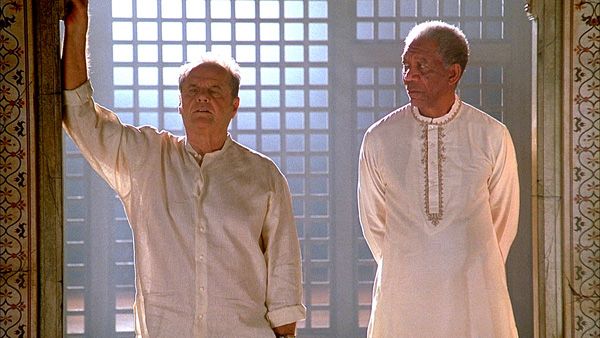
"The Bucket List" (Rob Reiner, 2007) Movies about cancer patients don't do well at the box-office, by and large, but this one seemed to linger in theaters for quite a while. The reason could be the chemistry of the two stars, Nicholson and Freeman, who wanted to work together, and, here, fit as a team like comedy and tragedy. Nicholson lays it on a little thick to compensate for the considerable Freeman gravitas, but in moments of quiet they're evenly matched.

This one was savaged by the critics for its
kumbaya—live-'til-ya-die saccharine quality, but armed with that fore-knowledge leavens the sugar-shock. Two cancer patients—one, ironically, the head of the no-frills hospital system he's being treated at—pull each other through their treatments and surgeries, with definite expiration dates and decide to fulfill a hastily cobbled together "bucket list" of things to do before they die. It includes the "Grumpy Old Men" comedy fodder of sky-diving and race-car driving, but also it doesn't shirk from the ravages of cancer treatment or the mood-swings accompanying the Kubler-Ross stages of death. And it's tough on the effects of a family when the figurehead, dying of cancer, decides he needs some quality time to eat, drink, be merry and see a handful of the seven wonders in a selfish act of squeezing as much experience into an ever-shrinking amount of time.

If there is anything that holds the movie back (besides its commitment to be a feel-good movie) it is
Rob Reiner's direction, which never rises above the perfunctory. It's something that's plagued all his films, but is most noticeable when he tries to do something bigger than a two-hander romantic comedy—it's why his "The Princess Bride" never quite rises in presentation to meet its ingenious material. Reiner perpetually films like he was aiming for television movies (but even now, TV directors are getting better at using wide screen compositions for HD). True, he had to worry about his actors looking convincing over stock footage (predominately used during the travel sequences), but there must have been a way to do it with more panache and sense of style. "No frills" makes for a dispriting experience...in hospitals and movies.

Friday, August 29, 2008

Stand By Me

An aside here, from "Shakespeare Week," to mention a film that has become identified with Summer (and its end), and is being shown tomorrow night as a part of a Special "Be A Little Spark" Event for charity. For details on the menu of highlights go to their web-site. It's for the best of causes.*


"Stand By Me" (Rob Reiner, 1986) "Stand By Me" just might be the best film ever adapted from a Stephen King story, in fine company with Stanley Kubrick's "The Shining," Brian DePalma's "Carrie," Frank Darabont's "The Shawshank Redempton" and "The Green Mile," David Cronenberg's "The Dead Zone," and (of course) "Children of the Corn V: Fields of Terror."**

King's collection of novellas "Different Seasons" came at a particularly inspired point in King's early career; each story is a gem, sitting outside of his then-established genre of horror writing, but still full of incident and character that could produce goose-flesh, or laughter. And the writing is sublime. Of the four stories included, only the "tale told in passing"--"The Breathing Method"--has not been filmed. The others--"Apt Pupil" was an indifferent Bryan Singer sophomore effort, and the classic "Rita Hayworth and the Shawshank Redemption" was the sublime Darabont film. But "The Body"--the story of boys of summer--was filmed first, as "Stand By Me." It's cast of young actors (River Phoenix, Jerry O'Connell, Wil Wheaton, and Corey Feldman, along with Keifer Sutherland, Casey Siemaszko, and John Cusack--who'd starred in Reiner's "The Sure Thing") would become established film players, with Phoenix breaking out early before his death at the age of 23. His death gives the resolution of the story an extra pang it didn't have when it was first released.

The story is of four 12 year old boys living in King's omnipresent town of Castle Rock (Maine in the story, Oregon in the film), who set out to find the body of Ray Brower--a kid who disappeared, and is gossiped to have been hit by a train--during an idyllic summer, made less so by the kids' circumstances at home, and their harassment by town bullies. Finding no real comfort anywhere, the outsiders set out to find the body in the wilderness for an adventure, and they are tested by Nature and their own natures.

"Stand By Me" is not so much a "coming-of-age" story as its been pigeon-holed, but a "coming-to-terms"...with one's lot in life, with those who threaten, and with the way life has a way of testing your mettle, and your sense of justice.

Robe Reiner has had a run of bad luck with his recent films clicking with the public. But "Stand By Me" was right in the middle of a superb run of well-done comedy films before his ernestness became a bit heavy-handed for most Americans' tastes.

There's an axiom in Hollywood that says, "You're only as good as your last film." But there's the "Billy Wilder corollary:" Really, you're only as good as your best film."

Given that, its only a matter of time before Reiner finds his audience again. Or they find him.


* And it should be mentioned and acknowledged that the Olaiya Land, one of the founders of the cause, inadvertently inspired the name of this blog back in the day. Thanks again, Olaiya.

** Kidding, kidding...