Showing posts with label Stephen King. Show all posts

Friday, October 25, 2013

Carrie (2013)

To Carrie Out the Lord's Vengeance
or 
"Mama, Don't Ruin it!"

I've been working on a review of Brian De Palma's latest film Passion the last couple of weeks (still working out how I feel about it—on a superficial enjoyment level it doesn't succeed very well, but if you appreciate craft and detail there is a lot to digest, and it makes you realize that a lot of older directors go through that shift where the details are more important than the Big Picture) and was watching an interview with De Palma* about the film (which I'll include again when I get around to finishing it) and at one point the subject of Kimberly Pierce making a new version of Carrie was broached.  

"We're friends", he said of Pierce, who made Boys Don't Cry and Stop-Loss. "I've seen some stuff and it looks good."  But the more telling comment from the talk is when someone brings up Piper Laurie (who played mother Margaret White in his version) and De Palma remarks: "Piper thought we were making a comedy."

As well she might have.  Stephen King's "Carrie" is a hoot to read (you can do so—textually—here), but it isn't if you take it too seriously.  Which is odd. King cackles and galumphs through his writing, something he also did when he took to acting and directing his films.  Which is why the best King adaptations have a surreal sense of giddy humor about them—they have to be a little over-the-edge, dangling their feet in the muddy waters of madness to be really, really good.  It's why George Romero made good King adaptations. And Kubrick (despite King's protestations).  And Carpenter.  And Reiner.  And De Palma.  But, if you get all solemn and reverential about them, they fall flat as pancakes.


Pierce gets precipitously close to that edge, but doesn't tumble over it.  She includes a couple of things that De Palma, and the screenwriter of both versions—and the musical version—Lawrence D. Cohen, left out of King's book, which are the opening scene of Carrie's birth (the harrowing circumstances alluded to in the first chapter) and a sub-plot involving Sue Snell.  Quite a few things are better—the kids...look like kids, not twenty-somethings from television sit-com's posing as teens.  The good of that is that the performances are more awkward and more vulnerable.  The downside is that they are all dewy lumps that don't have a lot of distinctiveness to them, so one is caught for a second wondering "which one is this, again?"  I mock the ages of the older Carrie cast-members, but they had the experience and chops (from those sit-coms, presumably) to make their characters known as soon as they entered a shot.  The 2013 kids are...awkward...looking like they're ready for a direction-cue in the middle of a take.  For example, as pretty and competent as Gabriella Wilde is (she plays this version's Sue Snell, the "remorseful" girl played first by Amy Irving), most of the time she's blandly waiting for her next line with a concerned furrow and not much else behind it.


One essential thing (given the times, making this Carrie somewhat relevant) is the inclusion of the evil genie of new media into the mix.  Every kid here has a cell-phone.  Every kid is documenting their lives like would-be film-makers (and Pierce throws in random samples of such stuff for bridging sequences, showing "normal" high school activity). But, the most innovative use of it comes when Carrie has a "period" in school that isn't scheduled and the girls in her high school gym class viciously taunt her, there's the added inevitability that some goonish lout will whip out their I-phone (usually banned from bathrooms for this very reason) to record the event.  At that point, the truly bad-bad girl of Kris Hargenson (a brunetted Portia Doubleday here, future Mrs. de Palma Nancy Allen then) decides to go one step further, post it on YouTube, and it's then that punishment is meted out to the class. For Kris, this is unfair—she doesn't want to be an out-cast as she sees Carrie is and lashes out, digging herself deeper and deeper into detention, punishment and malicious revenge—and that video is used to twist the knife during the horrific prom sequence.  It raises the stink of public media being thrown into the mix of private bullying and how it has escalated the trauma of humiliation by bringing mob mentality into the pecking order, empowering the mean-spirited far beyond their reach, and narrowing the victim of options for safe zones that might bring light (and perspective) to their situation.  At that point, humiliation becomes torture and isolation becomes impenetrable.


As I said, if you take this stuff too seriously, it becomes no fun at all.  And while Pierce's heart is in the right place, standing up for the repressed outcast and removing the puerile nudity of De Palma's version, she also goes a bit too far, making things less horror-ific, and more disturbingly real.  For example, taking the loony ecstasy that Laurie brought to her fundamentalist (no fun; all mental) mother—Julianne Moore's version is seriously deranged, scratching herself to bleeding at the slightest provocation—and making Moretz's Carrie a very active revenge-seeker (where Spacek's interpretation was all evil-eye and mannequin-stiff, Moretz directs the carnage like a magician), the changes make her much less sympathetic as a character.  Even though both movies show Carrie "learning her craft" by checking out resources in the library (I thought schools were banning books right and left—heck, they even ban "Carrie!"), the new Carrie seems to have more control than Spacek's, whose bursts of revenge felt like an id monster that would combust things with a look.  This one concocts tortures and lingers over them like a cat playing with a mouse.  Hey, control is great, but at what point does the tortured become the torturer?  At what point do we lose sympathy for her and see her as just another maniac terrorizing a school?  At what point does that earnestness work against the intent?


So.  Good attempt.  Maybe even worth the effort.  But, at some point, this new Carrie manages to undermine the reason it was generated in the first place—to give us a really good scare.  Perhaps real life events have just caught up and overwhelmed the perspective of seeing entertainment in this, or, to make debating points, the filmmakers just eked out some of that entertainment value.  But, I remember leaving the first Carrie feeling sympathy for the devil, seeing it as a tragedy.  This time, it seemed everything was a natural consequence of tinkering with forces beyond one's control, especially if self-control is in short supply.  There was no catharsis, and at that point, Carrie just stands for nothing, a nihilistic bloody mess. 

Carrie is a Rental.


*


Wednesday, August 1, 2012

Misery

Misery (Rob Reiner, 1990) A return to Stephen King territory for Reiner after adapting King's novella "The Body" into Stand By Me.  That one was an unexpected hit for Reiner, who'd only achieved a certain cult following with This is Spinal Tap and The Sure Thing.  Stand By Me changed all that, and Reiner had his pick of projects. 

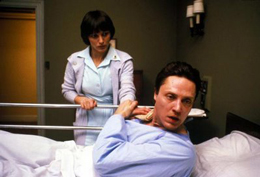
The story is every creator's worst nightmare: meeting critics and fans.  As adapted by William Goldman, Writer Paul Sheldon (James Caan) goes to his mountain writing-retreat to put the finishing touches on his latest novel—a departure from the successful historical potboilers he has been churning out.  Trouble starts when a traffic accident leaves him injured and in the care of nurse Annie Wilkes (Kathy Bates, who won a Best Actress Oscar for this), who declares herself his "number one fan."  The care she gives him is fine—of course, he's helpless, bed-ridden, incapacitated with two broken legs, and there is the usual paranoia that comes from being in the care of a stranger.  But his condition goes from "stable" to "critical" when Annie reads his manuscript, and doesn't like it as it's not the same thing he's been writing.  But, he's down-graded from "critical" when she gets ahold of his latest "Misery" book and discovers her favorite character is killed in it.  At this point, Annie down-grades from "stable" to "street-rat crazy." 

She restrains Sheldon to his recovery bed, burns his manuscrpt, then breaks his ankles—"hobbling" him—to keep him captive to write the next "Misery" novel bringing the character back to miraculous life.

Meanwhile, Sheldon's publisher (played by Lauren Bacall) reports him missing—he's missed his manuscript delivery date—and a search begins for Sheldon in the local area, spear-headed by Sheriff Buster (the late great Richard Farnsworth, aided by his dispatch, Frances Sternhagen), circling around the area around the vicinity of Annie, who may have been responsible for some mysterious hospital deaths in the past.

King was writing in his basic fear wheelhouse with this one.  A cult-figure for his contemporary horror novels, his fan-base must have been a little weird, inspiring nightmares of what they might do to him if they ever got ahold of him.  Metaphorically, he was also writing about his own feelings of helplessness dealing with drug addiction—Annie keeps Paul addicted to painkillers throughout his stay, witholding them from him when he becomes "bad," in her estimation.

This might fall into the thriller category, but I find it a horror film, just as much as Psycho is a horror film.   

And the most interesting aspect, for me, is the aspect of the creator's view of the "fans"—not all of them, just the most dedicated, the ones who see every work as a love-letter to themselves.  And an idea stuck in my head wondering if George Lucas ever had nightmares about fans dressed as stormtroopers, each one carrying a sledge-hammer, and their own ideas of what a "Star Wars" movie should look like. I wonder if he's ever seen this movie.

Friday, September 2, 2011

The Dead Zone

The Dead Zone (David Cronenberg, 1983)  Stephen King's "The Dead Zone" was written as a defense of assassination as a preventive measure for disaster (No, really...what if you could go back in time and kill Hitler as a child?*).  What if you had the power of foreknowledge and did nothing to prevent something catastrophic?  It may be a sin to kill, but the Catholic Curch also warns of sins of omission.  The extraordinary circumstances of a psychic being able to see the future and acting to prevent it is the stuff of philosophy, morality and science-fiction.**  But King, who took horror tropes and turned them on their pointed ears wasn't writing science-fiction.  His brand of personal horror turned this cautionary tale into one of tragedy.

Up to that time, David Cronenberg was known for viscerally-filmed Grade-Z horror films with an emphasis on the squishy, but his film of The Dead Zone (one of the early King adaptations after DePalma's Carrie, Kubrick's version of The Shining, and the Tobe Hooper-directed TV version of 'Salem's Lot) was one of the strongest of the bunch.  Cronenberg (and screenwriter Jeffrey Boam) took the larky good-nature out of the initial character of Johnny Smith (played in the film by Christopher Walken, but King thought it better suited for Bill Murray) and boiled the story down to essentials.  Smith (as anonymous a name as you'd want) goes on a date with Sarah Bracknell (Brooke Adams) and things are going alright—he's fallen in love, in fact—when Fate raises its Huge Hand in the form of a near-fatal traffic accident that puts Johnny into a coma for five years (Cronenberg, perversely, has the collision occur with a milk tanker—as in "no use crying over..."***).  Waking up, he finds that life is completely different—Mom's become unhinged, Sarah's up-and-married, he's semi-crippled, even after severe rehabilitation, and he can't find a job as a teacher of English Lit anywhere.

Oh, yes.  Then there's "the power."  By merely touching another human being, Johnny can see into that person's future, seeing their possible destiny and maybe death.  He wants to live a "normal" life, a life of obscurity and happiness, but this "gift" is more of a curse, throwing him into the limelight, giving him responsibilities that he can't want or need.  But, a man of conscience, Johnny can't keep his visions to himself—he has to warn people.  He can't merely witness, an innocent by-channeller, he has to act to prevent the tragedies he sees and insert himself between those he touches and their Fates.

A social man, his gift makes him increasingly isolated, trying to hide his abilities, and avoiding people and touching them to keep from seeing those visions.  But, as much as he tries to quash his ability to see the future, he is always confronted by it and must come out of his obscurity to prevent them from occurring.

Sounds like classic tragedy to me.  With biblical, even apocalyptic echoes.

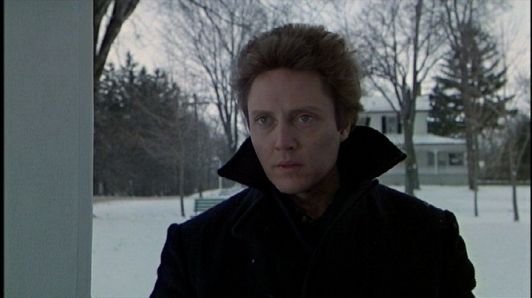
Cronenberg keeps the tone of the film oppressively heavy (Michael Kamen's score is particularly down-beat) and the Canadian locations have a dull, overcast, obliquely lit feel to them, like every moment is a late afternoon threatening to snow.  Smith is a particularly sepulchral figure, Walken's tall frame shrouded by a long black overcoat, hobbling stiff-leggedly with a cane, like a harbinger of doom, his eyes haunted, but Walken's hooded eyes grow wide, when he touches someone or an object they possess, as if grabbing a live electrical wire as he goes into his vision.  Before long, he is perpetually wearing black gloves.

But, on one of his rare excursions out he manages to take the hand of one Gregg Stillson (Martin Sheen), a Senator with eyes towards the presidency, and what he sees is Stillson launching a nuclear attack, ensuring Mutually Assured Destruction, and he becomes obsessed with stopping it. 

Screenwriter Jeffrey Boam does some compression and simplification of the novel that emphasizes coincidence for the sake of a romantically resonant ending, but all in all, it is one of the best of the King screen adaptations (you've got to be careful with King—if you boil down his stories too much and take out too many of his incidents, you can sometimes see that the skeleton of his writing is calcium-deficient).  The cast is amazing—Walken, Adams, Lom, but also Tom Skerritt, Anthony Zerbe (playing a strong character for once), Colleen Dewhurst, and the wonderful Jackie Burroughs—and keep things playing out naturally, with only Sheen veering into a kind of caricature. 

It's one of Cronenberg's tamer, more straightforward early films (relatively, although there's some gut-churning violence), but it's one of his great ones.

Cronenberg gives Smith's visions a perverse power.


* It's been years since I've read the book or seen the movie, and I'd forgotten that very question is asked by Smith in both: in the novel to a WWI veteran, and in the movie to his neurologist Dr. Weizack (Herbert Lom).

** King's next book "11-22-63" is about a man who travels back in time to prevent the Kennedy assassination.  I'm going to write one called "The Well" about an author who goes back to one too many times.  (Note: There was a "The Twilight Zone" episode called "Back There"—great score by Jerry Goldsmith, btw—about a man who goes back in time and—unsuccessfully—tries to prevent Lincoln's assassination.  It starred Russell Johnson, who, whenever he came into the studio I worked at, I'd make sure that his reading copy had nice bold type on it.  He appreciated it, and I had a standard exit line for his thanks: "Well, after all, you went back in time to save Lincoln...")

*** In the novel, the accident Johnny is in is caused by drag-racers.

Friday, June 26, 2009

The Mist

"The Mist" (Frank Darabont, 2008) A horror pastiche bubbled up from many long-crusted cauldrons, "The Mist" wouldn't cross anyone's radar as a "must-see." But considering it's writer-director Frank Darabont ("The Shawshank Redemption," "The Green Mile") revisiting Stephen King territory (usually Maine) with top-tier actors like Andre Braugher, Marcia Gay Harden, and Toby Jones, it's worth a look*

A night's damaging electrical storm produces a dawn mist that begins to seep down from the mountains. A trip into town for provisions traps a motley crew of citizens inside "The Food House" keeping the enveloping mist outside. Conspicuous consumption proceeds inside when a man bleeding from his head runs in screaming that "the mist" killed his companion, confirming that consumption is going on outside, as well. It becomes apparent that the lives of the people in the store amounts to a can of beans (
in Aisle 5), with roughly the same position on the food chain.

At that point,
to pass the time everyone starts playing "The Blame Game" falling in line between the scientific, the religious and the superstitious. But, whatever "it" is, "it's a problem of some magnitude"—several magnitudes, in fact, what with giant killer locusts (for the religious), flesh-eating pterodactyls (for the scientific) and big hairy spiders shooting acid webs (for the superstitious). Not to mention the towering Lovecraftian dromedaries (for the English majors). They all have nasty invasive ways to kill you and the rest of the movie boils down to whatever bone-headed motivation it takes to get people outside for the near-occasions of carnage that break out every fifteen minutes. Go down the checklist—hubris, zealotry, rationalization, drunkenness, or even "doing it for the kids." Then there are the defense measures that feel more like offense for the other side; how smart is it to douse a flying creature with gasoline in an enclosed space...lit by torches?

Darabont shoots things in a faux cinema-verite style, light on the hand-held, and does some quick cutting (but not too quick) to hop up the urgency (and discourages thinking too much—the store doesn't have a radio? Not even for muzak?). And tries to justify it all with a minute discussion of how folks are rational "as long as the machines are working and they can call 9-1-1." (Points for working sociology and political science into one sentence").

The execution is tried and true, but then there are a lot of sources to draw from: 50's atomic monster movies, "
The Fog," "The Thing," "Night of the Living Dead," as well as waves to "28 Days," "Planet of the Apes," "The Birds," "Alien," "Stargate," and King's own "Maximum Overdrive," which is about folks trapped in a diner while outside is a raging...18 wheeler. The ending has drawn a lot of criticism in some parts from some who though it was a "mist" opportunity, but it's a satisfying/disatisfying ending that also has cinematic precedence, whether you like it or not.

The lesson, once the smoke clears, seems to be: "Don't be so myopic, ye of little faith."

Either that, or always take more bullets.

* Starring is Thomas Jane, late of "The Punisher" films, and he proves to be a credible, believable leading man of the Harrison Ford School.

Friday, August 29, 2008

Stand By Me

An aside here, from "Shakespeare Week," to mention a film that has become identified with Summer (and its end), and is being shown tomorrow night as a part of a Special "Be A Little Spark" Event for charity. For details on the menu of highlights go to their web-site. It's for the best of causes.*


"Stand By Me" (Rob Reiner, 1986) "Stand By Me" just might be the best film ever adapted from a Stephen King story, in fine company with Stanley Kubrick's "The Shining," Brian DePalma's "Carrie," Frank Darabont's "The Shawshank Redempton" and "The Green Mile," David Cronenberg's "The Dead Zone," and (of course) "Children of the Corn V: Fields of Terror."**

King's collection of novellas "Different Seasons" came at a particularly inspired point in King's early career; each story is a gem, sitting outside of his then-established genre of horror writing, but still full of incident and character that could produce goose-flesh, or laughter. And the writing is sublime. Of the four stories included, only the "tale told in passing"--"The Breathing Method"--has not been filmed. The others--"Apt Pupil" was an indifferent Bryan Singer sophomore effort, and the classic "Rita Hayworth and the Shawshank Redemption" was the sublime Darabont film. But "The Body"--the story of boys of summer--was filmed first, as "Stand By Me." It's cast of young actors (River Phoenix, Jerry O'Connell, Wil Wheaton, and Corey Feldman, along with Keifer Sutherland, Casey Siemaszko, and John Cusack--who'd starred in Reiner's "The Sure Thing") would become established film players, with Phoenix breaking out early before his death at the age of 23. His death gives the resolution of the story an extra pang it didn't have when it was first released.

The story is of four 12 year old boys living in King's omnipresent town of Castle Rock (Maine in the story, Oregon in the film), who set out to find the body of Ray Brower--a kid who disappeared, and is gossiped to have been hit by a train--during an idyllic summer, made less so by the kids' circumstances at home, and their harassment by town bullies. Finding no real comfort anywhere, the outsiders set out to find the body in the wilderness for an adventure, and they are tested by Nature and their own natures.

"Stand By Me" is not so much a "coming-of-age" story as its been pigeon-holed, but a "coming-to-terms"...with one's lot in life, with those who threaten, and with the way life has a way of testing your mettle, and your sense of justice.

Robe Reiner has had a run of bad luck with his recent films clicking with the public. But "Stand By Me" was right in the middle of a superb run of well-done comedy films before his ernestness became a bit heavy-handed for most Americans' tastes.

There's an axiom in Hollywood that says, "You're only as good as your last film." But there's the "Billy Wilder corollary:" Really, you're only as good as your best film."

Given that, its only a matter of time before Reiner finds his audience again. Or they find him.


* And it should be mentioned and acknowledged that the Olaiya Land, one of the founders of the cause, inadvertently inspired the name of this blog back in the day. Thanks again, Olaiya.

** Kidding, kidding...