Showing posts with label Kathy Bates. Show all posts

Saturday, October 20, 2012

Shadows and Fog

Shadows and Fog (Woody Allen, 1991) When Woody Allen makes a film in the style of Ingmar Bergman (Interiors), it's done in deadly earnest.  But, when he takes on German Expressionism, entering the angular world of Lang, Murnau, with a para-nod towards Kafka, it's a comedy.  Not quite sure why; maybe he has an affinity towards one stylization and the other he just finds phony, but the different approaches are like, well, day and night.  Allen explored that theme—taking the same story and interpreting it as either comedy or tragedy—in Melinda and Melinda, a bit of a mis-fire—but one suspects that the Nordic tradition he buys completely, and completely dismisses the German (God knows why).

Here, the visual is pure dread, but the subject matter is a mixed bag of precision and vagueness, comedy and darkness.  Allen plays Kleinman, a passive-aggressive bookkeeper, who is recruited in the middle of the night by a vigilante mob (including David Ogden Stiers and James Rebhorn) to roam the streets looking for a serial strangler.  Being a professional coward, and only dealing well with facts and figures in black-and-white, Kleinman is ill-suited for the activity and begs off, inviting suspicion from the group.  When there is speculation that maybe he won't do his duty as a citizen because he might be the strangler, Kleinman caves.

On his dark journey through the city streets (the largest set ever built in New York's Kaufman-Astoria Studios, making this Allen's most expensive film), he runs across an all-star cavalcade of slothful potential victims: a philosophy student (John Cusack) with a weakness for prostitutes (among them Lily Tomlin and Jodie Foster, madamed by Kathy Bates), a circus love-triangle tangentially related (with John Malkovich, Mia Farrow and Madonna) and the town coroner (Donald Pleasence), who has a purely scientific interest in the killer.*

Kleinman soon realizes that life simply doesn't add up, that a little slippage occurs, especially when it comes to illusion and reality (in the form of a very handy and practical magician named Armstead, played by Kenneth Mars).  The film struggles with the dichotomy throughout, as highly contrasted as the black and white photography, never truly meshing, and finally ends, as many of Allen's weaker films—and one of Allen's strongest ones (Hannah and Her Sisters)—do, with a Deus ex Machina** that buttons everything up inexplicably, leaving no questions but a lot of raised eyebrows.

Which is fine for the purposes of the film, but it's hardly what you'd find in an example of German Expressionism, where the punishment fits the crime...and where things really are in black and white.  


* Yes, the film is top-heavy with fine actors (and Madonna), but if you look in the darkened nooks and crannies of the film you'll also find Fred Gwynne, William H. Macy, John C. Reilly, Josef Sommer, Wallace Shawn, Kate Nelligan, Kurtwood Smith and Philip Bosco.  Was this film cast or filmed at a SAG convention?

** Here's a question:  It's a Woody Allen film; Can there be a Deus Ex Machina if there's no Deus?

Wednesday, August 1, 2012

Misery

Misery (Rob Reiner, 1990) A return to Stephen King territory for Reiner after adapting King's novella "The Body" into Stand By Me.  That one was an unexpected hit for Reiner, who'd only achieved a certain cult following with This is Spinal Tap and The Sure Thing.  Stand By Me changed all that, and Reiner had his pick of projects. 

The story is every creator's worst nightmare: meeting critics and fans.  As adapted by William Goldman, Writer Paul Sheldon (James Caan) goes to his mountain writing-retreat to put the finishing touches on his latest novel—a departure from the successful historical potboilers he has been churning out.  Trouble starts when a traffic accident leaves him injured and in the care of nurse Annie Wilkes (Kathy Bates, who won a Best Actress Oscar for this), who declares herself his "number one fan."  The care she gives him is fine—of course, he's helpless, bed-ridden, incapacitated with two broken legs, and there is the usual paranoia that comes from being in the care of a stranger.  But his condition goes from "stable" to "critical" when Annie reads his manuscript, and doesn't like it as it's not the same thing he's been writing.  But, he's down-graded from "critical" when she gets ahold of his latest "Misery" book and discovers her favorite character is killed in it.  At this point, Annie down-grades from "stable" to "street-rat crazy." 

She restrains Sheldon to his recovery bed, burns his manuscrpt, then breaks his ankles—"hobbling" him—to keep him captive to write the next "Misery" novel bringing the character back to miraculous life.

Meanwhile, Sheldon's publisher (played by Lauren Bacall) reports him missing—he's missed his manuscript delivery date—and a search begins for Sheldon in the local area, spear-headed by Sheriff Buster (the late great Richard Farnsworth, aided by his dispatch, Frances Sternhagen), circling around the area around the vicinity of Annie, who may have been responsible for some mysterious hospital deaths in the past.

King was writing in his basic fear wheelhouse with this one.  A cult-figure for his contemporary horror novels, his fan-base must have been a little weird, inspiring nightmares of what they might do to him if they ever got ahold of him.  Metaphorically, he was also writing about his own feelings of helplessness dealing with drug addiction—Annie keeps Paul addicted to painkillers throughout his stay, witholding them from him when he becomes "bad," in her estimation.

This might fall into the thriller category, but I find it a horror film, just as much as Psycho is a horror film.   

And the most interesting aspect, for me, is the aspect of the creator's view of the "fans"—not all of them, just the most dedicated, the ones who see every work as a love-letter to themselves.  And an idea stuck in my head wondering if George Lucas ever had nightmares about fans dressed as stormtroopers, each one carrying a sledge-hammer, and their own ideas of what a "Star Wars" movie should look like. I wonder if he's ever seen this movie.

Thursday, June 9, 2011

Midnight in Paris

"Gertrude Stein Punched Me in the Mouth"
or
"L'époque est toujours plus belle de l'autre côté du pont Einstein-Rosen"

 "A Twenties Memory" by Woody Allen
Copyright © 1966-1971 by Woody Allen


I've been waiting for Woody Allen to make this film since before he asked to Play It Again, Sam (or even What's Up, Tiger Lily?). 

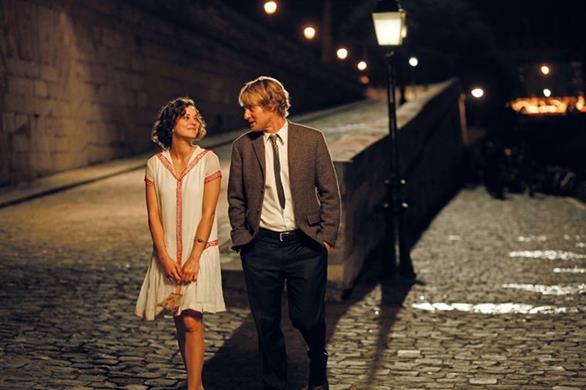
Based on a routine from his stand-up days,* which he later expanded for a piece in "The New Yorker" (see above), Midnight in Paris follows Gil (Owen Wilson) a self-absorbed, neurotically anxious writer of Hollywood fluff ("Wonderful, but forgettable...sounds like something I wrote"), who is obsessed with death,** as he travels to Paris from Pasadena with fiancee Inez (Rachel McAdams, but it could just as well have been Elizabeth Banks) and her conservative family. Gil is working on a novel, long in the gestation, and is distracted by the vapid shallowness that he is about to marry into.  Paris is shops, restaurants, museums and snootiness, and to escape the jejeune de vivre, he takes a late-night walk through the streets of Paris and is approached by a vintage taxi.  Entering the cab for Gil is a magical moment for him, on the same plane-breaking as when Tom Baxter (or is it Gil Shepherd) walks off the screen in The Purple Rose of Cairo.  He is instantly transported to 1920's Paris and becomes lost in "The Lost Generation"  (without the benefit of having survived World War I), meeting Cole Porter (Yves Heck), Ernest Hemingway (Corey Stoll), Zelda (Alison Pill) and Scott Fitzgerald (Tom Hiddleston), all the heroes of his favorite literary era and time, 1920's.  He's enchanted...and as his novel is about the time...inspired.  He goes back to Inez, gob-smacked, unable to explain where he's been all night, but "alibi's" his adventures as a dream (as they are, certainly in the aspirational sense).  He tries to bring Inez to the party, but the magic doesn't work—she's as unthrilled with Gil's stories as he is with her wine-tasting adventures with acquaintance Paul (Michael Sheen). 

She leaves.  And the taxi arrives, bearing Gil and Hemingway to the apartment of Gertrude Stein (Kathy Bates) and Alice B. Toklas (Thérèse Bourou-Rubinsztein), who are playing judgemental hosts to Pablo Picasso (Marcial Di Fonzo Bo) and his enchanting mistress Adriana (Marion Cotillard).  Gil gives his novel to Stein and Hemingway to critique, but he is drawn to Adriana, making her way through the 20's as best she can.

So, the two planes of existence for Gil are set up: his modern-day drudgery on the cusp of a marriage of inconvenience; and his fantasy past, where his dreams are reality and reality can make dreamsYou know where this is going.

It doesn't matter, though.  This is a "feel-good" Woody Allen picture—the kind people like—where the messages are still telegraphed the way they are in "obvious" Allen movies, the coincidences just a little too convenient, but so full of incident, grace and nuance (and quite a bit of humor) that it goes down well (as Allen groused throughout Stardust Memories, audiences "like his earlier, funnier [movies]").  That Gil is such a sunny presence in the past (and as played by Wilson, he has a guileless charm that doesn't sacrifice intelligence—he's the way you'd imagine Jimmy Stewart would play Woody Allen), even his kvetching is charming and not harsh.  It doesn't matter that you be a history buff and "get" all the references,*** (and we meet Luis Bunuel, Man Ray, Salvadore Dali [Adrien Brody], and on a side-trip, Toulouse Lautrec, Gaugin and Degas).  Of course, Gil is enchanted; he is an era when his heroes are still at the stage he is, becoming themselves, with their best work still ahead of them.  His age of magic is their everyday life.  The interesting lesson of the film (and what makes it special and wise) is that knife cuts both ways.  The "lesson" is both sour and sweet, but not hope-crushing—a little bit of salt in the creamy fluff.

And no, nobody punches Gil in the nose—but you can't help noticing that Wilson's is a little broken.

"Midnight in Paris" is an enchanting Matinee.


I mentioned before that I was in Europe. It's not the first time that I was in Europe, I was in Europe many years ago with Ernest Hemingway. Hemingway had just written his first novel, and Gertrude Stein and I read it, and we said that is was a good novel, but not a great one, and that it needed some work, but it could be a fine book. And we laughed over it. Hemingway punched me in the mouth.

That winter Picasso lived on the Rue d'Barque, and he had just painted a picture of a naked dental hygenist in the middle of the Gobi Desert. Gertrude Stein said it was a good picture, but not a great one, and I said it could be a fine picture. We laughed over it and Hemingway punched me in the mouth.

Francis Scott and Zelda Fitzgerald came home from their wild New Years Eve party. It was April. Scott had just written "Great Expectations," and Gertrude Stein and I read it, and we said it was a good book, but there was no need to have written it, 'cause Charles Dickens had already written it. We laughed over it, and Hemingway punched me in the mouth.

That winter we went to Spain to see Manolete fight, and he was... looked to be eighteen, and Gertrude Stein said no, he was nineteen, but that he only looked eighteen, and I said sometimes a boy of eighteen will look nineteen, whereas other times a nineteen year old can easily look eighteen. That's the way it is with a true Spaniard. We laughed over that and Gertrude Stein punched me in the mouth.


** Yes, this is the Woody Allen character.  His films never fall too far from the analyst's couch.

*** I certainly didn't—I had to do some referencing for the line: "That was Djuna Barnes (I was dancing with)?  No wonder she wanted to lead."