Showing posts with label John Malkovich. Show all posts

Saturday, September 14, 2013

The Great Buck Howard

The Great Buck Howard (Sean McGinley, 2008) Writer-director McGinley spent some time as the road-manager to The Amazing Kreskin and that formed the basis for his script for this, a production of Tom Hanks' Playtone Pictures.

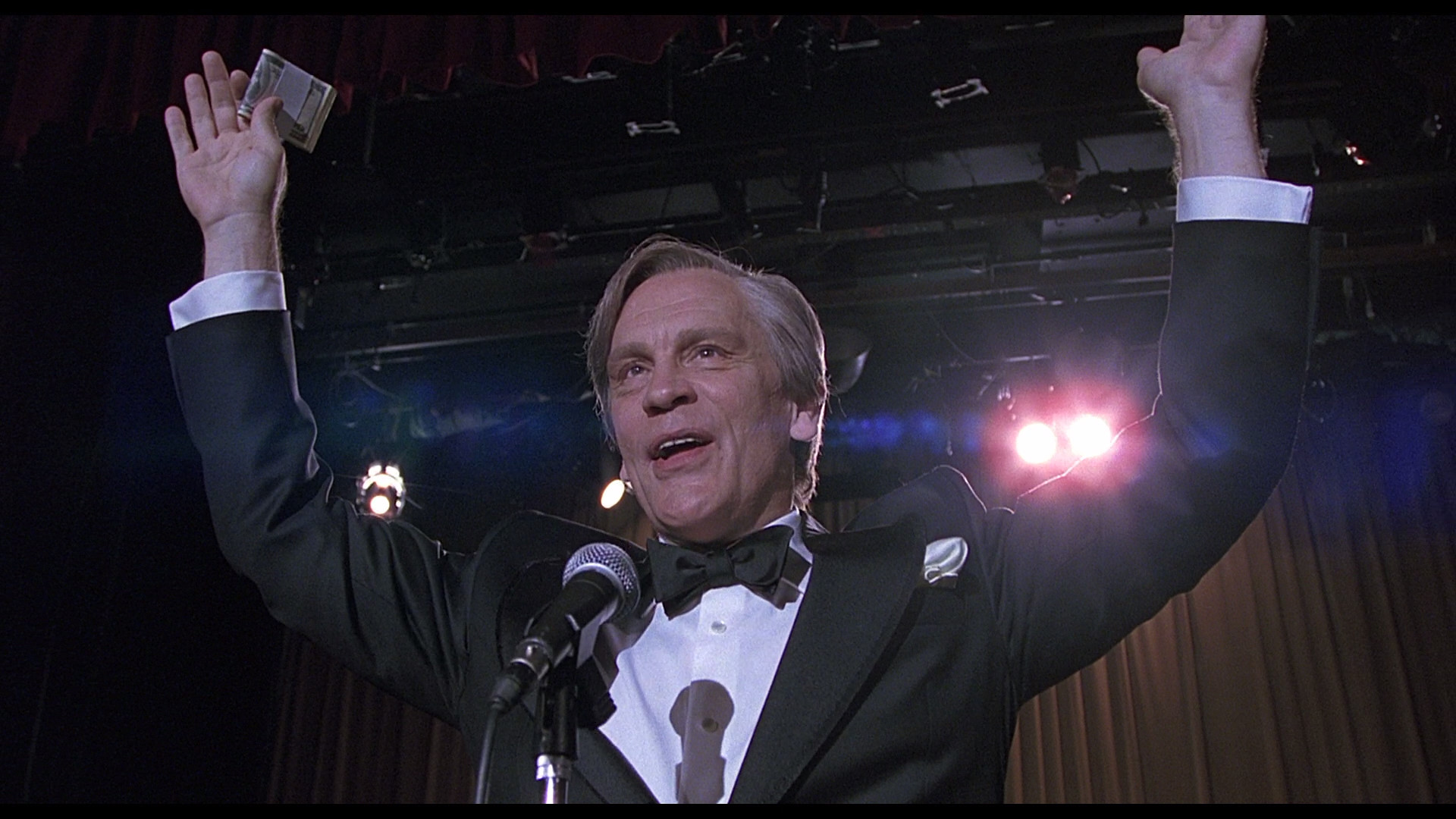
Looking at the promotional videos associated with the DVD, it would appear that Kreskin is fine with this, even though, in details, McGinley strikes rather close to the psychic bone here—yes, Kreskin in his hey-day appeared 61 times on "The Tonight Show with Johnny Carson."  Yes, he would close his shows by guessing where an audience member had hidden his pay-check (and he always got paid). That's all duly served up as quirks of "The Great Buck Howard," played somewhat petulantly by John Malkovich.  But are the other things in the movie like this—the grandiose ego, the out-sized self-importance, the schticky "I love this town" facile platitudes, the dismissive photo distribution, the intolerance for deviation from formula, and the truculence that borders on vengefulness.  Oh, Buck can be a good guy...on occasion...but mostly he's in one big perpetual snit that you don't need a mentalist to see coming.  Which makes one wonder why someone would take the job in the first place.


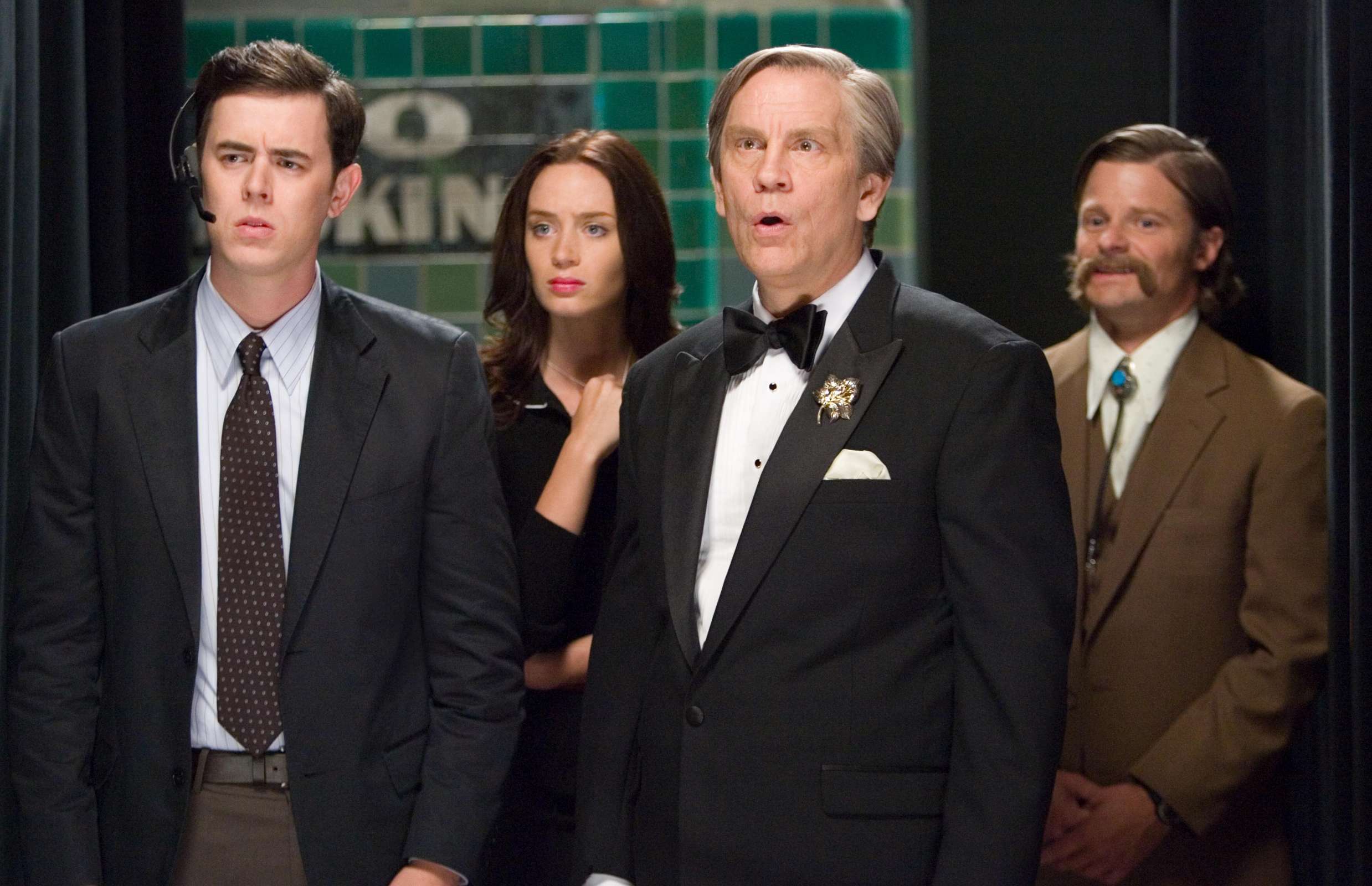
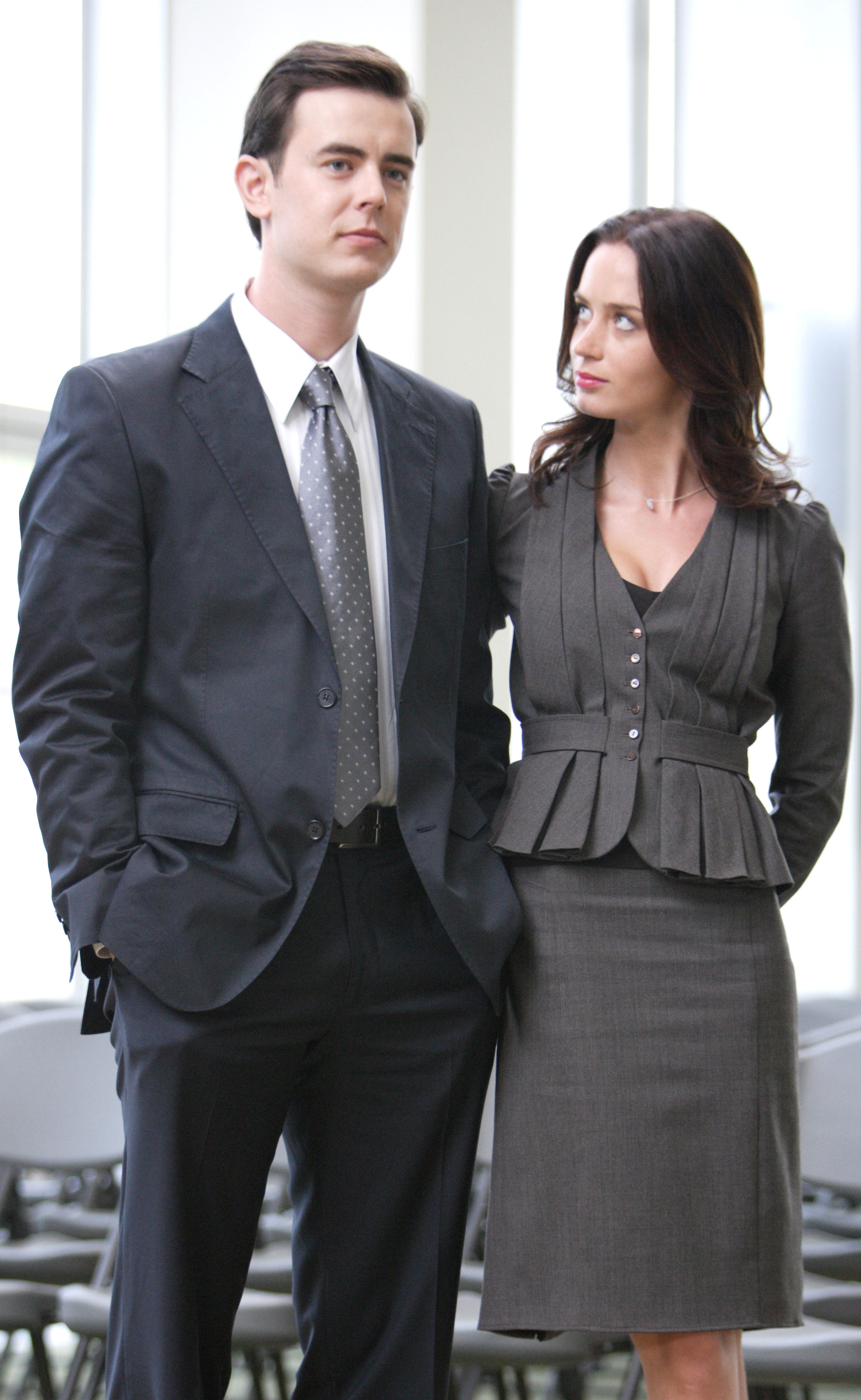
Troy Gable (Colin Hanks) drops out of law-school to be the personal assistant for "The Great Buck Howard," who is doing a cross-country tour of small town America, hoping to re-kindle some of the old magic of his mentalist show, when he was more famous...or famous at all.  A publicity agent (Emily Blunt) is hired as point-person for interviews and "events" that tend to fizzle out, but she's only as effective as her sorcerous subject and he works best in a controlled environment, one under his control and can anticipate, and any deviation might throw him off.


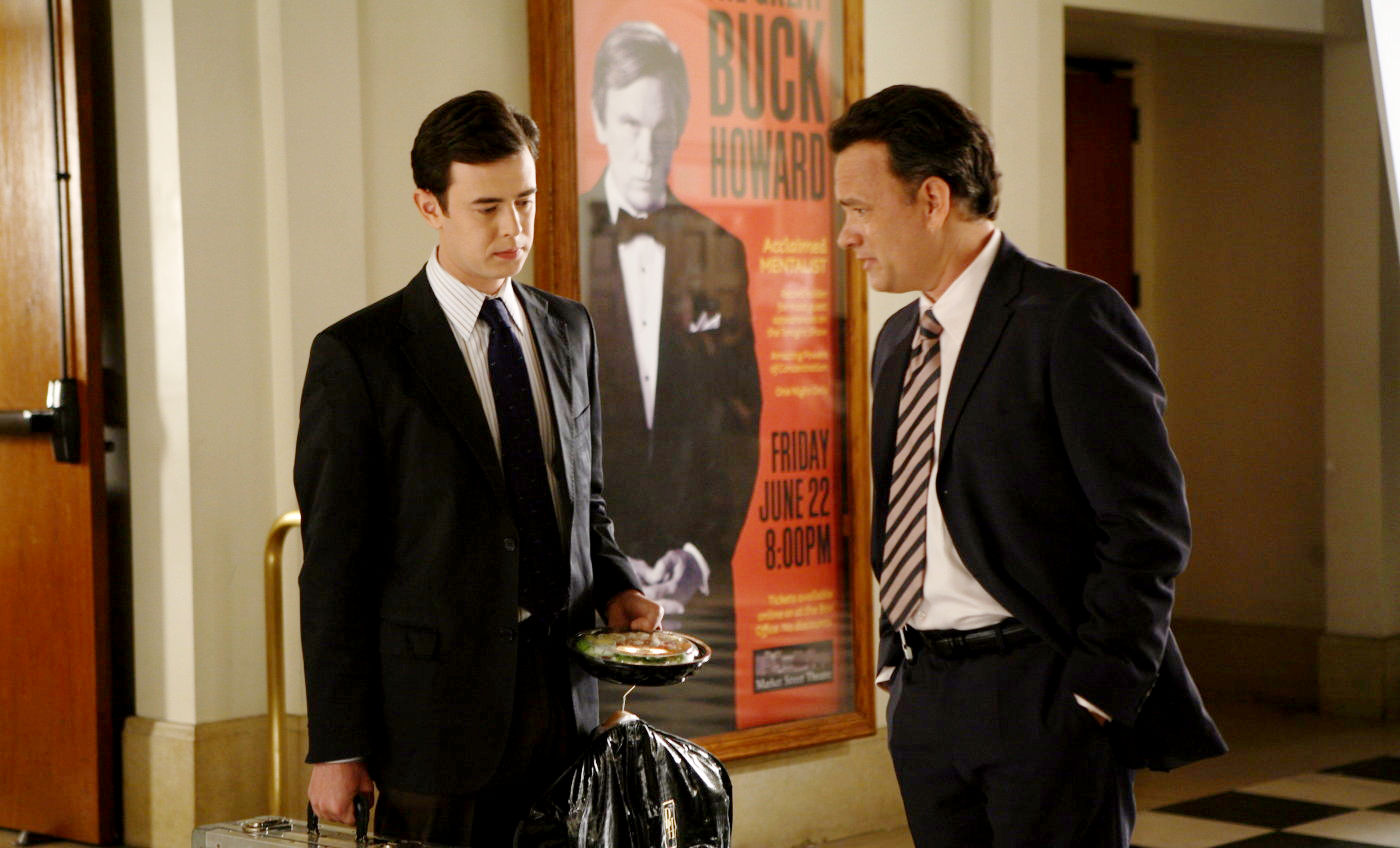
The film has its charms for a one-sided coming-of-age story, mostly in the casting with Hanks the younger (Hanks the older plays his skeptical father in a nicely subdued and flinty cameo) as a fine, callow presence (most of his performance has to be done in the eyes in the course of observing the shenanigans, and, appropriately, Troy never takes his eyes off Howard, when the job might more appropriately call for his attention to be elsewhere.  Blunt is great, as always, even if she isn't doing much more than 'love interest," and Malkovich does a tender walk between comedy and psychosis, cruel and entertaining in one flow.  There's also some nice touches by Steve Zahn (a favorite of mine) and Ricky Jay, as bumps on the road-trip.


Still, the Kreskin connection bothers me, especially as the movie's mentalist is a bit of a jerk, never himself coming of age.  I remember the film coming out and listening to Hanks (the younger) and McGinley do "press" and never once mentioning Kreskin.  Nor did I hear anything else about the man through the film's admittedly short run.  To see him come up so specifically and directly on the DVD was a bit of a surprise.

In fact, I don't remember him ever mentioning it, before I saw that supplemental feature.

Hmmm.  Perhaps he is a clairvoyant, after all.


Saturday, October 20, 2012

Shadows and Fog

Shadows and Fog (Woody Allen, 1991) When Woody Allen makes a film in the style of Ingmar Bergman (Interiors), it's done in deadly earnest.  But, when he takes on German Expressionism, entering the angular world of Lang, Murnau, with a para-nod towards Kafka, it's a comedy.  Not quite sure why; maybe he has an affinity towards one stylization and the other he just finds phony, but the different approaches are like, well, day and night.  Allen explored that theme—taking the same story and interpreting it as either comedy or tragedy—in Melinda and Melinda, a bit of a mis-fire—but one suspects that the Nordic tradition he buys completely, and completely dismisses the German (God knows why).

Here, the visual is pure dread, but the subject matter is a mixed bag of precision and vagueness, comedy and darkness.  Allen plays Kleinman, a passive-aggressive bookkeeper, who is recruited in the middle of the night by a vigilante mob (including David Ogden Stiers and James Rebhorn) to roam the streets looking for a serial strangler.  Being a professional coward, and only dealing well with facts and figures in black-and-white, Kleinman is ill-suited for the activity and begs off, inviting suspicion from the group.  When there is speculation that maybe he won't do his duty as a citizen because he might be the strangler, Kleinman caves.

On his dark journey through the city streets (the largest set ever built in New York's Kaufman-Astoria Studios, making this Allen's most expensive film), he runs across an all-star cavalcade of slothful potential victims: a philosophy student (John Cusack) with a weakness for prostitutes (among them Lily Tomlin and Jodie Foster, madamed by Kathy Bates), a circus love-triangle tangentially related (with John Malkovich, Mia Farrow and Madonna) and the town coroner (Donald Pleasence), who has a purely scientific interest in the killer.*

Kleinman soon realizes that life simply doesn't add up, that a little slippage occurs, especially when it comes to illusion and reality (in the form of a very handy and practical magician named Armstead, played by Kenneth Mars).  The film struggles with the dichotomy throughout, as highly contrasted as the black and white photography, never truly meshing, and finally ends, as many of Allen's weaker films—and one of Allen's strongest ones (Hannah and Her Sisters)—do, with a Deus ex Machina** that buttons everything up inexplicably, leaving no questions but a lot of raised eyebrows.

Which is fine for the purposes of the film, but it's hardly what you'd find in an example of German Expressionism, where the punishment fits the crime...and where things really are in black and white.  


* Yes, the film is top-heavy with fine actors (and Madonna), but if you look in the darkened nooks and crannies of the film you'll also find Fred Gwynne, William H. Macy, John C. Reilly, Josef Sommer, Wallace Shawn, Kate Nelligan, Kurtwood Smith and Philip Bosco.  Was this film cast or filmed at a SAG convention?

** Here's a question:  It's a Woody Allen film; Can there be a Deus Ex Machina if there's no Deus?

Saturday, October 30, 2010

By Request: Shadow of the Vampire

For Pete (who probably thought I forgot...)


Shadow of the Vampire (E. Elias Merhige, 2000) "Such is the cost of genius...Thank God!  An end to this artifice!"

God has nothing to do with it.

Besides, there's only room for one god on a movie set.

F.W. Murnau may be the greatest director "of all time."  He will have his way and his vision no matter what the cost.  Wanting to make a film of Bram Stoker's "Dracula," not even the small matter of the author's estate refusing the rights will stop him.  It is only the first purifying cross he must bear in his effort to make the perfect vampire movie.  His actors are either rebelling or morons, his crew is competent but not privy to his plans.  It's all in his head, as he is the auteur, and he will see his film to the bitter end, even if he is the last man standing.  No cost is too great, no sacrifice too small in his sociopathic, artistic blood-lust to see his film see the light of day and projector.


He could be the star of his own vampire movie.  Shadow of the Vampire is on the epidermis level a fictionalized version of the filming of Murnau's Nosferatu, but it is also the story of how movie-making can be a power struggle, completely opposite to the collaborative effort it usually is.  The Murnau of the film (portrayed by John Malkovich) solves all the problems, does all the ground-work, directs the actors in a running stream of manipulation during filming (it's a silent film, of course).  He wants authenticity no matter what, filming on location in castles and ships, distaining studio sets (despite Nosferatu's artistic expressionism), and going the extra mile—hiring Max Schreck* (Willem Dafoe, who was nominated for an Oscar for his performance) to play his vampire.


Here's where the film-makers leave reality behind and make their own story about creativity, and the supernatural hold power can sometimes hold over people: to realize his ideal of authenticity, Murnau, in the film, hires a real vampire.  Or maybe not.  Schreck, it is explained to the crew, has studied, with Stanislavsky, the immersive "method" of acting.  So, when he plays a vampire...he REALLY plays a vampire, always in costume, always in mood, even when the camera isn't rolling.  Just another demanding actor whose eccentricities must be humored.  And the humor is dark in Shadow of the Vampire, in the small areas ("I want make-up," Schreck sulks at one point.  "You're not getting it!" Murnau abrasively replies.) and in the larger scheme of things—the power struggles between the egomanical director and the homicidal vampire are giggle-inducing (in a good way)...and apt.  That Malkovich and Dafoe tend to resemble each other (and if Dafoe wasn't heavily made up and affecting Schreckage it would be even more apparent) and director Merhige keeps them sparring, negotiating, arguing throughout the film.  That the two don't destroy each other during the making of the film is only due to their mutual need.


Or maybe it's merely professional courtesy.


* Schreck, and this performance, are somewhat legendary.  Nicolas Cage, who executive produced the film, did his own version of Schreck's performance in Vampire's Kiss.  And Tim Burton named the manipulative toy magnate played by Christopher Walken in Batman Returns after the actor. 

Saturday, October 16, 2010

Red

"Better Dead Than Red"
or
"Who Wouldn't Want to See Helen Mirren with a Sniper Rifle?"*

Cute.**

That's the word for Red.  Not good.  Not bad.  Just "cute."  I mean, what's not to like?  A movie top-heavy with talent in front of the lens—in fact, there are so many Emmy/Oscar-winning actors (including Ernest Borgnine and Richard Dreyfuss buried in the credits) that one wonders why there wasn't a better project for them to do than this.  Yes, it's entertaining (if you turn the brain off).  Sure, it's occasionally funny—it's especially nice to see Bruce Willis back in his lighter mode, reminding one of how damned good he was in his "Moonlighting" days, and John Malkovich taking full advantage of his "crazy coot" part without pretensions of doing anything serious.  And it's nice to see a full cast of "mature" actors in a movie based on a comic book series, so that the potential audience demographic is as wide as Morgan Freeman's smile.  For a reviewer of my advanced age (55), it is a little disconcerting to see these storied thesp's I've grown up watching (often from their first filmed roles) being sold as "old farts in the pasture,"*** despite how easily they deal with their younger counterparts, like fine actors Karl Urban and Mamet collaborator Rebecca Pidgeon, though it's presented in a somewhat condescending manner.

The main problem I have with the movie is that (timing aside), it's just another in the series of "Dirty Dozen" discarded mercenary movies we've seen so many of this year, and it's an uninspired entry, at that.  Oh, sure, it's tricked up with animated post-card location bridges (that get tedious), a coy break-away editing style, and a pyrotechnic fetish that mushrooms every explosion into a lens-searing extravaganza, and the occasional "see-this-wonder-how-we-got-this" shot that is, basically, the director trying to draw attention from his actors ("I'm helping!!").  Wish he's paid a bit more attention to what was going on in the script, rather than in how to present it.

There's a little too much reliance on exposition that telegraphs what will happen in the movie (and it doesn't help that the actors tend to "wink" the importance of those lines at times).  And if there's a script problem, the director just figures out a way that he can draw attention away from it, rather than make it better.

Take, for example, an early shot of a line of gun-men—a nice, easily raked-over straight line of gun-men (wouldn't even need to go through a whole clip!)—advancing on a house that Willis' character Frank Moses lives in a quiet suburban neighborhood.  It looks impressive, until you realize how damn dumb it is.  These jack-booted thugs (and in a NRA wish-fulfillment, they are government ops) advance on the house, not breaking formation, swiss-cheesing the house back to its foundation in the dead of night.  Wow!  Cool!  One could make a case for "stylized comic action," if it wasn't so stupid-looking at first glance.  But, remember, I said "quiet suburban neighborhood?" You actually, earlier, do see neighbors.  So, where is everybody?  No one comes outside, the sequence goes on for many minutes, without a dog barking, a siren in the background, someone clappering-on the lights, or an actual NRA member shouting protest.  That's just dumb.  And it's the first of many "fish-bowl" sequences where things happen in only a world where this movie exists, as it has nothing to do with how "the real world" works—despite playing on the populace's paranoid things about "how the real world works."  One wishes that one could forgive the contrivances, but you can't, as the movie hinges on them.  And as sure as a bullet wound that was excruciating a few minutes ago, will be forgotten in the next few minutes, the director will find a way to wave something shiny at the camera (right before it explodes) to make you forget.  I don't mind having my disbelief suspended, so long as someone isn't constantly cutting the cable to sabotage it.

Director Schwentke (The Time Traveler's Wife) is more interested in the kill-shot (with minimal blood-loss) than story-logic.  But, lest one think I'm unappreciative, there is a neat shot, however it was done, of Willis stepping outside his skidding car firing his gun as the vehicle cantilevers around him.  Nice.

That's fun and all...even cute...but, I tend to like my spy stories to have a little more substance than cotton-candy to it, a bit more fiber, something at risk, so that when folks do go in harm's way, they do so because it is necessary to do so and the personal risk matters.  So that they matter. Or else, what's the point of all the point-and-shoot?  I'm not interested in watching a bunch of good actors having fun picking up a paycheck.

Still, want to know the coolest thing about Red?  Seeing Helen Mirren firing an automatic weapon without so much as a flinch or an eye-blink, deliberately keeping those flinty eyes wide open, while the burly male extras playing the disposable agents firing back are fluttering their eye-lids right and left.  Now, that's a Dame.

Red is a very cheap Rental.

* A quote from "Red" comic series writer Warren Ellis.

** Tommy Lee Jones revealed this (with a sneer) to be his least favorite word on "Inside the Actor's Studio."  Yup.

*** The title refers to the group's designation as "Retired: Extremely Dangerous."


Tuesday, June 22, 2010

Jonah Hex

"Jonah Bloody Hex...Ah'd Recognize that Half-Cooked Pie-Hole Anywhere."

The title of this post says it all: "Jonah Hex," the movie, is "half-cooked" as in half-baked and a "pie-hole" as in an empty void.

Sad, too.  "Jonah Hex" could have been a lot of savage fun if it were truer to the source—the DC comic book, the last semi-regular western title the publisher produces.

Jonah Hex was a confederate officer, who would not take part in a raid that would only produce civilian casualties, and so, he was the ultimate outlaw, trusted by neither the North or the South, and a bounty hunter, with a particularly nasty streak (not counting the melted-flesh scar adorning his right cheek*).

Hex was in a "funny book," although, he had no "powers and abilities far below those of mortal men," except a deadly accuracy with all things kill-making.  Seems that's not good enough for a four-color movie adaption these days, because the character now has a way to commune in the darker places of the spirit-world, awakening the dead with a touch in order to obtain information.  This hooey is a result of being saved from death by the mumbo-jumbo of the Crow Natives, who salved his wounds (but knew nothing from plastic surgery) and snatched his soul back from the after-life.**  Of course, the wounds were CAUSED by Natives in the comics, but consistency is the hob-goblin of little minds, and the pea-brains who made this one decided to air on the side of political correctness—which "Jonah Hex" never was and never should be.

The best of the "Hex" stories (not counting the ones where he was flung into a post-apocalyptic future, as a "Mad Max"-type) were written by a scribe with with his own twisted streak, Michael Fleischer (although don't call him "crazy" because Harlan Ellison implied it in an interview, and Fleischer sued...and lost).  The last issue he wrote had Hex meeting his end, and then being stuffed and mounted for display and the amusement of anyone who'd fork over two-bits.

He should contact his lawyers, because he might have better luck this time; this one's a PG-13 fiasco that's all-hat and no cattle, that tries to be gritty-tough, but doesn't have the powder to show a kill-shot.  A lot of people get killed, roasted, bludgeoned and chopped, but all discretely off-screen, even while its trying to be as nasty as can be, like a bully that talks tough but runs away from a fight.  And anyone who thinks "The A-Team" was poorly directed (guilty) will be amazed at the cluelessness displayed here by director Jimmy Hayward,*** former animator for Pixar and co-director of the very fine "Horton Hears a Who!"****

It's all shot in a snatch-and-grab style, awkwardly staged, with no time to linger over period detail, then settles into a Leone-like formality (with picturesquely ugly extras) that's to a spaghetti western what Chef Boy-Ar-Dee's "SpaghettiO's" is to fine Italian cuisine.  The Main Title fills in some animated back-story (fine), but then the thing hits the dirt like Hoss' played-out horse, with a tricked up story about a Doomsday Weapon about to be lobbed on Washington by Hex's former commander (who happened to murder his family to boot).  At about the half-way point, it looks like someone had seen "Sherlock Holmes"***** and tried to emulate the steam-punkish style, but—(never thought I'd say this!)—didn't have a clue how to match the precision of Guy Ritchie.

The movie's look changes dramatically whenever Megan Fox is on-screen, but that's not to the good.  Instead of the gritty telephoto look of the rest of the film, she looks like someone spent some precise time lighting her, as she's bathed in golden light with roseate high-lights in her hair—it's the reverse equivalent of smearing vaseline on the lens to hide an actresses' wrinkles—it stands apart from the rest of the film almost to a laughable degree—and for no good reason other than it makes her look damned good.  You can't shine gelled baby-spots on her performance, though, which, unencumbered of any modern girly-girl archness (at which she can be quite smart), is delivered in a flat, lazy drawl (sometimes, as she's inconsistent) and suggested to me that she might be this generation's Raquel Welch...or Jill St. John ("Ya look great, honey, just don't speak, okay?  You, too, Keanu").

It's a mess.  The script's bad (by the makers of the "Crank" movies—seems like a "natural" choice to me!), and only matched by the slip-shod film-making—whoever did it, and it could be a bean-counter at Warner for all I know.  The best parts are in the trailer, as the movie's only 85 minutes long (with credits), you're only missing 83 minutes of garbage.

I sat, during the credits, with my own Hex-like sneer on my face, contemplating just how badly this thing was screwed up, when the name of one of the Executive Producers showed up: Akiva Goldsman.  Of course!  The man who wrote the bad "Batman" scripts, who wrote "Lost In Space," "I Am Legend," "Practical Magic," "I, Robot," won an Oscar for "A Beautiful Mind ("schizophrenia can be fun, kids!!"), and adapted both "The DaVinci Code" and "Angels and Demons," and whose only talent seems to be the ability to "crack" a script by taking anything edgy or complicated and dumbing it down to the level of a kindergartner.  If he were a chef, his specialty would be a liquid, runny oatmeal.  His name has so symbolized terrible work that in my most churlish moments (usually after seeing one of "his" movies) I can only refer to him as "Hackiva."  The man should be barred from having control over anything of literary merit, and  consigned to merely working on "Chipmunk" sequels.  He's been pegged to direct the remake of (appropriately) "The Toxic Avenger."  One hopes that he's a better director than he is a writer/producer, and may prove to be with the bar set so low.  I doubt it.  It's tough to avoid the "Hackiva" hex.

"Jonah Hex" is a Waste of Time.


* Among the many flaws of the movie, the prosthetic creating this effect looks a bit plastic—you don't see it on the poster, of course, in another instance of white-washing the movie—but it does have one funny outcome:  Whenever Jonah goes to a bar, he always has to order a double because half of it goes through the open wound in his cheek.

** And, just to pile on the atmospherics, he also seems to be followed around by flocks of crow familiars, which must make it hard to sneak up on people, although he does from time to time. 

*** Okay, to be fair to Hayward—"Horton" IS a great movie and certainly the best of the recent big screen Seuss adaptations—was replaced by Warner execs by Francis Lawrence ("Constantine," "I Am Legend") during re-shoots, so that may account for the film's inconsistent tone and look. 

**** I first suspected hopelessness when the hilarious Will Arnett showed up...in a completely straight-laced role as a government functionary.  What a waste!

***** Both "Jonah" and "Sherlock" are Warner Brothers movies, so, that's a distinct possibility.

Tuesday, November 11, 2008

Changeling

"Collateral Damage"

The work of Clint Eastwood, senior citizen-director, has been an interesting mix of genres: Western, War, Mystery, Urban Dramas, Romances. But they've carried a consistent theme: They're stories about non-conformists bucking the system and sometimes paying the price, frequently focusing on the fringes of society that get caught up in "the big story," and how it affects lives and the fabric of society.

In the course of these films he's directed a number of actors in off-beat roles that garner attention and win awards, roles that have a tendency to focus on the strengths of that particular actor's skill-sets: Gene Hackman, Morgan Freeman, Laura Linney, Meryl Streep, Ed Harris, Tim Robbins, Kevin's Spacey and Costner, Sean Penn, Adam Beach, Ken Watanabe. Now, Angelina Jolie and John Malkovich and a whole raft of excellent character actors tell the story of the Wineville Chicken Coop Murders from 1928, another of those weird stories of early life in California and the ever-present existence of corruption in the caretakers of the area. Jolie and Malkovich are excellent, he has rarely been this restrained, and Jolie carries the movie with a beaten-down fury and odd little grace notes that pass over her like quick-silver. Eastwood seems to focus on her lips (notice the poster?), in fact, one of the interesting choices is to show the period Los Angeles locations and recreations in a grey bleached-out quality, while Jolie's Christine Collins character provides the color, particularly the garish red lipstick that she wears perpetually. But Eastwood makes use of an incredible cast of new faces and terrific performances. Amy Ryan (nominated for "Gone, Baby Gone" last year) has another fine role in this, and Colm Feore ("Thirty Two Short Films about Glenn Gould") plays L.A. Police Captain James Davis with a snaky smile and simmering demeanor. But there are ideal performances from relative newcomers. Michael Kelly plays an L.A. detective who manages to break the case, and its a measured unsentimental portrait of a desensitized cop developing a conscience. Jeffrey Donovan plays a nuanced heavy as a police higher-up who just wants to bury the case. Geoffrey Pierson has an anonymous character actor's face and a resoluteness as Collins attorney that surprises. Denis O'Hare is hissably good as an asylum's head doctor, and Jason Butler Harner is a fascinating combination of Dennis Hopper and Jack Nicholson as Gordon Northcutt. But the best of all may be young (14) Eddie Alderson, who has two scenes of heart-breaking regret that chill you right down to the bone.

It would all be for naught if the script weren't right, and
J. Michael Straczynski's screenplay (Eastwood insisted on filming the first draft!) is taut, lean...and traceable. Some fabrication and combining of characters was accomplished, but after a a year of research, Straczynski (Babylon 5) wrote that draft in eleven days. There are scenes that feel a bit rote, but that would be nit-picking. Straczynski takes a personal incident, opens it wide and brings it to a satisfying, if not buttoned up ending. Eastwood films it in his usual spare style, lingering on the shots of Old Los Angeles remembered from his youth, meticulously recreated with CG and the extraordinary production design of James J. Murakami.

Eastwood has another film, "Gran Torino," opening January 2009. The trailer for it plays with "Changeling." He stars in it, too, after saying he was retiring from acting. I don't think "retire" is in Eastwood's vocabulary.

"Changeling" is a matinee.

Tuesday, September 16, 2008

Burn After Reading

"Joel, you wanna know something? Every now and then say, 'What the fuck.' 'What the fuck' gives you freedom. Freedom brings opportunity. Opportunity makes your future."

Miles from "Risky Business" (1983) written by Paul Brickman

Then there's the corollary to those hopeful words, the Coen Brothers' new film "Burn After Reading." It's a comedy, so that means folks who swoon when they're making serious films, like "Miller's Crossing," or "No Country for Old Men" will look at it like it's a red-headed step-child, along the lines of "Raising Arizona," "The Big Lebowski," or "Intolerable Cruelty." Thing is, they're all products of the same sensibility; the perverse sense of the world that informed "Blood Simple," and "Barton Fink," "Fargo," and "O Brother, Where Art Thou?" informs "Burn After Reading," especially in this time of national dependence on the Intelligence Community.

But back to "WTF." A lot of people say "What the Fuck?" in "Burn After Reading." In fact, I'd have to see it again (not an unpleasant thought), but I got the impression that every single major character in the story says it at least once. And not in the good way of the opening quote that supposedly produces opportunity (though it might for those wearying "Up With People" souls who see every problem as an opportunity, and every half-empty glass as half-full).

No, it's usually uttered in shocked disbelief at the events that transpire. It's because "Burn After Reading" belongs to that sub-category of comedy (and tragedy) "The Incredible Mess." It's where the hopes and dreams of a dedicated few turn into a nightmare that no matter how hard they try, their efforts to extricate themselves only make matters worse. Fighting it is a losing strategy. "Yeah, sure, it looks like quick-sand; what's your hurry?"

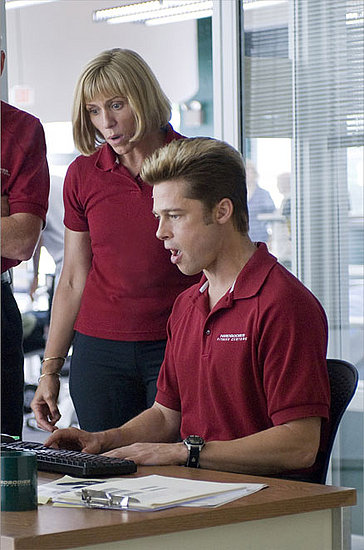
CIA analyst Osborne Cox (John Malkovich) has been fired from his job and he's pissed enough to write a tell-all book blowing the doors open on the Agency. One thing he won't put into the book-as he's ignorant of the fact--is that his wife, Dr. Katie (Tilda Swinton) is having an affair with friend Harry Pfarrer (George Clooney)--he's in the P.P. business (personal protection), and he's also cruising the Internet as one of Washington D.C.'s serial daters. So does Linda Litzke (Frances McDormand), who works at the nearby "Hardbodies" fitness center and who is now turning to plastic surgery because she's taken her body "as far as it will go." She doesn't have the money for it, but hope comes along in the form of a disk of Cox's financial information that falls into the hands of fellow "Hardbodies" employee Chad Feldheimer (Brad Pitt), who thinks he might be getting some sort of federal reward for turning it in, and hey, wouldn't that help pay for those operations?

The fuse gets lit, as loyalties shift, panic arises, priorities change and worst instincts lead to "worser" consequences. That reward turns to a sense of entitlement and then resentment, then to ransom. The events are somewhat monitored in disbelief by the CIA (in the form of the incomparable David Rasche and J.K. Simmons), as things spin out of control.

Everybody's great, besides Rasche and Simmons.

Clooney seems to excel with the Coen's--this is his third film with them, McDormand amps up the energy of her previous Coen-work, Swinton seems less self-contained and goes for the comedy like never before, and Malkovich swings between coiled fury and exploding fury. But the stand-out is Brad Pitt's selfless performance as Chad, the personal trainer who could very well be the stupidest person on face of the earth.* His hair piled high and high-lighted, an i-pod constantly filling the empty space in his head, his body moving spasmodically with its energy, he can be counted on to think he's doing the right thing, when he couldn't be more wrong--he is everyman, trapped in a life that resembles a first home improvement project--quite oblivious to the fact that sometimes you only get one chance to get things right without the benefit of "rep's." There's a sub-text running obviously through the thing of "the self," with the main players obsessed with their bodies and their own interests. Washington D.C. makes the perfect back-drop for it.

"Burn After Reading
" is rated "R" for pervasive...you know.

"Burn After Reading" is a matinee, I mean, what the fuck?**

* After Bill Pullman's character, Earl Mott, in "Ruthless People"(1986)

** Sorry about the "pervasive language," but, really--you see this movie, and you know that was the working title of this movie (a move that, if it was carried through, would have crippled the movie at the box-office by restricting advertising and such). I briefly considered not spelling out "the f-bomb" with the comic-standard "f@<#," but I figured...no, I'm not saying it again...but as the word appeared Sunday in the "When Harry Met Sally" Scene, I figured "if I use it there, I might as well use it here," pervasively.

Tuesday, July 29, 2008

Places in the Heart

"Places in the Heart" (Robert Benton, 1984) Robert Benton's distillation of life growing up in Waxahachie, Texas during the Depression begins with an accidental death, which expands to an act of evil, but ends, after Earthly trials, with an ambiguous epiphany that extends the simple gift of community into an expression of spiritual healing and harmony--one of the gutsiest segues from hard-scrabble reality to the Mystery of Faith ever put to film.

The cast is impeccable with unsentimental work from
Sally Field, to pitch-perfect early performances from Danny Glover and John Malkovich, to excellent work by Ed Harris, Amy Madigan and Lindsay Crouse. All portray an extended family that forgo the boundaries of blood and race to pull together and survive the deprivations of Nature and man.

Sure sounds like heavy stuff, but the artists behind and in front of the camera make it compelling drama that stays clear-eyed and rarely sinks into easy sentimentality. Quite the opposite; Glover plays the role of a poor share-cropper with a tentativeness that awaits disaster, and Malkovich makes his blind war vet a petulant jerk. Plus, there's a collection of townsfolk that includes greedy bankers, murderous racists and opportunists of every stripe. In "
To Kill a Mockingbird," racism seems like bad manners and poor up-bringing, while in "Places in the Heart" it's a way of life and charity is the exception, rather than the norm.

It's a story of perserverence in the face of great change, and, if not welcoming and embracing change, at least having the grit to roll with it. It's one of my favorite films from a fine film director.

And that ending. Gets me every time.


Monday, June 9, 2008

The Hitchhiker's Guide to the Galaxy (2005)

"The Hitchhiker's Guide to the Galaxy" (Garth Jennings, 2005) On first impression (and that was in the majestic Cinerama Theater for a matinee) the big budget movie version of Douglas Adams' radio play/novel came off as hurried and a bit slip-shod. One wanted it to run at half-speed to appreciate the jokes (we'd heard, seen and read a hundred times before) in this new context, but no, the little punks who'd made this were so comfortable with the material, and so comfortable with our knowledge of it, that they felt they could just rush it on by willy-nilly, and expect us to catch up despite the fact that we were carrying the deluxe popcorn with two drinks and a box-candy for later, maybe.

But revisiting it now on video, one has to say..."Yeah, nice job spiffing it up a bit." Of course, all it may take for you to like it might be the inclusion of your favorite bit from the
radio play/book/mini-series (in which case, I was satisfied--they included the sperm-whale bit, which I always thought was a fine, cheerful/melancholic distillation of life), and since it's a very breezy encapsulation (see first graph) odds are you might feel the loss of a passage or three. Still it's a nice forest, even if a few of your favorite trees have been culled.
What's good? Generally, the cast, with
Martin Freeman's "Dent, Arthur Dent" being a wonderfully down-played version of the character--the tv version with Simon Jones (the original Arthur--he has a fine cameo in the new movie) being a bit more Pythonesque (everything's a bit more Pythonesque in the tv series version)--Mos Def, a more off-center Ford Prefect, Bill Nighy a great Slartibartfast, Helen Mirren as "Deep Thought," Alan Rickman as the downcast robot Marvin, and Stephen Fry as the Voice of the Guide. The stand-out is Sam Rockwell who plays Galaxy President Zaphod Beeblebrox as W. with accelerated ADD (and isn't that a terrifying concept), and one has to admit that the filmmakers came up with a nifty solution for the two-head problem (Zaphod has them) that has plagued past productions. And you couldn't ask for a better beginning to the film.

All well and good.

Zooey Deschanel is a bit creepy as Tricia/Trillian (but then, she'd have to be), and there's an extended segment with John Malkovich which might have gone under the knife to include a couple more Guide entries, and the ending's a bit neat and tidy for an Adams adaptation, but really, I can't complain (except for that last bit), and the advanced design by Jennings and CGI-wizardry-gone-bizarre are full of little surprises right to the last jump of the Improbability Drive. Cheerful and friendly, while chirping about dark, dark things,
The Hitchhiker's Guide to the Galaxy" is a nice addition to the ever-expanding Library of all-things-Adams.

Now if they'd just do "Restaurant at the End of the Universe."