Showing posts with label Tilda Swinton. Show all posts

Tuesday, July 3, 2012

Moonrise Kingdom

A Troubled Young Person's Guide to Themes of Defiant Youth (ala Antonioni) with Kubrickian Stylistics (as interpreted by Wes Anderson)
or
Full Metal Jackasses


Moonrise Kingdom might be my favorite Wes Anderson film yet.  The films of Wes Anderson have gotten more and more juvenile, regressing in sensibility, but progressive in terms of connecting with a child-like world-view.  Like his dark companion in film, Tim Burton, Anderson chooses subjects and styles that appeal to his inner kid, pulling in favorite things from his growing up years  to include in his films.  But, unlike Burton, he doesn't concentrate on the dark and morose, focusing instead on a sense of wonder, even if in his world-view the adult act like children and the children try to act like adults.

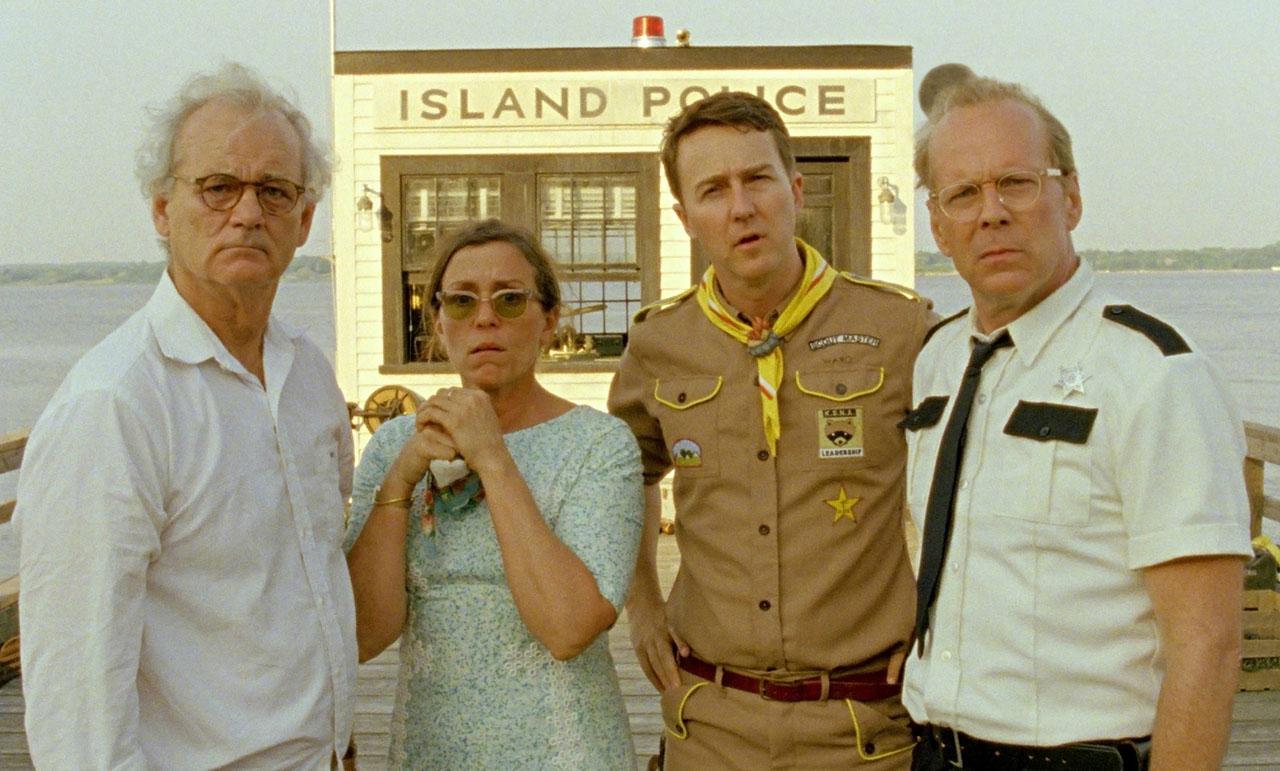
So, Moonrise Kingdom, co-written by Anderson and Roman Coppola (Francis' iconoclastic kid), set in the mid-60's and involving an East coast island community.  There are two factions, the authorities, represented by island law enforcement—Captain Sharp (Bruce Willis) and the troop leader of a group of "Khaki Scouts"—Scout Master Ward (Edward Norton).  There is a dysfunctional family, the Bishops (led by Bill Murray and Frances McDormand).  Both factions represent authority, and empty authority at that.  Their worlds are controlled, regimented, but still subject to outside forces and acts of God, like weather—there's a storm approaching as the film's exposition expert (played by Bob Balaban) is only too quick to report.

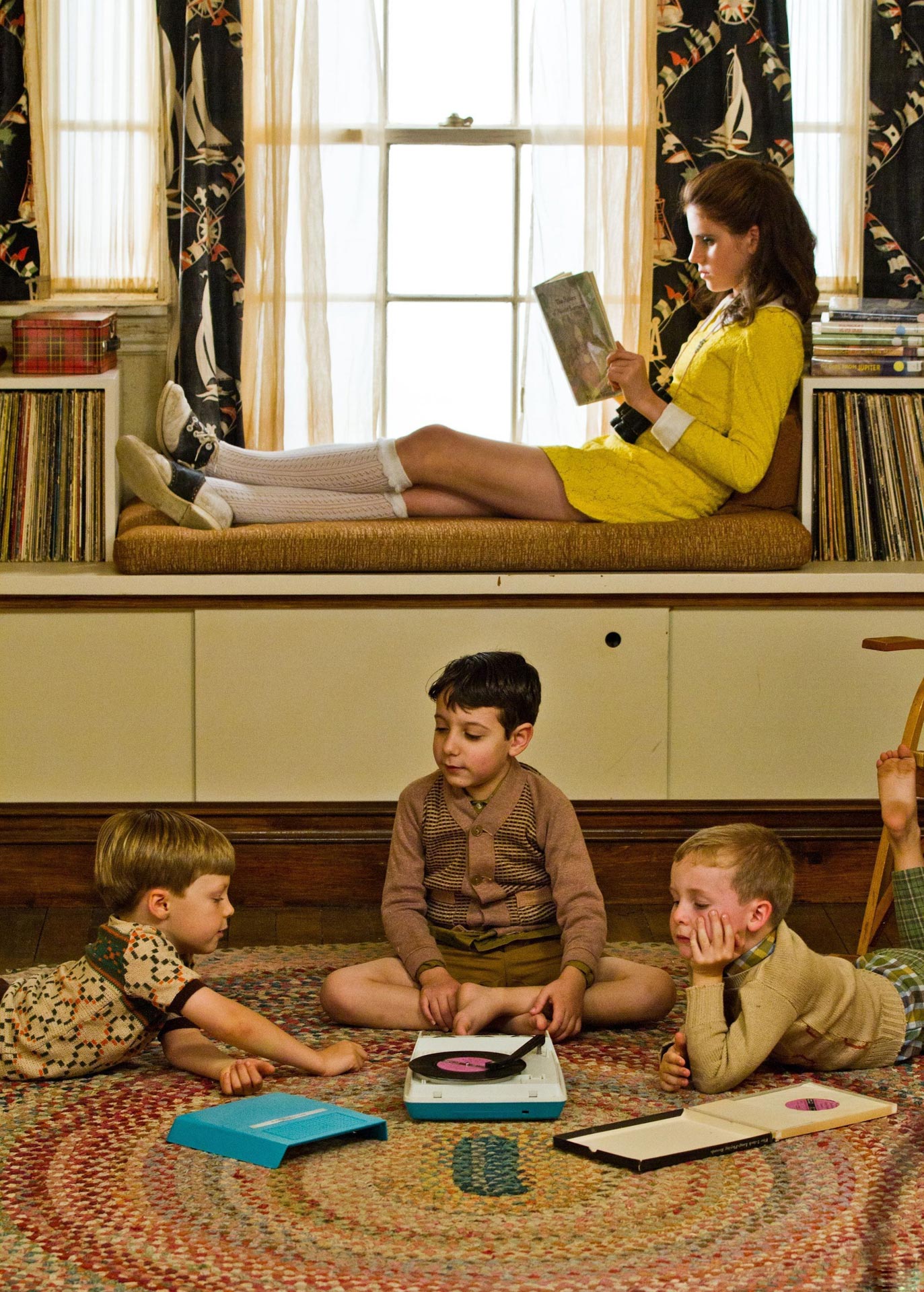
Into this mix come a pair of star-crossed likers, outcasts from both houses, like Romeo and Juliet.  Sam (Jared Gilman) is an orphan with enough issues that his foster parents no longer want him; Suzy (Kara Hayward) is the oldest child of the Bishops and already is labeled as a "very troubled child."  They meet at an amateur production of Benjamin Britten's "Noye's Fludde"*—he's on a scout outing, she plays a raven.  They begin corresponding in secret, and then both escape their cloisters, he from the Khaki Scouts camp, she from her family home.  They live off the land, he with his survival skills and supplies, she with her books and records, a mutually dependent family with different roles.  It doesn't take long for their disappearance to be discovered and the search parties form, the police led by Sharp and the Scouts, led by Ward, with the Bishops poking, prodding and threatening lawsuits.  The kids lead them all a not-so-merry chase, and there are casualties along the way. But, the fugitives press on, despite the fact that, on an island, they can never really escape.

It's a romantic's version of 'the barefoot bandit" story, but without the issues of ego, narcissism, and general public nuisance, and Anderson couches it all in an idiosyncratic format with scrupulous Kubrickian stylistic fluorishes—the measured tracking shots, the hand-held shots of freedom and chaos; the stylized expressionless acting, the structured mise en scene, perfectly balanced on a central fulcrum.  On top of that, it's hilarious, with dialogue that's formal, distinct, played absolutely straight, betraying no irony, delivered in a deadpan lack of elevation.

It's charming-no wonder these kids want out, left to their own devices.  They still want structure, just their own structure, and, although self-imposed outcasts, seem far more together than those of their "betters."

Fun, odd, and rebellious in Anderson's over-stated understated fashion.  Wonder what he'll do when he grows up.


Moonrise Kingdom is a Full-Price Ticket.


* Britten is the classical composer-thread rolling throughout Moonrise Kingdom, and his "Young Person's Guide to the Orchestra" is the starting theme for the film's opening sequence—a gliding, tracking tour of the Bishop's house.  They'll also do a version of it over Alexander Desplat's closing music over the credits.

Tuesday, September 16, 2008

Burn After Reading

"Joel, you wanna know something? Every now and then say, 'What the fuck.' 'What the fuck' gives you freedom. Freedom brings opportunity. Opportunity makes your future."

Miles from "Risky Business" (1983) written by Paul Brickman

Then there's the corollary to those hopeful words, the Coen Brothers' new film "Burn After Reading." It's a comedy, so that means folks who swoon when they're making serious films, like "Miller's Crossing," or "No Country for Old Men" will look at it like it's a red-headed step-child, along the lines of "Raising Arizona," "The Big Lebowski," or "Intolerable Cruelty." Thing is, they're all products of the same sensibility; the perverse sense of the world that informed "Blood Simple," and "Barton Fink," "Fargo," and "O Brother, Where Art Thou?" informs "Burn After Reading," especially in this time of national dependence on the Intelligence Community.

But back to "WTF." A lot of people say "What the Fuck?" in "Burn After Reading." In fact, I'd have to see it again (not an unpleasant thought), but I got the impression that every single major character in the story says it at least once. And not in the good way of the opening quote that supposedly produces opportunity (though it might for those wearying "Up With People" souls who see every problem as an opportunity, and every half-empty glass as half-full).

No, it's usually uttered in shocked disbelief at the events that transpire. It's because "Burn After Reading" belongs to that sub-category of comedy (and tragedy) "The Incredible Mess." It's where the hopes and dreams of a dedicated few turn into a nightmare that no matter how hard they try, their efforts to extricate themselves only make matters worse. Fighting it is a losing strategy. "Yeah, sure, it looks like quick-sand; what's your hurry?"

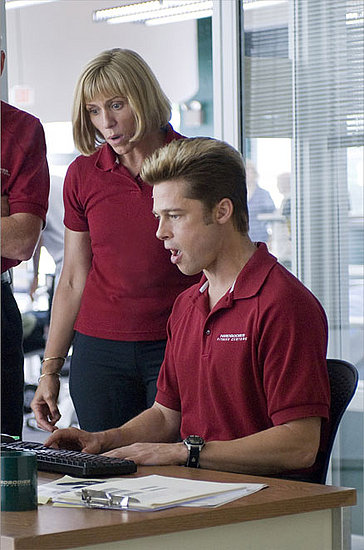
CIA analyst Osborne Cox (John Malkovich) has been fired from his job and he's pissed enough to write a tell-all book blowing the doors open on the Agency. One thing he won't put into the book-as he's ignorant of the fact--is that his wife, Dr. Katie (Tilda Swinton) is having an affair with friend Harry Pfarrer (George Clooney)--he's in the P.P. business (personal protection), and he's also cruising the Internet as one of Washington D.C.'s serial daters. So does Linda Litzke (Frances McDormand), who works at the nearby "Hardbodies" fitness center and who is now turning to plastic surgery because she's taken her body "as far as it will go." She doesn't have the money for it, but hope comes along in the form of a disk of Cox's financial information that falls into the hands of fellow "Hardbodies" employee Chad Feldheimer (Brad Pitt), who thinks he might be getting some sort of federal reward for turning it in, and hey, wouldn't that help pay for those operations?

The fuse gets lit, as loyalties shift, panic arises, priorities change and worst instincts lead to "worser" consequences. That reward turns to a sense of entitlement and then resentment, then to ransom. The events are somewhat monitored in disbelief by the CIA (in the form of the incomparable David Rasche and J.K. Simmons), as things spin out of control.

Everybody's great, besides Rasche and Simmons.

Clooney seems to excel with the Coen's--this is his third film with them, McDormand amps up the energy of her previous Coen-work, Swinton seems less self-contained and goes for the comedy like never before, and Malkovich swings between coiled fury and exploding fury. But the stand-out is Brad Pitt's selfless performance as Chad, the personal trainer who could very well be the stupidest person on face of the earth.* His hair piled high and high-lighted, an i-pod constantly filling the empty space in his head, his body moving spasmodically with its energy, he can be counted on to think he's doing the right thing, when he couldn't be more wrong--he is everyman, trapped in a life that resembles a first home improvement project--quite oblivious to the fact that sometimes you only get one chance to get things right without the benefit of "rep's." There's a sub-text running obviously through the thing of "the self," with the main players obsessed with their bodies and their own interests. Washington D.C. makes the perfect back-drop for it.
"Burn After Reading
" is rated "R" for pervasive...you know.

"Burn After Reading" is a matinee, I mean, what the fuck?**

* After Bill Pullman's character, Earl Mott, in "Ruthless People"(1986)

** Sorry about the "pervasive language," but, really--you see this movie, and you know that was the working title of this movie (a move that, if it was carried through, would have crippled the movie at the box-office by restricting advertising and such). I briefly considered not spelling out "the f-bomb" with the comic-standard "f@<#," but I figured...no, I'm not saying it again...but as the word appeared Sunday in the "When Harry Met Sally" Scene, I figured "if I use it there, I might as well use it here," pervasively.

Monday, May 26, 2008

The Chronicles of Narnia: Prince Caspian

The Chronicles of Narnia: Prince Caspian, (Adamson, 2008)

One of the best things about this movie remains what was best about its predecessor (The Lion, the Witch and the Wardrobe) - the four actors* who play the Pevensie children when they are playing children. Even though some of the dialog has been so modernized that you expect them to say things like 'Bite me', they play against and off each other as if they are real-life siblings. Less successful is when they take up their roles as the Kings and Queens of Narnia though we might be able to blame the source material for this. As book four** in the seven-volume saga, PC is another thinly-disguised allegory that desperately needs covering up.

The good news is we get less of the pontificating Aslan (Liam Neeson, voice) in this one, the bad news is that we don't get enough of Queen Jadis, the White Witch (Tilda Swinton). Instead our villains are the Telmarines, portrayed here as a Balkan people (somewhat confusingly, as in the book and here, they are said to be descended from pirates from the South Seas) who fall through a gap between our world and the land of Narnia. They are led by the Lord Protector, Miraz, (Sergio Casttellitto) who having killed his brother, King Caspian IX, is about to do the same for his nephew, also named Caspian (Ben Barnes).

The young prince escapes taking with him a magic horn with which he summons the help of the four Kings and Queens of the ancient realm of Narnia, long since under the thrall of the Telmarines. The horn does indeed summon the four Pevensie children though it is over 1000 years since their rule. Not only that but they come back to Narnia only a year older than their first visit.

Like its predecessor too, at its heart is a battle: here, the confrontation of the vastly superior Telmarine forces and the Narnian army. It does not seem long ago that we were treated to the novelty of CGI-created battle scenes; now, they are beginning to get old very quickly. Note to director: the beaver is better this time but the mouse is far, far too cute even for C.S. Lewis.

*William Moseley (as Peter); Anna Popplewell (as Susan); Skandar Keynes (as Edmund); Georgie Henley (as Lucy)

The Chronicles of Narnia: Prince Caspian is a matinee.


** Prince Caspian was the second of the Narnia books to be published but fourth chronologically. TLTL&TW was the first to be published but the second chronologically. There is still disagreement among readers and publishers as to a 'correct' order to read the books as Lewis did not set out to write a seven-volume series. He has been quoted as agreeing with those that think the books should be read chronologically but there are others who claim that this destroys the narrative sequence of the books.

Sunday, February 24, 2008

Michael Clayton

"This keeps getting better and better"

Michael Clayton is not himself today. A lawyer for the firm of Kenner, Bach and Ledeen, he finds himself at 45 and the end of his rope without a knot, deep in debt, estranged from family, and very aware that that whooshing going by his Mercedes window is his life and he doesn't have much to show for it. Then he gets a phone call. "Arthur Edens just stripped down naked in a deposition room in Milwaukee." As its the firm's biggest case at the moment with billions on the line, he has to go fix it.

That's what Michael Clayton does. He has little to do with the law. He's a fixer. Need a fast consult? He does it. Need palms greased? He does that. Tickets to the big game? Scored. A leaning story in the press? Not worth a thought. "I'm not a miracle worker," he says to a rich client who's just run over a jogger in one of his cars. "I'm a janitor." And his territory is the moral sludge that he must wade through on a daily basis

"I'm not the enemy here" he tells his friend Edens, who's off his meds and has broken down to a Howard Beale-ish moral clarity that is legally inconvenient. The madness drops from Edens' eyes. "Then who are you?"

That's the question. And at that point, to say any more would be spoiling one of the best, deepest and engaging drama-thrillers to come down the aisle in a long time. Supposedly, when Clooney saw this script by Tony Gilroy he wanted to direct it, but deferred to Gilroy who probably saved this screenplay for himself. One of the better script doctors, it was his work on the "Bourne" series of films that made his name, and his directorial debut crackles with the same precision he brings to one of his unaltered screenplays. Just to allay Warner Bros. fears, the film is top-heavy with directing talent: Clooney stars and produces, Steve Soderbergh and Anthony Minghella are on the production side, as well as Sydney Pollack (the film feels like a Pollack project) who pulls off a career-best performance as the law partner on top of all the chaos. Michael O'Keefe makes a welcome return to films as the firm's "asshole" (I wonder if its on his business cards), and Tom Wilkinson's Edens--babbling, disheveled, isolated, walking around in a pure light that only he knows is there--is the showiest part, has the best lines and the actor throws off his customary restraint and relishes the opportunity. Tilda Swinton is all contained paroxysm as an outwardly smooth CEO whose veneer of respectability is as thin as that of the chemical company she heads. Then there's the Clooney, all-furrowed, with a Raymond Burr hood over his eyes, hating himself and everything he's doing. His one moment of respite has all the subtlety of a burning bush.

And then, things get interesting.

"Michael Clayton" is a full-price ticket.

Monday, February 4, 2008

Broken Flowers

"Broken Flowers" (Jim Jarmusch, 2005) Don Johnston ("You're Don Johnson?!" "No. With a 'T'") is in a funk. A computer millionaire, he has no energy for anything. No desire. No drive. Certainly no energy for his girlfriend who walks out on him at the beginning of the film. In other words, he's Bill Murray's usual grown-up slacker, but without the savage wit. Murray may be the best conveyor of malaise since "Buster" Keaton was drummed out of the talkies. Adding to his girl-friend's anger, he has just recieved a pink envelope addressed in red ink from an old girl-friend, who warns him that the son he never knew existed is looking for him. It's a mystery,a nd he wants no part of it. But it's a "clue" to his mystery-buff neighbor (Jeffrey Wright) who sets up an elaborate scavenger hunt with four of his "passed ships" as the check-points (and they are Sharon Stone-really good, Frances Conroy, Jessica Lange, and an unrecognizable Tilda Swinton). It's a bit like Ulysses on an Odyssey of old battlefields. But he's a reluctant Ulysses and never too sure what to say to the women, but the object of his quest is his son. And by the end of the film, his world has been opened up, or at least there are more opportunities for him to get into trouble.

Tuesday, January 22, 2008

The Chronicles of Narnia: The Lion, the Witch and the Wardrobe

The Chronicles of Narnia: The Lion, the Witch and the Wardrobe (Adamson, 2005) Just enough inspiration to be enjoyable. If there wasn't, this would be a stiff "Lord of the Rings" wannabe with children, rather than Orcs. It's a breezy summation of C.S. Lewis' first classic for kids, and though it was sold as a Christian film to gather the flocks who flocked to "The Passion of the Christ," it comes across as less than inspirational. Some fine special effects, it ultimately comes down to a battle movie, which seems odd. Tilda Swinton makes a great evil Queen, and Liam Neeson voices the Lion of the title with the same gravitas he used with Qui-Gon Jinn In "Episode I." That's not necessarily a good thing.

Ultimately, "Narnia" is a good bench-mark for determining how advanced CGI effects are. At this point, it would seem that we're good on polar bears, centaurs, wolves and lions. Not so much with beavers. But as there are seven books in all in Lewis' series, I suppose there's time to get it right.