Showing posts with label Frances McDormand. Show all posts

Tuesday, July 3, 2012

Moonrise Kingdom

A Troubled Young Person's Guide to Themes of Defiant Youth (ala Antonioni) with Kubrickian Stylistics (as interpreted by Wes Anderson)
or
Full Metal Jackasses


Moonrise Kingdom might be my favorite Wes Anderson film yet.  The films of Wes Anderson have gotten more and more juvenile, regressing in sensibility, but progressive in terms of connecting with a child-like world-view.  Like his dark companion in film, Tim Burton, Anderson chooses subjects and styles that appeal to his inner kid, pulling in favorite things from his growing up years  to include in his films.  But, unlike Burton, he doesn't concentrate on the dark and morose, focusing instead on a sense of wonder, even if in his world-view the adult act like children and the children try to act like adults.

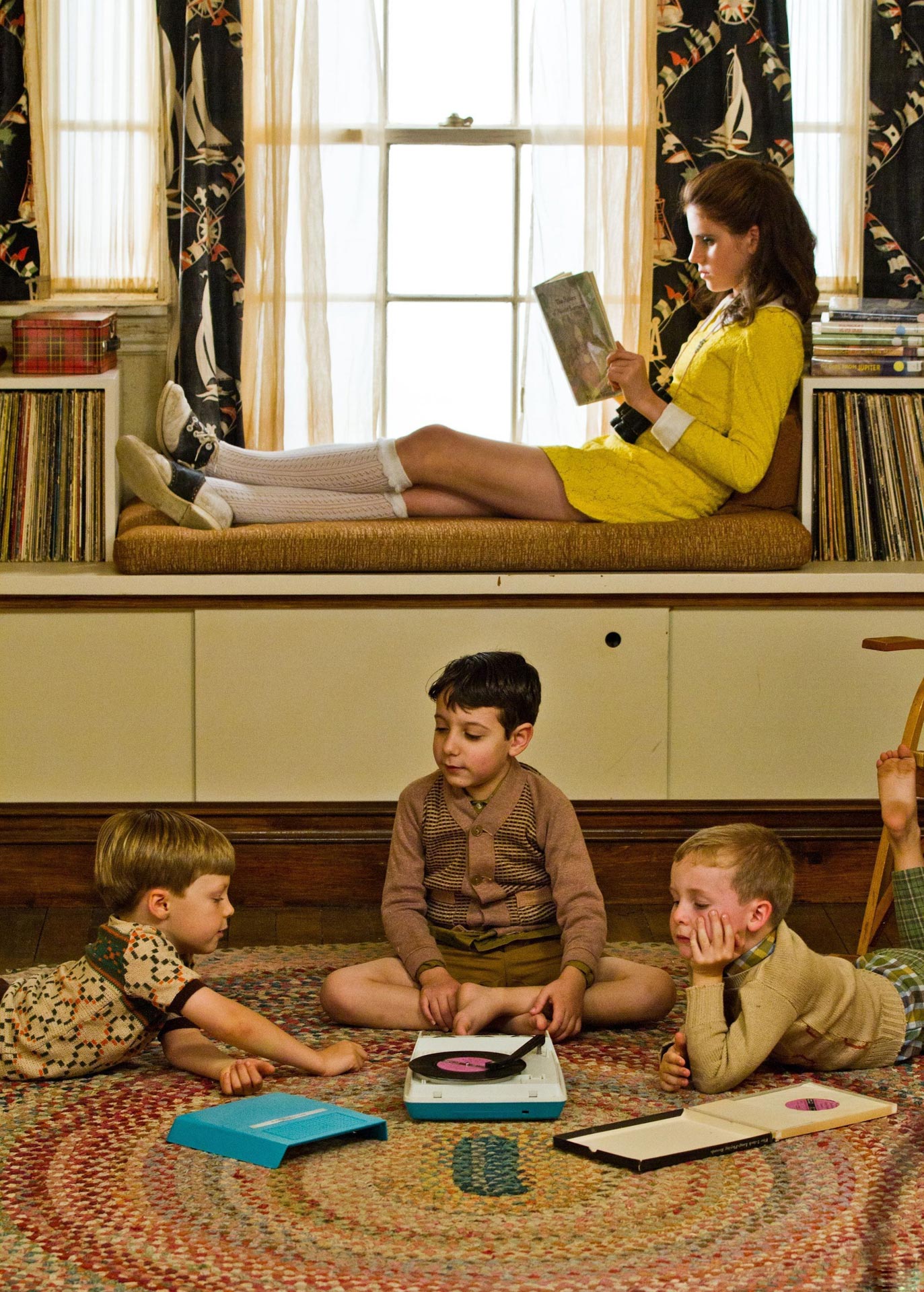
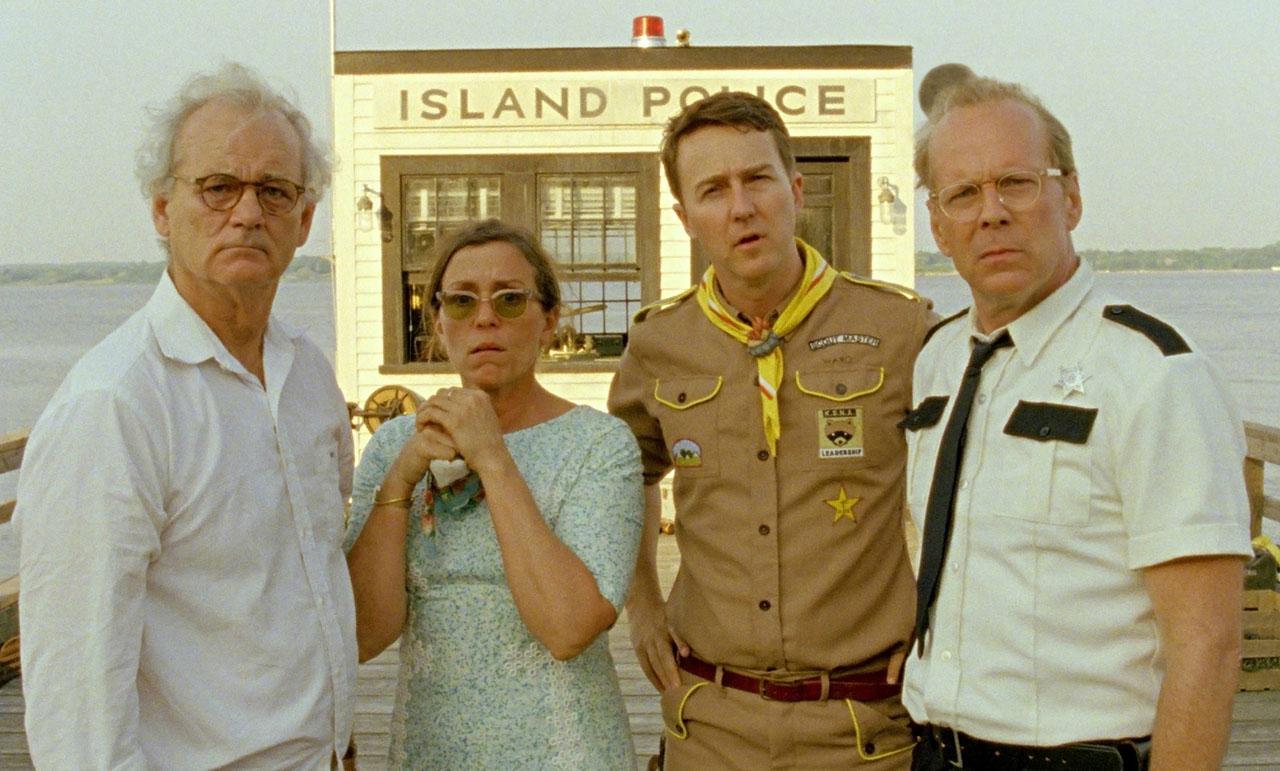
So, Moonrise Kingdom, co-written by Anderson and Roman Coppola (Francis' iconoclastic kid), set in the mid-60's and involving an East coast island community.  There are two factions, the authorities, represented by island law enforcement—Captain Sharp (Bruce Willis) and the troop leader of a group of "Khaki Scouts"—Scout Master Ward (Edward Norton).  There is a dysfunctional family, the Bishops (led by Bill Murray and Frances McDormand).  Both factions represent authority, and empty authority at that.  Their worlds are controlled, regimented, but still subject to outside forces and acts of God, like weather—there's a storm approaching as the film's exposition expert (played by Bob Balaban) is only too quick to report.

Into this mix come a pair of star-crossed likers, outcasts from both houses, like Romeo and Juliet.  Sam (Jared Gilman) is an orphan with enough issues that his foster parents no longer want him; Suzy (Kara Hayward) is the oldest child of the Bishops and already is labeled as a "very troubled child."  They meet at an amateur production of Benjamin Britten's "Noye's Fludde"*—he's on a scout outing, she plays a raven.  They begin corresponding in secret, and then both escape their cloisters, he from the Khaki Scouts camp, she from her family home.  They live off the land, he with his survival skills and supplies, she with her books and records, a mutually dependent family with different roles.  It doesn't take long for their disappearance to be discovered and the search parties form, the police led by Sharp and the Scouts, led by Ward, with the Bishops poking, prodding and threatening lawsuits.  The kids lead them all a not-so-merry chase, and there are casualties along the way. But, the fugitives press on, despite the fact that, on an island, they can never really escape.

It's a romantic's version of 'the barefoot bandit" story, but without the issues of ego, narcissism, and general public nuisance, and Anderson couches it all in an idiosyncratic format with scrupulous Kubrickian stylistic fluorishes—the measured tracking shots, the hand-held shots of freedom and chaos; the stylized expressionless acting, the structured mise en scene, perfectly balanced on a central fulcrum.  On top of that, it's hilarious, with dialogue that's formal, distinct, played absolutely straight, betraying no irony, delivered in a deadpan lack of elevation.

It's charming-no wonder these kids want out, left to their own devices.  They still want structure, just their own structure, and, although self-imposed outcasts, seem far more together than those of their "betters."

Fun, odd, and rebellious in Anderson's over-stated understated fashion.  Wonder what he'll do when he grows up.


Moonrise Kingdom is a Full-Price Ticket.


* Britten is the classical composer-thread rolling throughout Moonrise Kingdom, and his "Young Person's Guide to the Orchestra" is the starting theme for the film's opening sequence—a gliding, tracking tour of the Bishop's house.  They'll also do a version of it over Alexander Desplat's closing music over the credits.

Tuesday, July 5, 2011

Cars 2/Transformers 3/Audiences 0

"The Summer of Our Discontent"
or
"Cash for Clunkers"

You almost don't want to go To the Movies this Summer.  Oh, we were warned; so many sequels and comic-book movies, the "experts" pouted and clucked.  But the law of averages were in the audience's favor; there had to be something good in "the numbers."*  But, this Summer has made me a little gun-shy and I hesitate from pulling the trigger on my credit card for a ticket.  Nothing's excited me so far (apart from The Tree of Life**) and it's July already.  Of the comics films, only X-Men: First Class had powers and abilities far beyond most super-hero movies—certainly over the previous "X-Men" entries.  The 3-D "phenomenon" has constricted budgets, pushed opening dates, and the only thing it seems to add is an extra dimension of "suck" to the productions in the end.

Two recent releases left me so completely unmoved—probably because they were manufactured machine-movies about manufactured machines manufacturing fights with each other—that I thought it best to combine them under one article...so I wouldn't have to spend too much time contemplating their existence, and simply move on. They also evoked the same thought of "What do I care what happens to machines? Machines can be re-built!" 

And movies series can be re-booted.  There are a couple I'd like to give the boot to right now.

Ultimately, both films are just long commercials for toys.  Better to buy the toys and make your own adventure than what's being served.


"Spare Parts"

I went into the original Cars with exceptionally low expectations, and found a surprisingly fun little film to appeal to the NASCAR crowd and anyone who had a love for the open road.  Automobile comedy would seem to be the lowest gear for laughs, but Pixar (and its guru/director John Lasseter, this time co-directing with Brad Lewis) managed a fine film that, if it fell short of the other Pixar products, at least managed to land on all four tires...and that's where the rubber meets the road.

But, what do you do for a victory lap?  Go around the field one more time? (Well...yeah).  With the novelty of a talking car universe safely a given, Cars 2 expands the concept, so that everything is talking, cars, boats, planes—although the oil-rigs featured are strangely mute.  It also goes global, with an environmental plot about an oil billionaire car (???) who decides to go "green" and develops a new fuel called "Allinol" (heh) and a promotional World Grand Prix to go with it.  This gives "Lightning" McQueen (voiced by Owen Wilson) to go head-gasket-to-head-gasket with his racing rival, Francesco Bernoulli (John Turturro, who is having fun) for a best two out of three. 

Ah, but there's sand in the gas-tank, when a car-tel of lemon-models (Pacers, Pintos, Gremlins, Ugos) led by an evil genius (my guess it was an Edsel, but I was wrong) wants to exploit a weakness in the gas to destroy the racers in the Grand Prix, and it's up to Special Agent Finn McMissile (voiced by Michael Caine, standing in for a friend, I think)—a gadget-laden Aston Martin/Miata hybrid—and his co-agent Holly Shiftwell (Emily Mortimer) to stop the plot and learn the secret identity of the evil genius behind it all.  In a case of mistaken vin numbers, these crack agents think that Mater, the tow-truck (Larry the Cable Guy) is their American contact with information to stop the  plot in its tire-tracks.  

Now...wait a minute.  I know it's a movie about talking cars (fergawdsake), but it takes a new meaning of the term British Intelligence to make that kind of mistake.  So, the movie shifts its emphasis from the McQueen caracter to Mater very quickly and the movie never really recovers...I mean, there's only so much Larry the Cable Guy a person can take.  The movie's tone has the feel of those '60's films where they used to shoe-horn Rowan and Martin or The Three Stooges into a spy plot because it was "a trend" and they couldn't come up with anything better...or appropriate. So, it's all a little "off," the timing chain a little twisted, not sparking on all cylinders.  It LOOKS good—the city-scapes haven't looked so lovely since Ratatouille (although everything looks a little miniaturized, like a play-set), and the movie has a fairly amusing sequence in Japan—but the film moves way too fast to appreciate all the chrome and options and it's too loud and obnoxious that the impulse is to roll the windows up and ignore it.  Despite a stellar cast (Vanessa Redgrave voices The Queen?  And did I hear Michael Gambon—uncredited—as the disguised voice of the villain?) and despite its emphasis on Mater, nothing mattersthere's no conflict, there's no drama—just a hokey plot, some slip-shod comedy, and everything running on auto-pilot. 

As such, it would have been more appropriate to have Roger Moore as the voice of the spy-car.

Cars 2 may be buffed and shined, but its parts are used and worn, and rather than having that "new car" smell, it has a distinct lemon-scent.

Cars 2 is Cable-Watcher.
(Wilhelm Alert @ 01: 24)


"Rock-Em, Suck-in Robots"

You should have no expectations walking into any film, but you really need to lower your guard going into a Michael Bay construction. His early films are such an annihlation of style over substance—to the point where action sequences are a mashugenah mish-mash between what looks like slo-mo Americana commercials for insurance—that you wonder if the guy at that point had any sort of talent whatsoever (I mean, Tony Scott has the same commercial gloss to his films, but at least you can follow them).

Over time, though, Bay's act has gradually gotten better. The action sequences smoothed out without losing any of the kinetic energy the director was striving for. Maybe there was even a good idea or two among the shrapnel flying through the air. But, the emphasis was always, and will always be I suspect, about demolition derby film-making with the occasional "grace note" of grinning nihilism and exploitive misogyny. One suspects that Michael Bay may become a better film-maker, but he will never grow up.

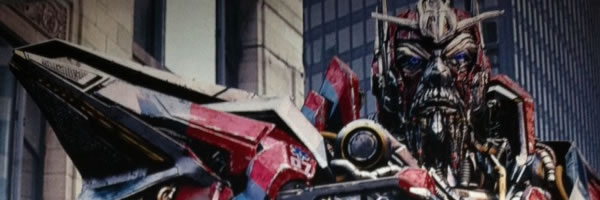
And he's still playing with toys. He directed all three "Transformer" movies, including the latest, Transformers: Dark of the Moon, and before getting into what's wrong with it, here's what's right: the action sequences, particularly a crazed, high-strung highway chase and a mechanical urban brawl fought on three fronts through the high-rises of Chicago*** are marvels of imagination and quite "followable"—in other words, Bay is starting to understand the logistics of a good action sequence involve perspective and relatable occurancesthe swooping overhead shots let you see the relationships of what's happening, rather than just presenting a hodge-podge of in-your-face shots.  Yes, they go on too long—the evidence being the kids in the audience who couldn't sit in their seats long enough even when things started to go crash and boom—but at least things made sense, rather than merely noise and rubble.  Now, if he could just have things happen simultaneously—rather than have things stop on the other fronts while he concentrates on one sector—Bay might actually generate something his movies always lack: suspense.

So, the technique is improving, but he's still a far distance from being a mature film-maker.  The few women cast in the film, save Frances McDormand who manages to retain some inventiveness and dignity in her role, are all dressed like hookers with Bay's camera leering over their curves,**** the dialogue attempts double entendre but never gets beyond the singular stage, and the annoying Beavis and Butt-head mini-robots from the last film are back and just as juvenile.  The whole movie has the same air of arrested development, although attempts are made to make it seem like it is happening in something more than a fantasy world where aliens disguise themselves as muscle-cars.  The plot revolves around a derelict Autobot being salvaged from the Moonits detection being the genesis of Pres. Kennedy's push for a fast lunar landing (and a cameo by "Buzz" Aldrin attempts to lend credibility to the idea).*****  But, there are also "realish-world" cameos by Kennedy (eerily good effects work), Nixon and Robert McNamara (not so much), Walter Cronkite (TV archival footage) and Bill O'Reilly (which negates the credibility factor...a lot).  John Turturro returns, and John Malkovich has a small role as a gung-ho business exec.  Shia LaBeouf is on-hand (much more caffeinated than usual, probably to be better noticed and for good comic effect, as, Unicron knows, the robots are DEADLY serious), and there's just enough of his parents in this one to outwear their welcome, whereas they were one of the best things in the original.  Here, that role is provided by Alan Tudyk, who enlivens the first half of the film before he's made into a functionary.

But, human interaction other than urgently delivered exposition or awkward comedy is rare as human beings become mere flotsam (sometimes literally) in the crushing of gears against gears.  Since I've whined in the past that the "Transformers" movies have suffered from "Saved-by-a-White-Man" Syndrome (where a movie's ethnic entities' problems are solved by the usually-white star), this is actually rather refreshing (in fact, the girl-friend/model is the only one who does anything to influence the fight, by displaying the same kvetching characteristic she does with LaBouef's character, a nice touch if you actually believe it inspires what transpires, rather than her merely being turned into designer-charcoal as an annoyance). 

One looks for small signs of hope wherever one can, when one is dealing with something in so need of repair.

Ultimately, though, for all the metallicrash on the screen, my attention kept returning to my watch...I couldn't wait to get out of there.

One further thought to Bay's detriment: he can't direct 3-D (the format I saw Transformers: DOTM in. On too many ocassions, the illusion was spoiled by Bay's insistance in putting an out-of-focus obstructing "something" in between the viewer and the "focus" of the scene...which in 3-D...DOES NOT WORK! The eye wants to focus on the nearest object and move outward in focus, and with merely a "blur" to look at, gets mixed signals, leading to a frustrating viewing experience. Bad idea. And given that Transformers was designed to be shown in 3-D, some bad direction.


Transformers: Dark of the Moon is a Cable-Watcher, but rent it, instead, so you'll be able to skip places, speed it up, watch it in chunks...it's too long and renting it, you'll have more control over how much time you're wasting..


* Just because there's a number in the movie doesn't mean it's going to be bad—it amuses me that the intro on the Cars 2 poster says "From the Makers of Toy Story 3."  And there are the inevitable jokes—that Ocean's 11 was followed by Ocean's 12, and I remember a comedian saying about Malcolm X: "I never saw Malcolm I-IX!!"  I saw Super and Super 8 this Summer...where're the other 6?


** Meek's Cutoff was interesting, but nobody's going to see that.  So much for blazing trails.


*** You shouldn't take these things too seriously or literally, although Roger Ebert in his nicely disingenuous journal entry "On the Origin of Transformers" wonders why such a global conflict shoukld be limited to "the corner of Michigan Avenue and Wacker Drive in Chicago."  Um...budget?


**** Bay's very first shot of the female leadRosie Huntington-Whiteley, a Victoria's Secret Model (but still...) is an up-skirt shot of her walking up a flight of stairs.  This isn't exactly the tradition of women making a "grand entrance."


***** This is the same "Buzz" Aldrin who, when confronted by an Apollo landing-hoax enthusiast, hauled off and punched the guy!  Who's getting the black eye now?

Wednesday, April 27, 2011

Miss Pettigrew Lives for a Day (Take Two)

Miss Pettigrew Lives for a Day (Bharat Nalluri, 2008) A bon-bon.  A truffle.  A "ladies' pic" with just enough naughtiness to raise the blood pressure a little and maybe bring some color into the cheeks and the blue hair.  Done to a fine "fare-thee-well" and all, but at the heart of the confection is a little piece of grit that could chip a tooth if you're not careful—"careful" being the operative word here.

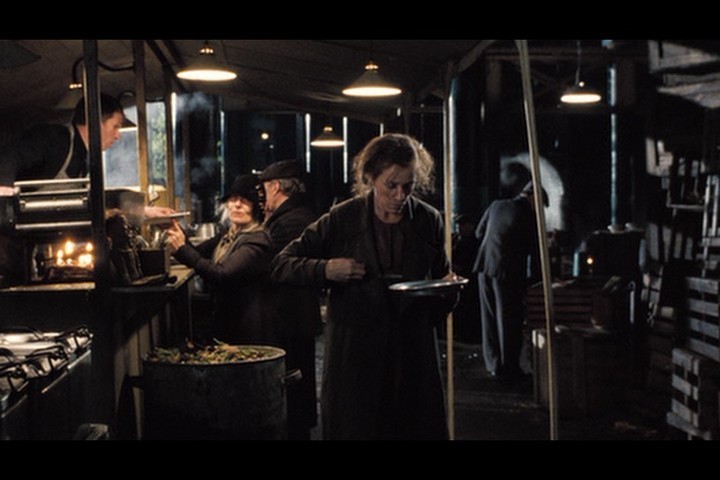
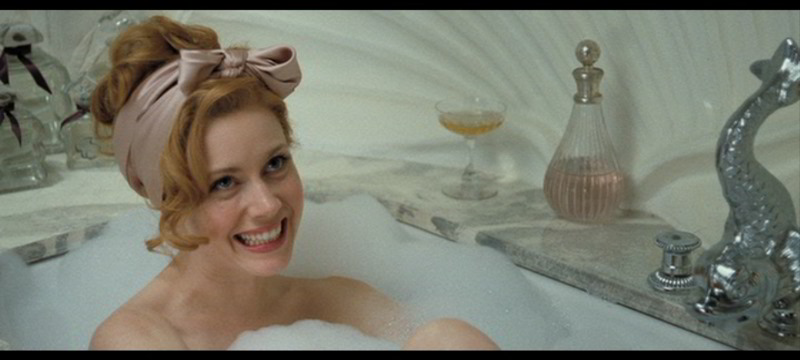
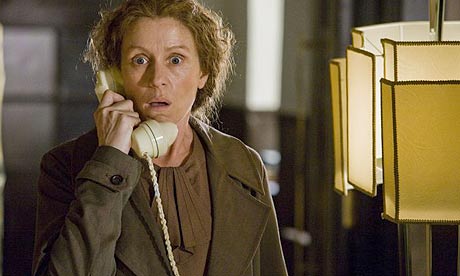
Miss Guinevere Pettigrew (Frances McDormand—what a treasure) has just been given the sack in the days before England is going to war with the Germans; the headlines are bold and the Wellingtons are flying eastward.  But Miss Pettigrew is without situation and penniless, cast adrift like the leaves scattering in the wind (which the Main Titles are animated to resemble).  She is desperate, so when she applies for another position and is roundly given the brush-off, she steals a business card and arrives unannounced at the residence of Miss Delysia Lafosse (Amy Adams)—nee Sarah Grubb "of the Pittsburgh Grubbs"—actress, semi-songstress, floozy and ditherer.

She couldn't have arrived at a better time.

Delysia is only dressed in a flimsy robe after entertaining a boy-producer (Tom Payne) in order to gain the lead in his new production, and she's doing so in the lavish love-nest of her boyfriend Nick (Mark Strong), who should be returning at any minute.  As should her other boyfriend, Michael (Lee Pace), who has just been released from prison after trying to nick a diamond for Delysia's engagement ring (the occurrence of which left Guinevere with only the clothes on her back—"small world").

It becomes immediately apparent that Miss LaFosse should not be acting but juggling and she needs a third hand to do so. 

And that's where Miss Pettigrew comes in, and quite literally.

Over the course of the day, everyone is in everyone's "business" if not in the very same room and the various conflicts conspire to creates "scenes" in glamorous settings and scandals if the back-biting and sniping become less passive and more aggressive.  The surface glitter, though, is shadowed by the twin horsemen of war and poverty and Pettigrew, who has known both, manages to be the voice of priority and reason, without completely throwing cold water on everybody's hot jazz.

It's a smart, funny screenplay, played well by an expert cast, even if the the direction gets a little swoopy and frenetic sometimes, and the music soundtrack is selected meticulously to given the film a rhythm and momentum that it desperately needs, even if some of the music chosen isn't precise to the period.

So, what's the "grit" that threatens to tarnish the gold that seems to permeate every one of Adams' costumes in this thing?  The unmistakable whiff of safety that wafts every so often.  That sentiment that everything will be alright, as long as "the right man" comes along.  Sure, the movie toys with "wrong" men, just as surely as Delysia does, but the flirting with "danger" is always casual, the consequences never showing themselves.  There are valid points that "love is not a game," and "you must not waste a second of this precious life," and particularly "there are times when decisions just have to be made, or you certainly will miss out."  All too true.

But, the insistence that all will be well with the subjectively agreed-upon "right" pairing between male and female?  Would it have been so sinful to have the ladies of the story be a little more independent as a solution as opposed to it seeming like a problem that needs to be cured?  As delightful as a movie may be, if those thoughts crop up, it has the tendency to spoil the party.


Tuesday, September 16, 2008

Burn After Reading

"Joel, you wanna know something? Every now and then say, 'What the fuck.' 'What the fuck' gives you freedom. Freedom brings opportunity. Opportunity makes your future."

Miles from "Risky Business" (1983) written by Paul Brickman

Then there's the corollary to those hopeful words, the Coen Brothers' new film "Burn After Reading." It's a comedy, so that means folks who swoon when they're making serious films, like "Miller's Crossing," or "No Country for Old Men" will look at it like it's a red-headed step-child, along the lines of "Raising Arizona," "The Big Lebowski," or "Intolerable Cruelty." Thing is, they're all products of the same sensibility; the perverse sense of the world that informed "Blood Simple," and "Barton Fink," "Fargo," and "O Brother, Where Art Thou?" informs "Burn After Reading," especially in this time of national dependence on the Intelligence Community.

But back to "WTF." A lot of people say "What the Fuck?" in "Burn After Reading." In fact, I'd have to see it again (not an unpleasant thought), but I got the impression that every single major character in the story says it at least once. And not in the good way of the opening quote that supposedly produces opportunity (though it might for those wearying "Up With People" souls who see every problem as an opportunity, and every half-empty glass as half-full).

No, it's usually uttered in shocked disbelief at the events that transpire. It's because "Burn After Reading" belongs to that sub-category of comedy (and tragedy) "The Incredible Mess." It's where the hopes and dreams of a dedicated few turn into a nightmare that no matter how hard they try, their efforts to extricate themselves only make matters worse. Fighting it is a losing strategy. "Yeah, sure, it looks like quick-sand; what's your hurry?"

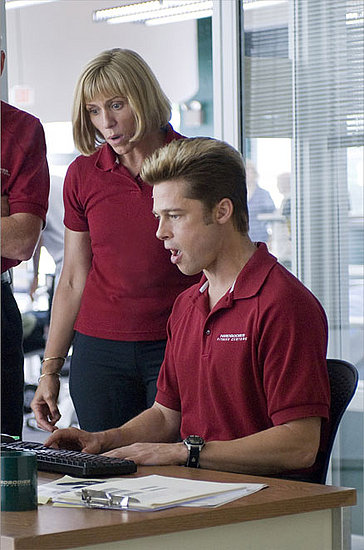
CIA analyst Osborne Cox (John Malkovich) has been fired from his job and he's pissed enough to write a tell-all book blowing the doors open on the Agency. One thing he won't put into the book-as he's ignorant of the fact--is that his wife, Dr. Katie (Tilda Swinton) is having an affair with friend Harry Pfarrer (George Clooney)--he's in the P.P. business (personal protection), and he's also cruising the Internet as one of Washington D.C.'s serial daters. So does Linda Litzke (Frances McDormand), who works at the nearby "Hardbodies" fitness center and who is now turning to plastic surgery because she's taken her body "as far as it will go." She doesn't have the money for it, but hope comes along in the form of a disk of Cox's financial information that falls into the hands of fellow "Hardbodies" employee Chad Feldheimer (Brad Pitt), who thinks he might be getting some sort of federal reward for turning it in, and hey, wouldn't that help pay for those operations?

The fuse gets lit, as loyalties shift, panic arises, priorities change and worst instincts lead to "worser" consequences. That reward turns to a sense of entitlement and then resentment, then to ransom. The events are somewhat monitored in disbelief by the CIA (in the form of the incomparable David Rasche and J.K. Simmons), as things spin out of control.

Everybody's great, besides Rasche and Simmons.

Clooney seems to excel with the Coen's--this is his third film with them, McDormand amps up the energy of her previous Coen-work, Swinton seems less self-contained and goes for the comedy like never before, and Malkovich swings between coiled fury and exploding fury. But the stand-out is Brad Pitt's selfless performance as Chad, the personal trainer who could very well be the stupidest person on face of the earth.* His hair piled high and high-lighted, an i-pod constantly filling the empty space in his head, his body moving spasmodically with its energy, he can be counted on to think he's doing the right thing, when he couldn't be more wrong--he is everyman, trapped in a life that resembles a first home improvement project--quite oblivious to the fact that sometimes you only get one chance to get things right without the benefit of "rep's." There's a sub-text running obviously through the thing of "the self," with the main players obsessed with their bodies and their own interests. Washington D.C. makes the perfect back-drop for it.

"Burn After Reading
" is rated "R" for pervasive...you know.

"Burn After Reading" is a matinee, I mean, what the fuck?**

* After Bill Pullman's character, Earl Mott, in "Ruthless People"(1986)

** Sorry about the "pervasive language," but, really--you see this movie, and you know that was the working title of this movie (a move that, if it was carried through, would have crippled the movie at the box-office by restricting advertising and such). I briefly considered not spelling out "the f-bomb" with the comic-standard "f@<#," but I figured...no, I'm not saying it again...but as the word appeared Sunday in the "When Harry Met Sally" Scene, I figured "if I use it there, I might as well use it here," pervasively.

Monday, May 26, 2008

Miss Pettigrew Lives for a Day

Miss Pettigrew Lives for a Day, (Nalluri, 2008)

Just because a movie is a light comedy doesn't mean it cannot be good. Remember Bringing Up Baby or It Happened One Night. Miss Pettigrew Lives for a Day might not be equal to either of these, but it's not a chick flick either. It is more in the tradition of a British costume drama, recreating the world of flappers and flyboys where life is as serious as the lyrics of a Cole Porter song.

Even though it tries to ground its reality in the onset of the Second World War, the director makes sure that things don't get too heavy. It helps that it is anchored by two actors on the top of their game: Amy Adams, just as she did in Enchanted, shows how she can play her part with total conviction whether it be a Disney princess come to life in New York or Sally Grubb from Chicago reinvented as Delysia LaFosse, cabaret singer in pre-war London. What could be irritating is beguiling. Frances McDormand matches her step for step as Guinevere Pettigrew, the nanny who has been sacked from every position she has held (with good cause it would appear) and who finagles her way into the life of Ms LaFosse just in time for the most important day of both their lives.

Just about everyone else gets into the spirit so well* that it is like watching one of those BBC adaptions of an Agatha Christie novel, period perfect and so beloved of PBS on a Saturday night. The only wrong note may be the casting of Lee Pace as the hearthrob, Michael. Unlike Delysisa's two other suitors, he comes across as far too modern and intense for the mood of the movie even though you still end up rooting for him.

(*None more so than Ciaràn Hinds and Shirley Henderson)