Showing posts with label J.K. Simmons. Show all posts

Tuesday, September 16, 2008

Burn After Reading

"Joel, you wanna know something? Every now and then say, 'What the fuck.' 'What the fuck' gives you freedom. Freedom brings opportunity. Opportunity makes your future."

Miles from "Risky Business" (1983) written by Paul Brickman

Then there's the corollary to those hopeful words, the Coen Brothers' new film "Burn After Reading." It's a comedy, so that means folks who swoon when they're making serious films, like "Miller's Crossing," or "No Country for Old Men" will look at it like it's a red-headed step-child, along the lines of "Raising Arizona," "The Big Lebowski," or "Intolerable Cruelty." Thing is, they're all products of the same sensibility; the perverse sense of the world that informed "Blood Simple," and "Barton Fink," "Fargo," and "O Brother, Where Art Thou?" informs "Burn After Reading," especially in this time of national dependence on the Intelligence Community.

But back to "WTF." A lot of people say "What the Fuck?" in "Burn After Reading." In fact, I'd have to see it again (not an unpleasant thought), but I got the impression that every single major character in the story says it at least once. And not in the good way of the opening quote that supposedly produces opportunity (though it might for those wearying "Up With People" souls who see every problem as an opportunity, and every half-empty glass as half-full).

No, it's usually uttered in shocked disbelief at the events that transpire. It's because "Burn After Reading" belongs to that sub-category of comedy (and tragedy) "The Incredible Mess." It's where the hopes and dreams of a dedicated few turn into a nightmare that no matter how hard they try, their efforts to extricate themselves only make matters worse. Fighting it is a losing strategy. "Yeah, sure, it looks like quick-sand; what's your hurry?"

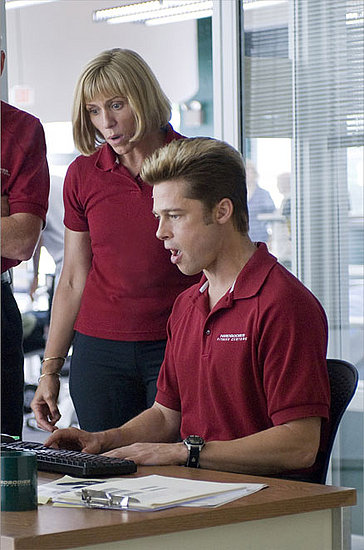
CIA analyst Osborne Cox (John Malkovich) has been fired from his job and he's pissed enough to write a tell-all book blowing the doors open on the Agency. One thing he won't put into the book-as he's ignorant of the fact--is that his wife, Dr. Katie (Tilda Swinton) is having an affair with friend Harry Pfarrer (George Clooney)--he's in the P.P. business (personal protection), and he's also cruising the Internet as one of Washington D.C.'s serial daters. So does Linda Litzke (Frances McDormand), who works at the nearby "Hardbodies" fitness center and who is now turning to plastic surgery because she's taken her body "as far as it will go." She doesn't have the money for it, but hope comes along in the form of a disk of Cox's financial information that falls into the hands of fellow "Hardbodies" employee Chad Feldheimer (Brad Pitt), who thinks he might be getting some sort of federal reward for turning it in, and hey, wouldn't that help pay for those operations?

The fuse gets lit, as loyalties shift, panic arises, priorities change and worst instincts lead to "worser" consequences. That reward turns to a sense of entitlement and then resentment, then to ransom. The events are somewhat monitored in disbelief by the CIA (in the form of the incomparable David Rasche and J.K. Simmons), as things spin out of control.

Everybody's great, besides Rasche and Simmons.

Clooney seems to excel with the Coen's--this is his third film with them, McDormand amps up the energy of her previous Coen-work, Swinton seems less self-contained and goes for the comedy like never before, and Malkovich swings between coiled fury and exploding fury. But the stand-out is Brad Pitt's selfless performance as Chad, the personal trainer who could very well be the stupidest person on face of the earth.* His hair piled high and high-lighted, an i-pod constantly filling the empty space in his head, his body moving spasmodically with its energy, he can be counted on to think he's doing the right thing, when he couldn't be more wrong--he is everyman, trapped in a life that resembles a first home improvement project--quite oblivious to the fact that sometimes you only get one chance to get things right without the benefit of "rep's." There's a sub-text running obviously through the thing of "the self," with the main players obsessed with their bodies and their own interests. Washington D.C. makes the perfect back-drop for it.

"Burn After Reading
" is rated "R" for pervasive...you know.

"Burn After Reading" is a matinee, I mean, what the fuck?**

* After Bill Pullman's character, Earl Mott, in "Ruthless People"(1986)

** Sorry about the "pervasive language," but, really--you see this movie, and you know that was the working title of this movie (a move that, if it was carried through, would have crippled the movie at the box-office by restricting advertising and such). I briefly considered not spelling out "the f-bomb" with the comic-standard "f@<#," but I figured...no, I'm not saying it again...but as the word appeared Sunday in the "When Harry Met Sally" Scene, I figured "if I use it there, I might as well use it here," pervasively.

Monday, January 14, 2008

Spiderman 3

Oh, What a Tangled Web We Weave....

I’ve always taken a jaundiced view of the Marveltm superheroes tm as opposed to the DCtm variety. Where the spandex crowd from Detective Comicstm sprang from pulps and adventure fiction, Marvel’s were derived from Stan Lee’stm previous job--writing romance comics. Back when I picked up the occasional Marvel in the 60’s it was always apparent that they were soap operas with fights, and that it was only a short spidey-jump from “*SOB!* I forgot to have children!” to “*SOB!* I will be Spiderman…No More!” The Marvel Superheroestm are drama-queenstm. This was never more apparent than the ending of the first “Spidermantm movie when Peter Parkertm walks away from the girl who’s just professed her love to him (and in a graveyard *SOB!*), because “with great power comes great responsibilitytm-okay I'll stop”(as with the soaps, this sentiment lasted until the next movie, which ended with them together—I guess responsibility ain’t so great, after all). “Spiderman” was a soap opera punctuated by brutal, ugly fist-fights (which don’t look so cool when not freeze-framed in pop-art patterns) I vividly recall reading the geek-reviews saying “Spiderman” is just like US!” Ri-ight. I’ll bet they didn’t have two gorgeous co-eds fighting over them in high school, as the comics character did. Where that movie worked was “Spidey” in action—especially in the ending where the camera followed him morphing into so many iconic poses favored by various artists over the years—Ditko, Romita, Kane, Andru, McFarlane. There, the true potential of a movie “Spiderman” paid off.

So, when the second movie, combining “Doc Ock/Spiderman…No More!/Mary Jane’s getting hitched,” came out, the screenplay (co-written by Alvin Sargent and Michael Chabon) practically sang. It was a perfect balance between character/melodrama/action and spectacle. In fact, “Spiderman II” is probably the best comic-book movie ever…and the most enjoyable since the first “Superman.” With the creators knowing what worked now, one anticipated “Spiderman III.”

Now, here it is—the most expensive movie ever made (supplanting even “Superman Returns**) and what does it show for all that money being thrown around? A bit, actually. The cast is uniformly good given the material with James Franco finally relaxing and having fun with his role as Harry Osborne. Thomas Hayden Church takes his role as The Sandman VERY seriously—he acts like he’s in an Ibsen play—though the most effective performance is by the “Particle-Matter Generator” Gizmo that created the sequence of him first emerging and pulling himself together. Topher Grace makes the most of his non-CGI moments as Eddie Brock/Venom. And Bryce Dallas Howard (Opie’s kid), after looking like something the cat dragged in for M. Night Shamyalan’s movies, cleans up very nicely as Gwen Stacy, as that essential character of the comics finally shows up.*


There are welcome returns (from the grave, flashback-style) of Cliff Robertson and Willem Dafoe, and J.K. Simmons proves once again he’s the perfect embodiment of Daily Bugle Editor J. Jonah Jameson.


Now, for Tobey McGuire and Kirsten Dunst, here's the problem. For the third in the series the writers were obviously looking for something interesting for the two leads to do. "We'd left them in No.2 happily in love. So....let's shake that up a bit." In this one Peter is going bad (didn't Superman do that in his third movie?) and "MJ" is hitting acreer set-backs to star-dom. Spiderman's popularity is up, while hers is down. Wasn't this "A Star is Born?" Only Tobey is Judy Garland, and Kirsten is James Mason. Getting kinda sudsy there, isn't it? McGuire is allowed to cut loose as "Bad Peter" (under the influence of a "symbiote"--that's how they say it--from outer space. Kirsten Dunst gets to sing in an opening sequence that Sam Raimi stages like its right out of MGM. There are some great fights (some of them are more...dust-ups) that lacked the zanily ferocious wit of the ones in II, go on too long, and are marred by some too-intricate camera-work (or camera simulation) for the sake of too-intricate camera work. Finalley, the whole thing ends in another "Spidey's Gotta Save MJ" grudge-match with the web-head up against Sandman, Venom and Son-of-The-Goblin. It far overstays its welcome and ends in what seems like an interminable wallow.

Anything else wrong? YEAH! Too much Stan Lee screen-time! Stan's cameos are getting longer and longer to the point where he might as well have a running character as a street-sermonizer. Stan! Y'know that phrase "'Nuff said?" Mean it next time!! Oh! And have we managed to get EVERY member of Sam Raimi's family on-screen yet? Next movie, Spidey's going to be fighting The Nepotist!

There's an awful lot to enjoy in fits and starts, but you have to be a certifiable card-carrying true-believer to be completely satisfied with this movie. It's a case of the film-makers throwing as much webbing as they can on-screen and seeing what sticks. Unfortunately, not much. What was promising to be the best comics franchise in movies is making the same mistakes as all the others: Too many villains, too much "business" and "busy-ness," and not enough care for the strengths of the characters and what has been done before. They've attempted too much and accomplished too little...while spending as much money as possible.

"Nuff said.

"Spiderman 3" is a rental, and no, you're not going to miss any details on the small-screen--everything's moving so fast you can't see it on the BIG screen either--not even IMAX!


*Curiously, the two women’s roles are completely reversed in the translation from the comics to the screen. In the comics, Gwen is the sincere hometown knockout, while Mary Jane was the flighty supermodel (“Romance” comics, remember? With a little “Archie” thrown in)

** I'm wrong here. Incredibly, the second most expensive movie in history is "X-men 3: The Last Stand." Hell, "X-men 3" didn't even LOOK good!

--------------------------------------------------------------------------
Post-Script: It's always alarming to see how well crap--even well-constructed crap--sells. Now, "Spidey3" is tearing up the box-office with enough momentum that it could very well become one of the "Largest Earning Films in History." In doing some research for an earlier post, I was alarmed to see what is now on the list of the "Big Boffo" films: "Shrek 2" is #3? It wasn't as good as "Shrek 1!" The second "Pirates of the Caribbean?" It was bad--not even fulfilling the promise of the first one, but it's at #6! "Independence Day" at 21? "Narnia" at 24? "Meet the Fockers?" At 29! ("Spidey 3" at the time of this writing is at #33).It's also interesting to note how sequels seem to fare better than the originals--as if their popular momentum has increased (something that might be attributable to more people seeing it initially on home-video than the theater)--certainly "Spiderman 3" bares that out even more than "2" did.

But one can't get too exercised about this: "
Norbit" was the top box-office draw one weekend, after all. And as James Aubrey once said: "No one ever went broke under-estimating the intelligence of the American people" (I believe that was right after he green-lit "The Beverly Hillbillies" for CBS).