Showing posts with label Tobey Maguire. Show all posts

Wednesday, May 29, 2013

The Great Gatsby (2013)

"Yours in Great Depression" During the Baz Age
or
I'm Half Crazy All for the Love of You....

"There are no second acts in American lives"
F. Scott Fitzgerald

There have been several versions of F. Scott Fitzgerald's Great American Novel that have hit the big screen since the novel was first published in 1925, and nobody seems to get it right, if "right" can be got at all.  There's a "lost" silent version with Warner Baxter, a 1949 version adapted by Richard Maibaum with Alan Ladd, that emphasized Gatsby's gangster roots, the Robert Evans vanity production of 1974 with Robert Redford and Mia Farrow, directed bloodlessly by Jack Clayton.  It's a challenge to produce such a tragedy that has a boisterous first act, and such a downer of a second, but that is what makes it so special, and so American.  In fact, the best version must be taken out of the novel, which was written in the midst of the period in which it was set, and take into account future events—the stock market crash in 1929 and the following "Great Depression," which sounded the death-knell for The Jazz Age with a long sustained flat note.  Fitzgerald's prescient, cautionary novel proved historically accurate with 20/20 foresight to the extent that you cannot make a movie of it unironically, given the past that was its future, and you cannot make a complete movie of it while remaining blind to what it did not foresee in reality, but captured artistically and thematically.

Baz Luhrman's version of The Great Gatsby jumps into that irony with both feet and splashes around in it, kicking and squealing like a child drunk with a secret.  It was a weird decision to film it in 3-D, but given the way Luhrman uses it, in vivid eye-popping colors, emphasizing the swoop of camera moves and the solidness of glass partitions, and the illusion of the reflections shimmering over it—and particularly in how he photographs our last views of East Egg, in a way that rather lovingly visualizes the novel's last line ("So we beat on, boats against the current, borne back ceaselessly into the past")—one begins to wonder any other way to do it.*  In a way, the movie feels like one big "Vertigo zoom" in three-dimensions, starting with an art-deco pattern that falls away to the production company logos and ending with an unfamiliar one—until you see it pop up again in Jay Gatsby's monograms.

Then, we begin the touchstones, green light on the dock, the Egg's, the parties, the shirts, the infidelities, "the man who fixed the 1919 World Series," Dr. T.J. Eckleburg, Oculist (correctly spelled this time), the fights, all done in Luhrman's hyper-speed (which is maintained throughout, as opposed to his previous film Australia, which flagged after the first 45 minutes), in a style somewhere between Preston Sturges, Sam Raimi, and Tex Avery, making the performances somewhat inconsistent (but more on that later).  The swooping, veering style allows for some fore-shadowing plummets down skyscrapers and serves as a visual counter-point to Jay-Z's thumping, pumping soundtrack, which is surprisingly synchronous, although slightly discordant and certainly anachronistic.


"One big 'Vertigo' zoom"
The neatest touch that the director throws into this Great Gatsby is the framing story paralleling F. Scott Fitzgerald, as Nick Carraway (Tobey McGuire), incarcerated in a sanatorium to dry out, composes the story at the behest of his psychiatrist (Jack Thompson), which allows Fitzgerald's words to flow out and become part of the story (the name of the sanatorium is Perkins Sanatorium, after Fitzgerald's editor, the brilliant Max Perkins, a nice little in-joke) and become part of the narrative, succinctly and effortlessly, providing a touch of elegance and perspective to the visual shenanigans.

Even that is a little problematic, as you can't believe those words and that phrasing is coming out of McGuire's googly-eyed Candide in this version—Sam Waterston's Nick in the '74 vintage and even Paul Rudd's in the 2000 BBC take, both have the mature feel for Carraway's observer/muse/co-dependent enabler.  It's a miscalculation, but not due to the casting of McGuire, so much as Luhrman's ADD approach to direction.  DiCaprio's Gatsby is prone to such inconsistency as well.  After establishing Gatsby as a figure of extravagant mystery and a certain false style, Luhrman has him marching up to Nick's cottage, servants in line behind, an image that recalls a parade.  It brings a laugh, but is far too comic for the character.  Sure, he's nervous, anticipating the forthcoming tea, and he's slightly out of his element.  But the effect takes away from all aspects of the character, even though it plays into Gatsby's too-romantic notions of reclaiming his past. Nor does it help that DiCaprio still looks like a boy-child here.


But where the casting falls off the most is Carey Mulligan as Gatsby's lost-love, Daisy Buchanan, the instrument of his downfall.  It's a tough character to cast, as difficult as Gone with the Wind's Scarlett O'Hara, seemingly worldly-wise (but actually sheltered), and fatally shallow, selfish in the moment, and murderously practical in the long run.  She needs to be someone who can dash all hopes by merely averting her gaze, and fascinating enough to attract it.  And she has to evoke some sympathy for her acts, despite her flaws.  As good an actress as Mulligan is (and has been) her Daisy comes across, finally, unknowable and not interesting enough to be an object of obsession, as she must be for the whole tale to work.  In fact, it would be tough to think of a modern actress who could be so cool in her actions, and attractive to risk everything for.  Stanwyck could do it, and Hepburn (Katherine), but it would take a full infusion of actorly personality to pull off.  With Mulligan, there's no spider's web of promise, only a longing weakness, around which the story can revolve.  And at the pace Luhrman spins the film, that character needs to have a substantial spine to keep it from flying apart.

It's not there.  There is substantial spectacle and evocation of the times, but the people caught in it cannot hold the thing together. It's just another variation of the theme.  As such, it's an interesting, but not a great "Gatsby."

The Great Gatsby (2013) is a Rental.


* The 3-D also helps the special effects, which, in Luhrman's vision of things have a distant postcard version of things and see quite a bit distanced from the real live action going on out front.  In fact, I imagine the film looking pretty crummy in 2-D, especially in the shots where the large estates look like models.

Tuesday, April 20, 2010

Ride with the Devil

"Ride with the Devil" (Ang Lee, 1999) The story of Quantrille's Raiders and the Missouri Irregulars were a sorry part of the Civil War story, but its tales of guerilla raids between two groups, the "bushwhackers" and the "jayhawkers," criss-crossing the Kansas-Missouri border, it's history with Quantrille, Bloody Bill Anderson and Jesse James and the murderous raid on Lawrence, Kansas in 1863 have been explored, somewhat tangentially, as the first battles in the Outlaw West.

Director
Ang Lee may seem an odd choice for a Western of this nature, but such was the case when he directed "Sense and Sensibility." Versatile, facile, and able to make universally accepted films across genres, there seems little Lee cannot succed at whether period romance ("Sense and Sensibility"), spy-noir ("Lust/Caution"), martial arts flick ("Crouching Tiger, Hidden Dragon"), even cross-blending sci-fi/horror and superhero movies ("Hulk").

"
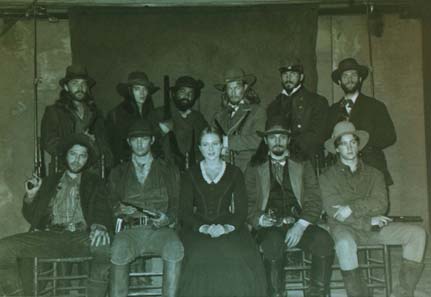
Ride with the Devil," with a screenplay by James Schamus (now head of Focus Features) was not a box-office success when it opened, perhaps as it was an unconventional western with controversial elements: four young people, Jake Roedel (Tobey Maguire), Jack Bull Chiles (Skeet Ulrich), George Clyde (Simon Baker), and Daniel Holt (Jeffrey Wright) all find themselves fighting as Confederate guerillas during the Civil War as "bushwhackers," not so much as they believe in the Southern cause—Holt is a freed slave—but because of issues with loyalty, friendship and attacks on their families. Soon, they're conducting murderous assaults on established Union positions with deadly accuracy, which Lee stages with a brutal efficiency: quick cuts, fast pace and attention to the damage a round bullet can inflict.
Housed for the winter in a make-shift shelter, they are looked after by Southern sympathizers, with particular interest paid by a war-widow named Sue Lee (Jewel), who begins an affair with Chiles and offers support and food during the harsh winter. It's a nicely paced gritty portrayal of life led as an outlier, and the elements are mixed as to keep one guessing about what will happen next.


The revelation here is Tobey McGuire, heretofore usually playing callow youths (which is why he was picked to play Peter "Spiderman" Parker), here he's got a versatile range of situations, starting out as a disillusioned follower, then his own man of a kind, backed by a steely gaze that turns durn creepy at times, and an "on-the-edge-of-cracking" voice that lolls over dialogue. Nice work, and Lee makes the most of him, using the boyish qualities of McGuire for moments of humor, terror and combinations of both.

Wrongfully overlooked.

Tuesday, January 22, 2008

The Good German

"The Good German" (Steve Soderbergh, 2006) This was the second of Blanchett's (erk!) "Christmas" movies. And it's a fascinating little experiment, but not a satisfying movie. In it, Steve Soderbergh attempted to do a film in the old "Warner Brothers" style. It's in black and white, done on back-lots with incandescent lights, and tube microphones and back-projection. Stylistcally, it looks a lot like Michael Curtiz's staging of "Casablanca," while in the many instances of conflict it resembles Orson Welles' in-your-face direction. The story, which takes place in a divided post-war Berlin is a bit like the cynical "Third Man" crossed with the more romantic "Casablanca." But it has the modern sensibility of more natural acting, language, nudity and hyper-cynicism. And it's like the two don't go together, there's such a cultural disconnect between the "silver-screen presentation" and the story that ultimately they're working at cross-purposes. It's tough to care about the machinations of the script when you're admiring the technique, and playing "identify that shot." Plus, the stars are ill-served by the conceits. Clooney is forced to be a bit more broad, which has never been his strength, and poor Tobey McGuire just can't cope--it doesn't help that he's playing drastically against type. The character actors fare better with more theatrical performances, and Cate Blanchett channels the languid sensibilities of Dietrich and Bergman to get by. Still, it's not an incompetent film--it's very accomplished. But the directorial decisions undercut the story, and one wonders why Soderbergh decided to pull off these stunts (which couldn't have been easy and certainly flew in the face of what studios think generate box-office) when a more straight-forward presentation might have served the story better. Whatever joys the old techniques generate (one of which is hearing Thomas Newman score a movie in the style of his father, Alfred) aren't worth torpedoing the film.

Monday, January 14, 2008

Spiderman 3

Oh, What a Tangled Web We Weave....

I’ve always taken a jaundiced view of the Marveltm superheroes tm as opposed to the DCtm variety. Where the spandex crowd from Detective Comicstm sprang from pulps and adventure fiction, Marvel’s were derived from Stan Lee’stm previous job--writing romance comics. Back when I picked up the occasional Marvel in the 60’s it was always apparent that they were soap operas with fights, and that it was only a short spidey-jump from “*SOB!* I forgot to have children!” to “*SOB!* I will be Spiderman…No More!” The Marvel Superheroestm are drama-queenstm. This was never more apparent than the ending of the first “Spidermantm movie when Peter Parkertm walks away from the girl who’s just professed her love to him (and in a graveyard *SOB!*), because “with great power comes great responsibilitytm-okay I'll stop”(as with the soaps, this sentiment lasted until the next movie, which ended with them together—I guess responsibility ain’t so great, after all). “Spiderman” was a soap opera punctuated by brutal, ugly fist-fights (which don’t look so cool when not freeze-framed in pop-art patterns) I vividly recall reading the geek-reviews saying “Spiderman” is just like US!” Ri-ight. I’ll bet they didn’t have two gorgeous co-eds fighting over them in high school, as the comics character did. Where that movie worked was “Spidey” in action—especially in the ending where the camera followed him morphing into so many iconic poses favored by various artists over the years—Ditko, Romita, Kane, Andru, McFarlane. There, the true potential of a movie “Spiderman” paid off.

So, when the second movie, combining “Doc Ock/Spiderman…No More!/Mary Jane’s getting hitched,” came out, the screenplay (co-written by Alvin Sargent and Michael Chabon) practically sang. It was a perfect balance between character/melodrama/action and spectacle. In fact, “Spiderman II” is probably the best comic-book movie ever…and the most enjoyable since the first “Superman.” With the creators knowing what worked now, one anticipated “Spiderman III.”

Now, here it is—the most expensive movie ever made (supplanting even “Superman Returns**) and what does it show for all that money being thrown around? A bit, actually. The cast is uniformly good given the material with James Franco finally relaxing and having fun with his role as Harry Osborne. Thomas Hayden Church takes his role as The Sandman VERY seriously—he acts like he’s in an Ibsen play—though the most effective performance is by the “Particle-Matter Generator” Gizmo that created the sequence of him first emerging and pulling himself together. Topher Grace makes the most of his non-CGI moments as Eddie Brock/Venom. And Bryce Dallas Howard (Opie’s kid), after looking like something the cat dragged in for M. Night Shamyalan’s movies, cleans up very nicely as Gwen Stacy, as that essential character of the comics finally shows up.*


There are welcome returns (from the grave, flashback-style) of Cliff Robertson and Willem Dafoe, and J.K. Simmons proves once again he’s the perfect embodiment of Daily Bugle Editor J. Jonah Jameson.


Now, for Tobey McGuire and Kirsten Dunst, here's the problem. For the third in the series the writers were obviously looking for something interesting for the two leads to do. "We'd left them in No.2 happily in love. So....let's shake that up a bit." In this one Peter is going bad (didn't Superman do that in his third movie?) and "MJ" is hitting acreer set-backs to star-dom. Spiderman's popularity is up, while hers is down. Wasn't this "A Star is Born?" Only Tobey is Judy Garland, and Kirsten is James Mason. Getting kinda sudsy there, isn't it? McGuire is allowed to cut loose as "Bad Peter" (under the influence of a "symbiote"--that's how they say it--from outer space. Kirsten Dunst gets to sing in an opening sequence that Sam Raimi stages like its right out of MGM. There are some great fights (some of them are more...dust-ups) that lacked the zanily ferocious wit of the ones in II, go on too long, and are marred by some too-intricate camera-work (or camera simulation) for the sake of too-intricate camera work. Finalley, the whole thing ends in another "Spidey's Gotta Save MJ" grudge-match with the web-head up against Sandman, Venom and Son-of-The-Goblin. It far overstays its welcome and ends in what seems like an interminable wallow.

Anything else wrong? YEAH! Too much Stan Lee screen-time! Stan's cameos are getting longer and longer to the point where he might as well have a running character as a street-sermonizer. Stan! Y'know that phrase "'Nuff said?" Mean it next time!! Oh! And have we managed to get EVERY member of Sam Raimi's family on-screen yet? Next movie, Spidey's going to be fighting The Nepotist!

There's an awful lot to enjoy in fits and starts, but you have to be a certifiable card-carrying true-believer to be completely satisfied with this movie. It's a case of the film-makers throwing as much webbing as they can on-screen and seeing what sticks. Unfortunately, not much. What was promising to be the best comics franchise in movies is making the same mistakes as all the others: Too many villains, too much "business" and "busy-ness," and not enough care for the strengths of the characters and what has been done before. They've attempted too much and accomplished too little...while spending as much money as possible.

"Nuff said.

"Spiderman 3" is a rental, and no, you're not going to miss any details on the small-screen--everything's moving so fast you can't see it on the BIG screen either--not even IMAX!


*Curiously, the two women’s roles are completely reversed in the translation from the comics to the screen. In the comics, Gwen is the sincere hometown knockout, while Mary Jane was the flighty supermodel (“Romance” comics, remember? With a little “Archie” thrown in)

** I'm wrong here. Incredibly, the second most expensive movie in history is "X-men 3: The Last Stand." Hell, "X-men 3" didn't even LOOK good!

--------------------------------------------------------------------------
Post-Script: It's always alarming to see how well crap--even well-constructed crap--sells. Now, "Spidey3" is tearing up the box-office with enough momentum that it could very well become one of the "Largest Earning Films in History." In doing some research for an earlier post, I was alarmed to see what is now on the list of the "Big Boffo" films: "Shrek 2" is #3? It wasn't as good as "Shrek 1!" The second "Pirates of the Caribbean?" It was bad--not even fulfilling the promise of the first one, but it's at #6! "Independence Day" at 21? "Narnia" at 24? "Meet the Fockers?" At 29! ("Spidey 3" at the time of this writing is at #33).It's also interesting to note how sequels seem to fare better than the originals--as if their popular momentum has increased (something that might be attributable to more people seeing it initially on home-video than the theater)--certainly "Spiderman 3" bares that out even more than "2" did.

But one can't get too exercised about this: "
Norbit" was the top box-office draw one weekend, after all. And as James Aubrey once said: "No one ever went broke under-estimating the intelligence of the American people" (I believe that was right after he green-lit "The Beverly Hillbillies" for CBS).