Showing posts with label James Franco. Show all posts

Tuesday, June 11, 2013

Oz the Great and Powerful

What a World, What a World;
or
There is no Baum in Gilead

Any movie attempting to resuscitate L. Frank Baum's "Oz" books has to deal with the series' own Wicked Witch of the West—that being M-G-M's musical version The Wizard of Oz, which had Judy Garland in it, and set the bar very high as far as expectations go (for quality that is, whereas for the box-office TWoO was not a box-office success at the time of its release and only became a classic after a couple decades worth of Thanksgiving showings on network TV).  Walter Murch's attempt to take an OZ story back to its roots, 1986's Disney's Return to Oz, was an abysmal failure, although artistically it was a terrific show--but probably butted heads with too many memories for its own goodness as, for instance, the Lion, Tin Man, and Scarecrow were not vaudevillians in theater-suits, as was the 1939 version, but looked more in line with the book's illustrations.

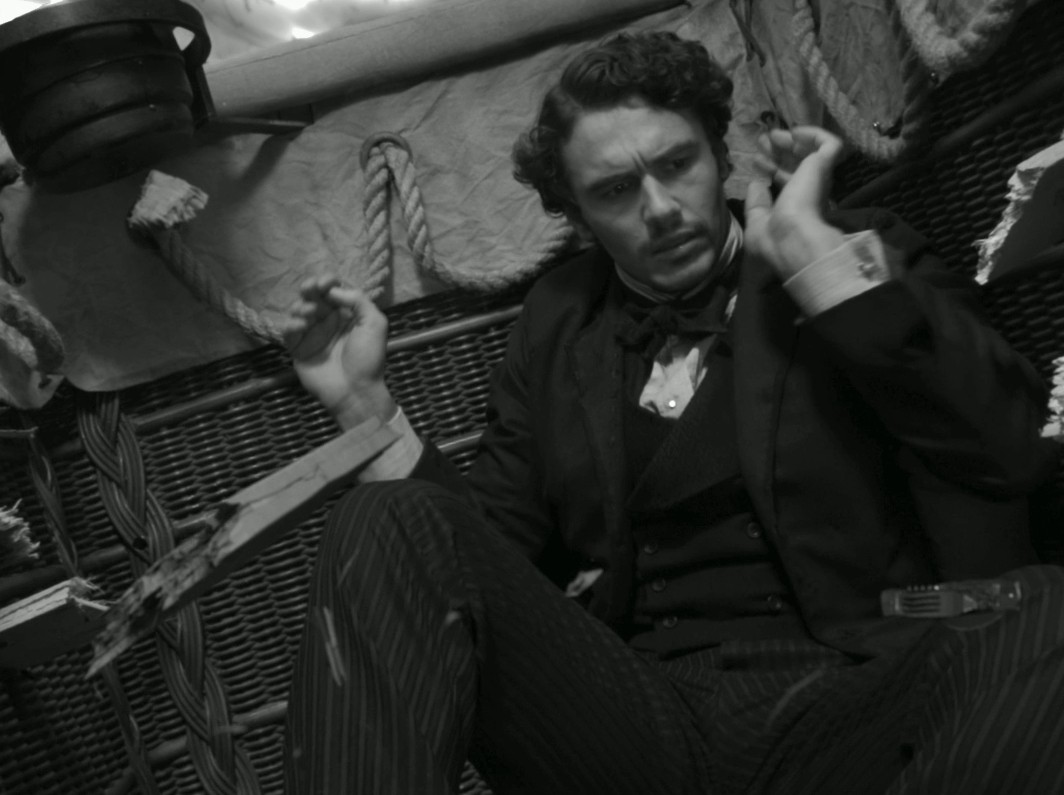
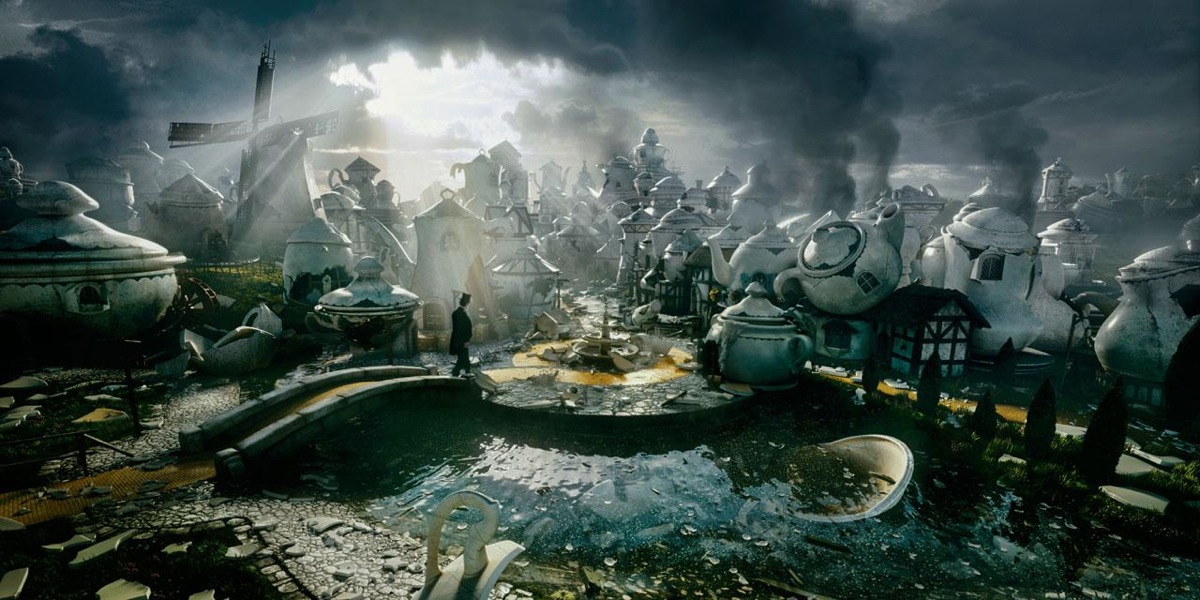
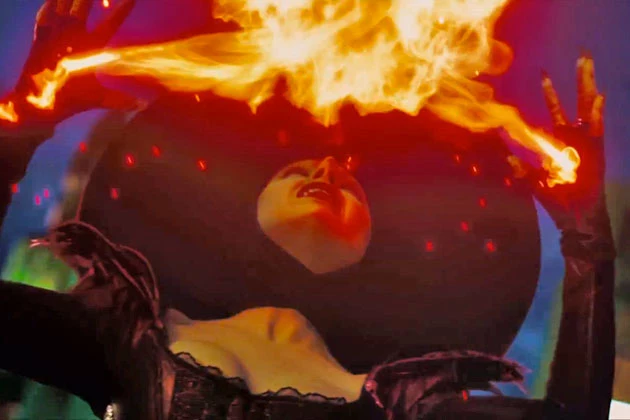
Sam Raimi, he of larkey horror films and the Tobey Maguire Spidermen, is probably a very good choice for doing an OZ film, as he has equal qualities of sweetness and sour, where Tim Burton (the next usual suspect*) would have made the film travel heavier to the morose.  Raimi's Disney's Oz the Great and Powerful (as convoluted and punctuationally challenged a title if ever, oh ever, there was one) manages to be its own thing while bowing and occasionally scraping to the previous' yellow brick road (which is revealed, as an aside, to have potholes, which nicely sums up the movie's respect, and lack thereof).  A prequel, kinda sorta to The Wizard of Oz, it starts out in a black and white box-square format (with a special effect detail amusingly violating it here and there) on a sound-staged Kansas that creepily recalls the musical version.  There scam-magician Oscar Diggs (James Franco) is conning rubes and comely assistants alike, and taking advantage of his stage-assistant, Frank (Zach Braff).  He's a jerk, only revealed to better purposes when a lost love (Michelle Williams) comes to visit to tell him she's going to marry farmer John Gale (father of Dorothy, making her mother of), and he takes the higher road, telling her she chose the better man.

But his past catches up with him...or tries to...and his road goes even higher, escaping a vengeful cuckolded circus strong-man in a helium balloon.  Kansas being Kansas, he is caught up in a tornado—one that presumably opens up a rip in the space-time continuum through some sort of meteorological consequence, and winds up in the storied land of Oz, where, true to movie-form, everything turns to color and the screen expands to wide-screen proportions.


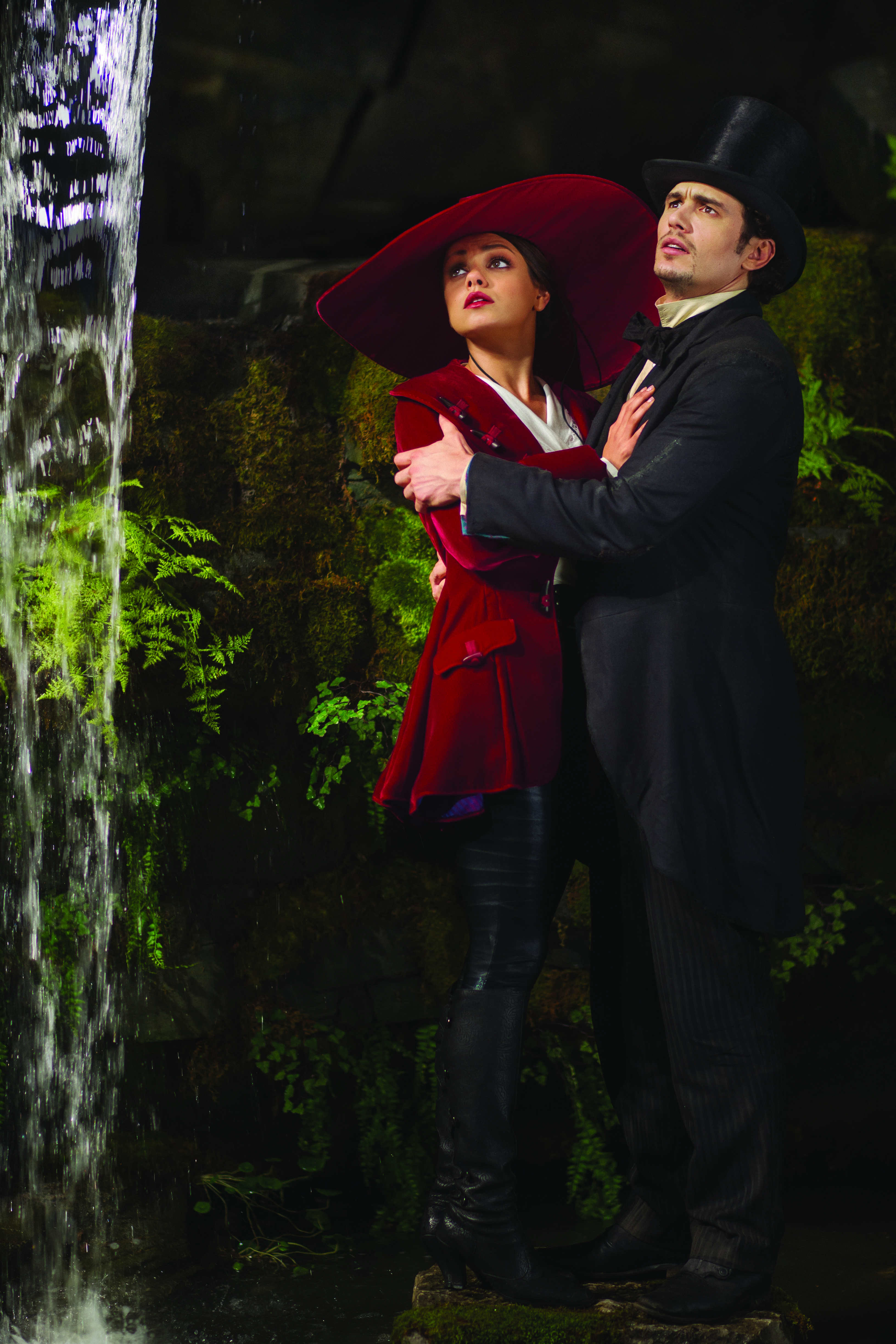
The pattern is set—Diggs is an outsider, a stranger in a strange land, but enough of a rouĂ© that any sense of wonder he initially feels is soon replaced by annoyance (Franco is great at that).  Oh, it's nice to have a minor seduction with the first female he stumbles on, Theodora (Mila Kunis), but the flying monkeys (in the form of Finley, voiced by Braff), and the girl who comes from hummle beginnings, the fragile porcelain girl (who comes from the neighboring land of Chinatown and voiced by Joey King), but before long he's embroiled in Oz's matriarchal politics between witches Theodora and her evil sister Evanora (Rachel Weisz), who are lording it over the Emerald Cityand the witch Glinda (Williams again), who is protecting the provinces from the influence of the Big Bad City.  This troika of females all think that Oscar will bring some sort of balance to Oz, and despite himself, he's got enough answers to help Finely and China, who become devotees.  Evanora is the first to see Oscar and think "there goes the neighborhood," and the plot and the make-up thickens in a battle royale between the various forces of magic, Evanora and Theodora in the Emerald City, and Glinda and Oscar and her army of tinkers, winkies and munchkins.  Tinkers and winkies and munchkins.  Oh my.


As Donald Rumsfeld said, you fight with the army you got.


And just to show this isn't Gramma's OZ (or Louis B. Mayer's) when we get welcomed to Munchkinland this time, and the town's welcome wagoneers start into a bouncey little song with high, tight voices (provided by composer Danny Elfman), Diggs just calls the whole thing off: "Stop!  Stop it!"  Musical numbers are not tolerated in this more cynical fantasyland.  Nor is anything approaching the good-heartedness of Baum or Fleming.  Even Glinda the Good Witch turns out to be something of a bad-ass here, far badder than in the '39 version.  And that's just a little backwards because the original has an empowered little girl who saves the day, while in this one it's a man, a messiah, who must sort things out in the messy rule of a matriarchy.  


This is progress?


The movie ends with some fantasy-nastiness.  Glinda is captured, tortured, and made to grovel before the sisters, Oscar comes to the rescue with his own Earth-bound pyrotechnics, similar to what he's use in the future.  But the movie feels very much like a movie of today—things end not with a splash of water, but a lot of impressive fireworks.  You want something a little meatier, though, something that might last and impress longer, but given the Oz that will come post-prequel, there's really nothing much to do about it.  The great and powerful Oz is merely a humbug, the man behind the curtain.  The evil sisters will remain evil, although Evanora's fashion sense (especially regards hosiery) will take a serious hit.  And Oscar will become a patriarch based on big promises with nothing much to back it up.  Sounds like any politician, really.  This Oz is not so magical, not so great and not so powerful.  What it needs is more brains, more heart and more courage.


Disney's Oz the Great and Powerful is a Rental.


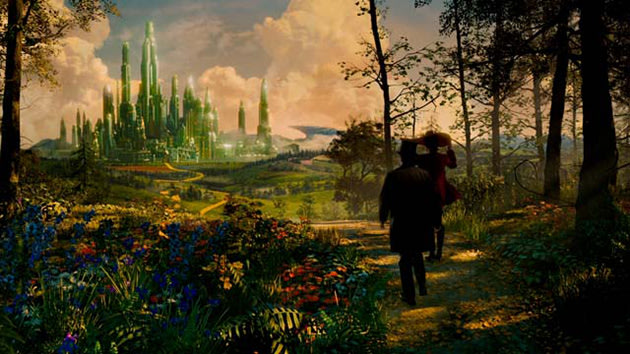
Yellow Brick Road?  Check.  Emerald City? Check.  Dark Forest?  Check.
Now we just needs brains, a heart and courage.


Oz, the Great and Powerful is available on DVD starting today.


And the original is forever.
 
* Frequently recalled as this film is scored by Burton co-conspirator Danny Elfman.

Wednesday, August 10, 2011

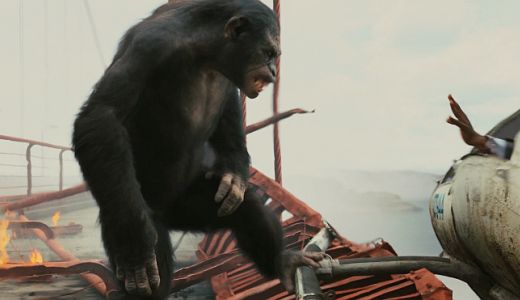
Rise of the Planet of the Apes

"Running the Serkis from the Monkey Cage"
or
"Well...That was Fun..."

Conquest of the Planet of the Apes was always the controversial one in the "Apes" series.  Test audiences were so upset at the carnage—rioting apes bludgeoning government officials with rifle-butts—that a drastic re-write and edit was demanded by 20th Century Fox (it's why, when you watch Caesar—Roddy McDowall—delivering his "let's be merciful" speech at the end, you only see his eyes to avoid any lip...er...mask-sync problems). Tonally, it's jarring...as well as being a load of bananas. Conquest could have been good...in the disquieting way that the "Apes" movies could be.  But, instead, the studio ham-strung it's simian rights leader.

It's different times now.   The cities aren't burning down, only our 401K's.  So, along comes Rise of the Planet of the Apes—as unnecessary and pointless as any movie could be in this dull Summer Season for movies—after all, it's not a "tent-pole" franchise and arriving rather late in August.  The "Apes" series had already run dry in its first go-'round, and in 2001, Tim Burton put out a "re-imagining" of the original that only proved that a "re-imagining" with better FX and make-up doesn't improve on something that depended on some good ideas first and the rest second.  This new one seemed like a too late after-thought, and although the trailers looked intriguing, the ad campaigns and posters were uninspiring—there were no "character" posters, no tie-in cups at the 7-11, no "franchise" buzz—just another "Apes" movie long past its relevancy.

Except it has one thing going for it—good ideas. And when I say "good ideas," I don't mean the lines are clever (they aren't—Caesar gets the best lines, and the most effective scenes are played without dialogue) or the acting is anything that will get James Franco another Oscar nomination (he plays it absolutely straight—he has to, and given what surely were bizarre circumstances on the set, that is quite the accomplishment and there's no "hip" attempt to distance himself from the subject). But, at the basic story-telling level of Rise, there are good ideas that play out and lead the audience along, incrementally ramping up the circumstances until you can accept the anarchic and truly mind-blowing with a straight face. Where Burton's Planet billed itself as a "re-imagining," Rise truly is one, turning the circumstances of the first film on its ear, as the circumstances of the Charlton Heston classic turned the evolutionary relations of man and monkey on theirs.

The film starts with a sequence cleverly patterned after "The Hunt" sequence from the 1968 film, and follows its hero's journey through the cruel circumstances of living in Man's World, after having a fairly free existence for most of its growing life,* paralleling Astronaut Taylor's cynically-smug attitude (and subsequent come-down) from the first film. That it goes into different territory, quickly and strategically, is where this film strikes out on equally sure footing.

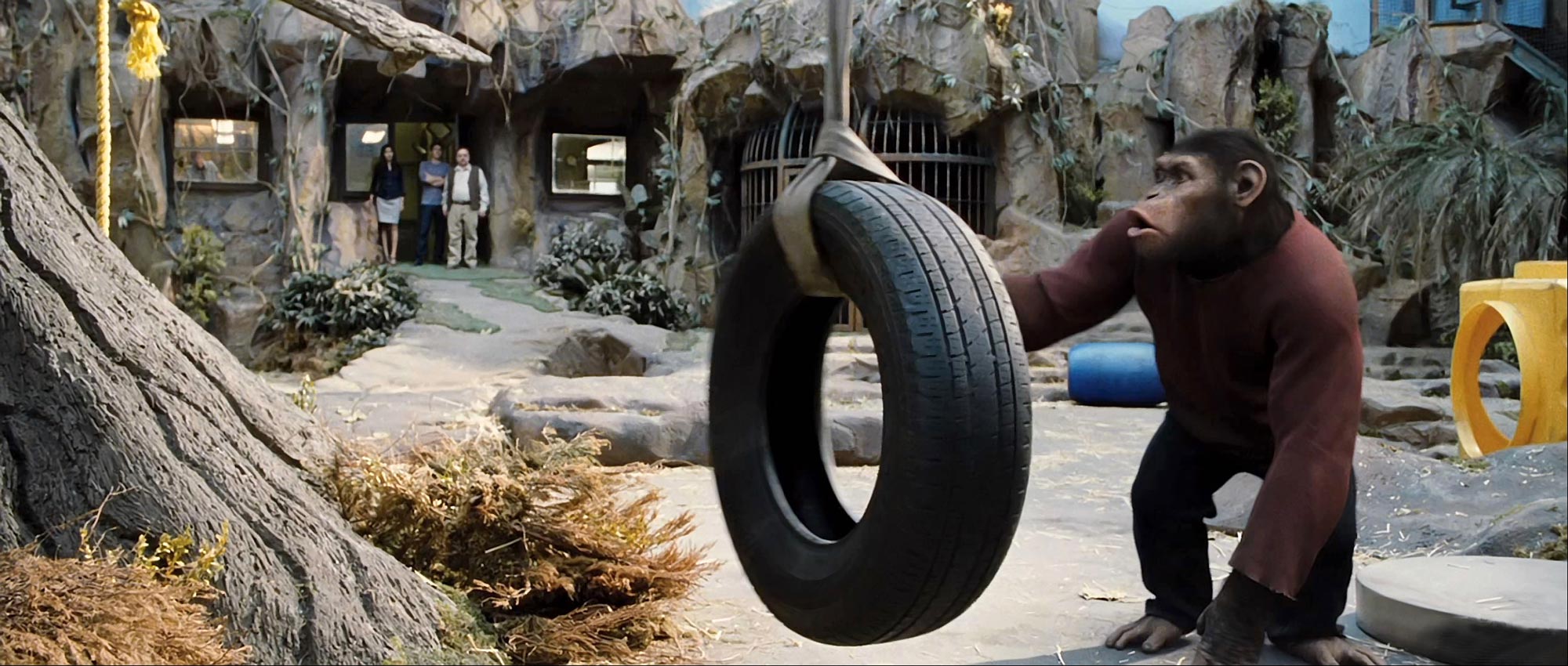
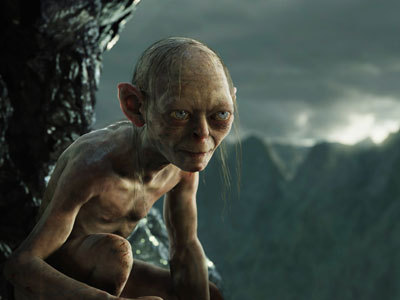
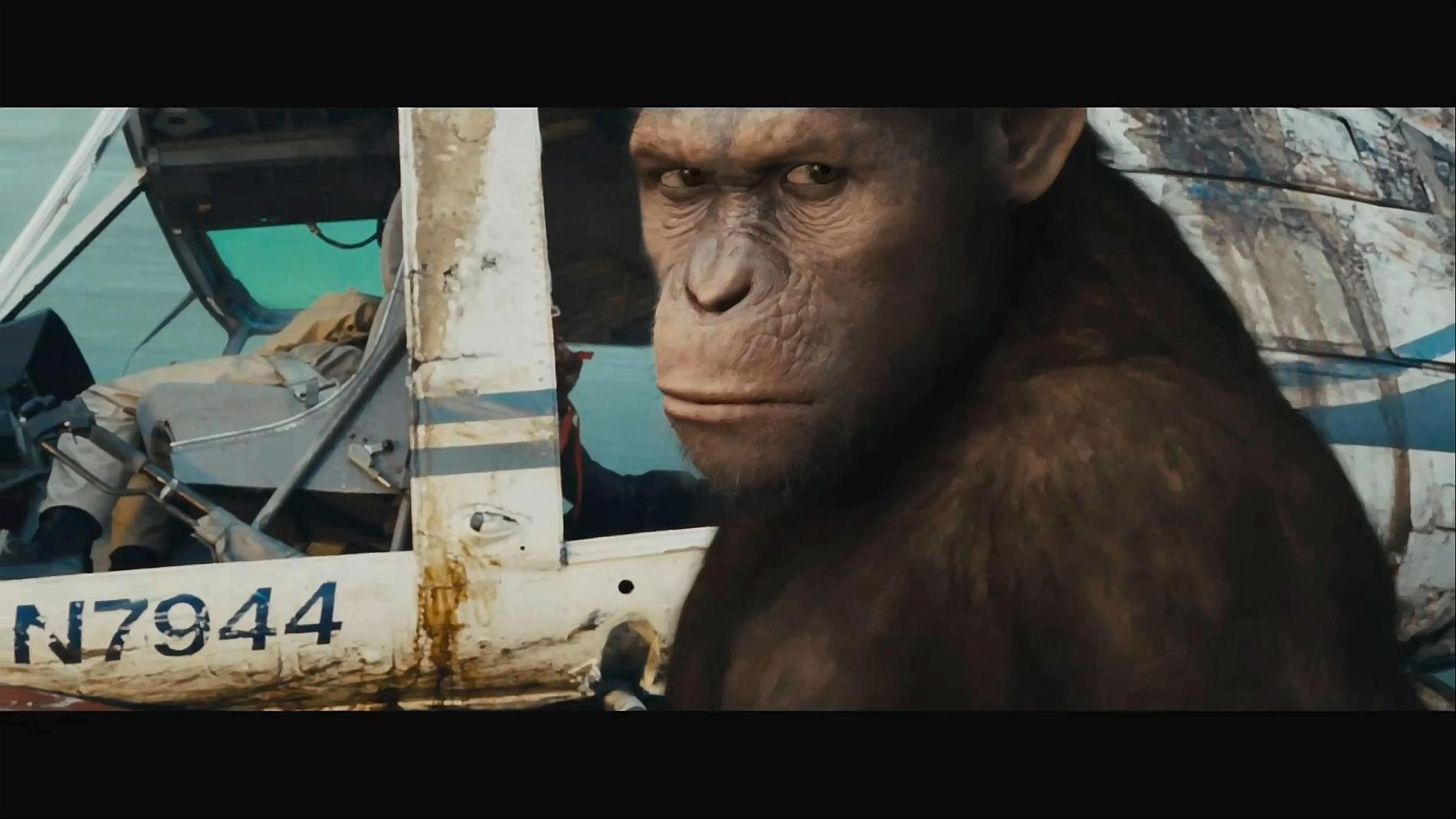
It couldn't have come at a better time, really, when motion capture technology allows abandoning the use of the monkey make-up that has gone before to achieve its animal effects—as well as having Andy Serkis (he was "Gollum" in the Lord of the Rings trilogy and played "Kong" in Peter Jackson's version of King Kong) mime-playing the lead Ape, Caesar,** which elevates the film, and pays off in strange (and surprisingly subtle) ways one couldn't imagine before. Also, that a lot of it hinges on basic silent movie techniques raises this one considerably in my eyes. Kudos to director Rupert Wyatt (only his second feature) for his good, strong story-telling and to writers Rick Jaffa and Amanda Silver for cracking this "Planet" wide open.***

One appreciates the big picture (man's technological hubris is again his downfall as in the first film) and the small (Caesar's symbol for freedom is nicely arced through the film, and it's not coincidence that the lab where Franco's Alzheimer's cure is developed and the primate facility at the Animal Control compound are structurally the same) that neatly draws parallels within itself and the franchise, taking what was good in concept, expanding on it and breaking out on its own.  The result is a rip-roaring film that stands on its own, yet makes one anticipate, even beg for, a continuation if it can be done as well as this one.

Rise of the Planet of the Apes is a very nifty (and unsettling) Matinee.


"...paying off in strange (and surprisingly subtle) ways."


* There may be a little too much of that, actually. The structure of the film so complemets the first film—to a point—that it seems unnecessary to "gild the lily" with so many call-backs from the original—we didn't need a word for word utterance of the first film's iconic line...and do you think the dullards at the Animal Control facility would REALLY be watching The Agony and the Ecstacy? (They'd be better advised to watch Spartacus, although it isn't owned by 20th Century Fox, nor does it star the appropriate actor). Now, Agony/Ecstacy would work...if the one guard was particularly religious...which could inspire in Caesar the whole concept of "The Lawgiver" that was presented in the original series. But, I digress (fan-boyishly)...

** The same motion-capture process that was employed with Serkis for Gollum and Kong was used here by
WETA, Peter Jackson's New Zealand FX company. Some of the early scenes are a bit dicey, but once things start galloping along...the FX work becomes truly amazing. Now, with motion-capture, it's become a unique combination of the mime-work done to portray the pre-human apes in 2001 and John Chambers' enhanced theatrical make-up (Arthur C. Clarke ruefully noted that Chambers won a special Oscar that year for his POTA work, rather than 2001: A Space Odyssey, as the Academy "didn't realize our apes were actors."). And back to the point of Franco's job here (and frankly, everybody's), he had to play it completely disciplined in his scenes with Serkis, even though the latter was surrounded by
one of the those crazy "motion-capture" suits, while on location (rather than a green-screen stage), which is a movie first.


*** Glenn Kenney, who writes for MSN Movies, fairly nailed it in the expansion of his review. Kenney's no slouch, but called the film "very nearly close to completely awesome" in the review, and noted that the film had four "Holy Shit!" moments, where something so unexpected happens that you wonder what could happen next (at the packed showing I attended, there were audible gasps at one particular happenstance—even though it parallels something that happens in the first film—followed by very nervous laughter).  I counted six (but I have a low threshold for "Holy Shit!" moments), where most of the movies this year have had precisely zero.

Thursday, April 21, 2011

Your Highness

"Du-uh..."
or
"Natalie Portman's Post-Oscar Slump, Part 1"

I've needed a laugh lately.  I've been second-and third-guessing myself, not sure which way to go on all sorts of matters.  And after seeing two movies, good and bad, in which anyone can be tread upon by the Government (The Conspirator and this Saturday's "Take Out the Trash" entry), I needed something light, something frothy, something not Hanna or The Lincoln Lawyer.

I needed a comedy, dammit!  After playing pin-ball in my head for a week and a half, I wanted a new thought to tilt me out of my doldrums. It would be appropriate, too, as every scene we've looked at Sundays of this April Fools Month has been a comedy (this week will be no exception), so a comedy might be just the thing to kick my torpor in the ass, or at least make it slip on a banana peel.

Wish I'd found one, because this isn't it.

Your Highness, in fact, makes me wish I was living in a different era—not the one depicted in the film, of course, but also not in a time when such a movie, with big stars (every Briton who isn't in the "Harry Potter" series, like Charles Dance and Damian Lewis), sumptuous locales and elaborate costuming can be so sloppily put-together that one gets the impression that at every stage the film-makers said "Eh...good enough" and moved on.  I noticed myself laughing exactly twice, and longing for something—anything—to be half-way clever or even half-way executed.*  I like my comedy to have a brain in its head, and something to say besides what could shock your grandmother.  Despite the cast, this one has so little going for it, you start to worry that at least the cast were well compensated.  Because it couldn't have been for love.

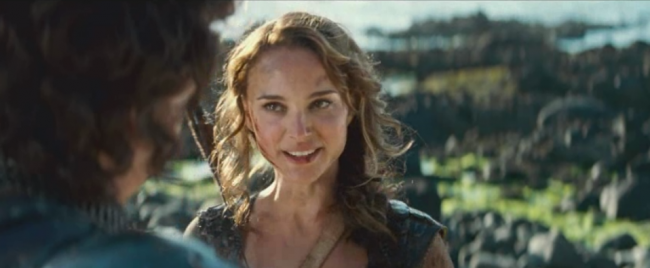
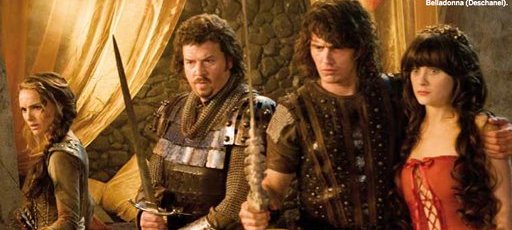
I'm a fan of James Franco, Natalie Portman and Zooey Deschanel, but why they should play second-fiddle to Danny McBride (who's usually lousy...Land of the Lost...and who barely registered as the reluctant groom in Up in the Air) is beyond me  Sure, Franco probably owes director David Gordon Green for his role in Pineapple Express (which I haven't seen, but have heard good things about), but he seems a bit lost in this, although gamely appearing cluelessly cheery throughout.  

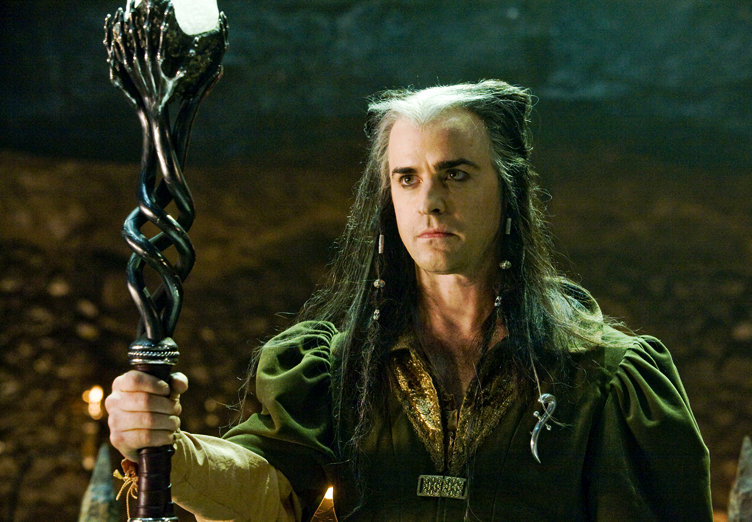
Borrowing heavily from every fantasy-adventure movie from the last 20 years (and liberally from Star Wars—their take on Yoda is particularly nasty, and they have a clockwork bird-familiar after the original Clash of the Titans), Highness tells the story of the sons of King Tallious (Dance) and his two sons—the heir to the throne, Fabious (Franco), and the ne'er-do-well younger Thadeous (McBride) who would appear to be "Your Lowness."  Fabious' bride Belladonna (Deschanel) is kidnapped by the evil sorcerer Leezar (Justin Theroux, who co-wrote Tropic Thunder, another high-concept low-result comedy) for his own nefarious plans.  Fabious recruits Thadeous to go on the search for Lezar, despite the fact that the younger Prince can't fight, doesn't travel well, and is in all things incompetent.  Plus, he's the "troop griper/whiner."  Good planning.  Dick jokes ensue.

Between the puerile humor there are some action sequences, but Green has a hard time deciding whether he's playing them for laughs or for jolts.  Not that it matters, as they succeed in neither, not even in the way that competent directors can achieve both or even one.  And, although things are accomplished, nobody really learns anything so character arcs are as flat as a crushed pixie (the only clever idea I saw in the whole thing).

But, one thing Your Highness did accomplish: I had no second thoughts about it.

Maybe Hanna would have had more laughs.

Your Highness is a Waste of Everybody's Time.

* A complete execution...of me...was what I wanted after seeing this movie!  One thing that is mentioned in all the write-ups I've seen is that the crew went into production with  only a story and everything was adlibbed on-set.  Really, they shouldn't be boasting about that.

Wednesday, March 16, 2011

Eat Pray Love


Eat Pray Love (Ryan Murphy, 2010) Eat Pray Love wants to be unconventional—it practically begs to be seen as revolutionary in its philosophy and presentation—but it is so thoroughly conventional that one wonders why they didn't just bother re-running another chick-travel film, about "finding oneself" only to turn the idea on its ear and make it about finding "the right man."  Three Coins in the Fountain, anyone?

I need another one of those like a fish needs a bicycle.

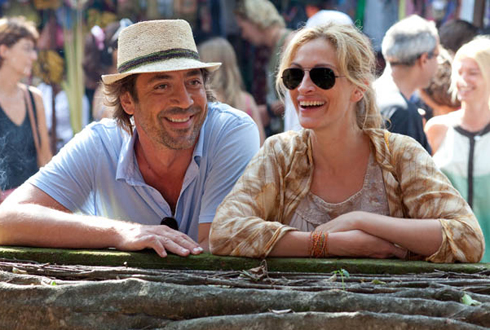
Don't get me wrong.  I'm glad author Elizabeth Gilbert (played here by Julia Roberts) had her little adventure after a divorce from her peacock of a husband (Billy Crudup) and an affair with an actor (James Franco...gee, both good life-choices picking the self-absorbed—Does that say anything?).  It's tough to work up any real sympathy for her as she has the funds, the time and the wherewithal to spend a year in Italy ("Eat"), India ("Pray"), and Bali ("Loooove").  Good on ya, Liz.  Hope you do a lot of charity work.  Because a lot of the folks who took care of your needs during the trip couldn't afford a journey like that, and, frankly, don't have the time and luxury to "find oneself, " they're too busy just trying to "deal."

I know; bad attitude.  I should go in "open" and "ready to receive."  Fact is, I'd be buying it if the author were trying to go from self-absorbed to self-actualizing, but she can't seem to construct a sentence (when she thinks long enough to not just "pop off") that doesn't have the word "I" in it.*  I suppose I should be happy that she goes to these places, rather than just having the world revolve around her to get there.

But the damned thing is such a cheat.  She escapes two failed relationships only to plunge into one at the end (Ooooh...big "spoiler" alert!), as if that is what is needed in her life, and it doesn't occur to her observing the arranged marriages and the servile populaces that her ability to have a choice is the best thing she has going for her, and that the ability to say "no"—to high calorie meals, to collective brain-washing, to pushy men—does "no" good unless it is actually utilized, rather than ignored for indulgence.  All she lost was a year of her time.  What she found...well, that's a good question.

Murphy also does some indulging—in over-editing this travelogue—you can't pick up a menu and order without unnecessarily seeing the food being prepared in the next shot, item by item—although Robert Richardson's photography manages to make it all blend seamlessly together despite the various styles he uses.  And the performances are heart-felt, especially Franco and Richard Jenkins and Javier Bardemfunny, that she doesn't get romantically involved with Jenkins' brashly wise Texan (who is the most moving person in the piece), could it be that he isn't attractive enough?  It's one of the things that makes you suspect how facile this movie is,** and that the protagonist only swims in the shallow end of the pool.

Ultimately, it's a movie that makes you go "how nice for you," while thinking that it's wasted two hours of your own valuable life.  That's right.  The world doesn't revolve around her.  It revolves around me.


Elizabeth Gilbert, enjoying her residuals.  Lesson learned.


* At a "Thanksgiving Dinner" in Italy, the table goes 'round counting their blessings, which involve other people and they are nice and heart-felt, then it goes to Liz, who thanks that she's surrounded by a table full of wonderful people (Good start, Liz), then finishes by saying "she's the luckiest girl in the world."  It's all about her.


** Other things that annoyed me: the Theme from "Last Tango in Paris" is a signature theme for Italy.  Really?  In fact, the whole soundtrack is chock-a-block with songs of western culture that nullify any depth of feeling for the places.

Tuesday, November 30, 2010

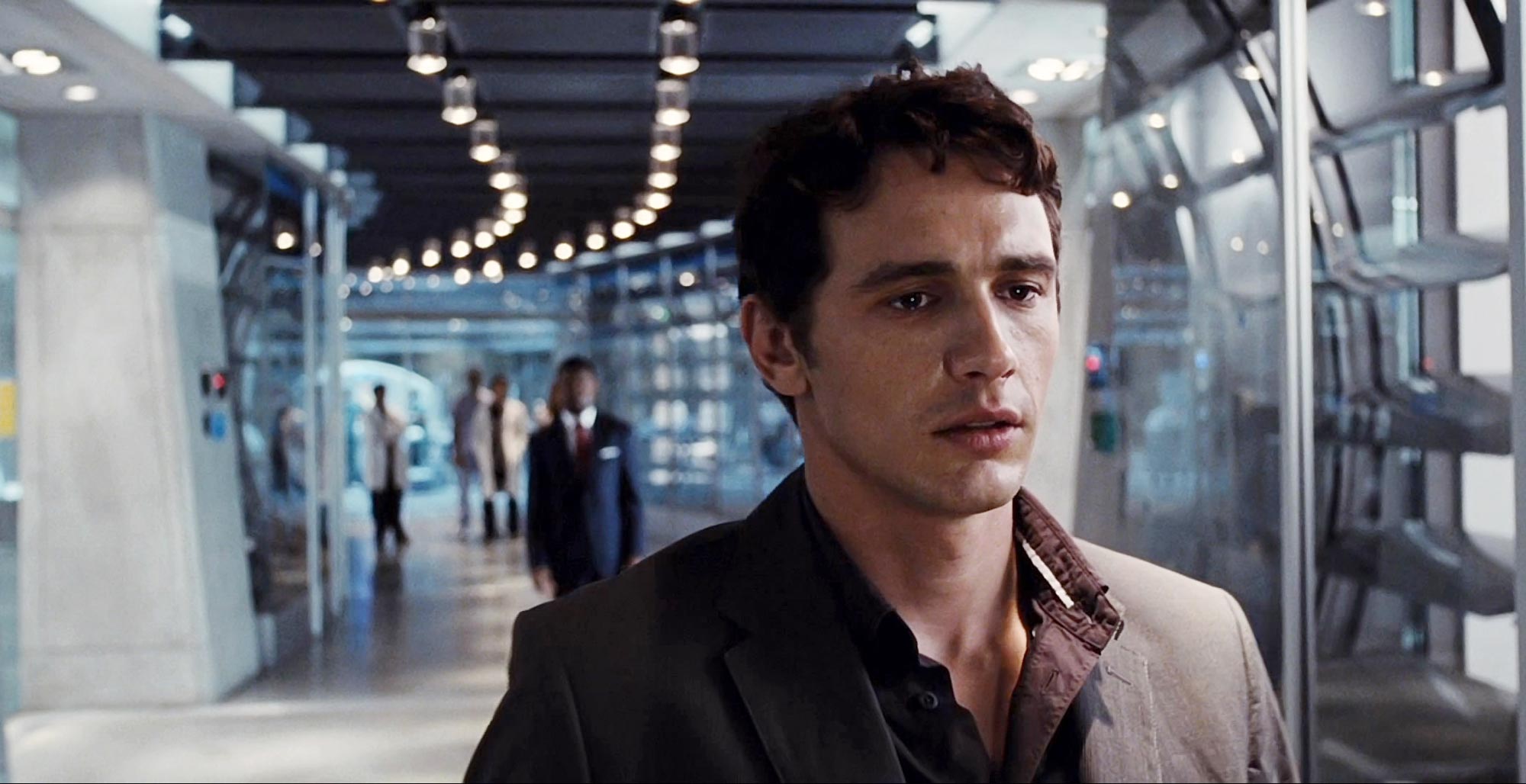
127 Hours


"Drinking Your Own Epiphany"
or
"Rock On/('Ooops')/Arm(our) Off"

The story of Aron Ralston, extreme....everything, who, on a solo trek through Canyonlands National Park in Utah finds himself stuck in a seam of the Earth pinned down by a boulder he has no way of moving, is a harrowing story of survival, self-reliance and an ultimate example of "a man's gotta do what a man's gotta do."* Beyond the gruesome headlines is the story of a young man, who, faced with a situation putting him, literally and figuratively "between a rock and a hard place" (the title of his book outlining the story), chose to follow his philosophy to an extreme act, losing a part of himself, but gaining far, far more.

Not your typical film subject.  In fact, it would be a daunting thing to film, not only from a technical aspect—limited staging, convincing illusions of the injury—but from a dramatic one, as well (we're talking one-man show in a cave).

Danny Boyle's film of the incident, though, 127 Hours, not only makes the film seem invisibly easy to accomplish—one doesn't think for a moment of the filming difficulties, so engrossed are you in the challenges of the film-Ralston in his tasks trying to extricate himself and survive, basically—it is an intense, kaleidoscopic presentation of a human psyche in solitary duress.  Ralston (James Franco) fights the battle on two fronts: physically, dealing with his limited options and the practical, and impractical, tools at his disposal; and mentally, as he struggles with the mental challenges of time, pain and personality.  With only 15 minutes of sunlight each day, which he finds the capacity to luxuriate through, he keeps a running countdown of resources, limited food and water, the tools at his command and his own diminished capacity.  He knows his time and options are limited, and gradually, as they run out—that poster embedded here suggests, very appropriately, an hour-glass—he must come to grips with his responsibility to himself, and the people in his life that, heretofore, have been merely fleeting encounters, as jettisonable as the wrapper of his last Power bar.

Time wounds all heels.  And in his forced imprisonment, the taking stock of Aron Ralston brings focus and clarityThe hyper-activity of Ralston's previous life, which Boyle crams into a split-screen multi-speed, multi-media format, is stilled, brought to a very narrow range of existence, and places him in the Here and Now, as opposed to the Next Empty Thing.  Time and relationships become essentials, and his own self, literally and metaphorically, becomes disposable.  He discards, mentally, physically, what has become useless.

And chooses life.

Wow.  Great story.  "Intense" (as one Grand Cinema patron remarked leaving the theater gasped) and harrowing.

Don't let the amputation aspects of the film turn you off to a great film experience.  Yes, it's graphic (Boyle prepares you for it with early attempts that do nothing to solve the situation—they're more exploratory surgeries), yes, there will be blood...and sinew and gristle...and nerve-slicing—which Boyle and his sound-designers amp up with a dentist-drill irritation—but, nothing that hasn't been CSI'd into our consciousness to the point of numbness.  By this time, the identification with Ralston has become so empathetic, that I (perversely, I guess) found the episode liberating, and an act to be cheered.

Boyle's quilting of the movie is brilliant, but he's aided and abetted by an army of technicians who keep things fascinating, not the least of which are cinematographers Enrique Chediak and Anthony Dod Mantle, and Boyle's Slumdog Millionaire composer A.R. Rahman (and a goofily eclectic soundtrack).

But the hero is Franco.  After seeming a bit of a "meh" actor in the first Spiderman movie, it has been fun to watch him grow as an actor, first in that series, and in the clutch of carefully chosen dramas and comedies he has made since.  Boyle has set a fine table, but Franco is the center-piece, the one essential ingredient that had to "work" to pull it all together.  This is a sure Oscar-nominated performance, and, if there's any justice, he'll get the statuette, as well.

Oscar-wise, Boyle might even pull a "two-fer."  We're on the cusp of December and the Christmas movie crush, but it is not hard to imagine 127 Hours turning out to be the best movie of the year.

127 Hours is a Full-Price Ticket. **


Aron Ralston.  Rock On.


* I still remember where I was and what I was doing when I first heard the news reports of his story and what he did. I also recall my reaction, which consisted of taking a deity's name in vain, and contemplating—for several minutes—what I would have done in that situation. I could conjure no definitive answer except "Maybe...but certainly not as well."

** I'd say "Give 'em a hand" but that might be a little crass.

Wednesday, January 14, 2009

Milk

"The Plural of 'Us's' is 'I'"

I had all these cute little headlines to put at the top of this review, reflecting my disappointment with Gus Van Sant's bio-pic of slain San Francisco supervisor Harvey Milk—"Condensed Milk," "2% Milk"—but ultimately it comes down to this: you owe it to yourself to see "The Times of Harvey Milk" the Oscar-winning documentary on Milk and his efforts to fight discrimination. No hidden links: You can watch it on Hulu here: http://www.hulu.com/watch/49577/the-times-of-harvey-milk It'll cost you nothing but 90 minutes of your time with minimal interruptions. "Milk" acknowledges its debt to this film in its final credits. Indeed, you'll see a lot of archive footage shared by both films. And "Milk," a features recreations of footage from this film. The film ends with Sean Penn, as Milk, saying the words that you'll find in the video at the bottom of this review into his tape recorder for the prescient "In the Event of My Death by Assassination" tape he made. But that sentiment was not a private one. And the film does a disservice to Milk making it so.

It also inadvertently plays into stereotypes by suggesting that Milk's assassin Dan White was a closeted gay man instead of the mentally ill person he was. White's angry (and public) resignation during a meeting of the Board of Supervisors is also made private in the film. White's sneaking into the city hall with a loaded weapon to avoid metal detectors is alluded to, but not that White re-loaded his pistol after shooting Mayor Moscone and heading to the Supervisor offices to kill three other board members (Milk was the only one present). That the crimes were deliberate seems incontrovertible. But White was only convicted of manslaughter and released after serving five years in prison.

And one can quibble about Penn's performance as well, making Milk more fey in his mannerisms (Milk had hidden his sexuality in New York for years), and giving him a thick Bronx accent more Harvey Fierstein than Harvey Milk (ironically, Fierstein narrates the "Times" documentary).

Still, ya gotta do what ya gotta do. The original documentary is 25 years old and is probably past its shelf-life. A dramatic re-telling of the tale was probably due (a twin project "The Mayor of Castro Street" has been in the works, first by Oliver Stone and more recently by writer Christopher McQuarrie and Bryan Singer for years, and has for the time being been abandoned) if only to keep reminding people of the toll closeted life inflicted on the gay population. The battle continues to put a familiar face on homosexuality. And if a melodramatic re-telling of a pivotal story is required, so be it.

Van Sant does a fine job of mixed media cutting between vintage footage, newscasts, and recreations. And he gets great work out of his cast, particularly Penn, who's never seemed so relaxed in a role, James Franco (who gets better with each movie) as his first partner in San Francisco, and Emile Hirsch from Penn's "Into the Wild" as one of his youngest recruits.

"Milk" is a Matinee.


Monday, January 14, 2008

Spiderman 3

Oh, What a Tangled Web We Weave....

I’ve always taken a jaundiced view of the Marveltm superheroes tm as opposed to the DCtm variety. Where the spandex crowd from Detective Comicstm sprang from pulps and adventure fiction, Marvel’s were derived from Stan Lee’stm previous job--writing romance comics. Back when I picked up the occasional Marvel in the 60’s it was always apparent that they were soap operas with fights, and that it was only a short spidey-jump from “*SOB!* I forgot to have children!” to “*SOB!* I will be Spiderman…No More!” The Marvel Superheroestm are drama-queenstm. This was never more apparent than the ending of the first “Spidermantm movie when Peter Parkertm walks away from the girl who’s just professed her love to him (and in a graveyard *SOB!*), because “with great power comes great responsibilitytm-okay I'll stop”(as with the soaps, this sentiment lasted until the next movie, which ended with them together—I guess responsibility ain’t so great, after all). “Spiderman” was a soap opera punctuated by brutal, ugly fist-fights (which don’t look so cool when not freeze-framed in pop-art patterns) I vividly recall reading the geek-reviews saying “Spiderman” is just like US!” Ri-ight. I’ll bet they didn’t have two gorgeous co-eds fighting over them in high school, as the comics character did. Where that movie worked was “Spidey” in action—especially in the ending where the camera followed him morphing into so many iconic poses favored by various artists over the years—Ditko, Romita, Kane, Andru, McFarlane. There, the true potential of a movie “Spiderman” paid off.

So, when the second movie, combining “Doc Ock/Spiderman…No More!/Mary Jane’s getting hitched,” came out, the screenplay (co-written by Alvin Sargent and Michael Chabon) practically sang. It was a perfect balance between character/melodrama/action and spectacle. In fact, “Spiderman II” is probably the best comic-book movie ever…and the most enjoyable since the first “Superman.” With the creators knowing what worked now, one anticipated “Spiderman III.”

Now, here it is—the most expensive movie ever made (supplanting even “Superman Returns**) and what does it show for all that money being thrown around? A bit, actually. The cast is uniformly good given the material with James Franco finally relaxing and having fun with his role as Harry Osborne. Thomas Hayden Church takes his role as The Sandman VERY seriously—he acts like he’s in an Ibsen play—though the most effective performance is by the “Particle-Matter Generator” Gizmo that created the sequence of him first emerging and pulling himself together. Topher Grace makes the most of his non-CGI moments as Eddie Brock/Venom. And Bryce Dallas Howard (Opie’s kid), after looking like something the cat dragged in for M. Night Shamyalan’s movies, cleans up very nicely as Gwen Stacy, as that essential character of the comics finally shows up.*


There are welcome returns (from the grave, flashback-style) of Cliff Robertson and Willem Dafoe, and J.K. Simmons proves once again he’s the perfect embodiment of Daily Bugle Editor J. Jonah Jameson.


Now, for Tobey McGuire and Kirsten Dunst, here's the problem. For the third in the series the writers were obviously looking for something interesting for the two leads to do. "We'd left them in No.2 happily in love. So....let's shake that up a bit." In this one Peter is going bad (didn't Superman do that in his third movie?) and "MJ" is hitting acreer set-backs to star-dom. Spiderman's popularity is up, while hers is down. Wasn't this "A Star is Born?" Only Tobey is Judy Garland, and Kirsten is James Mason. Getting kinda sudsy there, isn't it? McGuire is allowed to cut loose as "Bad Peter" (under the influence of a "symbiote"--that's how they say it--from outer space. Kirsten Dunst gets to sing in an opening sequence that Sam Raimi stages like its right out of MGM. There are some great fights (some of them are more...dust-ups) that lacked the zanily ferocious wit of the ones in II, go on too long, and are marred by some too-intricate camera-work (or camera simulation) for the sake of too-intricate camera work. Finalley, the whole thing ends in another "Spidey's Gotta Save MJ" grudge-match with the web-head up against Sandman, Venom and Son-of-The-Goblin. It far overstays its welcome and ends in what seems like an interminable wallow.

Anything else wrong? YEAH! Too much Stan Lee screen-time! Stan's cameos are getting longer and longer to the point where he might as well have a running character as a street-sermonizer. Stan! Y'know that phrase "'Nuff said?" Mean it next time!! Oh! And have we managed to get EVERY member of Sam Raimi's family on-screen yet? Next movie, Spidey's going to be fighting The Nepotist!

There's an awful lot to enjoy in fits and starts, but you have to be a certifiable card-carrying true-believer to be completely satisfied with this movie. It's a case of the film-makers throwing as much webbing as they can on-screen and seeing what sticks. Unfortunately, not much. What was promising to be the best comics franchise in movies is making the same mistakes as all the others: Too many villains, too much "business" and "busy-ness," and not enough care for the strengths of the characters and what has been done before. They've attempted too much and accomplished too little...while spending as much money as possible.

"Nuff said.

"Spiderman 3" is a rental, and no, you're not going to miss any details on the small-screen--everything's moving so fast you can't see it on the BIG screen either--not even IMAX!


*Curiously, the two women’s roles are completely reversed in the translation from the comics to the screen. In the comics, Gwen is the sincere hometown knockout, while Mary Jane was the flighty supermodel (“Romance” comics, remember? With a little “Archie” thrown in)

** I'm wrong here. Incredibly, the second most expensive movie in history is "X-men 3: The Last Stand." Hell, "X-men 3" didn't even LOOK good!

--------------------------------------------------------------------------
Post-Script: It's always alarming to see how well crap--even well-constructed crap--sells. Now, "Spidey3" is tearing up the box-office with enough momentum that it could very well become one of the "Largest Earning Films in History." In doing some research for an earlier post, I was alarmed to see what is now on the list of the "Big Boffo" films: "Shrek 2" is #3? It wasn't as good as "Shrek 1!" The second "Pirates of the Caribbean?" It was bad--not even fulfilling the promise of the first one, but it's at #6! "Independence Day" at 21? "Narnia" at 24? "Meet the Fockers?" At 29! ("Spidey 3" at the time of this writing is at #33).It's also interesting to note how sequels seem to fare better than the originals--as if their popular momentum has increased (something that might be attributable to more people seeing it initially on home-video than the theater)--certainly "Spiderman 3" bares that out even more than "2" did.

But one can't get too exercised about this: "
Norbit" was the top box-office draw one weekend, after all. And as James Aubrey once said: "No one ever went broke under-estimating the intelligence of the American people" (I believe that was right after he green-lit "The Beverly Hillbillies" for CBS).