Showing posts with label Danny Boyle. Show all posts

Wednesday, May 22, 2013

Trance

Post-Modern-Femi-Noir
or
I See London, I See Trance

Danny Boyle has been on something of a tear lately.  His last couple films have been popular show-cases of how diverse and direct his story-telling skills can be now, and resonant with audiences.  And yet none of his recent films should have "worked:"  Oscar-winning Slumdog Millionaire's combination of pop culture, Bollywood, gangsterism and classic literature; 127 Hours' brutal and claustrophobic story about a man  who cuts off his own arm, which still manages to be uplifting and even inspiring.  Boyle is now a household name and an A-list director thanks to Slumdog.  His previous film, the sardonic sci-fi film Sunshine did not attract an audience, nor did his kids' film Millions (despite being delightful, both for kids and adults).  His new prestige made him the natural choice to become the creative director for last year's London Olympics.

It was while working on them that the opportunity came to take a break, and he rushed this film, Trance, into production—not that you could tell, it's full of his multi-media eclecticism that at times can run out of control.  The script had already been directed (by its writer Joe Aherne) as a TV movie in 2001.  It's a heist film with several twists, and, as Doyle has said in interviews, it was a dark tonic to the celebratory work he was doing for the Games.

We are introduced to the movie by Simon (James McAvoy) who gives us a brief art history lesson on particular paintings and their peculiarities.  But one thing about this ersatz collection sets them apart; "You haven't seen them because they've been stolen."  Simon works as an art auctioneer and walks us through a brief summary of audacious art thefts, and the precautions that auction houses take to protect their commodities.  "Lesson number one," though, is "don't be a hero.  No work of art is worth a human life." 


"Rule No. 1: Don't Be a Hero."
It's a lesson he should take to heart.  A robbery does take place, and true to instructions, Simon isn't a hero--he's in on it, the job's "inside man.'  But, in the shell-game of keeping up appearances, he is given a severe head trauma, and (isn't this a pretty picture?) can't remember what he did with the painting.    This is, of course, quite upsetting to the ringleader, Franck (Vincent Cassell), who tries to extract the information in the typical gangster fashion (old fashioned threats of death, disfigurement, and the actual pulling out of  fingernails).  Nothing breaks through Simon's personal pentimento.

Go to Plan B.  They send Simon to hypnotherapist Elizabeth Lamb (Rosario Dawson), who's had quite a success breaking addictions, changing lives and messing with heads.  It's the latter skill that comes in good stead as she quickly realizes that Simon is not just a guy in need of finding his car-keys, but may be in league with the devil.  Finding his memory might make him a memory.


Doyle's good at messing with heads, as well, as Trance proves fairly quickly. 

Under his hypnotherapy, loyalties are tested (particularly the audience's), and no matter what subject matter on screen, whether grisly or enticing, it's tough to take your eyes off the screen.  Pretty soon you're not sure what's real, what's illusion...or (finally) what's going on.  Some neat tricks are played, expectations are shattered, but all to the service of a script that isn't all that great.  One can appreciate the twists and turns and diversions, and the slightly feminist slant that the movie tilts the traditional role of the femme fatale in film noir.  But, ultimately the biggest trick that's pulled is the illusion that a better movie is happening.  For all the visual pyrotechnics and the reality warping manipulation of the audience, Trance isn't that good a movie, and unconsciously or consciously, a trifle.

Trance is a Rental.


Goya's Witches in the Air—the "MacGuffin" of the movie

Tuesday, November 30, 2010

127 Hours


"Drinking Your Own Epiphany"
or
"Rock On/('Ooops')/Arm(our) Off"

The story of Aron Ralston, extreme....everything, who, on a solo trek through Canyonlands National Park in Utah finds himself stuck in a seam of the Earth pinned down by a boulder he has no way of moving, is a harrowing story of survival, self-reliance and an ultimate example of "a man's gotta do what a man's gotta do."* Beyond the gruesome headlines is the story of a young man, who, faced with a situation putting him, literally and figuratively "between a rock and a hard place" (the title of his book outlining the story), chose to follow his philosophy to an extreme act, losing a part of himself, but gaining far, far more.

Not your typical film subject.  In fact, it would be a daunting thing to film, not only from a technical aspect—limited staging, convincing illusions of the injury—but from a dramatic one, as well (we're talking one-man show in a cave).

Danny Boyle's film of the incident, though, 127 Hours, not only makes the film seem invisibly easy to accomplish—one doesn't think for a moment of the filming difficulties, so engrossed are you in the challenges of the film-Ralston in his tasks trying to extricate himself and survive, basically—it is an intense, kaleidoscopic presentation of a human psyche in solitary duress.  Ralston (James Franco) fights the battle on two fronts: physically, dealing with his limited options and the practical, and impractical, tools at his disposal; and mentally, as he struggles with the mental challenges of time, pain and personality.  With only 15 minutes of sunlight each day, which he finds the capacity to luxuriate through, he keeps a running countdown of resources, limited food and water, the tools at his command and his own diminished capacity.  He knows his time and options are limited, and gradually, as they run out—that poster embedded here suggests, very appropriately, an hour-glass—he must come to grips with his responsibility to himself, and the people in his life that, heretofore, have been merely fleeting encounters, as jettisonable as the wrapper of his last Power bar.

Time wounds all heels.  And in his forced imprisonment, the taking stock of Aron Ralston brings focus and clarityThe hyper-activity of Ralston's previous life, which Boyle crams into a split-screen multi-speed, multi-media format, is stilled, brought to a very narrow range of existence, and places him in the Here and Now, as opposed to the Next Empty Thing.  Time and relationships become essentials, and his own self, literally and metaphorically, becomes disposable.  He discards, mentally, physically, what has become useless.

And chooses life.

Wow.  Great story.  "Intense" (as one Grand Cinema patron remarked leaving the theater gasped) and harrowing.

Don't let the amputation aspects of the film turn you off to a great film experience.  Yes, it's graphic (Boyle prepares you for it with early attempts that do nothing to solve the situation—they're more exploratory surgeries), yes, there will be blood...and sinew and gristle...and nerve-slicing—which Boyle and his sound-designers amp up with a dentist-drill irritation—but, nothing that hasn't been CSI'd into our consciousness to the point of numbness.  By this time, the identification with Ralston has become so empathetic, that I (perversely, I guess) found the episode liberating, and an act to be cheered.

Boyle's quilting of the movie is brilliant, but he's aided and abetted by an army of technicians who keep things fascinating, not the least of which are cinematographers Enrique Chediak and Anthony Dod Mantle, and Boyle's Slumdog Millionaire composer A.R. Rahman (and a goofily eclectic soundtrack).

But the hero is Franco.  After seeming a bit of a "meh" actor in the first Spiderman movie, it has been fun to watch him grow as an actor, first in that series, and in the clutch of carefully chosen dramas and comedies he has made since.  Boyle has set a fine table, but Franco is the center-piece, the one essential ingredient that had to "work" to pull it all together.  This is a sure Oscar-nominated performance, and, if there's any justice, he'll get the statuette, as well.

Oscar-wise, Boyle might even pull a "two-fer."  We're on the cusp of December and the Christmas movie crush, but it is not hard to imagine 127 Hours turning out to be the best movie of the year.

127 Hours is a Full-Price Ticket. **


Aron Ralston.  Rock On.


* I still remember where I was and what I was doing when I first heard the news reports of his story and what he did. I also recall my reaction, which consisted of taking a deity's name in vain, and contemplating—for several minutes—what I would have done in that situation. I could conjure no definitive answer except "Maybe...but certainly not as well."

** I'd say "Give 'em a hand" but that might be a little crass.

Monday, December 29, 2008

Slumdog Millionaire

"Is That Your Final Answer?"
or
"My karma ran over your dogma"


There's a backlash against "Slumdog Millionaire." There had to be. Showing up at the end of the year with such a positive critical reputation and so many glowing reviews, a few noses-out-of-joint had to be lifted in the air to pronounce that it couldn't be "that good."

But it is.

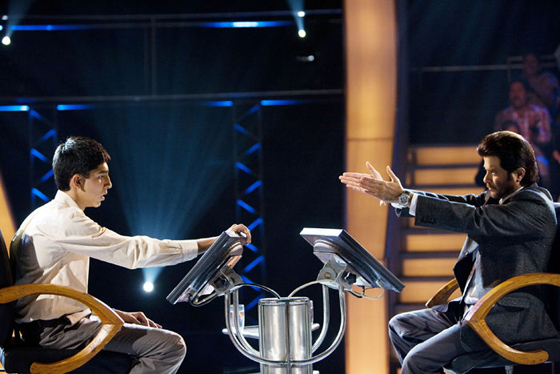
The irony is that these clowns' dismissal roughly parallels the story of director Danny Boyle's energetic film where it is assumed that a seemingly humble chai-wallah for a cell-service call center could not possibly know the answers to go (as the pompous host intones) "from rags to raja'" on the Hindi version of "Who Wants to Be a Millionaire."
*


When we first meet Jamal (Dev Patel), he is one question away from winning it all...and losing his life. Strung up like a piece of meat, he is being tortured by the local authorities*** to find out how he's cheating—he must be as so many others (of more worth) haven't done as well on the game-show as he has. Sounds like the "feel-good" movie of the year ala "Forrest Gump," or as Time Magazine blurbles: "A Poignant Hymn to Life." **

Obviously, it's more complex than either view.

The movie even begins with its own "Millionaire" question for how he manages to do it: A. He cheated; B. He's lucky; C. He's a genius; D. It is written.

Is that your final answer? Really? (feigned look of concern)

You'll do a lot better with the movie if you don't pick just one, or pigeon-hole it into being this type or that, for the answers have too many facets, too many colors and shadings, and offer up the extremes of life—the ebullient and the tragic. In the end, it's a little bit of all of them.

This movie would seem like an odd tangent for Danny Boyle if every step of his career weren't punctuated by abrupt changes of pace. Especially lately after splitting from his writing partner John Hodge. To go from the zombie epic "28 Days Later..." to the sublime kid's parable "Millions," then to the sci-fi allegory "Sunshine" to this are as stunning turn-arounds as the dervish-like camera moves he is constantly spinning in "Slumdog Millionaire." Boyle lived in India for five years, and so his camera-eye goes right to the colors and exoticism of Indian street-life.

In a dizzying chase sequence early in the film,
a five year old Jamal and his older brother Salim are running from the police through the back-alleys of a shanty-town on the outskirts of Bombay. Boyle (and his Indian co-director Loveleen Tandan) films a wide variety of shots in different styles and speeds, sometimes step-editing the shot, twirling the camera, changing perspective, while out of the corner of your eye you see odd little details of street life going on (at one point, he cuts away to a close shave at a barber's, while in the alley behind the shop the kids streak by. But one never loses perspective on the chase, despite the wildly disparate angles and frenetic pace—something sadly lacking from the Bond-movie chase masters in "Quantum of Solace"—and the result is exciting and masterful.

We follow the two boys as they become orphaned in a religious attack on their Muslim slum,
live lives of begging and thievery on the street and the garbage dumps with their "third musketeer," a street-girl named Latika, then get picked up by gangsters who organize rings of street-beggars, blinding the best ones because they'll bring in double. The boys escape, but Latika is left behind, and that becomes an obsession for Jamal who is determined to find her again, while Salim follows his instincts into the Mombai underworld.

Sound like fun?
Some critics seem to think so. Even without the beatings and torture that start the film. But "Slumdog Millionaire" follows its own karmic path to a pre-determined destiny in tune with the mixture of sweet and rancid of Indian life. And what these jaded writers don't get is the dharma of it all: when things are good, you better recognize it and enjoy it while it lasts.

Because it won't.

Doyle manages to capture the sense of India--an acid-trip without the acid (or so I've been told)--and communicate it on-screen—the colors, the desperation, the joys that crash through the crust of grinding poverty—to a delirious ending that would please
Ganesh. Stay through the closing credits.

Enjoy it while it lasts.


"Slumdog Millionaire" is a Full-Price Ticket.


* Although it no longer dominates the American air-waves, I've seen it in Spain ("Who Wants to be a Mult-multi-Millionaire?" and Austria. No matter where you go in the world, "Who Wants to be a Millionaire?" plays just the same.


** Although did I ever tell you about the time my Mother and her sisters went to see Martin Scorsese's "Casino" because they thought it was a musical? Fuggedabaht Joe Pesci being bludgeoned to death, or the guy with his head crushed in a vice--there's a sex scene between Pesci and Sharon Stone! Eyeeeww!

*** The Inspector in charge of the interrogation is played by Irffan Khan—memorable in "The Namesake " and "The Darjeeling Limited ," but absolutely essential to the effect of "A Mighty Heart." His unstated power and ability to internalize conflicting emotions across his face makes him fascinating to watch.

Sunday, February 3, 2008

Millions

"Millions" (Danny Boyle, 2004) One of those ones I missed in the theater, and one I deeply regret. It's a little gem of a movie Boyle made between his zombie-film "28 Days Later" and this year's sci-fi film "Sunshine," about a saint-obsessed child who finds a large duffel-bag of pound notes, seemingly from heaven, in the days before the change-over to the Euro. His older brother uses it to gain influence in his new school quickly becoming BMOC (Dad, a recent widower, has just moved his family to a new development by the train-tracks), but Damian wants to give it to the poor. He is visited by numerous saints to guide him along on his spiritual quest (and quite perkily announces their names and birth to death dates and how they died at each arrival). It's a highly charming movie, while avoiding the usual cute kid cliches, and maintaining a quite sophisticated tone of drama and off-the-wall comedy. That was a trick even Disney found hard to pull off. It gets a very high recommendation from me. **

** Dan "The Man" told me a funny story about Danny Boyle at our last visit. He went to see a preview of "Millions" and there was a Q & A with Boyle afterwards. After the obligatory three questions about video cameras from techies and director-wannabes, Dan stood up and asked, "Mr. Boyle, as a recovering Catholic, do you have a love-hate relationship with your success, and do you feel redeemed?" This question so flummoxed Boyle that he couldn't answer and couldn't focus on anything else, ending the Q & A. I would liked to have heard the answer, frankly.

Wednesday, November 14, 2007

Sunshine

"...They went at night."

"Sunshine" is Danny Boyle's homage to "2001"* while serving up an environmental metaphor in a sci-fi setting, a dissertation on the uses of faith, while also landing in the "Incredible Mess" subcategory of films.

It goes like this: Our sun is dying. Seven years ago, the spaceship "Icarus I" headed out for the sun to drop a payload the "mass" of Manhattan Island to re-ignite it and stop the new Ice Age developing on Earth. The ship disappeared mysteriously, and so, "Icarus II" was launched, same mission, same payload. You'd think with the luck they had with the first one, they wouldn't name the second ship the same thing. Plus, if you're going to the sun, "Icarus" might not be the most inspiring legend to name your ship after.**

Be that as it may, the ship is as "green" as can be, with its own eco-system/garden (overseen by Michelle Yeoh) providing oxygen for the ship. But it wouldn't be much of a space drama if things went smoothly, and before you can radio "Houston, we've got a problem," people get hot under the helmet-collar and things start to come apart faster than an "O" ring on a chilly day. The ship's shrink may be getting a bit too much sun. The "payload expert" (Cillian Murphy) and systems engineer (Chris Evans) are not getting along in what the pilot (Rose Byrne) calls "an excess of manhood breaking out in the com-center," and a slight miscalculation by the navigator creates a series of unfortunate events, and turns him suicidal.

Geez, folks, go outside. Get some sun.

Danny Boyle can be counted on to breathe new oxygen into any genre, like "Trainspotting" for the "kitchen-sink" film, "28 Days Later" for the "zombie" movie, but "Sunshine" has so many echoes of Kubrick's "2001" right down to color schemes, ship designs, POV shots, "Icarus's" somewhat fussy computer behavior, freeze-frames in vague situations and close-up eye shots that "A Space Odyssey" is never too far from his frame (Murphy even has a slight resemblance to Keir Dullea). The dynamic of the crew is right out of Scott's "Alien," and the denoument is subject to interpretation (after the "multiple endings" debacle of "28 Days Later"). One also suspects that to secure a rating, or due to some preview-audience's expressed discomfort, some make-up effects have been toned down to near-imperceptibility. But, by and large, its a fascinating excercise in a genre that, if it asks too much of a leap of faith from its audience, can become laughable. "Sunshine" is far from that. It's always a little bit exhilarating to see a sci-film that obeys the laws of orbital mechanics, knows the dangers of space-travel (where math can be fatal), and doesn't have one ray-gun.

Best to see it on a big screen, it's full of little details that won't translate on video.

"Sunshine" is a Matinee for a rainy day. Bring some sun-block.

* in fact, it's a bit scary how many little ties to "2001" there are. Why, you'll even see a black monolith or three in this film.

** In his acceptance of the D.W. Griffith Award from the Director's Guild in 1999 Kubrick evoked the Icarus story to talk about D.W. Griffith's rise and fall in the film business. "I always felt the message of the 'Icarus' story wasn't "Don't fly too high," but, rather, "Do a better job on the wax and feathers!" You can see that speech here.