Showing posts with label 2010. Show all posts

Friday, October 12, 2012

Garbo the Spy

Garbo the Spy (Edmon Roch, 2010) Back to reality, but still dealing with spies, so "reality" is relative.  And the time-frame is similar—just as James Bond's creator, Ian Fleming, drew inspiration from his work with the OSS during the second World War, so, too comes this documentary—a true account of the work of Juan Pujol Garcia, a real-world double agent, who worked for the Nazis first, then after establishing credibility with them as a British-based spy (although he was actually living in Lisbon), offered his services to the Allies "for the good of humanity," and with the help of the OSS, creating for the Germans a funded network of 27 agents—all fictional.  To the Reich, he was known as "Arabel." To the West, he was "Garbo."  

His accomplishments were many.  First, he siphoned off considerable German funds to pay for his "network"—even establishing a pension for one of his phantom agents who had "died."  He was also able to send duplicate messages to both sides, allowing the British cyphers at Bletchley Park to have a "Rosetta stone" with which to check their round-the-clock de-coding efforts—an almost impossible task as the German changed their codes daily—and Garbo's writing style was so formal and distinct, his messages were easily identifiable.

But his coup was in spreading disinformation, the most successful instance being a big one—he managed to convince the Nazi's, particularly the CIC, Field Marshall von Runstedt, that the invasion of Europe would take place at the Pas de Calais under the command of the disgraced General Patton, rather than its actual location of Normandy—a ruse that was so successful, it was still believed in August of 1944, two months after D-Day, delaying an increased resistance to the Allied advancement to Berlin.  That's some trust.

The documentary is a potpourri of information—not unlike the hodge-podge of sources "Arabel" would cook up in his work—talking head interviews, vintage war-time footage, and recreations from such films as The Longest Day, Patton—big theater results of Garbo's deceptions.  The tone is slightly cheeky, with an emphasis on pulled quotes, especially from films like Our Man in Havana, Mata Hari, and an obscure Leslie Howard film called Pimpernel Smith, Howard being an impetus to the counter-intelligence efforts—his death in the war effort was both a cautionary tale and an exposure of Allied spy efforts.  Garbo is entertaining, as long as one can enjoy the breezy tone without darkening it with thoughts of the wholesale slaughter going on at the time.  But it is interesting in its tale of how world events can be shaped by one man with a lie and the razor's edge that is walked in times of conflict.


Juan Pujol Garcia or "Arabel," as he was known to the Germans

Wednesday, May 23, 2012

Sound of Noise

Ruhe, Bitte!
or
" Ett, Två, Tre, Fyra "


What better way to celebrate Robert Moog's 78th birthday (well, besides the fun synthesizer sig on the Google site) than a look at this fascinating 2010 film, which is just making its way to local theaters in my area?

Sound of Noise is right in my wheel-house (or more appropriately) bass-trap, and is fun for anyone who might be "into" music, sampling, and sound design.  It, for certain, has my vote for best "sound design" of the films I've seen so far this year (despite the filmmakers using a lot of "sounds" that seem very familiar to me).

A product of Sweden (and released there in 2010), it involves artist-types (in this case, musicians, and more extremely, drummers) who've had it with a world being satiated and lulled with a steady stream of elevator music, whether in confined spaces, or piped onto the streets themselves.  "Listen to this city, contaminated with shitty music!" fumes Sanna Persson (played by...Sanna Persson), after she and her partner Magnus (played by Magnus Börjeson) perform a piece that gets them in dutch with the police.  That performance is to drive the van along the freeway while Magnus drums in the back and Sanna gears up and down through the van's transmission, driving over highway turtles, in effect playing a musique concrete piece...or should that be musique asphalt?  A subsequent police pursuit causes a crescendo into a local embassy, attracting the attention of city's anti-terrorist unit, and investigator Amadeus Warnebring (Bengt Nilsson, in a terrific performance).

Warnebring has grown up in a musical family, steeped in the world, snooty with it, but for him, there was no interest.  His brother became a world-class (and arrogant) conductor, and Amadeus is the silent black sheep of the family and developed a severe dislike of music, in general, which has strained their relationships.   

But just because he isn't "musical," of note, doesn't mean he doesn't have gifts.  Despite the hustle-bustle of the embassy crash site, while the rest of the scene is speculating whether there's a bomb in the van, he recognizes a sound, and stealthily approaches the ticking van.  It's not an IED.  It's a metronome, still swaying with the beat, a reminder of his youth staring at the keys of a piano.

That proclivity for silence will come in good stead on this investigation.  For the musicians have composed a piece "for city and six drummers" in four parts that will wreak havoc on the city and disrupt life as we know it.  Gathering up four rebel drummers (are there any other kind?) Sanna and Magnus plan four performances that "might be dangerous, certainly illegal" for the group to perform, each using "found" sound and the materials at hand to pull off.

This is where the film really gets good...and clever.  Each performance (telling would be spoiling) is intricately planned and performed, each becoming simpler and more disruptive in its effects until it becomes personal for the detective, who is always just a step behind...until the third movement.  To explain further would be spoiling the surprises, and the enjoyment of the thing, but the film-makers are extraordinarily clever in the creation of the piece as a whole, working in a variety of media (including animation) to pull it off.

This is the sort of film-making that gives one hope, and although some CGI is employed (there had to be), it's of the seamless variety that doesn't over-stage, but merely supports the idea.  Sound of Noise is odd, wacky, and quite extraordinary, and rises above the static of most film-making being done today.


Sound of Noise is a Full-Price Ticket.

Wednesday, September 14, 2011

Green Zone

This week, we're re-publishing some reviews of the films from the post 9-11 environment.

"Weapons of Myth Destruction"

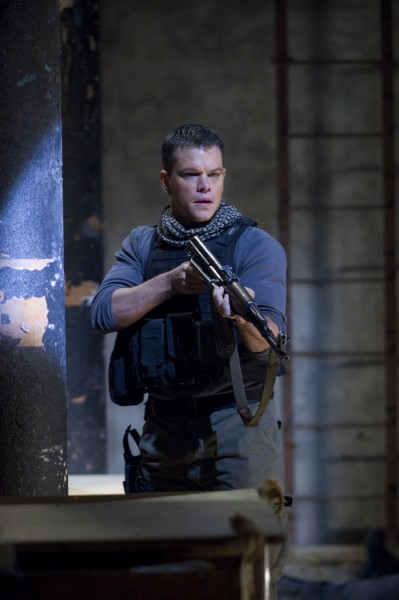
The team that brought you the more popular of the "Bourne" movies (Paul Greengrass, stunt coordinator Dan Bradley and star Matt Damon) basically take the same "run-and-shoot" scenario into the Iraq War in Green Zone—a government operative goes rogue and takes on the higher-ups with something to hide, who are willing to kill him in order to silence him. And just as The Bourne Ultimatum felt like a re-tread of The Bourne SupremacyGreen Zone has the same worn been-there, fragged-that quality, owing more to tracts like  Body of Lies (which this one closely resembles, despite having an "original" screenplay by Brian Helgeland) and the earlier collaborations of this particular action troika. It's the Iraq War, but without the "shock-and-awe," unless the awe comes from a stifled yawn.
The same issues—the manufacture of intelligence to promote a "sellable" war scenario—are at play in both the Greengrass and Ridley Scott films. The main difference being that this one lands square in the middle of the early "dazed and confused" days of the Iraq War (having just passed its seventh Anniversary) with the first crews of Army inspectors coming up trumps in their search for the legendary Weapons of Mass-Destruction, the Holy Grail of this Crusade. Adapted freely—very freely—from the book "Imperial Life in the Emerald City" (which reads like a book version of the documentary No End in Sight), the screenplay posits American efforts to steam-roll a provisional government into Iraq by propping up their own Iraq partisan (based on Ahmed Chalabi) who hadn't set foot in Iraq for thirty years and was of dubious integrity, and the double-blind of an Iraqi general (played by Yigal Naor), whose reports of destroyed WMD's are falsified by the White House, and the promised assurances of participation in any new government for cooperating are ignored in the process of "De-Ba'athification."* Helgeland took the strategic failings of the Coalition Provisional Authority and used them as background for the cut-and-paste screenplay, constructing an "Army rebel" scenario in which Damon's "Roy Miller" is disgruntled with how his squad is continually sent on bogus WMD searches, chasing wild geese rather than chemical weapons. It becomes clear to the acronym-spewing MOP'd op that something is SNAFU, as the sites they fight to raid appear free of ordinance of any kind...and haven't for a very long time. Miller's investigation with the help of a frustrated CIA agent (Brendan Gleeson) becomes an effort to keep the SNAFU's from becoming FUBAR before he goes Tango Unicorn. Besides the angry and destabilized citizenry, they also have to fight a CPA op hard-wired to the White House (represented reprehensibly by Greg Kinnear) and the Special Forces commander who doesn't ask and doesn't tell, but merely re-loads (the terrific Jason Isaacs, nearly unrecognizable, looking like Bono in fatigues). You can't swing an HD camera (in simulated field-documentary fashion) without coming into conflict with somebody. **

It's one of those trope-heavy screenplays heavy on the "table-turning" dialogue ironically bantered back-and-forth during different stages of the screenplay—the big ones (delivered with the required dripping sarcasm) are "don't be naive," and "you didn't ask to confirm?" Ho-ho! Gotcha. You are so "occupied." These are the small PR victories lost in the cluster of the Iraq War.

It's not that Green Zone is bad. It is quite competent. But it is tired, and tired at its reckless pace feels silly and unnecessary...and a waste of time. Still, far more people will see Green Zone than
No End in Sight, so if the message has to be "Damonized" at least it's doing some good, though in 20/20 hindsight.

Now...about the next one...


Green Zone is a Rental.


* Although the process is a matter of public record as is the Coalition Provisional Authority's dissolving of the Iraqi Army, the "playing" of the general is more akin to President Bush's tactics in dealing with Democratic senators while he was governor of Texas—he'd make promises to get a crucial vote and renege on those promises.

** Like the "Bourne" films and Greengrass' United 93, the film doesn't have a still shot in it, or a held shot of more than four seconds, making Kathryn Bigelow's The Hurt Locker look serene by comparison, but it's not as bad as second-unit director Dan Bradley's work on. Quantum of Solace, which looked like it was filmed from the POV of a Mixmaster set to "discombobulate." The guy's who's turned this sort of stuff into a science is J.J. Abrams, who's designed a personal system for hitting the camera—actually whacking it—in a certain rhythm to give it a "shaky-cam" stutter while letting you follow the action and still identify the participants.


Restrepo

This week, we're re-publishing some reviews of the films from the post 9-11 environment.


"Where the Road Ends, The Taliban Begins..."

There have been two exceptional documentaries coming out of the Bush War years, No End in Sight, the clinical analysis documenting the rememberances of the caring people who were stymied trying to bring some stability to the Iran conflict, and this, Restrepo, filmed by Tim Harrington and author Sebastian Junger ("The Perfect Storm"), about one year in the life of a troop in the deadliest section of the Afghanistan War, the Korengal Valley.

It's what they call a "killing zone" in war, the lowest spot in a valley surrounded by treacherous hills and mountains that defy any sense of uniqueness, with just enough green-belt to defy easy targetting.  When the soldiers of Battle Company first see it, their response is sickeningly bleak, their brio dissipating in the dust kicked up by the rotors of the Chinook delivering them to the sight.  "This is a shit-hole," says one of the men (boys, really), "And I thought 'I am going to die here.'"

They deploy with such bravado, broken and stripped down in basic training to become efficient weapons of our nation, only to see themselves further broken down by the constant beat-down of war.

And then the casualties come.  First one, and then Juan "Doc" Restrepo, who we meet at the beginning of the film, drunkenly, defiantly flexing his war-attitude on the way to deployment, a demoralizing blow to the Corps, as he was considered the best, most capable of the troop.  "Not this guy.  Not this guy.  Not this guy," mantras one of the soldiers in the post-rotation interviews.  If the Enemy could kill their best, what chance did they have?

To get more of an upper-hand, the soldiers, under the cover of night and snipers, hurriedly build a new operational post on high-ground, an "eagle's nest" with rudimentary protection—shells of dirt, basically—and their most powerful weapons to give them a vantage point, and an advantage to take them out of the bowl of death the original outpost is, strategically.  An Alamo, if you will. In simultaneous respect and defiance, they named the outpost after Restrepo, bringing a sense of permanence to his sacrifice, his first memorial, which is described as an up-raised middle digit to the unseen forces trying to kill them.

The shots are extreme hand-held moving with the nervous panic of war and long, carefully composed telephoto shots of the countryside, the plumes of explosions, while, in a reminder of where it all stands in The Scheme of Things, predator-birds glide through the shots.  Ever want to see what it's like to be inside an armored vehicle when it's up-ended by an IED?  It's here.  The language is raw as are the emotions, the cinematography iffy, often filmed in low-light conditions that defy clarity.  But, this is a necessary document of the Armed Forces in Afghanistan, showing how hope is also a casualty of war, and the evidence of it are in the haunted, even dead, eyes of the men in post-deployment interviews.  One can't look into them, without thinking that governments should be careful...as a sanctified task...to avoid such situations in the future.

In The Big Red One, Samuel Fuller's end statement was that the only victory in war was surviving it. True enough, simple as that is. But, it goes deeper than that, and is more complex. For war does more than kill the living, it also kills the future of the survivors, the wounds are internal, festering, healing far too slowly, leaving them—if total victory is not achieved—with the sense of no accomplishment, despite throwing their all, their "last full measure" into the blades of the abattoir.

Restrepo is often difficult to watch, but as an unvarnished, declassified document in the on-going revelation of the effect of war on men (and women), it is the kind of tough love it takes to quell the savage beast.

Restrepo is a Matinee.

His buddies and the filmmakers made sure he would not be forgotten.
May none of them be...

Co-director Tim Harrington was killed April 20, 2011 in Misrata, Libya
covering the uprising there. 


Tuesday, August 30, 2011

Cameraman: The Life and Work of Jack Cardiff

Cameraman: The Life and Work of Jack Cardiff (Craig McCall, 2010) I love films about cinematography and there are damned few of them; I tend to come away with a new appreciation of light and vision, and the world looks fresh and new, bright and awash with color.  It happens so rarely when I watch films that the world seems different—the films of Orson Welles or Nicholas Roeg do that to me...and films about cinematography.*

When I saw Cameraman... pop up on the Netflix queue, I jabbed the Play button immediately.  The work of Jack Cardiff (the subject of the film) spanned a career of 70 years and the palettes of black and white through to color and technicolor—there's a difference—(and from the silver screen to the painter's canvas, sometimes employing both).  A cinematographer for much of his career, he also directed in the 60's and 70's and returned to cinematography later.  But he worked with the camera from the era of Things to Come to photographing Rambo: First Blood Part II, and worked with directors as diverse as Michael Powell, Laurence Olivier, Alfred Hitchcock, Henry Hathaway, John Houston, the Boulting Brothers, William Knightley, Richard Fleischer, Joseph L. Mankiewicz, King Vidor, Mike Newell, John Irvin and Joshua Logan.  Cardiff raised the level of everything he worked on and directors knew he had the eye of a painter and the craftsmanship of an engineer.  He was truly a renaissance man.

Documentarian Craig McCall shows it all and knows how to get great quotes from the man and anecdotes about the various personalities he worked with, the directors he worked for and the subjects he photographed, literally a man in the middle who knew how to make both sides look their best.  Some of the surviving directors give testimony, as well as Martin Scorsese, Powell's editor-wife Thelma Schoonmaker, Lauren Bacall, Charlton Heston, Kirk Douglas (a rare post-stroke interview), John Mills, as well as Moira Shearer, Kim Hunter and Kathleen Byron.

In showing the history of this one man, it is also a fascinating overview of the entire art and history of the cinema as well, and how the well-composed image is as timeless as beauty itself. This is gorgeous to look at, and very educational and highly, highly recommended.


* One of my favorites is Visions of Light, which was produced with the ASC Union and has a broad spectrum of subject matter and timeline, as does Camerman.  You can't do a film about lighting movies without mentioning Dietrich, and I'll always remember that 45 degree angle trick.


Friday, July 22, 2011

Uncle Boonme Who Can Recall His Past Lives

"The Thais That Bind"
or
"Personally, I Think it's Something in the Tea..."

Maybe it was me.

What I know about Thai culture, cinema and such can fit onto a plate that holds a decent portion of Phad Thai.  Very little.  But wait a minute.  Is that required?  It shouldn't be.

It is the responsibility of the film maker to use the language of film to communicate their ideas to the audience.  That's their job.  If they're too obscure or hiding their point behind a wall of technique (or lack of it), that's their fault, not mine.  Film should be universal.  That doesn't mean it should aspire to the lowest common denominator in its means of expression.  But, it would be nice if it met us half-way, so we don't have to make a field-trip into the director's head, or depend on some (God help us) Entertainment section interview with the director to explain it all to us cretins.

So, if the 2010 Palme D'Or winner at the Cannes Film Festival, Uncle Boonme Who Can Recall His Past Lives leaves me cold, that's why.  It's not that I mind the long takes of shots (I like that, actually), the glacial pace (ditto), the banal dialog (it's the visuals that really matter), or the odd subject matter (sex with a catfish?...uh...okay, I'll buy that, read any fairy tales lately?)*  It's just that the film is episodic, the segments unrelated, and never really comes to its point.

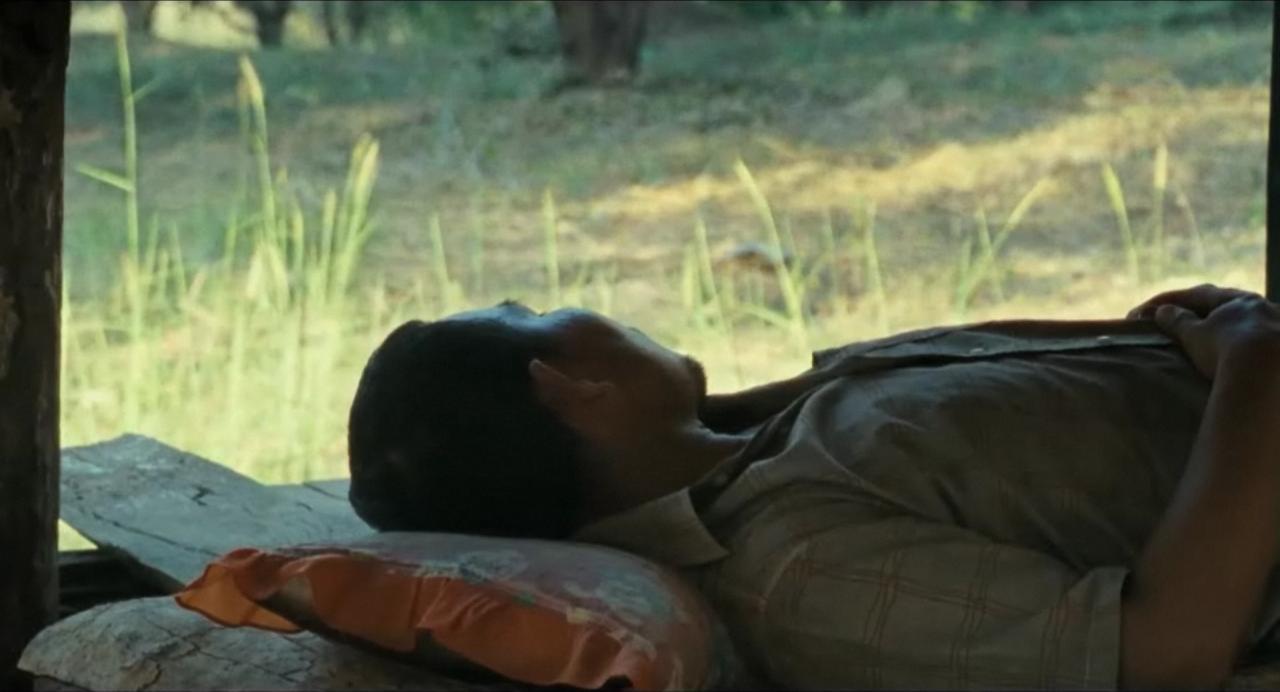
Boonme is a farmer in a Thai forest, and he's dying of kidney failureHe is visited by his sister-in-law and her son, who are there to spend time with the dying man in his last days.  But, other guests arrive, as if, with his demise approaching, tying up some of the loose threads of his life.  His wife shows upHis dead wife, looking considerably younger than at her death.  Then, his son who went missing many years ago, shows up, transmorgrified as one of the Ghost Monkeys who inhabit the forest (this occurred by taking a Ghost-Monkey wife).  They talk, tell their stories.  Then we go to the story of the Princess who is given the gift of a young, beautiful reflection of herself at the base of a waterfall.  The catfish spirit of the water offers her that beauty if she joins him in the water.  And, if I interpreted this correctly, she turns into a catfish (Well, if the son can turn into a Ghost-Monkey...).  Then, Boonme and his two corporeal relatives go spelunking, where they find a cavern of bright iridescent rock that resembles the stars in the night-sky...and a pool of water that contains blind colorless fish.  Presumably, in this segment Boonme dies, as he stops moving.  We see his memorial service.  Then, after the sister-in-law and her son, in monk's robes, sit and watch television in their hotel room, with her other child, a daughter.  At some point, Mom and son decide to go to a restaurant that has karaoke, but the daughter doesn't want to go.  So, the spirits of the mother and son go off to eat, leaving the bodies watching TV (spiritlessly...now THAT part I "get.").

It's about the mystery of the Spirit.  It's about how we change in a lifetime.  It's about how the closer we get to death, we become more of the spirit than the corporeal.

It just doesn't say it very well.  I found it a drag.

Uncle Boonme Who Can Recall His Past Lives is a Rental, I guess.


* Yeah, I can't let that go unexplained, and lest you be alarmed, Boonme in Not Rated, but has no nudity, and things are merely implied.  But the segment reminded me of the variation of "The Frog Prince" that was put out by the Aurora Model Company when I was a kid:  The Frog holds a sign that says "Kiss Me And You'll Live Forever.  You'll Be A FROG, But You'll Live Forever!"

Thursday, April 7, 2011

Made in Dagenham

"Girls Behaving Badly (Acting Well)"
or
"That's How We've Always Done It"

Nigel Cole's Made in Dagenham tells the story behind the struggle to get the Equal Pay Act of 1970 passed—the one that finally guaranteed that in a Union job, a woman received equal pay to a man.

What's that, you say?  "We don't have that law in America?" 

Yes.  Precisely.

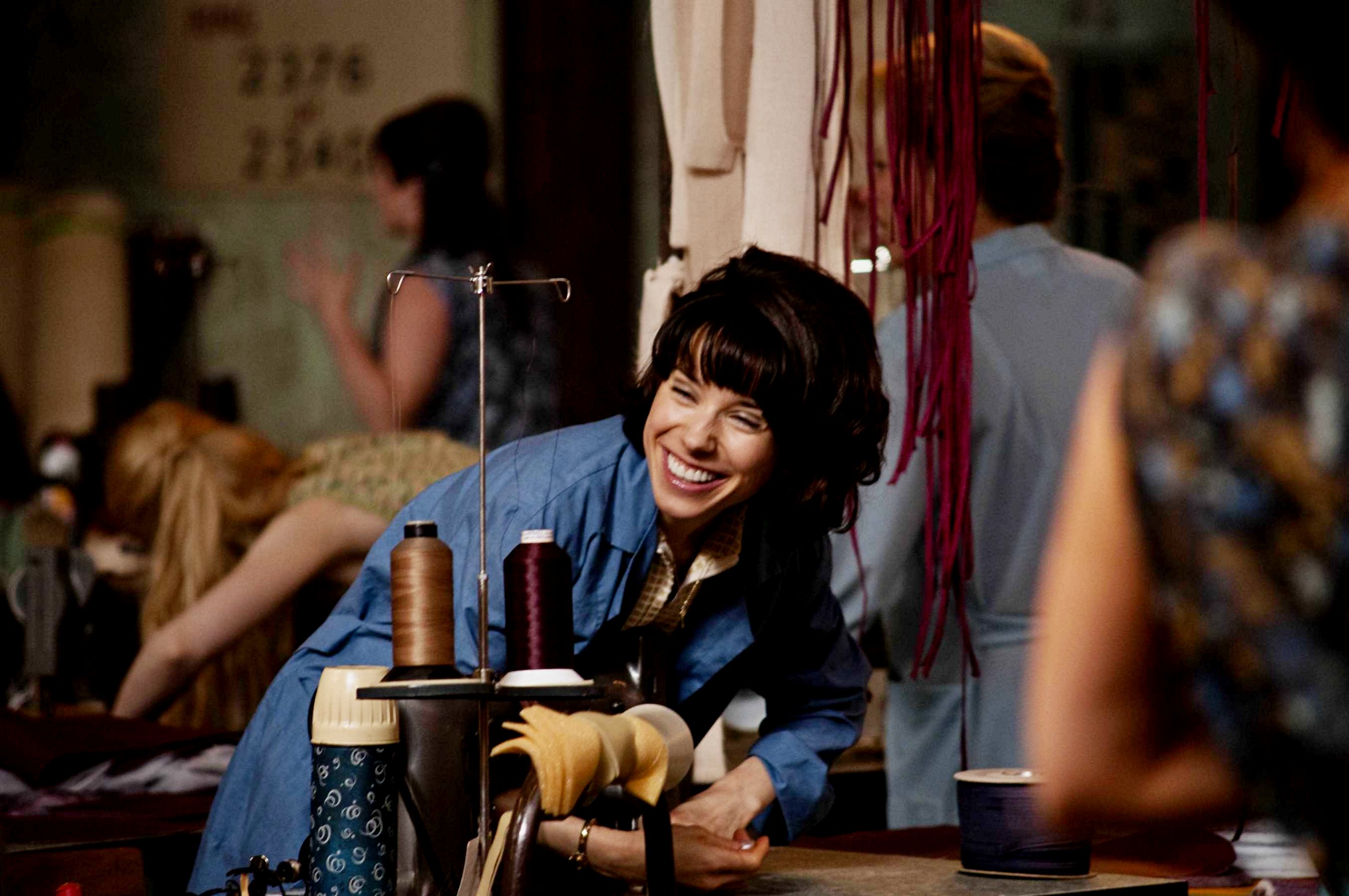
The action that led to that piece of...one hesitates to say "forward-thinking"...legislation was the 1968 Ford sewing machinist's strike in Essex, which resulted from the lady-sewers being down-graded to "unskilled worker" status and receiving a 15% reduction of their salaries.  Initially, the about-to-be-strikers merely wanted their status returned to normal, but finding reluctance on the part of the Union to support them, the entire group staged a walk-out, shutting down auto production for the entire plant.  It was only with the intervention of Secretary of State for Employment and Productivity Barbara Castle (played here by Miranda Richardson) that a compromise was reached, first bringing the women's salary to 92% of the men, upgrading it to 100% the following year, and, finally, the working out of the Equal Pay Act of 1970

The strike lasted all of three weeks.

But those three weeks shut down auto production at Ford's Essex plant, alienating the male Union workers and driving a wedge in Ford working households, splintering the machinist's Union (hypocritically balking at "all things being equal," comrade), and raising the ire of the Ford Motor Company, which sends an emmissary (played by Richard Schiff, and although shaved and looking different, he portrays the "dark side" of his "West Wing" character, Toby Ziegler). 

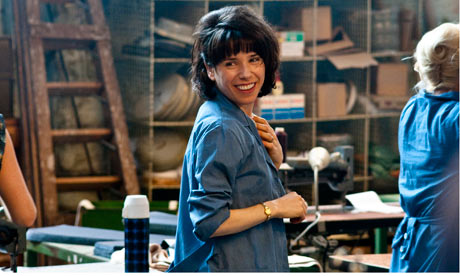
This all happened, but not in the way Made in Dagenham would have you believe.  The sewers left en masse, all 187 of them, but the film simplifies it to one woman who serves as the catalyst for the action.  There was no "Rita O'Grady" (Sally Hawkins), she's a construct by writer William Ivory to be a mouth-piece for all the issues in the film, the one everyone gravitates to when they have a point to make about the situation.*  She starts out being naive and not a "joiner," the better to have things explained for the audience, but she morphs into a Union firebrand who says all the right things at all the right times, while everybody else takes a back seat.  It simplifies things in the story process, sure, but if you're going to pay tribute to the efforts of a group, do you ignore them for the most part, in favor of fiction?  How's that paying tribute?  "Rita" is the one who impresses the Union rep Albert Passingham (Bob Hoskins) to join the negotiations.  She speaks up to the dragging Union bosses who don't see their demands as a "gain."  She's the one that Lisa Hopkins (Rosamund Pike), the upper-class, degreed wife of a Ford manager comes to when we need to be told the oppression of women extends beyond the factory...all roads lead to "Rita."  Like Cole's previous film Calendar Girls, there's a bit of patronization to the film, a sort of "aren't they cute, fighting for their rights and all (bless 'em)"

But, it's heart is in the right place.  At least.

Made in Dragenham is a Rental.

* Norma Rae was fictionalized, too, but at least there was a "Norma Rae," in the person of Crystal Lee Sutton.

Wednesday, April 6, 2011

Kaboom

"What Kind of Guy Are You?"
or
"Madeleine O'Hara, What Do You Know About the Animal-Mask Men?"

I was trying to concoct some bogus review for a non-existent movie to play as an April Fool's Prank, but Gregg Araki's Kaboom will do just as well.

A farcical paranoid comedy/sex-romp,* it revolves around two 18 year old college students, Smith (Thomas Dekker) and his "partner-in-crime," "'vag-itarian' best friend" Stella (Haley Bennett), who are both experiencing odd disruptions in their sex-lives.  Smith is "undeclared" sexually, attracted to all sexes, but right now, specifically, to his meat-head surfer roommate Thor ("Like the comic ... shyeah!"), and Stella is gay (even if her attitude is anything but).  Both are majoring in go-nowhere subjects (she in Art and he in Cinema Studies), which is alright as a) Stella wryly (as per usual) says "college is just a pit-stop between High School and the rest of your life," and b) what they're learning outside of class is far more relevant, if not entirely explainable. 

At one particular mixer, Stella hooks up with Lorelei (Roxane Mesquida) who claims to have "special powers"—she's a witch and not a nice one (of course, witches can become clingy and domineering, they're witches!)—while Smith falls victim to a hallucinogenic appetizer and a one night stand with London (Juno Temple)—they have a lot in common, such as both losing their fathers early, being fascinated with each other, and being amateur sleuths to all the odd occurrences happening on campus.**  "Strange seems to be the new normal," says Smith, as he copes with flashes of dreams involving people he hasn't met (yet), and the suspicion that while in his drugged state he was witness to a brutal cult-murder.  Smith has a hard time deciding whether he's in reality or fantasy-mode, something that will stand him in good stead for the adventure to come.

Kaboom is fast, cheap, and out-of-control (but good-naturedly so), fairly well-acted (which is surprising, although "slacker" isn't the toughest acting challenge to pull off), the comedy is fresh, funny, nicely played in a Buster Keaton-ish dead-pan and comes from very unexpected places.  Araki's direction, meanwhile, whirls around and gets in the faces of his "'Friends' with benefits," wheeling between blinking-in-your face close-ups, and disorienting fever-dreams.  Every few minutes there's a flash of weirdness that has nothing to do with sex--which is all very casual, as opposed to more hung-up directors who like to set it up, telegraph it, and underline it with high-lighter.***

It almost feels like a bizzarro "Scooby-Doo" episode, with no dog and where everybody has the convoluted "friends share" sexual history of Fleetwood Mac.  Even the last movie-ending scene has a whiff of "if it wasn't for those darny nosey kids" to it.

Not everbody's recipe for a fresh time at the movies, but a good, goofy, twisted diversion.

Kaboom is a Rental.

* One place calls it "Sci-Fi," but I don't see it.  It's much more in the "innocent caught in the intrigue" sub-category of Mystery-Thrillers.

** What can I say, it's set at a California college, all sci-fi architecture of open-air teutonic concrete.  Great place for a mystery.

** All the better to make their own chapters on the DVD menu...anyway, Araki makes no big deal of it.  Sex happens.  And in California, so do cult-murders.

Tuesday, March 22, 2011

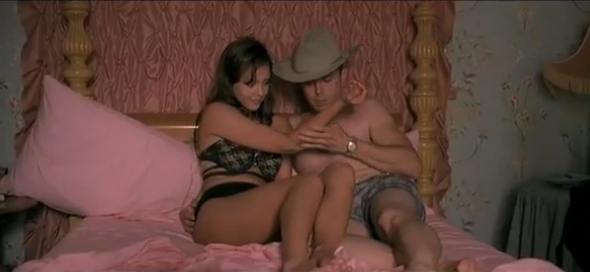
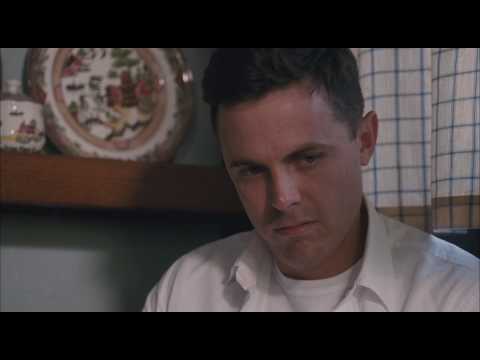
The Killer Inside Me (2010)

The Killer Inside Me (Michael Winterbottom, 2010) Searingly sordid film noir that only reinforces what film noir truly is, rather than merely high-contrast photography and light bleeding through venetian blinds.  Film noir is evil breaking the rules of polite society...any rules... and The Killer Inside Me goes beyond it to even breaking the rules of film noir—nothing is sacred, not even that all-consuming reson d'etre that makes up the twisted spine of plots and double-crosses of film noir—love in the wolf's clothing as lustTrue merciless Sociopathy—the psychopathic disregard of everything—knows no boundaries, has no sweethearts, and at the end, may have no reason at the heart of it. 

Because there is no heart.

Deputy Lou Ford (Casey Affleck) is assigned a bull-shit job in the department: the scion of a big construction contractor is seeing a prostitute on the edge of town, and Daddy wants her gone.  Lou should pay her a visit, be polite, but suggest that her presence is not appreciated and she should look to relocating her cottage-industry.  Doesn't go that way, though.  When Joyce Lakeland (Jessica Alba) opens the door, sparks fly.  And they're not good sparks.  He's attracted to her but he's got a job to do.  She's attracted to him but she's got a job to do.  He insists.  She deflects.  Then she starts throwing punches.

It's love at first fight.  And before the story ends, Ford will follow a twisted path to revenge with maximum collateral damage, culminating in the type of eruptive fulmination that has precedence in such noir films as White Heat and Kiss Me Deadly.  It's not the "safe" bad manners of the vast majority of noir films but treads along the (hopefully) abandoned railroad tracks at the edge of the worst of human behavior and, without a thought, crosses over—the type of evil that noir wanna-bes like Frank Miller's Sin City only aspire to, but can only reach by rathcheting up the carnage.  Body counts don't count, not if you want to reach the tortured, torturing depths of a writer like Jim Thompson, the author of "The Killer Inside Me."

Thompson was a pulp-writer who used a typewriter as a blunt instrument, and his style so direct that Stanley Kubrick regularly hired him in his early directing career (working on The Killing and Paths of Glory), probably for that quality that Stephen King describes: "Big Jim didn't know the meaning of the word stop. There are three brave lets inherent in the forgoing: he let himself see everything, he let himself write it down, then he let himself publish it."  Such naked lack of self-censorship is at the nuclear core of Thompson's writing—a brave, maybe fool-hardy ability to go there.

So, The Killer Inside Me, with killer instincts towards thoughtless violence (against men...and—especially—women, who, traditionally in noirs, are dispatched with a single, sanitarily unseen gun-shot) will not be everyone's cup of razor blades.*  It's shocking, unholy, and (hopefully) repulsive to the viewer.  But, it plumbs the depths of the abyss to see just how black noir can be. 


* I spent the end of last year waiting for it to make it to theaters.  Never did.  Instead, I first encountered it on the shelf at Blockbuster.  The film is just too rough and dark to make a profit in a theater-run.

Friday, March 18, 2011

Biutiful

"Cast-aways"
or
"Living on the Razor Blade"

Director Alejandro González Iñárritu has directed three features starting with the much-beloved Amores Perros that deal with interlocking stories and the tangential way that things interconnect—all butterflies and hurricanes.  Now, with Biutiful, he's abandoned that global gambit for a more focused film dealing with the ramifications of one life trying to do something decent in the underbelly of exploitation.  Rather than Iñárritu going to far-flung locations to show the skein of inter-connectedness, it all takes place in Barcelona, the diaspora of the world, rather than spreading out, coming to one place.  The world's economic crises—the current one and the on-going struggles of third-world countries, has created a surplus of one thing: refugees and immigrants, easily exploited by those trying to keep costs and prices down by keeping the labor lower.

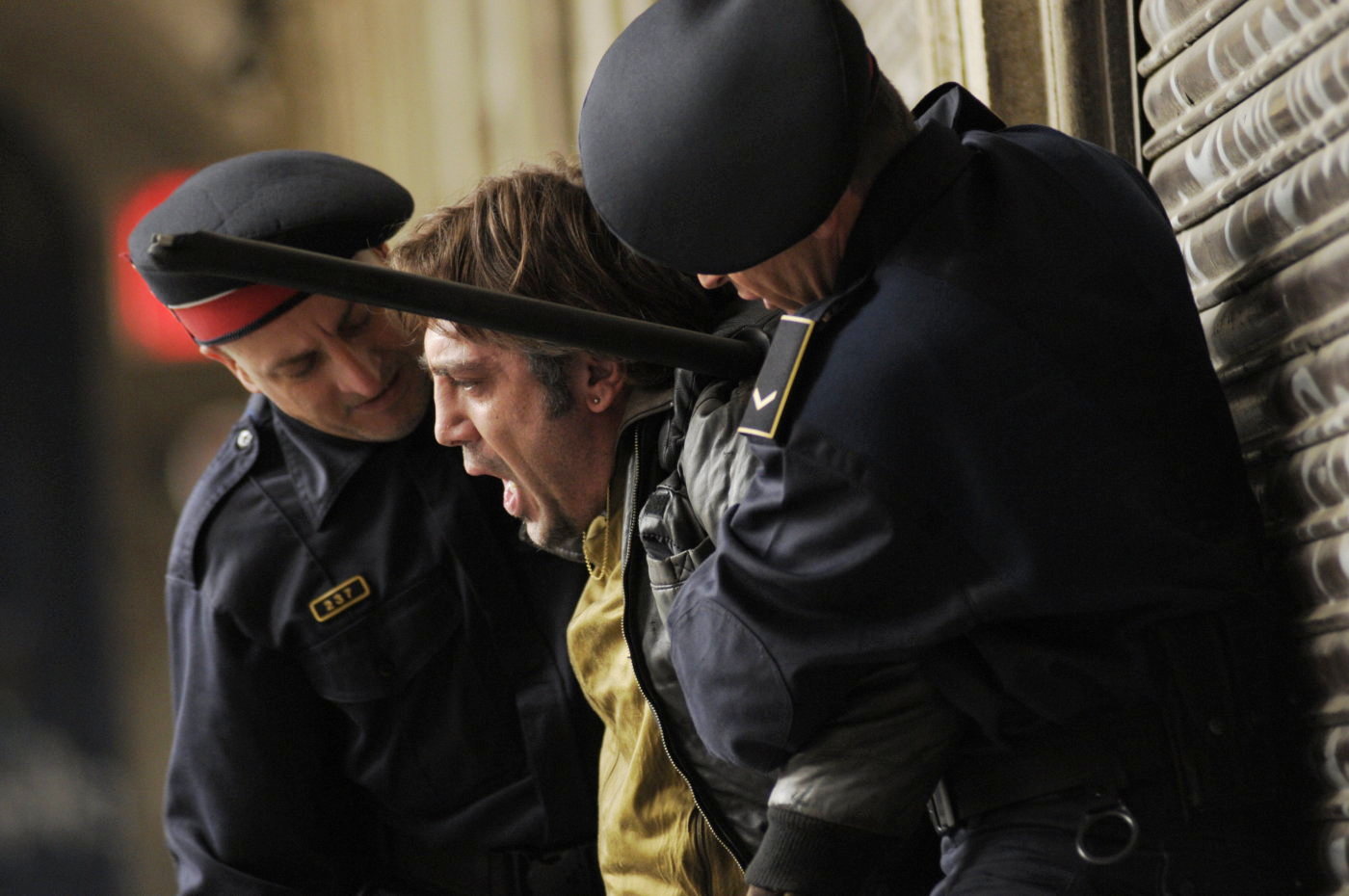
The spider in the web is Uxbal (Javier Bardem, and he's amazing in this), part-time single fatherhis wife is a bi-polar, drinking, sluttish massage therapist and has lost custody of their two small children to him—and full-time black-marketer and employment agency for the disadvantaged.  That's being polite.  He works for a sweat-shop that ekes out its living by supplying warm bodies to various enterprises: the Senegalese sell crafts (and drugs) on the streets with increasingly ineffective bribes to the police in lieu of licenses, the Chinese make copies of movies and other cheap knock-offs, and...with Uxbal's brother's help...are farmed out for cheap labor on construction projects, which is the big score.  He's sort of an HR guy, without regard to humanity or resources.

He also has an ability—as in The Sixth Sense, he "can see dead people."  The recently departed are usually hanging around (sometimes literally) their bodies not knowing what to do or where to go, and Uxbal quiets their whispers, takes in their final words to help the grieving kin, and sends them on their way.  For this, he receives a small fee from desperate families.  Uxbal is teetering on the ledge of so many worlds, it is amazing that he is as  balanced as he is, sheltering his children from the encroaching corruption—that he is a gateway to—from all sides.

Oh.  One other thing: he has pancreatic cancer that has metastasized and he only has a couple months to live.  With so much blade-running, he's ignored his own health issues and condemned himself—but with so much responsibility, he won't just lay down and die.  What he needs is someone like himself to allow himself to move on.  He's a "dead man walking" on a tight rope.  The only question is...what will send him over the edge.

And this is the problem (if you want to call it that) with Iñárritu, the writer/director—he doesn't know when to stop.  For all the digging he does to bring his audience down into the mire of man's inhumanity and crimes against brothers, he can't help but take it to the realm of not just the fantastic...but the unbelievable.  We can believe the exploitation of workers and sweat-shops and slave-barracks because we've seen it, but to pile on a ghost story seems a desperate bid to make things mystical and "significant," when the story already has heft and worth.  By gilding the mass-produced imitation lily, he undercuts a searing look at human desperation that would have been fine on its own.

Maybe...just maybe...he wanted to cushion the impact of our race to the bottom by providing a happy landing for its protagonist.  But it seems a bit like hedging his bets to provide that, while reducing the importance of the very people he's trying to give a face to.  Which "big picture" is more important?

Biutiful is a Matinee