"Girls Behaving Badly (Acting Well)"
or
"That's How We've Always Done It"
Nigel Cole's Made in Dagenham tells the story behind the struggle to get the Equal Pay Act of 1970 passed—the one that finally guaranteed that in a Union job, a woman received equal pay to a man.
What's that, you say? "We don't have that law in America?"
Yes. Precisely.
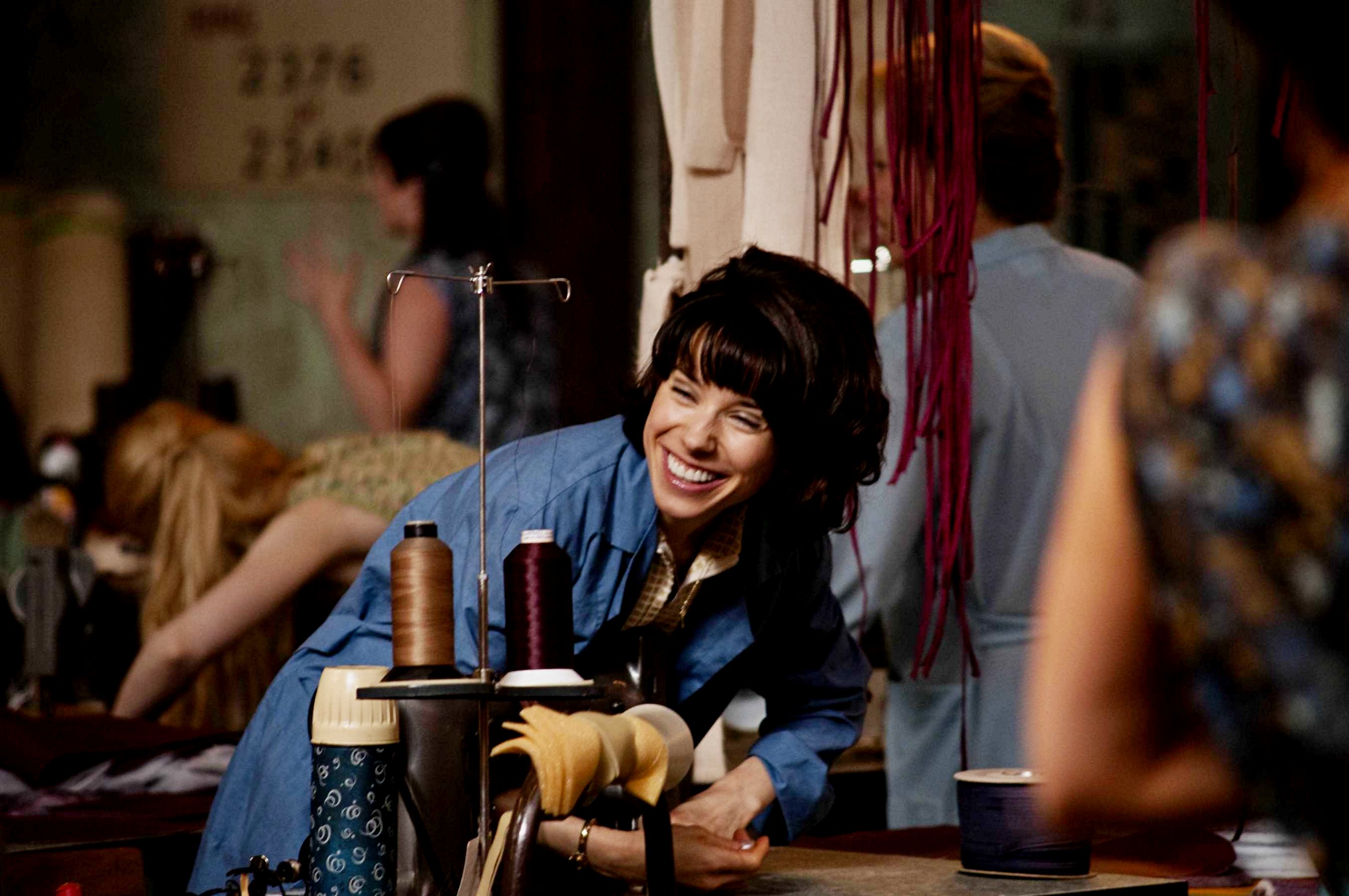
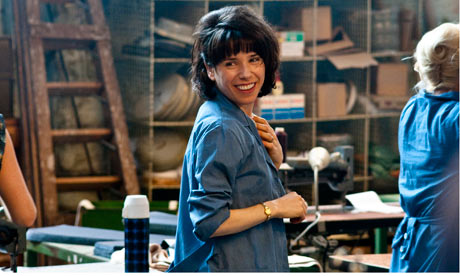
The action that led to that piece of...one hesitates to say "forward-thinking"...legislation was the 1968 Ford sewing machinist's strike in Essex, which resulted from the lady-sewers being down-graded to "unskilled worker" status and receiving a 15% reduction of their salaries. Initially, the about-to-be-strikers merely wanted their status returned to normal, but finding reluctance on the part of the Union to support them, the entire group staged a walk-out, shutting down auto production for the entire plant. It was only with the intervention of Secretary of State for Employment and Productivity Barbara Castle (played here by Miranda Richardson) that a compromise was reached, first bringing the women's salary to 92% of the men, upgrading it to 100% the following year, and, finally, the working out of the Equal Pay Act of 1970.
The strike lasted all of three weeks.
But those three weeks shut down auto production at Ford's Essex plant, alienating the male Union workers and driving a wedge in Ford working households, splintering the machinist's Union (hypocritically balking at "all things being equal," comrade), and raising the ire of the Ford Motor Company, which sends an emmissary (played by Richard Schiff, and although shaved and looking different, he portrays the "dark side" of his "West Wing" character, Toby Ziegler).
This all happened, but not in the way Made in Dagenham would have you believe. The sewers left en masse, all 187 of them, but the film simplifies it to one woman who serves as the catalyst for the action. There was no "Rita O'Grady" (Sally Hawkins), she's a construct by writer William Ivory to be a mouth-piece for all the issues in the film, the one everyone gravitates to when they have a point to make about the situation.* She starts out being naive and not a "joiner," the better to have things explained for the audience, but she morphs into a Union firebrand who says all the right things at all the right times, while everybody else takes a back seat. It simplifies things in the story process, sure, but if you're going to pay tribute to the efforts of a group, do you ignore them for the most part, in favor of fiction? How's that paying tribute? "Rita" is the one who impresses the Union rep Albert Passingham (Bob Hoskins) to join the negotiations. She speaks up to the dragging Union bosses who don't see their demands as a "gain." She's the one that Lisa Hopkins (Rosamund Pike), the upper-class, degreed wife of a Ford manager comes to when we need to be told the oppression of women extends beyond the factory...all roads lead to "Rita." Like Cole's previous film Calendar Girls, there's a bit of patronization to the film, a sort of "aren't they cute, fighting for their rights and all (bless 'em)"
But, it's heart is in the right place. At least.
Made in Dragenham is a Rental.
* Norma Rae was fictionalized, too, but at least there was a "Norma Rae," in the person of Crystal Lee Sutton.
Thursday, April 7, 2011
Made in Dagenham




Friday, April 2, 2010
The Long Good Friday
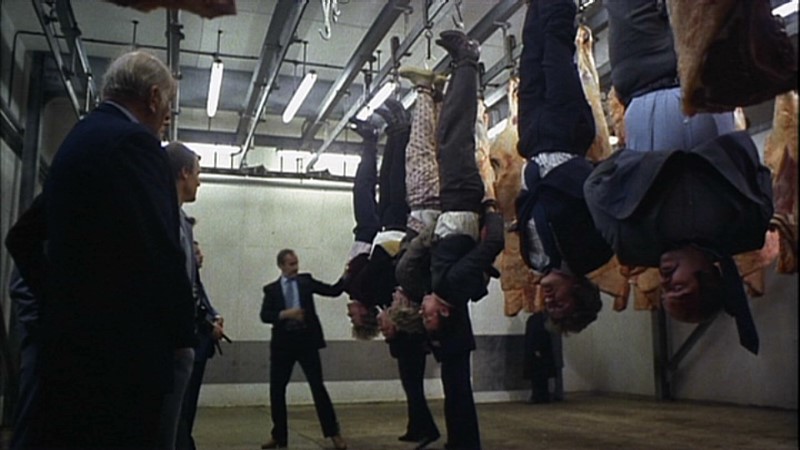
 "The Long Good Friday" (John Mackenzie, 1980) Dense, gritty film about the London underworld that could just as well be about the British government being undermined by terrorists.
Easter weekend as planned is a good one for Harold Shand (Bob Hoskins). He's set up an elaborate yacht-party for his investors, a few politico's in his influence and a guest appearance by a U.S. mob-boss (Eddie Constantine), to toast Harold's new developments planned along the Thames dockyards. Everything seems to be in place—the pay-offs to the pols, the cheap Irish workers are kept in line, and the Americans want to help finance the new construction.
Then things start to go North. An old pal of Harold's (Paul Freeman), acting as a courier to the IRA, has siphoned off some funds, and been murdered in revenge. Harold's mum went off to Good Friday services and, while in the church, somebody blew up the Shand Rolls. A bomb has been discovered in one of Shand's casinos, and he's been getting some stick from Jeff (Derek Thompson), his college-educated lieutenant. Shand and his better half (Helen Mirren) are having trouble keeping the partiers occupied and unaware of the difficulties, especially when one of Shand's restaurants they've set as a meeting place is blown up moments before they step inside.
This gets on Harold's bad side. Harold's a bloke from Stepney, who's risen in the ranks and wants to do his part to make England great again, with international relations enhanced by their entry into the Common Market. He's polishing his image to make further entries into legitimate business.
But all those explosions are getting in the way.
It's a delicate balancing act he must portray in 36 hours: on the one hand, pulling whatever strings (and tendons) he can to find out who's sabotaging him, and on the other, keeping a respectable front for his business partners, current and future.
It's a crackling tale full of malice, the occasional conflagration, some well-placed bullets, and the occasional sharp edge. For the holidays, there's even a crucifixion (off-screen). Hoskins is brilliant in this, barely keeping a veneer of civility over his tough roots, capable of his own explosions at any time, and Mirren is the one trying to keep him from shattering. Look for the first feature-appearance of Pierce Brosnan as a gum-chewing hit-man, and stay on top of the dialogue—it's pretty complex.