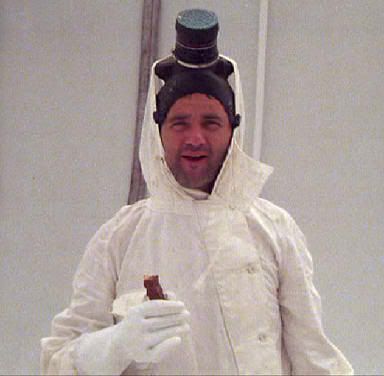
"The Gods Must Be Crazy" (Jamie Uys, 1980)
Inelegantly filmed comedy that begins almost as a social documentary, then devolves into a slapstick fest with automatic weapons. "The Gods Must Be Crazy" has its liberal heart in the right place, but is inept in its execution and a bit desperate in its storyline, bringing in running guerilla battles into a storyline that should have remained with its set-up: the encroachment of civilization (so-called) on indigenous people.
Xin (N!xau) is a Sho, living in the Kalahari desert. A member of a tribe of hunter-gatherers, they have (somewhat unbelievably) managed to escape any kind of contamination by industrialized society, other than the ocassional plane flying over, which to the Sho are manifestations of the god who provides them life and food.
One day, god tosses a Coke bottle out of his winged chariot, which falls to the Earth and which the Sho see as a wonderful tool—multi-functional and beautifully elegant—that they then use in their day-to-day. But, as there's only one and many Sho, it leads to squabbling and fights that threaten the tribe's cohesion, so Xin (wisely, I think) determines that he will walk to the ends of the Earth to give it back to his gods.
The ends of the Earth are a long slog, and Xin inevitably confronts dim examples of his gods, in their rattle-trap conveyances and their cities and jails, arbitrary rules and disorganization and squabbles that make a Coke bottle seem like...garbage.
After a series of increasingly action-oriented situations, Xin accomplishes his goal and makes it back to his tribe, a little wiser to the ways of the gods and not having any of it. The End...until the four sequels happen.
This thing was a world-wide smash when it played around the world, and it's difficult to see why. Look, I dig the message on many levels, all well and good, but I watched in stupefied pity as the film became increasingly more awful on the way to its graceful conclusion, in much the same funk I watch the films of Ed Wood. It's one of those cases that match the phrase that graces the header of Jim Emerson's excellent "Scanners" blog ("There's nothing I like less than bad arguments for a view that I hold dear." -- Daniel Dennett ). And "The Gods Must Be Crazy" is a bad argument...about bad arguments. There were charges of racism when the film came out and a couple nations even banned it, but I don't know if it's racism when everybody looks a little silly (As the whites are the most lame bunch of saps, I suppose you could make a case for "reverse racism" if you actually believe in that term, which, to me, seems like something you'd say in schoolyard bickerings). I see the film as a missed opportunity; it could have been a lovely film, comedy or no, about "losing my religion," and the shattering of long-held beliefs—it is, of course, but it's not a "lovely film" by any stretch. It's like a Benny Hill sketch of that theme. All it needs a is a "Yakkety Sax" soundtrack.
K came back from her trip to South Africa, with a constant refrain excaping from her lips: "Hey! Teacher! Leave those kids alone!" That snippet of Pink Floyd elegantly encapsulated her feelings about what "civilization" has done (and is still doing) to "raise up" indigenous peoples to "improve themselves" in the name of God and Knowledge and Commerce. They'd survived centuries without it—why now? All the teachers haven't learned the lesson that what they are providing has only led to poverty and loss of a way of life that had been working, and never will again, making them dependent on an imposed system (Wow, I'm starting to sound dangerously conservative here!) they had previously never wanted...or needed. The teachers are providing solutions that don't work to a problem that they, themselves, created. When will they ever learn?
Next planet, I guess, huh?
In the meantime, I live two blocks from an "Indian Reservation" and a very large casino that rakes in the bucks with gambling, fatty buffet-food, nostalgic entertainment and cheap liquor. They've learned the lessons we taught them very well, and have turned them against us. Cochise should be raising his bow in triumph. Now, that's comedy for ya.
Saturday, July 3, 2010
The Gods Must Be Crazy

Friday, April 2, 2010
The Long Good Friday
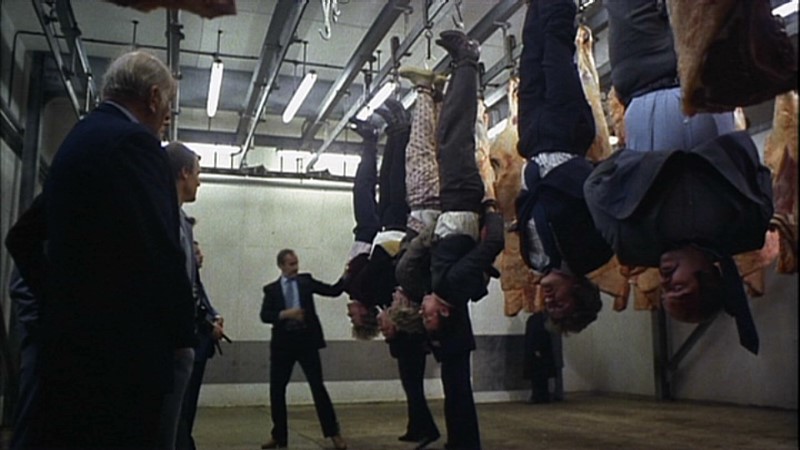
 "The Long Good Friday" (John Mackenzie, 1980) Dense, gritty film about the London underworld that could just as well be about the British government being undermined by terrorists.
Easter weekend as planned is a good one for Harold Shand (Bob Hoskins). He's set up an elaborate yacht-party for his investors, a few politico's in his influence and a guest appearance by a U.S. mob-boss (Eddie Constantine), to toast Harold's new developments planned along the Thames dockyards. Everything seems to be in place—the pay-offs to the pols, the cheap Irish workers are kept in line, and the Americans want to help finance the new construction.
Then things start to go North. An old pal of Harold's (Paul Freeman), acting as a courier to the IRA, has siphoned off some funds, and been murdered in revenge. Harold's mum went off to Good Friday services and, while in the church, somebody blew up the Shand Rolls. A bomb has been discovered in one of Shand's casinos, and he's been getting some stick from Jeff (Derek Thompson), his college-educated lieutenant. Shand and his better half (Helen Mirren) are having trouble keeping the partiers occupied and unaware of the difficulties, especially when one of Shand's restaurants they've set as a meeting place is blown up moments before they step inside.
This gets on Harold's bad side. Harold's a bloke from Stepney, who's risen in the ranks and wants to do his part to make England great again, with international relations enhanced by their entry into the Common Market. He's polishing his image to make further entries into legitimate business.
But all those explosions are getting in the way.
It's a delicate balancing act he must portray in 36 hours: on the one hand, pulling whatever strings (and tendons) he can to find out who's sabotaging him, and on the other, keeping a respectable front for his business partners, current and future.
It's a crackling tale full of malice, the occasional conflagration, some well-placed bullets, and the occasional sharp edge. For the holidays, there's even a crucifixion (off-screen). Hoskins is brilliant in this, barely keeping a veneer of civility over his tough roots, capable of his own explosions at any time, and Mirren is the one trying to keep him from shattering. Look for the first feature-appearance of Pierce Brosnan as a gum-chewing hit-man, and stay on top of the dialogue—it's pretty complex.




Saturday, December 19, 2009
The Formula
 "The Formula" (John G. Avildsen, 1980) Fairly lousy movie, done in the clunky Avildsen style, of a police detective (George C. Scott) following a series of murders that involves the MacGuffin of a synthetic substitute for petroleum. Avildsen is the perfect director for thudding cartoons like the "Rocky" series and "The Karate Kid." But when having to provide any subtlety or style, as he attempted to do with "Slow Dancing in the Big City," it's a miserable failure. And one has to say that he didn't add anything to the thriller or detective genres (or even the "paranoid thrillers" established in the 70's) with "The Formula."
There is one joy, however, and that is to see the meeting of two of the better actors of the American stage square off, and really, it's probably the only reason the film got made (except for a tenuous tie-in to the then-dissolving energy crisis). They have one scene together of any consequence. Both men are a bit over-weight—Marlon Brando playing the fattest of oil-cats—and the two meet for a semi-perfunctory sizing up of each other.* One anticipates sparks flying between two titans.
And they don't. It's a genial little walk in the sun and the two banter back and forth—Scott's Lt. Barney Caine probing gently and Brando's Adam Steiffel waxing folksy and feigning detachment. But it's fun to watch. Brando's off in his "method" world—if he seems distracted it's because an assistant is feeding his lines through a hearing aid, and Scott observes the performance with an odd amusement, completely out of character.** What you're seeing is a fellow thespian (and fellow Oscar refuser) do his thing and barely suppressing his amusement...and bemusement.
It happens sometimes in movies, when very talented people with nothing to prove collide in a scene. As when Meryl Streep and Vanessa Redgrave play old friends in "Evening," or Al Pacino just sits back and revels in Jack Lemmon's shop-talking in "Glengarry Glen Ross." It doesn't help a bad movie. It can't help "Evening" or "The Formula." But it's one of those magical moments when artifice is usurped by genuineness and the joy of creation is reflected off the screen to the audience.
* Come to think of it, Brando's character would have been more effective if he were an insular baron.
** Apparently, the rueful shakes of Scott's head during the scene are his reaction to Brando doing a completely different "read" of his lines than previous takes.
Tuesday, December 9, 2008
Atlantic City
 I've made no secret of my prejudices against the directorial style of Louis Malle: He's one of the handful of directors I know who can make salacious subject matter dull. In college, after seeing "Lacombe Lucien " and "Pretty Baby" in a period of three weeks, I started repeating the same joke whenever any person dared mention his name. I'd say sneer that the perfect Louid Malle film would be two guys in a room talking and Malle using three cameras to film it.
 And what happens? He makes "My Dinner with Andre."
And...I like it!
So, I don't seek out Louis Malle films, though I've endured a handful of them. And he's the exception that proves the rule. I approach his films with caution rather than openness. "Alright, prove me wrong!" is in my head before I watch a Malle film. Or, in Hitchcock's words: "Enchant me."*
Not fair, I suppose, but I went through that same ritual when I popped "Atlantic City" into the DVD player. But that's how it is with me.
And hey, "Atlantic City" is a pleasant surprise. An English language film (written by playwright John Guare) with an eye toward the sordid side of American life, set in a transitional Atlantic City before it was "Trumped" up into "Vegas-East." The crumbling facades make an apt back-drop for the toothless lions and hapless turks trying to score The Good Life.
Burt Lancaster and Kate Reid turn in terrific performances: he, a retiree living a fantasy life as a former High Roller that never was; and she, a bed-ridden glamor queen in crumpled disarray, entombed in her boudoir.

Then, there's the gal he anonymously peeps at night as she ritualistically cuts lemons and squeezes the juice on her skin. To him, it's a stolen moment of sensuality. For her, she's trying to remove the stink from working at a Casino fish-fry. She's Sally Matthews (Susan Sarandon) and she's just recently been hit up by her ex, who shows up in town with a wad of stolen heroin in the shape of a nest-egg, and Sally's kid sister--who just happens to be carrying ex's kid. Messy. Complications ensue.

What's marvelous about the movie is the perfect setting for the parade of wannabe's and neverwas's in a tourist city whose seedy veneer is being stripped away to the crusty rebar underneath. Of course, it's to be replaced by just another false-facade. but, like the city, eveybody's in transition: to a better life, to a better understanding of life: to a shallow grave.
It's pleasant and seamy, but then Malle's always been attracted to the under-belly of civilization and the psyche; here, the psyche's are good impressions deep, and there's just the faintest whiff of good intentions in the air, that despite the squalor gives the movie an almost sunny disposition.
There are things that made me wince—a too-long stutter of a reaction shot in an unexpected farewell scene, and a too-cute End Crawl with Michel Legrand's poppy chansons being demolished out of existence by a wrecking ball. But, a nicely done film from one of my least-favorite directors.
* Said to Anthony Perkins on the set of "Psycho" when the actor told Hitchcock he had an idea for walking up the Bates staircase, but he had to show it to him: Perkins walked up the stairs with a feminine gait to his hips, Hitchcock roared with laughter, and that's how it appears in the film.
Tuesday, April 1, 2008
Caddyshack
"Caddyshack" (Harold Ramis, 1980) One has few regrets in life,  hopefully. As one gets older, experience colors perception, and suddenly movies like "The Rules of the Game" speak to you in new ways, and movies like "Caddyshack"...well, I've been spending a remorseful few minutes thinking of all the people I'd recommended this movie, too. Not that "Caddyshack" is horrible, mind you. But it hasn't aged well since my college days.* Fond memories of Harold Ramis' "Animal House for Juvenile Adults" is full of references and gags that seem geezer-ish. But there are some things that hold up. It's Chevy Chase's funniest perfromance in the movies (I believe that is the very definition of "Damning with Faint Praise"), and one of Bill Murray's wildest--you get the impression that they were winging it, Chase improvising the physical with Murray skewering the dialog. It showed Rodney Dangerfield to be a wierdly endearing clumsy performer for the movies, and it's Ted Knight at his foolish best. Two bits still work--the "Baby Ruth" gag, and the little mini-epic contained in it of the minister's perfect game in the rain. But, don't be surprised if the one thing you take away from it is John Dykstra's roly-poly gopher puppet. Here's an interesting "Caddyshack" link.