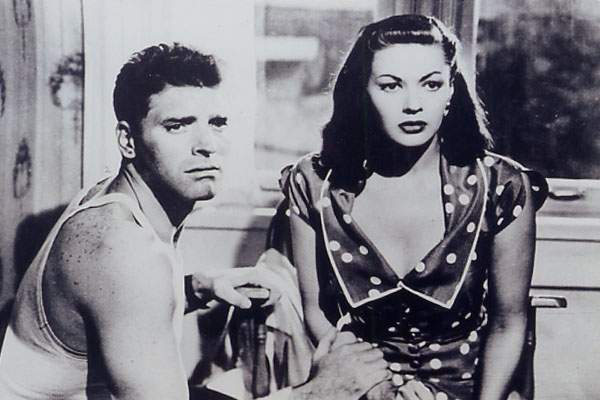
 "Criss-Cross" (Robert Siodmak, 1949) You can't tell a grown man what to do. That's the problem. Even though he's old enough to know better ("old enough to vote for two presidents") and even though he keeps saying that he's over all that, Steve Thompson (Burt Lancaster) comes back to L.A. and manages to get hooked up with his ex-wife (the wide-eyed Yvonne De Carlo) all over again.
And she's trouble. His mom knows it, his police lieutenant pal Peter Ramirez (Stephen McNally) knows it. Even his bartender (Percy Helton) knows it! On top of which, she's been seen stepping out with local hood Slim Dundee (Dan Duryea). And before you know it—boom!—she marries the bum.
So what are Thompson and Dundee doing planning an armored car robbery together? Dimes to donuts Anna Thompson Dundee is at the center of it all.
Bet her maiden name was "Conda."
The mess that Thompson finds himself in is done with the best of intentions, but one of the tenets of film-noir is that good intentions done for bad people are a recipe for disaster. No good deed goes unpunished in the dark alleys and side-streets of film noir, even in blinded-by-the-light sunny Hell-A. And director Siodmak,one of the architects of noir-style, finds the shadows cast even in the noon-day sun.
"Criss-Cross" is a good minor example of the genre, with nice performances by Lancaster, DeCarlo and Duryea. And look for Tony Curtis in a brief (and silent) early appearance.
Tuesday, August 18, 2009
Criss-Cross



Monday, May 25, 2009
Run Silent, Run Deep
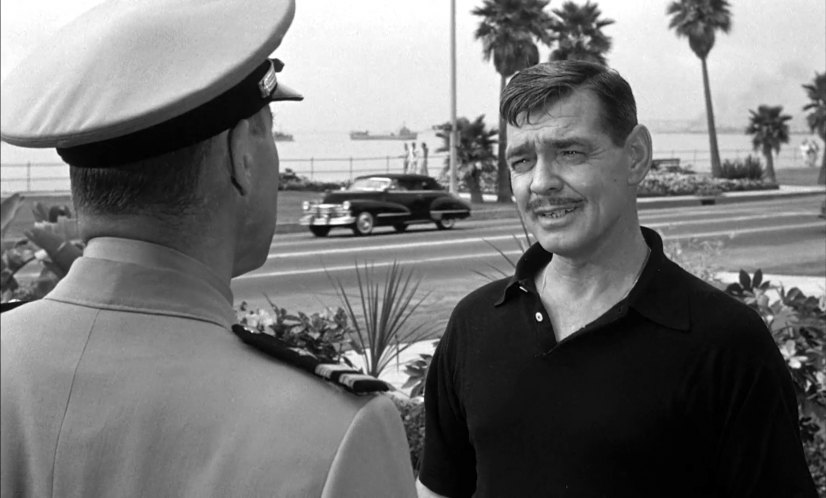
 "Run Silent, Run Deep" (Robert Wise, 1957) One of those general entertainment movies that manages to do so many things exceptionally well that one comes away grateful for the experience. Directed by Robert Wise with a true sense of claustrophobia, the script by John Gay maintains a strict military accuracy while displaying a keen sense of drama, psychology and brevity. A psychological drama, a war film, a story of mystery as well as redemption, the film manages to pull everything off with a propulsive rhythm and fine performances throughout.
Produced by Hecht-Hill-Lancaster, Burt Lancaster the producer takes a back-seat to his star, Clark Gable, the older actor in one of his understated roles that takes into account his age. Gable's the flawed figurehead with shades of Ahab who finagles his way into the command of the S.S. Nerka patrolling the Pacific during World War II, having already lost one sub and and a frustrating convalescence at a desk-job.
Lancaster's exec Jim Bledsoe is torqued because Gable's Cmdr. "Rich" Richardson has pulled rank to get command—his command—and is now drilling the men to dive and shoot a torpedo within a record 35 seconds. The already suspicious crew starts to snarl about all this practice with nothing to show for it. Then a lucky strike convinces some of them the new Captain is golden, while the other half think he's out to torpedo their mission. Lancaster turns into a reluctant arbiter.
But, in their first attempt to sink Richardson's unsinkable Japanese war-ship things don't go so well leaving crew-members dead and injured and Lancaster in command.
Robert Wise is a master of filming people at work with a story-teller's eye for finding the perfect angle (without calling attention to it and himself) and an editor's sense of pace and construction. Wise is also a chameleon of style tamping down his presentation of professionals doing their jobs while also being able to ramp up the spectacle for the unreal worlds of musicals and science fiction. Given his work on this film, you could see why he'd be the perfect choice for the similarly set-bound "Star Trek: The Motion Picture."
He also makes goods use of the usual crew of character actors who make up the Nerka's lovable mugs: Jack Warden, Brad Dexter, Don Rickles, Nick Cravat and Joe Maross. The close quarters of a submarine makes the authentic plainness of their faces all the more important and brings them to a prominence near the bright lights of Gable and Lancaster. Both those lights are shaded somewhat, with Lancaster doing subtle, measured work, the kind that would dominate his later career. Gable, even subtler, is the King, here in his twilight, still burning brighter than the vast majority of actors. By this time, Gable was moving slower and had learned the power of economy and his Captain Richardson draws you in.
Finally, the story is a cracker-jack construction. Just when you think you've got it figured out, screenwriter Gay throws in an added complication that ramps up the idea that these are men strategizing in chaos and only repeated dips into the boiling oil of battle can make them seasoned enough to think clearly through the smoke and death.
"Run Silent, Run Deep" is an intelligent tribute to the fighting services without resorting to jingoism, racism or choired flag-waving. The film-makers' respect for the professionalism under duress of sub-crews runs silent and deep.
Memorial Day, 2009


Tomorrow: An "Anytime Movie" with a magician's touch
Friday, May 8, 2009
Judgment at Nuremberg
 "Judgment at Nuremberg" (Stanley Kramer, 1961) It was Katharine Hepburn who shepherded this film from its origins as an episode of "Playhouse 90" to this version as a three hour epic.* The movie is padded with shots of Spencer Tracy touring the city (still in rubble in 1960, twelve years after the judges trials at Nuremberg**), and background of the characters, including a chaste meeting of minds with a Nazi widow (Marlene Dietrich, still oozing mystery at the age of 60). Screenwriter Abby Mann makes the citizenry complicit in his expanded screenplay, despite their protestations of ignorance. And the military at the time of the trial was in the middle of the Berlin Airlift, their attention now turned to "the Bolsheviks" and cozying up to Germany for strategic advantage, casting the worth and even the result of the trial in question for political expediency. The movie is allowed much more cynicism than the Playhouse 90 broadcast, where the words "gas chambers" were subject to censorship by sponsor The American Gas Association.
The movie threatens to swamp itself with star-power but leavened it by Tracy disappearing into his role. Maximilian Schell repeats his television performance (winning an Oscar in the process, as did Mann for his adaptation). Of the newcomers, the best performances are Montgomery Clift in face and body language denoting a characters damaged by the brutality of the Nazi regime. And Judy Garland, who'd always seemed like a raw nerve in her films, acts merely from the neck up—and that's all that's required. Not as controlled are Richard Widmark, whose prosecutor is a bit too demonstrative in private for a courtroom strategist, and Burt Lancaster, given a great speech but, a weakness of the actor, aware of it. Laurence Olivier was intended to play German Ernst Janning, but dropped out. I'm not sure that would have been an improvement, but it would have been interesting.
Kramer struggles with the material; he would later become an expert on courtroom directing. But here, he's more intent on making the drama look interesting with camera moves by circling witnesses and, most egregiously, using a fast zoom to zero in on a dramatic moment. It's used sparingly, but even that's too much for the material. He would learn to trust his actors and inherent drama of the scene to carry it.
But, "Judgement at Nuremberg" manages to be something that eludes most Kramer films—it's a bit more timeless, especially in regards to the short-sightedness of chipping away at bedrock principles for today's political viability and the future's further erosion. One could be speaking of water boarding as torture in Abby Mann's summation speech.
Read it. Read the whole thing. But linger on the words after the picture below.
Judge Haywood: The trial conducted before this Tribunal began over eight months ago. The record of evidence is more than ten thousand pages long, and final arguments of counsel have been concluded.
Simple murders and atrocities do not constitute the gravamen of the charges in this indictment. Rather, the charge is that of conscious participation in a nationwide, government organized system of cruelty and injustice in violation of every moral and legal principle known to all civilized nations. The Tribunal has carefully studied the record and found therein abundant evidence to support beyond a reasonable doubt the charges against these defendants.
Herr Rolfe, in his very skillful defense, has asserted that there are others who must share the ultimate responsibility for what happened here in Germany. There is truth in this. The real complaining party at the bar in this courtroom is civilization. But the Tribunal does say that the men in the dock are responsible for their actions, men who sat in black robes in judgment on other men, men who took part in the enactment of laws and decrees, the purpose of which was the extermination of humans beings, men who in executive positions actively participated in the enforcement of these laws -- illegal even under German law. The principle of criminal law in every civilized society has this in common: Any person who sways another to commit murder, any person who furnishes the lethal weapon for the purpose of the crime, any person who is an accessory to the crime -- is guilty.
Herr Rolfe further asserts that the defendant, Janning, was an extraordinary jurist and acted in what he thought was the best interest of this country. There is truth in this also. Janning, to be sure, is a tragic figure. We believe he loathed the evil he did. But compassion for the present torture of his soul must not beget forgetfulness of the torture and the death of millions by the Government of which he was a part. Janning's record and his fate illuminate the most shattering truth that has emerged from this trial: If he and all of the other defendants had been degraded perverts, if all of the leaders of the Third Reich had been sadistic monsters and maniacs, then these events would have no more moral significance than an earthquake, or any other natural catastrophe. But this trial has shown that under a national crisis, ordinary -- even able and extraordinary -- men can delude themselves into the commission of crimes so vast and heinous that they beggar the imagination. No one who has sat at through trial can ever forget them: men sterilized because of political belief; a mockery made of friendship and faith; the murder of children. How easily it can happen.

There are those in our own country too who today speak of the "protection of country" -- of "survival." A decision must be made in the life of every nation at the very moment when the grasp of the enemy is at its throat. Then, it seems that the only way to survive is to use the means of the enemy, to rest survival upon what is expedient -- to look the other way.
Well, the answer to that is "survival as what?" A country isn't a rock. It's not an extension of one's self. It's what it stands for. It's what it stands for when standing for something is the most difficult!
Before the people of the world, let it now be noted that here, in our decision, this is what we stand for: justice, truth, and the value of a single human being.
* Probably to give her love and paramour Spencer Tracy another plumb acting role. His health (owing to his tendency to drink to excess) was always improved when he was working.
** Although shots of Richard Widmark driving through the city are obvious process shots.
Tuesday, December 9, 2008
Atlantic City
 I've made no secret of my prejudices against the directorial style of Louis Malle: He's one of the handful of directors I know who can make salacious subject matter dull. In college, after seeing "Lacombe Lucien " and "Pretty Baby" in a period of three weeks, I started repeating the same joke whenever any person dared mention his name. I'd say sneer that the perfect Louid Malle film would be two guys in a room talking and Malle using three cameras to film it.
And what happens? He makes "My Dinner with Andre."
And...I like it!
So, I don't seek out Louis Malle films, though I've endured a handful of them. And he's the exception that proves the rule. I approach his films with caution rather than openness. "Alright, prove me wrong!" is in my head before I watch a Malle film. Or, in Hitchcock's words: "Enchant me."*
Not fair, I suppose, but I went through that same ritual when I popped "Atlantic City" into the DVD player. But that's how it is with me.
And hey, "Atlantic City" is a pleasant surprise. An English language film (written by playwright John Guare) with an eye toward the sordid side of American life, set in a transitional Atlantic City before it was "Trumped" up into "Vegas-East." The crumbling facades make an apt back-drop for the toothless lions and hapless turks trying to score The Good Life.
Burt Lancaster and Kate Reid turn in terrific performances: he, a retiree living a fantasy life as a former High Roller that never was; and she, a bed-ridden glamor queen in crumpled disarray, entombed in her boudoir.

Then, there's the gal he anonymously peeps at night as she ritualistically cuts lemons and squeezes the juice on her skin. To him, it's a stolen moment of sensuality. For her, she's trying to remove the stink from working at a Casino fish-fry. She's Sally Matthews (Susan Sarandon) and she's just recently been hit up by her ex, who shows up in town with a wad of stolen heroin in the shape of a nest-egg, and Sally's kid sister--who just happens to be carrying ex's kid. Messy. Complications ensue.

What's marvelous about the movie is the perfect setting for the parade of wannabe's and neverwas's in a tourist city whose seedy veneer is being stripped away to the crusty rebar underneath. Of course, it's to be replaced by just another false-facade. but, like the city, eveybody's in transition: to a better life, to a better understanding of life: to a shallow grave.
It's pleasant and seamy, but then Malle's always been attracted to the under-belly of civilization and the psyche; here, the psyche's are good impressions deep, and there's just the faintest whiff of good intentions in the air, that despite the squalor gives the movie an almost sunny disposition.
There are things that made me wince—a too-long stutter of a reaction shot in an unexpected farewell scene, and a too-cute End Crawl with Michel Legrand's poppy chansons being demolished out of existence by a wrecking ball. But, a nicely done film from one of my least-favorite directors.
* Said to Anthony Perkins on the set of "Psycho" when the actor told Hitchcock he had an idea for walking up the Bates staircase, but he had to show it to him: Perkins walked up the stairs with a feminine gait to his hips, Hitchcock roared with laughter, and that's how it appears in the film.
Thursday, November 27, 2008
The Leopard
"The Leopard" aka "Il Gattopardo" (Luchino Visconti, 1963) I've seen "The Leopard" only once. Its beauties compel further viewings with which more of the complexities of the work will become apparent. One can't wait to get started. * Sydney Pollack supervised the dubbed version, and even he acknowledged it hurt the movie. One of the odd things about it is Lancaster's performance: He's actually better dubbed in Italian with a different, gruffer voice, rather than the soft, smokey baritone of his own voice. In fact, the combination of Lancaster's screen-work and substituted voice combine to make the greatest performance he never gave!
Epic.
Extraordinarily epic.
Exquisite three hour film (that is, if you watch the original Italian, rather than the edited, dubbed American version*) of the change-over from one generation of Italian artistocracy to one with fewer ties to the past, amidst a changing landscape that will ultimately change fortunes. Don Salina (Burt Lancaster) is a prince of the old lineage observing the change that will ultimately overthrow the government and his rights to power, even as he sees the old ways and traditions begin to erode in the rise of his nephew Tancredi Falconeri (Alain Delon) who chooses to marry below his station to the manipulative Angelica (Claudia Cardinale). In one of the many allusions to the animal kingdom, Don Salina fears that his generation of leopards is being handed over to jackals.
In its timeline and its scope, it could be labeled the Italian "Gone With the Wind." Certainly the care and attention to detail that director Visconti, Director of Photography Giuseppe Rotunno, and Production Designer Mario Garbuglia brought to bare can be compared to the extravagance of the American epic. But it's a smarter, richer film—a far better film—with layered subtleties that GWTW never aspired to.
Visconti had a special affinity for the material. Like the author of the original novel, Giuseppe Tomasi di Lampedusa, the director was born to the aristocracy. He knew its joys and pleasures and tastes, and he follows Lampedusa's celebration of that life in its recognition. But Visconti became a Marxist, so he looks at the excesses and hypocrises with less sentiment than Lampedusa does. But, he also acknowledges that change ultimately doesn't change much where fortunes are involved.
Contained here are some of the beautiful images that Visconti, Rotunno, and Garbuglia composed, rich in color and detail like fine paintings. But they're in motion and filled with life and portent and commentary.


Films like "The Leopard" are why one falls in love with the medium in the first place.


