Showing posts with label Robert Wise. Show all posts

Monday, May 25, 2009

Run Silent, Run Deep

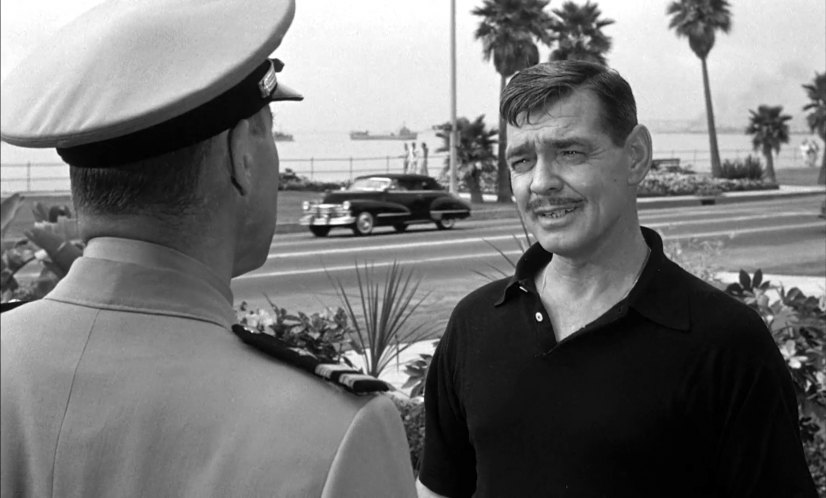
"Run Silent, Run Deep" (Robert Wise, 1957) One of those general entertainment movies that manages to do so many things exceptionally well that one comes away grateful for the experience. Directed by Robert Wise with a true sense of claustrophobia, the script by John Gay maintains a strict military accuracy while displaying a keen sense of drama, psychology and brevity. A psychological drama, a war film, a story of mystery as well as redemption, the film manages to pull everything off with a propulsive rhythm and fine performances throughout.

Produced by Hecht-Hill-Lancaster,
Burt Lancaster the producer takes a back-seat to his star, Clark Gable, the older actor in one of his understated roles that takes into account his age. Gable's the flawed figurehead with shades of Ahab who finagles his way into the command of the S.S. Nerka patrolling the Pacific during World War II, having already lost one sub and and a frustrating convalescence at a desk-job.

Lancaster's exec Jim Bledsoe is torqued because Gable's Cmdr. "Rich" Richardson has pulled rank to get command—his command—and is now drilling the men to dive and shoot a torpedo within a record 35 seconds. The already suspicious crew starts to snarl about all this practice with nothing to show for it. Then a lucky strike convinces some of them the new Captain is golden, while the other half think he's out to torpedo their mission. Lancaster turns into a reluctant arbiter.

But, in their first attempt to sink Richardson's unsinkable Japanese war-ship things don't go so well leaving crew-members dead and injured and Lancaster in command.

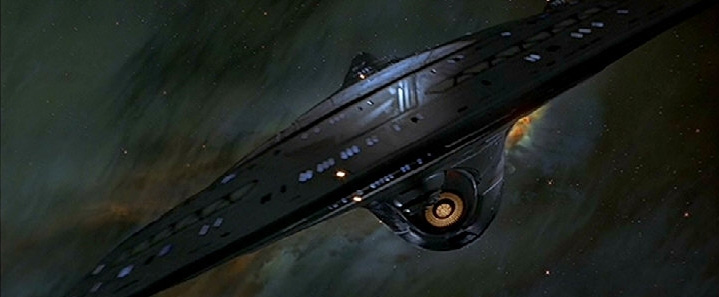
Robert Wise is a master of filming people at work with a story-teller's eye for finding the perfect angle (without calling attention to it and himself) and an editor's sense of pace and construction. Wise is also a chameleon of style tamping down his presentation of professionals doing their jobs while also being able to ramp up the spectacle for the unreal worlds of musicals and science fiction. Given his work on this film, you could see why he'd be the perfect choice for the similarly set-bound "Star Trek: The Motion Picture."

He also makes goods use of the usual crew of character actors who make up the Nerka's lovable mugs:
Jack Warden, Brad Dexter, Don Rickles, Nick Cravat and Joe Maross. The close quarters of a submarine makes the authentic plainness of their faces all the more important and brings them to a prominence near the bright lights of Gable and Lancaster. Both those lights are shaded somewhat, with Lancaster doing subtle, measured work, the kind that would dominate his later career. Gable, even subtler, is the King, here in his twilight, still burning brighter than the vast majority of actors. By this time, Gable was moving slower and had learned the power of economy and his Captain Richardson draws you in.

Finally, the story is a cracker-jack construction. Just when you think you've got it figured out, screenwriter Gay throws in an added complication that ramps up the idea that these are men strategizing in chaos and only repeated dips into the boiling oil of battle can make them seasoned enough to think clearly through the smoke and death.

"Run Silent, Run Deep" is an intelligent tribute to the fighting services without resorting to jingoism, racism or choired flag-waving. The film-makers' respect for the professionalism under duress of sub-crews runs silent and deep.

Memorial Day, 2009

Tomorrow: An "Anytime Movie" with a magician's touch

Friday, April 17, 2009

Now I've Seen Everything: Star Trek

In which the author, having seen everything that needs to be on the subject, draws some conclusions about the series, or director.

Lord knows how many times I've seen each episode of The Original Series, but I believe it approaches the Sagan-ian concept of "billyuns and billyuns." But, I'll state this up-front: "Star Trek, the Movie Series" is only somewhat similar to "Star Trek, the Television Series." Whereas TOS was the crew dealing with a space phenomenon or political crisis, The Movie Series was an extended soap opera that just happened to coincide with space phenomena, usually man-made or man-manipulative. If the infinity of Space is not enough for screen-writers, then what's a Heaven for?

Sulu, prepare for time-slingshot.

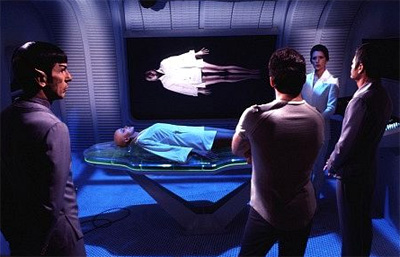
"I: The Motion Picture" (Robert Wise, 1979) The success of "Star Wars" in 1977 scuttled a second "Star Trek" series (without Spock and possibly with Kirk) that Paramount was hoping to release as a syndicated show (that experiment held off until "ST:TNG"), and putting it on the front-burner as a Major Motion Picture. Fans were ecstatic, but the show was in trouble. First writer-director Philip Kaufman jettisoned an escape pod working with creator Gene Roddenberry who had Executive Producer rights over the show. Then, Roddenberry worked on a script—one to have been used as the "STII" pilot. It was a last minute decision,* plus they needed a director--all this with a drop-dead delivery date that was already established and would not move. The chronometers were still running.

Veteran director
Robert Wise, not unfamiliar with big movies and sci-fi, stepped in and started wrestling the bag of Rigelian cats: getting reluctant "Spock" Leonard Nimoy to commit to it, and whatever Nimoy got, Shatner had to have, too. Neither of them liked the script, which Roddenberry kept changing to no one's satisfaction. Writer Harold Livingston was hired to make changes, which Roddenberry would re-write, which Livingston would re-re-write. Pretty soon, the writers were not talking to each other and actively working against each other. Petulance on and off-screen was the order of the day, but Wise managed to get the filming done, only to find that the sfx group hired to do the extravagant effects was still in R&D mode. They were "jettisoned", and Paramount reached very deep into their pockets to secure the two most prominent effects men working at the time: John Dykstra (who'd supervised "Star Wars") and Douglas Trumbull (who'd done the same for "Close Encounters of the Third Kind"). The two whizzes took half a film apiece and began the tedious work of doing all the effects, while composer Jerry Goldsmith began composing an epic score for scenes he couldn't see.

They made it. But barely. Audiences watching "
Star Trek: The Motion Picture" opening weekend probably didn't realize when they saw a splice in the first reel that it had only been made, physically into each reel, that week, and "shipped wet" as they say. There were no screenings of "Star Trek: The Motion Picture" before its debut. Indeed, very few people had seen it at all.

What they would have found was
a strangely starchy movie that displayed dazzling effects (that went on for a bit too long), a bloodless screenplay, one of William Shatner's most self-centered performances (and that's saying something), and an odd off-kilter rhythm that had no momentum...and felt like nobody had watched it all the way through.

Because no one had. Wise would barely mention the film later in his career, revisiting it only to tighten, and
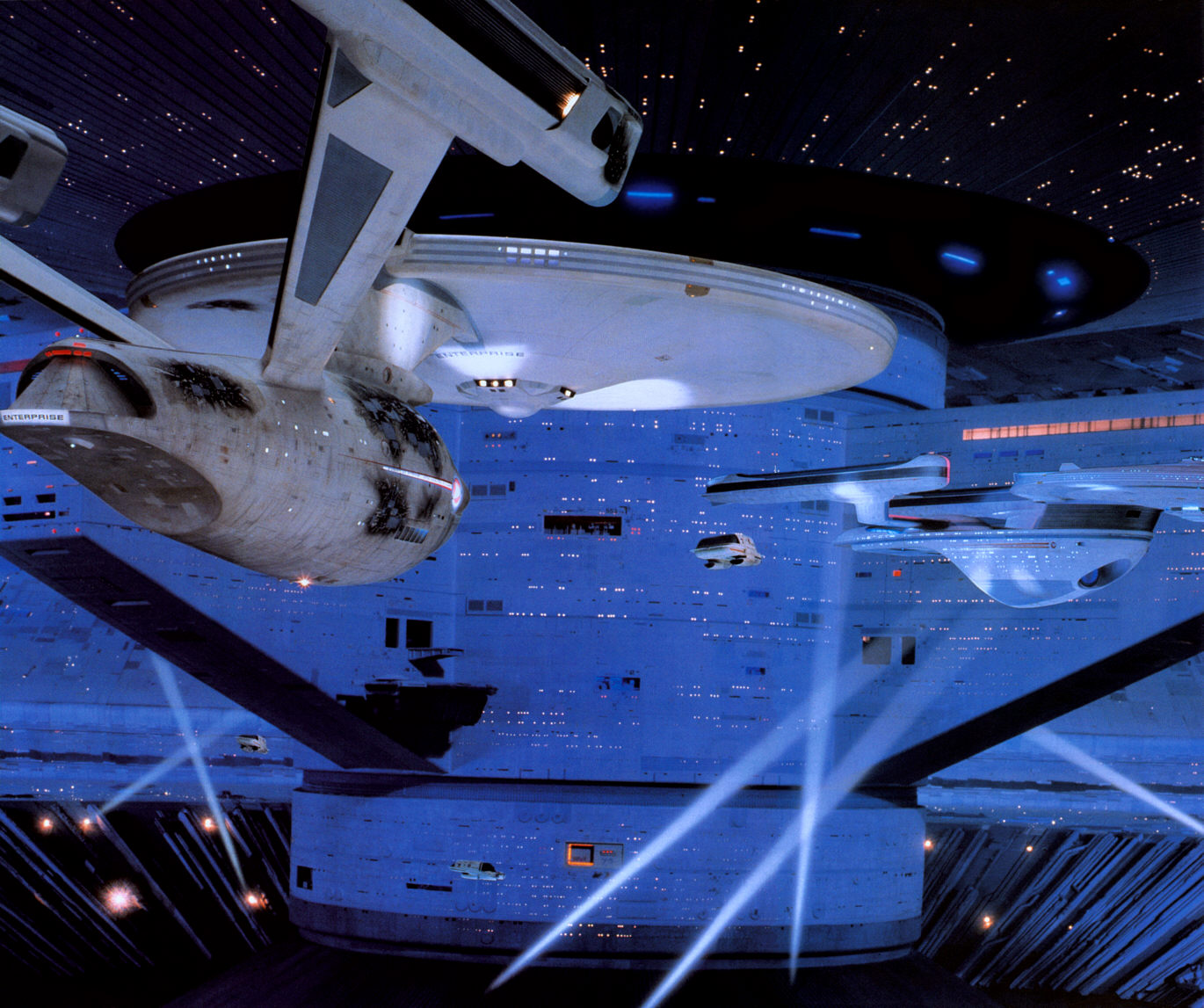
switch-out new digital effects for what didn't work the first time around. There was some improvement, but not much. Although "Star Trek: The Motion Picture" is closer to its roots than the other films in the series, it's dramatically inert, with long sections of "space-sightseer" scenes gazing at ships and phenomenon. Jerry Goldsmith's music does what it can to goose up the energy (and does—it became synonymous with "Star Trek"), but TMP is bloodless, as drained of color and imagination as the gray jump-suits the crew was shoe-horned into.


"II: The Wrath of Khan" (
Nicholas Meyer, 1982) The first "Star Trek" movie did fine at the box-office, but was deemed a disaster by the Paramount brass, expecting revenues along the lines of "Star Wars." Roddenberry was demoted to "Consultant" status, plans for a follow-up (there were no plans for a continuing series) green-lit only on the condition that it could be done cheaply and with a tighter reign over the entire Enterprise. The solution was a television exec Harve Bennett, who slashed budgets, prepped a television crew to film and scoured the Original series for some kind of story. He found it in the Eugenics War episode, "Space Seed," guest starring Ricardo Montalban as rebel leader Khan Noonien Singh, who led a devastating Civil War on Earth and was exiled with his remaining followers to space in suspended animation.
Montalban was enthusiastic, but worried he might play it too much like his then-current television role of Mr. Roarke on "Fantasy Island." The cast was brought back, even Nimoy—with the enticement of having a great death scene, the leak of which created a howl of protests among "Trekkies."

To direct,
Bennett
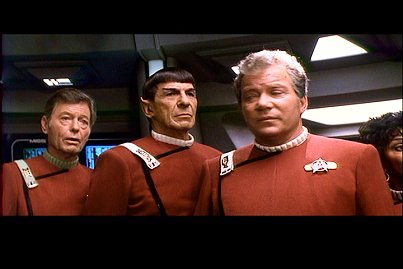
acquired a writer-in-need-of-a-director's-gig, and Nicholas Meyer, best-selling author of "The Seven Percent Solution" and writer-director of the H.G. Wells-Meets-Jack the Ripper yarn "Time After Time," filled the bill admirably, even heroically, despite the fact that, like Bennett, he'd never watched an episode in his life. Meyer refined a script from a handful of screenplays "with some good ideas," to breathe more life into the characters and make the story personal. The result was a coming-of-age movie of sorts for Captain Kirk (William Shatner), as he suffers through a less-than-celebratory birthday and must confront a series of past regrets.
But
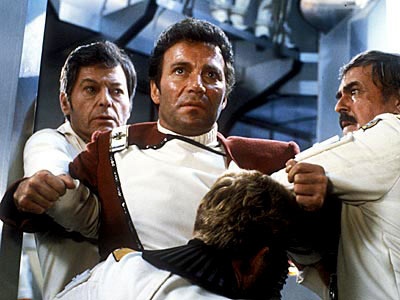
the blood-and-thunder comes from the Clash of Ego's between Khan and Kirk, both driven by revenge and hatred. The two actors have rarely been better: Montalban, quietly disturbing and hissing like a snake, and Shatner, blustery and over-the-top, but able to milk scenes less-checked actors might let slip by. The rivalry is palpable, despite the fact that the two actors never appear on the same stage, or act against each other—a technical challenge that nobody seems to notice, given the impressive results on the screen.
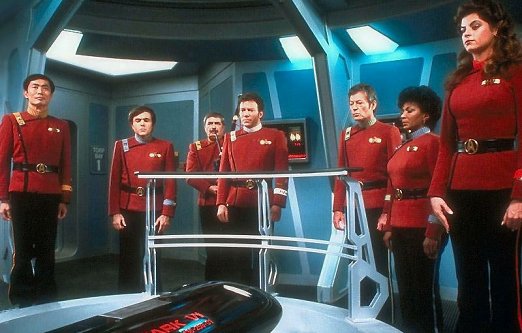
"The Wrath of Khan" (retitled from "
The Vengeance of Khan" as a courtesy to George Lucas who was shooting "The Revenge of the Jedi" (sic) at the time) became a huge hit with Trekkies and general audiences and plans were immediately put in place to create a follow-up.


"
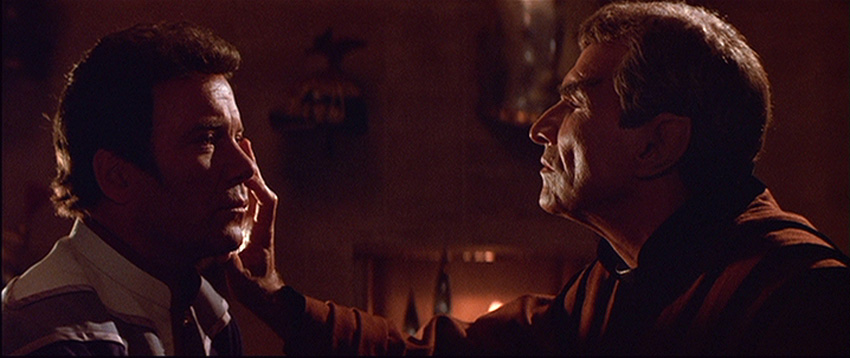
III: The Search for Spock" (Leonard Nimoy, 1984) The problem was...Spock was dead at the end of STII. And it was a really good death scene—audiences responded to it. But, seeing the success the movie had with preview audiences, Bennett (over Meyer's objections) constructed a coda that held out hope that Spock might still be alive in the photon-sarcophagus lying on the Genesis planet. And as bait to the recalcitrant Nimoy, Bennett held out the chance to direct the third "Star Trek" film. Nimoy heartily agreed, the novice director having two advantages—he knew "Star Trek" and he wouldn't have to appear until the end of the film.
The results were a bit stodgy, but Nimoy proved to have a good pointed ear for dialog, and was generous in spreading the story around through the acting company—everybody got a good "bit" in the film, which was more of a re-visitation of the "Wrath of Khan" and dismantling the story infra-structure that it built. By the end of III, things were a lot simpler in the "Star Trek" universe, though not necessarily for the better. III was a bit of a re-hash, continuing the soap story-line from II, and not invoking the sense of wonder and exploration that was the hallmark of the series. "Star Trek" took a small step down on this one. But it would leap forward warp-speed.
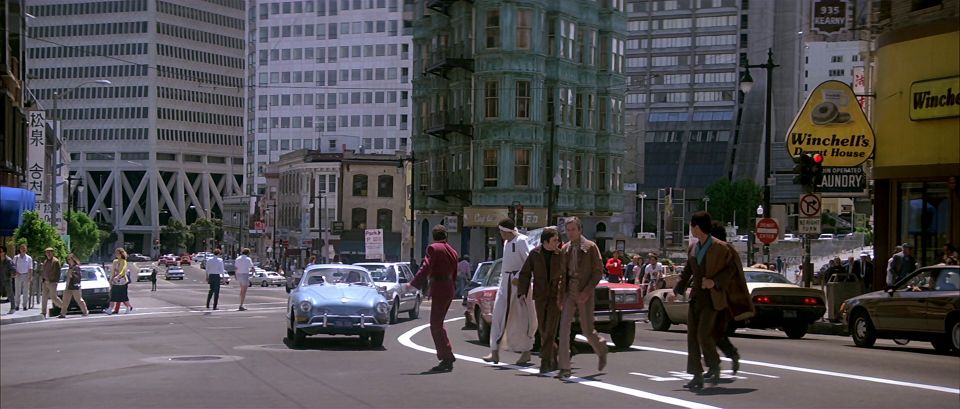
"IV: The Voyage Home" (Leonard Nimoy, 1986) Okay, Spock's alive, the stolen Enterprise destroyed and the mutinous crew under Admiral Kirk is being hunted by Starfleet. What to do? Turn themselves in. But when they get back to Earth, the planet is under attack by....a big black tube. The crew puzzles out that the thing is looking for whales, long ago extinct, and so to save the Earth, the Enterprise goes back in time to bring back humpback whales and assuage the...tube.

Sounds dumb.
But it works like gang-busters. The script—a collaboration between Bennett and Nicholas Meyer (Meyer did the funny time-travel section) has a grand time making the Enterprise crew fish out of water in the backwards 1980's, satirizing current society, and letting the actors make the most of the comedy. Nimoy's directing is clean and stays out of the way. And he keeps the movie fun and gee-whiz all the way through. Audiences responded with enthusiasm, making "The Voyage Home" the most profitable of the "Star Trek" movies. Paramount had their franchise, and was beginning production of a follow-up series with Roddenberry for syndication. What could go wrong?


"V: The Final Frontier" (William Shatner, 1989) It seemed only natural that if Nimoy was given a chance to direct a "Star Trek" movie, that Shatner be given the opportunity as well. Quid pro quo. Which is Andorian for "Let's turn the asylum over to the craziest inmate!"

The script tries for the breeziness of IV
and comes away seeming juvenile in tone, and as the actors were at this point in their 50's, it seemed sadly giddy and embarrassing. The other actors are given demeaning jokes to pull off—navigators Sulu and Chekhov get lost in the woods, and Engineer Scott knocks himself out walking into a support beam. Shatner's recently demoted Captain Kirk has no such problems, but has such brio that he debates "God;" "Why would 'God' need a star-ship?" Why, indeed? Everything about this exercise is sub-par—the script, the performers, the sets, the un-special effects. This one entry nearly scuttled the franchise (producer Bennett, given a cameo in this film, was petitioning jettisoning the old crew and starting afresh with a "Starfleet Academy" idea—hold that thought), so Paramount went to a fall-back position.


"
VI: The Undiscovered Country" (Nicholas Meyer,
1991) The studio asked Nimoy to spear-head one last "Trek"—Nimoy had parlayed his "Trek" success with two movies, "Three Men and a Baby" and "The Good Mother," one a huge success, the other a controversial downer (probably unfairly--I haven't seen it). Nimoy was savvy enough—and humble enough—to tread the rocky shoals of warp-speed ego's and planet-sized demands of the franchise, and bring back Nicholas Meyer to helm it. "Why Would God Want a Starship?" was the crux of V. "Only Nixon Could Go to China" was the basis of VI: where Captain Kirk is the one man in the Universe to broker a peace between a suspicious Federation of Planets and the traditional heavies, the Klingons.
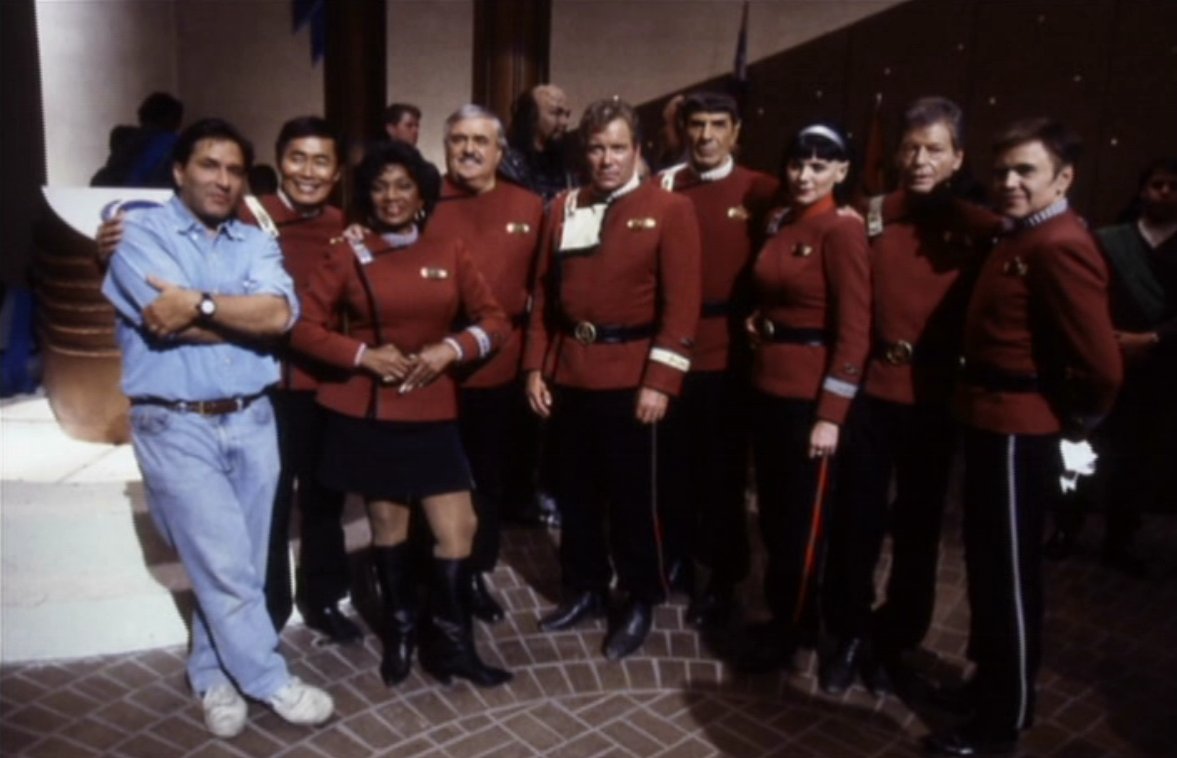
Meyer's smartest move was to separate Kirk (the attention-needy Shatner) and Dr. McCoy (the late DeForest Kelley) from the rest of the cast so that everyone is given moments to shine—even Sulu (George Takei) is given his own command. Plus, the movie series gets its strongest guest star in Christopher Plummer, delightedly chewing the futuristic scenery. ILM is back to bring the FX back to top-shelf. And some minor screen-time is given to Kirk and Spock musing about their own usefulness. In fact, Paramount had already developed plans to ditch this crew and begin producing films featuring the very popular "Next Generation" cast.

"VII: Generations"
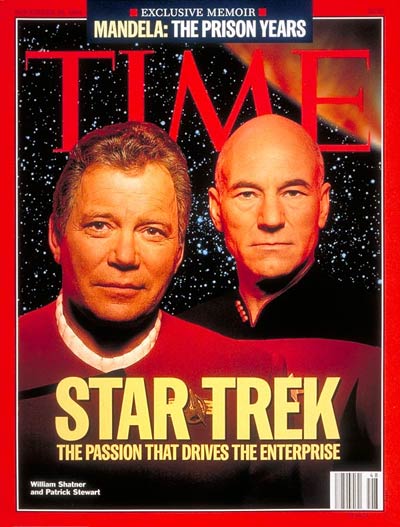
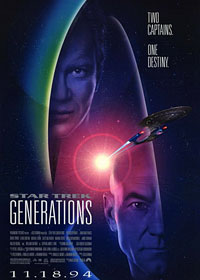
(David Carson, 1994) A clean slate, sort of. Producer Harve Bennett was gone. TNG producer Rick Berman was "in." Nimoy and Meyer moved on. But on the heels of the production of the "Next Generation" series finale, came the first "Next Generation" movie.** And it is a classy affair (Time Magazine put it on their cover!). Cameos by Scotty (the late James Doohan)and Chekhov (Walter Koenig) to start things off, to accompany a prologue of Captain Kirk (William Shatner) as reluctant witness to the launch of the Enterprise-B. This introduces a cosmic thread/Nexus that destroys things but grants the destroyed their heart's desire....

Eh? Say that again...slowly.

Dr. Soren (
Malcolm McDowell...really good at playing pathetically manic, or is that maniacally pathetic?) is a scientist teaming with ex-pat Klingons to capture the Nexus and make it his own private Valhalla, no matter how many civilizations are wiped out in the space-time (as if anything could stop it!)

The Enterprise-D, helmed by
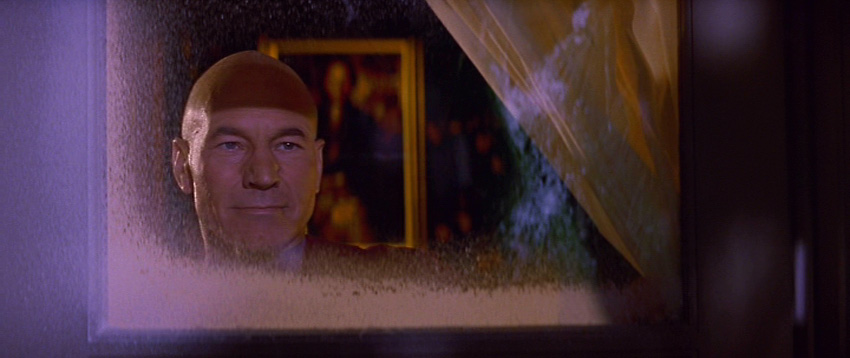
Captain Jean-Luc Picard (the cerebral, invaluable Patrick Stewart) must out-wit Soren, but Picard is caught in the Nexus (and before you can say "Didn't I see this in the original series episode "This Side of Paradise?" and we must all live in our own private Purgatories) and whisked off to his heart's desire, which would appear to be a stable family life with a perpetual Dickensian Christmas. He's shaken out of it by handy crewman-living-outside-the-plot-device Guinan (Whoopi Goldberg) to take things back to reality, back in time, and stop Soren. Fortunately, Captain Kirk's fantasy is right next door (it involves a rustic farm, horses, and chopping pre-scored wood-blocks) and the two Captains team up against the Bad Doctor.

Shatner gets his dream come true—Kirk dies, is resurrected and dies heroically on-camera in the same movie (Stick it, Nimoy!)—
the Enterprise gets destroyed (great sequence of the saucer section crash-landing on a planet). "Generations" points out the flaws in trying to shoe-horn "The Next Generation" crew into the "Star Trek" movie format: just as the Original Series was about ideas and Cosmic Concepts and the movies about Relationships and Action, "The Next Generation" cerebralness doesn't translate well when dumbed down to action set-pieces. The TNG actors were better at knitting their brows than duking it out. Plus, the actors were all pretty mature when the movies started, so having them run around dodging phaser blasts seems lame. Still, "Generations" seemed to break the curse of the even-numbered "Trek's" being good, and the odd ones being bad—as over-simplified as that summary is.

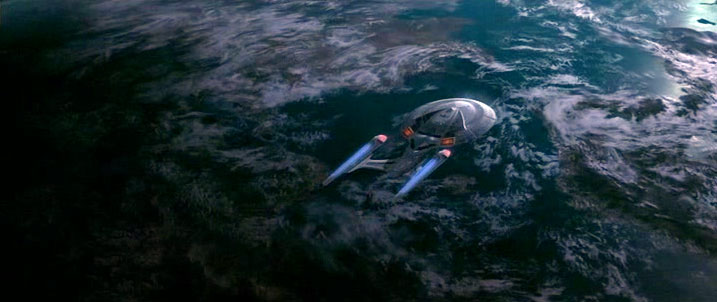
"VIII: First Contact" (Jonathan Frakes, 1996) The first totally "Next Generation" movie is still an exercise in nostalgia. The villains (and by this time, the movies are supposed to have moustache-twirling villains) are the Borg—a neat little concept from the TNG series, an assimilating marauder-race, part human part machine, interdependent on a hive-mind. Except the writers, Ronald D. Moore and Brannon Braga, take it a bit too literally, giving the Borg a "Queen" (which nullifies part of the Borg "specialness" and gives them an instant weakness). The just-commissioned Enterprise-E must go back in time (again?!) to stop the Borg from undoing the key Earth event that established the United Federation of PlanetsZephram Cochrane's first test-flight of the the Phoenix using warp-technology, which, in turn led to the first contact Earth had with an alien species. And just as Nimoy got his chance to direct, The next generation's second-in-command, Jonathan Frakes, who'd directed some of the more intricate TNG episodes, directed "First Contact" with a fine balance between drama, horror and comedy. "First Contact" would prove to be the best of the "Next Generation" films, filling in a lot of "Trek" back-story, while having fun de-bunking myths, while giving the entire cast something to do and finding room to guest-star James Cromwell, Alfre Woodard and Alice Krige (and two quick cameo's from cast-members of the "Trek" series "Voyager"). Ambitious in scope and epic in execution, "First Contact" would prove to be a tough act to follow.

"IX: Insurrection"(Jonathan Frakes, 1998) More in line with traditional "Next Generation" storylines, "Insurrection" feels like a bit of a re-tread. The story concerns a "Fountain of Youth" planet that one of those slimey Federation diplomats (Anthony Zerbe) is trying to requisition in trade negotiations with a youth-obsessed bad guy (F. Murray Abraham). It's up to Picard and co. to help the planet's citizens and go against Starfleet's imperialist wishes. Frakes again directs and he's just as assured, but the script (by TNG stalwart Michael Piller) is sub-par and ends with another Picard-dukes-it-out sequence, which is never a good idea. Plus, it's not a good idea to have a "Fountain of Youth" planet when the crew is noticeably agingincluding unageable android Data (Brent Spiner). A weak entry, it was chalked up to the "odd/even" phenomena and plans were made for another movie.


"X: Nemesis" (
Stuart Baird, 2002) John Logan, Academy award winning writer of "Gladiator" *** wrote the script for "Nemesis" (with a lot of input from Brent Spiner), which has the crew fighting renegade Romulans (which have suddenly grown a parallel race of bat-like humanoids personified by the impressive Ron Perlman) led by the supposed clone of Captain Picard himself (Tom Hardy). Why this should matter is never made clear, but motivation and character are all a bit murky in this installment which doesn't seem to gell at all. Picard's actions at the end are inexplicable and Data sacrifices himself for the good of the ship. Everyone mourns. So sad....

But...he's an android. He's a robot. It seems a bit silly, like feeling bad for your beloved Chrysler when you have to tow it to the junkyard.
Besides, Spiner hedged his bets with a spare-parts version which has conveniently been provided.
It seems very much like a transitional "Trek" story—Riker and Troy (Marina Sirtis) are married and he gets his own command. Wedding bells are breaking up that old crew of mine. But some sequences feel cheap and unplanned and director Stuart Baird (who is a hell of a good editor) is a bit out of his depth tying it all together. Box office results for this one were far below expectations, and the voyages stopped at X. Inspiration seemed to have dried up, given a universe of possibilities. Paramount, having trouble maintaining anything franchiseably dependable, desperately needed something to cold-start the warp engines.

Whither "Star Trek?" Well, Harve Bennett long ago had the idea of firing all the actors and re-starting the franchise from scratch at Starfleet Academy. With the deaths of DeForest Kelly, James Doohan and Majel Barrett, it seemed the time was right to re-boot the franchise ala "Batman" and James Bond, with fresh blood. Time will tell, as "Star Trek" goes back in time once again...this time, to save itself.


XI: Star Trek (JJ Abrams, 2009) Will it revive one of Paramount's major tent-pole series (and does Paramount, given the way it keeps dropping the dilithium crystal-ball, deserve that?) God, make it so.


* Harlan Ellison on Tom Snyder's "Tomorrow" Show told a great anecdote about he and Roddenberry going up to Studio head Michael Eisner, who was rejecting story ideas about time-travel, Adam and Eve, dinosaurs ("It's gotta be bigger!" he'd always say). Ellison went into a spiel about a story where The Enterprise finds God. No--really finds God. Eisner paused. "Not big enough."
** Indeed, "Generations" began filming the week after the series wrapped, with only a week-end break.
*** Which, if I remember Ridley Scott and Russell Crowe correctly, went into production without a complete script!

Tuesday, December 23, 2008

The Daze After "The Day The Earth Stood Still"

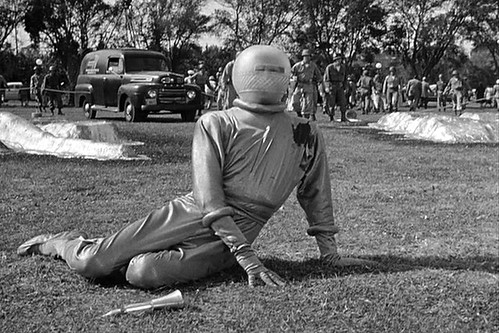
The Day The Earth Stood Still (Robert Wise, 1951) Iconic sci-fi pic that managed to be just strange enough to be spiritual without having to explain itself. Edmund H. North's script (adapted from the 1940 Harry Bates story "Farewell to the Master") just assumed that any advanced civilization's technology would seem like magic to us (ala Clarke's Third Law). It's anti-nuke theme was somewhat off-set by it's Christ allegory under-pinnings: a human-appearing being from above comes to Earth with a "message," is killed and resurrected to give mankind a lesson in humility. That the alien--Klaatu (Michael Rennie)--walks among us under the guise of a "Mr. Carpenter" just nails the significance home.

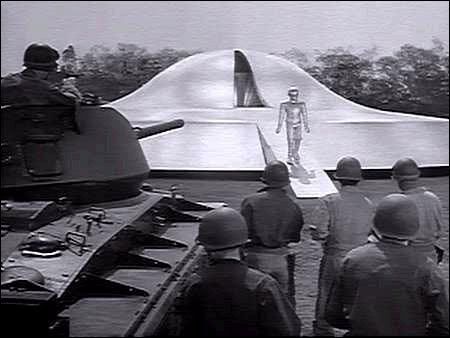
Right from the get-go, The Day The Earth Stood Still announces its intention with a "spooky" theremin-laced score (by the brilliant Bernard Herrmann), quite at odds with its message of peace. Wise shows a global humanity surrounded by its current technology (radio, television, radar) spreading the news of an invader from space, which lands in the Mall area of a tourist-clogged Washington D.C. in Spring. Phalanxed by a wall of tanks and military might (with a larger crowd of tourists behind it) the alien presence reveals itself and is shot by a panicky soldier for its trouble. Before you can say "Kent State," the alien is taken to Walter Reed to be treated, observed and questioned, and the formal Klaatu--patient, curious, but with a hint of passive condescension--does his own analysis, escaping from the hospital and blending with the populace as "Mr. Carpenter"--taking a room at a boarding house, becoming involved with a widowed secretary (Patricia Neal)--it IS the '50's, after all--and her son, seeing humanity first-hand.

Meanwhile, his Enforcer, Gort, a lumbering, laser-cyclopsed, soft-metal robot stands guard over the saucer, turning his evil eye on any hint of aggression, without any regard to how much of the GNP was flushed to make those tanks. If Gort could laugh when he turned on his eye-light, he'd probably do it with glee.


There are so many small details that delight: Patricia Neal
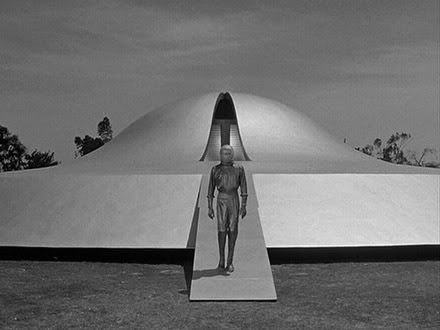
's uncommonly common working Mom, with a wary eye towards Mr. Carpenter--there's not even the hint of romance there; Sam Jaffe's cameo as Einstein stand-in Dr. Barnhardt, looking at his business-suited stranger visitor from another planet with eyes of dazzled wonder; the whole design of the thing that has so permeated our culture with sleek silver surfaces that fold in and out of each other seamlessly; "Gort, Klaatu Barada Nikto!" which, indicative of the race's parsimoniousness, roughly translates to: "Robot, take Klaatu's body back to the space-ship and repair whatever damage has been done to it, bring him back to life, and oh! while you're at it, don't turn me into a smoking pile of ash, thank you very much*"--talk about "Three Little Words!"; Robert Wise's unerring sense of staging and for putting the camera in the exact, most effective place without making you aware that it's the most effective place. Wise is always given short-shrift as a director, implying a yeomanlike sensibility rather than an artistic one, but the Man Who Edited Citizen Kane also conceived beautiful, eerie, creepy shots like this:

Thanks to Glenn Kenny of "Some Came Running," who reminded me **


The Day the Earth Stood Still is a classic film—a time-capsule, of a kind—from a different time and place and space that reminds, yes, with great power comes great responsibilty--but there's always someone more powerful, who might take yours away, and make you stop and smell the fall-out.

—————————————————————————————————————————————————————


"Everything New (Testament) is Old Again"

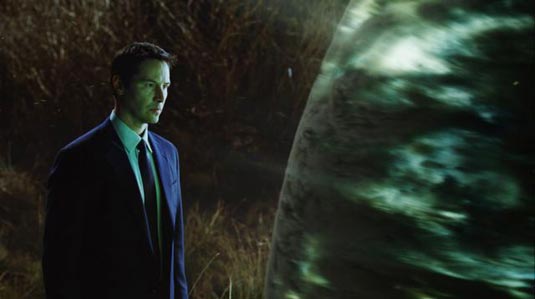
So why remake it? Well, it's a question that Klaatu's United Planets couldn't negotiate--and Gort's Galactic Police Force would probably give you the eye. But the agent of Keanu Reeves saw a poster of the original and dollar signs swam into his head and here, we have it. And Scott Derrickson (who put a different head-spin on "The Exorcism of Emily Rose") thought he could turn it into a warning about global warming, and Reeves thought that, though the original Klaatu preached peace, he did so threatening force, which he found "fascist."

Sigh.
***

That sounds noble in thought (if a tad simplistic). On-screen, it's a different matter entirely.

Because it's a "re-imagining" (rather than "a remake"), there is no "
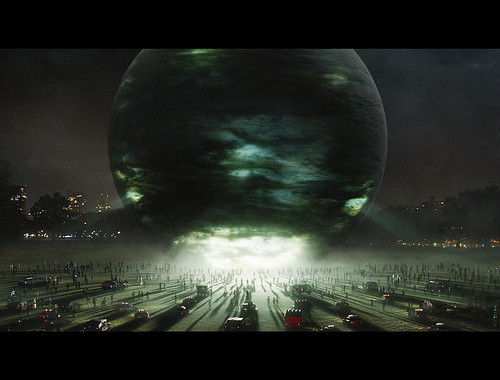
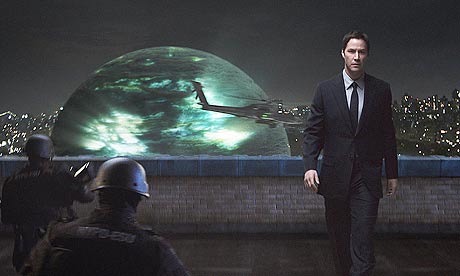
flying saucer," but a cloudy, spacy "orb" (all the better to remind you of the planet, but I kept wondering what kept it in place), and rather than the military, scientists are in the front line (with Princeton astro-biologist Helen Benson, played by Jennifer Connelly, as the point-person). The military is back-up.

The scenario starts the same: Land-Bang-End up in Hospital. And there things start to change. The original Klaatu had no special powers. Gort was the "muscle" (and here, the robot is 20 feet tall, gun-metal gray in color, and a completely CG construct--it's actually simplified from the original's design--and, as with the first Gort, its unreadability makes it a genuinely creepy sight). Keanu Reeves' Klaatu has a nasty way with bio-feedback that does damage. So much for pacifism. But, this Klaatu isn't Christ-in-a-business-suit. This one goes back a few chapters, back to the Old Testament. Particularly those parts dealing with Noah and Moses. The threat is environmental, rather than nuclear, and to sustain one of "the handful of planets that can support life," Keanu-Klaatu's United Planets are thinking of a little Silent Spring Cleaning of the life-form doing the most damage. Good thing he doesn't carry around a cook-book!

The following section is SPOILER material, so if you want to be surprised how it ends—if you care—don't highlight the next paragraph which, like the Earth, gets blacked out:


That scouring consists of billions of nanite-sized metal locusts (why they have to specifically look like insects, I have no idea, but I'd guess it has something to do with why Klaatu's named "Mr. Carpenter" in the first one). So, this "plague" starts doing its damage, devouring metal of all kinds, sports-arenas and such, and one can only hope that it can distinguish "green" technology, like solar panels and wind-generators, from the other kinds, but I suspect not--that might involve thinking! Keatu, or Klaanu, or whatever you want to call him, decides at the last minute that because humans have the capacity for change, they maybe, just maybe, could save their environment, so he sacrifices himself sabotaging the plague, leaving humans with no electricity, no technology, and presumably the resolve to stop the global warming crisis with, as a much wiser alien once inventoried, "stone knives and bear-skins." Thanks, Kleatu or Kono, or whatever your name is, thanks a lot. Who's gonna pick up these continents of dead nanites corrupting the soil, Mr. "Ecology?" And they thought the first one gave off mixed signals?


Keanu Reeves has the most limited range of any actor who hasn't suffered a stroke, but he does have two specialties at which he excels: endearingly stupid, or robotic. The latter serves him well, as in Speedthe portions of The Matrix when he was portrayed by pixels, and this film. His strange visitor from another planet is a nice piece of craft, slightly more human than Jeff Bridges' "Starman," and extremely efficient in his movements--when he turns his head to look you right in the eye, you'd better take him seriously. He's quite effective in the role. Jennifer Connelly delivers the techno-babble expertly (as she did in "Hulk"), but she really doesn't have much more to do than Patricia Neal did, as the role is basically reduced to "concerned mother." As the child she's concerned about, Jaden Smith at least doesn't fall into the "predictable child" category. He finds different ways of doing things than the "stock-child" role. Kathy Bates is too good for her role of Secretary of Defense, Jon Hamm, of "Mad Men," doesn't really separate himself from the pack, but Robert Knepper does a fine job as a Colonel in charge of trying to stop a tidal wave with a tea-cup. It's always great to see cameo's by James Hong, and John Cleese, who plays Prof. Barnhardt in this version.*****

But, ultimately, there wasn't much point in doing this, other than to give people jobs, and give some Hollywood-types more "green" cred. The production was carbon-neutral (wouldn't that have been ironic?), which means they presumably paid carbon credits used to destroy old-growth forests for eucalyptus plantations.

"The Universe wastes nothing," Keatu says at one point.

He's never been to Hollywood.

The Day The Earth Stood Still (2008) is a cable-watcher.


* I hope there's a "please" in there, somewhere!

** Kenny has a wonderful illustrated tribute to director Robert Mulligan, who died this week. It's far better than anything I could contribute.


*** My wife and I have a habit--a ritual, if you will--whenever we watch a movie with Keanu in it. After every
line of his dialogue, one of us will murmur a disappointed "Don't speak," in response to his poor inflaction choices--or lack of them.

**** There is one amusing bit--when Benson is shanghaied to participate in the landing investigation by the military, it's set-up and photographed exactly as it was done in "The Andromeda Strain"...directed by original TDTESS director Robert Wise. Coincidence? Nothing's a coincidence in a "re-imagining."

***** I hate playing the "If only..." game—it smacks of frustrated screenwriters—but, as they had an Albert Einstein-clone in the original, it would have been interesting to have a Stephen Hawking in this one—brilliant, but crippled, talking through a voice-box. If Klaatu wanted inspiration from the human race, who better? Then, imagine this scenario: the group leaves, but Klaatu hangs back, turning to look at the wheelchair-bound pysicist. "I could cure you..." Pause The voice-box rasps: "Save...the...world."

But, they didn't.