Showing posts with label 1957. Show all posts

Thursday, April 26, 2012

Love in the Afternoon

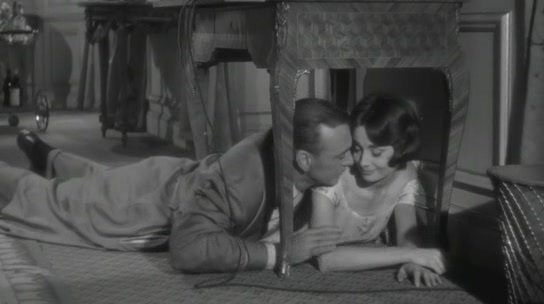
Love in the Afternoon (Billy Wilder, 1957) Light Billy Wilder film from the effervescent days when he was directing Audrey Hepburn at the start of her career.

This one had me smiling immediately with Maurice Chevalier's opening narration—"Zis is the city, Paris France"—echoing Jack Webb's "Dragnet" opening.  Chevalier plays a private detective, Claude Chavasse, specializing in "matrimonial work," and lately the case-work has been dominated by one subject, American millionaire Frank Flannagan (Gary Cooper), who is cutting a wide swath through the world's female population, both married and unmarried divisions.  The work has turned Chavasse into a cynic about the paths of love—he's gumshoed too many of them—in marked contrast to his daughter, Ariane (Hepburn), a cello player (hold that image in your head for a moment), still wide-eyed at the prospect of romance, and fascinated with her father's work, something he does his utmost to discourage.

When she gets wind that a cuckolded husband (John McGiver, hyperventilating amusingly in fine comic fashion) plans on breaking in on his wife's tryst to ventilate Flannagan, she steps in from the balcony to insert herself into the situation.  This inevitably (in the movies, at least) to an affair between the elder lothario and the young ingenue, one that she manipulates by trying to talk a competitive game in conquests.  The situation is ripe with comic possibilities, which Wilder exploits every chance he gets, even using Flannagan's moving musical accompaniment (the final assault is preceded by a four piece rendition of "Fascination").

Much has been made of Cooper's age in the film, and it is an issue.   Cary Grant was supposed to be Flannagan (Wilder had been trying to entice Grant into one of his films for years) but when a deal wasn't reached,* Cooper, who at 56 was Grant's senior by three years, was hired.  Cooper is an odd fit, as opposed to younger men like, say, Gregory Peck (as in Roman Holiday) or William Holden (in Sabrina), but Wilder works around it, initially, keeping Coop' in shadow to emphasize his "mystery man" status, and Cooper's early performance is, interestingly, boyish and somewhat immature.

And that's the point.  Flannagan is a man-child, used to getting everything he wants.  And Ariane has her choice between younger men—immature and unsophisticated—and Flannagan—sophisticated but immature.  All it takes for him to grow up is a level of commitment, something he's avoided his whole life by having a train to catch.  Both character arcs feel complete and satisfying, even though it is the "7-10 split" of May-December romances, and one feels a little creepy watching them make out.

And a little guilty, in the same way that it was tough to watch the denouement of Sabrina.  Okay, it's charming that she likes the old guy, but if he really was thinking this through, with all this new-found maturity, wouldn't he be thinking about her, and what she has to look forward to in a life with him (which can be summed up in one word..."short")?

And then, one considers Wilder, and the blithe, darkly cavalier sensibility that he brought to the movies, moral though his stand-point might be.  One can imagine Wilder, the guy who ended Some Like It Hot with "Nobody's perfect," with a similar tag for this movie: "Aren't you concerned about the age difference?"  "If she dies, she dies..."

 At this point, Grant was getting concerned about his age and being paired with young actresses ("robbing the cradle, again" is how James Stewart summarized the situation late in his career), but his misgivings must have subsided enough to co-star with Hepburn in Charade for Stanley Donen six years later.

Saturday, April 14, 2012

The Rising of the Moon

When Orson Welles was asked what movies he studied before embarking on directing Citizen Kane he replied, "I studied the Old Masters, by which I mean John Ford, John Ford, and John Ford."  Over the last three days we've been looking at little-seen films from The Old Master, each different in tone, temperament and subject matter, but all unmistakably the work of America's storied film-maker, the irascible, painterly, domineering, sentimental puzzle that was John Ford, John Ford, and John Ford.

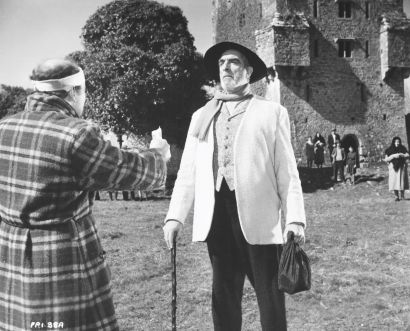
The Rising of the Moon (John Ford, 1957) Interesting, charming anthology film from Ford, featuring three short stories (of approximately thirty minutes each) from the Emerald Isle.

Ford was able to parlay his success with The Quiet Man—made on a shoe-string (and with a Western in the bargain for Republic Pictures) and reaping a pot of gold—to make this labor of love to promote the Irish film industry, with a cast of actors from the country's Abbey Theater (which figures prominently in the film's third sequence).  As a carrot for American audiences, Ford uses Tyrone Power as a presenter for each of the stories, each different in tone and style, but bearing Ford's ability to bring out the best in his cast, while also keeping a reign on several threads of character arc interlacing throughout each tale, to make a verdant pattern full of blarney.  Each one also has a distinct style of shooting, one landscaped, one close-quartered, one urban and chiaroscuro, that slyly reflect themes and moods of the story, even if the whimsy is a constant factor.

The three stories are thus: 

"The Majesty of the Law"—A police inspector (Cyril Cusack) ventures to the country-side, wind-blasted and rough-hewn to arrest a man for assault.  He attracts the interest of some locals, briefly toys with a rapscallion (Jack McGowran) who is trying to avoid him, then visits an old friend to shoot the breeze.  Things are not what they seem, and the segment ends on a complicated note.

"A Minute's Wait"—A busy, typical day at Dunfail station.  A brief stop-over opens the bar and the train empties of passengers.  Then things get complicated involving a match-making minister, a honeymooning British couple, young lovers, a goat, and a ghost story-in-passing.  Just when things get resolved, more complications ensue, and the train is delayed another "minute's wait."  The train empties again...and again...and again, as places change, stories get crossed, and get schedules get thrown out the window, while everyone gets increasingly drunk.  Man schedules, God laughs, and life gets in the way...and nothing is stationary.

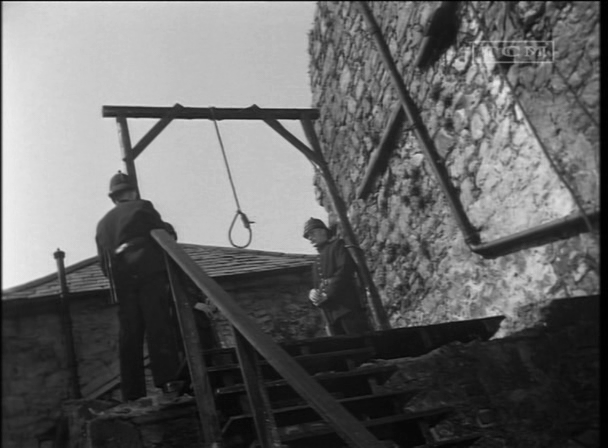
"1921"—The entire world seems to be a little off-kilter and threatening to fall into the abyss in this story set during the Black and Tan Wars, and the height of the British/Irish conflict.  Sean Curran (Donal Donnelly) is set to be hung for treason.  A snaking queue of townspeople parades in protest in front of the prison as the scaffold is prepared  ("That step is loose.  Fix it or he'll break his neck before he falls" says the Irish prison functionary in a display of gallows humor) Curran is set to hang and the Brit overseers are feeling the pressure keeping the lid on a situation that could quickly get out of hand.   A visitation by nuns, one of them Curran's sister inflames events and the intrigue moves to the streets as the Army presence builds up and loyalties are tested.  "There's a little treason in all of us," says a local bobby working for the Brits, summing up the situation and the tale.

It's great story-telling all the way through, with nothing familiar in the Ford crowd-pleasing arsenal: no John Wayne hook, no western fallback, no Ford stock company dependence, just the Old Master weaving his magic, with an artist's eye and a director's sense of pace, detail, and theatricality, each episode given its own look and feel, everything fresh, but rooted in the man's   presentation and gifts, unfamiliar, yet unmistakably Ford country.

Psycho is not my favorite Hitchcock film, but I revere it as a display of the director at the top of his story-telling gifts and mastery of the form.  In the same way, The Rising of the Moon shows Ford's abilities to play with the arts of tale and film, and is the purest example of the director's gifts..and his craft.   

Thursday, June 16, 2011

Witness for the Prosecution (1957)

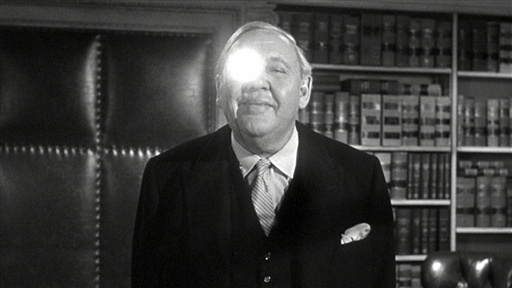
Witness for the Prosecution (Billy Wilder, 1957) Lady Justice is having some work done as we first approach "The Old Bailey," where the majority of the drama for Witness for the Prosecution takes place.  Good thing, too, although some attention should probably be paid to the legal loop-holes that keep cropping up inside the chambers.  This Agatha Christie-penned theater chestnut is given a nice presentation by Wilder, who has added much comic-relief in the form of giving brilliant barrister Sir Wilfrid Robarts, QC (Charles Laughton), a nurse after a debillitating heart-arttack (played by Laughton's wife, Elsa Lanchester).*

It was the third re-write of the story in as many adaptations, starting with Christie adding a justifiable coda to her original story for the theater adptation, and Wilder providing further complications in order to have Lanchester's presence, and giving Marlene Dietrich a song and a romantic scene with Tyrone Power in flashback (although both actors can't really pull off playing young at this point in their careers).

And that's an interesting point: the acting is what this one is all about.  This is Power's last completed film, and his anguished defendent is an interesting mix of distraught agitation and Big Studio Heart-throb mannerisms.  Laughton's performance is hilarious and dry as vermouth, while Lanchester fusses and kvetches

And Dietrich is as cool as can be.  Quite past her prime as a fascinating beauty, she is still fascinating, playing her Christine Vole as cold and aloof—Dietrich excelled at that, but with a simmering quality underneath the surface, especially in her work with Joseph von Sternberg, like an iceberg with a volcano at its heart.  She always was just on the edge of camp-sexiness,** but the heavy lidded smoldering eyes always had an air of superiority that were deadly serious.  And those eyes are still in play here, never revealing much, and keeping the characters and the audience off-guard...and then on, especially when she turns on the dramatic fire-works in the latter stages of the film.

Laughton and Lanchester were given Oscar nominations for their performances,*** but I'd make a case that Dietrich was robbed of a nomination—maybe because of the stunt-casting, the nature of the part, but also...maybe...because they didn't recognize how good she is.

* Er...she plays the nurse, not the heart attack...

** Her mannerisms were devastatingly lampooned by Madeleine Kahn in Blazing Saddles.

*** He lost to Alec Guinness for The Bridge on the River Kwai, and she to Miyoshi Umeki for Sayonara.  Can't argue with the first one.

Wednesday, December 8, 2010

A Face in the Crowd


A Face in the Crowd (Elia Kazan, 1957) The cyclical rise and fall of media pundits makes this prescient diatribe against the dangers of television consistently fresh and relevant.  Sure, it might have been talking about Arthur Godfrey, but it fits the bill for "The Glenn Beck Story," too.  A rube gets built up as a "voice of the people," and then, given money, power and a platform turns into a little  cathode-ray god, his TV-face just being make-up over a manipulative withered soul drunk for power...or love...or advantage over his neighbor.  It's why MSNBC's Keith Olbermann always refers to Beck as "Lonesome Rhodes"—that's the "aw-shucks" nom-de-tube of the character in the movie—but it could be any of the sensations over the years, like Morton Downey, Jr. (Remember him? Good, if you don't), briefly, Jerry Springer, or any of the kiss-and-televangelists who've grabbed the spot-light, only to have scandal take it back, shine it on them, and see them scurry back, cockroach-like into the wood-work ...until they think people have forgotten.

So, on this day of the repeat performance of the "Glenn Beck-Broke" Tour slamming into theaters tonight, let's take a look back at A Face in the Crowd...even though the story is still being played out ad nauseum by Beck and his future issue in an endless cycle of hucksterism and snake-oil.

It's the dark side of a Frank Capra "everyman" movie.  Capra always flirted with fascism in those films, but Budd Schulberg's screenplay tackles it head-on: Marcia Jeffries (Patricia Neal) discovers an Arkansas drunk, Larry Rhodes (Andy Griffith, never more brilliant than he is here) in a small-town jail, and coerces him to sing on a local radio station.  He develops a following, and soon wins a sponsored television gig in Memphis, then moves up to New York.  His folksy homilies and willingness to make fun of his sponsors endears him to the public at large, and soon his influence begins to spread, attracting political machines who want to attach their candidates to "a man of the people."  In a time before "red states" and "blue states" divided rural and urban political boundaries, it was still a goal to reach the "real" America in the heartland.  While Rhodes gains his following, he also starts to spend his capital in his sequestered private life: he begins an affair with Jeffries, then throws her under the tour bus for a cheerleader.  At this point, Rhodes thinks he's Teflon, and nothing can besmirch his reputation. 

But, he who lives by the sword, dies by it.  A microphone deliberately unmuted shows his true colors to a public fed only the rouged mask, and "Lonesome" Rhodes begins the quicker descent down the hill of notoriety.  No homily can save him.  No tears.  No hysterics.  No more.  Hopefully, he has some gold stashed away.

It's a cautionary tale...for everybody.  Edward R. Murrow not only suggested television could be "merely wires and lights in a box," but that it could also be a weapon.  And in a world where to exploit can lead to success, it's primed and cocked.  It's just an instrument, at the beck and call of those who would use it to reach into our homes and our hearts.  The message of A Face in the Crowd, although a might heavy-handed in presentation at times, still applies today, just as it did in the past, and just as surely as it will in the future. 


Monday, May 25, 2009

Run Silent, Run Deep

"Run Silent, Run Deep" (Robert Wise, 1957) One of those general entertainment movies that manages to do so many things exceptionally well that one comes away grateful for the experience. Directed by Robert Wise with a true sense of claustrophobia, the script by John Gay maintains a strict military accuracy while displaying a keen sense of drama, psychology and brevity. A psychological drama, a war film, a story of mystery as well as redemption, the film manages to pull everything off with a propulsive rhythm and fine performances throughout.

Produced by Hecht-Hill-Lancaster,
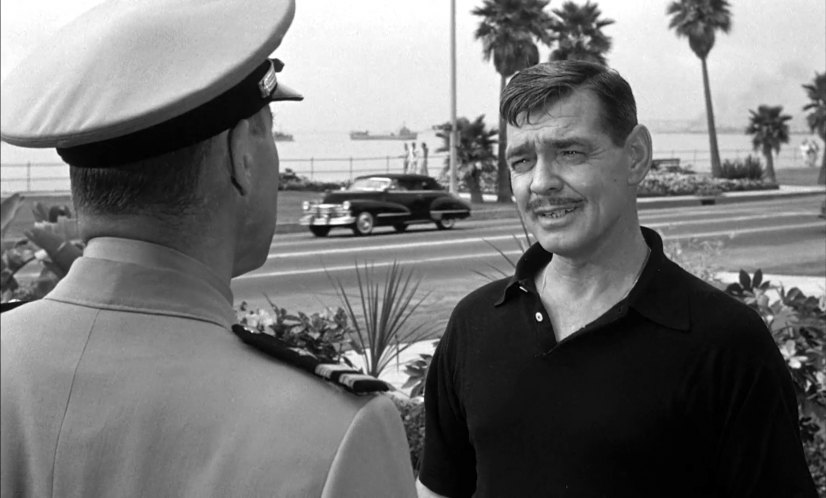
Burt Lancaster the producer takes a back-seat to his star, Clark Gable, the older actor in one of his understated roles that takes into account his age. Gable's the flawed figurehead with shades of Ahab who finagles his way into the command of the S.S. Nerka patrolling the Pacific during World War II, having already lost one sub and and a frustrating convalescence at a desk-job.

Lancaster's exec Jim Bledsoe is torqued because Gable's Cmdr. "Rich" Richardson has pulled rank to get command—his command—and is now drilling the men to dive and shoot a torpedo within a record 35 seconds. The already suspicious crew starts to snarl about all this practice with nothing to show for it. Then a lucky strike convinces some of them the new Captain is golden, while the other half think he's out to torpedo their mission. Lancaster turns into a reluctant arbiter.

But, in their first attempt to sink Richardson's unsinkable Japanese war-ship things don't go so well leaving crew-members dead and injured and Lancaster in command.

Robert Wise is a master of filming people at work with a story-teller's eye for finding the perfect angle (without calling attention to it and himself) and an editor's sense of pace and construction. Wise is also a chameleon of style tamping down his presentation of professionals doing their jobs while also being able to ramp up the spectacle for the unreal worlds of musicals and science fiction. Given his work on this film, you could see why he'd be the perfect choice for the similarly set-bound "Star Trek: The Motion Picture."

He also makes goods use of the usual crew of character actors who make up the Nerka's lovable mugs:
Jack Warden, Brad Dexter, Don Rickles, Nick Cravat and Joe Maross. The close quarters of a submarine makes the authentic plainness of their faces all the more important and brings them to a prominence near the bright lights of Gable and Lancaster. Both those lights are shaded somewhat, with Lancaster doing subtle, measured work, the kind that would dominate his later career. Gable, even subtler, is the King, here in his twilight, still burning brighter than the vast majority of actors. By this time, Gable was moving slower and had learned the power of economy and his Captain Richardson draws you in.

Finally, the story is a cracker-jack construction. Just when you think you've got it figured out, screenwriter Gay throws in an added complication that ramps up the idea that these are men strategizing in chaos and only repeated dips into the boiling oil of battle can make them seasoned enough to think clearly through the smoke and death.

"Run Silent, Run Deep" is an intelligent tribute to the fighting services without resorting to jingoism, racism or choired flag-waving. The film-makers' respect for the professionalism under duress of sub-crews runs silent and deep.

Memorial Day, 2009

Tomorrow: An "Anytime Movie" with a magician's touch

Friday, March 20, 2009

An Affair to Remember

"An Affair to Remember" (Leo McCarey, 1957) I'm of two minds about "An Affair To Remember," which is as it should be, as it's two movies: the deft romantic comedy on-board ship and the maudlin tragedy with musical numbers (by a kid's chorus)—not one of my favorite genres! The first part is terrific, and the second part is insufferable, at least to me, and shows the best and worst of director Leo McCarey.

Let's start with the good stuff, shall we?
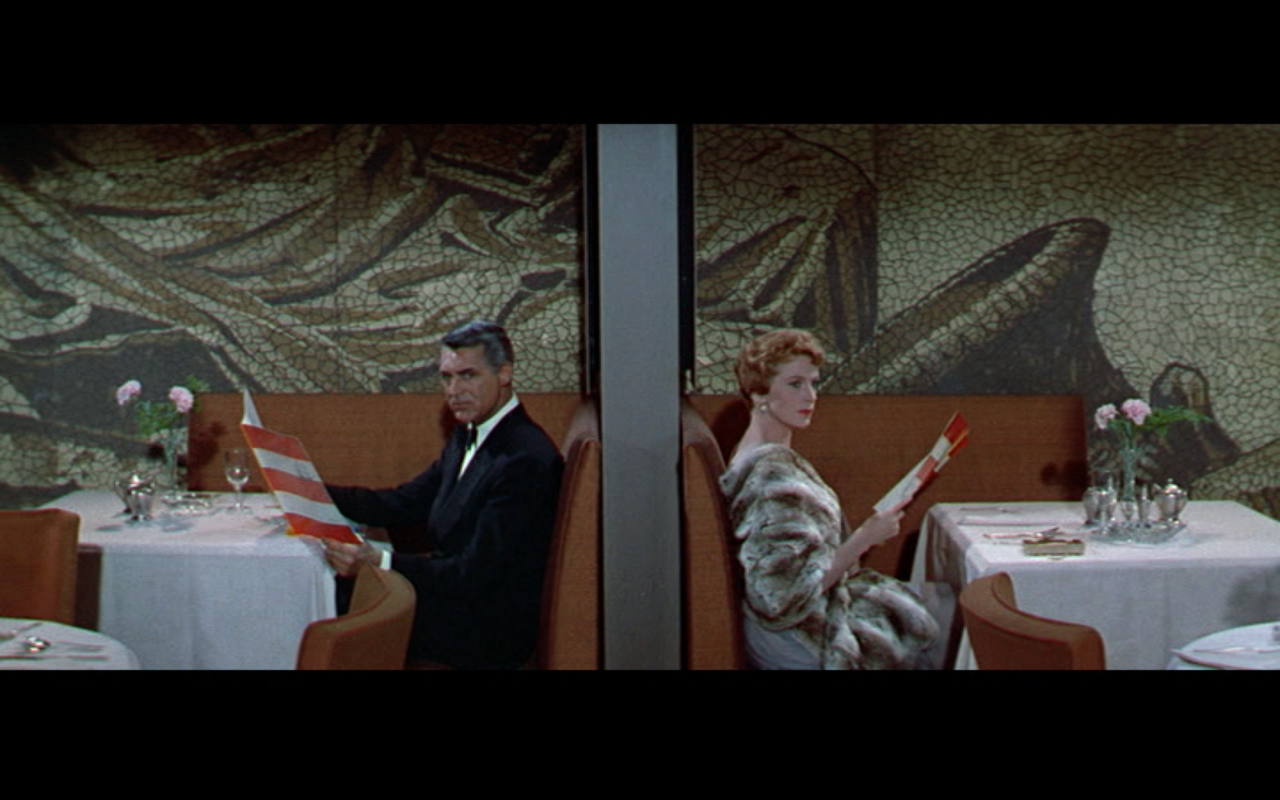
Two co-dependents, a gigolo and a "kept woman," meet on board a cruise that in practicality and the metaphoric sense represent escape from a pair of disasterous relationships. They "meet cute," and spend the rest of their cruise tryng to avoid each other in public, as he's an infamous playboy and she's just trying to maintain her reputation. It's a neat little cinematic problem (filmed in cruise-ship-length Cinemascope). They resolve to 1) jilt their lovers and their dependent life-styles and 2) vow to meet at the top of the Empire State Building in six months or once they're on their feet (ironic turn of phrase, that).

This part of the film is great fun because it's light and airy and features
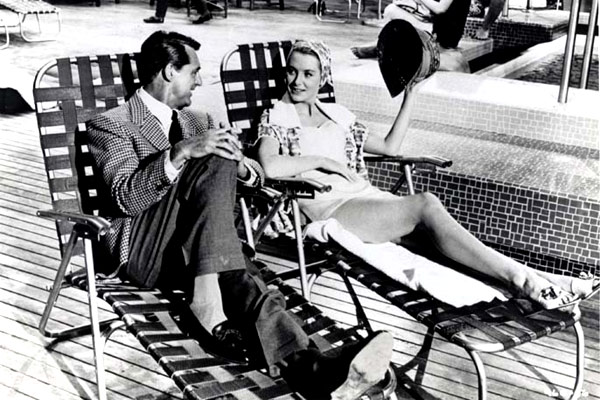
two performers who could do romantic comedy like no other (McCarey solidified Cary Grant as "Cary Grant" in the film "The Awful Truth"), and reflected the circumstances of filming. Grant is perfectly matched with Deborah Kerr, whose reputation as a comedienne has historically been given short-shrift. Here, the two characters conspire to meet in the close quarters of the ship, while avoiding detection by the nosey passengers. In real-life Grant and Kerr got on like a house-afire: Grant was nursing a broken-heart at the time of filming, and Kerr was a fellow British ex-pat with his sense of home and humor. You can see the chemistry between the two—at one point, Kerr flubs a line and the two don't break the scene, leaving Grant with a delighted look on his face, and Kerr making it feel like real-life. When they're separated as they leave the boat, the movie no longer floats, but founders with melodrama and tragedy.

McCarey (who directed "
Duck Soup") falls back on an old Marx Bros. solution: to give the audience a little breathing room, throw in a few songs (a tactic that Groucho famously harpooned in "Horse Feathers" when he addresses the audience: "I have to stay here, but there's no reason you folks can't go to the lobby 'til this blows over.").

I'm even more cynical about this section of the film for a number of reasons, both having to do with McCarey. "An Affair To Remember" is a remake of McCarey's earlier "
Love Affair" (1939, starring Irene Dunne and Charles Boyer),* and except for the wide-screen color photography and the songs nothing much changed, although it's easier to see Boyer as a European playboy (trying to pass off Cary Grant as Italian, is about as successful as passing him off as an American). Watching the film, McCarey's first after a couple of anti-communist propaganda pieces ("You Can Change the World" and "My Son John"), one begins to see it as McCarey's Pension Guarantee. He wears all the hats: co-writer, producer, director and—the part that rankles a bit—lyricist for all the Harry Warren songs in the film's last half. Nice gig that he hired himself for. And if any of those songs became a hit, he had money from the residuals for life.

I don't begrudge McCarey's double-dipping—this happened quite a bit in Hollywood when a producer could get away with it,** but one wonders--with a co-lyricist credited--just how much McCarey contributed to the songs. Me, I want to head for the lobby when the orchestra starts up (especially for such enduring classics as "TomorrowLand" and "The Tiny Scout," which lie at the bottom of
Warren's prolific, accomplished output). They're padding, and prolong the wait to the inevitable reunion (which is given remarkably short-shrift) at the movie's end.
Also, there is a moment of revelation in "An Affair to Remember" that, hard to admit, is just beyond the considerable acting abilities of Cary Grant to pull off. McCarey blows that moment by leaving his camera on Grant the entire time when a cut-away (to what he's looking at) might have provided more dramatic weight (merely by the editing) to Grant's angst. Long takes are great, but there's an absence of information here that hurts the scene and what it's trying to convey. That we are also unprepared for that revelation by any fore-shadowing compounds the error.

And it is a mistake. In planning and execution.

One still seeks out McCarey films...especially the chance to see the film that didn't win the Academy Award for Best Picture (and he felt should have) the year "The Awful Truth" did—the sad and melancholy "
Make Way for Tomorrow." It has yet to see a DVD release in this country.

* It was remade again, using the original title, by producer Warren Beatty and director Glenn Gordon Caron with Beatty, Annette Bening and Katharine Hepburn (in her last role) as Beatty's grandmother. The material about a lifelong lothario meeting the woman whom he chooses to settle down with, only to be separated by tragedy must have seemed particularly poignant to Beatty.

** Here's a nasty one: "The Theme from Star Trek." Written by Alexander Courage for the original series, producer Gene Roddenberry then penned completely unnecessary lyrics (beyond the South Sea Island "Aaa-aah's"), merely to skim half the proceeds from Courage's pay-check to himself. Nice guy. But he had the power to do it...so he did.


Thursday, January 8, 2009

Olde Review: The Seventh Seal

This was part of a series of reviews of the ASUW Film series back in the '70's. Except for some punctuation, I haven't changed anything from the way it was presented, giving the snarky, clueless kid I was back in the '70's a break. Any stray thoughts and updates I've included with the inevitable asterisked post-scripts.


"The Seventh Seal" aka "Det Sjunde inseglet" (Ingmar Bergman, 1957)

An odd combination of films await those in
130 Kane this Saturday night: Ingmar Bergman's "The Seventh Seal" and Ken Russell's "The Devils."

For those of you whose only experience with
Ingmar Bergman is his wildly splintered and heavy film "Persona" from last quarter's ASUW series, "The Seventh Seal" will seem to be made by another man. At this time, Bergman wasn't so experimental, so strange. He was, as he is now, alive and vibrant with the charm of film-making and his '50's films ("The Magician," "Wild Strawberries," "Through a Glass Darkly") although dealing with "heavy" subjects of God and Death and self still possessed a lightness in the telling, a lightness that carried over from his beginnings in films and was lost in the dark broodings of his late '50's and '60's films. There was a time for comedy, and time for deep-think in the space of the best Ingmar Bergman films.

There are many characters in "
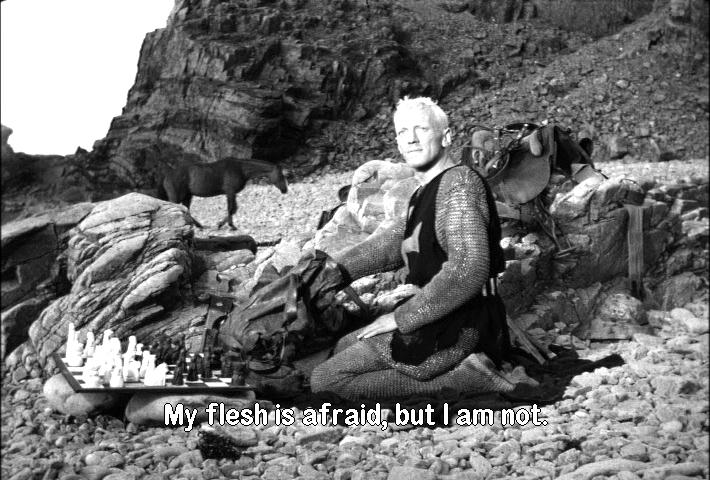
The Seventh Seal," but at the film's hub are two. The most important is The Knight, who is played Max von Sydow, the supreme brooding actor. The Knight is home from the religious wars where the quest for God has been fruitless—where the point of the quest, after the year's ox-killing has been lost. But the quest for God continues. It has to. God can't be in the war, but can he be found outside amidst plague, witch-burnings and ignorance?

The answers are hard to come by, and even harder to come by while being pursued by another hold-over from the wars, the second most important character being
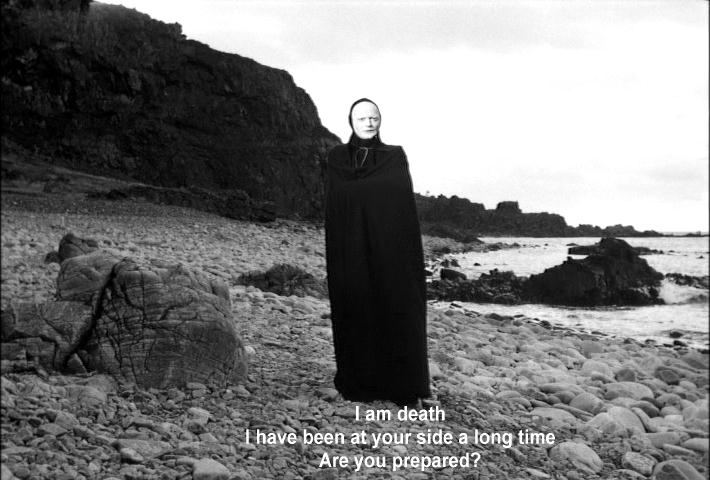
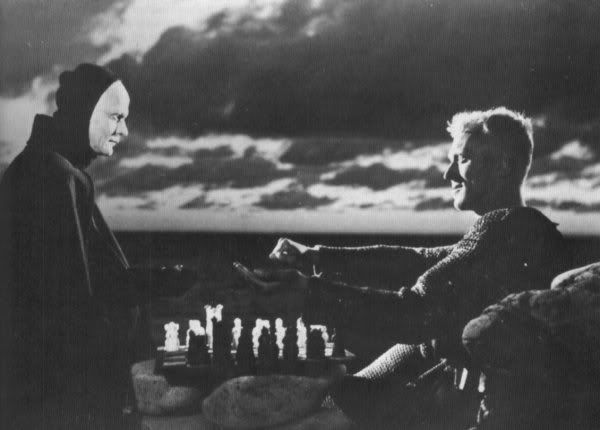
Death. Death pursues the Knight and they engage in continuing battles of wits and of chess. The two opponents are only the hub of the story. There are others: the Knight's man-servant whose musings are concerned more with life that what is beyond; a troupe of actors; a wood-cutter and his adulterous wife. Bergman combines them all in a film that wheels between light and heavy in tone, but always excellent in quality.

Broadcast on KCMU-FM on January 8th, 1976 (thirty-three years ago today)

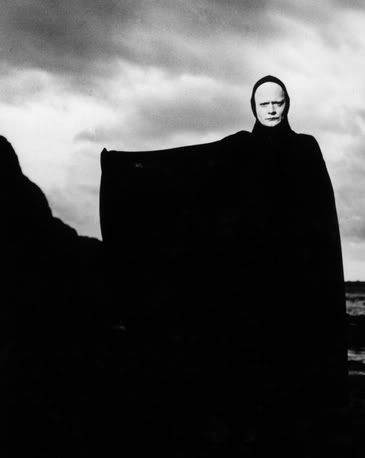
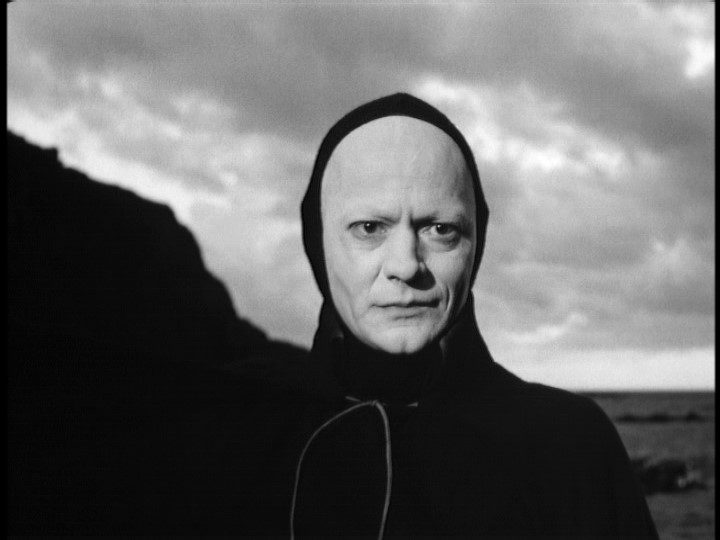
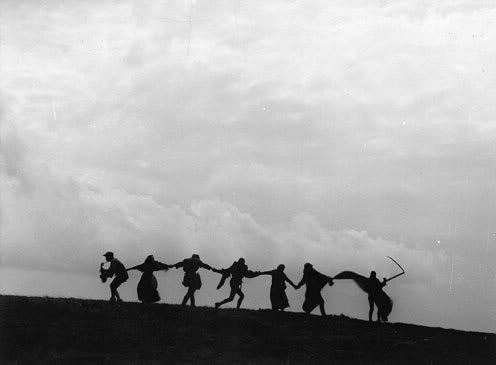
Sounds like I ran out of time there at the end--I usually only had two or three minutes per film to talk. So, I didn't even mention the stark black-and-white photography that has become so iconic, along with Bergman's simple personification of Death--an actor dressed entirely in a black cassock, with just his face appearing...in sharp contrast. And the image of The Knight playing chess with Death has been copied, parodied, purloined and done...well, to death. In "Bill and Ted's Bogus Journey," they played "Battleship."

It sounds bleak, and it is—it is the Plague-Years, after all.
But the film ends with a touch of hope and sacrifice, that even after all the Knight has seen—and not seen in the form of God—he can still cling to ideals. Typing this out, it occurs to me that the film we're reviewing tomorrow has a lot in common with Bergman's masterpiece.


Wednesday, November 14, 2007

The "3:10 to Yuma" Shoot-Out

"Thar' Ain't Room in this Genre for Both of Us"

It's a truly fascinating experience to revisit Delmer Daves' strange little 1957 "oater" "3:10 to Yuma," and look at what James Mangold ("Walk The Line") has done with it 50 years later. The original was a tight little psychological western based on an Elmore Leonard short story, but, as with his latter urban capers, character informs action. And it provided Van Heflin and Glenn Ford two of the finest roles of their careers. Ford, never the most inspired of actors, does wonders with the role of rogue-bandit Ben Wade, who's just as handy with his words as a gun, and is just as dangerous hand-cuffed and guarded as he is on the loose. No one is safe in his sphere and he rules a band of outlaws on sheer force of personality. And Ford ekes out every subtlety, every nuance of his clever dialog and makes it look easy as taking a nap. His is a villain that never admits he's not in control of the situation. He's evenly matched by Van Heflin, looking haggard and down-trodden as a desert-farmer, who takes on a prisoner-transfer to save his farm, and maybe a touch of glory. Such a man is constantly in threat of temptation from the devil, and it's only his cussed stubborness that makes him see through a job when other men give up. Heflin has the less fun role, but gives it his all, and is rewarded by a Divine Intervention that is announced by a choir of angels (who are backing Frankie Laine singing the inevitable Title Song).

So, 50 years on, what can Mangold bring to the material? Well, not much really. It's puffed up with some more action and the dialogue is retained (at least in spirit) a surprising amount of the time (original screenplay writer Hallstead Welles gets the lead screenplay credit). What new things are added are informed by earlier instances in the original and made explicit, some times thuddingly, and everything is tamped down in a nihilistic amoral rasp as is expected of a western post-Leone/Eastwood (but with none of the wit or stylism). More explosions (Two, instead of the none in the first), one in an unnecessary story-detour through a railroad camp. The one opportunity the modern makers had--that of fleshing out the denouement in terms of character, they manage to make even more false, by pumping up the action and circumstances, straining credibility to the snapping point. Crowe's Ben Wade has the same dialogue, but none of the swagger, and enough skills that one wonders just what he's doing staying around the whole movie. Christian Bale's Dan Evans has the same motivations as the original, but his circumstances are worse, and to make his family connection explicit and situations more dire, his son sneaks along on the expedition. Still, its pretty obvious how much Mangold loves the original, seeing how much is retained, but the expansion of the story works against it, and we are left with what's good in the new one...being the old one.

But there are things missing, too. Besides the more colorful straight-ahead performances of Ford and Heflin, there is a marvelous one by the fine character-actor Richard Jaeckel, who makes Wade's lieutenant, Charlie Prince, a craftily-goofy rooster of a character. Ben Foster's performance has some of the characteristics, but is a stone-cold psycho (no doubt written that way) and pales by comparson.

And then there's that Frankie Laine song...

Decision: "3:10 to Yuma" (1957)
"3:10 to Yuma" (2007) is a rental.