 "Rise...and Rise Again...and Again...and Again"
Every fifteen years or so, there must be a big budget remake of the "Robin Hood" legend—that's a bit less than the turnaround cycle for The Compleate Works of Jane Austen. The last time the fletches flew on the big screen there were two competing Hoods—the flashy Kevin Reynolds/Kevin Costner version and one starring Patrick Bergin. Before them was "Robin and Marian," various series, and "The Adventures of Robin Hood," the Warner Bros. classic with Errol Flynn, which was itself a remake of silent versions. Then, there have been satiric vignettes in "Shrek" and "Time Bandits,"* Mel Brooks has done a movie ("Men in Tights") AND a series ("When Things Were Rotten")—Mel loves his Public Domain. Disney has touched on it a couple times as well, including an animated funny animals version.
The character and his ancillary co-stars have a long oral tradition with many variations of "The Hode," so it's natural that someone drums him up for another "Have at ye" every few years, each reflecting the times in which they were made. Robin has been yeoman and nobleman, Crusader and thief, trickster and military man, young and old. Although we've been down this well-trod pathe in the glenne before, it was interesting to think about what the "Gladiator" team of Ridley Scott and Russell Crowe could do with the story, and how they would approach it.
And the answer is: with a little bit of everything. Scott with the help of scenarist Brian Helgeland** has a Robin Hood, an orphan Saxon Crusading with Richard the Lionheart (Danny Huston-he's great in this), who's an expert bowman and strategist by day, and a grifter by night. At the end of the Crusades, he is given a task, the complications of which lead him to Nottingham and the masquerade of being Robert Loxley, slain son of Sir Walter Loxley (Max von Sydow) and spouse of Lady Marian Loxley (Cate Blanchett)—this Robin is both commoner and gentry. The Sheriff of Nottingham (Matthew McFadyen) is not given much to do this time 'round, instead the intrigues are by Sir Godfrey (Mark Strong) and King Phillip of France, who plot to undermine the already shaky reign of the new King John (Oscar Isaac), the last son of King Henry and Eleanor of Aquitaine (Eileen Atkins), and invade England.
The general structure of "Robin Hood" is superficially similar to “Gladiator” with big battles at both ends, and Scott uses the same stutter-shutter technique to give some verve to the action scenes. But there it ends. Crowe is considerably lighter as Robin Hood, though he does summon up genuine moments of drama. Performances are fine all around withCate Blanchett and William Hurt being stand-outs. But the best performance is by Max von Sydow as the elderly Sir Walter. Blind, but nobody’s fool, Sir Walter takes the news of his son’s death with grim determination and courtesy for its messenger, and comes up with the Robin-as-Loxley ruse to protect Marion from having their land confiscated should he die. Von Sydow has been ill-used of late, playing teutonic villains of similar coldness, but this role shows him at full thespian power, and it would be robbery if he was not nominated for an Oscar for this performance.
The film boasts good values all around, with Scott’s keen eye for cinematography and detail, the writing is clever and often ingenious (I think the fact that it's another Robin Hood movie sours a lot of people's expectations). The film never drags and offers considerable entertainment value. Only at the end does it falter, with a beach battle that seems overly-stretched in terms of production value and credibility. Either there was not enough planning or extras, but it looks to be constructed to not show something as opposed to creating an epic battle. Too much is made of the presence of landing craft as obstacles, and of one particular participant in the clamor, which seems to be done for scoring political points rather than good story-telling.
But that is twenty minutes out of 140. For the most part, this new “Robin Hood” hits its mark. Yes, it might be superfluous (we can say this—with a straight face—with so many sequels headed our way?), but what's there on the screen is an interesting "take" on the legend that has lasted so long.
"Robin Hood" is a Matinee.
* John Cleese's immaculate nobleman with a "Bonny Prince Charlie" manner is one of my favorites.
** The original script, by the team of Ethan Rieff and Cyrus Voris, called "Nottingham," was more radical, but interesting in a concept-twist kind of way, but once Ridley Scott came on board, the concept changed.
Tuesday, May 18, 2010
Robin Hood (2010)

Friday, February 19, 2010
Shutter Island
 "What's yer Next Move, Boss?"
or
"Tag! You're It!"
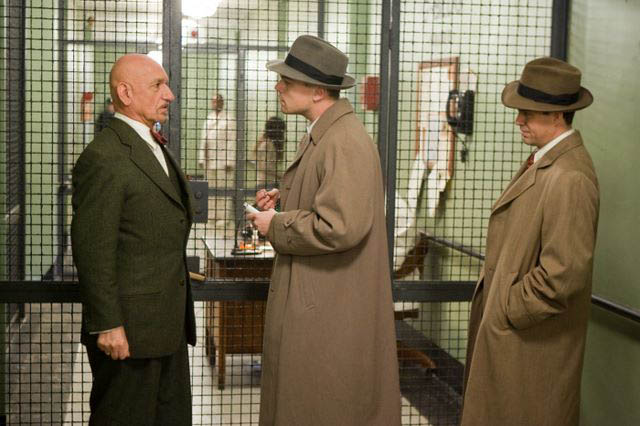
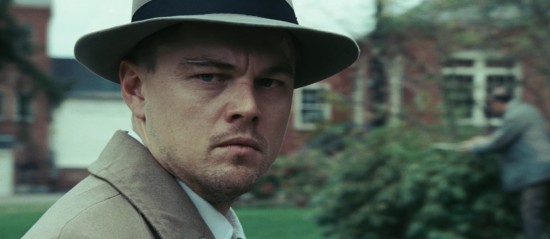
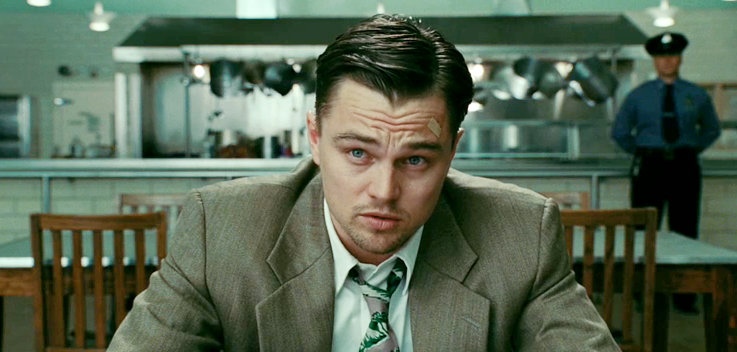
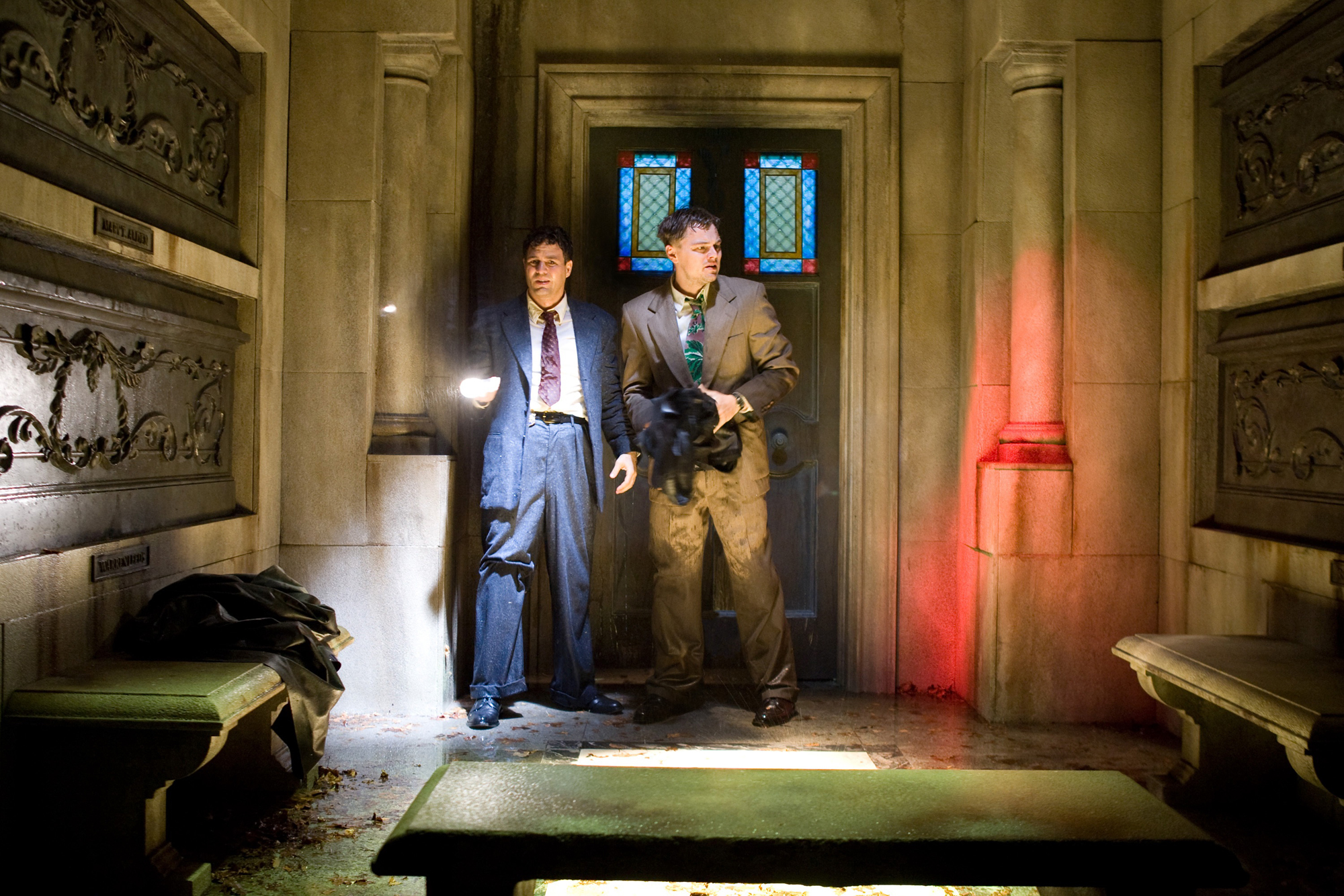
It is 1954, and out of the fog comes a ferry boat carrying two U.S. Marshalls, heading for "Shutter Island", where squats, in various stages of dis-repair, Ashecliffe, an asylum for the criminally insane. In the "head," sea-sick,* is Marshall Teddy Daniels (Leonardo DiCaprio), "the legend" as his partner from Seattle Chuck Aule (Mark Ruffalo, who has a rather thick Massachusetts accent for it) calls him. The two are investigating the disappearance of an inmate from Ward B, the women's section, and right from the get-go, the two are at a disadvantage.
Upon crossing the electrified fence, their weapons are confiscated, security being what it is. "What?" Teddy smirks at the guard "You act like insanity is catching." The guard only smirks back. That should have been his first clue.
The doctors (Ben Kingsley and Max von Sydow) are helpful to a point, but then they become somewhat diffident and challenging, even obstructing, protective of their "advanced" techniques—"a moral fusion between law and order and clinical care." The missing woman, Rachel Solendo (Emily Mortimer), drowned her kids after her husband was killed during the Normandy invasion and has never acknowledged the act. But she somehow managed to escape from a cell, locked from the outside, and with a guard on duty. Investigating, Daniels finds a cryptic note "The Law of 4. Who is 67?"
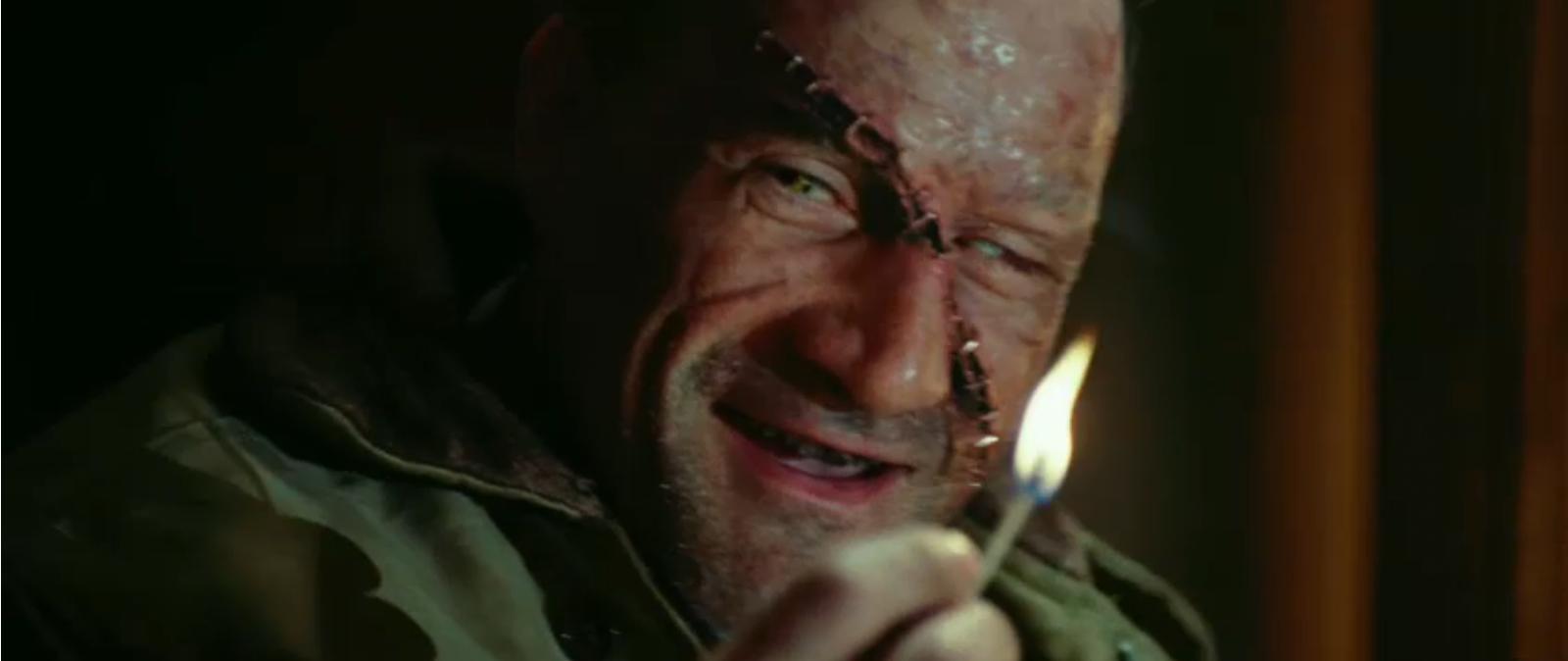
But that's all surface. Daniels volunteered for this case because he wanted to get to Shutter Island for some personal business. He's still haunted by the death of his wife, Dolores (Michelle Williams), who died in a fire that was set by an insane fire-bug named Andrew Laeddis (Elias Koteas**), presently incarcerated in Ashecliffe's Ward C—for the most dangerous criminals. Daniels has done some investigating of the facility, and what he's turned up indicates that radical techniques, from experimental drugs to lobotomies, are being practiced, and as funds are being channelled there from the House Un-American Activities Committee, he thinks the government is working on a secret brainwashing program to infiltrate radicals as double agents. Teddy wants to blow the lid off the place.
That is, if Nature doesn't get the chance first. A hurricane is barrelling down on Shutter Island ("It's like f...ing Kansas out there!"), threatening to cut off power to the electrical systems keeping the prisoners locked up and backed off. If the power goes, there's no back-up generator to kick in.
All of this concerns his partner, Marshall Chuck Aule; Teddy's been doing all this investigating of Ashecliffe, the doctors are resisting co-operating, they have no guns, the facility controls the ferry that's their only way out, and there's a storm coming. They're stuck on an island with a bunch of crazy convicts and an administrative staff who doesn't like them much, and wouldn't mind if they just...oh, had an accident or something. And Teddy's starting to get sick—plagued by migraines that Dr. Cawley (Ben Kingsley) diagnoses only too quickly with some handy aspirin nearby. Then, there's the German Doctor Naehring (Max von Sydow) who's the co-director of Ashcliffe and chief diagnostician. Teddy was one of the soldiers who liberated Dachau, so he's immediately suspicious of him. "Do you believe in God, Marshall?" Naehring challenges him. "Ever seen a death-camp, doctor?" Teddy sneers back.
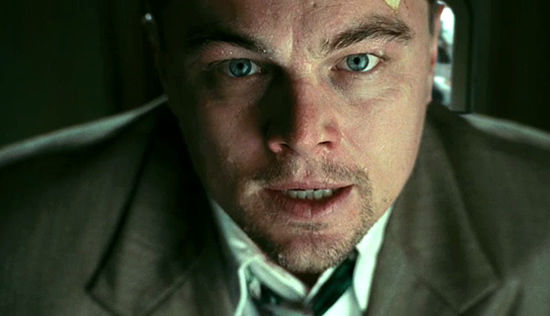
There's a lot of story-point to juggle,*** but director Martin Scorsese focuses on the atmospherics, which is laid down with a heavy hand in the same manner as he directed "Cape Fear." When it comes to working on genre features, Scorsese is never subtle, and the film is filled with dark spaces (with things that go KA-BOOM in the night), blinding lightning strikes, dripping facades and the most suggestive of dream-sequences. Before too much has happened, you begin to question everything you see, and at that point the director throws the continuity girl off the cliff and does whatever he wants, reality having little to do with the movie. The secret to this kind of film-making is keeping audiences guessing and Scorsese stretches it out as far as he can (to the point where some audience members will still be questioning it after they leave the theater).
Which is unfortunate. Because the most important thing about this movie (and story) is another of author Dennis Lehane's moral quagmires. That is what one should be discussing, as opposed to "What just happened?"
So, call this another in a series of "minor Scorsese films" (but not so minor that it might win a mercy "Best Picture" Oscar), and we hope (again) that we'll see another film from him with more substance than mere style. One wonders how much Scorsese is sacrificing by hitching his film-making wagon to star Leonardo DiCaprio. DiCaprio is a bankable star so studios are only too happy to finance a Scorsese film starring him and this allows Scorsese to keep working in a youth-oriented market in the most profit-based center of film-making, Hollywood. But DiCaprio the baby-faced star (no matter how much he scowls) is the water to Scorsese's boiling oil. There is a sense, and it may only be mine, that DiCaprio is shoe-horned into Scorsese projects for which he is not suited, and perhaps the two should have a trial separation to see what kind of film the mature film-maker will produce without his too-young star. In the first part of his career, Scorsese's non-Robert DeNiro films were "Alice Doesn't Live Here Anymore," and "After Hours," two distinctive films that, even without the director's frequent collaborator, said something about our lives and times prismed through Scorsese's kinetic view-finder. After his tampered-with version of "Gangs of New York," he has produced "The Aviator," "The Departed," and this film, all with DiCaprio, and they are films more like "New York, New York," that accentuate style over substance. Great cinematic rides they may be, but they're flashes in a film-can, that leave you still hungry to see a great movie.
"Shutter Island" is a Matinee.
Post-script: I've changed my rating of "Shutter Island" to a matinee and I'm not so sure it is a minor Scorsese film, as it's stayed with me for more than a week, and the images and intricacies keep popping into my brain to slap me upside the head. "Missed it!" I think the "Decaprio" element still brings the movie down a bit, but a second viewing of "Shutter Island" shows intricacies that in the first viewing one doesn't know they don't know. That's subtle film-making that doesn't wave red flags at the audience, and the film slots into Scorsese's body of work quite smoothly. Trouble is, I can't go into details about it, or I might spoil the movie for anybody else.
Well, we'll just leave that for a piece down the road.
* Teddy is another Mass. cop who has the shakes about water. In "Jaws," Chief Brody's wife tries to be helpful: "There's a technical name for it..." "Drowning" is his quick reply.
** No, it's not Robert DeNiro, although it looks like him in the trailer. It's Elias Koteas...with a really big scar.
*** The script is by "Avatar" adapter Laeta Kalogridis, who Lehane thought did a masterful job with a difficult assignment. It is.









Friday, February 6, 2009
Olde Review: The Emigrants/The New Land
This was part of a series of reviews of the ASUW Film series back in the '70's. Except for some punctuation, I haven't changed anything from the way it was presented, giving the snarky, clueless kid I was back in the '70's a break. Any stray thoughts and updates I've included with the inevitable asterisked post-scripts.
This Saturday's ASUW film program is something very special: Jan Troell's "The Emigrants" and "The New Land"—an unglossed, beautifully done look at a Swedish community's emigration to America.
"The Emigrants"/"The New Land" aka "Utvandrarna"/"Nybyggarna" (Jan Troell, 1971) When it was released in Sweden, Jan Troell's film was all of a piece—a several hours epic called "The Emigrants." Americans are notorious for not being able to sit that long to watch one movie, and so for American distribution, it was cut into two parts (as was Richard Lester's "The Three Musketeers"). Fortunately, the film had a natural break in the middle, as Troell's film was based on two books in a trilogy* by Vilhelm Moberg, so there was little, if any, damage to the story as far as continuity.
And it is quite a story: the tales of how the emigrants left everything they had, searching for a nirvana they heard about called America, and then, when arriving, found the stories were stories and that their struggles had to continue...as there was no way back. (These stories) have always had a special place in the history of film, especially American film. Audiences have long taken an interest in the struggles of their forebears—one of the reasons why ABC's "Roots" has gone through the ratings roof this week. One can possibly attribute this to a kind of lazy pride, clutching the courage and struggles of our ancestors to ourselves. And if so, so what? We're all entitled to a little pride in their accomplishments. It might provide the springboard for some equally courageous acts in our lives. And this pride in the past struggles reaches across racial/religious lines: we can feel proud at the struggle of other peoples' against their misfortunes. Hence, the great popularity displayed by "Roots" this week.
What about the movie, huh?)**
Oh...yeah. Jan Troell's treatment of the sometimes gentle, sometimes violent story of "The Emigrants" is to treat it gently, "matter-of-factly." He has compassion for his community, but that compassion will not allow him to prevent the cruelties of the journey, the country and the people of America. And there is a poetry in this style. Stanley Kubrick found it in "2001: A Space Odyssey," and "Barry Lyndon," and Troell has it throughout "The Emigrants" and "The New Land," with only one exception in the latter.
The film starts in Sweden as Karl-Oskar Nillsson is pressured by family needs to take a wife and we are presented with Kristina. It is Liv Ullmann and her life previous to the marriage to Karl-Oskar is presented to us in a brief, languorous series of shots that entail an entire life of child-like freedom—sheltered, playful and entirely composed of little incidents, little insignificant moments, that thoroughly define her character and will stay with us throughout both movies as we see her struggle and grow old too early with her husband. Those moments remained in my mind through the films, and I saw them a year apart.
Those few moments of insignificance that tell the story are what define Troell's style of story-telling. It means that the actors are put under a great strain to present authentic portraits of people, and the cast led by Max von Sydow and Ullmann come through with a total feeling of lived-in performances. You believe every one of the actors are who they are, that the relationships are real, (and) they are a community. There's not a false moment there in a film that is totally composed of moments suspended in time.
I'm not going to go through a list of favorite moments—there are too many that they are a jumble in my mind. but there us one: Karl-Oskar hacking his way through foliage—surveying—walking through this alien country. He pauses, takes his axe and hacks into a tree. He writes his name on the unbarked portion and then, in a way summarizing the whole of what has gone before, lies under the tree and tips his hat over his eyes, his back supported by the tree—his land. It's a scene of total satisfaction. And you felt that satisfaction with him because you've been through it with him. That scene ends "The Emigrants" and begins "The New Land" and I envy anyone who enters 130 Kane Saturday night and can experience—in one sitting—this epic that is only small in scale.

Broadcast on KCMU-FM on January 28-29th, 1977
Thirty-two years on, if you mention "The Emigrants" to me, that scene is the one that pops up—of Max Von Sydow silently lying under the tree, his hat over his eyes, in a moment of peace and solitude that it has taken an entire movie to achieve. It is remembered fondly. "The Emigrants" was nominated for four Academy Awards including Best Picture and it's hard to imagine it making its way through the rabble in this day and age to become one of The Five. It's narrative structure (what I was painfully trying to explain here) is supported by its images, rather than a straight-ahead narration. The camera sits back and observes, making no editorial comment, picking up telling details by accident as if it was a documentary—a documentary where the light is just right and everything is extremely picturesque.
But it is no more oblique because of it, and it is presented without pretension or artifice, except to make it all look as good as can be. There was a market for this kind of of film in the 60's and early 70's, although one doubts that one could convince today's casual movie-goer of making plans to see these two films about the emigrant experience in early America—that field's been plowed in the minds of today's audience, and it might not be an evening's entertainment to see people working hard to build a life out of the dirt.
But it's worth it, if only to see von Sydow and Ullmann—two of Ingmar Bergman's stökk company—in a couple of their best roles. But there are benefits in seeing a good story well-told.
A couple of observations: "Roots" was on everybody's collective mind when this review was written, so it was probably natural to stem off of it, but there's a bit too much made of it, the review is about "The Emigrants," after all; The comparison to "2001" is apt as far as story-telling style, but not "Barry Lydon"—"Lyndon" has an omniscient Narrator, while "The Emigrants" does not. The review really doesn't do much service to the films, which are marvellous. Troell went "Hollywood" for an ill-advised remake of John Ford's "The Hurricane" (starring Mia Farrow!), then returned to Sweden, where he continues to work today.
* Actually a tetralogy: "The Emigrants" (1951), "Unto a Good Land" (1954), "The Settlers" (1961), and "The Last Letter Home" (1961). (or is it a "quadrilogy?")
** ABT***
*** "About Bloody Time"
Thursday, January 8, 2009
Olde Review: The Seventh Seal
 This was part of a series of reviews of the ASUW Film series back in the '70's. Except for some punctuation, I haven't changed anything from the way it was presented, giving the snarky, clueless kid I was back in the '70's a break. Any stray thoughts and updates I've included with the inevitable asterisked post-scripts.
"The Seventh Seal" aka "Det Sjunde inseglet" (Ingmar Bergman, 1957)
An odd combination of films await those in 130 Kane this Saturday night: Ingmar Bergman's "The Seventh Seal" and Ken Russell's "The Devils."
For those of you whose only experience with Ingmar Bergman is his wildly splintered and heavy film "Persona" from last quarter's ASUW series, "The Seventh Seal" will seem to be made by another man. At this time, Bergman wasn't so experimental, so strange. He was, as he is now, alive and vibrant with the charm of film-making and his '50's films ("The Magician," "Wild Strawberries," "Through a Glass Darkly") although dealing with "heavy" subjects of God and Death and self still possessed a lightness in the telling, a lightness that carried over from his beginnings in films and was lost in the dark broodings of his late '50's and '60's films. There was a time for comedy, and time for deep-think in the space of the best Ingmar Bergman films.
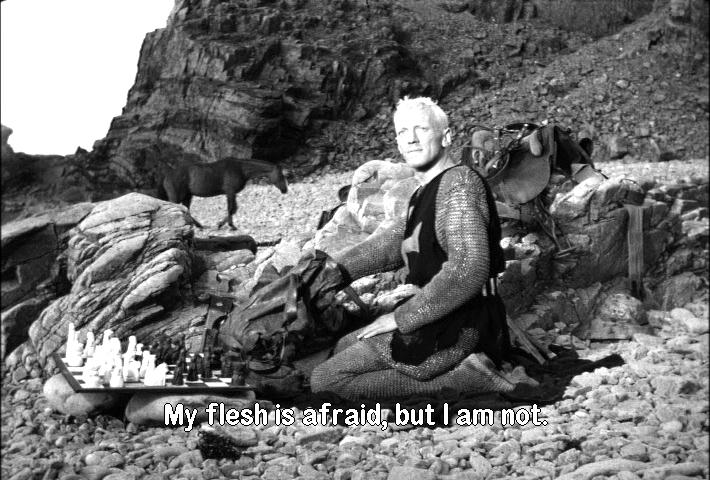
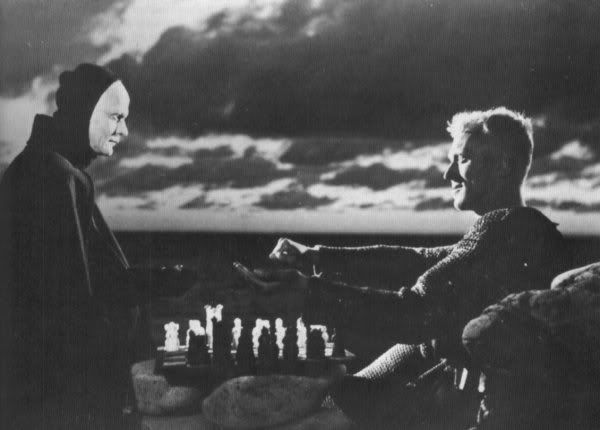
There are many characters in "The Seventh Seal," but at the film's hub are two. The most important is The Knight, who is played Max von Sydow, the supreme brooding actor. The Knight is home from the religious wars where the quest for God has been fruitless—where the point of the quest, after the year's ox-killing has been lost. But the quest for God continues. It has to. God can't be in the war, but can he be found outside amidst plague, witch-burnings and ignorance?
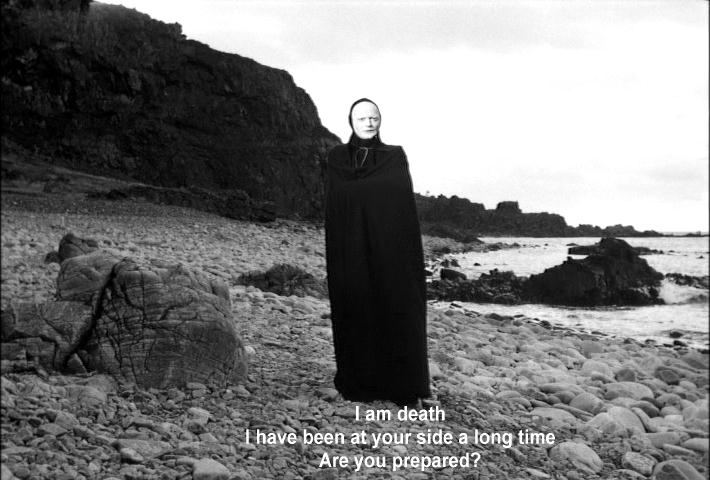
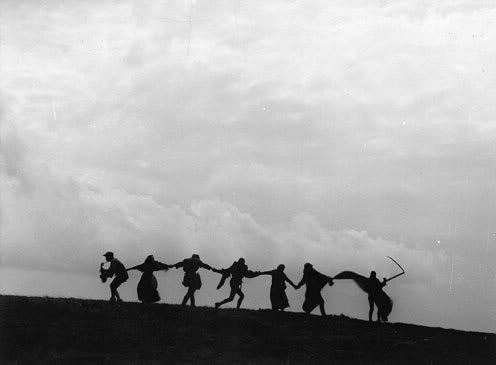
The answers are hard to come by, and even harder to come by while being pursued by another hold-over from the wars, the second most important character being Death. Death pursues the Knight and they engage in continuing battles of wits and of chess. The two opponents are only the hub of the story. There are others: the Knight's man-servant whose musings are concerned more with life that what is beyond; a troupe of actors; a wood-cutter and his adulterous wife. Bergman combines them all in a film that wheels between light and heavy in tone, but always excellent in quality.
Broadcast on KCMU-FM on January 8th, 1976 (thirty-three years ago today)
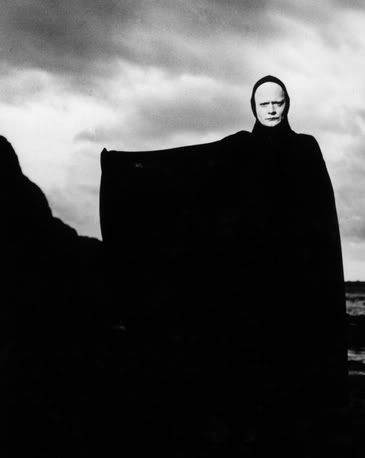
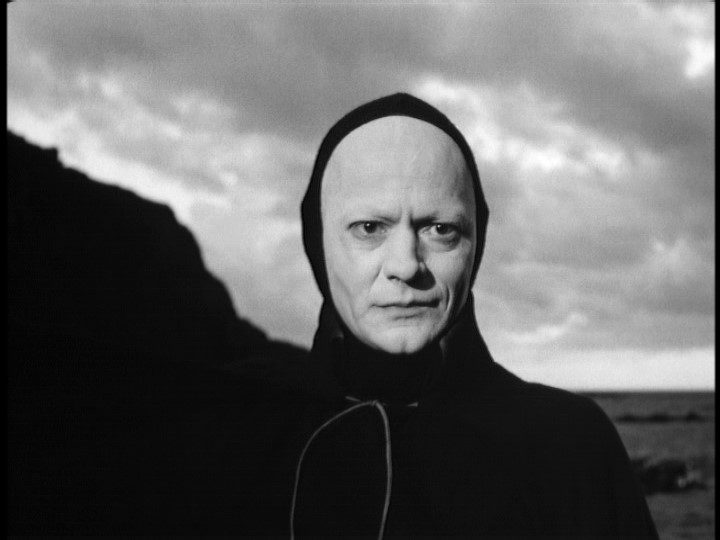
Sounds like I ran out of time there at the end--I usually only had two or three minutes per film to talk. So, I didn't even mention the stark black-and-white photography that has become so iconic, along with Bergman's simple personification of Death--an actor dressed entirely in a black cassock, with just his face appearing...in sharp contrast. And the image of The Knight playing chess with Death has been copied, parodied, purloined and done...well, to death. In "Bill and Ted's Bogus Journey," they played "Battleship."
It sounds bleak, and it is—it is the Plague-Years, after all. But the film ends with a touch of hope and sacrifice, that even after all the Knight has seen—and not seen in the form of God—he can still cling to ideals. Typing this out, it occurs to me that the film we're reviewing tomorrow has a lot in common with Bergman's masterpiece.


Saturday, September 13, 2008
The Diving Bell and the Butterfly-Take Two

"Still Life with Wandering 'I'"
Bauby's condition is referred to clinically as "Locked-In Syndrome," where the brain is active, although the body cannot move. And Schnabel's filmgives a lie to the label, as Bauby's life-in-paralysis is anything but locked-in. Although he is frequently only a passenger in his life, Schnabel points out that reality and perception is only when component to a life. There is also the vast store of life inside the mind.
Throughout the film we are privy to Bauby's internal life,*but often those thoughts become images--memories, imaginings, lusts, fantasies, body-images. Rarely are there violations of the POV rule, where we share Bauby's point of view in whatever form it takes, and turn around to see his minimal reactions--a quivering lip, a tear, a drool. But even those are edited to form a piece of the whole--to make a sum of Jean-Do's experience of a "still," but rich life.**

The Normal: Jean-Do's point of view rom his hospital bed Extreme POV: Bauby watches his right eye-lid being sewn shut
 Break-Out: Jean-Do extrapolates out from his view-point to see his mistress' face
 Body-image: Jean-Do imagines himself unable to move underwater in a rigid diving suit
 Fantasy: Jean-Do imagines his isolation on a family outing at the beach.
 Memory: Jean-Do remembers shaving his father (Max Von Sydow)--
a time when he assisted someone who was helpless Interpretation: Pictures hung in his hospital room, abnormally close, contrasting
 Memory or Imagination: Calving glaciers--a symbol of decay?
 Hallucination: Is his mistress visiting or not?
 Scene-setting: Jean-Do imagining his interaction, or director convenience?
Reality
* Even though the producers are American, and the scriptwriter and director are British, the entire film is in french dialect at Schnabel's insistence. It has an added benefit--it is one more "remove" from Bauby. We can hear his thoughts, but, unless you're French and speak it, it needs to be translated, just as his internal thoughts needed to be communicated through his eye-blinks and interpreted. It is one more level of audience-sympathy with the subject.
** Schnabel couldn't adhere completely to that rule--In the phone conversation with his publisher, the director cuts to the publisher's office to see her quandry about agreeing to a book by a paraplegic--something Bauby is not privy to, and his nurse cannot see.Friday, June 6, 2008
Olde Review: The Exorcist
"The Exorcist" (William Friedkin,
 1973) When Ellen Burstyn was in Seattle last year, she was asked why she had chosen to star in "The Exorcist." She replied by calling attention the film's first scene after the blood-red titles--the scene which is predominated by an Iraqi morning prayer. That, Ms. Burstyn said, was what she thought the film was about--a call to prayer. Now, Ellen Burstyn struck me as being a brilliant and sensitive individual. But I'm afraid she was duped, as a lot of us were, by the writer and director of "The Exorcist," and by the Warner Brothers promotion department. When "The Exorcist" came out we were pummelled by newsaper and magazine articles on the authenticity and "religious significance" of the movie. A major "debate" erupted amongst Christian theologians about the devil's existence and the validity of the movie as a "Christian" document.
Well, in the three years since the film was released the furor has died down, so I think I can say what I'm about to say without fear of ex-communication: "The Exorcist" is nothing more than a horror movie. What is worse it's a horror movie with religious pretensions. This isn't to say that religious ideas can't enter into a horror movie. It can and can be done well. James Whale turned Frankenstein's Monster into a psuedo-Christ figure in "The Bride of Frankenstein," and the religious or anti-religious qualities of "Dracula" have been dealt with very extensively in the Hammer films with Christopher Lee. But these films' religious associations were in the background of the film, or atleast are cliche items with the genre so we don't notice them so much. There were also done by directors who knew what they were doing. William Friedkin is so hap-hazard about things in this film that he badly slips up with one of his "devices" - a medallion that keeps cropping up in the film, something Friedkin said in an interview would give his film "resonances," has since been the subject of an intelligent article that, because of the medallions' sloppy useage, sees "The Exorcist" as a marriage between Satan and the Church, exactly opposite to the film's supposed religious intentions. Hap-hazard work and a definite lack of thought on Friedkin's part are to blame.
So, "The Exorcist" is a horror movie with religious pretensions, not unlike 1976's "The Omen." The writer of "The Exorcist" (William Peter Blatty) stated that the film's intention was to "waken" our dormant fear of Satan and sleeping love for God and the innate goodness of man. Instead, "The exorcist" sent a number of people to mental institutions and sickened many to the point of vomiting in the theater. Blatty said that the sickness was "healthy, for the film worked on these people's guilts." Many clergymen, notably those who appeared in the film leapt to the film's defense.
One can see by this how religious pretensiousness can pile up like manure in a stable. People didn't throw up because of their sins, they threw up because the film was revolting, disgusting, and at the very least, unsubtle in its depiction of demonic possession and although one can admire the performances of the actors and the very original use of sound in the film, those are about the only things for which the film can be praised.


And looking at the film as a Catholic, I can say that the film did not make me change the belief that there is no personified evil, only the innate evil in various degrees within ourselves. But it did make me lose the belief I held since "The French Connection" that William Friedkin was a brilliant director.
Broadcast on KCMU-FM on January 21, 1977
Not much to add here, except to say that I am shocked, SHOCKED that Warner Bros. would try to legitimize their little puke show rather than just come out and say "We wanted to scare you so much that you'd plotz, and make a LOT of money!" "The Exorcist" seems tame these days. The film has had, what, four sequels? (two of them prequels, from the same source material--one from Renny Harlin after Paul Schrader's directed version was considered "not very marketable" and both were ultimately released to video so folks could judge for themselves, plus there was a "re-possessed" version of the original, with a minimum of new material released domestically which made $40 million) and any number of rip-off's and devil-tail riders. The immediate sequel was an unintended laff-riot directed by John Boorman, and Exorcist III was written and directed by Blatty himself, and was quite good--in fact, the best of the series. All of them experienced studio interference to up the "split-pea soup factor." Christian Document. Call to prayer. Right. Pass the collection plate.
Disclosures about the pedophilic activities of priests and their cover-up by Church authorities does make it seem like there's been a marriage between the Church and Satan to me, and made me lose Faith in any organized religion. Rather than a "lapsed" Catholic, I consider myself a "recovering" Catholic. More fervor was created watching "Deliver Us From Evil" than "The Exorcist." And not the good kind.
And Ellen Burstyn practices Sufism.
Meet the New Boss...
Thursday, May 8, 2008
The Diving Bell and the Butterfly (aka Le Scaphandre et le Papillon)
 The Diving Bell and the Butterfly (Schnabel, 2007) So what do you expect from a movie based on the story of a man so disabled that he could only communicate by blinking an eye, and who manages to write a book about his experience as a sufferer of 'locked-in syndrome'? You would probably expect to be moved, to feel both pity and admiration for the subject of the movie and to learn of the frustration that you anticipate he must feel. Welcome to The Diving Bell and the Butterfly: unsentimental, funny and often brutally honest.
Dr. Lepage: We want you to take it easy for a few days.
Jean-Dominique Bauby: What do you think I'm doing now?
The beginning of the movie is a stunning tour-de-force, especially Janusz Kaminksi's use of point-of-view camera work, taking us inside what Schnabel imagines it must be like to awake from a coma to find your mind is fully functioning but your body isn't. We see and hear what Jean-Dominique Bauby (Mathieu Almaric) is experiencing as he struggles to understand what has happened to him.
Jean-Dominique Bauby: I decided to stop pitying myself. Other than my eye, two things aren't paralyzed, my imagination and my memory.
 We watch his tortuous escape from the diving bell of his isolation through the patient work of his speech therapist, Henriette Durand (Marie-Josée Croze) his physical therapist, Maria Lopez (Olatz López Garmendia aka Mrs Schnabel) and finally publisher's assistant Claude (Anne Consigny), as he finally frees his imagination to take flight as a butterfly.
Papinou Bauby: "Having a mistress is no excuse for leaving the mother of your children; the world has lost its values."
Because it is evident from his memories and what we can piece together about him that he was a social butterfly - a man devoted to a selfish life for which he is never apologetic. He abandoned the mother of his children, and even when she returns to care for him, he does not treat her any differently just because he is now utterly dependent. Yet, we also see the positive in him not least in the tender relationship he has with his father (played by Max von Sydow) and with his three children. The movie is equally uncompromising with those that seek to help Bauby. We see the doctors as compassionate but clinical just as we see some of his carers as well-meaning but bumbling.
It would have been easy for Schnabel to have succumbed to a more clichéd film of the indomitable rise of the human spirit. Instead he shows us a more nuanced and balanced portrait that recognizes both strengths and weaknesses.