This week, we're re-publishing some reviews of the films from the post 9-11 environment.
 "Killing the Future with the Past"
There have been a great-many films about The Iraq War; emphasis on the "many," not so much on the "great." None have penetrated the box-office top five, and the movie-going public, with a constant dose of it (when things are going badly) on the news, have made the conscious decision to avoid paying attention at every opportunity. It may seem a disparaging thing to note, but, the public seems to have better sense than the government representing it.
Body of Lies with the one-two star punch of DiCaprio/Crowe, under the direction of Ridley Scott did manage to gain an audience (though not enough to topple the reigning champ, Beverly Hills Chihuahua), and it's just as well—it's a summation of just about every "Bush-war" film that has gone before, without adding anything new.
Part of the problem is Ridley Scott, who more often cares about how his films look than what they say. Part of the problem is William Monahan's script (which covers much of the same ground as the other films dealing with a high-tech war in a low-tech country, where boots on the ground see more than eyes in the sky--it just got there last, is all). And the other problem is that the war has gone on so long, that we might be running out of things to say about it, at least until some of the secrecy veil is lifted about the machinations going on in the marble halls and scrub rooms of Washington and Virginia.
Not to say the film doesn't have a lot to say. At one point--with a tight deadline to meet--I checked my watch to see if the film was about to wrap up, it being so full of incident and detail, and was shocked to see that an hour hadn't even gone by yet. There was still another hour to go! There is such a flood of realistic sounding information that it probably resembles the tsunami of information Homeland Security has to sift through with their Cray's. All of that research, all that sound and fury and the all the movie comes up with is "Tell the Truth."
Thanks. We knew that going in.
The points writer and director make are obvious: DiCaprio, in the Sandbox, has more of a grasp of what's happening, despite his getting marching orders from puppet-master Crowe in Langley. Scott repeatedly makes the point as DeCaprio curses at Crowe over his ear-bud, while Crowe's character is dealing with domestic needs at home. While Dicaprio's Robert Ferris is doing wet-work, Crowe's Ed Hoffman is SUV-ing the kids to school, with all the icy coolness of the uninvolved. And that happens frequently.
Ultimately, it's a waste of time, and is another of the many Ridley Scott projects that looks good, but doesn't add up to much in the long run. We've seen this story before.
Now, give us a good ending.
Body of Lies is a rental
Thursday, September 15, 2011
Body of Lies


Friday, February 19, 2010
Shutter Island
 "What's yer Next Move, Boss?"
or
"Tag! You're It!"
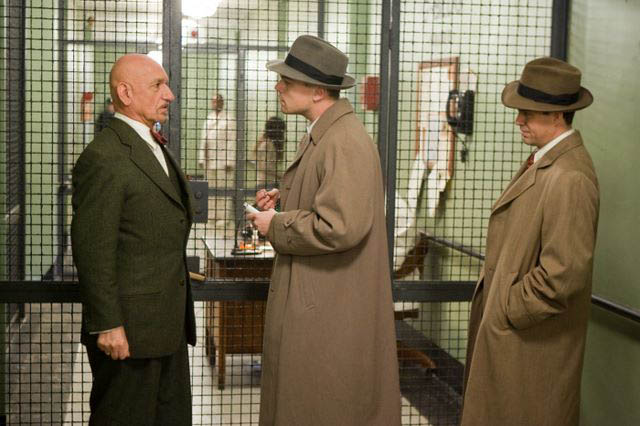
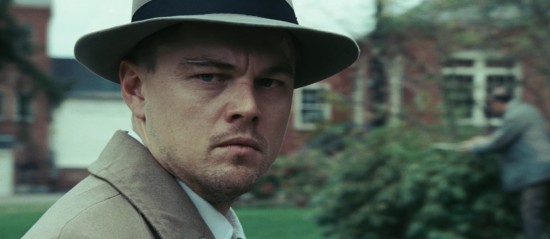
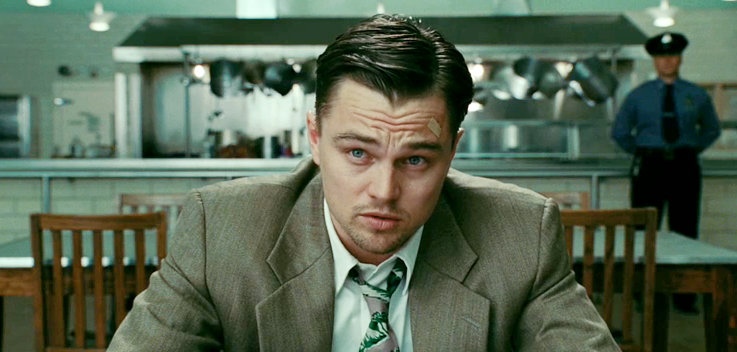
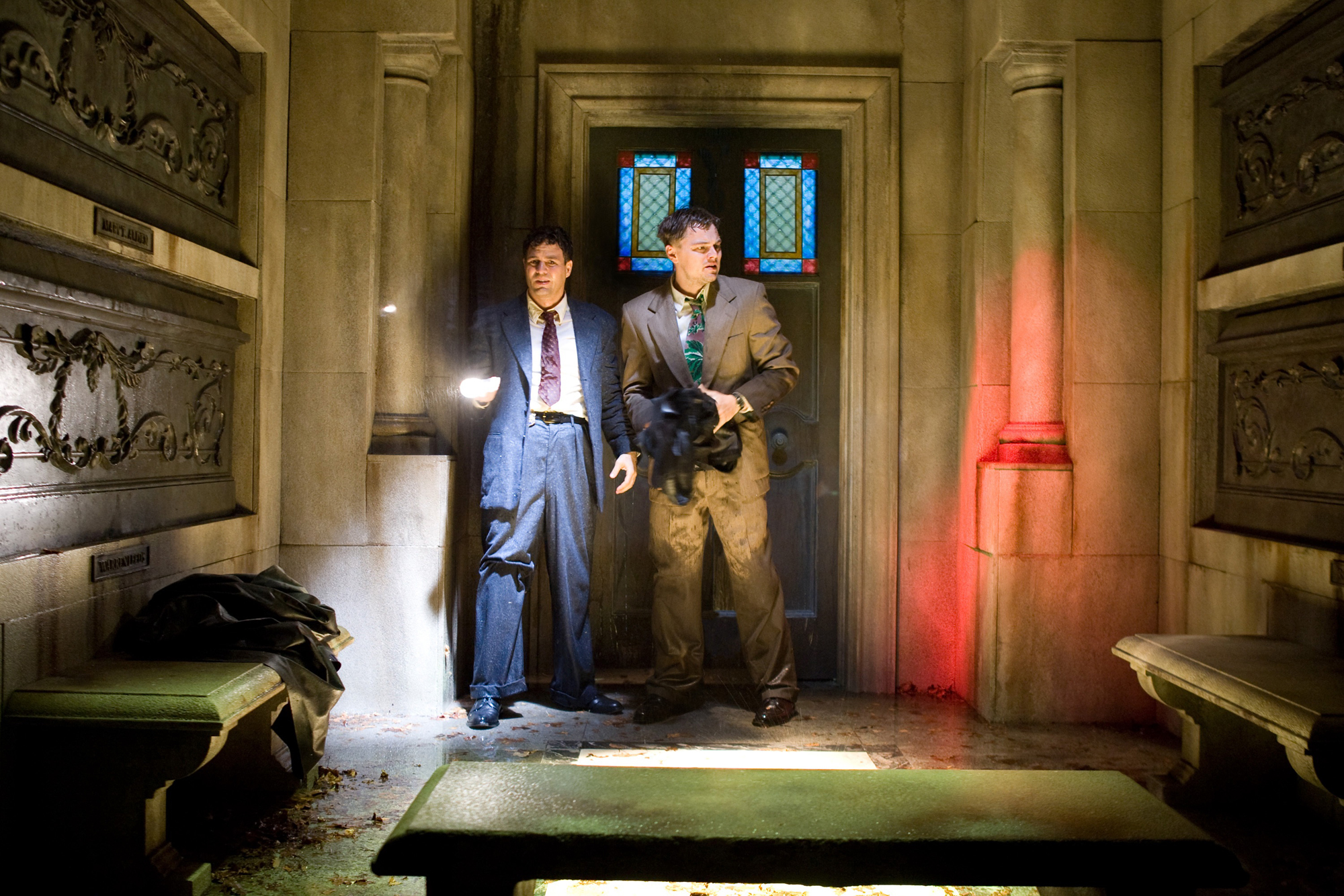
It is 1954, and out of the fog comes a ferry boat carrying two U.S. Marshalls, heading for "Shutter Island", where squats, in various stages of dis-repair, Ashecliffe, an asylum for the criminally insane. In the "head," sea-sick,* is Marshall Teddy Daniels (Leonardo DiCaprio), "the legend" as his partner from Seattle Chuck Aule (Mark Ruffalo, who has a rather thick Massachusetts accent for it) calls him. The two are investigating the disappearance of an inmate from Ward B, the women's section, and right from the get-go, the two are at a disadvantage.
Upon crossing the electrified fence, their weapons are confiscated, security being what it is. "What?" Teddy smirks at the guard "You act like insanity is catching." The guard only smirks back. That should have been his first clue.
The doctors (Ben Kingsley and Max von Sydow) are helpful to a point, but then they become somewhat diffident and challenging, even obstructing, protective of their "advanced" techniques—"a moral fusion between law and order and clinical care." The missing woman, Rachel Solendo (Emily Mortimer), drowned her kids after her husband was killed during the Normandy invasion and has never acknowledged the act. But she somehow managed to escape from a cell, locked from the outside, and with a guard on duty. Investigating, Daniels finds a cryptic note "The Law of 4. Who is 67?"
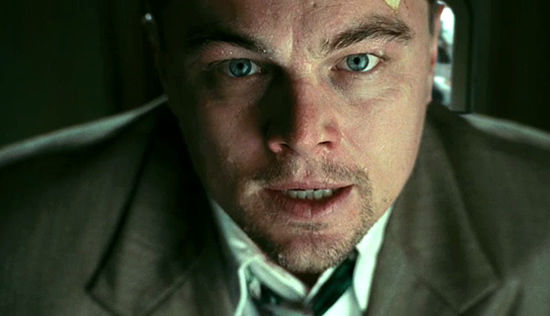
But that's all surface. Daniels volunteered for this case because he wanted to get to Shutter Island for some personal business. He's still haunted by the death of his wife, Dolores (Michelle Williams), who died in a fire that was set by an insane fire-bug named Andrew Laeddis (Elias Koteas**), presently incarcerated in Ashecliffe's Ward C—for the most dangerous criminals. Daniels has done some investigating of the facility, and what he's turned up indicates that radical techniques, from experimental drugs to lobotomies, are being practiced, and as funds are being channelled there from the House Un-American Activities Committee, he thinks the government is working on a secret brainwashing program to infiltrate radicals as double agents. Teddy wants to blow the lid off the place.
That is, if Nature doesn't get the chance first. A hurricane is barrelling down on Shutter Island ("It's like f...ing Kansas out there!"), threatening to cut off power to the electrical systems keeping the prisoners locked up and backed off. If the power goes, there's no back-up generator to kick in.
All of this concerns his partner, Marshall Chuck Aule; Teddy's been doing all this investigating of Ashecliffe, the doctors are resisting co-operating, they have no guns, the facility controls the ferry that's their only way out, and there's a storm coming. They're stuck on an island with a bunch of crazy convicts and an administrative staff who doesn't like them much, and wouldn't mind if they just...oh, had an accident or something. And Teddy's starting to get sick—plagued by migraines that Dr. Cawley (Ben Kingsley) diagnoses only too quickly with some handy aspirin nearby. Then, there's the German Doctor Naehring (Max von Sydow) who's the co-director of Ashcliffe and chief diagnostician. Teddy was one of the soldiers who liberated Dachau, so he's immediately suspicious of him. "Do you believe in God, Marshall?" Naehring challenges him. "Ever seen a death-camp, doctor?" Teddy sneers back.
There's a lot of story-point to juggle,*** but director Martin Scorsese focuses on the atmospherics, which is laid down with a heavy hand in the same manner as he directed "Cape Fear." When it comes to working on genre features, Scorsese is never subtle, and the film is filled with dark spaces (with things that go KA-BOOM in the night), blinding lightning strikes, dripping facades and the most suggestive of dream-sequences. Before too much has happened, you begin to question everything you see, and at that point the director throws the continuity girl off the cliff and does whatever he wants, reality having little to do with the movie. The secret to this kind of film-making is keeping audiences guessing and Scorsese stretches it out as far as he can (to the point where some audience members will still be questioning it after they leave the theater).
Which is unfortunate. Because the most important thing about this movie (and story) is another of author Dennis Lehane's moral quagmires. That is what one should be discussing, as opposed to "What just happened?"
So, call this another in a series of "minor Scorsese films" (but not so minor that it might win a mercy "Best Picture" Oscar), and we hope (again) that we'll see another film from him with more substance than mere style. One wonders how much Scorsese is sacrificing by hitching his film-making wagon to star Leonardo DiCaprio. DiCaprio is a bankable star so studios are only too happy to finance a Scorsese film starring him and this allows Scorsese to keep working in a youth-oriented market in the most profit-based center of film-making, Hollywood. But DiCaprio the baby-faced star (no matter how much he scowls) is the water to Scorsese's boiling oil. There is a sense, and it may only be mine, that DiCaprio is shoe-horned into Scorsese projects for which he is not suited, and perhaps the two should have a trial separation to see what kind of film the mature film-maker will produce without his too-young star. In the first part of his career, Scorsese's non-Robert DeNiro films were "Alice Doesn't Live Here Anymore," and "After Hours," two distinctive films that, even without the director's frequent collaborator, said something about our lives and times prismed through Scorsese's kinetic view-finder. After his tampered-with version of "Gangs of New York," he has produced "The Aviator," "The Departed," and this film, all with DiCaprio, and they are films more like "New York, New York," that accentuate style over substance. Great cinematic rides they may be, but they're flashes in a film-can, that leave you still hungry to see a great movie.
"Shutter Island" is a Matinee.
Post-script: I've changed my rating of "Shutter Island" to a matinee and I'm not so sure it is a minor Scorsese film, as it's stayed with me for more than a week, and the images and intricacies keep popping into my brain to slap me upside the head. "Missed it!" I think the "Decaprio" element still brings the movie down a bit, but a second viewing of "Shutter Island" shows intricacies that in the first viewing one doesn't know they don't know. That's subtle film-making that doesn't wave red flags at the audience, and the film slots into Scorsese's body of work quite smoothly. Trouble is, I can't go into details about it, or I might spoil the movie for anybody else.
Well, we'll just leave that for a piece down the road.
* Teddy is another Mass. cop who has the shakes about water. In "Jaws," Chief Brody's wife tries to be helpful: "There's a technical name for it..." "Drowning" is his quick reply.
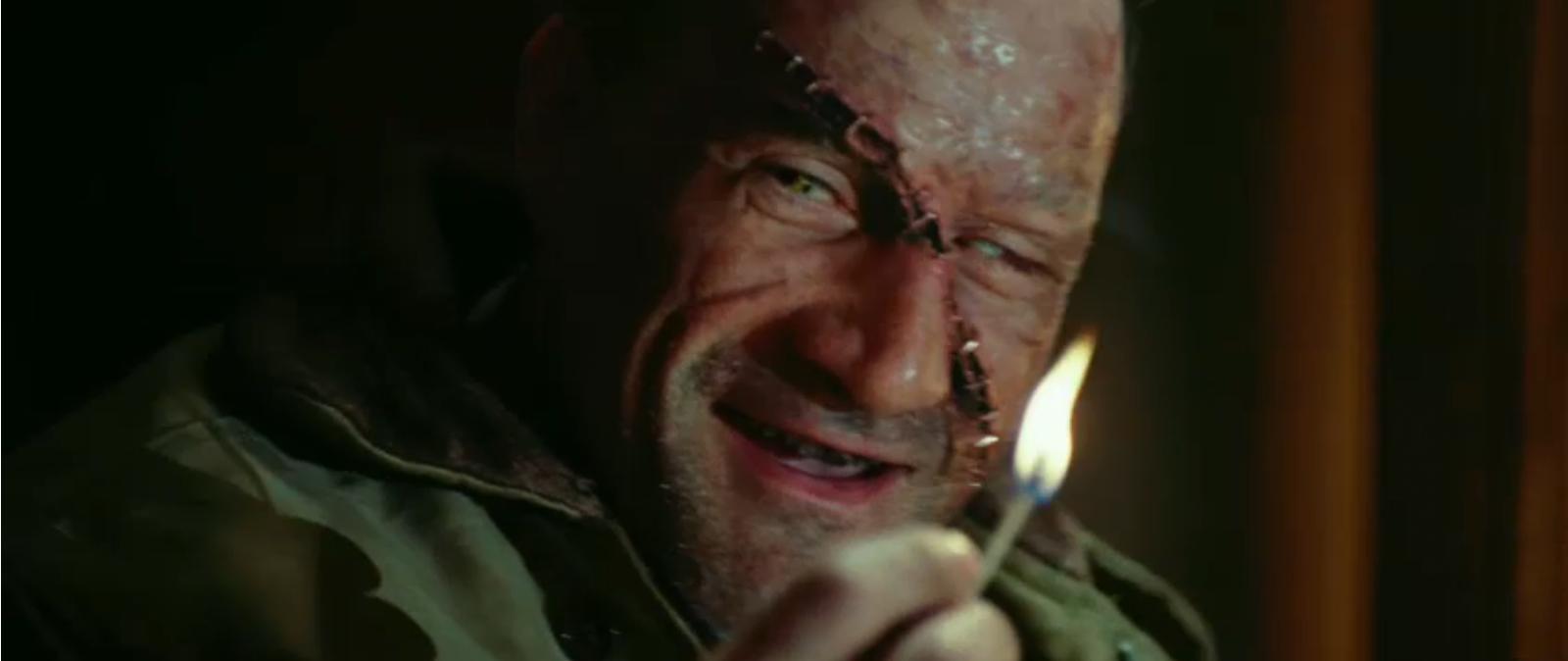
** No, it's not Robert DeNiro, although it looks like him in the trailer. It's Elias Koteas...with a really big scar.
*** The script is by "Avatar" adapter Laeta Kalogridis, who Lehane thought did a masterful job with a difficult assignment. It is.









Thursday, November 6, 2008
Body of Lies
"Killing the Future with the Past"
There have been a great-many films about The Iraq War; emphasis on the "many," not so much on the "great." None have penetrated the box-office top five, and the movie-going public, with a constant dose of it (when things are going badly) on the news, have made the conscious decision to avoid paying attention at every opportunity. It may seem a disparaging thing to note, but, the public seems to have better sense than the government representing it.
"Body of Lies" with the one-two star punch of DiCaprio/Crowe, under the direction of Ridley Scott did manage to gain an audience (though not enough to topple the reigning champ-"Beverly Hills Chihuahua"), and it's just as well—it's a summation of just about every "Bush-war" film that has gone before, without adding anything new.
Part of the problem is Ridley Scott, who more often cares about how his films look than what they say. Part of the problem is William Monahan's script (which covers much of the same ground as the other films dealing with a high-tech war in a low-tech country, where boots on the ground see more than eyes in the sky--it just got there last, is all). And the other problem is that the war has gone on so long, that we might be running out of things to say about it, at least until some of the secrecy veil is lifted about the machinations going on in the marble halls and scrub rooms of Washington and Virginia.
Not to say the film doesn't have a lot to say. At one point--with a tight deadline to meet--I checked my watch to see if the film was about to wrap up, it being so full of incident and detail, and was shocked to see that an hour hadn't even gone by yet. There was still another hour to go! There is such a flood of realistic sounding information that it probably resembles the tsunami of information Homeland Security has to sift through with their Cray's. All of that research, all that sound and fury and the all the movie comes up with is "Tell the Truth."
Thanks. We knew that going in.
The points writer and director make are obvious: DiCaprio, in the Sandbox, has more of a grasp of what's happening, despite his getting marching orders from puppet-master Crowe in Langley. Scott repeatedly makes the point as DeCaprio curses at Crowe over his ear-bud, while Crowe's character is dealing with domestic needs at home. While Dicaprio's Robert Ferris is doing wet-work, Crowe's Ed Hoffman is SUV-ing the kids to school, with all the icy coolness of the uninvolved. And that happens frequently.
Ultimately, it's a waste of time, and is another of the many Ridley Scott projects that looks good, but doesn't add up to much in the long run. We've seen this story before.
Now, give us a good ending.
"Body of Lies" is a rental
Tuesday, January 22, 2008
Celebrity
 Celebrity" (Woody Allen, 2002) A lot of prominent beautiful people have fun with the outlandish behavior of celebrity in Woody Allen's nebbishy black and white film. Kenneth Branagh plays Woody in this one and you just want to slap him. "Stop with the tic's, already!" It feels a lot like "Crimes and Misdemeanors" and "Hannah and her Sisters," so it's Woody writing "like Chekhov" as one of the characters says. He must have just got done reading "The Grasshopper" on this one. Still its nice to reconnect. The last film I saw was "Manhattan Murder Mystery." Been awhile. Nice to see that not much has changed.
Monday, January 14, 2008
The Departed
 Institutionalized Ball-Busting
Call it the Scorsese Thesis: First a guy tells you what he's gonna tell ya, then Marty shows ya, then you're on your own.
In the case of "The Departed" "the Guy" is Jack Nicholson's Frank Costello, a seedy Boston crime-lord from "some years ago." "I don't want to be a product of my environment," says the shadowy Frank (Scorsese's way of showing Frank as a younger man). "I want my environment to be a product of me."
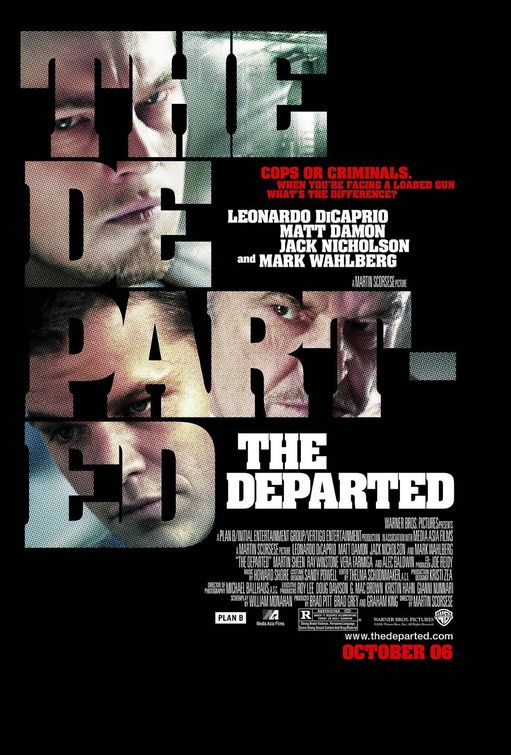
Nicholson's Costello makes good on that promise on two fronts--in the scenario of "The Departed," and the movie, itself. Costello's control over his Boston turf (or, using the accent Martin Sheen employs here, "too-urf")is so absolute, his reach extends from his surly band of criminals to the police department, culminating in one of his own crew (Matt Damon) infiltrating the very task force investigating his activities. Simultaneously, the player on the other side, Captain Queenan (Sheen) has trolled the new recruits to find his own mole (Leonardo deCaprio) to infiltrate Costello's crew. It turns into a complicated Spy Vs. Spy with both moles straddling the moral fence, while completely unsure of their footing on either side. And while trying to rat out their suspected counter-part while not drawing attention to their own treacheries. They're mutually duplicitous. As Costello says in the Thesis: "When I was growing up, they would say you could become cops or criminals. But what I'm saying is this. When you're facing a loaded gun, what's the difference?"
It's a complicated game of Jack's Straws...set in a house of mirrors. Drop Nicholson's weight into the middle of it, and the whole thing threatens to pancake...much like the movie. This first colaboration with Scorsese is similar to Marlon Brando's eccentric performance in "The Missouri Breaks," where an actor so drapes himself in business that he attracts the eye in the same way as a car-wreck--you wonder what in Hell this crime-clown (it is much like Nicholson's Joker in "Batman" without the make-up)is going to do next. Damon and DeCaprio were not clued into his on-set antics and so their scenes are played with the right touch of paranoid hesitancy. There's a strained wariness behind their eyes and they've rarely been better.
As good as they are (and excessive as Nicholson is) best among the cast is Alec Baldwin as a fast-talking divison head, but the real revelation here is Mark Wahlberg. Marky-Mark walks away with the picture and dominates every scene he is in, no matter who's in it with him. In fact, in the one scene Baldwin and Wahlberg share, Scorsese throws in a couple of "Raging Bull" camera moves for a verbal feint and parry between the two. It's a director's nod to two extraordinary actors doing solid work, free of gimmicks.
As for Scorsese, if you're looking for a return to his greatest efforts, this isn't it. It makes you wonder what he's up to. This story is nothing new, and is in fact based on a Chinese film (and its two sequels, actually) that owes more to the early personal style that he fails to deliver on here. What's the fascination? We've seen the cop/criminal discotomy, as well as the conflicts of working undercover in better films. He's doing program work, not personal work. This isn't "Raging Bull" or "Mean Streets" or "KunDun" or "Goodfellas." This is "Alice Doesn't Live Here Anymore." Or "New York New York." Or "The Aviator." One senses he's pacing himself, keeping his hand in the game doing agency "package" movies until the next inspiration comes along. Perhaps he should ditch DeCaprio, and find that last, good DeNiro project. He's too good a film-maker to waste on remakes and empty biographies. Maybe after the struggles he went through to bring his last personal project to the screen he's asking himself at this point in his career "What's the difference?"
"The Departed" is a Rental-You gotta problem wid 'at?