 For Want of a Nail....
or
The Sound of Slamming Chadors
With all the talk about Iran's nuclear capabilities, here's a brilliant film about Iran's equally volatile nuclear families.
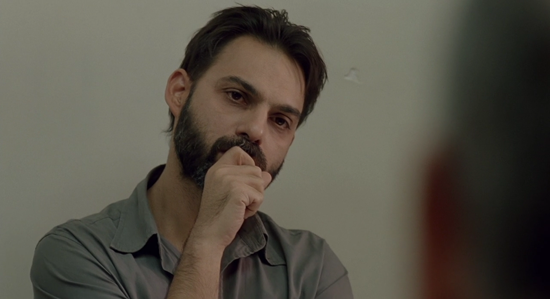
It begins as Nader (Peyman Moadi) and Simin (Leila Hatami) are petitioning for a divorce, bickering over the issues that are causing the rift. Simin wants to leave the country, and finally has the opportunity to do so within a 40 day time-limit. She wants Nader and their daughter Termeh (Sarina Farhadi) to come with her, but he will not—he is chief caretaker for his father, suffering from Alzheimer's, and he will not give up his responsibilities, and as the head of the household, he will not let the daughter leave, either. And yet the whole point of Simin trying to get them out of the country is for Termeh to have a better chance at life, without the bitter subjugation of women and the yoke of Sharia law...not that she can say that in court (of course).
It's a case of "He said/She said" that plays out with complications, obfuscations, deflections, feints, irrelevancies, and opinions posing as facts, and no choices about anything. They have reached an impasse—she wants them to leave, and he feels he can't leave—and so petitioning for divorce is the only way for her to leave, but she must do so without the daughter. He won't let the daughter go, as long as he needs help taking care of Dad, and so...hence, the petition for a divorce.
The scene is played in a long (but complicatedly acted) two-shot of the couple facing the camera explaining the situation, bickering back and forth and pleading their case before an unseen magistrate...or uncaring bureaucrat...and, owing to the camera position, us, putting the audience in the uncomfortable position of sharing that man's perspective. We're hearing all of this for the first time (as is he) and as the mire they're in increases, one wonders how it could possibly be resolved, even if, to the magistrate, it is "a small problem," insufficient to grant a divorce, but enough for the couple to take the matter into their own hands for A Separation (or جدایی نادر از سیمین , or Jodái-e Náder az Simin, or "The Separation of Nader from Simin").
That act complicates things further: Nader has to work, Termeh attends school, and Simin's absence leaves Dad alone and unmanaged for a dangerous amount of time. Simin suggests hiring a care-taker, and they hire Razieh (Sareh Bayat)—poor, pregnant, with six year old daughter in tow, and working without her unemployed husband's permission (he's played, in a tough role to make sympathetic, by Shahab Hosseini)—who, before long, is overwhelmed with her duties, but must continue with them to provide for her family.
Now, bear in mind, I've just described the first fifteen minutes of the movie, which twists and turns into more complications, altercations, and incarcerations, in what seem to be an insolvable cluster of traps within traps involving duty and responsibility, ideology over practicality, patriarchal authority over common sense, and the inexorable demand of law to tidy things up by whatever means seems to be easier and more expeditious at that moment in time, with the volume and volubility increasing over time until the tension is ready to be snapped by anything, like the upsettlingly loud violence suggested by the sound of Nader and Simin's rattlingly concussive front door. If this were a comedy, it would be one of the "incredible mess" variety, where everything collapses of its own weight and complexity, and only when those affected from it emerge, dusty and disheveled and with nothing left to lose, does the madness of the situation become apparent to them.
But, this isn't a comedy. It feels like real life, whether Persian or American, and makes one realize that there's more in common than what separates the two countries, and the whole thing plays out like an expansion of that first scene—unsolvable, intractable, frustrating—not a vicious circle, but a vicious triangulation...with very sharp damaging points.
And it's not a comedy because no one, not anybody, comes to their senses.
It's the stuff of great drama, even tragedy, and were it to originate in the U.S., it might be subject to the dramaturgy that always makes me want to put my head in my hands and burble (half-jokingly) "why doesn't everybody just get a good night's sleep?" But, the thought never crosses the mind watching this understated, deceptively low-key presentation, subtly and artfully processing the hysterics of the situation, and channelling it into Art. It's devastating. And A Separation is right up there with The Tree of Life and The Descendants as one of my favorite films of the year—each taking on the subject of (as Warren Beatty, of all people, described it) "the sanctity of Family" and finding distinct ways to present it.
A Separation is a Full-Price Ticket.
Wednesday, March 14, 2012
A Separation




Friday, January 14, 2011
The Secret in their Eyes

The Secrets in Their Eyes (aka El secreto de sus ojos) (Juan José Campanella, 2009) Argentinian film that won the 2010 Academy Award for Best Foreign Film. It is difficult to say, after the fact, exactly what The Secret in Their Eyes actually is: is it fiction, deposition, fever dream, memory, fantasy, wish-fulfilment...any of them, all of them a bit. And yet, it is a mystery with a conclusion, a love story with a happy ending, a character study, a psychological thriller—all of it.
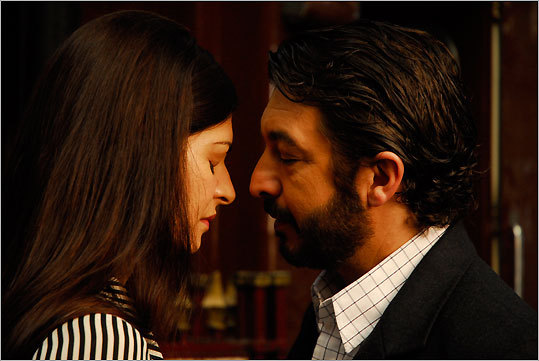
It begins as a blur: a writer is trying to begin his novel...and begins it many times: a hazy, blurred separation of lovers at a departing train; the last memory of a woman soothing an ailment with tea and lemon; a brutal rape. All facets of the story, but not one facet, above all. The author, Benjamin Esposito (Ricardo Darín) a former legal counselor in retirement, is trying to write a novelization of a case that he can't shake for the life of him: what he calls the Morales case—the sexual assault and murder of Liliana Coloto (Carla Quevedo), new bride of Ricardo Morales (Pablo Rago). It is a case that he got by default, but it haunts him: the way the girl appears crumpled at the crime scene, the devastation of the husband, the utter lack of clues—and that a rival counselor (Mariano Argento) has arrested and beaten a confession out of two construction workers who could not have been there at the time. Determined to find the real killer, if only to bring peace to Morales, Esposito breaks a few rules, goes by his own instinct on the slimmest of leads, consequently landing him in hot water with his immediate superior Irene Menedez-Hastings (Soledad Villamil) and her boss.
That he is holding an unspoken love for her is only part of the complicated story, a facet.
At one point in the story it is observed that you can change anything about a person...but you can't change their passion. And that's what The Secret in their Eyes is all about: passion. Passions that define us, and might undo us. For Esposito, passion is what drives him to write the story of this one case that led him to fear for his life and go into exile, the results of a deliberate miscarriage of justice that has nothing to do with passion, but only a cynical machination of wielding power to one's own ends. His return to discover, to begin the investigation again and see it through to its inevitable conclusion...in all facets...drives the film along its complicated time-line, to a satisfying resolution.
But, the journey, and what it says about people...and passion...will haunt you for days.




Thursday, January 21, 2010
Patton
 "Patton" (Franklin J. Schaffner, 1970) "Patton" was a different kind of war movie. Where most of the genre would concentrate on the cinematic battles, or use the war as a back-drop for soap-stories, "Patton" chose to take the more quixotic route of "Lawrence of Arabia" (or more appropriately, "The Desert Fox" about Patton's "player on the other side" in Africa, Erwin Rommel) by making a personal story about war and how it shapes the human being. The war is the most important story, of course. But the story of General George S. Patton, Jr. (played by George C. Scott, with all the eerie command he brought to every role, probably far more than the real Patton personified) is so intertwined with the war, as a mover and shaker of it, and his fortunes so changed by it (and not for the good) that even as it revels in the eccentricities of the man, it also shows how out of touch a professional warrior and student of conflict can be in this day and age.
"God, how I hate the twentieth century" is one of the laugh-lines of "Patton." But it's one of the truest lines of the script (by Fox scribe Edmund H. North and a very young Francis Ford Coppola). Patton, the soldier, was from another time (he thought so, literally), and his romantic notions of war and warriors made him an "odd duck" of the military, and a "lame duck" when it came to the political strategies inside an Army at war. He held disdain for bureaucratic warriors on both sides of the conflict (including "that paper-hanging son-of-a-bitch" in Berlin), the exceptions being his West Point classmate Eisenhower, and Rommel, who had opposing tank battle scenarios to Patton's own. The movie has the Germans studying Patton and his techniques, more approving of Patton than his fellow Allied Commanders.
 Scott's position as the centerpiece of the film is critical, but director Franklin J. Schaffner,* who apprenticed in live television and whose previous film was the better-than-it-deserved "Planet of the Apes," brought his customary expansiveness to the war. With a wide-screen process dubbed "Dimension 150,"** Schaffner created vistas of carnage and blazing battles of ferocity that took a dirtier, grimier and bloodier view of battlefield action than had been seen previously in the "clean-kill" war movies preceding it.
 Patton, the man, romanticized war, revelled in it, but the film bearing his name went further than most in de-glamourizing the traditional heroics of the less thoughtful war films, carefully explaining the strategies, viewing the battles dispassionately, almost like a chess-master reviewing the board, and in the after-math, taking stock of the scattered pieces. However planned a battle may be, it ends in chaos. Chaos and death. And in "Patton," you can almost smell the stench of a battle-field's carnage.
 Death is omnipresent in "Patton," with detailed shots of dead and wounded in the battlefilds, and the crude graveyards made in haste. Some of the eeriest parts of "Patton" take place in those moments, the cascading trumpets and marching jig of Jerry Goldsmith's score stilled to shimmering strings, and unresolved motifs.
 Schaffner used his locations well, taking a page from David Lean, cramming as much information into the frames as he could, or by presenting stark landscapes that seemed to go on forever, showing the regimentation of war, how vast numbers of human beings could crowd a frame, or how solitary individuals could be lost in a landscape, or for that matter, History. The scenarists and Schaffner choose to leave Patton alive, just days before having his neck broken in a jeep accident. They leave him contemplating the transience of Glory walking mythically (and quixotically) towards a solitary wind-mill.
 It is also about showmanship. A lot of actors turned down the role (some, like Rod Steiger, to their regret), but it was a tour de force for George C. Scott, who buried himself in the role, studying biographies, running films of the general over and over, doing an extensive make-up transformation—shaving his head to sport a Patton buzz-cut, matching the moles on Patton's face, and even having his teeth capped to make his smile more like the general's. There were some things he wouldn't do, like try to match Patton's voice—Scott felt simulating Patton's high-pitched voice would undercut some of his authority in the role.
The effect was extraordinary. Patton's kids, who were never too keen on the idea of the film, were amazed at Scott's appearance, and the role (which won Scott a Best Performance Oscar—which he famously refused) replaced the real-life General in the imaginations of the Nation, despite ample archival evidence.
Partially, it is the opening. Written by Francis Ford Coppola in an early draft of the script, it is a combination of several of Patton's inspirational addresses to his troops, performed—as if a stage performance—by a solo Scott before an out-sized American flag. It is this section of the script that most intrigued Scott, the stage actor, but also intimidated him. It was the last section filmed, and director Schaffner promised that it would be placed after the Intermission, as the actor—rightly—felt that the address would overpower the rest of the performance.
Schaffner, having a showman's instinct, reneged. And that speech, setting the tone and tenor of the performance that dominated the film, went immediately into pop iconography. It has been parodied and propagated for decades, a radical introduction to one of the more colorful players in the second World War. A thesis, a preamble, if you will, a first movement...but, more appropriately, a shot across the audience's bow.
** It was camera-maker Todd AO's challenge to Cinerama, and presented a viewing range, or scope, of 150. Only two movies were shot in "Dimension 150"—"The Bible" and "Patton." George C. Scott appeared in both of them.
Wednesday, September 30, 2009
Olde Review: Closely Watched Trains
This was part of a series of reviews of the ASUW Film series back in the '70's. Except for some punctuation, I haven't changed anything from the way it was presented, giving the snarky, clueless kid I was back in the '70's a break. Any stray thoughts and updates I've included with the inevitable asterisked post-scripts.
This Friday's films in 130 Kane Hall at 7:30pm are "Closely Watched Trains" and "Lacombe, Lucien." "Closely Watched Trains" aka "Ostre sledované vlaky" (Jirí Menzel, 1966) "Closely Watched Trains" is a wry, sometimes hysterical Czech film by Jiri Menzel, a person you've probably never heard of and have already forgotten.* It tells the story of Miloš Hrma, an insignificant young man in the scope of WWII, whose father was retired at 48 and now spends his day lying around and keeping track of the comings and goings of the train. Another relative was a hypnotist and a couple years back, he tried his skills on an advancing Nazi tanke-gruppe and was promptly crushed to a pulp (I am telling you this because there is no way in Hell that you'll be able to read the sub-titles in the opening minutes).** These are only two examples of Menzel's comedy-of-errors style of telling his story.
Menzel takes little incidents of the story of Miloš's work-a-day situation standing at the train platform—a job he wanted "just so he could strut on the platform." And his stories are sometimes hilariously satirical (for an example, there is an hysterical look at a town Nazi explaining the war situation and in a blase manner explaining that withdrawals from the American forces are such wonderful tactical maneuvers). Sometimes (most of the time), the stories are very ribald; one of the sub-plots is Miloš's constant failure with women, which, in context with the habits of a fellow platform-strutter, makes him turn to a suicide attempt in a dilapidated hotel. The hotel is being worked over by a fellow with a pile-driver. In this scene what is going to happen—how the two will intersect—is very apparent, but the sequence's effect is that it displaces the humor of the situation (which passed with the audience's first realization of what, inevitably, will happen) with suspense. Will it happen before Miloš is dead? It's an effective sequence because it anticipates viewer reaction and changes it to the further effect of the film.
In the last half-hour, Miloš is used like a pawn in a chess game in an attempt to head off a Nazi munitions train. It's outcome is consistent with the rest of the film, but there is no sense of real tragedy at the end, more an explosion of fulfillment. You may find "Closely Watched Trains" a very entertaining film.
Just a reminder (he said, slapping his forehead with his palm) I wrote this back in February 1977, and, although sorely tempted, I didn't change anything besides punctuation (and had to get fairly creative with that!). "Closely Watched Trains" won the Oscar for Best Foreign Film in 1968, and is one of three films I remember most fondly from the Winter ASUW series—the other two being "Hari-Kiri" and "Il Posto"—"Trains" probably because it's crack comic timing reminded me of my beloved Warner Brothers cartoons, with a dash (a mad dash!) of Buster Keaton thrown in for good measure. And the comedy came from character, not from out of the blue.
This review is more than thirty years old, but it's heartening—in fact, a bit miraculous—that Jiri Menzel is still making movies, his last being "I Served the King of England," which was also about young professionals learning their craft to uproarious results.
* This was near the end of the series and I was getting a bit punchy by this time, but that's no excuse for insulting the audience that one is trying to "encourage" to go see a film.
** As I recall they were "white-on-white" and virtually indecipherable. Criterion has put out the DVD of "Closely Watched Trains" and they're more scrupulous in their translations and making sure that they're legible. Criterion is a great DVD publisher.
Friday, December 26, 2008
La Vie en Rose (Prenez Deux)
 Sentimentality is a funny thing. The world over, people wept for France's "little sparrow" Edith Piaf and the brief life that was snuffed out too soon. That she was the instrument of her own demise made no difference. That she started out as a street urchin, singing for her drinks and drugs, was discovered and "cleaned up" for public consumption but never lost the grime of the street from her soul, went through love and loss, then disappeared into a fog of drugs that left her a shell of what she once was, didn't matter. Driven by ego and the need for acceptance—from an audience she now had contempt for—she continued to perform, collapsing on-stage frequently, and still had the temerity to sing, as her last signature piece, "I Have no Regrets."
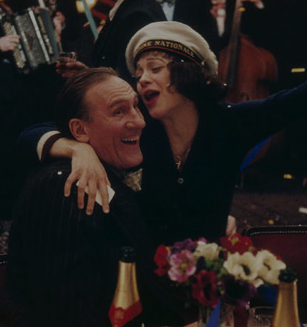


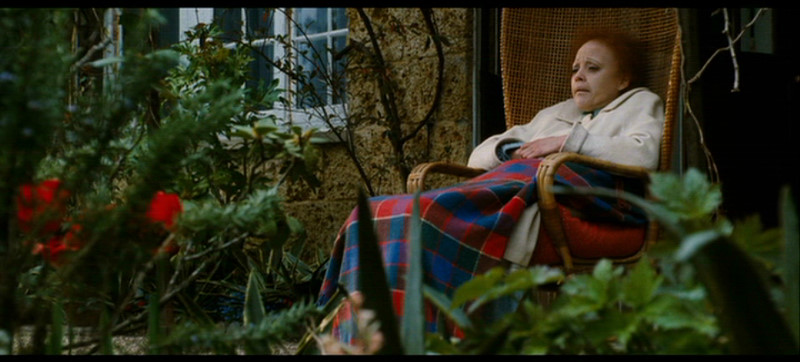


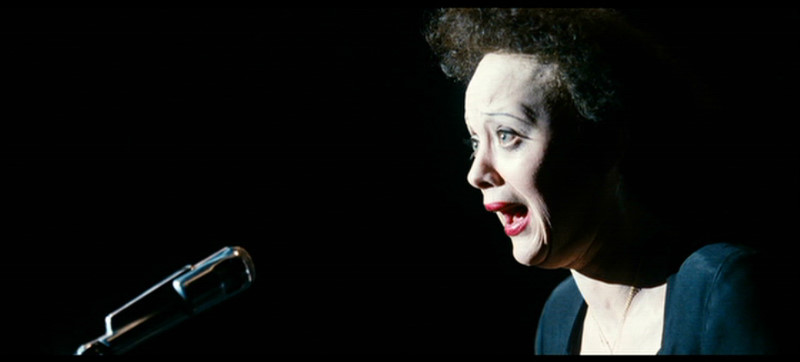
Swell. As I said, sentimentality is a funny thing. Watching Dahan's "La Môme," (or "La Vie en Rose" in this country) K muttered: "...France's Judy Garland." Yes, but I don't think Garland was so ferociously unempathetic. Piaf wore her street-toughness like armor and treated those who tried to manage her...with disdain. They must have really loved her to keep working for her, to the point of self-delusion, to the detriment of their own worth.
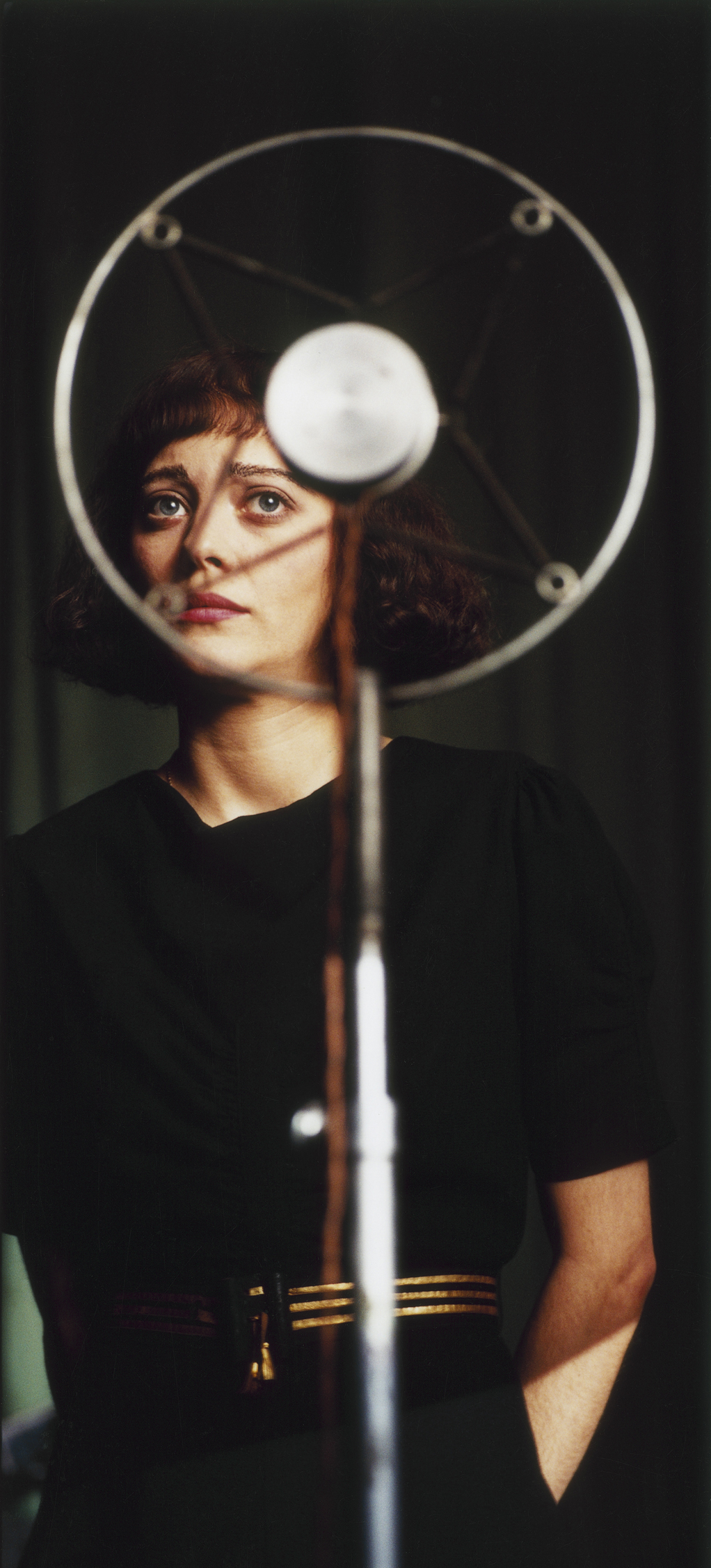


Not very sympathetic thoughts for a celebration of "the little sparrow." But, Dahan made a tough-minded film that still manages to eke out sympathy for its hard-bitten subject. And there are moments of visionary work: I'm thinking of the sequence of Piaf's formal "debut"—with new wardrobe, new presentation, new hand gestures and a hard-taught respect for a song's text—all done in fading montage and a burgeoning score. But Piaf is silent (a practical consideration, as there are no recordings of her during that period). It's a controversial, contrarian move, but all the more powerful because of it.


It showcases Piaf as presentation, and the point could not have been made more forcefully had a singing voice been dubbed in. A lot rides on Marion Cotillard's performance of that scene, and she is never less than stubbornly brilliant in the film, brushing away easy sympathy for the character, and conveying her power brutishly. The film also won an Oscar for its intricate make-up work, but Cotillard works far beyond its confines to convey the ravages that life, but mostly Piaf's stubbornness, heaped upon her shoulders.
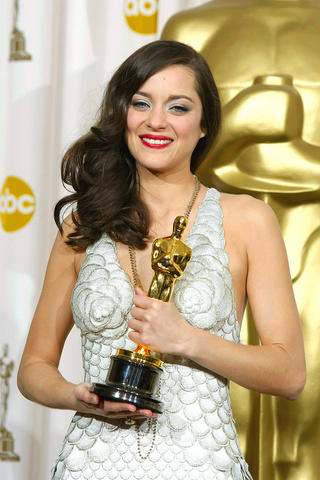

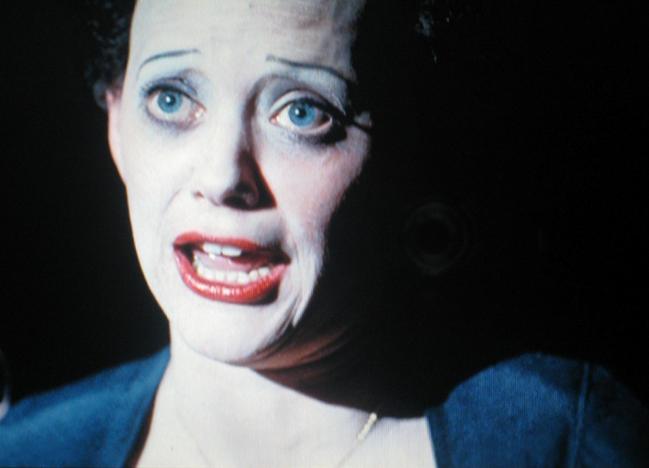
When Piaf died, I was in grade school and the teacher brought in her records to play for us what the world had lost. Most of us listened attentively, though not comprehending what this had to do with the price of tea in China (as if we cared about that, either!). But a bunch of the kids hid giggles behind hands and snorted at the quavering tones and incomprehensible language. As that old memory came bubbling up, I couldn't help thinking Piaf would be on the side of the urchins and not the sparrows.
C'est la vie.
Tuesday, September 23, 2008
Darling

 of a rags-to-riches story with a Chekhovian twist, it could be subtitled "Days of Cabiria," it's such an antithesis to Fellini's film about the travails of a "well-known night-bird." Diana Scott (Julie Christie, in her Oscar-winning performance) goes from vaguely dissatisfied London wife to jet-setting model/princess using a series of men as if they were rungs on the ladder. Dirk Bogarde plays a BBC journalist with whom she has her first affair that shatters her marriage ("Isn't it a shame that it's so hard to be happy?" she intones at one point) Then, when things start to get a bit perfunctory she becomes a plaything with a jaded playboy (Laurence Harvey, barely expressive). Soon, the sense of been there-done that completely eclipses her enjoyment of every current situation, and as she's completely incapable of being self-aware ("Is that really me?" she says in shock when a party-goer imitates her) that it's not simply a matter of imagining the grass in greener on the other side of the fence, so much as vaulting the fence and rolling in it for awhile.


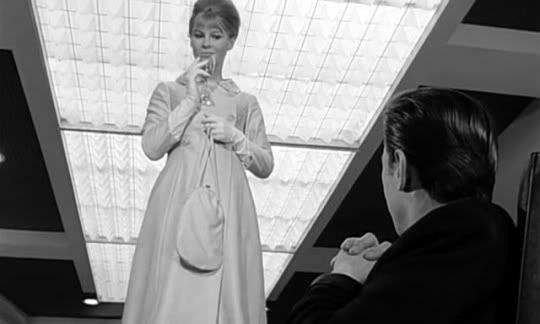

It brings to mind the story Richard Harris told on "The Tonight Show" of driving home in Ireland after an extended pub-crawl and falling asleep at a stop-light. He was awakened with a tap at his window, and the driver behind him asked quietly, but pointedly, "Exactly what shade of green are ye waitin' fer?"
"Darling" is an artifact of the 60's, and has not aged well, although one can see its spawn every day in the natter-columns. Schlesinger's direction is not nearly so mannered as he could be, and Frederick Raphael's screenplay is at its best when no one's talking. But it is interesting, at least, as a cultural bell-weather to see what Madame Bovary's "cup of tea" is "in this day and age."
Monday, August 25, 2008
Hamlet (1948)
 "Hamlet" (Laurence Olivier, 1948)
This is the story of a man who could not make up his mind" intones Laurence Olivier at the beginning of his Production of "Hamlet" (L.O. gets the opening card over Wm. Shakespeare).
Well, yes, that's an easy way to look at it. And while it's essentially true, it negates the fact that Hamlet is struggling with the moral implications of killing, especially since the object of all the daggers he's throwing out with his eyes is, himself, a murderer, traitor, and is sleeping with his mother.* Hamlet tries every trick in the book to expose the treachery, even takes a stab at killing him himself (with collateral damage**) Hamlet is wrestling with his conscience the whole way--while depressed, grieving--and with not good reason: his quest is based on the flimsiest of evidence--the word of a ghost. A ghost that even his Spock-like friend Horatio saw, to be sure (or not to be), but a ghost nonetheless. Such evidence would never stand up in the Court of Elsinore. The Dark Prince must also wrestle with the consequences of his actions--from his father he knows of the existence of Hell and the damnation murderous actions would lead to.
"Couldn't make up his mind." He wanted to slit the King's throat, not his own.
Every production of "Hamlet" must wrestle with the text *** that ballooned with many versions, asides, and blind alleys. Olivier stripped it bare: No Rosencrantz, no Guildenstern, no Fortinbras, no battle on the plain in Denmark and so, no "Let my thoughts be bloody" speech. Hamlet does not compare his plight with the futility of war, and in 1948, considering his "rally-the-troops" version of "Henry V," an anti-war statement must have seemed in bad taste, after surviving the blitzkrieg.
And just as every Hamlet must pick and choose what sections to explore, every actor playing Hamlet must contend with ghosts;**** not the play's, but the players of the past. Like baseball veterans chasing old records, each Hamlet is a reflection of the past, and a portent to other Princes. The current crop of actors taking on the role must have considered Olivier's take, or Richard Burton's, or Nicol Williamson's, just as Olivier must have thought about John's Gielgud and Barrymore. Olivier does take chances given the film medium. His "Frailty, the name is woman" speech is done in voice-over with some choice epithets that burst out of him on-set. That's a good choice for the scene, where Hamlet is in a public space following a celebration and could conceivably be overheard by some hanger's-on. He is much more verbal in his further monologues when he is thought to be crazy, or alone. The "To Be or Not To Be" speech is performed on a parapet overlooking the sea, with dagger in hand. It's a good concept to have the prince "on-edge" at that juncture.
The unique staging of that speech is one of those elements that absolutely separate the filmed Hamlets from each other.***** To me, there are three others: the presentation of the Ghost of the murdered Old Hamlet, the use of Polonius, and the approach to Ophelia. Here's how Olivier treats them.
The Ghost: Olivier wraps him in vapors of the real and optical variety, dressed in his battle armor, looking sepulchral, and emaciated, like a classic death figure, with a low-whispered voice--supplied by Olivier and played back slowly. Polonius: As played by Felix Aylmer, and directed by Olivier, Polonius is a comic figure, whose verbosity is played for laughs, and most treat him with a feigned patience, and wish he'd get to the point.
 Ophelia: As played by the 18-year old Jean Simmons, Ophelia is very much the traditional Ophelia as delicate flower. She goes crazy with the loss of Hamlet, the death of her father, and no Laertes to bolster her. She is an Ophelia too frail to stand on her own and crushed by the whirl of events, and her cracked sanity is portrayed by a far-away gaze and "fairy-princess" demeanor. How influenced she is by Hamlet's shifting moods is hard to say. But she is "ingenue-as-victim" in the Hollywood tradition.
The other thing I hear about Olivier's "Hamlet" is that it is somehow a "film noir" interpretation of the play. Except for some fine deep-focus black and white photography, I don't see it. No play of shadows--in fact, everyone is extremely well-lit. And the movie's very set-bound; nobody's walking down the "mean streets" of Elsinore.
Laurence Olivier's "Hamlet" won the Best Picture Oscar in 1948, with Olivier winning Best Performance by an Actor. He was the first person to ever direct himself to an Oscar-winning performance. Only one other actor has done it: Roberto Benigni.
* Gertrude. One of the interesting things to note about the various "Hamlet's" is the varying ages between mothers and sons. They're starting to get it right, but it wasn't always thus: In the 1990 Hamlet, Gertrude (Glenn Close) is only nine years older than Hamlet (Mel Gibson). In this one, Gertrude (Eileen Herlie) is fourteen years younger than Hamlet (Olivier)! I guess it's an improvement when your realize in the original stagings Gertrude was probably played by a man! And incidentally, Herlie also played Gertrude to Richard Burton's Hamlet--he was five years younger.
** I've always called "Polonius," the verbose father of Laertes and Ophelia, "Collateralous."
***Unless you're Kenneth Branagh, whose 1996 all-star "Hamlet" used the second Quatro version (1604) (with additions from the First Folio version), clocked in at 4 hrs., 2 mins., was filmed in 70mm, with 6 track Dolby sound, but at least had Rosencrantz, Guildensterm, Fortinbras, the "Let my thoughts be bloody" speech, and had a Gertrude who could have conceivably (heh) been Hamlet's mother!
**** There are other ghosts at Elsinore if one is to believe Olivier's camera-work. Elsinore is an enclosed castle with labyrinthine corridors and vast open emoting spaces. Between acts, we flit down corridors and up spiraling staircases as if the audition is, itself, an apparition, seeing everything in turn with an omniscient view-point. And in a reversal of stage tradition, we go to the actors, rather than them coming to us.
***** Most actors address the audience on-stage. Mel Gibson's Hamlet performs it in a burial catacombs, Kenneth Branagh, while looking in a mirror, and Ethan Hawke, at the video store.


Tuesday, May 13, 2008
Boys Don't Cry
 Boys Don't Cry, (Peirce, 1999) Teena Brandon is trouble in trouble and so is Brandon Teena. From what we can piece together about her life growing up as a girl with a sexual identity crisis and what we see on-screen of his brief time living out his dream to be accepted as a man, there are elements of character that cannot be escaped or maybe do not change, whichever gender we are. Boys Don't Cry is a tragedy.
Whether we know the real story or not, the farther you travel into the movie, the more certain you are that there is never going to be an escape. Brandon (Hilary Swank) cannot escape the prison of his body, Lana (Chloe Sevigny) cannot escape the confines of Falls City, the small mining town to which Brandon flees the 'big city' of Lincoln, Nebraska. John (Peter Saarsgard) cannot escape his sociopathic rage when his world is threatened by the arrival of Brandon.
Peirce often shows us the bare, flat Nebraskan landscape as cars race by, their headlights merging into a solid line of motion. Is it a contrast to the lives of these people who aren't going anywhere - even when they talk of Graceland and Memphis and Tennessee? Instead, they drink to get out of their heads as they lie to themselves trying to make their world a better place. Which it never is.
It's a sad and at times brutal movie that is moving without trying to be too profound about its subject matter. It is almost a love story. Almost.
Boys Don't Cry is available on DVD from 20th Century Fox.
Friday, March 21, 2008
Elizabeth - The Golden Age

In Elizabeth - The Golden Age (I guess they realized they couldn't call it Elizabeth II), there was plenty of scope to explore this tension. Elizabeth is monarch of a divided country. She is the Virgin Queen, admired, we are told in the history books for her devotion to her country but under pressure too to marry, not just to produce an heir but also to make an alliance that will help protect England from its adversaries. This is the time of the Spanish Armada, a time when England was under threat from the most powerful country in Europe, when England was isolated and under the threat of invasion. Much like it would be 250 years later and again 400 years later. A time of conflict between two versions of the same religious faith with one determined to destroy the apostates because they have God on their side. Within the country, there are many who would support her overthrow. Well, you get the picture - there are plenty of themes here that would resonate with a modern audience.
But this Elizabeth is Good Queen Bess - Bette-Davis style. Though we see a little of her crisis of conscience over the death sentence for Mary Stuart, we see far more swash-buckling CGI as the filmmaker rewrites history for the convenience of the movie pitching Sir Walter Raleigh into the heat of the battle like an earlier Captain Jack Sparrow even though he actually spent the entire time firmly on dry land. Such distortions are to be expected and don't really interfere with the purpose of such a movie (this is not a History Channel documentary after all) but they are also symptomatic of why this movie was so disappointing.
It is as glossy and vibrant as its predecessor though it is a little disconcerting to see how clean this Elizabethan Age was. It was almost bearable to have the characters speak a strange mixture of modern English with a few archaisms thrown in for effect but in the end the movie was too over-blown and empty.
Where there could have been interesting contrasts between her public face and her private needs, between her sense of duty and her need for control, the movie sets up situation after situation and then shies away from them, preferring instead to go to the next great wide shot. Clive Owen starts out playing the foil to Elizabeth - theirs is not only a sexual but also an intellectual game they are playing with each other and he is willing to take great risks not just to advance his plans to open up the New World but also to entertain the thought of a relationship with her. Yet, the movie just meanders. It is not just that he becomes dull as she tells him, it is the movie. He dutifully straps on his high leather boots, dons his pirate shirt and does his best Erroll Flynn impersonation. Thank goodness, Samantha Morton is there to play Mary Stuart. Geoffrey Rush seems completely wasted as Walsingham and by the end, Cate looks like she can't wait to get back to playing real people like Jude Quinn.
Saturday, March 15, 2008
Black Orpheus
.jpg)
It has been called a masterpiece and won, among other awards, an Oscar for Best Foreign Language Movie, so Black Orpheus has been on the Netflix queue as one of those films that you think you should get around to seeing. This week it eventually found its way to the top of the list. To begin with, it was somewhat hard going. The opening felt a little too much like a cheesy travelogue about Rio at Carnaval time. Like Carmen Jones another adaptation of an older, well-known story, it did not seem to have aged all that well. Yet, the more I watched it, the more it grew on me.
Orfeu Negro, (to give it its orginal title), is a re-telling of the Greek myth told over a three-day span around the time of the Carnaval in Rio de Janeiro. The players in this version are drawn from the favelas of Rio and the treatment of their lives is bucolically unreal. Thought they clearly live an impoverished life, all that is seemingly important is the Carnaval and all that it represents: abandonment to enjoyment. Early on, one of the characters gleefully recounts that she has no money for food because she has spent it all on her costume. Here is one of the paradoxes of the movie. In its Technicolor splendor, it portrays the colorful excess of the Carnaval with gaily dressed partygoers who seem to have nothing more on their mind than to let their feet dance them around the city for hours. Yet, it is clear that these people's lives are wretched. Their homes are sparsely furnished and flimsily constructed. Carnaval is important to them because it is the one day they can forget how drab and unattractive their lives usually are. Farther into the movie, things are not quite so idyllic as they appear at first, as we begin to notice the presence of the police and the army. Scenes of revelry are punctuated by moments of crowd control that include baton charges and the use of motor vehicles bulldozing their way through the party throngs. Toward the end of the movie, we witness the rounding up of what we assume to be prostitutes and their clients. so, what are we watching - a stylized rendition of a love story set in a fairy-tale land or a transfer of a myth to a modern context? Is the Death figure only a mythological character or is he a real-life serial killer?
The movie gains some shape and pace in the last 20 minutes, as it began to follow the arc of the Orpheus legend more closely. It became more atmospheric and dramatic and you may finally start to care a little more about the characters. One piece of advice, though. If you watch this on DVD, go for the sub-titles over the dubbed dialog. Whoever the voice talent was, and they were not working with the greatest of translations to begin with, they were clearly in a world of their own.
Friday, February 29, 2008
La Môme

Which translates as ‘The Kid’ . However, on release in the USA, it was re-titled La Vie en Rose, which roughly translates as ‘the world through rose-colored glasses’, though there is little of Edith Piaf’s life that would fit that description, and the movie doesn’t pull many punches in sugar-coating things. I hadn’t seen this movie before it won its pair of Oscars but there it was at the video store so we thought we would give it a try. Friday night, neither of us feeling at our best, rain coming down outside and nothing much else to do than give the cat some medicine. What could be better? - a biography of a French singer who died young after a lifetime of abuse but who is still revered in her native country though I suspect less well-known over this side of the pond. I had grown up with the sound of her voice as part of my soundtrack of France along with General de Gaulle and Jane Birkin. The treat of the movie was indeed the songs themselves - often using Piaf’s own voice, and it was not hard to see why the Academy liked Marion Cotillard’s performance so much.
However, as a movie, it was no great shakes. It followed the path (or should I say walked the line) of many a biopic of the tortured artist without adding anything much to the genre. The decision to use a non-linear approach to the time line of her life did not seem to have much point to it (other than maybe to obscure some of the less salutary aspects of her life that might detract from this hagiography) and about the only memorable scene for me was one in which Piaf having received news of the death of the love of her life stumbles in her grief through her apartment to emerge through a doorway back on stage again, emphasizing how much her life was played out in public as well as in private.
Monday, February 4, 2008
All the King's Men (1948)
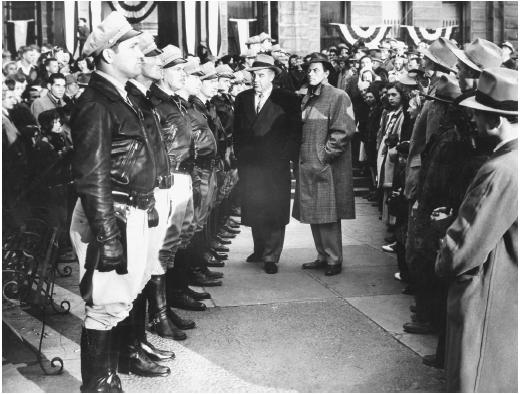
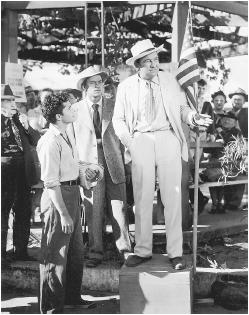
 The Oscar-winner for Best Picture of 1949 and it's hard to argue. Rossen's adaptation of Robert Penn Warren's Pulitzer Prize-winning novel about the corrupting powers of politics, it boasts two powerful (and Oscar-winning)performances: Broderick Crawford as innocent-turned-player Willie Stark and Mercedes McCambridge as his cynical-to-the-marrow political assistant. McCambridge is so good and so inventive that she might just as well have been given the statue for the next five years. Would that the other performances have been as electric as these two, but one could say that they shine even more brightly next to the lesser lights. It's particularly interesting to see Crawford so restrained at the beginning of the film, but once he sees how the game is played he turns on the after-burners and soars over everybody else in the frame with him. Mention should be made of the ocassional glimpses of a documentary style in the rally scenes amid the more traditionally blocked studio framing. And the film may seem a bit abrupt in places--but that's because Rossen, determined to get the film below two hours, gave his editor instructions to take most of the scenes and cut precisely thirty seconds from the front of it and thirty seconds from the back (making sure not to clip off any dialog). What was left was the hard nugget of the scene's core and "All the King's Men" feels more brutal in its pace and attitude because of this uncompromising strategy.
Sunday, February 3, 2008
The Last King of Scotland
 for "The Queen," and the two leading actors of his screenplays won both Best Performance Awards: Helen Mirren for "The Queen," and Forrest Whitaker for this film. They both had great material to work with. Morgan's talents for breathing life and personality into history (catch his HBO film, "Longford," while you're at it) puts to shame the recent spate of "highlights-biographies" ("Ali," "Nixon," "Man on the Moon," "Chaplin," "Ray") that are like filmed Cliff Notes. And Whittaker is amazing in the film ("How'd they get him?" K. asked when he was first on screen. No, it's Forrest Whittaker), projecting the half-baked soul of Idi Amin Dada. It's a Supporting-sized role, but so large does Whittaker's portrayal loom over the movie that he dwarfs everyone else, even James McAvoy's starring performance as cocky Scotts physician Nicholas Garrigan, who goes looking for some selfish adventures and winds up being The Devil's Internist in Uganda. And what starts as lucky breaks for a kid out of medical school turns into a nightmare of bad choices as the wildly paranoid Amin sinks deeper into madness, torturing first his enemies, and then those in his circle of confidence. In a country run by a lunatic, its a short trip from adviser to being strung up from a meat-hook (lest you think, "Last King..." is as genteel as "The Queen," think again, the violence is bloody, and the torture is dwelled upon).
 The director is Kevin Macdonald, a former documentarian, and he seems to have a problem with pace. "Last King" feels drawn out, and in need of additional editing (as did his previous film, the interminable "Touching the Void," which managed to make an incredible story something of a drag). But the sense of place and time feels genuine--you might not believe afterwards that the story is actually fictitious.
Monday, January 14, 2008
To Kill a Mockingbird
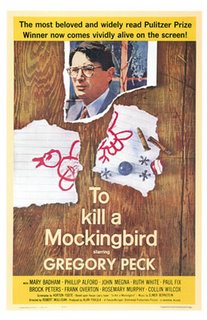 What is it about this film that puts it on so many favorites lists. Horton Foote’s masterful telescoping of Harper Lee’s frail, powerful novel? The fact that, as movie adaptations go, this is certainly one of the best? That it has an impeccably picked cast, directed to feel absolutely real, including three of the best child-performances in all of movies, by one of the best directors of actors, Robert Mulligan? The beautiful, fragile score by Elmer Bernstein, certainly contributes.
I remember seeing “To Kill A Mockingbird” when I was seven years old, and not “getting it” much. I remember being annoyed with my Mom for trying to cover my eyes during the “scary” parts—although Robert Duvall as “Boo” Radley did genuinely creep me out back then (in fact, he still does, a bit). I didn’t “get” the dog-shooting (“He won’t kill a mockingbird, but he’ll sure-as-shootin' kill a dog!”) But I remember that it was a scary movie for a kid. In the film, the night was so dark, and any light cast spooky elongated shadows and trees moved and leaves rustled. The World seemed restless and alive when it should have been still and asleep. It was a world that, under the pretense of peace and calm, seethed with menace and dread just under the surface.
And that’s the key, I think. There seemed to be, in the movie, at least, a sense that the tremulous world was lurching and struggling to change—that the very earth was metamorphosing and demanding it, while the people entwined in that world, moved along, oblivious to the change, holding onto a complacent life that would inevitably end. At the same time, “Mockingbird” has the feel of nostalgia—the palpable sense that life flows through our fingers like sand, and that we’re always in danger of losing that life we hold precious.
But you don’t think of these things when you’re a child. Summers are endless. Life is eternal. If born into a nurturing, protecting household (and that is key) there is the illusion that the world is benign and all things are possible…under heaven.
Heaven is a concept easily grasped by a child. If you’ve been “good” in your life, as a reward after death, you go to a “good” place to spend Eternity. In the years of growth, a child struggles to understand its world and to assert itself in an environment it has no control over. In a world too complex to understand, the concept of Heaven is a comfort to a child. It’s simple. It’s uncomplicated. It’s black and white. Like Good and Bad.
Like integrity.
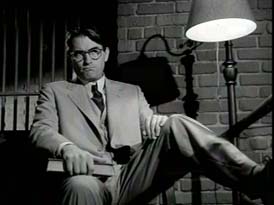
Atticus Finch (Gregory Peck) awaits a lynch-mob, that to his initial dismay and then wonder is shamed and turned away by his own children
The children in “To Kill a Mockingbird” learn the world isn’t nearly as simple as they thought. That the Radley “kid” may not be the evil thing they whisper about in the dark before they go to sleep. That other peoples’ lives may not resemble their own. That their father is many things—but he is also fallible. Jem breaks down when Tom Robinson is convicted of raping a white woman, but I would doubt that he’s crying for Robinson. He’s crying for his father’s failure—a disappointment as palpable as his father being not willing to play football for the Methodists. Jem and Scout are too young to understand the idea of integrity. No, that's not quite accurate. They’re too young to understand the pressures of a world where integrity might be compromised. And they’re too young to understand that their father’s belief in right and good could actually cause them harm. But it is that integrity that makes their father dependable, despite the tragedies of the summer. It is that integrity in a fragile, changing world that will sustain and endure and remain a constant as sure as the north star in the void. And that echoes long in our minds at the end of the film with its last line of narration: “He would be in Jem’s room all night. An he would be there when Jem waked up in the morning.”
When the American Film Institute held a vote for the cinema’s best hero, the honor did not go to the Sergent Yorks or the Skywalkers or the Bonds or any of the roles played by Eastwood, Willis or Schwarzenegger. It went to a character of gentle heroics who in the course of the movie only fires one shot, who does not raise a hand in anger, and with jaw set and quiet voice does what he knows to be right. It was a shock that Atticus Finch would be voted the greatest movie hero, but it was the best choice possible, and legitimized the idea of holding such a silly poll in the first place.
Stephen Frankfurt's evocative title sequence.
Music by Elmer Bernstein
Anytime Movies are movies I can watch anytime, anywhere. If I see a second of it, I can identify it. If it shows up on television, my attention is focused on it until the conclusion. Sometimes it's the direction, sometimes it's the writing, sometimes it's the acting, sometimes it's just the idea behind it, but these are the movies I can watch again and again and never tire of them. There are ten. This is Number 9.
2. Citizen Kane
3. Once Upon a Time in the West
4. -Only Angels Have Wings
5. The Searchers
6. Mr. Smith Goes to Washington
7. Chinatown
8. American Graffiti
9. To Kill a Mockingbird
10. Goldfinger
The Departed
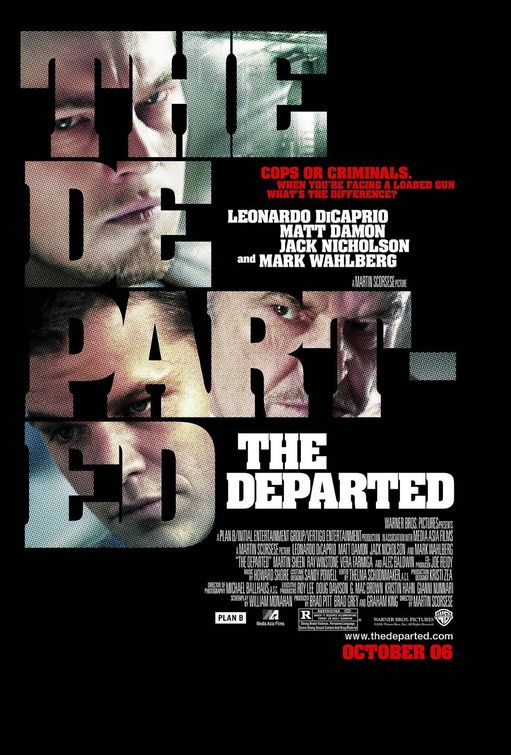 Institutionalized Ball-Busting
Call it the Scorsese Thesis: First a guy tells you what he's gonna tell ya, then Marty shows ya, then you're on your own.
In the case of "The Departed" "the Guy" is Jack Nicholson's Frank Costello, a seedy Boston crime-lord from "some years ago." "I don't want to be a product of my environment," says the shadowy Frank (Scorsese's way of showing Frank as a younger man). "I want my environment to be a product of me."
Nicholson's Costello makes good on that promise on two fronts--in the scenario of "The Departed," and the movie, itself. Costello's control over his Boston turf (or, using the accent Martin Sheen employs here, "too-urf")is so absolute, his reach extends from his surly band of criminals to the police department, culminating in one of his own crew (Matt Damon) infiltrating the very task force investigating his activities. Simultaneously, the player on the other side, Captain Queenan (Sheen) has trolled the new recruits to find his own mole (Leonardo deCaprio) to infiltrate Costello's crew. It turns into a complicated Spy Vs. Spy with both moles straddling the moral fence, while completely unsure of their footing on either side. And while trying to rat out their suspected counter-part while not drawing attention to their own treacheries. They're mutually duplicitous. As Costello says in the Thesis: "When I was growing up, they would say you could become cops or criminals. But what I'm saying is this. When you're facing a loaded gun, what's the difference?"
It's a complicated game of Jack's Straws...set in a house of mirrors. Drop Nicholson's weight into the middle of it, and the whole thing threatens to pancake...much like the movie. This first colaboration with Scorsese is similar to Marlon Brando's eccentric performance in "The Missouri Breaks," where an actor so drapes himself in business that he attracts the eye in the same way as a car-wreck--you wonder what in Hell this crime-clown (it is much like Nicholson's Joker in "Batman" without the make-up)is going to do next. Damon and DeCaprio were not clued into his on-set antics and so their scenes are played with the right touch of paranoid hesitancy. There's a strained wariness behind their eyes and they've rarely been better.
As good as they are (and excessive as Nicholson is) best among the cast is Alec Baldwin as a fast-talking divison head, but the real revelation here is Mark Wahlberg. Marky-Mark walks away with the picture and dominates every scene he is in, no matter who's in it with him. In fact, in the one scene Baldwin and Wahlberg share, Scorsese throws in a couple of "Raging Bull" camera moves for a verbal feint and parry between the two. It's a director's nod to two extraordinary actors doing solid work, free of gimmicks.
As for Scorsese, if you're looking for a return to his greatest efforts, this isn't it. It makes you wonder what he's up to. This story is nothing new, and is in fact based on a Chinese film (and its two sequels, actually) that owes more to the early personal style that he fails to deliver on here. What's the fascination? We've seen the cop/criminal discotomy, as well as the conflicts of working undercover in better films. He's doing program work, not personal work. This isn't "Raging Bull" or "Mean Streets" or "KunDun" or "Goodfellas." This is "Alice Doesn't Live Here Anymore." Or "New York New York." Or "The Aviator." One senses he's pacing himself, keeping his hand in the game doing agency "package" movies until the next inspiration comes along. Perhaps he should ditch DeCaprio, and find that last, good DeNiro project. He's too good a film-maker to waste on remakes and empty biographies. Maybe after the struggles he went through to bring his last personal project to the screen he's asking himself at this point in his career "What's the difference?"
"The Departed" is a Rental-You gotta problem wid 'at?