Saturday, July 6, 2013
I Never Sang for My Father
It's a simple equation: kids want their lives, and parents want their lives back.
Gene Garrison (Hackman) is an author/college professor who's the chief care-taker/"baby-sitter" for his elderly parents, who have just returned to upstate New York from their winter home in Florida. Mom's frail, as is dad (Douglas), but he won't admit it.
Gilbert Cates produced the play on Broadway (where it starred Hal Holbrook, Alan Webb, Teresa Wright and Lillian Gish), and directed it (such as he did) for film. It's not great work, hand-held, close-up stuff that basically gets out of the way of the actors, with a bit too much transitory busy-ness—there's a lot of walking out of rooms as if that's going to stop a conversation, but it doesn't. Cates went on to a career of directing mostly TV movies, but became most famous for producing the annual Oscar telecasts.
One hesitates to come down too hard on I Never Sang... because the issues are familiar if limited to the personalities involved and the selfish motivations of such, but the acting, especially by Douglas, Hackman and Parsons is note-perfect and feels real.
It's just that the film is dully presented, and looks like an after-school special for those going through a mid-life crisis, and it ends, never resolving the issues or presenting any ideas or insights. To do that would involve compromise and none of the characters are willing to, while the movie itself does so at every stage.
Gene Hackman has retired from films and acting, but it would be nice if he would grace audiences with his take on the Douglas role, just to see what he would do with it.
It is interesting to note that the "Death ends a life" monologue from the play/film is considered one of the most "overdone audition monologues" in theater.
Tuesday, April 3, 2012
Hi, Mom!
Hi, Mom! (Brian De Palma, 1970) Second full-length film (although it seems more a comedy pastiche in final form, like the Zucker Brothers were making at the time) that De Palma and his producing buddy Charles Hirsch cooked up as a sequel of sorts to Greetings (retaining Robert De Niro and his "character" John Rubin), while having absolutely nothing to do with the first film. Ostensibly about a young film-maker who wants to make "peep-show art" out of filming the real lives of his neighbors in the co-op across the street—shades (opened, naturally) of Rear Window—it meanders into Rubin's plotting a relationship with one of his subjects (Jennifer Salt), while at the same time becoming involved in an experimental theater group, staging a radical audience participation vehicle called "Be Black, Baby!"
Mean-spirited (but in a smart way), with that stagey kind of improv quality to it that only works 40% of the time, it feels like De Palma taking off the gloves, cracking his knuckles and using his camera like a fist against complacency. It also has that bi-partisan cynicism to it that's very refreshing—for instance, "Be Black, Baby!" is shown being presented (in grainy black and white on a rounded edge square screen) over a parody of NET,* now called NIT—National Intellectual Television. It's a chortling, vicious piece of satire done in multi-parts (with the Rubin segments interrupting and becoming more and more inconsequential, the "peep-art-show" concept having long been abandoned**), starting with citizens being accosted on the street about their failure to know what it means "to be black in America," then more segments that are less cinema verite, but have a good improv feel, and then the actual presentation of the play in which privileged whites are challenged, force-fed "soul" food, beaten, robbed and arrested (with one attempted rape thrown in for good measure), before being released to the outside world again—"Hope you enjoyed the show!"—at which point, they're interviewed about their experience (the best line in the whole thing is "Clive Barnes was right!"). In one swell foop, art, pretentiousness, and "touchy-feely" moccassin-walking are given the mau-mau, and come up wanting.
It's "bad-kid movie-making" with a smart-alecky breeziness ("Hi, Mom!") that beats any number of elaborately formal set-pieces that De Palma has subsequently staged. One misses this "turk" De Palma***—the one that would do things that upset audiences, and sit back, cigar in his teeth, saying "Wait'll you see the next one!" Maybe it's not De Palma's fault. Maybe we've just become insensitive enough that nothing he can produce shocks us anymore.
If that's true, imagine how miserable Hitchcock would be.
* The percursor to PBS.
** The best segment in the Rubin sandwiching sequences is one where he meticulously plans a seduction of Betty Shaefer—Salt's character—in order for him to film it—yes, a sick idea, but quaint in these days. But, things go awry when he arrives at the apartment and she tries to pull him into bed immediately, while he does his best to keep anything from happening, a lovely little turn on sexual roles, expectations, and how much power a director "actually" has. De Niro does his best work here, hemming and hawing and making excuses, constantly glancing at his watch and re-buttoning every shirt-button she's unbuttoned, and trying to use any of his by-now useless preparations in order to delay, delay, delay (you might say "the worst laid plans")
*** And he might, too. In an interview, the director has said that the "Be Black, Baby" segments of Hi, Mom! are the best thing he's ever done. Sad to think that, after all his successes, the elder De Palma looks back and sees this edgy, slap-dash sequence as the epitome of his career. But...if one is dissatisfied with one is doing, with all the compromises and concessions to getting a picture made and marketed, it's easy to look back on the brash days and say "That's when I had the freedom to do anything I wanted!" After the bludgeoning De Palma's films of The Bonfire of the Vanities and Redacted took, one can see that a bit more clearly. He could make that kind of film today. But, the market...and the critical elite...will bash it down.
Wednesday, December 7, 2011
Tora! Tora! Tora!
Tora! Tora! Tora! aka (トラ・トラ・トラ!)(Kinji Fukasaku/Toshio Masuda/Richard Fleischer, 1970) "The American Pacific Fleet was attacked and partially destroyed by Japan on . . . Sunday Morning December 7, 1941. This attack led to the entering of the United States into World War II. All of the events and characters depicted are true to historical fact." 20th Century Fox's former studio head Darryl F. Zanuck had served in the second World War, and spent his senior years at 20th by the overseeing of large movies showcasing major battles of that war, his most prominent being The Longest Day, based on Cornelius Ryan's book documenting the Normandy Invasion. But, in 1966 plans were put in place to make an historically accurate film about the Pearl Harbor attack, based on Ladislas Farago's "The Broken Seal." Ambitious in its scope, the film would be made with both Japanese and American crews, and for a great deal of the pre-production the man in charge of the Japanese unit was director Akira Kurosawa. Kurosawa agreed to the film, thinking that David Lean was making the American section, but when he discovered it was, instead, Richard Fleischer, the Japanese master bent some rules in order to allow himself to be "fired" from the film. He was replaced by two directors known to be as efficient and workmanlike at bringing films in on-time and under-budget as Fleischer. The intention was not to make great art, but to make an historically accurate film, devoid of trumped-up drama (From Here to Eternity had done that already) and stick to the main subject of the planning and execution of the attack.
The result, although accurate, is rather flat. Fleischer's American scenes seem drab and stale and, peopled with character actors like Jason Robards, E.G. Marshall, Joseph Cotten and Martin Balsam, lacking in star power.* The Japanese sequences, perhaps because they have less of an American film studio-feel, seem to have more verve and energy...and better performances. The movie seems to reflect the situation of the real life events: the Japanese have all the bright ideas, while the Americans have the lethargy associated with "a sleeping giant."** Still, the battle sequences and attack footage is extraordinarily well done, a combination of L.B. Abbott's and A.D. Flowers' model work and the Fox Studio's sometimes hair-raising practical effects crews and stuntmen.
I attended the premiere of Tora! Tora! Tora! with my family at a special showing at the old Paramount theater in Seattle. It was a special preview for the local chapter of the Pearl Harbor Survivors local chapter, of which my father, John Wilson, late of the U.S.S. Missouri, was a member. The only story my Father ever told of the war was the events of December 7th, when he was waiting on the dock of the U.S.S. Arizona to attend on-board church services with his friend, Howie Whims, who, for whatever reason, was late. Were it not for his buddy's tardiness, my Father would have been onboard the doomed Arizona at the time of the attack, and likely might have joined the ranks of the sailors who are still entombed there.***
It was an odd thing sitting in that audience with that audience. 29 year previously, they had witnessed the true horrific events of what was being fictionalized on screen. The mistakes made (by both sides) that made the devastation so complete was laid out for all to see. But, however good the effects and pyrotechnics, they couldn't recreate the carnage of that day: the deafening noise, the stench of burning oil that enveloped Pearl for weeks, the bodies, the desperation. The sight of good friends and comrades-in-arms caught in the gears of the attack and lost forever.****
The retired sailors sat stonily, watching the film—no doubt poor competition for the memories unreeling in their own heads and hearts and souls. There was a smattering of applause when a Japanese zero was shot down, but it was unenthusiastic, hardly celebratory. For them, it was a film about—and I say this hopefully—the worst day of their life. However artfully done, however accurately portrayed, who would want to sit through that? As Sam Fuller succinctly put it in The Big Red One, "Surviving is the only glory in war." I hope, on that day, they could appreciate their own glory.
* Actually, it's not a bad strategy. Less attention is paid to the actors on-screen to the advantage of the story. Films such as Zanuck's The Longest Day or A Bridge Too Far become parlor games after awhile ("Look! There's Sal Mineo and Richard Beymer! Isn't Gene Hackman in this movie?")
** That's taken from the thing the movie is most famous for—Yamamoto's assessment of the attack ("I fear all we have done is to awaken a sleeping giant and fill him with a terrible resolve"). Even Michael Bay's Pearl Harbor used it. It's a good line, making the Imperial General seem both presecient and tragic. Unfortunately, it appears that, historically, Yamamoto never actually said it.
*** It's one of the reasons I have no patience with Michael Bay's post-Titanic disaster, Pearl Harbor: there is one shot, meticulously recreated, following the path of the most damaging bomb that struck the ship—one of those CGI-sailors scrambling for cover below could likely be my Father, and it irks me that Bay's sensibilities had more gung-ho enthusiasm for the bombs than for the victims.
**** Those sailors' names are etched in stone at the Pearl Harbor Memorial, which is constructed over the still capsized hulk of the Arizona, which still burbles oil to the surface to this day. But, there's another section, a more recent section, with fresher names cut into the rectangular portal that leads under the surface to the Arizona. It's for survivors of the attack, who after living through the war, living a full life with wives and families, still chose as their final resting place the ship in the Harbor where they lost so many friends. I never fully understood "survivor's guilt" until I saw that.
Wednesday, March 9, 2011
Ryan's Daughter

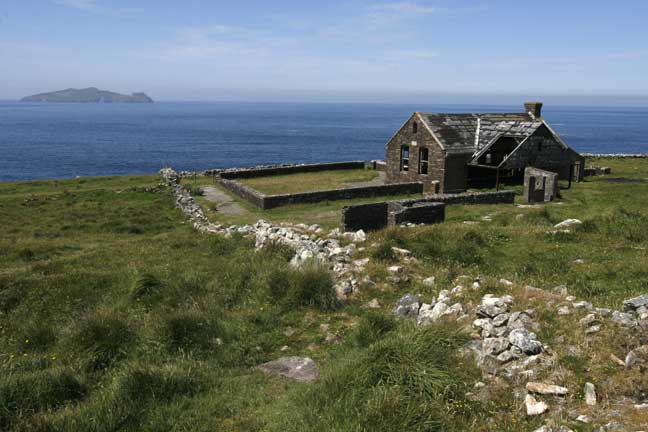
Ryan's Daughter (David Lean, 1970) This is director David Lean's supposed "big flop," although, now, given a few decades of perspective (40 years?), Time can be seen to be quite kind to it, revealing it to be solid as a film, and as film-making, unburdened by the need to survive in the capricious tastes of film-critics during the "youth-culture" cusp of the 1970's. While so many of the films that were sending the filmophiliacs into paroxysms of tortured metaphor have crumbled into the dust of pretentiousness, this one still stands up as a story well told...even if the story might be a little frayed and dog-eared.
One can quibble. Yes, it's elephantine in a way that a small-scale story shouldn't be (it's more than 3 hours, time enough for an epic, or at least a couple more infidelity stories thrown in!) and the huge landscapes that Lean favors tend to dwarf the participants of the tiny Irish town of Kirarry (not to mention there's a LOT of people in the crowd scenes...where do they all LIVE!). But, the only serious charge is that Lean is merely being Lean (as in being himself, as opposed to the inelegantly penny-pinching film-making of its era—he spent a year making it "just-so," due to the ever-changing coastal climate of the location, and another year editing and fine-tuning it). Lean may not have been a versatile director, altering his technique for every film (nor does a leopard change its spots...because it's a gall-durned leopard and doesn't have to) but he certainly achieves the maximum in every shot...and one is never confused or questioning what is going on. For all the big vistas, there's a lot of small nuance going on, that merely represents good story-telling.
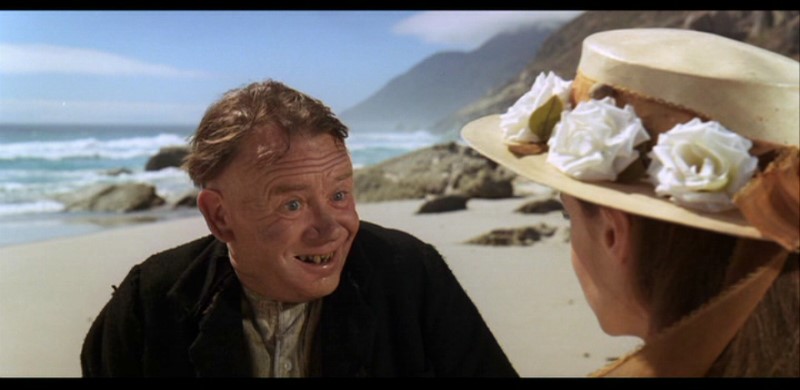
Sure, there are things that grate: Maurice Jarre's egregiously "mickey-mousing" score, or maybe a couple of scenes are pushed a little hard—the post-traumatic stress incident that erupts from John Mills' "village idiot" swinging his leg against the wall, the venality of the town's citizenry—but, one can see why Lean did what he did, and the drama benefited, ultimately, from such touches.
It started out as an adaptation of Flaubert's "Madame Bovary" by screenwriter Robert Bolt. By this time, Bolt and Lean had a working relationship as tight as Powell and Pressburger ("The Archers") did. Lean told the writer he was not interested, even if it was written for his wife, Sarah Miles. Lean had higher ambitions for his films now. Like Lawrence of Arabia and Doctor Zhivago, he wanted the problems of his figures in a landscape to have political overtones, rather than just the caprices of their natures. And with present day tensions in Belfast between British Army forces and the IRA in the headlines, locales were switched, accommodations made, and, one feminist nice concession, the female adulterer didn't have to pay the ultimate price for her crimes of indiscretion. Oh. She pays...(things hadn't advanced that far!), but it's the male (a cute, but out-of-his-depth, Christopher Jones) who sacrifices himself...in the guise of destroying evidence.
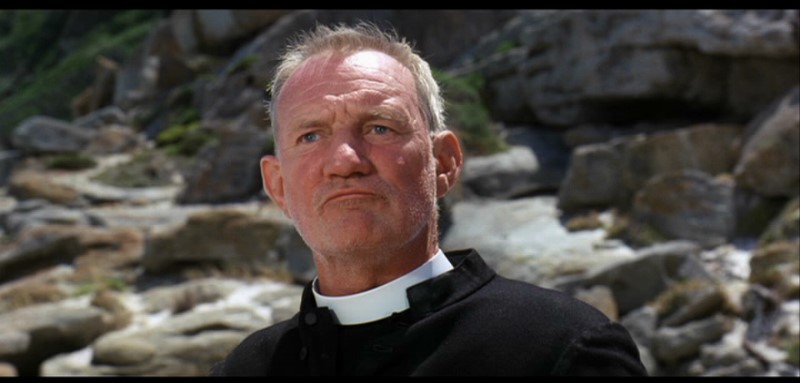
Bolt wrote his "Irish Bovary," but called it "Michael's Day," after John Mills' poor unfortunate—unfortunate, maybe, but he's the only character who doesn't judge, the lowest of the social strata, but the highest in moral character, followed by the priest Father Hugh (Trevor Howard), who is judgemental, but doesn't allow that to not seek the judged's salvation. In Kirarry, the first one now will later be last, and those who are triumphant by film's end will suffer a life of misery due to it...just by being themselves.
Lean's Irish crowds can be seen in the cackling crones of John Ford's Irish films, or the scandalously rich elite in George Cukor's films—these film-makers are only too happy to take down the gossips and gadabouts in the eyes of the audience, showing their true colors despite the trappings of civility. In truth, they are more like barnyard animals taking full advantage of pack mentality and pecking order. It's not the only instance of Lean using Nature to tell the story, not with so much scenery and weather filling his frames perfectly. But, their shallow triumphs have no permanence, because their attitudes leave a lasting impression, long after they've left the screen.
The actors, save for the callow Jones, are great: Miles is not afraid to show her Rosy Ryan as a selfish brat, Mills creates a character as pathetic (and sometimes as mawkish) as Chaplin's Little Tramp (and he won an Academy Award for it), Leo McKern, bold and blustery as Rosy's too-eager-to-please Conformist-father, but the best are Robert Mitchum, cast against type as Rosy's cuckolded older husband—a bull in a china shop just aware of breaking his first dish—and Trevor Howard, who even whispers in a roar as the Kirarry parish priest—a great, bold, stamping performance of ingenuity and froth.
But, in the end, it is Lean's film, as personal as he could make it with those wide Earth-framing lenses. The figures may be fighting the crags and spray of the Irish coast, but when Lean chooses to bring them front and center, it is always with the best design sense and a painter's eye. Look at the two frames below: as Rosy runs from her husband's bed to join her wounded soldier of a lover, smoke inexplicably—chimney fire, maybe?—roiling over the hill, darkening the moment; and the next shot, as Mitchum's school-master Charles Shaughnessy, sees with his own eyes and not his suspicions, his betrayal out in the open, trapped behind glass and bars, he retreats, his eyes falling into shadow, displaying the loss he is reluctant to express.
It doesn't get much better than that. And there's over three hours of this meticulousness and beauty. It might be a bit rich. But it's quite the banquet.
Wednesday, February 23, 2011
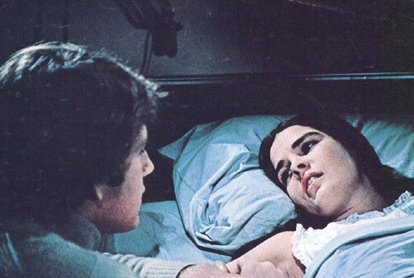
Love Story (1970)

Love Story (Arthur Hiller, 1970) What can you say about a 40 year old movie that manages to stay alive, despite being so much of its time? That it's maudlin, and saccarine, completely apolitical in a time of radicals, shamelessly tear-jerkey, and ridiculously dishonest in its treatment of disease? That its success was completely manufactured by a marketing strategy so machiavellian that it belied any of the inspiration that might go along with a phenomenon? That, what looked like a delicate butterfly to those enthralled with it, actually more resembled one of Disney's hippoes in a tutu
Yeah, yeah. But, damn it, it works. (sob!)
At least, it did on me when it was first released.
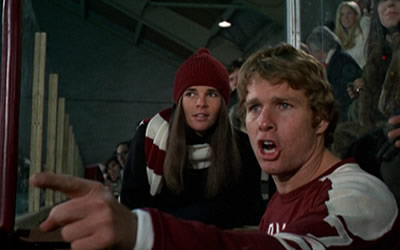
Truth is, Love Story started as a screenplay that Erich Segal sold to Paramount. Producer Robert Evans (to whom the credit for its success must assuredly go, as it was, literally, "a labor of love" for his then girl-friend Ali MacGraw). It was a low-budget film with no "buzz" and Segal was encouraged to write a "tie-in" novel to help boost its caché. Released on Valentine's Day, and bolstered by studio-engineered "block-buying," it made the New York Times Bestseller List, and, being slight and written in a punchy, simple style, mushroomed to become a "thing." The success of the movie was almost a sure-thing.
With the passage of time, the "phenom" aspect of it has disappeared and one can look at it without much prejudice. Arthur Hiller's direction is largely inelegant, combining a "caught-on-the-fly" feeling that was popular in the wake of Easy Rider (but without the pretentious editing tricks) with television style blocking. The film hinges on a score by Francis Lai (A Man and a Woman) that is used for a few "frolic-in-love" scenes. The acting varies in quality from professional turns by veterans Ray Milland and John Marley to the "do as little as possible and just be sincere" performance by Ryan O'Neal, and a functional one by Ali MacGraw, that started to show the cracks in her abilities that weren't apparent in Goodbye, Columbus.* Still, it jerks tears...if one has lost or (and probably more importantly) if one has not. Imagined grief can sometimes be more powerful than the actual if one lives in a fantasy-world. Anyone who has lost someone to a lingering disease will be a bit perplexed by this aspect of Love Story and could righteously yell "bullshit." Roger Ebert went so far as to call what heroine Jenny succumbs to as "Ali MacGraw Disease" ("Movie illness in which the only symptom is that the sufferer grows more beautiful as death approaches"). Movie Magic in Hollywood. "She's going. I need pancake make-up STAT"
But, the part the most galling aspect of Love Story—The Book! The Movie! The Phenomenon!—to me, personally, is its bracketing tag-line—"Love means never having to say you're sorry"—which would make a great Hallmark card if it wasn't such crap.** It would be easy if love meant never having to say you're sorry (certainly, it would be nice if it meant never having to say you're sorry that you've loved!) But the fact of the matter is that, if you're doing it right...or wrong...love really means saying you're sorry. It's common courtesy. And hopefully, you learn from having to say it, to change the behavior that demands an apology. Love cares. Love accomodates. Love humbles. And ('cause the Bible tells us so) love never dies.
Not in the real world.
Sorry.
* MacGraw and O'Neal were nominated for Oscars for Best Lead Performances that season, which seems less to do with merit than with studio electioneering. The film was nominated for 7 Academy Awards, but only won one...for Lai's score. It was Patton's year that year (and I'd argue that Jerry Goldsmith's lean score for that film has had more importance, both to its film and the legacy of film music, than Lai's). But, in a year of Patton, Five Easy Pieces and M*A*S*H, Woodstock, Let It Be, The Great White Hope, Women in Love, and Ryan's Daughter, it's a little difficult to see how Love Story could compete on any level.
** Just found an article where even MacGraw says "it makes no sense."
Thursday, January 21, 2010
Patton
"Patton" (Franklin J. Schaffner, 1970) "Patton" was a different kind of war movie. Where most of the genre would concentrate on the cinematic battles, or use the war as a back-drop for soap-stories, "Patton" chose to take the more quixotic route of "Lawrence of Arabia" (or more appropriately, "The Desert Fox" about Patton's "player on the other side" in Africa, Erwin Rommel) by making a personal story about war and how it shapes the human being. The war is the most important story, of course. But the story of General George S. Patton, Jr. (played by George C. Scott, with all the eerie command he brought to every role, probably far more than the real Patton personified) is so intertwined with the war, as a mover and shaker of it, and his fortunes so changed by it (and not for the good) that even as it revels in the eccentricities of the man, it also shows how out of touch a professional warrior and student of conflict can be in this day and age.
"God, how I hate the twentieth century" is one of the laugh-lines of "Patton." But it's one of the truest lines of the script (by Fox scribe Edmund H. North and a very young Francis Ford Coppola). Patton, the soldier, was from another time (he thought so, literally), and his romantic notions of war and warriors made him an "odd duck" of the military, and a "lame duck" when it came to the political strategies inside an Army at war. He held disdain for bureaucratic warriors on both sides of the conflict (including "that paper-hanging son-of-a-bitch" in Berlin), the exceptions being his West Point classmate Eisenhower, and Rommel, who had opposing tank battle scenarios to Patton's own. The movie has the Germans studying Patton and his techniques, more approving of Patton than his fellow Allied Commanders.
Scott's position as the centerpiece of the film is critical, but director Franklin J. Schaffner,* who apprenticed in live television and whose previous film was the better-than-it-deserved "Planet of the Apes," brought his customary expansiveness to the war. With a wide-screen process dubbed "Dimension 150,"** Schaffner created vistas of carnage and blazing battles of ferocity that took a dirtier, grimier and bloodier view of battlefield action than had been seen previously in the "clean-kill" war movies preceding it.
Patton, the man, romanticized war, revelled in it, but the film bearing his name went further than most in de-glamourizing the traditional heroics of the less thoughtful war films, carefully explaining the strategies, viewing the battles dispassionately, almost like a chess-master reviewing the board, and in the after-math, taking stock of the scattered pieces. However planned a battle may be, it ends in chaos. Chaos and death. And in "Patton," you can almost smell the stench of a battle-field's carnage.
Death is omnipresent in "Patton," with detailed shots of dead and wounded in the battlefilds, and the crude graveyards made in haste. Some of the eeriest parts of "Patton" take place in those moments, the cascading trumpets and marching jig of Jerry Goldsmith's score stilled to shimmering strings, and unresolved motifs.
Schaffner used his locations well, taking a page from David Lean, cramming as much information into the frames as he could, or by presenting stark landscapes that seemed to go on forever, showing the regimentation of war, how vast numbers of human beings could crowd a frame, or how solitary individuals could be lost in a landscape, or for that matter, History. The scenarists and Schaffner choose to leave Patton alive, just days before having his neck broken in a jeep accident. They leave him contemplating the transience of Glory walking mythically (and quixotically) towards a solitary wind-mill.
It is also about showmanship. A lot of actors turned down the role (some, like Rod Steiger, to their regret), but it was a tour de force for George C. Scott, who buried himself in the role, studying biographies, running films of the general over and over, doing an extensive make-up transformation—shaving his head to sport a Patton buzz-cut, matching the moles on Patton's face, and even having his teeth capped to make his smile more like the general's. There were some things he wouldn't do, like try to match Patton's voice—Scott felt simulating Patton's high-pitched voice would undercut some of his authority in the role.
The effect was extraordinary. Patton's kids, who were never too keen on the idea of the film, were amazed at Scott's appearance, and the role (which won Scott a Best Performance Oscar—which he famously refused) replaced the real-life General in the imaginations of the Nation, despite ample archival evidence.
Partially, it is the opening. Written by Francis Ford Coppola in an early draft of the script, it is a combination of several of Patton's inspirational addresses to his troops, performed—as if a stage performance—by a solo Scott before an out-sized American flag. It is this section of the script that most intrigued Scott, the stage actor, but also intimidated him. It was the last section filmed, and director Schaffner promised that it would be placed after the Intermission, as the actor—rightly—felt that the address would overpower the rest of the performance.
Schaffner, having a showman's instinct, reneged. And that speech, setting the tone and tenor of the performance that dominated the film, went immediately into pop iconography. It has been parodied and propagated for decades, a radical introduction to one of the more colorful players in the second World War. A thesis, a preamble, if you will, a first movement...but, more appropriately, a shot across the audience's bow.
** It was camera-maker Todd AO's challenge to Cinerama, and presented a viewing range, or scope, of 150. Only two movies were shot in "Dimension 150"—"The Bible" and "Patton." George C. Scott appeared in both of them.
Wednesday, October 28, 2009
The Private Life of Sherlock Holmes
"The Private Life of Sherlock Holmes" (Billy Wilder, 1970) It may be one of the best movies you've never seen. There's no mystery to that; no one's seen the full length version of "The Private Life of Sherlock Holmes." Conceived in the heady days of the '60's, with their roadshow presentations (long ago extinct) that played one theater once a night, and in itself was a full evening's entertainment, "Private Life" was going to be a three hour epic (with intermission) that dramatised four "untold" tales of Sherlock Holmes (Robert Stephens) by his co-hort and longtime companion Dr. Watson (Colin Blakely). But, by the time of its completion, roadshows were no longer good box-office for theaters, Sherlock Holmes didn't seem to appeal to the "young" crowd, and one episode's extensive nudity would have slapped the movie with a restricted rating, further reducing the audience. At the time of "M*A*S*H," would anybody want a three-hour Sherlock Holmes movie?*
So, as sure as Dr. Watson is with a knife, "Private Life" was eviscerated, the prologue and two of its mysteries hacked away (no complete version remains of these sequences), leaving the third (the Russian ballet story) and the post-Intermission grand story involving the Loch Ness monster, the dead parakeets, the monks, and the midgets as the only evidence of the crime. All that's left are scattered clues of a better film—pieces of scenes hidden away in the "Bonus Materials" of the current DVD, collections of pictures with no soundtrack, soundtracks with no pictures. Elements are lost, stolen or strayed. Wilder was heart-broken, saying that the movie felt longer cut down to 2 hours.**
Truncated and compromised as it is, it is still probably the best Sherlock Holmes movie ever made and that includes the quickie Basil Rathbone's, and the BBC series with the inimitable Jeremy Brett (which has a similar love for the arcana and dusty minutiae of the Holmes canon) and the thousand of impostors who are satisfied with merely the deerstalker, the Inverness cape, the mahogany calabash with meerschaum bowl,*** and the fustiness. Though not "official," and certainly having fun with the Great Detective, it still manages to take Conan Doyle's consulting detective and surround him with an engagingly modern story with the benefits of historical hind-sight.
The movie began as a proposed musical to feature Peter O'Toole as Holmes and Peter Sellers as Watson (!!), but over the course of the '60's, the film evolved into the basic Wilder formula of the unmasking of subterfuge and becoming an only somewhat strait-laced series of adventures. The ones that remain have a sub-text of Holmes' sexuality—he uses his co-habiting with Watson as a means to avoid being a "donor" for a Russian ballerina seeking to produce brilliant prodigy, and his seduction (more like playing along) of Madame Valladon (Geneviève Page) to glean more information—both incidents leaving Watson sputtering indignation—that leave the matter, finally, obliquely melancholy.
That's the "Private" section.
The mystery of the Madame Valladon, found floating in the Thames, and her missing engineer-husband will consume Holmes for the majority of the movie, his motivations conflicted between curiosity, a sense of justice, enticement of the mystery, his conflicted relations (or lack of them) with brother Mycroft (Christopher Lee), and an odd empathy with Valladon. For Watson, it's a welcome relief from hiding the syringe from Holmes. The solution of it will leave the detective even more conflicted, as his actions create a double negation, sending him back to drugs and questioning his abilities.
Despite not being an official Holmes story, it feels more of a tribute than even Conan Doyle's work, for here the focus is on Holmes and less on the poor innocents whose worlds have been invaded by evil and the un-British. As such, it gives us a peek behind the steel curtain of Holmes' reasoning, to show us a bit of the man behind the detective.
Appropriately, what you find is another mystery.
"The Private Life of Sherlock Holmes" can be seen...for free...on Hulu.com.
* All I need do to point out the efficacy of the character is to say that he's pulling in good numbers for his current TV-show. Holmes doesn't have a TV show? What about the "consulting" physician who can "read" patients and every week has a mystery that even his intellect is challenged to solve, who is a social mis-fit, addicted to narcotics, and has a friend that he sometimes shares quarters with by the name of (ahem) Dr. James Wilson? And as he's not a "Holmes," he's a "House." I'm surprised nobody thought of Hugh Laurie to play Holmes before now? (Probably too identified as "Wooster!")
** It's a strange phenomenon, but it happens—I can vouch for it. Full-length movies that are well-done feel like shorter movies that films that are edited for time. It has something to do with continuity, flow-through of the story-line, cutting rhythm—hard to say. But I do know that sitting through the SIFF premiere presentation of Sergio Leone's "Once Upon a Time in America" in its Paramount studio's strict timeline version seemed interminable, while Leone's original flashback structure, which is a good 45 minutes longer, seems to streak by.
*** Devotee's of the Doyle stories know that Holmes doesn't...and probably wouldn't...use such a pipe, preferring harsh tobaccos that would be disastrously mellowed by the meerschaum bowl. It's only become "the" pipe for Holmes (it's even used in this film's poster!) due to the stage and filmed versions of the Holmes character. Blame William Gillette.
Wednesday, July 2, 2008
Olde Review: Colossus: The Forbin Project
"Colossus" is a nicely put-together movie, well-written, well-directed and well-acted. In fact, it's so nicely put toegther it's a little hard to imagine that it was made by Universal Studios during their "throw-away movie" period.** And it's so nicely put together that Universal hardly promoted it and it didn't make much money (except for Seattle, where it had a long run at, of all places, "The Harvard Exit." ***
Thursday, June 26, 2008
Olde Review: Diary of a Mad Housewife
This is a companion piece to "Olde Review: The Nights of Cabiria"
"Diary of a Mad Housewife" (Frank Perry, 1970)
As for "Diary of a Mad Housewife," it was the first time I had seen it in an unbutchered form, and I hate to make snap-judgements on a film,* but all the time I was watching it, I was painfully aware that it was made in 1969, released in 1970, at the heighth of the "youth-movie" craze, when, in order to make a point (and a buck!) subtlety was thrown out the window and you were beat over the head with "THE MESSAGE." I felt it was a shame that to see Frank and Eleanor Perry, who collaborated on the sensitive "David and Lisa," consciously changing their style to fit what was profitable at the time, so that the whole movie was written and directed like the opening cocktail party of "The Graduate." It's fine for ten minutes of the film, but the whole film? After awhile, I began to think I was in a cage, no matter how honorable the film's theme is. Anyway, Ithought I'd tell you where I stood at the beginning."Diary..." tells the story of Tina Balser,** (Carrie Snodgress) who is married to an overly-ambitious, ego-centric, heartless,and just plain insensitive husband (played by Richard Benjamin, just the way you'd expect him to play it-hissing is allowed). She has two obnoxious little girls who take after their dad, and she's somewhat dazed (and just a little miffed) by the whole situation, especially after a hectic day (capsulized in a fantastic title sequence) when her husband heaps new work on her, complains she does no work, and then he wants to go out. In desperation, she has an affair with a writer (who is just as chauvinistic as her husband--but at least, she can talk to him).
Like Cabiria, Tina caroms off disaster into disaster, because in the worlds of her two males, she is always wrong, in their views. Her lover (Frank Langella) who is her only means of escape from her home-life, is no solution to her problem. He is just another problem. Finally, she goes into analysis, where she tells her story, and here, too, is no solution, for her "group" is too obsessed with each of their own personal problems to help work out hers. Our last sight of Tina is of her face, not really listening to the arguments of her group, her eyes slowly look around the room, carefully avoiding the people. Then, finally, she looks at us, like Cabiria. She stares at us, then smiles, not the half-sad smile of Fellini's heroine, but the smile of someone in an absurd situation and realizes it, and realizes also that she can't get out. Just before we fade out on her, her eyes widen. Maybe onto another means of help; maybe on out of a realization that she's trapped and has withdrawn back into herself.
Broadcast KCMU-FM October 7th and 8th, 1976
Again, not much to add. I'm far less enamored with "Diary of a Mad Housewife" because the cartoonish stylization employed by the Perry's to exaggerate Tina's plight--the hellish counter-argument to the domestic bliss of the Mrs. Cleaver/Mrs. Brady/Donna Reed's that had been foisted on television audiences--is as much a lie as the tv versions. The "madness" of the American housewife of the 60's was a very real side-effect of the help-mate/second-class citizen role that was typical in the pre-exploded nuclear family. Now, economic conditions have blasted the stay-at-home Mom to a luxury of the upper-class. Now, mom's work...and do the rest of the "mad" duties, as well.
This is progress?!
* There's a lie if ever I've read one. Snap and summary judgements are a critic's bread and butter (not to mention terribly efficient!). The trick is being able to justify it. And there, some re-adjustment sometimes has to be put in play.
** Uh, get it?