Showing posts with label Japanese. Show all posts

Wednesday, December 12, 2012

Walking Kurosawa's Road: Sanshiro Sugata Part 2

The inability to write about the films of Akira Kurosawa to my satisfaction led me to to take a different path: start at the beginning, take each film in sequence, one after the other, and watch the progression of the man from film-maker to Master.   I'm hoping I can write more intelligently and more knowledgeably about his work by, step by step, Walking Kurosawa's Road.

Sanshiro Sugata Part 2 (Akira Kurosawa, 1945) Any director thinking that "they don't do sequels," should bear in mind that Kurosawa did one...with only his third feature film.  Before embarking on his next project, the soon-to-be Japanese Master was pressed by his financiers to follow up his popular judo film with a continuation of the story, following the path of Sanshiro, now two years in self-imposed exile, having abandoned his position as Judo champion.

Things have changed, but he hasn't.  The city he comes back to is now under occupation, and the disciplines that Sanshiro struggled so mightily to learn, seem to have little significance in this new atmosphere.

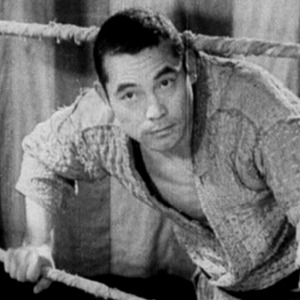
Returning home, his acclaim is widespread, but he's dissatisfied.  A promoter tries to entice him into participating in a match with an American heavyweight champion for money, something both against the rules of Sanshiro's dojo and his own hard-fought-for beliefs,  He attends, however, and is disgusted when the martial artist roped into the match is summarily pummelled before the crowd of blood-thirsty Americans and Japanese.


Things had changed for Japan, as well.  Defeated in World War II, and occupied by the United States, the country that Kurosawa made the sequel in was far different from the one in which he'd made the original.  And one can tell by the very first sequence, he bristled at it (despite the fact that the first film, made during the war, was chopped up by Japan's ministry, to the point where no original print exists).  Imagine my shock when the first words heard in this film are in English.  They come from a belligerent American sailor hectoring, then threatening his rickshaw-driver—the abuse comes in a different language, but the opening is parallel to the situation in the first film, only now it's Sanshiro who comes to the aid of the driver, in the position (flat on his back) that he was in at the beginning of the first film, before his transformation.


He retreats to his Master's dojo, but sinks into a deep depression while, simultaneously, training that young rickshaw driver he'd earlier saved.  His disciplines start to fall away, as he begins to drink, his fortunes falling as his young student's rises.  The dojo provides no respite and relief—he is challenged to a fight by a tag-team of brothers, the Higaki's (also brothers to Gennosuki Higaki, the previous film's final combatant), one extremely aggressive and the other, deeply insane, to exact revenge on their fallen kin.  He also reunites (discretely) with the woman who loves him, and with Gennosuki, who is now in ill health and seeks a reconciliation before he dies, a far cry from his brothers' path of vengeance. 


The battles Sanshiro must fight—and avoids fighting—are much like the battles raging in his own mind.  With his fame, and abilities still intact, he is caught in a dilemma of purpose—should he fight with the stakes becoming decreasingly honorable?  And how long can he maintain his reputation while avoiding confrontation (and does he even want that reputation—with its incumbent honor—anymore, given how cheaply and shallow the value others impose on it are?  Is his reputation worth it in such a world?  And will the matches with his own demons (represented by the brothers) keep him from maintaining his own "wa?" 

It's a universal problem negotiating the minefields, internal and external, that dot our lives.  But, there's something else going on here, given the context and the environment in which Kurosawa made this film.  This was his first post-war film after the Japanese surrender (Kurosawa paused in the filming of The Men Who Tread on the Tiger's Tail in order to listen to Emperor Hirohito's "Gyokuon-hōsō") and for the nation this was a crushing, demoralizing defeat, especially given the fervor that the government had invested in its people.


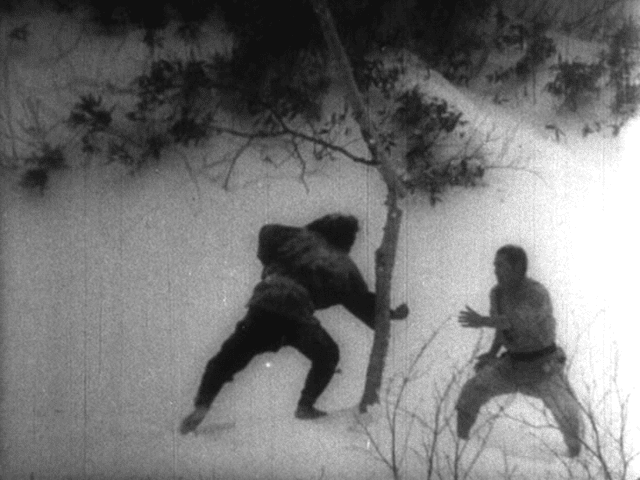
How does a nation, especially one so steeped in tradition and pride, endure after such a concession?  Kurosawa encapsulates the answer in the fighting brothers who have challenged Sanshiro, one incapacitated by an epileptic "spell," the other who fights the master on a hilltop—not of frantic wind-swept grass as the first film—but a precipice blasted by snow.  After a long struggle, where Sanshiro is mostly passively defensive, the revenge seeking Higaki is defeated and sent tumbling down the hill.  He is saved and tended to by Sanshiro, while under the baleful watch of the younger Higaki brother, who in a moment of clarity, understands Sanshiro's purpose and responds to his brother's lament with the same words...and a beaming smile.


The influence of the good, the dedicated, the humble, and the charitable perseveres in this world of defeat and cynicism.  One could take the position for seeking revenge, but how much better it is to have grace—not curling up and dying, of course—and follow the better path, as this most popular of Japanese heroes, demonstrates.

This may be the greatest sequel in all of film.  But more than that, it is a gift from an up-and-coming master filmmaker to his nation, at its most desperate hour, in gratitude for the opportunities he had been given, and providing balm, solace, and wisdom, to go on.  It is an amazing film, inside of itself, and outside in the world in which it was made.


Tuesday, December 4, 2012

Walking Kurosawa's Road: The Men Who Tread on the Tiger's Tail

The inability to write about the films of Akira Kurosawa to my satisfaction led me to to take a different path: start at the beginning, take each film in sequence, one after the other, and watch the progression of the man from film-maker to Master. I'm hoping I can write more intelligently and more knowledgeably about his work by, step by step, Walking Kurosawa's Road.

The Men Who Tread On the Tiger's Tail (aka 虎の尾を踏む男達 aka "Tora no o wo fumu otokotachi?") (Akira Kurosawa, 1945) Set-bound tale of a feudal lord's attempt to make it back to friendly territory after a successful naval campaign against his enemies.  But, to get there, Lord Yashitsune Minamoto (Hanshirô Iwai) must travel through land controlled by one of his enemies, Togashi (Susumu Fujita), who is on the lookout for him and will kill him if he is found.  To get through, he poses as a porter, accompanied by six samurai, led by Beiko (Denjirô Ôkôchi), acting as monks on a religious pilgrimage to raise funds for a temple to be built in Kyoto.

It's a tale of suspense, with very little action, save for the subterfuges, disguise, flummery, and appeals to Kataoka's patriotism and faith (which are legitimate but used for false purposes), knowing that any slip-ups will mean death by sword by a very large collection of border guards.  So, in other words, all of the heroes are lying and using the best instincts of their foe against him.  Hardly the high-minded ideals one associates with dedication to country or God.  In fact, the only of the group that isn't decidedly two-faced is the comic relief, another porter (played by Kenichi Enomoto), who could be Japan's answer to Jerry Lewis in his early career, whose frequent panic attacks could give it all away at any second.  You'd want to strangle Enomoto's porter, if he wasn't so entertaining and a tonic against the heavy earnestness of the rest of the movie.


The film was made during the last days of the Pacific War during World War II, which is why the only segment filmed on location is the forest scenes at the beginning.  The rest was filmed at Toho Studios and filming was briefly interrupted to listen to Hirohito's surrender speech ending hostilities.  Toho and Kurosawa were visited by John Ford during the filming, and one of the first people to see The Men Who Tread on the Tiger's Tail upon completion was British director Michael Powell.  However, the film was banned by the Supreme Commander of the Allied Powers (led by General MacArthur) for its depictions of feudalism (in the attempt to make the Japanese less tied to their heritage and more embracing of American culture), but if they'd taken a more careful look at the film, they'd find that it was making a statement against the very cultural fanaticism the SCAP was trying to prevent.  Oh, well. The result was that the film was banned until 1952.  


One can't help but think that this might have had an influence in his next two films, where the war's ending and the Allied occupation of Japan played very important roles.


Wednesday, December 7, 2011

Tora! Tora! Tora!

Tora! Tora! Tora! aka (トラ・トラ・トラ!)(Kinji Fukasaku/Toshio Masuda/Richard Fleischer, 1970) "The American Pacific Fleet was attacked and partially destroyed by Japan on . . . Sunday Morning December 7, 1941. This attack led to the entering of the United States into World War II. All of the events and characters depicted are true to historical fact."  20th Century Fox's former studio head Darryl F. Zanuck had served in the second World War, and spent his senior years at 20th by the overseeing of large movies showcasing major battles of that war, his most prominent being The Longest Day, based on Cornelius Ryan's book documenting the Normandy Invasion.  But, in 1966 plans were put in place to make an historically accurate film about the Pearl Harbor attack, based on Ladislas Farago's "The Broken Seal."  Ambitious in its scope, the film would be made with both Japanese and American crews, and for a great deal of the pre-production the man in charge of the Japanese unit was  director Akira Kurosawa.  Kurosawa agreed to the film, thinking that David Lean was making the American section, but when he discovered it was, instead, Richard Fleischer, the Japanese master bent some rules in order to allow himself to be "fired" from the film.  He was replaced by two directors known to be as efficient and workmanlike at bringing films in on-time and under-budget as Fleischer.  The intention was not to make great art, but to make an historically accurate film, devoid of trumped-up drama (From Here to Eternity had done that already) and stick to the main subject of the planning and execution of the attack.

The result, although accurate, is rather flat.  Fleischer's American scenes seem drab and stale and, peopled with character actors like Jason Robards, E.G. Marshall, Joseph Cotten and Martin Balsam, lacking in star power.*  The Japanese sequences, perhaps because they have less of an American film studio-feel, seem to have more verve and energy...and better performances.  The movie seems to reflect the situation of the real life events: the Japanese have all the bright ideas, while the Americans have the lethargy associated with "a sleeping giant."** Still, the battle sequences and attack footage is extraordinarily well done, a combination of L.B. Abbott's and A.D. Flowers' model work and the Fox Studio's sometimes hair-raising practical effects crews and stuntmen.

I attended the premiere of Tora! Tora! Tora! with my family at a special showing at the old Paramount theater in Seattle.  It was a special preview for the local chapter of the Pearl Harbor Survivors local chapter, of which my father, John Wilson, late of the U.S.S. Missouri, was a member.  The only story my Father ever told of the war was the events of December 7th, when he was waiting on the dock of the U.S.S. Arizona to attend on-board church services with his friend, Howie Whims, who, for whatever reason, was late.  Were it not for his buddy's tardiness, my Father would have been onboard the doomed Arizona at the time of the attack, and likely might have joined the ranks of the sailors who are still entombed there.***

It was an odd thing sitting in that audience with that audience.  29 year previously, they had witnessed the true horrific events of what was being fictionalized on screen.  The mistakes made (by both sides) that made the devastation so complete was laid out for all to see.  But, however good the effects and pyrotechnics, they couldn't recreate the carnage of that day: the deafening noise, the stench of burning oil that enveloped Pearl for weeks, the bodies, the desperation.  The sight of good friends and comrades-in-arms caught in the gears of the attack and lost forever.**** 

The retired sailors sat stonily, watching the film—no doubt poor competition for the memories unreeling in their own heads and hearts and souls.  There was a smattering of applause when a Japanese zero was shot down, but it was unenthusiastic, hardly celebratory.  For them, it was a film about—and I say this hopefully—the worst day of their life.  However artfully done, however accurately portrayed, who would want to sit through that?  As Sam Fuller succinctly put it in The Big Red One, "Surviving is the only glory in war."  I hope, on that day, they could appreciate their own glory.


* Actually, it's not a bad strategy.  Less attention is paid to the actors on-screen to the advantage of the story.  Films such as Zanuck's The Longest Day or A Bridge Too Far become parlor games after awhile ("Look!  There's Sal Mineo and Richard Beymer! Isn't Gene Hackman in this movie?")

** That's taken from the thing the movie is most famous for—Yamamoto's assessment of the attack ("I fear all we have done is to awaken a sleeping giant and fill him with a terrible resolve").  Even Michael Bay's Pearl Harbor used it.  It's a good line, making the Imperial General seem both presecient and tragic.  Unfortunately, it appears that, historically, Yamamoto never actually said it.

*** It's one of the reasons I have no patience with Michael Bay's post-Titanic disaster, Pearl Harbor: there is one shot, meticulously recreated, following the path of the most damaging bomb that struck the ship—one of those CGI-sailors scrambling for cover below could likely be my Father, and it irks me that Bay's sensibilities had more gung-ho enthusiasm for the bombs than for the victims.

**** Those sailors' names are etched in stone at the Pearl Harbor Memorial, which is constructed over the still capsized hulk of the Arizona, which still burbles oil to the surface to this day.  But, there's another section, a more recent section, with fresher names cut into the rectangular portal that leads under the surface to the Arizona.  It's for survivors of the attack, who after living through the war, living a full life with wives and families, still chose as their final resting place the ship in the Harbor where they lost so many friends.  I never fully understood "survivor's guilt" until I saw that.

Thursday, October 27, 2011

Walking Kurosawa's Road: Sanshiro Sugata

The inability to write about the films of Akira Kurosawa to my satisfaction led me to to take a different path: start at the beginning, take each film in sequence, one after the other, and watch the progression of the man from film-maker to Master. I'm hoping I can write more intelligently and more knowledgeably about his work by, step by step, Walking Kurosawa's Road.


Sanshiro Sugata (aka: 姿三四郎; aka Judo Saga) (Akira Kurosawa, 1943) Every hero's journey begins with the first step; it is true in this film's story and in reel life, this being the first full-length feature of legendary film director and stylist Akira Kurosawa.  One already sees reflections and echoes of the Master's work and influence rippling out from this one, even as it, itself, builds on the reverberations of Western film-making traditions.

Made during the Second World War and heavily cut by the Japanese government for sentiments that some petty bureaucrat probably imagined might hurt the war effort, Kurosawa's first big effort and first success has never recovered from the sword of the censor—the missing pieces have never been found. 

But, what there is proves enlightening...and telling.

It is a hero's journey.  Sugata (Susumu Fujita) is a novice fighter who wants to learn jujitsu, but is given short shrift by the school of martial artists he joins.  When they hear a master of the rival judo order is in town, the entire group decides to confront the man, Shogoro Yano (Denjirô Ôkôchi).  In a fight at a canal's edge, Yano takes on all comers, dispatching them into the frigid water—the first of many examples of the "last man standing" scenes that would dominate Kurosawa's film and his students, Sergio Leone (and also Clint Eastwood).  Those impressive results are all Sugata needs to switch disciplines, studying the ways of judo with Yano.

But, what the apprentice gains in skill he lacks in discipline, squandering his unfocused talents getting into sporadic street-fights that disappoint his Master.  In a desperate bid to win Yano's respect, Sugata dives into the freezing waters at the judo temple, risking his life, but also gaining an understanding of "satori," represented by the sight of a single blooming flower, growing straight and tall in the frigid waters.  The strength of Nature is revealed to him, and the apprentice has found the inner truth to master his craft. 

At that point, Sugata becomes renowned as the toughest fighter in town to beat, and he is challenged by jujitsu fighters determined to best him.  One can't help seeing the "gunslinger" analogy here, as the new guns and old challenge the now-humble, wiser Sugata to matches of skill to the death, like he was the "fastest draw."  Just as, no doubt, Kurosawa drew on Westerns for his martial arts saga, his work would come full-circle, inspiring Westernized versions of his work—specifically, The Magnificent 7 and A Fistful of Dollars.

It's an analogy to life itself—you make your way through it, and you may have what it takes, but it is only by knowing oneself and seeing the Bigger Picture that one can truly make a success of life.  Already, Kurosawa is tackling big themes.  But, you can already see his command of staging with Nature acting as an emotional well-storm, culminating in a passionate fight between two rivals for one woman's hand, on a wind-swept hill of violently whipping tall grass.

I have so many Kurosawa film reviews sitting in various drafts here at LNTAM, never feeling secure in my grasp of his work, so I've decided I'm going to start at the beginning and work my way through his career.  In the next few weeks, you'll be seeing more and more of his films cropping up here, a result of my own faltering tentative journey observing his remarkable work.  Hopefully, somewhere along the path, focusing on his work, I can achieve some wisdom about it.


Thursday, December 11, 2008

Olde Review: Fires on the Plain

This is a companion piece to "Forbidden Games" broadcast on KCMU-FM

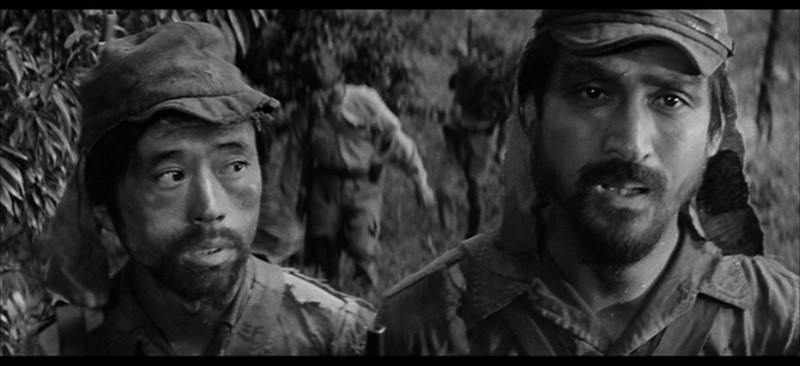
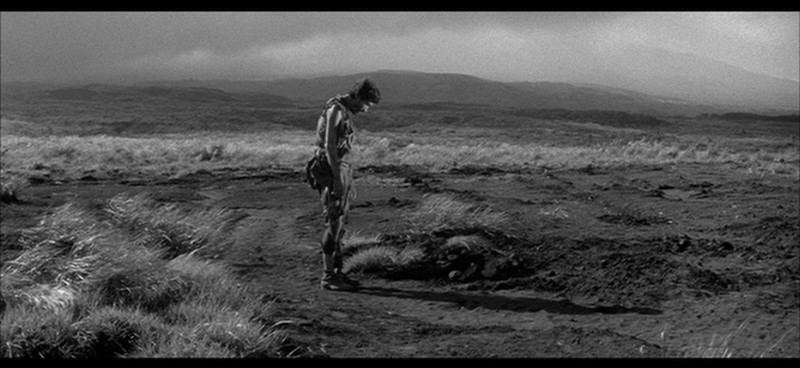
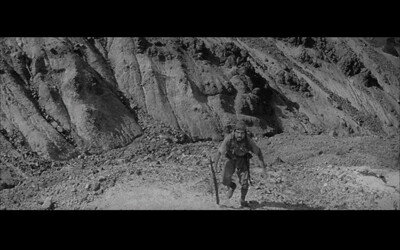
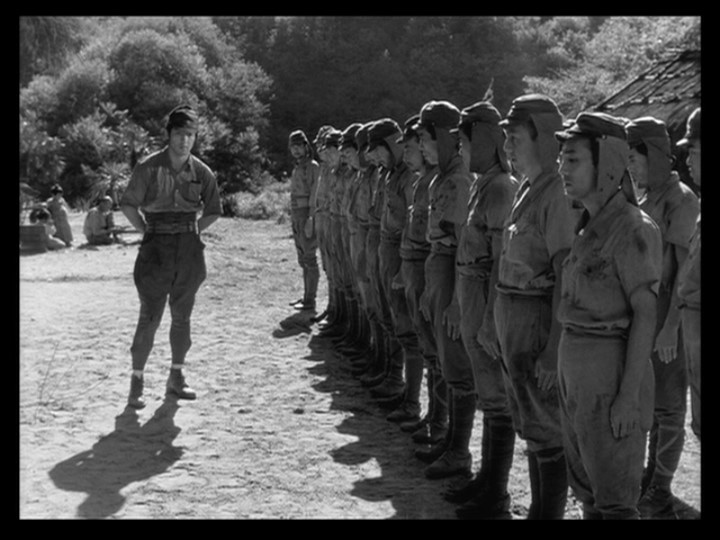
"Fires on the Plains" aka "Nobi" (Kon Ichikawa, 1959) Kon Ichikawa's "Fires on the Plain" is not so gentle as "Forbidden Games" — it is something that pretty much has to be endured. It deals with the final days of World War II and the ravaged Japanese Army—disorganized, suffering heavy losses, and losing its humanity. The conditions under which they fight are unbearable: disease is rampant, there is no food and no loyalty and no real reason to keep fighting but to survive. Ichikawa focuses on one soldier who, too, is trying to survive, but survive as a moral being, for he is already doomed by tuberculosis.

On his trek through the war-zone, the atrocities he sees become greater, the desperation he sees heightens until there are no sides. The war becomes one to survive, each on his own against everyone else. There is no meaning to the war, and also, no meaning to life for all morality, if it can exist in war, is lost. The ending of "Fires" is horribly shocking and if your are in no mood, or cannot take such strong stuff, I would advise you to avoid seeing the film. The total effect is somewhat devastating and probably "Fires on the Plain" is the most excruciating indictment of war and the effect on the men caught up in it.

It is interesting to set this film up against Ichikawa's beautiful "The Burmese Harp," which looks at the same section of the war for the Japanese. But one gets the impression that, for Ichikawa, "The Burmese Harp" didn't express enough of the outrage he felt for war. "The Burmese Harp" looks positively sublime next to "Fires on the Plain," and even though they touch on the same themes, the two films could not be more different. Just looking at stills from "Fire" is a bit grueling, but this review whets my apetite to see it again, especially in light of another, similar film, Clint Eastwood's "Letters from Iwo Jima," and in the light of encountering "The Burmese Harp" and appreciating its artistry.

As I tended to do, I truncated these reviews as they were the final ones for the quarter, and I wanted to make room for closing thoughts:

"Forbidden Games" and "Fires on the Plain" are the last films in the Fall ASUW Film Series, and so, too, this is my last movie review. At this point, KCMU is in a state of flux so I have no idea whether I will be back next quarterwith the Winter ASUW Film reviews, or whether we will have film reviews at all. It's pretty much up in the air right now. I would like to see things continue. I have had fun doing them: seeing new films that I might have missed, allowing myself to express my raves and my gripes about them. The toughest thing about writing them is to distill what you want to say about a film into five minutes, two and a half minutes, or even one minute; time is always the biggest enemy in radio work and that proved to be the case not only writing in writing them, but in producing them, as well. I felt that something else had to be included besides my droning on—at least music, maybe an actuality now and then—and that was time-consuming. A few times my reviews would be late (once it just never went on) and again, time—my time—will be the biggest consideration of whether they will continue. But whatever the fate of the reviews next quarter, the films will continue. And this is the line-up for Winter Quarter....
...I would like to thank the DJ's on the air for even playing the damn things: Tim Hunter, Don Zwicker, Steve Flume, John Windus, and Abby Goldman. I would like to thank Diane Jotautus of the Audio-Visual department who put up with me all these weeks, for letting me see the films, and I'd like to thank Rajeeve Gupta of the Film Showings Committee for giving me the opportuntiy. Lastly, I'd like to thank you, for these reviews do no good unless someone is out there listening. And so, that's the Last Movie Review Show.

I felt compelled to say all that because 1) I felt a great deal of responsibility for these things, and 2) I had enough ego to think anybody gave a rip. I still have trouble compressing my thoughts into a cogent, pithy review that manages to touch on all the issues a film brings up. But, I've also learned that there's just so much of this stuff a person can tolerate (and how long has this one gone one?) The comment about my droning on is on-the-beam—back then, I didn't know how to speak on the radio,it was all just a flat monotone in desperate need of some character. The names I remember fondly. Tim Hunter went on to a successful career as "the funny one" on a morning DJ team locally, John Windus ended up working in radio in the Portland area. Everyone else...long-lost, though I still remember them in my mind's eye. I remember after a while I started calling Abby, Abby "Gold-person" as a joke, which she picked up and used on the air. Diane Jotautus was great supervisor—I worked for her in the A-V Department, and gave it up to concentrate my time doing radio—and more often than not, would watch the films with me to break up the monotony of the office-work. It was also a quick way to check the prints that were showing.

And I did do the Winter series. Some of them have already appeared, but the remaining ones from the quarter will appear on the weeks they were delivered, or thereabouts, 32 years ago.

That's a lot of time spent in the dark.

Wednesday, July 16, 2008

Olde Review: Hara-Kiri

This was part of a series of reviews of the ASUW Film series back in the '70's. Except for some punctuation, I haven't changed anything from the way it was presented, giving the kid I was back in the '70's a break. Any stray thoughts and updates I've included with the inevitable asterisked post-scripts.

"Hara-Kiri" aka "Seppuku" (Masaki Kobayashi, 1962) Well, now that I've got that off my chest,* perhaps I should talk about "Hara-Kiri," which has quite a number of similarities to "The Wild Bunch," and a few things of its own that any self-respecting film-watcher would goggle at.

First, to be very general, it is a samurai picture. The year is 1630, and Hashiro Tsugomo appears at the House of Iyi to ask permission of the honorable elder to commit suicide near his house. The elder doesn't want that, but he doesn't want to give this obviously impoverished samurai any money to prevent the act. This is just the first of a series of conflicts that occur between the two men from two classes.

The story itself will fascinate you as it fascinated me. It is directed by Masaki Kobayashi with the same devotion to rigid formality as a (director like) Sergio Leone, and (it's) just as full of beautiful scenes, as the one in which Tsugomo is told by his son-in-law that his grand-child is dead; his house, dark with shafts of light ripping through it, mists rising up inside the room. There's also a sequence of a samurai battle on a plain of tall grass, surrounded by dark brooding skies, which ranks with some of the best film I've ever seen.**

Like "The Wild Bunch," "Hara-Kiri" is bloody, what with sword-play and threatened sword-play. And like "The Wild Bunch," the ending has the protagonist trapped in a situation that will certainly take his life, as he is so outnumbered--it is only a matter of how many he can take with him before he succumbs to the inevitable. When he decides to fight, Tsugomo is committing hara-kiri of a much more honorable nature to himself, personally, than the ceremonial form. And, so, too, it might be said for The Wild Bunch.

"Hara-kiri" is in Japanese with English sub-titles, so, again, go early if you want to be in a position to read them.

A warning has been placed in The Daily's ad for these two films saying: "The depiction of violence in these two films is extensive and explicit. Please do not come if the prospect or reality of this bothers you." I second that warning.

Broadcast on KCMU-FM on October 28th and 29th

* This is a companion piece to my review of "The Wild Bunch"

** This sequence has stayed in my mind for three decades without my being able to recall what film this wonderfully achieved sequence originated from. It pays to re-read old reviews, no matter how painful it can be at times.

Wednesday, April 23, 2008

The Burmese Harp

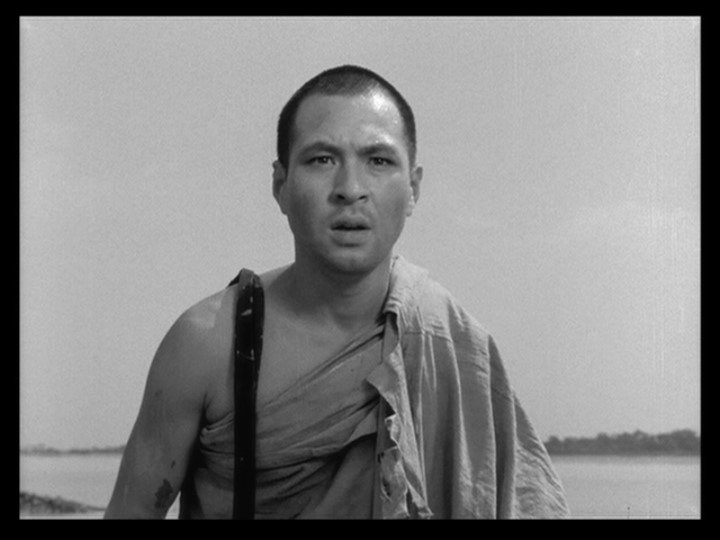
"The Burmese Harp" ("Biruma no tategoto")(Kon Ichikawa, 1956) Sublime Japanese war story about an Imperial troop in Burma set during the last days of the Second World War. Led by a former choir-master, Captain Inouye, the men comfort themselves with song, and on the practical side, communicate in hostile territory through a code of music. Leaving aside the fact that music might not be the perfect sound to "blend" in the jungle, the film does make the point of it as a universal language in one miraculous scene. As the troops sit huddled in a hut in a Burmese village awaiting an ambush by Allied forces, the tension becomes unbearable. As a ruse to draw them in and trick the enemy that they are relaxing rather than poised over their weapons, the men begin to sing "Hanyu No Yado," a plaintive song of home. To their astonishment, the Allies begin to chime in, as the melody bears a remarkable similarity to passages of "Home, Sweet Home." For a time, the enemy forces combine as they perform and listen and unite. The war has ended. The Allies are there to inform the Japanese troops and confiscate their weapons, and the music's common ground has provided a demilitarized zone between cultures. No one dies that night.

But the war goes on. The Americans are having a tough time convincing die-hard Japanese soldiers that hostilities have ended. In their temporary prison camp, the troop is asked to help in bringing in the still-fighting men. Mizushima, the self-taught player of the difficult Burmese lute, volunteers and is seemingly lost in a battle to the death among British and Japanese forces. But, on their way to the Mudon prison camp, Captain Inouye passes a lone Buddhist monk, who resembles Mizushima, and speculation begins about his fate.


It's a moving, satisfying film about comradeship and duty and how the two combine and divide us. It's also beautifully composed and shot. I can't recommend it highly enough.

Kon Ichikawa was a replacement director on the project, but it was a story that he particularly loved. His troops aren't interchangeable soldiers, they are individuals who react to situations differently, dream of home and family and are frequently repulsed by the nature of their war. Ichikawa uses the jungle settings as vast backdrops that dwarf the men--swallows them, throwing them back in time amidst the stone idols that litter the landscape. Slow, stately and passionate, "The Burmese Harp" is one of the greatest war films I've ever seen.


Kon Ichikawa died February 13, 2008, one of the masters of the Japanese cinema.

Tuesday, January 22, 2008

Spirited Away

Spirited Away (Sen to Chihiro no kamikakushi), (Hayao Miyazaki, 2001) This is the first Miyazaki animation I have seen, and it's a little off-putting to be hit with so much in one film--a bit like "Yellow Submarine" but with crystal meth instead of mushrooms--everything's just a little bit threatening. And one has to get used to the sudden shifts in motivations of characters at times, and the almost constant sense of dislocation. Puts one in sympathy with the main character, certainly, and keeps one mindful that we're back in Oz, again, except the Emerald City is a bathhouse, and the Great and Powerful Oz is also the Wicked Witch of the West. Better take "Howl's Moving Castle" off the queue, and replace it with "My Neighbor Totoro." K. lost patience with it 90 minutes in, and went to bed.