Showing posts with label Martial Arts. Show all posts

Tuesday, October 1, 2013

The Grandmaster

Two Words.  Vertical.  Horizontal.
or
Once Upon a Time in Forshan

Let's get one thing out of the way first.  The version I saw of Wong Kar-wai's The Grandmaster (aka "Yi Dai Zong Shi" aka 一代宗師)  is the Weinstein Company release, which runs 108 minutes.  The original Chinese version runs 130.  That's about 20 minutes of footage missing.  So, I don't know whether I'm reviewing Wong Kar-wai's latest film, or a long, long trailer for it.

Normally, I wouldn't be doing much kvetching about this, but I've seen enough of the man's movies to know that The Grandmaster is something very, very different from what he's done in the past (In the Mood for Love, Chungking Express, 2046): more formal, less dialog-driven, more image-conscious and more experimental (and Wong has pushed all sorts of boundaries already in his career).  Usually, when a distribution company does this much hatchet-work on a film (Ironically, this film is "presented by Martin Scorsese," who's also had a couple films filleted by the Weinstein's), the most interesting character-driven parts get left behind as "fat," leaving the parts with the most action.  

Well, in this case Wong might have already done that for us, for in telling the life-story of Ip Man—one that's been in the process for ten years—he's hit the highlights and the high fights and other than some discussions of philosophy and technique, that's it.  It's simultaneously illuminating and frustrating: frustrating because the movie plays like a bio along the lines of DeVito's (and Mamet's) Hoffa or Mann's Ali, all life-highlights and nothing to connect the dots;  illuminating because it appears to be a dramatic choice, making Ip Man's life segmented between life and work and philosophy and not much else—there is no historical context other than the scripted titles telling you what is going on in the rest of the world.*


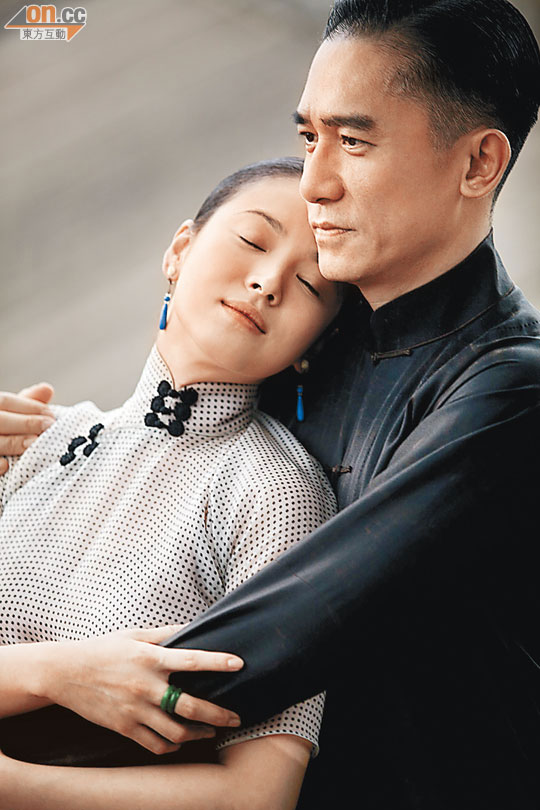
It begins with a fight in the rain between Ip (Tony Leung Chiu Wai) and several combatants, staged as a brutal ballet in various speeds, escalates through the number and various tactics of the opponents, and ends with the defeat of the strongest combatant.  Ip then flashes back on his life starting with his marriage to Cheung Wing-sing (the incredibly beautiful Hye-Kyo Song), and the news that the master of Northern China, Gong Yutian (Wang Quixiang) has retired and bequeaths the role of master to Ma San (Jin Zhang), with the caveat that the South should have their own master.  It is decided that Ip should challenge Gong for the right, and he is put to the test by three Southern masters before the match with Gong.  

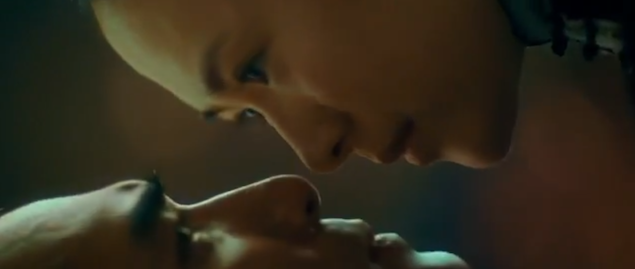
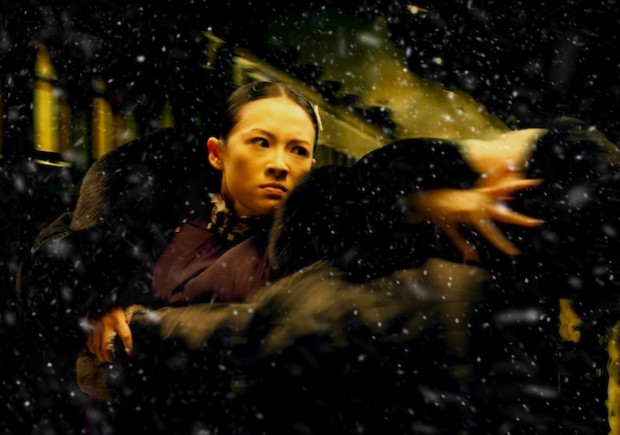
That match is anything but typical, has nothing to do with the training of the Southern masters, and Gong declares Ip his heir in Southern China.  That does not sit well with Gong's daughter Gong Er (Ziyi Zhang), who challenges Ip for the sake of family honor.  Their meeting and subsequent fight is an amusing affair of restraint and dexterity, and the fight concludes to Gong's satisfaction. Ip can only smile and say "I want a rematch."

Gong Er's moment of triumph.  You can see it in her face.

Now, despite this country-wide grudge match, and the Sino-Japanese War, which plunges the country into a depression and, as a result, sends Ip to Hong Kong to provide for his family, the film could not be more personal, keeping its eye on Ip, while, in the meantime, Gong, who has been only secretly trained in kung fu by her father, seeks revenge against Ma San, in a totally focused, life-sacrificing mission to the death.  The two are poles apart in purpose and drive and yet they are drawn together, players on opposite sides.  The film is a series of fights, the important ones, punctuated by a series of beautifully photographed scenes of domesticity and meditation, broken up into chapters of title cards, as from the silent film days.

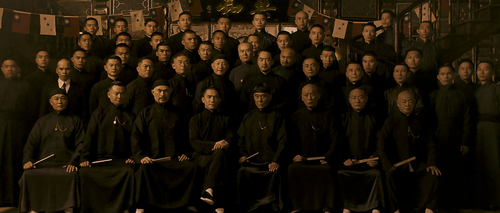
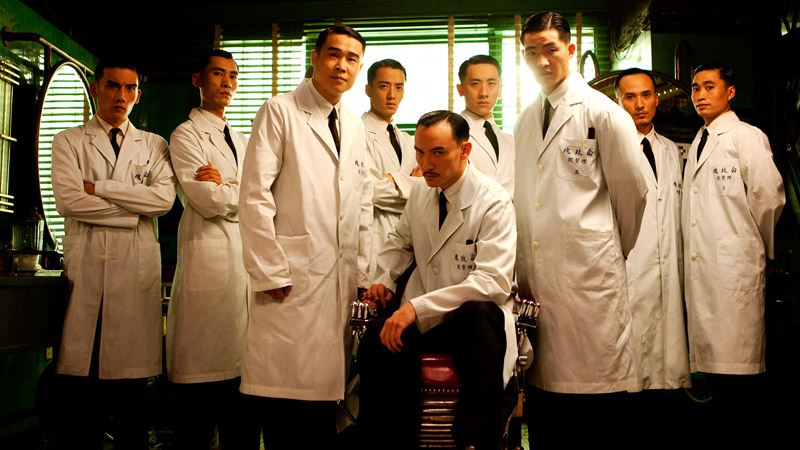
Wong's approach to this is very formal, the photography sumptuously lit, golden light betraying dark spaces and staged sometimes as formal portraits of a time and place, emotions run high, but not betrayed by the faces of the principals, the most expressive being Ip Man's wife, who disappears from the film very early on.  I'd be hard-pressed to find a more beautiful film to see this year, even if the beauty comes at a certain static quality that pushes the audience away, albeit gently.  And the fights are balletic brawls, filmed with depth and in tight close-ups, but at a pace that allows for position and space to be registered without sacrificing pace.  In fact, it's quite invigorating to see a slow-motion concentration edited quickly as the fights are done here, as it is during the first fight in the rain.  But, befitting the styles and other situations—the Gong Er/Ma San fight has its own bizarre energy-forceWong gives each confrontation a different presentation that makes each one different, and mesmerizing.

There is one odd, touching thing that brings up the ghosts of the past just as the title cards harken back to the silents, Wong brings to bear Sergio Leone as a touchstone by making sure that he gives Gong Er a borrowed theme from Once Upon a Time in America to communicate the regret she cannot express herself.  It produces goose-bumps, and not just from recognizing the source of the haunting cue, but for being so solidly apt and instantly evocative (Ennio Morricone can do that).  It's a beautiful, odd, off-kilter film.  I only wish to see more of it.

The Grandmaster is a shortened Matinee.


Portrait of the Artist as a Portrait-Artist:
Wong Kar Wai book-ends chapters in Ip Man's story with staged sittings

* There have been three other films, heavily fictionalized, on the same subject in the time that Wong was working on this film, as well as a couple television films about him.

Wednesday, December 12, 2012

Walking Kurosawa's Road: Sanshiro Sugata Part 2

The inability to write about the films of Akira Kurosawa to my satisfaction led me to to take a different path: start at the beginning, take each film in sequence, one after the other, and watch the progression of the man from film-maker to Master.   I'm hoping I can write more intelligently and more knowledgeably about his work by, step by step, Walking Kurosawa's Road.

Sanshiro Sugata Part 2 (Akira Kurosawa, 1945) Any director thinking that "they don't do sequels," should bear in mind that Kurosawa did one...with only his third feature film.  Before embarking on his next project, the soon-to-be Japanese Master was pressed by his financiers to follow up his popular judo film with a continuation of the story, following the path of Sanshiro, now two years in self-imposed exile, having abandoned his position as Judo champion.

Things have changed, but he hasn't.  The city he comes back to is now under occupation, and the disciplines that Sanshiro struggled so mightily to learn, seem to have little significance in this new atmosphere.

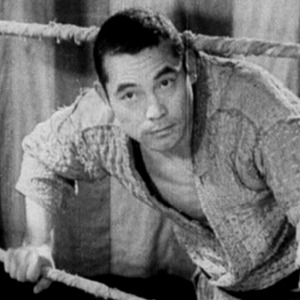
Returning home, his acclaim is widespread, but he's dissatisfied.  A promoter tries to entice him into participating in a match with an American heavyweight champion for money, something both against the rules of Sanshiro's dojo and his own hard-fought-for beliefs,  He attends, however, and is disgusted when the martial artist roped into the match is summarily pummelled before the crowd of blood-thirsty Americans and Japanese.


Things had changed for Japan, as well.  Defeated in World War II, and occupied by the United States, the country that Kurosawa made the sequel in was far different from the one in which he'd made the original.  And one can tell by the very first sequence, he bristled at it (despite the fact that the first film, made during the war, was chopped up by Japan's ministry, to the point where no original print exists).  Imagine my shock when the first words heard in this film are in English.  They come from a belligerent American sailor hectoring, then threatening his rickshaw-driver—the abuse comes in a different language, but the opening is parallel to the situation in the first film, only now it's Sanshiro who comes to the aid of the driver, in the position (flat on his back) that he was in at the beginning of the first film, before his transformation.


He retreats to his Master's dojo, but sinks into a deep depression while, simultaneously, training that young rickshaw driver he'd earlier saved.  His disciplines start to fall away, as he begins to drink, his fortunes falling as his young student's rises.  The dojo provides no respite and relief—he is challenged to a fight by a tag-team of brothers, the Higaki's (also brothers to Gennosuki Higaki, the previous film's final combatant), one extremely aggressive and the other, deeply insane, to exact revenge on their fallen kin.  He also reunites (discretely) with the woman who loves him, and with Gennosuki, who is now in ill health and seeks a reconciliation before he dies, a far cry from his brothers' path of vengeance. 


The battles Sanshiro must fight—and avoids fighting—are much like the battles raging in his own mind.  With his fame, and abilities still intact, he is caught in a dilemma of purpose—should he fight with the stakes becoming decreasingly honorable?  And how long can he maintain his reputation while avoiding confrontation (and does he even want that reputation—with its incumbent honor—anymore, given how cheaply and shallow the value others impose on it are?  Is his reputation worth it in such a world?  And will the matches with his own demons (represented by the brothers) keep him from maintaining his own "wa?" 

It's a universal problem negotiating the minefields, internal and external, that dot our lives.  But, there's something else going on here, given the context and the environment in which Kurosawa made this film.  This was his first post-war film after the Japanese surrender (Kurosawa paused in the filming of The Men Who Tread on the Tiger's Tail in order to listen to Emperor Hirohito's "Gyokuon-hōsō") and for the nation this was a crushing, demoralizing defeat, especially given the fervor that the government had invested in its people.


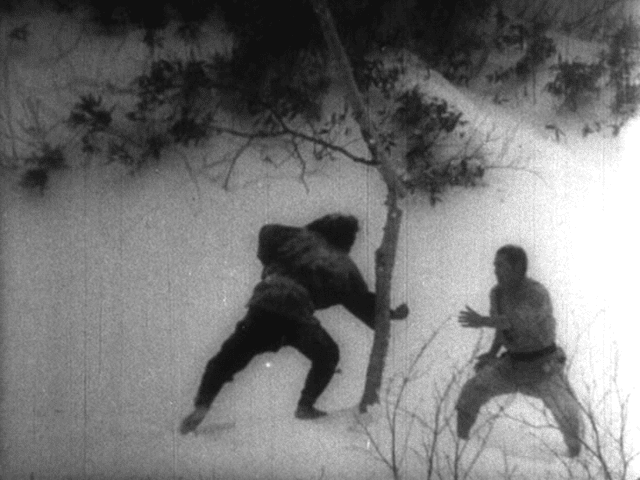
How does a nation, especially one so steeped in tradition and pride, endure after such a concession?  Kurosawa encapsulates the answer in the fighting brothers who have challenged Sanshiro, one incapacitated by an epileptic "spell," the other who fights the master on a hilltop—not of frantic wind-swept grass as the first film—but a precipice blasted by snow.  After a long struggle, where Sanshiro is mostly passively defensive, the revenge seeking Higaki is defeated and sent tumbling down the hill.  He is saved and tended to by Sanshiro, while under the baleful watch of the younger Higaki brother, who in a moment of clarity, understands Sanshiro's purpose and responds to his brother's lament with the same words...and a beaming smile.


The influence of the good, the dedicated, the humble, and the charitable perseveres in this world of defeat and cynicism.  One could take the position for seeking revenge, but how much better it is to have grace—not curling up and dying, of course—and follow the better path, as this most popular of Japanese heroes, demonstrates.

This may be the greatest sequel in all of film.  But more than that, it is a gift from an up-and-coming master filmmaker to his nation, at its most desperate hour, in gratitude for the opportunities he had been given, and providing balm, solace, and wisdom, to go on.  It is an amazing film, inside of itself, and outside in the world in which it was made.


Thursday, October 27, 2011

Walking Kurosawa's Road: Sanshiro Sugata

The inability to write about the films of Akira Kurosawa to my satisfaction led me to to take a different path: start at the beginning, take each film in sequence, one after the other, and watch the progression of the man from film-maker to Master. I'm hoping I can write more intelligently and more knowledgeably about his work by, step by step, Walking Kurosawa's Road.


Sanshiro Sugata (aka: 姿三四郎; aka Judo Saga) (Akira Kurosawa, 1943) Every hero's journey begins with the first step; it is true in this film's story and in reel life, this being the first full-length feature of legendary film director and stylist Akira Kurosawa.  One already sees reflections and echoes of the Master's work and influence rippling out from this one, even as it, itself, builds on the reverberations of Western film-making traditions.

Made during the Second World War and heavily cut by the Japanese government for sentiments that some petty bureaucrat probably imagined might hurt the war effort, Kurosawa's first big effort and first success has never recovered from the sword of the censor—the missing pieces have never been found. 

But, what there is proves enlightening...and telling.

It is a hero's journey.  Sugata (Susumu Fujita) is a novice fighter who wants to learn jujitsu, but is given short shrift by the school of martial artists he joins.  When they hear a master of the rival judo order is in town, the entire group decides to confront the man, Shogoro Yano (Denjirô Ôkôchi).  In a fight at a canal's edge, Yano takes on all comers, dispatching them into the frigid water—the first of many examples of the "last man standing" scenes that would dominate Kurosawa's film and his students, Sergio Leone (and also Clint Eastwood).  Those impressive results are all Sugata needs to switch disciplines, studying the ways of judo with Yano.

But, what the apprentice gains in skill he lacks in discipline, squandering his unfocused talents getting into sporadic street-fights that disappoint his Master.  In a desperate bid to win Yano's respect, Sugata dives into the freezing waters at the judo temple, risking his life, but also gaining an understanding of "satori," represented by the sight of a single blooming flower, growing straight and tall in the frigid waters.  The strength of Nature is revealed to him, and the apprentice has found the inner truth to master his craft. 

At that point, Sugata becomes renowned as the toughest fighter in town to beat, and he is challenged by jujitsu fighters determined to best him.  One can't help seeing the "gunslinger" analogy here, as the new guns and old challenge the now-humble, wiser Sugata to matches of skill to the death, like he was the "fastest draw."  Just as, no doubt, Kurosawa drew on Westerns for his martial arts saga, his work would come full-circle, inspiring Westernized versions of his work—specifically, The Magnificent 7 and A Fistful of Dollars.

It's an analogy to life itself—you make your way through it, and you may have what it takes, but it is only by knowing oneself and seeing the Bigger Picture that one can truly make a success of life.  Already, Kurosawa is tackling big themes.  But, you can already see his command of staging with Nature acting as an emotional well-storm, culminating in a passionate fight between two rivals for one woman's hand, on a wind-swept hill of violently whipping tall grass.

I have so many Kurosawa film reviews sitting in various drafts here at LNTAM, never feeling secure in my grasp of his work, so I've decided I'm going to start at the beginning and work my way through his career.  In the next few weeks, you'll be seeing more and more of his films cropping up here, a result of my own faltering tentative journey observing his remarkable work.  Hopefully, somewhere along the path, focusing on his work, I can achieve some wisdom about it.


Monday, January 14, 2008

The Curse of the Golden Flower

The Crouching Tiger in Winter

'What family doesn't have its ups and downs?" says Elanor of Aquitane in "
The Lion in Winter." Some family's more than others. Take the royal family in Zhang Yimou's "The Curse of the Golden Flower." The Emperor (Chow Yun Fat) is poisoning the Empress (Gong Li). The Empress has slept with her step-son, the Crown Prince. The CP is sleeping with the daughter of the Emperor's physician--who's providing the poison to the Emperor for the Empress. And the daughter of the physician, she's sleeping with the Crown Prince, too, and, well, it just gets a little messy at this point. And instead of King Henry's family-war of precisely chosen words, this family battles with ever-increasing sizes of armies, internecine plots and even ninjas who call to mind the flying monkeys of "The Wizard of Oz" albeit with razor-sharp scythes, and throwing weapons.

A technical element that reminds of "Wizard" is the stunningly ravishing (in all senses of the term) color photography that hasn't been seen since they stopped using the three-color-dye Technicolor process (or since Dorothy clicked her heels together and returned to sepia-toned Kansas). Zhang, even more so than in "
Hero" and "The House of Flying Daggers," suffuses the screen with a sumptuous chiaroscuro of reds, lavenders and golds--this is truly one of the most beautiful films to come out this year,* and it more than lives up to Zhang's past flashes of spectacle.

Dramatically, though, the film falls a little flat--setting up a confrontation that gradually escalates from hand to hand combat to eventually rivalling the endlessly epic battle set-pieces in the "
The Lord of the Rings" trilogy (and as the armies just kept getting bigger and bigger, it brought to my mind an old Chuck Jones cartoon where Bugs Bunny and Elmer Fudd engaged in a frantically escalating war: from knife to pistol to rifle to rolling cannon to BIG rolling cannon). After an extended bloody battle sequence, the movie ends where it began, only with a lot fewer characters and the biggest clean-up operation the Forbidden City has ever seen. Needless to say, there's going to have to be a new planning committee for next year's Chrysanthemum Festival.

"The Curse of the Golden Flower" is just too beautiful and detailed to be appreciated on the small-screen, but too inconsequential to pay full-price. Find a cheap matinee and enjoy the colors.

* I rushed out to see "The Curse..." because of the past intimate, intricate sound design of
Tao Jing, hoping that he would surpass the masterful job done on "The House of Flying Daggers." Alas, although the design is a marvelous skein of chimes and movement, the best sounding film I've heard this year is "The Fountain."