Showing posts with label Chinese. Show all posts

Wednesday, October 14, 2009

Chungking Express

"Chungking Express" aka "Chung Hing sam lam" aka 重慶森林 (Kar Wai Wong, 1994) One of those little miracles that happen in a film-maker's career. Wong Kar-wai was making a historical epic that bogged down and to clear the cob-webs and stretch his film-making muscles made a quick, contained film that exceeded all expectations. "Chungking Express" as it is known in the West* contains 2 1/2 linking stories (a third became Wong's later "Fallen Angels") of split-second encounters between characters, and except for two extended shots of a night sky, are completely contained in the boxy locations and tunnels of the locales. The first features Brigitte Lin as a drug-runner/hit-woman, bedecked in noirish blond wig and sunglasses (at night) who gets stung in her own sting under the unsuspecting nose of detective He Qiwu—Badge no.223 (Takeshi Kaneshiro), who encounters her, contrary to both their jobs, in a bar where they're both drowning their sorrows; he, over a relationship that he's finally admitted is over, she, over her deal gone wrong.

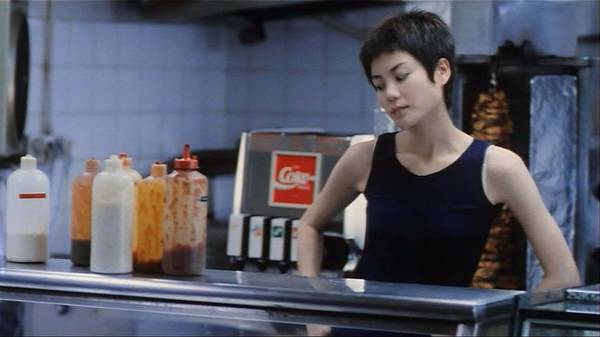
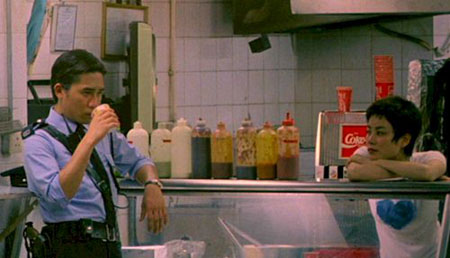
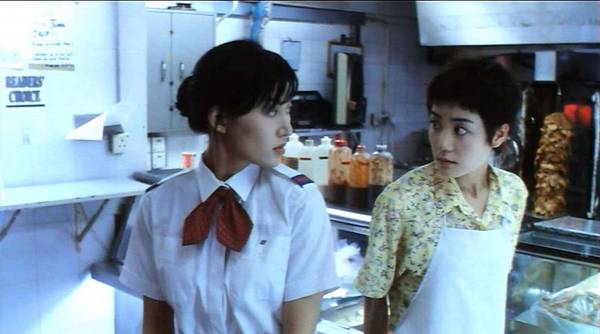
Qiwu hangs out at the Midnight Express fast-food stand, where the owner keeps trying to set him up with his waitresses, but he's never fast enough before another man steps in. He's just too late to start dating
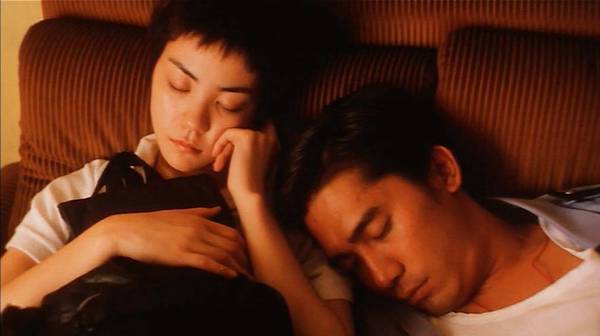
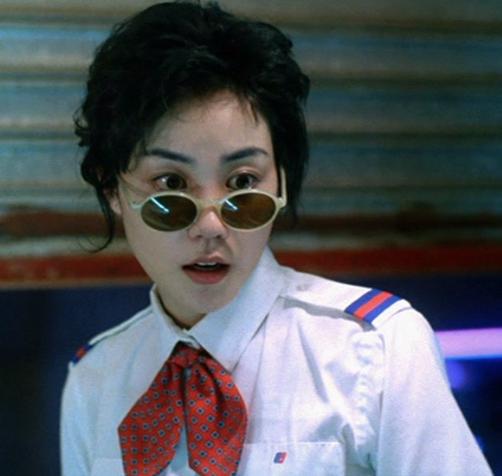
the new waitress, Faye (Faye Wong), as she's just developed a crush on another regular customer—a traffic cop, known only in the film as no. 633 (Tony Leung). He's just broken up with an airline hostess, and not getting over it. So Faye sneaks into his apartment and starts changing...everything, and he's so pre-occupied that he doesn't register the stuffed animals that have appeared, the different food in his cupboards, the more colorful decor—all he knows is...he's getting happier.

Time is a problem for everybody passing the Midnight Express. For the smuggler, the longer time goes by, the less control she has over her shipment. Qiwu has broken up with his girlfriend and is giving it exactly one month before he will admit it's over.
633 will let time pass him by unless Faye steps in and speeds things up a bit (and she is always shocked if he happens to do just that).

And Wong plays his own tricks with time, not just by compressing it with some stylish editing tricks, but also elongating it in the first section in moments of high action, chases and fights;
the actions become a blur and bodies and lights turn into cartoonish in-betweening streaks of speed that allow for a better handle on what's happening than just depending on jerking hand-held shots at the blistering pace of life.** Music plays a major role with key songs punctuating the stories reflecting mood (from reggae to ballad-rock to lounge) but also the polyglot of cultures combining in "The Mansions."

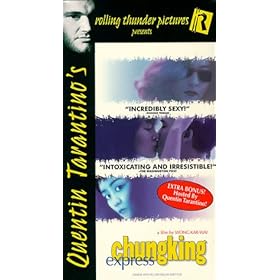
"Chungking Express" is a favorite of mine, as I first encountered it in theaters after a divorce and it's themes of coming to terms and revivification—and that life isn't a series of highlights and benchmarks, but a on-going process of becoming—touched me at a vulnerable time. To re-connect with it again (albeit, disguised in a rather incongruous "Quentin Tarantino Presents" formatting—his commentary on it is slightly annoying, but his enthusiasm infectious) is like bumping into an old friend you hadn't seen in years ("You remember that time...?)


* The Chinese title actually translates to "Chungking Jungle;" the Western title is a split between the name of the locations—The Chungking Mansions, the setting for the first half of the film and "Midnight Express" a fast-food stand that serves as a fulcrum for the film.

** A fascinating combination of the skills of the director, cinematographers Christopher Doyle and Wai-keung Lau and editors William Chang, Kit-Wai Kai, and Chi-Leung Kwong.

Thursday, April 30, 2009

Lust, Caution

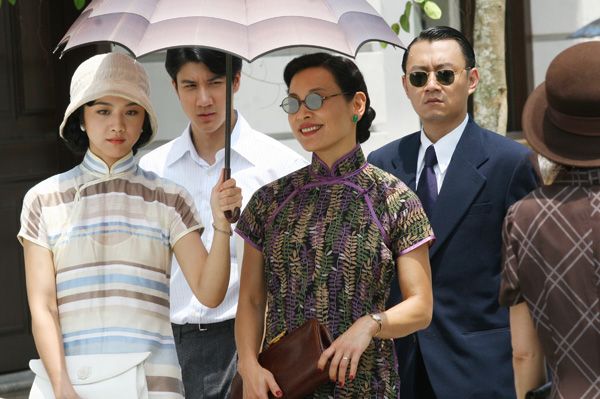
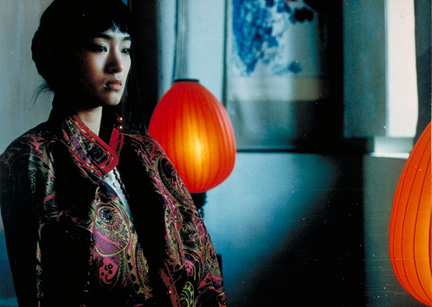
"Lust, Caution" aka "Se, jie" aka 色,戒 (Ang Lee, 2007) Despite its NC-17 rating, "Lust, Caution" is a spy thriller, not a sex film (the "NC" rating was created to separate films of merit that had explicit sexual content from the porn-dominated "X" rating, but it doesn't seem to have translated for mainstream audiences). A group of drama students in Japanese occupied Hong-Kong put on a patriotic play that raises donations for the resistance. But the play's director ("Typical director," says one of the actors, "he never listens to anyone else.") decides it's not enough to raise money—a relative of his has discovered his employer is a Chinese collaborator, and the student troupe in a surge of patriotism (and drunkeness) vow to assassinate the man, Mr. Yee (Tony Leung Chiu Wai). They set up an elaborate ruse insinuating two of the troupe as prominent business-people and over shopping trips and mah-jongg games befriend Mrs. Yee (Joan Chen). Before long, the smartest and most gifted of the actors, Chiang Chi (Wei Tang) has caught Yee's eye, and makes plans to set him up for the kill.
Despite spending hours at the movie theaters watchingIngrid Bergman and Cary Grant movies (Lee uses them specifically), she would have saved herself a lot of grief if she'd seen the only movie the two starred in together, Alfred Hitchcock's "Notorious" (1946)." Spying is probably the world's second oldest profession, seeing how inexorably linked it is with the first. In "Notorious," Bergman's floozy socialite is used by intelligence services to infiltrate a Nazi cell by playing on the affections of one of its leaders. She's a honey trap, using her target's weakness for her as a weapon. Her superiors (in all matters, save moral) are only too willing to let Bergman's character prostitute herself for their ends. And like Louis Calhern and his hypocritical "Notorious" cronies, the actors-playing-resisters are only too willing (while feeling somewhat guilty) to let Chiang Chi seduce Yee.

But this is where the drama is. "Lust, Caution" was attacked by some for its "plodding" pace, and
its contained emotions, but it deals with masquerades and the subjugation of self for appearance, something that everybody* knows and buys into as a matter of course. For Lee, its another of his "repression" films, be it "Sense and Sensibility" or "Hulk" or "Brokeback Mountain" where the Id's fight is the prominent conflict on-screen.

As far as spies are concerned, this is the very well-plowed field that
John le Carré has toiled in for years, where the loyalty of the heart
betrays loyalty to duty or country. Depending what side of the Cold War you situate the tale it is a Triumph of the Will for good or bad.

So "Lust, Caution" slots in well with both the spy genre and Lee's ouvre, and one day, one hopes it might be re-discovered as a highlight of both lists.

Ciang Chee realizes her friends have no problems prostituting her.


* Well, everybody but Madonna....

Saturday, January 31, 2009

Raise the Red Lantern

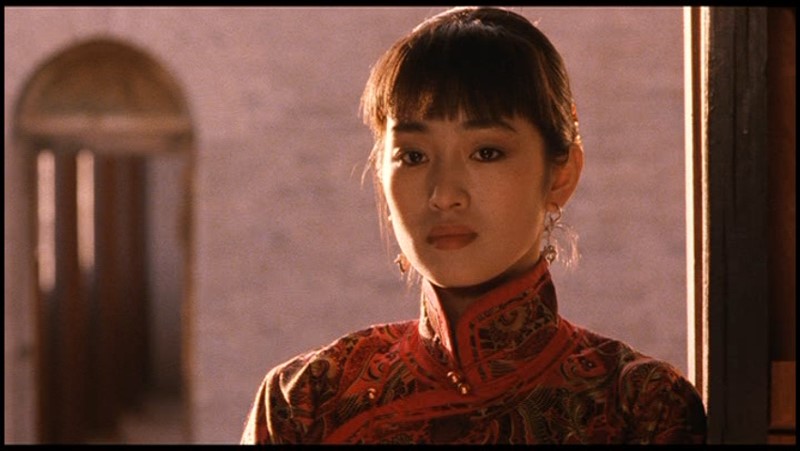
"Raise the Red Lantern" aka "Da hong deng long gao gao gua" 大紅燈籠高高掛 (Yimou Zhang, 1991) Typically gorgeous Zhang Yimou film, although at this early stage with a very limited budget. But that doesn't limit his imagination. The film is staged (with the exception of a prologue) in an clutch of houses, which are the enclave for The Four Mistresses of The Master. Wife #4 Songlian (Li Gong) was a college student who dropped out when her father died, and now is the new bride, the youngest and most frequenly sought by The Master for her favors. Every night is a competition among the wives as the one for whom the red lanterns are raised receives special treatment. This leads to duplicity and deception and Songlian is caught in the middle and learns cunning when dealing with the outwardly polite, but squabbling mistresses.

The compositions and colors are as sumptuous as one has come to expect from Zhang, but his manipulation of light is just as impressive, the film descending into murky twilight as the bitter consequences of the Mistress' actions become apparent, and the psychological wounds tear at the women. Although the acting is by and large austere, the director keeps the emotions brewing through his subtle manipulation and triangulation of passed looks and simmering reactions. Very early in his career, it shows Yimou Zhang as a master of formal cinema, and capable of great effect with merely actors and a limited location. As he embraced new technology and expanded his horizons, his cinema would explode. with possibilties. He is one of the few directors whose work I always anticipate.

Monday, January 14, 2008

The Curse of the Golden Flower

The Crouching Tiger in Winter

'What family doesn't have its ups and downs?" says Elanor of Aquitane in "
The Lion in Winter." Some family's more than others. Take the royal family in Zhang Yimou's "The Curse of the Golden Flower." The Emperor (Chow Yun Fat) is poisoning the Empress (Gong Li). The Empress has slept with her step-son, the Crown Prince. The CP is sleeping with the daughter of the Emperor's physician--who's providing the poison to the Emperor for the Empress. And the daughter of the physician, she's sleeping with the Crown Prince, too, and, well, it just gets a little messy at this point. And instead of King Henry's family-war of precisely chosen words, this family battles with ever-increasing sizes of armies, internecine plots and even ninjas who call to mind the flying monkeys of "The Wizard of Oz" albeit with razor-sharp scythes, and throwing weapons.

A technical element that reminds of "Wizard" is the stunningly ravishing (in all senses of the term) color photography that hasn't been seen since they stopped using the three-color-dye Technicolor process (or since Dorothy clicked her heels together and returned to sepia-toned Kansas). Zhang, even more so than in "
Hero" and "The House of Flying Daggers," suffuses the screen with a sumptuous chiaroscuro of reds, lavenders and golds--this is truly one of the most beautiful films to come out this year,* and it more than lives up to Zhang's past flashes of spectacle.

Dramatically, though, the film falls a little flat--setting up a confrontation that gradually escalates from hand to hand combat to eventually rivalling the endlessly epic battle set-pieces in the "
The Lord of the Rings" trilogy (and as the armies just kept getting bigger and bigger, it brought to my mind an old Chuck Jones cartoon where Bugs Bunny and Elmer Fudd engaged in a frantically escalating war: from knife to pistol to rifle to rolling cannon to BIG rolling cannon). After an extended bloody battle sequence, the movie ends where it began, only with a lot fewer characters and the biggest clean-up operation the Forbidden City has ever seen. Needless to say, there's going to have to be a new planning committee for next year's Chrysanthemum Festival.

"The Curse of the Golden Flower" is just too beautiful and detailed to be appreciated on the small-screen, but too inconsequential to pay full-price. Find a cheap matinee and enjoy the colors.

* I rushed out to see "The Curse..." because of the past intimate, intricate sound design of
Tao Jing, hoping that he would surpass the masterful job done on "The House of Flying Daggers." Alas, although the design is a marvelous skein of chimes and movement, the best sounding film I've heard this year is "The Fountain."