Showing posts with label Spy. Show all posts

Saturday, August 31, 2013

Ice Station Zebra

Ice Station Zebra (John Sturges, 1968) The movie that was (supposedly) Howard Hughes' favorite movie—one that he would watch obsessively.

One can only wonder why.  It is not exactly inspired, entertainment, though competently directed by John Sturges.  It was also one of the last of the prestigious "roadshow" presentations , shot in "Super-Panavison-70" and featuring "Overture" music and an Intermission at the theater.  But, beyond that, the film may be one of the dullest thrillers ever filmed. 


ISZ has the same stolid air of other adaptations of Alistair MacLean adventure yarns (The Guns of Navarone, Where Eagles Dare).  It's just not as adventurous, and the locations—studio-created—are claustrophobic and closed-in, as opposed to having any dramatic vistas or intriguing locales of other MacLean stories.  Here, it's meeting rooms, a submarine and a burned out polar station on a floating ice flow.  People don't get out much, and the whole film feels close and boxed-in (quite a trick in "Super-Panavision-70). Oh, there are intrigues—it wouldn't be a MacLean story if there wasn't one or two double-crosses thrown in—but they're fairly typical.  The sub' has to have a debilitating leak, and as befitting a Cold War drama (the coldest!), there are dueling loyalties and the to-be-expected double-agent (but who?).  It never rises above the slightly edgy to the exciting and is mostly clichĂ©-ridden, especially when it comes to the "whodunnit" aspects.


Fairly good cast with not much to do except glower at each other, and top-liner Rock Hudson isn't at his best at that, and is ham-strung by the script (by MacLean, Douglas Hayes—he wrote Kitten with a Whip, after all—Harry Julian Fink, and W.R. Burnett, no slouches, any of them) from doing anything interesting, like humor.  Patrick McGoohan has one interesting scene where he loses it, but mostly he's clipped and acerbic in hyper-Danger-Man mode.  Jim Brown matches him frown for frown—twin performances by actors playing characters hating each other, and Ernest Borgnine does a Russian accent.  A lot of testosterone, mostly going to waste, in material which is stretched to the breaking point.

Supposedly there's going to be a remake, so there's a lot of room for improvement. 


Patrick McGoohan recreates my expression watching this movie


Wednesday, July 3, 2013

Ministry of Fear

Ministry of Fear (Fritz Lang, 1944) So, here's the joke: a man walks out of an insane asylum and finds the world is crazier than he is.  

But, then, it usually is in Lang's films.  The forces of evil or nature are such that we don't stand a chance unless our own better natures or our just plain "stick-to-it-ive-ness" allows us to survive and move through.  And in Lang's directorial vision, the film frame is as much a trap as anything else, one that can be violated by unseen dangers that will drop into frame as if materialized by a malicious God out of nowhere to threaten those within it.


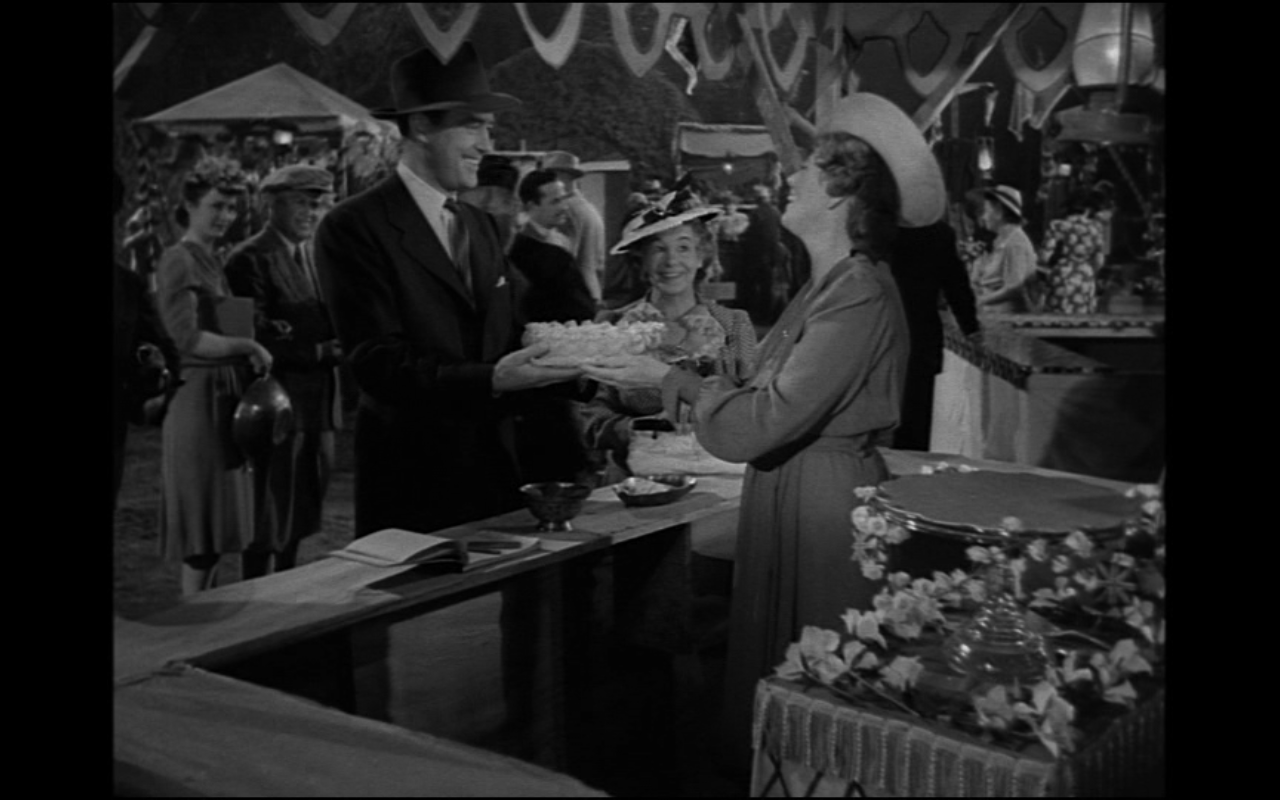
Ministry of Fear, based on a Graham Greene novel published the previous year, follows the dogged tracks of Stephen Neale (Ray Milland) as, having been released from Lembridge Asylum, he awaits a train to London and decides to pass the time at a charity fĂȘte supporting "The Mothers of Free Nations" where there is a booth for guessing the weights of cakes.  After dropping a shilling on a wrong guess, his next stop is a fortune teller's booth, where he's astonished to find the woman giving him the exact weight of one of the cakes at the booth across the way.  Neale can't resist using his knowledge (and testing the medium's prediction) and is astonished to find that he's guessed correctly and won.  


Everything's a little off-kilter in Fritz Lang's world.

Off to his train he goes, not knowing that his taking the cake has caused a commotion back at the tents and exhibits.  The cake has "gone" to the wrong man, intended for another (Dan Duryea).  On the train, Neale's cabin-mate is a blind man to whom he offers a slice.  But, Neale is astonished to find that instead of eating his portion, he's crumbling it in his hands.  The blind man is no blind man, and he attacks Neale, steals the cake and jumps off the train, pursued by Neale.  But it is the time of the Blitz, and as the two chase through a field in the night, bombs begin dropping, targetting their train.

Okay.  We'll stop there.  But, already, things are not what they seem, people are not who they say they are, and nobody can be trusted...not even a damn pastry.  It's not a cake, at all.  It's a MacGuffin, the movie-making slang for the object that the players in a movie seek (and has a sliding scale of relevance and importance*). 

The subsequent fandango has Neale involved with "The Mothers of Free Nations," a seance, dodging bullets with the police and secret service, and all sorts who pretend to be something they're not.  It's enough to drive a sane man crazy—if one hadn't already left an asylum.  That time in crazy-land might actually have steeled Neale for his subsequent adventure, which is no piece of cake.  Lang was the master of the paranoid thriller (at least until Alan J. Pakula teamed up with Gordon Willis in the post-Watergate 70's) and his ordinary man caught in the extraordinary is the very DNA of a Hitchcock thriller—in fact, Ministry of Fear might have been one of those that "got away" from The Master of Suspense.  With its seances, wolves in bureaucratic clothing and things that go boom in the night, all it needs is a national monument to be pure Hitchcock.  It's a fun, terrible ride, well worth seeking out.


*

Tuesday, November 13, 2012

Skyfall

Once More into the Security Breach, Dear Friends...
or
"Old Dog.  New Tricks."

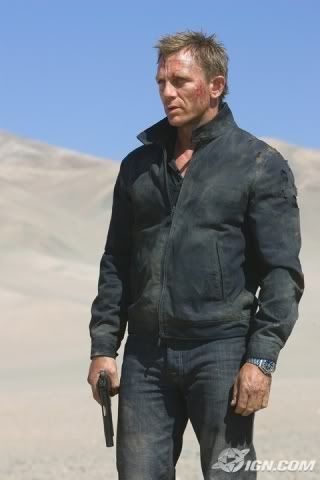
Bond is back, as promised, a longer wait than usual.  But with the Bond series (this is the 23rd "official" film from EON), that's usually a good thing.  After 50 years, there have been enough of the slap-dash ones that have been sub-par in order to get "product" into the theaters every biennium.  The Bond films have always been best when Cubby Broccoli's kids take a couple years to plan, take a breath and then throw themselves pell-mell into a fury of film-making that lasts less than a year, but creates something above and beyond what has been done in the past, both within the series and by its competitors.  Those interruptions usually occur with a change-over of studio or lead actor.  In this case, M-G-M's past financial cliff (if we want to be current) gave a couple more years distance between this one and its predecessor, Quantum of Solace—which entered production with an unfinished script, an overcompensation of chase scenes, and a misguided editorial effort to make the Bond series re-Bourne.  It was a decided stumble, after the brilliant series re-boot in Casino Royale, which tossed aside the easy laughs that were purloined for the "Austin Powers" movies and went back to Fleming's book (written in 1954) and found ways to make it work in a 21st Century without jet-packs.

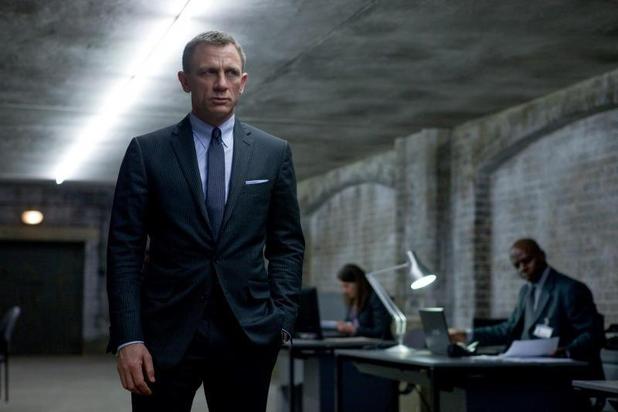
EON should take all the time it wants if something like Skyfall is the result.  Based on a story outline by Peter Morgan (The Queen), then fleshed out and re-tinkered by series regulars Purvis and Wade, and polished by John Logan, the script is a fine thriller in the odd "out-there" Bond tradition, while also making comments about the series and its relevance in the world.  And as directed by Craig-pick Sam Mendes (they'd worked together on Road to Perdition), photographed by Roger Deakins, and edited by Stuart Baird, it takes the Bond series to stylish heights it hasn't achieved in years.  This one is sumptuous, looks great, has great dialogue, and isn't one long chase from start to finish.  This one is decidedly old-school, God save the Queen.

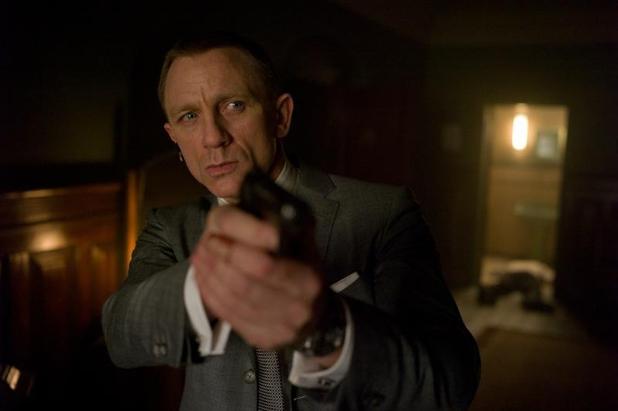
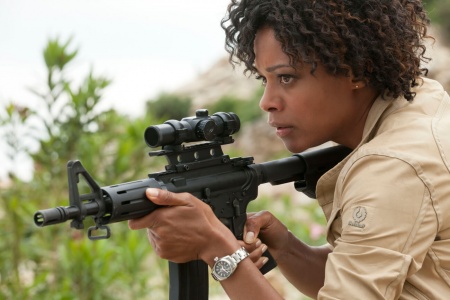
Somebody had better save her, and if Her Majesty isn't directly in danger, her stand-in, head of the Her Majesty's Secret Service, will serve.  An assassin has swiped a hard-drive with the names of embedded agents in terrorist organizations.  Two agents are dead.  One's dying, and Bond (Daniel Craig) tries to staunch his bleeding, but is rebuffed by his boss "M" (Dame Judi Dench, again) over his head-set: "Leave him."  And with a curt "Yes, mum"  Bond abandons the dying agent, miffed, but in pursuit, throughout the bazaars, streets and railways of Istanbul, with the aid of a female operative named Eve (Naomie Harris, a fine addition to the cast). It's a rough-and-tumble, messy fight with a lot of improvisation, a lot of destruction to property, old and new, and a last minute attempt by Eve to try to take out the assassin (Ola Rapace) before the train disappears into a tunnel.  But she hesitates, fearing she'll hit Bond.  "Take the bloody shot!" barks "M" and she fires, and Bond is hit, knocked off the train and falls hundreds of feet into a river, where his body is swept away.  The assassin and hard drive are gone, and so is Bond, sinking into a particularly macabre title sequence by Daniel Kleinman to Adele's defiantly melancholy title song

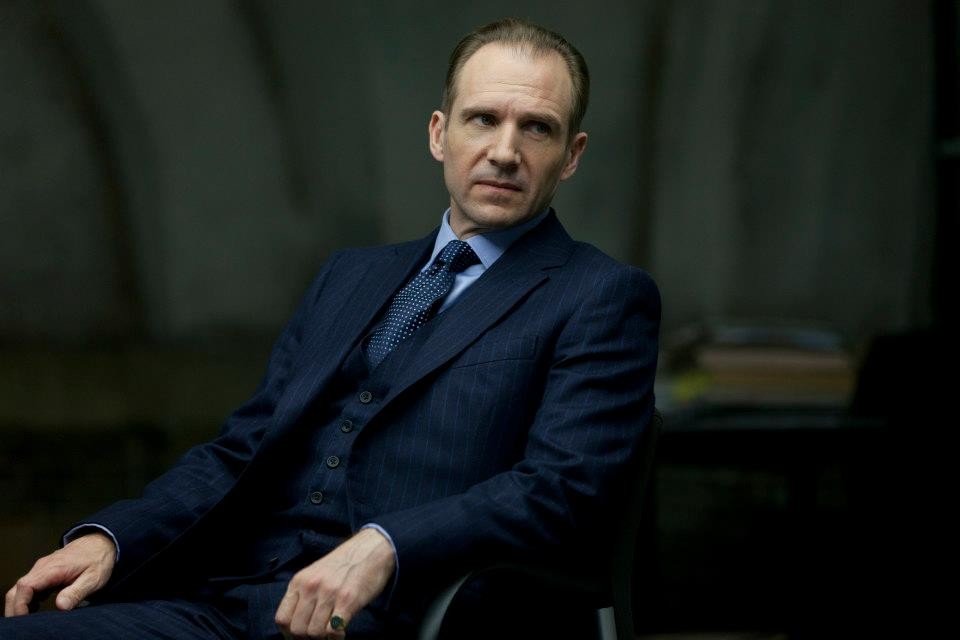
Wow.  But, we've seen this before.  Bond died (surreptitiously) in You Only Live Twice, and Fleming's novel of the same name had Bond lost in a mission,* only to have him return in the next novel "The Man with the Golden Gun," brainwashed by Soviet agents to attack MI6 headquarters and kill his boss.  That doesn't happen here, but the outcome—"M" sending 007 on a mission somewhat ill-prepared to either prove himself or die in battle—does.   As far as "M" is concerned, she's on the way out anyway, a victim of the botched operation and its ramifications in what the Minister of Intelligence (Ralph Fiennes) euphemistically calls "retirement planning."

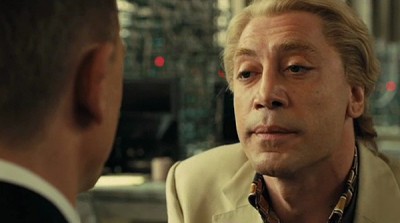
Seems that hard-drive has fallen into the wrong hands, a particularly misguided hacker named Silva (Javier Bardem), with a score to settle with MI6, exposing its agents and doing as much damage to the organization and Lady "M" as possible.  Britain's spy network is in retreat, ironically having to go to ground and reorganize with means both high-tech and historical to gain the upper hand.


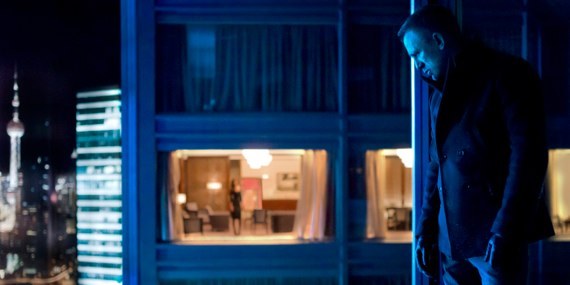
Roger Deakins' cinematography is, at times, breath-taking.

That's the first 15 minutes or so of Skyfall, and one is loathe to reveal much else, even though, for a series that has depended on formula story-telling for so long, there is much that is surprising and different about this chapter.  For instance, despite the film being (as it always is) about Bond, there is much more supporting cast here with more to do than previous films in the series, more humor than previous Craig films (and not the kind of low-pun stuff that passed as humor—and writing—during the Moore and Brosnan years) with nice jabbing dialogue that doesn't just reveal plot, but attitude and character.  For instance, an MI6 analyst doing a perfunctory word-analysis on Bond (we've seen a bit of it in trailers) is a fine examination of 007's sophistication, wit and grit.  And when, later he's grilled by Silva about his hobbies, Bond says one word: "Resurrection."

Apt answer, that, but one can apply it to the entire series, as well.  Whenever the movies push the envelope on outlandishness (You Only Live Twice, Moonraker, Die Another Day) the production team steps back, takes a breather, and takes Bond back to his roots creating better than average entries (On Her Majesty's Secret Service, For Your Eyes Only, Casino Royale) and reinvigorates the possibilities of where the character and the movies can go, usually falling back on Fleming for a guide.


But the Fleming titles are gone (except for three odd ones), the stories (mostly) filmed, so Skyfall only takes inspiration from the author, specifically the novel version of "Golden Gun," and instead of the film having Bond "go rogue," this time, he does just the opposite, coming back to the fold in a time of crisis, tossed out on his mission by "M" to prove himself and the viability of the secret service and its methods.

The results are extraordinarily good, making this the best of the original movie stories not directly linked to Fleming and depending less on protracted action scenes, but emphasizing suspense and crackling good dialogue.  As "M" speechifies in her competency hearing, the targets are smaller, more dangerous, less predictable, and no longer tied to nation-states that can be manipulated by politics.  Now, it's individuals with access to disrupting vulnerable infrastructures that hold societies together and who will cause damage just to make a point.  One can draw parallels to Julian Assange (Silva uses YouTube to identify agents) and his unquestioning devotion to exposing anything and anyone—as long as it's not himself.

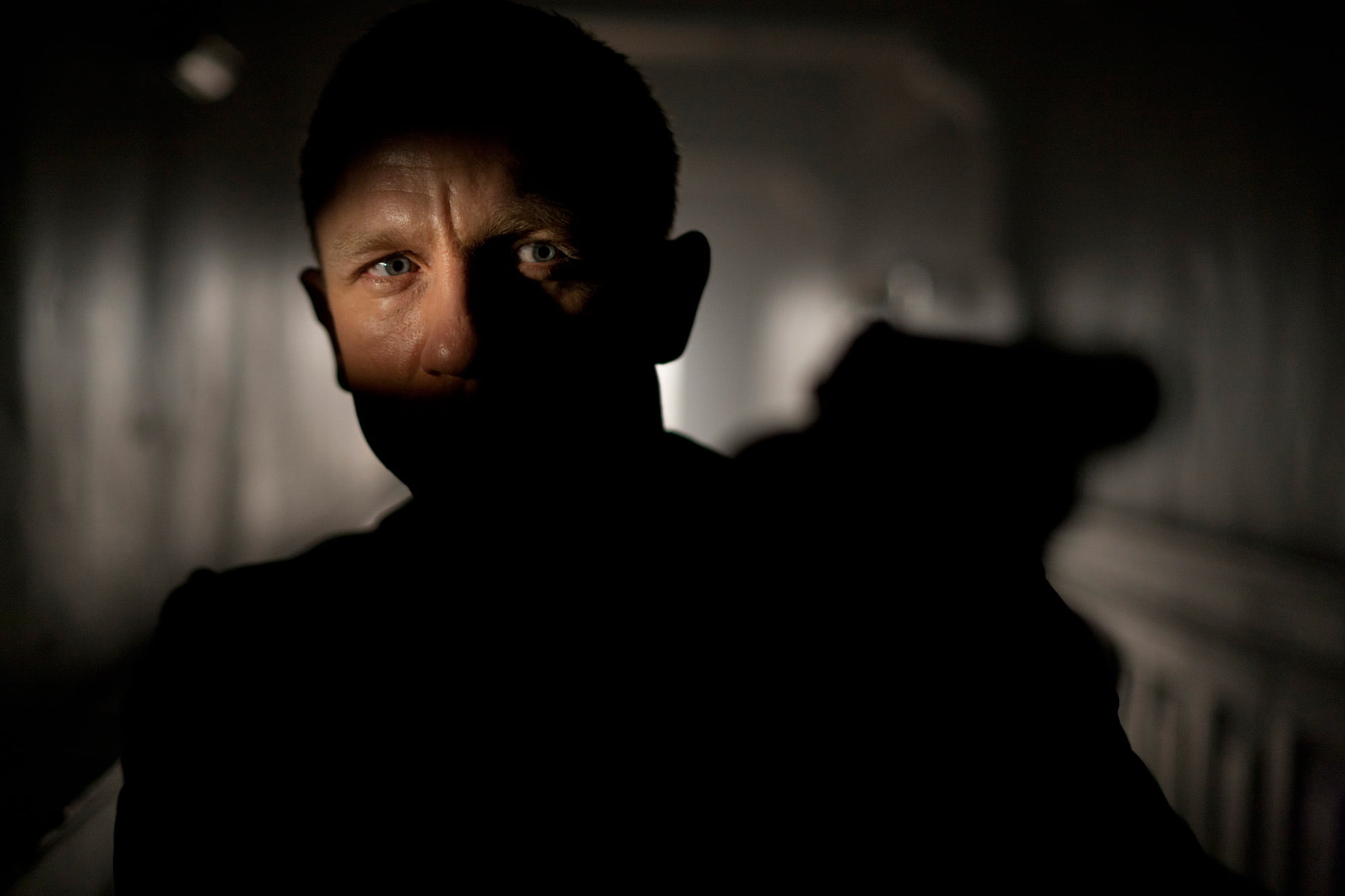
The cast, as it has been for awhile, is uniformly excellent.  Craig's Bond is just as steely, just as obstinate, but the actor enjoys playing him as a bit of a wreck, physically and mentally.  His Bond, after a time away, is not the man he was, and he goes through the film slightly hampered, his eyes hooded and bleary, his appearance often haggard and mussed, his demeanor prickly and defiant.  Dench has far more to do than any "M," and any past tremulousness is gone, and she's excellent in every way.  Ralph Fiennes plays his role quietly and competently with a heavy gravitas—he's a fine addition to the cast.  The Bond women, this time out, are very interesting and not just decorative: field operative Eve is cheeky and gives as good as she gets (that'll become important later), and as the femme fatale of the piece, BĂ©rĂšniece Marlohe has a brief, but well-played expertise—her Severine has a dragon lady's cool, with a sex-worker's high-contrast too-bright smile that droops with a crash, revealing a trapped animal.  Ben Whishaw's "Q" is a contrast to what has gone before, far younger, far more tart than Desmond Llewelyn's court-jester toy-maker, but a whipper-snapper computer whiz.  Albert Finney has a small, pertinent role (that could have easily gone to Sean Connery, but it was thought he'd be too 'distracting," according to Mendes).  And Bardem makes his villain creepy-scary in the best tradition of the series, jolly in his evil, but believably so, cracked from his past and with an atypical physical deformity (as Fleming was wont to endow) that feels right given the context and is the stuff of nightmares.

After a high-powered finale—yes, things blow up as they do in Bond films, but not the way one expects—and by the end, Bond truly has gone back to his roots, as anyone who's looked at  the early Bonds will be able to tell, with ghosts left behind, family in place, and tradition—the old ways—firmly established.  Bond is back, and will be back.  With pleasure.

Can't wait.


Skyfall is a Full-Price Ticket.


"...the things we do for England..."


* Fleming killed Bond off twice...at least left readers on the edge of their last pages—in "From Russia With Love" and "You Only Live Twice," and one suspects he had the same love/hate relationship with his character as Arthur Conan Doyle did with Sherlock Holmes, killing him off over the Reichenberg Falls, then returning him years later, at readers' request.

Thursday, November 1, 2012

Argo

Hoo-Ray for Hollywood (grumble)
or
The Best Bad Idea We Have...By Far

The 1979-1981 Iranian hostage crisis, the 444 day ordeal of the American Embassy workers captured and held by a well-organized angry mob (funny how those angry mobs in the Middle East have a sustainable infrastructure that can keep the ball...and the U.S...in the air for over a year), was an event that gave us our first taste of extremist Muslim terrorism and the presidency of Ronald Reagan (Way to go, Iran!  Can't wait to see the inadvertent fallout from your nuclear program!).

One of the back-stories of the whole magilla was what became known as "The Canadian Caper," where six of the workers walked out of the Embassy and stayed at the Canadian ambassador's residence for a nice chunk of the crisis and managed to fly home  under the noses of the cracked-down Iranian security thugacracy.  What was not known was that the operation to extricate those workers—on the QT, hush-hush, and only recently declassified—was the work of the very agency that was being blamed for the Shah's presence in the first place*—the CIA.

The story of the very weird "Mission: Impossible"-styled rescue is told in Argo, the third film to be directed by Ben Affleck (after Gone Baby Gone and The Town) and it's his most assured movie to date.  It's also his safest and least nuanced.  Maybe the story is so bizarre, so full of dangerously easy irony and satire, that the director in Affleck felt the need to tone things down on his style (much the same way that Affleck the actor does here, as well, in his performance as CIA advisor Tony Mendez) and just "stick to the facts" and get his recreations down right (there's enough pride in this that the end-credits show a split-screen of archive footage and movie film footage to prove the point), thinking he'd be guilty of "gilding the lily" or even undermining it by...I don't know...showing any "style," other than switching film-stocks and shooting in a "found-footage" way of snatch-and-grab.  And yet, were that true, the film might have had a far more different ending, rather than the one Argo actually presents.  It would have been nice to throw in some of Affleck's previous shooting ingenuity, rather than create the dichotomy that Argo ultimately presents.

It is a story that captures the imagination.  Six of the American embassy workers in Tehran manage to hole up at the residence of the Canadian ambassador, but time is of the essence as the Iranian guard are closing in on their location after carefully piecing together intel from the embassy.  The wonks at the State department and CIA try to come up with a scenario that might get the workers over the border—bicycles—but Mendez is skeptical of putting the six out in the open for a "casual" bike trip of a couple hundred miles.  Mendez's scheme (hatched after a viewing of a "Planet of the Apes" movie) hides them in plain sight—have them pose as a scouting group for a sci-fi movie that needs a desert location (like, say, Iran) and have the group (who have appeared out of nowhere) just fly out under those assumed roles and identities working on a project viable enough to be fact-checked at the time of departure.

So, Mendez recruits an industry friend, John Chambers (John Goodman), who has done extensive make-up and prosthetics work for the CIA and the Army (as well as winning an Oscar for his monkey-faces on those "Planet of the Apes" movies) to start a project that has enough publicity splash to make it all the way to Iran. A producer, Lester Siegel (a fabrication and played by the masterful Alan Arkin), is recruited to lend industry cred and get the word out to the press, allowing Mendez to fly to Tehran to train the hostages on their roles, synchronize watches, and sweat the details, which are many and widely scattered.

The idea is so crazy and "out there" that it "just could work."  The beauty of it is that it did,  but not quite in the way Affleck and scripter Chris Terrio would have us believe.  In fact, the final "ex-filtration" is so nested with complications and roadblocks—and a seeming need to fulfill some perceived action quotient—that it becomes frustratingly conventional in a "Hollywood" sense. 

This is slightly gear-grinding.  By now, we should be so used to The Movies' need to dramatically enhance actual events, that it shouldn't come as a surprise that some fact-tinkering is involved.  But, Affleck's film is so cynical of Tinseltown tampering,** that it's a little cake-eating to then rely on such notions for a white-knuckle finale, as the actual situation is tense enough without having to also (oh, I don't know) stage a gunfight on the sinking Titanic.  And it strains credulity that at each checkpoint on the way out, everything must come down to the wire, in the very nick of time...every...single...time.  I mean, didn't anything go right on this mission? Sure, the whole thing was a "Hail Mary" pass, but some of the planning had to have come off.  The story had a genuine happy ending.  Did it have to be The Ultimate Happy Ending?

Maybe the election year has got my fact-checker in overdrive, because up until then, Argo is a measured, understated, restrained, almost bloodless film, that manages to be smart, clever, and tense.  And while there's very little of the flair displayed in his first two films, it is a fine example of Affleck's impeccable sense in casting (although—quibbling again—he might have had someone genuinely Latino to play Mendez), and having the great good sense of staying out of his actors' way.

It might not be Affleck's best work to date, but for all that could have gone wrong, the results are quite impressive.  Hmm.  Maybe art does imitate life.

Argo is a Matinee.


The "Canadian Caper" embassy workers with President Carter


Argo concept art, created by comics veteran Jack Kirby

* The movie gives some back-story but is a little cagey in what it leaves out.  The CIA "coup" deplaced the democratically elected Persian prime minister Mossadegh who had the affrontery to nationalize the Iranian oil industry (pissing off the British) and flirting with communists (pissing off the Americans) and returned the Shah, who'd only fled the country fearing a communist take-over, to power.

** There are more zingers at the expense of the film industry than any movie since Altman's The Player.  My favorite: "We're going to make a movie in the most desolate, dangerous, paranoid place on Earth." "Universal City?"

Friday, October 12, 2012

Garbo the Spy

Garbo the Spy (Edmon Roch, 2010) Back to reality, but still dealing with spies, so "reality" is relative.  And the time-frame is similar—just as James Bond's creator, Ian Fleming, drew inspiration from his work with the OSS during the second World War, so, too comes this documentary—a true account of the work of Juan Pujol Garcia, a real-world double agent, who worked for the Nazis first, then after establishing credibility with them as a British-based spy (although he was actually living in Lisbon), offered his services to the Allies "for the good of humanity," and with the help of the OSS, creating for the Germans a funded network of 27 agents—all fictional.  To the Reich, he was known as "Arabel." To the West, he was "Garbo."  

His accomplishments were many.  First, he siphoned off considerable German funds to pay for his "network"—even establishing a pension for one of his phantom agents who had "died."  He was also able to send duplicate messages to both sides, allowing the British cyphers at Bletchley Park to have a "Rosetta stone" with which to check their round-the-clock de-coding efforts—an almost impossible task as the German changed their codes daily—and Garbo's writing style was so formal and distinct, his messages were easily identifiable.

But his coup was in spreading disinformation, the most successful instance being a big one—he managed to convince the Nazi's, particularly the CIC, Field Marshall von Runstedt, that the invasion of Europe would take place at the Pas de Calais under the command of the disgraced General Patton, rather than its actual location of Normandy—a ruse that was so successful, it was still believed in August of 1944, two months after D-Day, delaying an increased resistance to the Allied advancement to Berlin.  That's some trust.

The documentary is a potpourri of information—not unlike the hodge-podge of sources "Arabel" would cook up in his work—talking head interviews, vintage war-time footage, and recreations from such films as The Longest Day, Patton—big theater results of Garbo's deceptions.  The tone is slightly cheeky, with an emphasis on pulled quotes, especially from films like Our Man in Havana, Mata Hari, and an obscure Leslie Howard film called Pimpernel Smith, Howard being an impetus to the counter-intelligence efforts—his death in the war effort was both a cautionary tale and an exposure of Allied spy efforts.  Garbo is entertaining, as long as one can enjoy the breezy tone without darkening it with thoughts of the wholesale slaughter going on at the time.  But it is interesting in its tale of how world events can be shaped by one man with a lie and the razor's edge that is walked in times of conflict.


Juan Pujol Garcia or "Arabel," as he was known to the Germans

Wednesday, October 10, 2012

Quantum of Solace Revisited

Cutting to the Chase
or
"Once More into the Cuisinart, Dear Friends"


When last we left James Bond, newly double-0'd agent On Her Majesty's Secret Service, he was nursing a broken heart and the betrayal by his lover, by the one way that he knew to ease the pain--shooting someone in the leg with an assault rifle.

After the success of
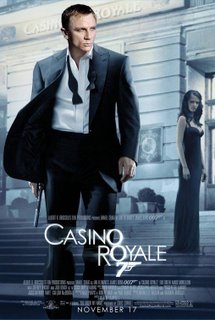
Casino Royale, the last complete James Bond novel not to be given an "official" film version, and the revival of the franchise with the casting of Daniel Craig, one had to wonder what the producers would do for an encore.


Or a sequel.
Quantum of Solace* takes place 30 minutes after the ending of Casino Royale, (in mid-car-chase) with Bond going "rogue" and seeking revenge.**
It's the first "true" sequel in the Bond series--all of them previously being stand-alone stories, where for budgetary or scheduling reasons, the secondary characters --like CIA agent Felix Leiter--would be played by different people from movie to movie.

Here, things are consistent: Jeffrey Wright again plays Leiter, Giancarlo Giannini returns as Rene Mathis as does Judi Dench as "M." And the mysterious Mr. White (Jesper Christensen), behind so much of Bond's troubles last film is in the rather bumpy custody of MI6, where he drops the news that there's a world-wide criminal organization that the Brits aren't even aware of, presumably the one financing the bombing of the Skyway jet, the funding of "freedom fighters," and high stakes poker games from the last film. Apparently these activities are so "under the radar" that the world's network of spies--and in this film even Bolivia has a Secret Service--hasn't noticed. But that is just a wild goose chase to Bond achieving that quantum of solace about the events of Casino Royale.

One could go on and on with the trivial aspects of QOS, but in broad strokes, one can answer the entreaties of those who couldn't wait for the next installment last time. No, it isn't as good as the last one;  Casino Royale was one of the best film in the series (this is No. 22 of the "official" Bond films), even after the perspective of a couple years.

Does Bond find out the answers to the questions he's seeking? Yeah, for all the good it does us. We spend 95% going down a blind alley--at 90 miles an hour, with a shaking camera pointed aimlessly and an average edit length of half a second. More on that in a moment.


Does Daniel Craig take off his shirt? Yes, all too briefly for some, I'm sure.

The dialog is crisp and also very, very brief. The acting is uniformly good, with particular mention of Craig,
Dench, and Giannini. Even the "Bond girls," traditionally where the Bond films fall down in the presentation category, can act: former model Olga Kurylenko is quite good, using a cat-walk scowl as the basis of her performance; and Gemma Arterton is pert, spunky...and sadly disposable. Mathieu Amalric--so good in The Diving Bell and the Butterfly--makes the most of his reptilian looks, as a sort of bug-eyed Roman Polanski.***


All well and good. The film feels like a less goofy version of the Roger Moore Bonds where outlandishness is the order of the day, but without the obvious winking. There are some lighter moments (and Craig makes the most of them) but most of it is played with deadly earnest. One expects to get lost in some details along the way by the orange light of the explosions. Indeed, two of the major players in this film are brought up and never mentioned again.****

But there is a major problem with Quantum... which dims the viewing experience, that being the slap-dash way that director Marc Forster and his second unit director Dan Bradley (who stunt coordinated the "Bourne" and last couple "Spiderman" movies) have staged and assembled the action sequences--and there are a lot of them--on land, sea, air, and fire, by foot and all manner of motorized vehicles. These sequences are nearly incomprehensible, with a rapid pace that does not allow the distinguishing of any participant or the context in which they're being done. A good action director allows the time to register surroundings and environment, and provides the context of relationship--who's doing what to whom and where. It's that information that provides suspense. Without that information, it's just fleeting images that don't add up—in other words, a trailer. What Forster and Bradley may be trying to do is put the audience in the same dizzying, disoriented position as Bond, but even then, there are times when there isn't enough context to inspire alarm. At one point, in one of the hand to hand fights it becomes apparent that, suddenly, one of the combatants has acquired an axe. There was just enough time for me to register that perhaps the film would be better if it were edited with that. The shame is that a lot of work went into these sequences--QOS is the most expensive Bond film while simultaneously being the shortest--and a couple of marvelous shots that literally tumble along with Bond merely disorient, rather than thrill, as you're not allowed to see the original position from where these shots start. At the end of it all, you're left with a battered Bond but absolutely no idea how he got that way.

This is a major mis-step. These are suspense films, after all. But in pushing the envelope of how fast to take these action sequences, post-Bourne, the film-makers have reached the point where they are no longer telling a story, no longer communicating with the audience, at which point they've failed in their own mission.

I'm not even sure what is to be gained by seeing Quantum of Solace in a theater, even in the back row. The best way to get anything out of the action is to watch it at a slower speed on DVD.


Hence, "Quantum of Solace" is a Rental.


Two of examples of the subliminal editing style of Quantum of Solace.


* The name is taken from a Fleming Bond short story in which Bond merely sits and listens to a tale of a marriage turned ruinous, and a "quantum of solace" is the smallest particle of comfort one can derive to keep it going. The only Bond titles left to be used are "Risico," "The Property of a Lady," "The Hildebrand Rarity," and "James Bond in New York," none of which is a "grabber" of a title, or would make a good song. But then, who thought you could do anything with Thunderball? Passing a reader-board for another theater en route to the Cinerama, it read simply "007."

** "What, he's gone 'rogue' again?" is what a friend said after seeing the trailer. Bond had already done something similar in the Timothy Dalton-starring Licence To Kill, which combined equal parts "Miami Vice," Yojimbo, and elements of the Fleming novel, "Live and Let Die."'


*** Director Marc Forster used directors Guillermo del Toro and Robert Rodriguez as voice-actors on this film, and the "director" connection applies to a henchman called "Elvis" who reminds one of Quentin Tarentino. What with the "colorful" names of the villains, ala Resevoir Dogs and the producers' history with QT--he famously announced that he wanted to make "Casino Royale" with Pierce Brosnan and griped about not getting the chance--it wouldn't be too far afield to think he was being tweaked.


**** I've since been told by one of the "Opening Night Regulars" I see the Bond's with, that a sequence resolving their stories (all one minute of it) was left on the cutting room floor, giving the producers a chance to start afresh next film, rather than continue with yet another sequel
.


Casino Royale (2006) Revisited

Breaking Bonds

Is it that good?
Short answer: yes.
Is he that good?
Yeah. He's the best thing about it. There are other good things as well, but let's look at Bond 6.0.


Not conventionally handsome, not the Arrow-shirt version of Bond, Craig has a multi-planed face that's great to watch whether it's jammed up against a shattered bathroom mirror considering just how much pressure it's going to take to strangle an assailant* or, half-a-movie later in another bathroom mirror, clearly satisfied with himself in a newly-tailored tuxedo jacket. His acting choices are subtle, nicely measured. His atypical look is just one of the many breaks from the past in a series that has not only embraced clichĂ©s, but luxuriated in them, and would even occasionally ham-string a promising entry to accommodate them (quite opposite from the early intentions of the producing team, which was to go against the grain of conventional thrillers--something not to far afield from Fleming's literary intentions--and surpass them, and in that regard, Casino Royale is the first film since Goldfinger to actually improve on its source.) The films are, after all, about Bond, so you'd better have somebody interesting in the lead, and Craig's Bond, his face becoming criss-crossed with scars as the movie progresses, makes you care just how much of a toll the mission is taking on him, both physically and psychologically. When was the last time anybody gave a damn about James Bond's soul in the movies?

In this "reboot" the clichés are dusted off, their origins shown and exposed for the good ideas they once were. The stunts and longish action sequences are still there, but they're used, at their best, to expose character.** There are gadgets, but nothing you couldn't find in catalogs this Christmas (technology has long since caught up to Bond with cell-phones, GPS tracking and personal defibrillators). "The James Bond Theme" is merely hinted at in the body of the film and in the "Secret Agent Man"-ish title song*** (growled by home-boy Chris Cornell), and saved for the end with a fully formed (for good and ill) Bond.

As good as Craig is, he's matched by his co-stars. Mads Mikkelson as LeChiffre has a nice, oily quality to him, and certainly projects the most danger to Bond since Robert Shaw's Red Grant (in From Russia With Love), The only cast member retained (so far) from the Brosnan films is Dame Judi Dench, whose "M" is finally given the authoritative role over Bond that Bernard Lee once had, rather than seeming like Bond's subordinate.

And the Bond-"girls?" Well, there is Ivana Milicevic, who's there mostly for decoration. But Caterina Murino certainly can act, and brings a nice world-weary resignation to the role as a terrorist's wife out for some revenge. But the revelation here is Eva Green, who's Vesper Lynd manages to flesh out the cypher that Fleming created. A mystery in the book, Green conveys a genuine human being, and her scenes with Craig are some of the best written exchanges (and are cracklingly well delivered) in the series, and includes one heart-breaker of a scene, after a brutal fight in a stairwell. It's so moving and so well-done that it's surprising to see it in a Bond movie.

And that's the thing: there has always been a great deal of disparity between what constitutes a "Good James Bond Movie" and a genuinely "Good Movie." And this is a "Good Movie"...which happens to have James Bond in it...that can stand as a fine drama, AS WELL AS holding its own in the adventure/action aisle. I didn't cringe at a performance or roll my eyes at a joke once and if there was one thing I was dissatisfied with it might be the small amount of screen-time given to Jeffrey Wright...and maybe tweak the ending a bit. Credit the writers (regulars Purvis and Wade and the ubiquitous Paul Haggis), the director (Martin Campbell, who did "Edge of Darkness") and super-editor Stuart Baird. This is going to be a fun one to watch slowed down on DVD. Oh, and "Cubby" Broccoli's kids, who followed up one of the most profitable movies in the series (the loud, obnoxious video-gamer Die Another Day) with this one, that challenged, re-wrote, and kept the edge of Fleming's writing, when the temptation might have been to cash in on what worked before with just more of the same. 

Talk about gambling...

Casino Royale (2006) is a Full-Price Ticket to be chased by a large tumbler of Scotch and a warm, comforting shower

The View from 2012:  It still holds up, and if there are three great Bond films, Casino Royale would be firmly there, hovering near, if not holding, the top spot.  Craig has proven to be a boon to the series, raising the bar, advising, bringing in top-drawer talent, and raising the entire series' image in the larger movie community.  One might even consider him indispensable (but that idea has been disproven before), which is a far cry from the derision that was tossed out when his choice was first announced.


* Oh, did I say "strangled?" There's a lot of very brutal violence in this movie (not just card-playing in tuxedos) that managed to skirt by with an inexplicable PG-13 rating, including a scene where Bond is stripped naked, tied to a seat-less chair, and has his testicles beaten with a very heavy, very gnarly knotted rope--a scene that should send any 13 year old boy running for the bathroom. This is not the clean "one-shot/no-blood" violence of past Bonds. Here the violence is fast, painfully brutish and bloody. Be warned.

** There is a wonderful moment when Bond has just (barely) foiled an attempt at industrial espionage, where he cocks his head, exhausted, at the untouched target and quietly marvels at what he's done.

*** The title sequence is also unique--gone are the writhing go-go girls--but it should delight anyone who grew up with the imaginative main titles of many a 60's spy series.

Friday, September 7, 2012

Dark Journey

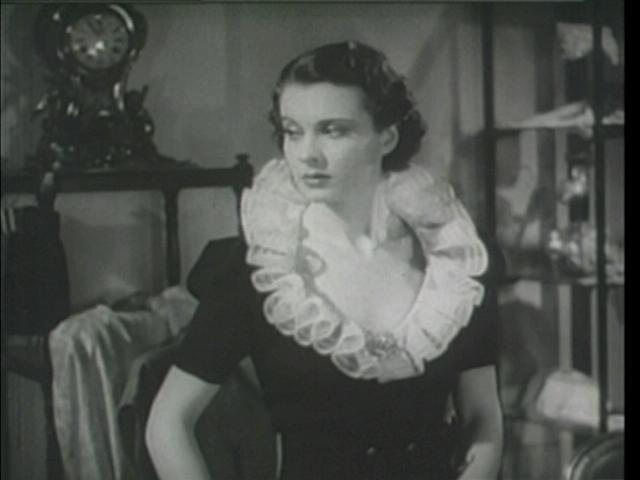
Dark Journey (Victor Saville, 1937) All's fair in love and World War I—but when love and war are running congruently, neck and neck, that's when things really get dicey.  Especially when the warring lovers are spies, spying on each other.  There's Madeleine Goddard (Vivien Leigh) is a designer and couture diva who regularly makes a shopping run between France and Switzerland, cloaking her activities as an agent for the British.  She moves through the hoi-poloi (who never seem aware there's a war going on) attracting all the best customers, none of them suspecting that her decorative scarves and pattern swatches contain secret plans and schematics.  Her assignment—find out who's the head of the German intelligence agency, Section 8.  Enter the snakily charming Baron Karl von Marwitz (Conrad Veit), a German deserter who caddishly trolls the gargantuan supper-clubs with their high ceilings and higher society for the more low hanging fruit of females.  It is through one of his companions that he becomes acquainted with Madeleine, becomes smitten and just a little stalkerish with her.  For some reason, she finds this attractive and the two begin a wary relationship.

Yeah, well, hunt a tiger...and opposites attract, and all that.  It isn't giving away any state secrets that the revelations that ultimately come about are a little less than surprising.  Nor is it surprising that two intelligence agents so visibly hiding in plain sight might not actually be that effective (C'mon kids, it's called "undercover" for a reason).  Imagine the dinner table conversation: "What did you do today?" "Nothing.  And you?"  "Same thing."  Double crossing does not "go" with star-crossing.
Anyway, you thought YOU had a complicated relationship.  This was a few years before Leigh would toss away such behavior with a dismissive "Fiddle-dee-dee."  And it's fun to watch the complications that ensue when the two spies are a little too loose with their lips.  It's amazing that WWI was won at all.

The costumes and sets are lavish (and very un-WWI era).  Leigh and Veidt do very well conveying conflicting loyalties, but the plot is a bit spare in details as to be confusing.  It's never really determined who has the upper hand—is Madeleine basically a "honey-trap" to seduce the German and get him where he can easily be captured, or is it all a misinformation campaign by either side.  Whatever it is, the romance is the least charged of the themes in the film, even though Leigh and Veidt try their damnedest to be anything more than inscrutable.  It's an interesting spy melodrama, it's just that there's not a lot to love.