 Breaking Bonds
Is it that good?
Short answer: yes.
Is he that good?
Yeah. He's the best thing about it. There are other good things as well, but let's look at Bond 6.0.
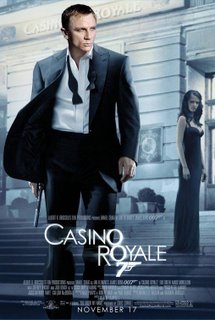
Not conventionally handsome, not the Arrow-shirt version of Bond, Craig has a multi-planed face that's great to watch whether it's jammed up against a shattered bathroom mirror considering just how much pressure it's going to take to strangle an assailant* or, half-a-movie later in another bathroom mirror, clearly satisfied with himself in a newly-tailored tuxedo jacket. His acting choices are subtle, nicely measured. His atypical look is just one of the many breaks from the past in a series that has not only embraced clichés, but luxuriated in them, and would even occasionally ham-string a promising entry to accommodate them (quite opposite from the early intentions of the producing team, which was to go against the grain of conventional thrillers--something not to far afield from Fleming's literary intentions--and surpass them, and in that regard, Casino Royale is the first film since Goldfinger to actually improve on its source.) The films are, after all, about Bond, so you'd better have somebody interesting in the lead, and Craig's Bond, his face becoming criss-crossed with scars as the movie progresses, makes you care just how much of a toll the mission is taking on him, both physically and psychologically. When was the last time anybody gave a damn about James Bond's soul in the movies?
In this "reboot" the clichés are dusted off, their origins shown and exposed for the good ideas they once were. The stunts and longish action sequences are still there, but they're used, at their best, to expose character.** There are gadgets, but nothing you couldn't find in catalogs this Christmas (technology has long since caught up to Bond with cell-phones, GPS tracking and personal defibrillators). "The James Bond Theme" is merely hinted at in the body of the film and in the "Secret Agent Man"-ish title song*** (growled by home-boy Chris Cornell), and saved for the end with a fully formed (for good and ill) Bond.
As good as Craig is, he's matched by his co-stars. Mads Mikkelson as LeChiffre has a nice, oily quality to him, and certainly projects the most danger to Bond since Robert Shaw's Red Grant (in From Russia With Love), The only cast member retained (so far) from the Brosnan films is Dame Judi Dench, whose "M" is finally given the authoritative role over Bond that Bernard Lee once had, rather than seeming like Bond's subordinate.
And the Bond-"girls?" Well, there is Ivana Milicevic, who's there mostly for decoration. But Caterina Murino certainly can act, and brings a nice world-weary resignation to the role as a terrorist's wife out for some revenge. But the revelation here is Eva Green, who's Vesper Lynd manages to flesh out the cypher that Fleming created. A mystery in the book, Green conveys a genuine human being, and her scenes with Craig are some of the best written exchanges (and are cracklingly well delivered) in the series, and includes one heart-breaker of a scene, after a brutal fight in a stairwell. It's so moving and so well-done that it's surprising to see it in a Bond movie.
And that's the thing: there has always been a great deal of disparity between what constitutes a "Good James Bond Movie" and a genuinely "Good Movie." And this is a "Good Movie"...which happens to have James Bond in it...that can stand as a fine drama, AS WELL AS holding its own in the adventure/action aisle. I didn't cringe at a performance or roll my eyes at a joke once and if there was one thing I was dissatisfied with it might be the small amount of screen-time given to Jeffrey Wright...and maybe tweak the ending a bit. Credit the writers (regulars Purvis and Wade and the ubiquitous Paul Haggis), the director (Martin Campbell, who did "Edge of Darkness") and super-editor Stuart Baird. This is going to be a fun one to watch slowed down on DVD. Oh, and "Cubby" Broccoli's kids, who followed up one of the most profitable movies in the series (the loud, obnoxious video-gamer Die Another Day) with this one, that challenged, re-wrote, and kept the edge of Fleming's writing, when the temptation might have been to cash in on what worked before with just more of the same.
Talk about gambling...
Casino Royale (2006) is a Full-Price Ticket to be chased by a large tumbler of Scotch and a warm, comforting shower
The View from 2012: It still holds up, and if there are three great Bond films, Casino Royale would be firmly there, hovering near, if not holding, the top spot. Craig has proven to be a boon to the series, raising the bar, advising, bringing in top-drawer talent, and raising the entire series' image in the larger movie community. One might even consider him indispensable (but that idea has been disproven before), which is a far cry from the derision that was tossed out when his choice was first announced.

** There is a wonderful moment when Bond has just (barely) foiled an attempt at industrial espionage, where he cocks his head, exhausted, at the untouched target and quietly marvels at what he's done.
*** The title sequence is also unique--gone are the writhing go-go girls--but it should delight anyone who grew up with the imaginative main titles of many a 60's spy series.


