Showing posts with label Bio-Pic. Show all posts

Friday, November 18, 2011

J. Edgar


The F.B.I. (Love) Story
or
"What Determines a Man's Legacy is Sometimes That Which Isn't Seen"

J. Edgar Hoover ruled the Federal Bureau of Investigation for 45 years under the Department of Justice.  Over the course of his tenure, he made the FBI his personal weapon in defending the nation from threats as he saw them, even as they changed form—from Bolshevik radicals to hayseed bootleggers and bank robbers to Communists to Civil Rights Activists to his very bosses.  He did this unsubtly and unequivocally with press-trumpeted raids and whispered-about secret files that, if it didn't make him (as the phrase goes) "the most powerful man in the country," he was certainly the most feared.  It was always assumed that Hoover had "the goods" on everyone, and guaranteed his long-held government post with weapons in manila files.

When he died (in office), Hoover's mug had the well-known face of a haggard bulldog—keeping secrets is something that can age you rapidly—and keeping secrets is something Hoover did best.  Not only those of others, but his own.  Rumors swirled about the nature of his relationship with FBI Associate Director Clyde Tolson—that they were secretly gay lovers rather than "gentleman cops," that Hoover was a cross-dresser, and that the reason Hoover didn't pursue the gangsters of La Cosa Nostra in the '40's and '50's was because of compromising photographs in the hands of Meyer Lansky.  Nothing has ever been confirmed.  It's all just rumor, the smirking kind that the powerful get (but there's never any proof).

Which is why news of a Hoover bio-pic, written by Dustin Lance Black and directed by Clint Eastwood seemed so intriguing.  Eastwood isn't afraid to take chances, turning cliches on their ear and Black's clear-eyed script for Milk garnered an Oscar.  Their film J. Edgar promised "red meat," of the kind that could be delightfully and salaciously chewed.

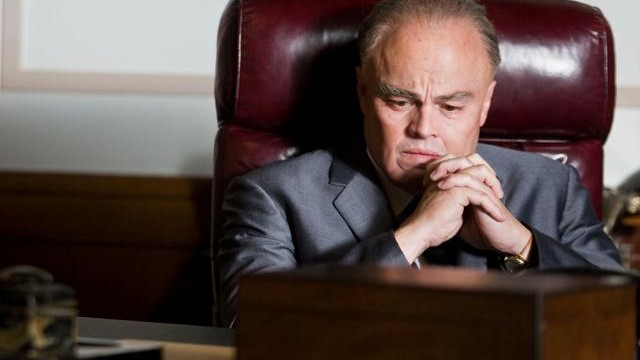
 And the two men have taken chances...but not with the result you would think.  Rather than being a rant or skreed, J. Edgar is actually a sympathetic look at the FBI director and his peccadilloes and shortcomings.  There's nothing hysterical (save for one fist-fight that breaks out between Leonardo DiCaprio's Hoover and Armie Hammer's Tolson) in script or direction, but it offers a look at a severely closeted man who had to be in the times he lived and with the mantle he carried.  Ambitious, yes.  Paranoid, certainly.  Vain and glory-hunting, without a doubt.  Hoover craved the spotlight and his role in being "Head G-Man," while at the same time operating in the shadows, single-mindedly hoarding the secrets of others, while keeping his own in the height of ironies.   At the same time that he espoused the Bureau ethic for red-blooded American males as agents, one wonders if it is done for appearances' sake, a beard that would mask his own leanings while also serving as a "hiding-in-plain-sight" revelation of his own taste in men.

Black and Eastwood conduct the story-telling in flashback, as Hoover in his latter years, decides to set the record straight, dictating his memoirs to an amusingly rotating number of agent-stenographers who disappear as soon as a point is questioned, or a weakness revealed.  The story is a white-wash, reflecting the man's "official" view of the Bureau's history in a mix of incident and myth.  At many times, J.Edgar is a bit reminiscent of Citizen Kane, with its fracturing point-of-view, shifting perspective, and ironic commentary on some of the incidents.*

It also shares Kane's sense of the unattainable summation of a life.  C.F. Kane's had little to do with "Rosebud," just as Hoover's gay leanings was a small part of his whole story.  It began with a controlling mother (Judi Dench), determined to keep young John Edgar from becoming a drunk like his father.  Groomed to become "the most powerful man in the country," Mother Hoover controls her son's life to make him the image of the perfect son, diction lessons to force past a stammer, impeccable grooming, and the enforcement of all of her prejudices.  And the nullification of any behavior less than manly.  He is made in the image of his Mother's "perfect son," even though that image may be completely counter to reality.  It sets him on a lifelong course of fighting her battles, never really being his own man, as much as posing in the presentation he wanted to project.  A performance.  An actMyth and lies.

It is a story soaked in ironies: the man who kept secrets on everybody, but the biggest being his own; the investigator who saw no harm in exposing other's private lives, while keeping an iron grip on his own; the policeman who targetted and made war on many enemies, the primary one being himself.  Black and Eastwood present a case for sympathy, even empathy, for a man who shaped, and was shaped, by his times, who rose through the ranks of power in society, to not be shunned by it, and who searched for verifiable fact while living in denial, and closeted by the bureau of his own making.

J. Edgar is a Matinee.


Hoover and Tolson at their regular table at The Stork Club.


* Not to mention that DiCaprio's "old-man" make-up makes him look more like the aged Charles Foster Kane than the jowly Hoover (still, it's better than the never convincing make-up that Hammer sports as an aging Tolson), and the shots of Hoover witnessing the Inaugural parades of Franklin Roosevelt and Richard Nixon are shot from the same angle as the "newsreel" shot of Kane in a balcony appearance with Adolph Hitler.

Wednesday, November 17, 2010

Nowhere Boy


"Playing the Chords You're Dealt"
or
"Portrait of the Walrus as a Young Man"

"Half of What I Say is Meaningless/
But I Say it Just to Reach You/
Julia"
John Lennon, after Khalil Gibran

It's always going to be John Lennon who is the focus of dramas based on The Beatles; there have been a couple already (even two about his assassin) and PBS has Lennon Naked in the wings.  No biographies of McCartney (no drama, really), Harrison (no dharma, really), or Starkey (trying to think of the last movie about a drummer...).  It's always Lennon.  Partially because he's capital-F Fascinating, but also because he was so capital-F "F'd up."

All of The Beatles were born into a world in flux, all born during the second World War, and, in turn, they would change the world, as they themselves were changed by having that world screaming at their feet.  But, that's The Beatles story.

Lennon's story is as fractured as his snarky-twee published stories are.  Raised by his strict Auntie Mimi and his jocular Uncle George, he barely escaped the Strawberry Field Salvation Army orphanage—a place that he would ultimately turn into a personal childhood playground, given the choice—(Odd, that Lennon was forever looking at alternatives to his situation as an answer...even the bad ones—he was never satisfied, until the end).  His father, Alf, was a merchant marine and never home.  His mother, Julia, was a perpetual teen-mother, bi-polar, substance-abuser and sex-addict.  Mimi took John to keep him close to Julia (rather than with Alf), while simultaneously keeping them apart.  No wonder he was never comfortable.

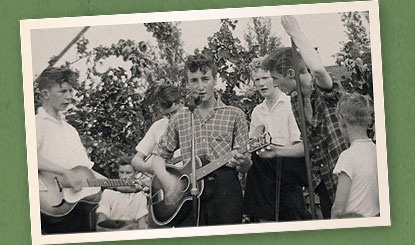
Sam Taylor-Wood's Lennon bio-pic Nowhere Boy (one of the few real references to Beatles songs in the thing) tells the story of Lennon's turbulent teen years—can you imagine being in charge of Lennon when he was going through puberty?—when he was flushing through some independence, experiencing second-hand death, sex, and music, all swirling through a loyalty-abandonment battle when he meets his long-lost Mother...and begins to understand the circumstances of his own almost Dickensian story.  That Julia also inspires his dedication to music, and the forming of his band The Quarreymen (the proto-Beatles), whose first concert starts to lock in the relationships that would inform the rest of his life, makes this movie a bit like being fortunate enough to watch a lightning strike.  It makes great drama,  and the screenwriter Matt Greenhalgh does a masterful job of making a familar story fresh, and putting in the comedic grout that informed Lennon's manner, while also capturing in smart, short-touches portraits of McCartney (Thomas Sangster) (their first meeting is wonderfully indicative) and Harrison (Sam Bell).

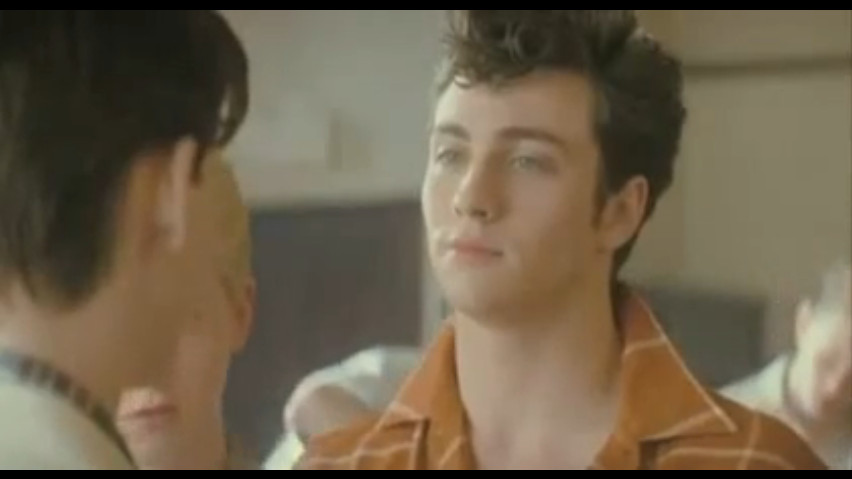
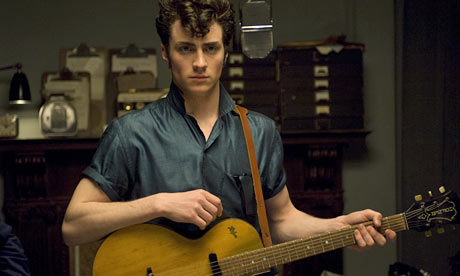
Kristin Scott Thomas does a great job of showing the brittle side of Aunt Mimi, while also quietly showing why she was such a good co-conspirator with her chargeAnne-Marie Duff's Julia is a girl-child, too immature to be a mother, as she always wants to be the girl-friend.  But the miracle is Aaron Johnson, who doesn't really look like Lennon (in the same way that Joaquin Phoenix never looked like Johnny Cash in Walk the Line), but has done such a fine job of looking at documentaries and studying the much filmed Lennon, that he has the manner down...so much so, that he begins to resemble him, mostly in motion, until you just accept the impersonation.  We've seen our share of bad Beatles imitations, but Johnson captures the illusion in all its facets of the diamond in the rough, and the Spaniard in the Works.

Nowhere Boy is a Matinee.


Friday, August 20, 2010

Flash of Genius

"Flash of Genius" (Marc Abraham, 2008) The things we take for granted.


Everyday things.  Post-it Notes.  I've made thousands of notations on them.  Little scraps of paper that have contained scribbled things of importance, however temporary, that they should be kept, stuck—squirrelled away—and when no longer needed, when they are  transferred or kept in a more permanent record, are discarded without heed.  How many Post-it Notes have I thrown away?  I probably couldn't count how many.

But the man who invented the Post-it Note—his name is Art Fry—was an employee of the 3-M Corporation, and when that particular entry in the office supply/stationary field produced them millions in profits, the corporation awarded the team its "Golden Step" Award, a "gold watch" of recognition.


At least, he got an award.*  Dr. Robert Kearns merely got screwed. 


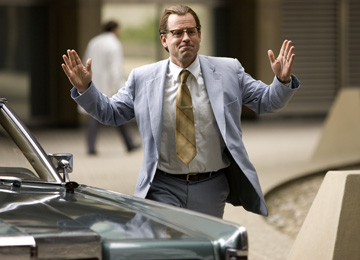
Portrayed by Greg Kinnear (in a muted "odd-duck" fashion), Kearns was the inventor of the intermittent windshield wiper that you (if it's an option in your car) can adjust to the precise rhythm to whisk away the occluding inclement weather in varying conditions from light mist to "pissing down."


It's a small luxury—probably not worth having in a car—but, it's nice to have when you don't need the wipers much.  Just a "smoosh" every ten seconds or so is good enough to keep the visibility clear and to keep you on the road, as opposed to having the constant "thwop-thwop" unnecessarily, or (God forbid!) just turning the wipers on once, yourself, to go the trick.


But, it was a big deal to car companies who were trying to develop the idea, but couldn't hack it.  Kearns patented his solution in 1964 and shopped it around the Big 3 car companies, only to find dismissive attitudes...until Ford saw it work.  A tentative deal was struck with Ford, who requested specs so they could do testing to meet national safety requirements, and subsequently, Kearns research was turned over to the car company.


At which point, they said, "Thanks but no thanks!"  And Kearns' fledgling "blinking eye" wiper manufacturing dream was scraped aside.  That ended that.


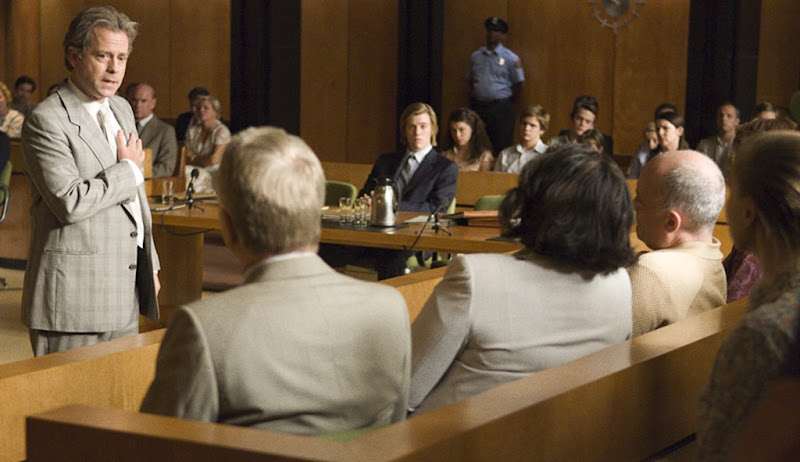
That is, until Ford came out with an intermittent wiper blade in 1969, followed soon by other car manufacturers.  Smelling an 8-cylinder rat, Kearns began researching and subsequently sued Ford for patent infringement.  The travails on Kearns' psyche and home-life (and any subsequent work from his home-town car manufacturers in Detroit) are well-documented in "Flash of Genius," though the facts are hedged a bit—the landmark Ford suit was not argued by Kearns himself as portrayed in the film and a settlement was reached, and it was the subsequent Chrysler law-suit that Kearns, with the aid of his children, argued themselves in court.


Still, it's a suitable David vs. Goliath story, of the little guy taking on The Big Dogs and emerging chewed but triumphant, achieving his goals, but—bucking the trend of most Hollywood happy endings—not achieving his heart's desires.


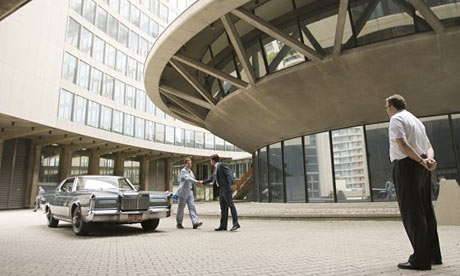
Good intention that, but it subsequently leaves the film feeling a little hollow, like the somewhat cold camera set-ups that Abraham and cinematographer Dante Spinotti use to portray the halls and spaces inhabited by Kearns' nemeses.

An interesting little film about a man who refused to be taken for granted.


Dr. Robert Kearns (1927-2005)


* And a better job in the company with presumably higher salary.

Saturday, July 24, 2010

Coco Chanel and Igor Stravinsky

"And Then the World Tilted..."

I was attracted to this icily erotic French film by its promise to dramatize one of the great contretemps of the Art-world, the May 29, 1913 premiere of "Le Sacre du Printemps" at the Théâtre des Champs-Élysées, where the combination of Stravinsky's score for the Ballets Russes and Vaslav Nijinsky's radical choreography caused a riot in the theater.  The incident has become fabled and even famously made it into film criticism,* the impression being that fist-fights were breaking out among the tuxedoed intelligentsia.  But, in the film "Coco Chanel and Igor Stravinsky," it is presented, not as a riot of the soccer hooligan variety, but rather some rather rude behavior on the part of a few incensed art patrons, cat-called by opposing members of the audience, until the gendarmes arrive and break things up.  Riots, as with real estate, depend on "location, location, location."  This was, after all, an opera house filled with tuxedoes and stuffed shirts.


Composer Stravinsky (Mads Mikkelson) is humiliated by the incident, but it fascinates fashion diva Coco Chanel (Anna Mouglalis**), in the audience, to the point where she offers patronage to the composer at her villa.  Too proud to accept money, he does accept residence for his tubercular wife and clutch of children...and a study for his composing.  The country estate is just the breath of fresh air the family needs, and the space and time the composer requires to further his career.


But what does Chanel need?  In mourning after the death of her lover ("She even makes grief look chic"), moved by the music she heard, and very much "an independent woman" (after a fashion) her motives may be altruistic, but at this stage in her life they may be more direct.  At one point, showing the Stravinskys their bedroom at the villa, the composer's wife notes the high-contrast black and white palette of the room.  "You don't like color, Mademoiselle Chanel..." "As long as it's black" is the assured reply.


She might also be drawn to a kindred spiritBoth she and Stravinsky are glaciers, moving slowly, not revealing much fire except through their work, very much interior people.  But where she is direct ("I'm late"), he is circumspect ("I am patient"). Both are precise and intricate and do not broach compromises;  she likes clear strong lines and simplicity in fashion and he writes brutal hard edged dissonances.  They both think differently from the norm, and each other, and they both rock their respective worlds.  And things tilt massively when their worlds collide.

Director Jan Kounen directs the film sparingly, allowing images to tell the story more fully than words: an image of Stravinsky lost in thought at the piano while a metronome ticks unaccompanied says far more about his creative doldrums than a scene of frustrated acting out; a child on a still swing breaks the heart.  Mikkelson, very much an actor of coolness, betrays no emotion as his character finds himself adrift in two worlds that have nothing to do with his roots, and Anna Mouglalis' Chanel is a gliding sylph-like presence who economically portrays drama without betraying any of the planes of her face.  Words fail as these two artists concerned with the world of the sensuous act out a passion whose only previous outlet has been through their work.

It's an interesting study of two cultural revolutionaries whose orbits cross, lending a brief, propulsive energy to both, and whose gravity then extends shock-waves beyong, tilting our world.

"Coco Chanel and Igor Stravinsky" is a Matinee.


   * That would be Pauline Kael's fatuous statement that the unveiling of Bernardo Bertolucci's "Last Tango in Paris" "altered the face of an art-form," comparing it to the riotous "Rite of Spring" opening.  If Ms. Kael had done some research, she might have mentioned that "The Rules of the Game" provoked a more similar reaction (Oh, you sensitive French!) or the premiere of "2001: A Space Odyssey" where walk-outs were prevalent—Rock Hudson huffed up the aisle yelling, "Will someone explain to me what this movie is about?"  It's about 2 1/2 hours, "Rock."  Will that do for ya?

** Mouglalis' work is unusually well-informed; since 2002, she has been one of the model faces for Chanel.

Saturday, May 8, 2010

Chaplin

"Chaplin" (Richard Attenborough, 1983) Elephantine, lugubrious bio-pic of the man underneath "The Little Tramp," Charles Spencer Chaplin. If more bio-pics were this ill-serving, it would be good reason to avoid the limelight altogether. Years after sweeping the Oscar-race with his ever-so-respectful biography of "Gandhi"* (starring Ben Kingsley), director Attenborough took on his famous countryman's auto-biography and varnished it with the same extra coats of shellac (with broad strokes) that made a still-life out of his film of "A Chorus Line."

Charles Chaplin is a more-than-worthy subject for a sweeping biography that covers a huge amount of history in both the times of the U.S. and England, but also of the film industry. Chaplin was one of the rare few film-makers to make it out of the silent era alive and functioning, amassing a great fortune, becoming beloved world-wide—his Tramp character was recognized world-wide, with even more reach than Mickey Mouse—and treading the then-virgin territory of film star-dom with all its glamor, responsibilities...and pit-falls. Only thing, part of the problem was too many virgins. A clown-comedian who made his living, first by exposing the pomposity of authority, and then—as the Tramp—actively fighting it, he ran afoul of the authorities who didn't take too kindly to his irreverent side, little noting that the Tramp's triumphs were a balm for a restless public, sublimating dissatisfaction in a permanent trap on-screen, keeping it from spilling into reality. They should have thanked him. But instead, the authoritarians, be they Nazi's or J. Edgar Hoover, fought him. And Chaplin had enough hubris and pomposity himself, to think that the public would always rally to his side.

Now, that's a story. One that Chaplin would appreciate, if he wasn't living it. But, instead, Chaplin saw himself as he always saw himself—the hero. You could say of Chaplin what
Alice Roosevelt Longworth said of her President-father Theodore: "He wanted to be the bride at every wedding, and the corpse at every funeral." Chaplin loved being the Clown and the center of attention, but he also wanted to be taken very seriously, as he saw himself. Quite the dichotomy. That Chaplin couldn't embrace his own pretensiousness as part of the act was what turned his reel-comedy into real-tragedy.

But don't drop any tears for Chaplin. He lived an extraordinary life...of his own creation. Well, feel bad for him for this movie, perhaps.

The problems start with the screenplay. The timeline uses his films as the spine of it, set up by little incidents that inspired them. A more fitting strategy for a film-symposium than a movie, especially a movie about a comedian: Nothing kills a joke faster than having to explain it. The films are the high-lights; they are punctuated by explorations of Chaplin's relationships with the women in his life, starting with his Mother (eerily played by
Geraldine Chaplin, the person's real grand-daughter!), then his lost loves, whether by his own design or by his inability to maintain a love greater than his own. This is interrupted by the lamest of devices—going over the autobiography with his ghost-writer (Anthony Hopkins), in a kind of literary psychiatric session. They amount to repeated episodes of the aging Chaplin clinging to his fantasies and the writer calling "Bull-shit," once literally.

This may be a convenient way to film in the blanks, but it also splinters the narrative force. Are we to believe Charlie, the biographer, or what we see with our own eyes being represented? And as the subject is a film-maker, it's a bit like falling down a rabbit-hole of fun-house mirrors. Who do you trust? The end-result is taking none of it very seriously, as Attenborough can't resist speeding up some episodes in
a representation of silent film techniques. Nothing is real. A little contrary for a biography.

Then, the tone is so heavy. Starting with a title sequence of Chaplin taking off his "Tramp" make-up (exposing the real man, get it?) to a melancholy score by
John Barry, that would be more suited for a funeral, the film never gives up the tone of self-important tragedy that ultimately swamps the movie and any good feelings that one might have for Chaplin, the man, his work or the movie.

But, every dark cloud has a silver lining. In the case of "
Chaplin," it is its star, Robert Downey, Jr. Downey was a once-removed member of "The Brat Pack," the coterie of young actors who buzzed through Hollywood in the late 70's and 80's, appearing in ensemble pieces by John Hughes and other directors. Appearances in his father's films, a couple of featured roles and a disasterous stint on "Saturday Night Live" offer no hint of the disciplined, exemplary work he brings to the title role, eerily evoking the lookespecially the smile of Chaplinand, most amazingly, pulling off the physical comedyChaplin's particularly physical comedythe role required. He was honored with his first Oscar nomination (losing to Al Pacino's first Oscar win for "Scent of a Woman."), but, after "Chaplin," Downey's performances would turn more physical, quick-silvered and nuanced, paving the way for a universal respect for his craft that even an errant personal life couldn't derail. Downey's evocation is the one reason to watch "Chaplin," rather than, say, reading about him...or better yet, watching the man's films.

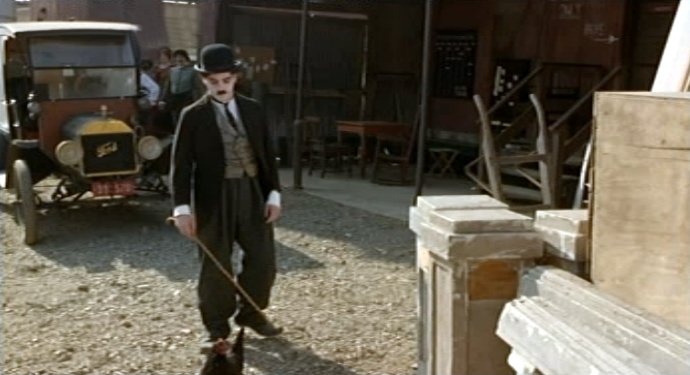
The immigrant looks upon the Promised Land: Robert Downey Jr. as Charlie Chaplin looks at a strip of this new medium, film, left on the cutting room floor. Of course, the footage is of him.


* "Gandhi" beat out "E.T., the Extra-Terrestrial" for Best Picture that year. I understand the Academy's hesitancy to give the statue for an alien combination of "Shane" and "Lassie," but no amount of prestige attached to a project can replace a film's status years after the fact. This one was a mistake. And short-sighted, replacing typical Awards reverence for "prestige," rather than popularity or endurance.

Saturday, November 7, 2009

Amelia

"Well...See Ya"

There have been enough bio-pics on Amelia Earhart that the only interest this one could hold would be in Mira Nair's presentation, or in any clarification of "The Mystery"—Earhart's disappearance during the last leg of her round-the-world flight. "Amelia" provides neither. It's is Nair's most conventional film, focussed on nailing the period details and the pictorial splendor of airborne sight-seeing. And as the particulars of the disappearance are so sketchy, the best the film can be do is merely suggestion (with a little obfuscation, but we'll get to that)*, "Amelia" comes off as a grandiose Lifetime movie—an "Aviatrix Flick"—that, while it occassionally gets off the ground, never really soars.

The problem is
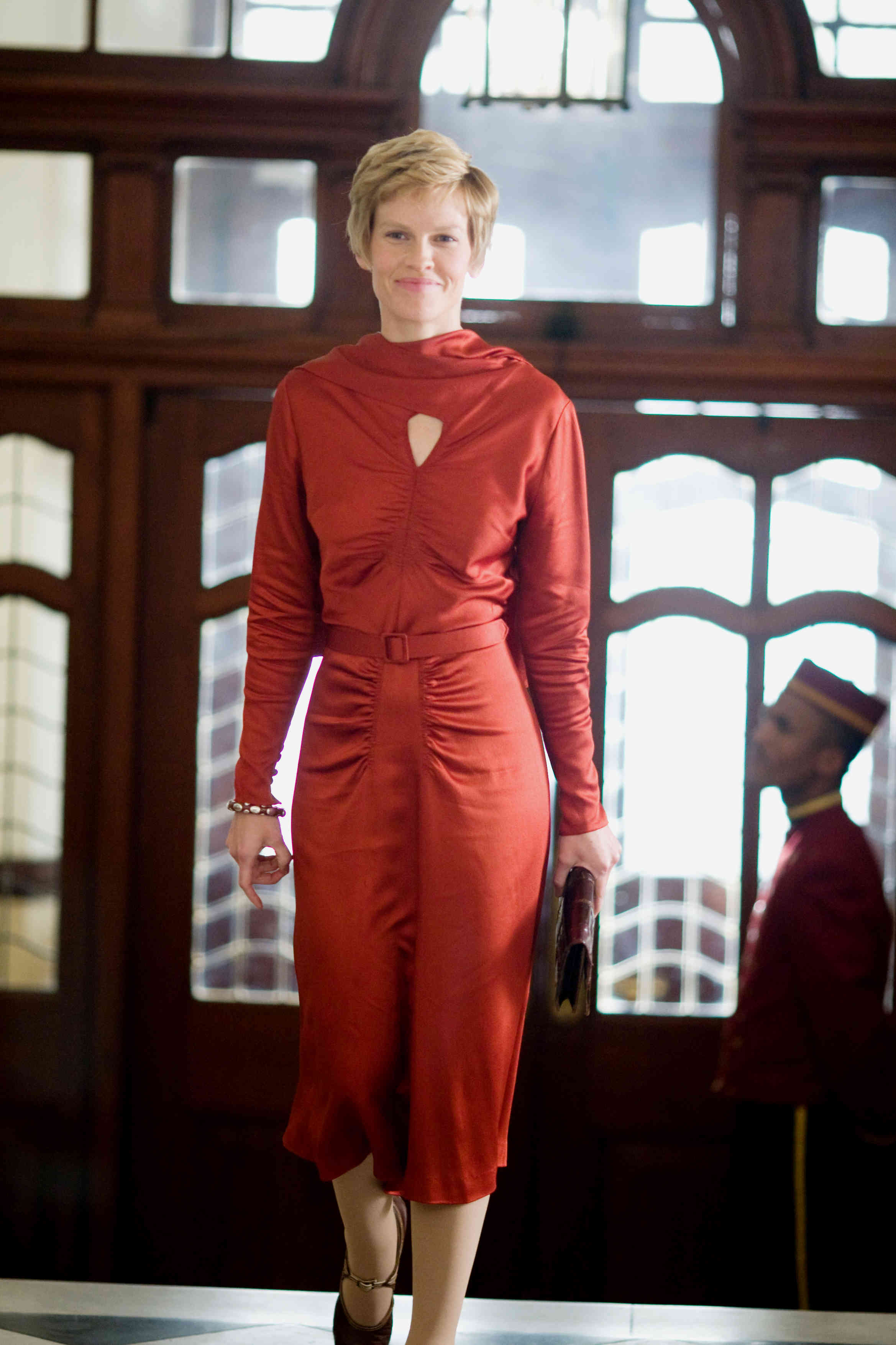
Amelia, herself. After many records and accomplishments (which the movie ticks off studiously), her story ends in silence and perceived failure, which unfairly casts a pall over the woman's storied existence. And Amelia was a taciturn presence, not unlike Lindbergh, projecting confidence by competence, her super-ego revealed only in her goals. Hilary Swank is a perfect choice to play her—thin as a rail but seeming corn-fed, horse-toothed with a helmet of straw—and she obviously did her research on Amelia's voice. But Earhart's newsreel performances are merely performances and Swank's Amelia has the same air of phoniness that Cate Blanchett's Katherine Hepburn had in that other aviator movie. Richard Gere as publisher George Putnam (and "Mr. Earhart") has the same vocal problem, affecting an accent that wavers up and down the East Coast. Faring better is Ewan McGregor as Gene Vidal (father of Gore), with whom Earhart worked with the government to establish air-routes and create the first commercial airlines; that the movie makes more hay of a speculated affair between Vidal and Earhart than that accomplishment is part of the film's weakness.

The buffeting lift and drag on this film may be attributable to two strong scriptwriters building on each other's work:
Ronald Bass, who, if anything, tends to making his characters too likable, and Anna Hamilton Phelan, who doesn't (particularly in "Gorillas in the Mist: The Story of Dian Fossey"). The two seem to clash on who Earhart "is," a symbol or human being, devoted to flying or feminism, faithful or philandering. Such "takes" on her character fly afoul of the issue that the film should have focussed on and never strayed from: the "true path" of seeking freedom. It's the one through-line of Earhart's life, from childhood (which the movie skimps in detailing) on. It is only in Earhart's narration (taken from her writings, no doubt heavily influenced by publisher husband Putnam) that emphasize a still clean sky with borderless landscapes below, a world without limits on the ground or in the sky, whichever your sex. That her life on the ground is forever hemmed in, trying to secure funds for that freedom, could have made a dramatic metaphor if the film-makers had bothered to notice.

But some of it's there. Enough to inspire if one wants to look beyond the ghost of the most celebrated "Missing Person" of the last century, and see what she accomplished while she still walked the Earth and conquered the sky.

"Amelia" is a Rental.


* Quibble section: Beyond her standing in front of a Patton-esque American flag backdrop that if one were to calculate beyond the frame would indicate fifty stars, and the montage of filmed endorsements that would be created for a medium yet to be invented—and they don't explain why she came in third in the 1929 "Women's Air Derby"—the details of the disappearance are fudged a bit. Her navigator for the round-the-world flight, Fred Noonan, is depicted as drinking before the fateful flight, which, though it might have happened earlier in the trip did not re-occur preceding that most precarious of hops to the tiny Howland Island landing strip. A recent PBS documentary on a re-creation of the fateful trip (right down to the aircraft used) seemed to hint that Earhart might have ignored Noonan's inclinations to fly south of Howland, where the pilot could have sighted one of two islands that might have accomodated a touch-down, and instead flew north, decreasing their chances with a dwindling fuel supply. But that is just one more theory in the dozens that have been posited in the years to explain the failure to accomplish what was, essentially, a risky maneuver even under the best of conditions.


Friday, August 14, 2009

Becoming Jane

"Becoming Jane" (Julian Jarrold, 2007) Jane Austen is a double-edged sword for Hollywood, a god-send and a nightmare. Her stories make great movies that make quite a bit of coin and their period settings and costuming guarantee that they will receive at least technical Oscar nominations. The only problem is Jane died at the age of 41, having written only six complete novels, those being (say along with me now) "Emma," "Sense and Sensibility," "Pride and Prejudice," "Mansfield Park," "Northanger Abbey," and "Persuasion." They have become their own English cottage industry in the last 20 years or so, and there have been numerous films and BBC series of each of them. I would dare say that Keira Knightley has a shot at appearing in all of them, and if not her, Kate Winslet. Emma Thompson could retire making adaptations of Austen films, so successful was her adaptation of "Sense and Sensibility." But, it's counter-productive to keep making the same six movies over and over (although God knows they've tried*) There have been modern-dress adaptations of them, like "Clueless," and "Bridget Jones's Diary," and "The Jane Austen Book Club."** An obvious solution would be to broaden one's literary horizons and go back to the Brontë sisters (although they're a bit gloomy and have also been well-represented in media).

But instead they've concocted a sort of "Jane Austen Begins" origin story which plays fast and loose with the facts in order to make
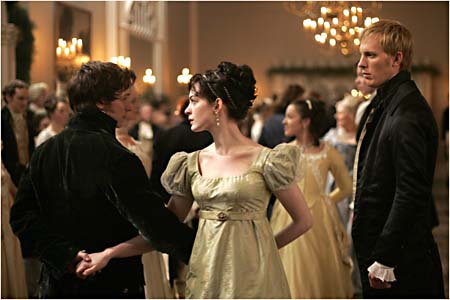
her life play like a Jane Austen novel (but without the "incandescent marriage" or happy ending). It's a great cast with Anne Hathaway as the spunky young Jane, James McAvoy as her would-be love Tom Lefroy, Julie Walters and James Cromwell as Jane's fretting parents, and Maggie Smith and Ian Richardson as the stodgy bumps in the road of romance that are an intrinsic part of any Jane Austen story.

Was there a romance? Well, Jane did write about Lefroy to her sister Cassandra:


"I am almost afraid to tell you how my Irish friend and I behaved. Imagine to yourself everything most profligate and shocking in the way of dancing and sitting down together."

And Lefroy supposedly confessed in his dotage to having "a boyish love" for her. Probably a lot of sighing went on. But "Becoming Jane" blows it up to be the Great Love of her life, the inspiration for her writing, becoming a wish-fulfillment of what could have been. Maybe. But maybe, as it is inconveniently often is, the truth is a bit more complicated than that. "Becoming Jane" would have you believe that she was a great literary success—when the truth is that she was published anonymously as "By a Lady." She enjoyed good sales of her book (two of which were published posthumously), but few knew her identity while she was alive. That flies in the face of what the movie manufactures for a "happy ending."

Still, the filmmakers get to cherry-pick the Austen canon for their story, and carefully insert the few known biographical bits—Wikipedia has this fine quote by a biographer saying that details of her life are "famously scarce." But, they know she ended up writing those novels, so once they know the end-point the authors can start constructing
the path of the creature of "Becoming Jane." Whether that portrait is becoming, doing justice to the author, is open to debate. There's a term that serves as an ad hominem defense for writers making it up in the absence of facts—"writing to silence," in other words, there's no one alive to protest the accuracy. The assumption for the people who wrote "Becoming Jane" is that she wrote what she knew, and that her novels were somewhat autobiographical, negating that most essential of writerly gifts—imagination. If that's not an injustice to any writer, I don't know what is.

* One of my favorite titles for a movie in the last 15 years was the gangster spoof, originally called "Jane Austen's 'Mafia!'" as a knock on how many adaptations of Austen there had been, but the producers chickened out and took her name off before it opened.

** And just as this was to be published, I became acquainted (via PBS) of the British mini-series "Lost in Austen," in which a modern day Austen fan exchanges positions with Elizabeth Bennett of "Pride and Prejudice" (via time portal, and one would assume a fiction/non-fiction bridge) and tries to keep the storyline in place—much like an Austen heroine—while trying to put herself and Elizabeth back in their proper places. Naturally, a movie adaptation is being planned with an executive producer being Sam Mendes...who is the husband of Kate Winslet.

Naturally.

Wednesday, June 10, 2009

An Angel At My Table

"An Angel at My Table" (Jane Campion, 1990) Incredible tale of the New Zealand author who was institutionalized for schizophrenia, and narrowly avoided a leucotomy procedure* by winning a prestigious book award. Talk about your narrow escapes. But escapes were what Janet Frame specialized in, from her "magic realism" writing style to her globe-trotting adventures that took her to England and Spain, while keeping herself locked inside her own creative mind.

Partly due to her diagnostic history, and partly due to her "odd duckishness" Frame had a ying-yang non-relationship with Society. The film portrays her as "odd man out" in various capacities, the one Campion seems to relish most is that while she is being socially shunned by a group of boorishly egotistical literati, she is the only one of them that has been critically acclaimed...or, for that matter, even published, already achieving what the full-of-themselves coffee klatsches only hope to accomplish. They dismiss her for her dowdy clothes and chia-pet hairstyle out of hand, not bothering to consider that they couldn't tell a book (they hadn't written) by its cover.


Made for television, the film is more conventionally framed than most Campion films, known for their stark use of isolating empty space, and sometimes fractured story-telling style, but Campion gets compelling performances from the three women playing Frame—Karen Fergusson, Alexia Keogh, and finally, settling on Kerry Fox for the second half of the film exploring the author's wandering adulthood. As an introduction to Campion's work, this is a good start, with a compelling true story with a straight-forward approach to the aspects of magic-realism that infuse her work.

My favorite shot of "An Angel at My Table:" Janet "does the twist" by herself
in the dark by the light of her camper/writing-garret.

* A leucotomy was a specific form of lobotomy back in the dark ages when the practice was given enough medical credence to actually give a unique name to it rather than calling it what it was—hammering an ice-pick behind someone's eye-ball to sever neural connections in the brain. I'm wondering if insurance companies covered that.

Wednesday, February 4, 2009

Che

"The Face That Launched a Thousand...Poster Sales"

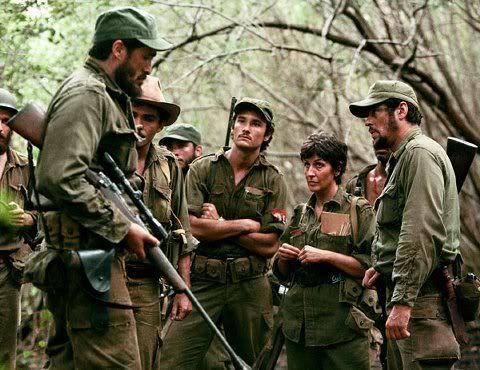
As I did with "W." here are some very brief political comments on the subject of the Ernesto "Che" Guevara bio-pic "Che":* I don't look at the world with red stars in my eyes, and think History has proven that Communism is a flawed political system where human beings are concerned. In the Cuban Chapter of that story, "Che" was The Revolution's question to George W. Bush's answer: An ideologue who thought nothing of spreading his vision to nations other than his own, whose patriarchal attitude towards foreign peoples blinded him to the hypocrisy of spear-heading "revolutions" that he had no part of. While Castro settled to enjoy the spoils of his coup, Che felt the need to "spread freedom" throughout the world, a "freedom" that was inherently in his country's best interests (sound familiar?). This, and other ironies are not explored too deeply in Steve Soderbergh's massive 4 1/2 hour epic, which is less a biography of Che, as it is a necessary chapter in the evolution of the "War film."

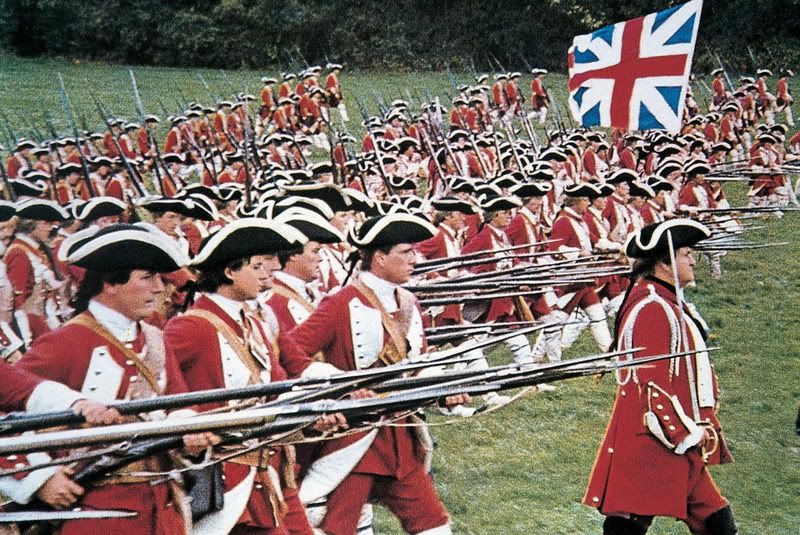
Blame the American Revolution, I guess. When those up-starts chose to battle the British in extremely non-formal (and un-cinematic) patterns, film-makers have been struggling to bring some sort of cohesion to the chaos of men at war. Face it. Watching patterns of soldiers moving forward in massive lines is great cinema. Crowds of men (you've supposedly come to know as characters) rushing forward pell-mell in a panic is tougher to capture and make sense of (though Welles did well, and Gibson). Better to keep the numbers fewer, or better yet focus on one participant, be he John Rambo or Oliver Stone's Pvt. Taylor. Bush-fighting—that's another story.

Soderbergh starts his two films
** with maps: of Cuba in Part 1 (subtitled "The Argentine"); Bolivia (And South America), in Part 2 (subtitled "Guerrilla"). The major cities, territories and geographical locations are pointed out one by one, each with their own color (which made me wonder "Is that the color filter he'll be using in that location?") But it's a great technique—so great I'm surprised it hasn't been done more. The familiarization of the territory means you never have to orient the viewer again about what's happening where. And so, Soderbergh and his screenwriters Peter Buchman and Benjamin A. van der Veen don't have to do major scenes of exposition talking about over-arching plans before battles (especially in an improvised war). Tossed off mentions of cities will suffice. The audience will remember.

This allows Soderbergh to streamline the momentum of both movies; We're allowed to focus on characters, survival tactics and the problems of motivating volunteers on a perpetual camping trip with a dodgy supply of weapons and the opportunity for disaster around every corner (but isn't that any soldier's view of war in the field?). Nor is there the need to stop every few minutes and have a Juan Esposito character come in and talk about "The Big Picture." We've been given the run-down of the territory (and despite these being revolutions, all wars boil down to real estate.

That this revolution was a jungle war of fighters coming down from the mountains as self-employed mercenaries to either win hearts and minds of the native populace (it is stated repeatedly that Che was not Cuban, but Argentinian-it's even in the title of the first film) or to re-supply or target a government stronghold. As with any war, a lot of it depends on luck and a lot of it depends on what the other side does not know but suspects. Both elements helped the rebels defeat the Batista government forces...who were Cuban, and felt a loyalty to their homeland, and an affinity to the rebels as they were countrymen. They also didn't have much fight in them, when push came to...nothing much.

Despite a "to-the-bone" performance by
Benicio Del Toro (the film is almost completely in Spanish, although those who would speak English do so), Guevara remains an enigmatic figure. There are attempts to de-mythologize him--his frequent asthma attacks make him a hindrance to the fight, but as a physician he is able to treat it to a certain extent. He starts as being the Chief Medical Officer, and gradually works his way to being a field commander and strategist. By the end of the first film, he is clearly in charge of his small brigade and the film ends with an extended house-to-house battle in Santa Clara that features a surprisingly well-orchestrated train derailment. Soderbergh shoots in an effective hand-held style, as in a news-reel (mostly shot by the director himself) that gives the street-fighting a see-it-now authenticity, rather than a well-orchestrated set-piece (which it had to have been to film).

Taking the myth out of the fight and the romance out of the struggle is a lot of what makes the marrow of "Che."  We see the day-to-day problems of the guerrillas fighting disease, starvation, infection and the occasional opportunist.  Soderbergh and his screenwriters put forth a Che Guevara who is principled to "The Revolutionary Code," with a piece-meal sense of morality.  The portrait is a noble one, but the film-makers subtly undercut it, allowing cracks between the lines, details that are not called attention to.  Although a supposedly brilliant strategist, Che (and Castro, nicely portrayed by
Demian Bichir) are seen frequently smoking cigars in conversation.  Unless the jungle's on fire wouldn't that be a tell-tale sign to patrols that there are humans nearby?  Not to mention that those Cuban cigars are made through the exploitation of Cuban nationals (and mostly women at that, in sweat-shop conditions).  Women are seen fighting with the guerrillas, but that macho attitude doesn't seem to be applied to them.  At one point, Che's second flirts obliquely with him, which he deflects by mentioning his wife and child in Mexico City, although by the start of the next film, he is married to her (with three kids). 


Soderbergh is not-so-subtle in one juxtaposition.  At the beginning of the second film, Castro reads Che's farewell letter in which he states his intention that should he die, his last image will be the same blue sky seen by his Cuban comrades.  When his last moment comes Soderbergh switches (for the first time) to a point-of-view shot to show us the unromantic reality of his last vision.
If there is anything marring Soderbergh's scrupulously lived-in presentation, it is in the "star-cameo's" that occasionally crop up to jar you out of the situation, as much as they do in "The Greatest Story Ever Told."  Franke Potente and Julia Ormond (in a blonde wig so as to be unrecognizable, but really, can one make a serious picture these days without Julia Ormond?) are seen in city surroundings where their movie-star looks blend a bit, but jungle scenes of Matt Damon and Lou Diamond Phillips tug right out of the jungle and back into Hollywood. 

But the arc of the two movies allows you to see the "Che" you want to see: the "Che" triumphing in adversity of Part 1, or "Che" scrabbling into an inevitable defeat in Part 2.  There's a lot of history not gone into in-between, but for the polarized, and the polarizing this will do for now.


"Now, watch this drive."The real Che, after la revoluçion.


* Thus, avoiding Godwin's Law: The longer an Internet string, the more inevitable a comparison to Hitler will be made. I've seen too many comment threads on this film devolve into the "Evil Che" harangue (usually by people who haven't seen it). Thank you. That corner exists on the Internet somewhere and I would suggest going there, even though I'm not entirely unsympathetic. But if it shows up in this comments section it will be erased...permanently. Any attempts to add it again will be erased...permanently. Try to add it again, and you should check into a hospital because you're clearly trying to see a different result from the exact same action and that is a sign of insanity. I have no patience with ideologues who've long stopped thinking. I'm here to discuss the film, and I'll discuss it or "The Birth of a Nation" or "Triumph of the Will." Film is controversy--unless it's "Marley & Me"...and even then...

**After its "Road-Show" performance (which is the one I saw), "Che" will be released separately (if all goes according to plan) as "Che, Part 1: The Argentine" and "Che, Part 2: Guerrilla." IFC, which is distributing the film, is also making it available as a Pay-per-View Event.

***One more thing, completely tangential:  During his ill-fated campaign in Bolivia (after his never-mentioned ill-fated campaign in the Congo) Guevara lived under a series of code-names, as he was trying to keep his presence in that country a secret. In Part Two, he's known as "Ramon" and then in his last days, as "Fernando." I walked in not soon after the Inauguration whistling "Black Superman-Muhammad Ali,"  but walked out with " Fernando" in my head.  I don't think the writers of the Abba song were making a connection.